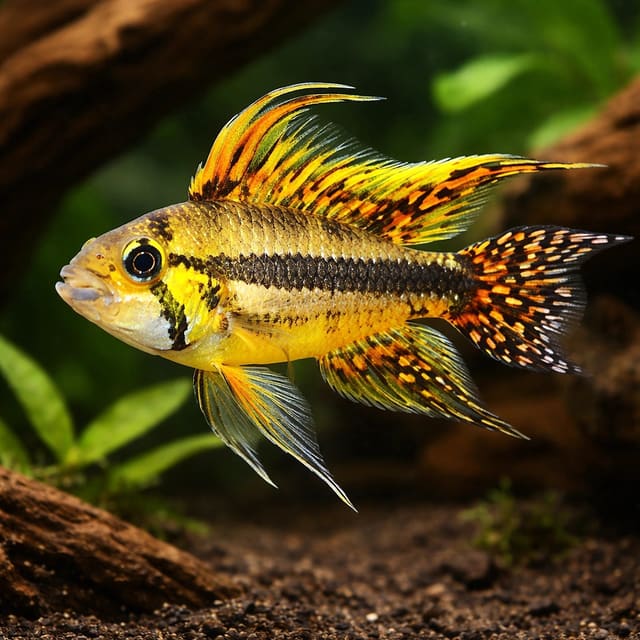
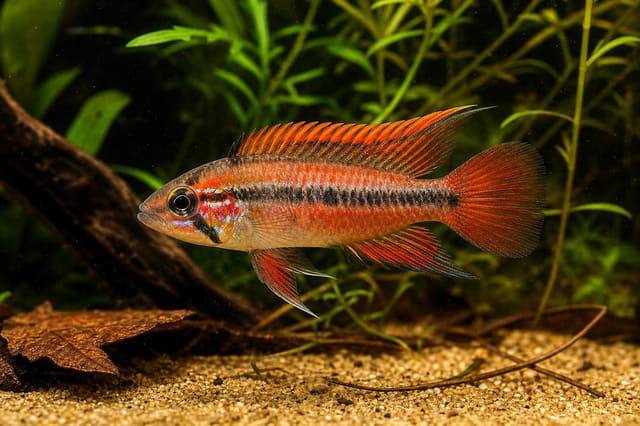
Spadetail Checkerboard Cichlid (Dicrossus maculatus)
26–30°C · pH 4.8–5.4 · 68L
£25.99
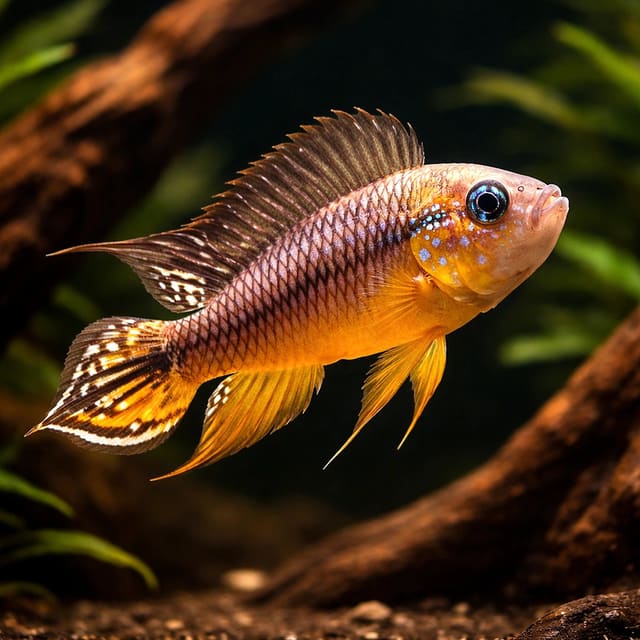
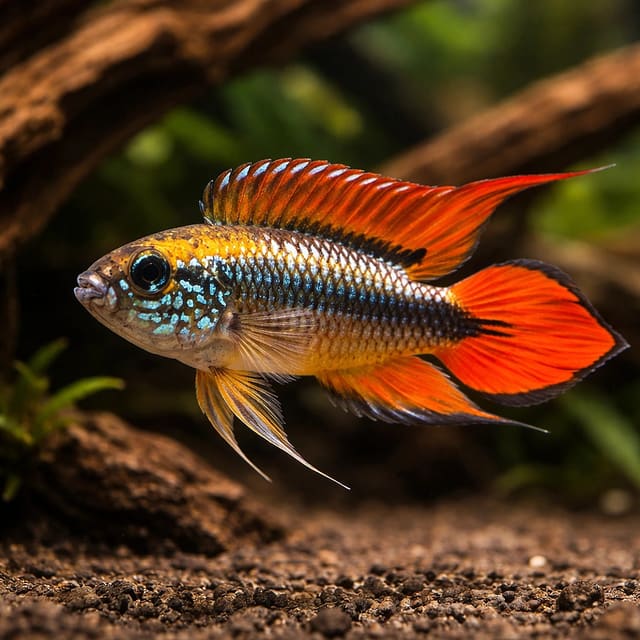
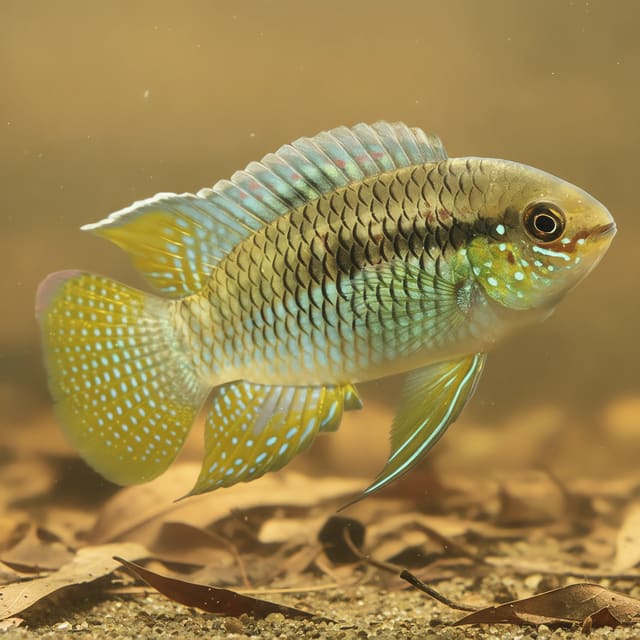
One live spotted checkerboard cichlid, Dicrossus maculatus, also called the spadetailed checkerboard cichlid. A rarely seen dwarf cichlid from the Tapajós and Maués rivers of Brazil that reaches about 5.3 cm SL. It needs very soft, acidic, clean water, a planted 60 x 30 cm tank with small caves, and quality frozen foods. Sex is not chosen.
Adult size is the maximum length this species reaches at full maturity (scientific sources). The livestock you receive will be younger and smaller. Product-photo provenance and any image-specific limitations are stated on the listing.
Dicrossus maculatus
One live spotted checkerboard cichlid, Dicrossus maculatus, also called the spadetailed checkerboard cichlid. A rarely seen dwarf cichlid from the Tapajós and Maués rivers of Brazil that reaches about 5.3 cm SL. It needs very soft, acidic, clean water, a planted 60 x 30 cm tank with small caves, and quality frozen foods. Sex is not chosen.
Adult size is the maximum length this species reaches at full maturity (scientific sources). The livestock you receive will be younger and smaller. Product-photo provenance and any image-specific limitations are stated on the listing.
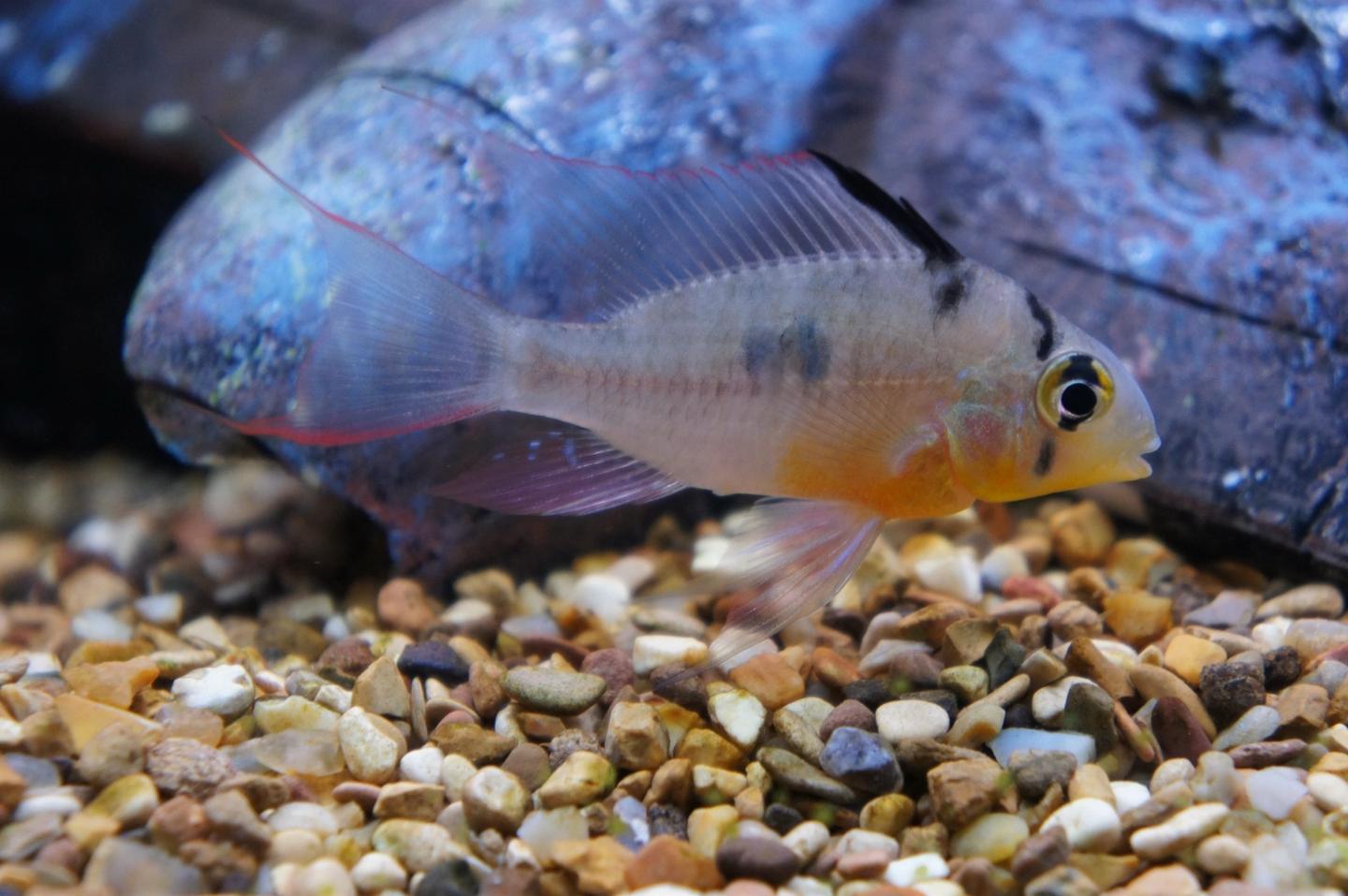
Cichlids are a family of roughly 1,800 accepted species, not one care type. Before buying, identify the exact species and source, then compare adult measurement, usable tank dimensions, social system, territory, tested water, diet and an exit plan. No family-wide minimum tank, water range or tank-mate list is safe.
Maintain these water conditions for optimal health and vibrant colors
The spotted checkerboard cichlid, Dicrossus maculatus, is a small South American cichlid with two rows of dark blotches along its flanks, the pattern that gives the whole genus its checkerboard and chessboard nicknames. Seriously Fish calls this species the spadetailed checkerboard cichlid, a name that fits the pointed tail of adult males, and we also list it as the Spadetail Checkerboard Cichlid (Dicrossus maculatus). It is the same species under a second name, so if you are comparing the two listings, compare what each one offers rather than expecting a different fish.
This listing is for one live fish. There are no size, sex or quantity options on it, so we do not choose a male or a female for you, and the fish arrives at our dispatch size rather than fully grown. If you want a particular sex for breeding, read the section on telling males from females before you order, and contact us first.
Steindachner described the species in 1875, and it is the type species of Dicrossus, the fish the genus name is anchored to. FishBase places it in the Cichlidae, in the subfamily Geophaginae, and lists it as a valid species under that name. Wikipedia's account of the genus recognises five species today: D. filamentosus, D. foirni, D. gladicauda, D. maculatus and D. warzeli.
FishBase gives a maximum of 5.3 cm standard length, measured from the snout to the base of the tail, and Seriously Fish gives the same 53 mm. FishBase also lists a length of 6.0 cm for a female without saying whether that is standard or total length. Schindler and Staeck, writing in 2008, describe the two species recognised at the time, D. maculatus and D. filamentosus, as dwarf cichlids of roughly 45 mm standard length at most. Plan for a fish of roughly 5 to 6 cm, with the tail on top of that.
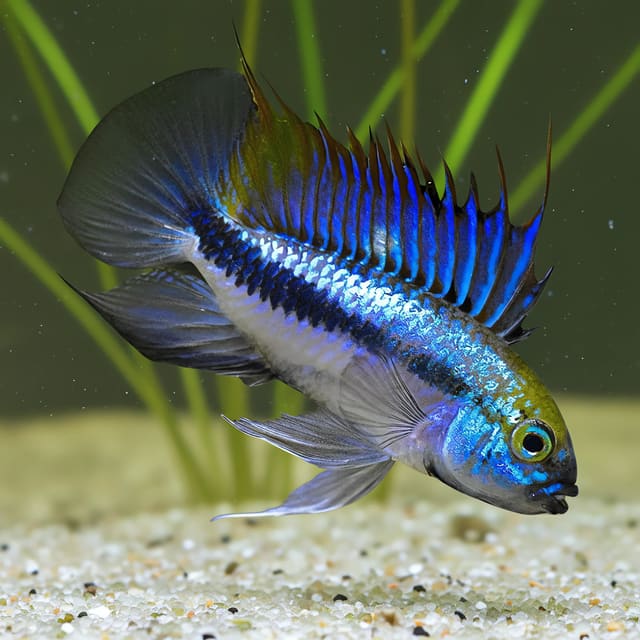
This is a fish for someone who already keeps soft-water species and is ready to give it its own carefully run aquarium. It is peaceful, small and beautifully marked, but it wants very soft, acidic and very clean water, and FishBase notes that it is rare in the aquarium trade. Seriously Fish says the same: it is not commonly available, and it is sometimes mistaken for its more popular relative, D. filamentosus. This listing is for D. maculatus itself, not the lyre-tailed species.
All Dicrossus share a set of features set out in the original 1875 description and later work, as summarised by Schindler and Staeck in their 2008 description of D. gladicauda: small size, an elongate shape, a body only moderately compressed from side to side, a serrated edge to the preopercle (a bone on the gill cover), and two series of dark blotches arranged like a checkerboard along the flanks. The serrated preopercle is something Dicrossus shares with its closest relative, Crenicara, and Schindler and Staeck describe it as a conspicuous and relatively rare feature among South American cichlids. You will not see it on a live fish without a lens, but it is one of the features that mark the two genera as sister groups.
Römer, Hahn and Vergara, who described two further species in 2010, split the genus into two groups by pattern. D. maculatus, D. filamentosus and D. gladicauda each carry two rows of large spots. D. foirni and D. warzeli carry three rows: double spots in foirni and short horizontal dashes in warzeli. So the first check on any checkerboard cichlid is to count the rows. Two rows of large blotches puts you in the group this fish belongs to.
Inside the two-row group, the tail of a grown male is the clearest guide. Schindler and Staeck describe the caudal fin of adult male D. maculatus as lanceolate, meaning it tapers to a single point like a spade or spearhead, which is what the spadetailed name describes. In D. filamentosus the male's tail is lyre-shaped and drawn out into two filament streamers, one at the top and one at the bottom. In D. gladicauda it is lopsided, with a streamer on the upper lobe only and a rounded lower lobe. They also note that the body blotches of D. maculatus are more rounded, where D. gladicauda has squarish or rectangular ones.
| Species | Rows of body markings | Adult male tail |
|---|---|---|
| Dicrossus maculatus | Two rows of large, more rounded blotches | Lanceolate (single pointed spade) |
| Dicrossus filamentosus | Two rows of large blotches | Lyre-shaped with two filament streamers |
| Dicrossus gladicauda | Two rows of squarish or rectangular blotches | Asymmetrical: streamer on the upper lobe, rounded lower lobe |
| Dicrossus foirni | Three rows of upright oval double spots | Not separated by tail shape in the sources used here |
| Dicrossus warzeli | Three rows of short horizontal dashes | Not separated by tail shape in the sources used here |
Females and young fish do not show the male tail shape, so a small or female maculatus is identified by the two-row, rounded-blotch pattern rather than the fin. It is easy to see why, as Seriously Fish notes, the species is sometimes mistaken for D. filamentosus.
Seriously Fish gives the most practical guide to sexing. Females are similar in size to males and may even be larger, so size is not a reliable way to tell them apart. Females have less vivid colouring, while males show a striking blue sheen on the sides of the head and on the gill plates. Around breeding time a female's ventral fins, the pair of fins under the chest, turn vivid yellow. Add the lanceolate tail of a grown male and you have the main signs. On a young fish at dispatch size none of these may be showing yet.
FishBase gives the range as the Amazon River basin in Brazil, in the Rio Tapajós drainage, the Rio Maués and near Parintins, and describes the species as living in rivers. Seriously Fish places it in the Rio Tapajós, the Rio Maués and the surrounding parts of the Brazilian Amazon basin. The genus as a whole is found in rivers of the Amazon and Orinoco basins, according to Wikipedia, but this species sits at the southern edge of that picture.
Römer, Hahn and Vergara make a neat point about that. They note that D. maculatus and D. warzeli appear to be the only members of the genus known exclusively from south of the main channel of the Amazon. The other species are found to the north, in the Rio Negro and Orinoco drainages. If you keep more than one checkerboard cichlid, it is worth knowing that this one comes from a different side of the river system entirely.
Published field notes on D. maculatus itself are thin, so the closest picture comes from its Tapajós neighbour. Römer and colleagues report that D. warzeli has been found only in clearwater rivers, where juveniles of about 20 mm SL were collected in small brooks with sandy bottoms and patches of leaf litter. Those fish were searching the bottom for small invertebrates and detritus by picking up and turning leaves, and they were collected only in very soft water with no detectable hardness and a pH regularly measured below 5, often below 4. That describes warzeli, not maculatus, and we include it only as context for the kind of water the Tapajós Dicrossus come from.
The same paper adds an important contrast. Compared with D. foirni and D. warzeli, the authors say D. maculatus is known to be far less sensitive to shifting water conditions, especially pH and hardness. That is good news for a keeper, but it is a comparison with relatives, one of which, warzeli, seems restricted to extremely soft, acidic water, and not a licence to keep this one in hard tap water.
FishBase records the species as Least Concern on the IUCN Red List, assessed in November 2018, and rates its resilience as high, with a minimum population doubling time of less than 15 months. It also notes the species is rare in the aquarium trade, which matches what Seriously Fish says about its availability.
This is the part of the care where the sources disagree most, so here they are side by side, followed by what we recommend.
| Parameter | FishBase | Seriously Fish | What we suggest |
|---|---|---|---|
| Temperature | 22 to 25 °C | 26 to 30 °C | 25 to 26 °C, where the two ranges meet |
| pH | 4.8 to 6.0 | 3.4 to 5.4 | 4.8 to 5.4, where the two ranges overlap |
| General hardness | Not given | Less than 1 °dH (very soft) | As close to zero as you can manage |
The temperature ranges do not overlap at all. FishBase's figure is cooler, Seriously Fish's is warmer, and they meet at 25 to 26 °C. Holding the tank there keeps you inside, or right at the edge of, both published ranges. Seriously Fish's warmer and more acidic figures are worth noting if you plan to breed the fish, because its breeding notes stress very acidic water for the eggs to hatch.
Very few UK taps deliver water anywhere near these figures. The usual route is reverse osmosis (RO) water, which starts with almost no hardness, and then lowering the pH with natural materials such as peat, dried leaves or alder cones, or with a product made for blackwater tanks. Do it in the mixing container before the water goes in, and test pH and hardness every time you make up a batch, so each water change matches the tank rather than shocking it. A pH controller is not needed if you change water on a steady routine with water that has been prepared the same way every time.
At this softness there is almost nothing in the water to buffer the pH, so it can drift as waste builds up between changes. That is one of the reasons Seriously Fish describes high quality water as absolutely vital, especially at such low pH. Small, frequent water changes with matched water are kinder than large, occasional ones, and keeping the tank lightly stocked gives you more margin.
Buy liquid or electronic tests for pH and general hardness that read accurately at the very low end of the scale; strips are rarely precise enough here. Check ammonia and nitrite while the tank is maturing and after any change to filter or stocking, and keep nitrate low with regular changes. Write your readings down. A log makes slow drift easy to spot before it becomes a problem.
Römer and colleagues' note that this species is far less sensitive to pH and hardness than its two Rio Negro and Tapajós relatives is encouraging, and it may help a fish ride out small fluctuations. But both care sources still describe soft, acidic water, and Seriously Fish's figures are very soft indeed. Our advice is to meet the published conditions rather than test the fish's tolerance.
Seriously Fish gives a minimum base of 60 by 30 cm, about 68 litres, for this species. Treat it as the floor for a single fish or a pair, and go bigger if you add dither fish. A longer tank gives more territory and more choice of cover, and it is the better option if you want to watch natural behaviour or try breeding.
Seriously Fish recommends a heavily planted set-up with plenty of cover in the form of caves with tiny entrances. Small caves are easy to provide: half coconut shells with a notch cut in the rim, small clay caves, or flat pieces of slate propped on stones, each turned so the opening faces into the planting. Spread two or three around the tank rather than grouping them, so a fish can claim one without standing guard over all of them.
Plants that grow well in very soft, acidic water suit the tank best. Floating plants are useful to soften the light and give the fish shaded areas to rest under. Mosses and epiphytes tied to wood will grow in these conditions without needing rich substrate or bright light.
A soft, fine sand suits a small cichlid that FishBase classes as benthopelagic, living near the bottom and in midwater, and a scattering of dried leaves on top recreates the leaf litter described from Tapajós streams. The leaves also release tannins that help hold the pH down and tint the water amber. Replace them as they break down.
Gentle filtration suits a small fish like this: a sponge filter or a small canister with a spray bar turned towards the glass keeps the water moving without blasting the fish around the tank. Keep the lighting moderate and broken up by floating plants. If you run a heater, choose one that holds the temperature steadily at 25 to 26 °C, and fit a lid, as you would on any tank housing small, active fish.
Set the tank up and let it run for several weeks before the fish arrives, so the filter is mature and the pH and hardness have settled where you want them. In soft, acidic water it pays to be patient here. A stable, mature tank is the single best thing you can give a newly arrived soft-water cichlid.
Seriously Fish's feeding advice is short and clear: feed a variety of good-quality frozen foods as the staple diet, and use live foods, which may be vital to bring the fish into breeding condition. FishBase does not record the wild diet of this species. The closest field observation comes from its Tapajós neighbour, D. warzeli, whose juveniles were seen picking up and turning leaves in search of small invertebrates and detritus. That fits a small cichlid that forages close to the bottom.
For a fish of about 5 cm, the frozen foods sold for small aquarium fish are the right size. Rotate between a few, such as daphnia, cyclops, brine shrimp and bloodworm, rather than relying on one. Thaw a small portion in a little tank water and feed what the fish will clear in a couple of minutes. We would feed small amounts once or twice a day rather than one big meal, because small portions protect water quality in a lightly buffered tank.
If you want to try good-quality small granules or flakes once the fish has settled, treat them as a supplement rather than the main diet, because Seriously Fish lists frozen foods as the staple.
If you plan to breed the fish, live foods earn their place. Seriously Fish says they may be vital for bringing this species into breeding condition. Small live foods such as daphnia or newly hatched brine shrimp are the easiest to provide at home, and live foods also tempt a new arrival that is slow to start eating.
Uneaten frozen food is the quickest way to spoil soft, acidic water. Feed into a clear area of the tank so you can see what is eaten, siphon out leftovers after the meal, and if the fish lives with dither fish, make sure the checkerboard cichlid is getting its share. A small cichlid can go short when quick tetras reach the food first.
Seriously Fish describes this species as very peaceful towards non-conspecifics, meaning fish of other species. The way that is worded leaves room for disagreements between fish of its own kind, so give two or more maculatus enough space and enough caves to keep apart when they want to.
One of the most useful notes on the species comes from Seriously Fish's breeding section: adding a few small shoaling fish, such as tetras, can vastly improve the parental care that mature fish show. The usual explanation is that calm fish moving in open water signal to a cautious cichlid that the tank is safe.
Any tank mate needs to suit the same very soft, acidic water and the 25 to 26 °C target. It should be small, peaceful and happy in a quiet, planted tank. Small tetras and similar shoaling fish that come from soft, acidic water are the natural choice. Check each one's own requirements before you buy, because many popular community fish do best in harder water than this species needs.
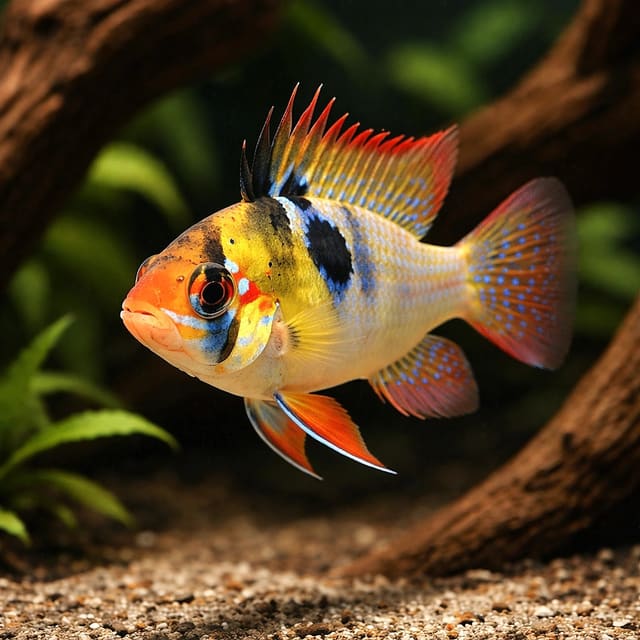
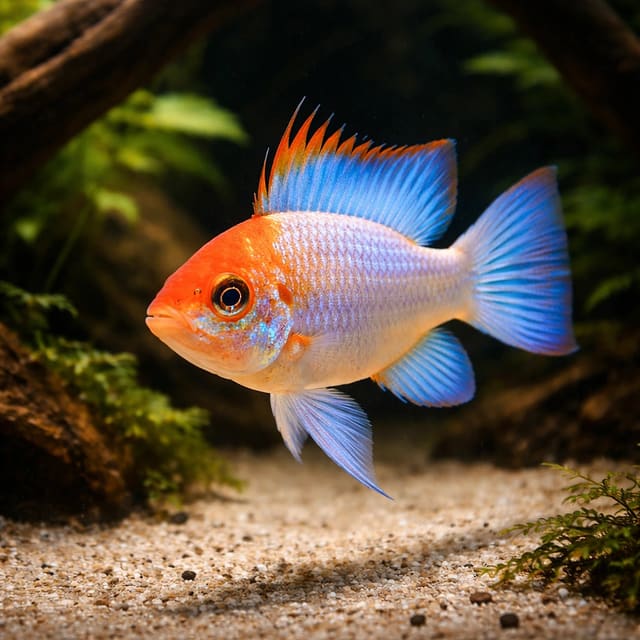
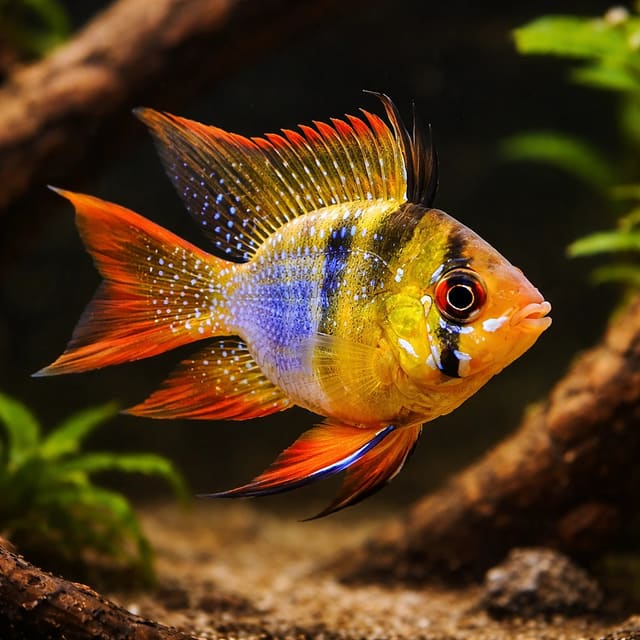
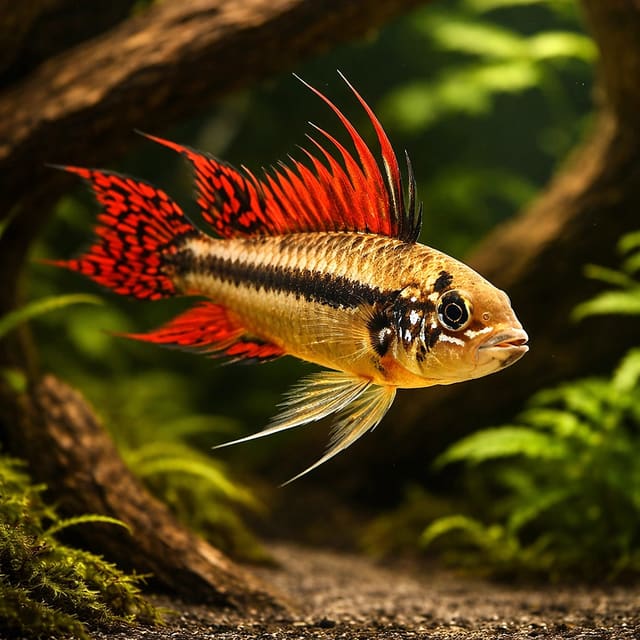
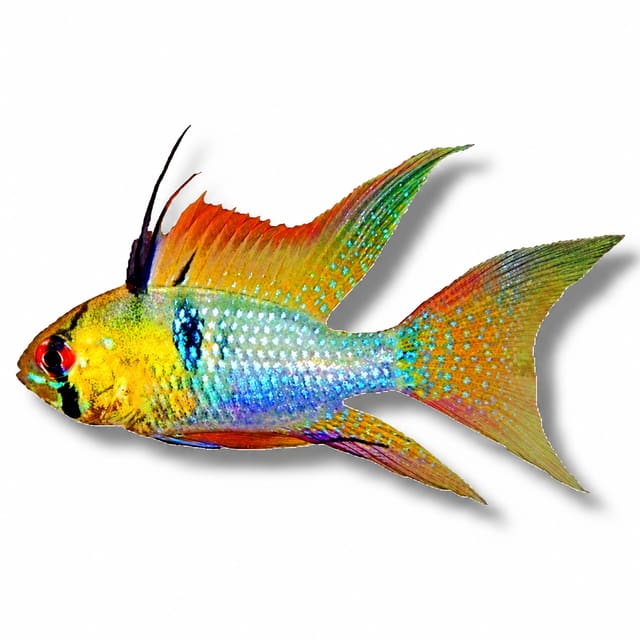
We list other South American dwarf cichlids, such as Cockatoo Dwarf Cichlid (Apistogramma cacatuoides), Super Red Agassiz's Dwarf Cichlid (Apistogramma agassizii) and the Asia Form Ram Cichlid (Mikrogeophagus ramirezi). Each has its own water and space needs, set out on its own page, and none of our sources covers keeping them alongside Dicrossus maculatus. If you are choosing between dwarf cichlids rather than mixing them, those pages are a good place to compare.
Seriously Fish is honest about it: Dicrossus maculatus is a challenge to breed because of the very soft, acidic water it needs, but when it does happen it is a very rewarding experience. Here is what the sources do and do not tell us.
The most striking part of the breeding story is the female's care. According to Seriously Fish, her ventral fins turn vivid yellow around breeding time, and she uses them to give signals to her fry: when she extends them, the fry come towards her, and when she closes them, the fry stop. It is not unusual to see a female herding her brood around the tank, often guiding them into a safe place just before they settle for the night.
Seriously Fish adds a point that differs from many Apistogramma: a brooding maculatus female may not spawn again successfully until all the fry have been removed from the adults' tank. Plan a separate, matured grow-out tank with matching water before you start.
Seriously Fish includes a note, written about D. filamentosus, that the pH and temperature during spawning, hatching and the first month of the fry's lives can affect the ratio of males to females in a brood, and that raising the pH towards 5.5 and lowering the temperature towards 24 °C in that first month gives a more balanced ratio. It places that note on its maculatus page, but it was written about the related species, so treat it as a lead worth testing rather than an established fact for this fish.
The sources we used do not give the clutch size, where the eggs are usually laid, how long they take to hatch, or what part the male plays once the fry are free-swimming. We would rather leave those gaps open than guess. If you breed this species, keep notes: you will be adding to a short list of published observations.
With a soft-water dwarf cichlid, the things most within your control are all about water: a stable pH, a matured filter, and keeping waste from building up in water with almost no buffering. Get those right and the fish has the best chance of staying healthy.
A well-settled spotted checkerboard cichlid holds its fins open, breathes steadily, explores the planted areas and caves, and comes out to feed. Its two rows of blotches stay crisp, and a male's blue sheen on the head and gill plates shows clearly.
If you see any of these, test the water before anything else, and change some of it with water prepared to match if a reading is off. Get advice before adding treatments, because medication doses are usually worked out for ordinary tap water and may not behave the same way in very soft, acidic water.
A small quarantine tank, run with the same soft, acidic water as the main aquarium, is worth having if you already keep other fish. It lets you watch a new arrival closely and makes sure it is eating before it joins the display tank.
Römer and colleagues note that this species is far less sensitive to shifting pH and hardness than its relatives D. foirni and D. warzeli. That tolerance is a cushion, not a target. Make any change to pH, hardness or temperature slowly, through matched water changes rather than chemicals added straight into the tank, and keep the routine steady from week to week.
Please read our delivery and live-arrival information before ordering. Your aquarium must be ready before the parcel arrives, with the filter running, the water tested and the temperature matched. Someone needs to be at the delivery address to receive live animals. We email you the confirmed delivery date and tracking.
The fish travels in an oxygen-filled bag inside insulated packaging, with heat packs when conditions call for them, by a tracked courier licensed to carry live animals.
Start a continuous video while the parcel is still sealed, and open it in the same take, showing the fish in its still-sealed bag. If the fish arrives dead, dying or clearly compromised, email hello@tropicalfishco.co.uk on the day of delivery with your order number and that video. Photos alone do not meet the policy. The resolution is a replacement with your next order or a refund for the affected fish, subject to the guarantee terms.
Floating matches temperature only, not pH or hardness. With this species your tank water may well be much softer and more acidic than the water in the bag, so if your readings differ a lot from ordinary tap water, ask us for advice before the fish goes in.
Give the fish a day or two of peace before its first small feed, and offer frozen or small live food rather than dried. Watch its breathing, appetite and behaviour through the first week, check pH and ammonia while the filter adjusts, and keep the cave and planting arrangement as it is so the fish can learn its surroundings. Once it is eating and exploring, it has made the move successfully.
These are the sources used for this guide.
No reviews for this item yet. Bought one? Honest reviews only, good or bad.
What customers say about ordering from us
Easy website plenty of info on fish your buying great to pick a time slot
TRACEY DURRANT · 7 Oct 2026
Got some lovely fish thank you
Kevin Mackie · 7 Oct 2026
Reviews of our shop, collected by Judge.me, an independent third-party review collector. Newest first.