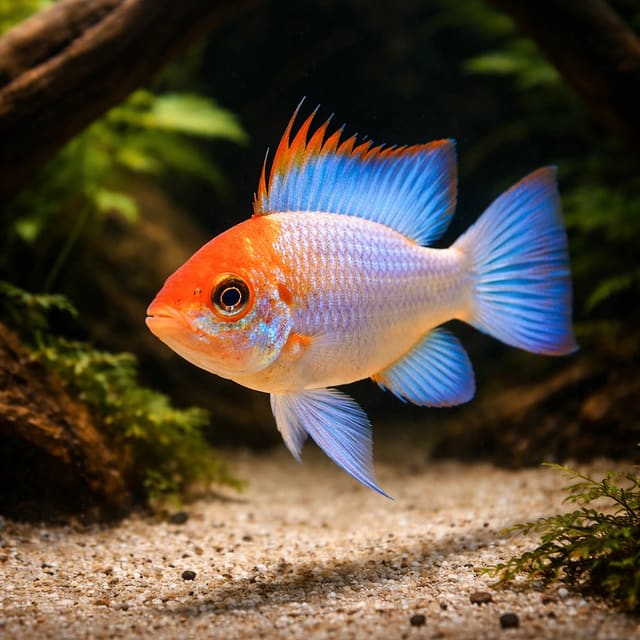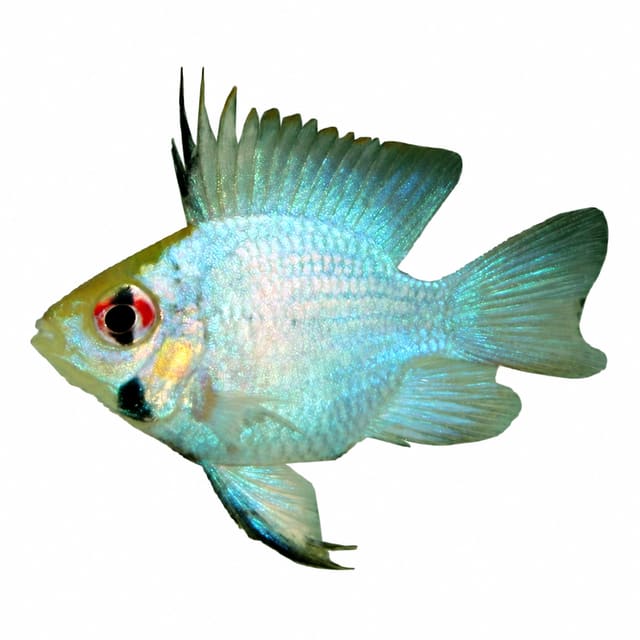
Asia Form Ram Cichlid (Mikrogeophagus ramirezi)
27–30°C · pH 4–7 · 54L
£5.99
The Spadetail Checkerboard Cichlid (Dicrossus maculatus) is a freshwater cichlid from Brazil’s Amazon basin that reaches 5.3 cm standard length. It suits keepers able to maintain a mature aquarium at Seriously Fish’s 26–30°C and 0–1 dGH, with pH 4.8–5.4 as the overlap of Seriously Fish and FishBase, a base of 60 × 30 cm and a volume of about 68 litres. Sold individually as one live fish per purchase.
Adult size is the maximum length this species reaches at full maturity (scientific sources). The livestock you receive will be younger and smaller. Product-photo provenance and any image-specific limitations are stated on the listing.
Dicrossus maculatus
Save when buying multiple fish. Each quantity is one fish; sex and pair formation are not guaranteed unless the selected variant explicitly states them.
The Spadetail Checkerboard Cichlid (Dicrossus maculatus) is a freshwater cichlid from Brazil’s Amazon basin that reaches 5.3 cm standard length. It suits keepers able to maintain a mature aquarium at Seriously Fish’s 26–30°C and 0–1 dGH, with pH 4.8–5.4 as the overlap of Seriously Fish and FishBase, a base of 60 × 30 cm and a volume of about 68 litres. Sold individually as one live fish per purchase.
Adult size is the maximum length this species reaches at full maturity (scientific sources). The livestock you receive will be younger and smaller. Product-photo provenance and any image-specific limitations are stated on the listing.
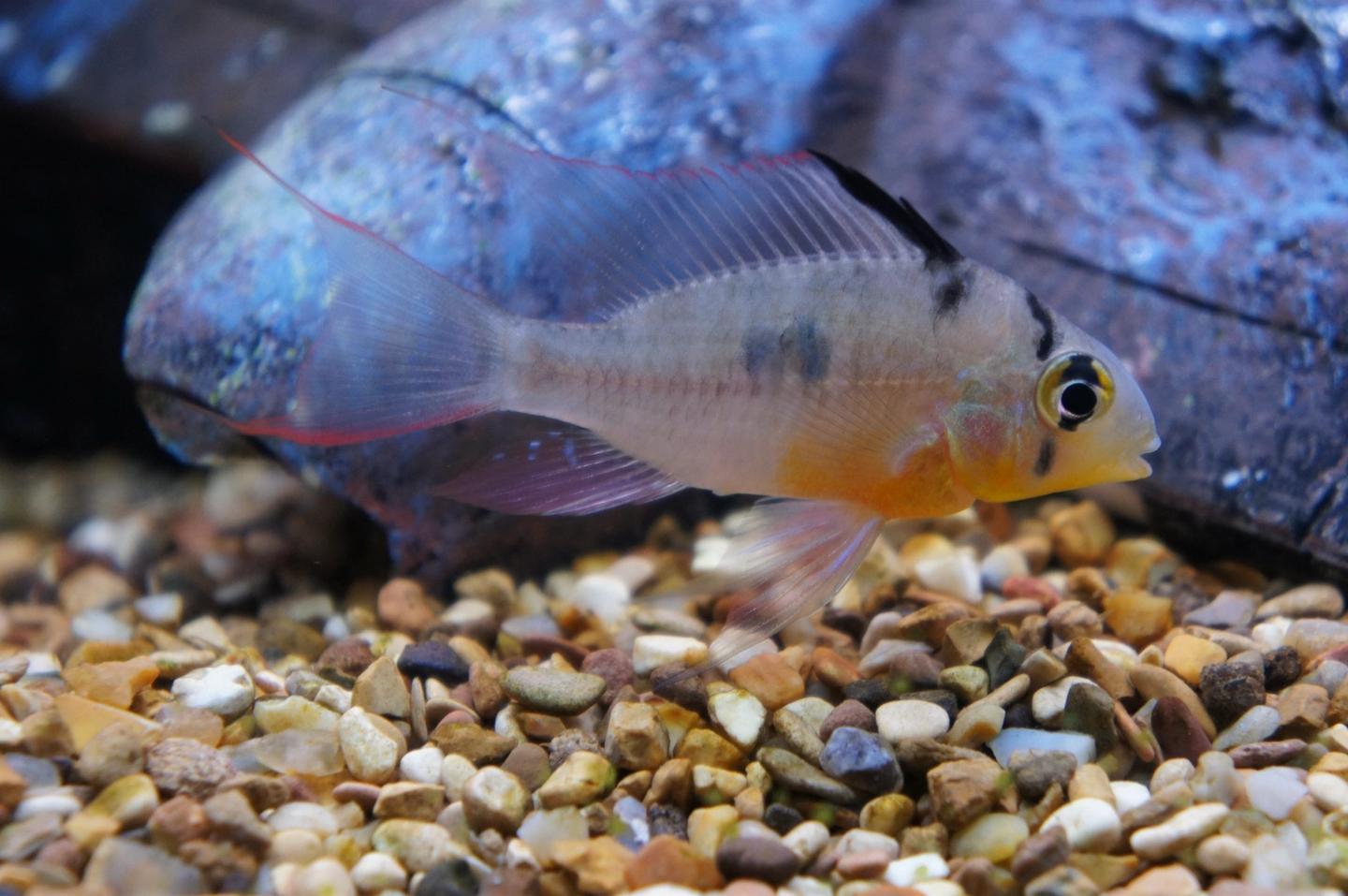
Cichlids are a family of roughly 1,800 accepted species, not one care type. Before buying, identify the exact species and source, then compare adult measurement, usable tank dimensions, social system, territory, tested water, diet and an exit plan. No family-wide minimum tank, water range or tank-mate list is safe.
Maintain these water conditions for optimal health and vibrant colors
The Spadetail Checkerboard Cichlid (Dicrossus maculatus) is a small freshwater member of the cichlid family from Brazil’s Amazon basin. Its recorded range includes the Tapajós River drainage, Maués River and waters near Parintins. It reaches a maximum recorded 5.3 cm standard length and suits a keeper who can maintain a mature, heavily planted aquarium with extremely soft, acidic water.
FishBase records the identity, Brazilian distribution and 5.3 cm maximum. For aquarium planning, Seriously Fish recommends a 60 × 30 cm base and a volume of about 68 litres, with water at 26–30°C, pH 3.4–5.4 and 0–1 dGH. Use pH 4.8–5.4 for routine care because it is the overlap of Seriously Fish’s aquarium range and FishBase’s recorded environmental range.
| Suits | Not suited to |
|---|---|
| Mature, filtered aquariums | New or biologically unstable aquariums |
| Very soft water at 0–1 dGH | Hard, alkaline community systems |
| Heavily planted layouts with several caves | Bare layouts without retreat spaces |
| Peaceful companions sharing the same water needs | Unscreened companions with conflicting chemistry |
| Keepers who test water consistently | Setups where narrow chemistry cannot be maintained |
The spadetail name helps distinguish this fish from Dicrossus filamentosus, with which it is sometimes confused. FishBase places D. maculatus in Cichlidae and assesses it as Least Concern. Its small adult length does not make it suitable for an unfiltered bowl or an immature nano aquarium: water quality, floor space and cover remain decisive.
One purchase supplies one Spadetail Checkerboard Cichlid. The dispatch length is approximately 1–2 cm, while the recorded adult maximum is 5.3 cm standard length. Treat the dispatch measurement as the size supplied, not as an indication of sex or eventual appearance, and plan the aquarium around the adult measurement from the start.
Sex is guaranteed only when the selected option explicitly states male or female. This Spadetail Checkerboard Cichlid listing has no sex-guaranteed option.
Size is not an accurate way to sex Dicrossus maculatus. Seriously Fish notes that females can be similar in size to males or larger; females tend to be less vividly coloured, while males may show a striking blue sheen on the head and gill plates. These are biological tendencies rather than a basis for choosing the sex supplied.
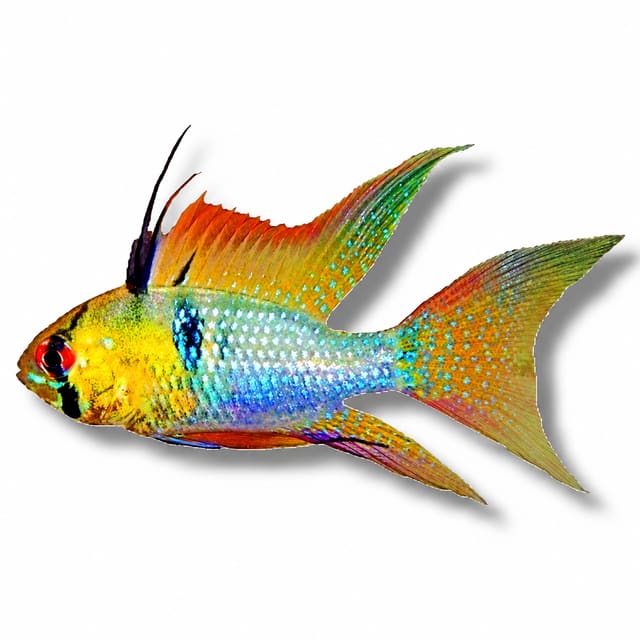
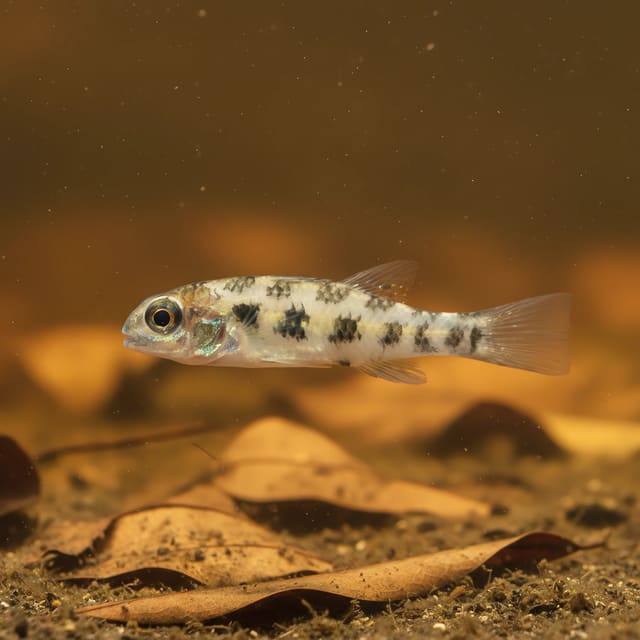
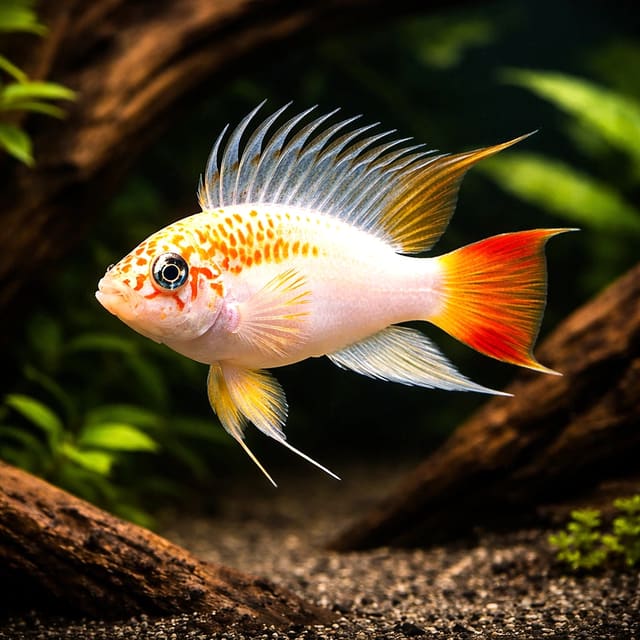
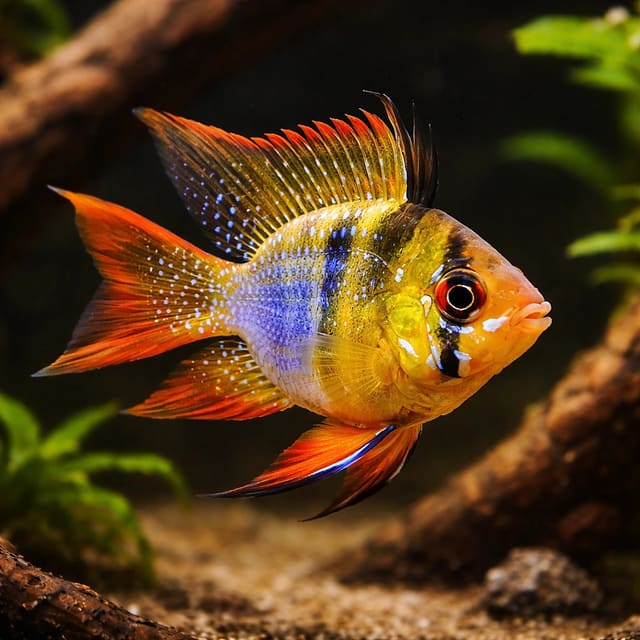
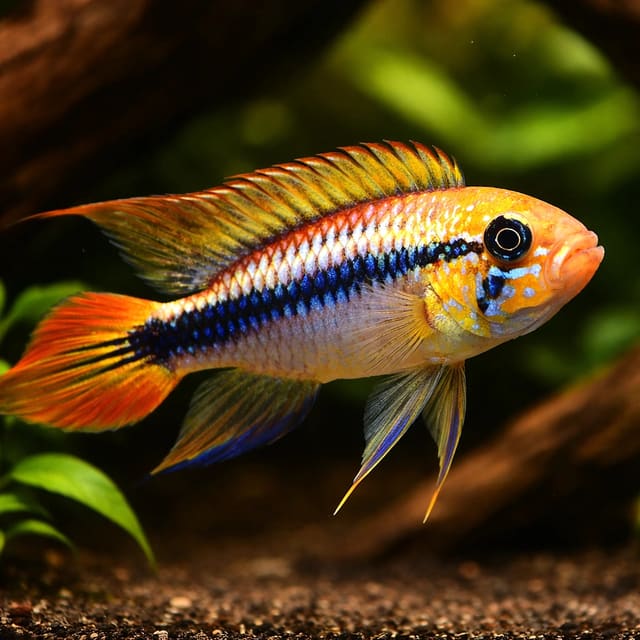
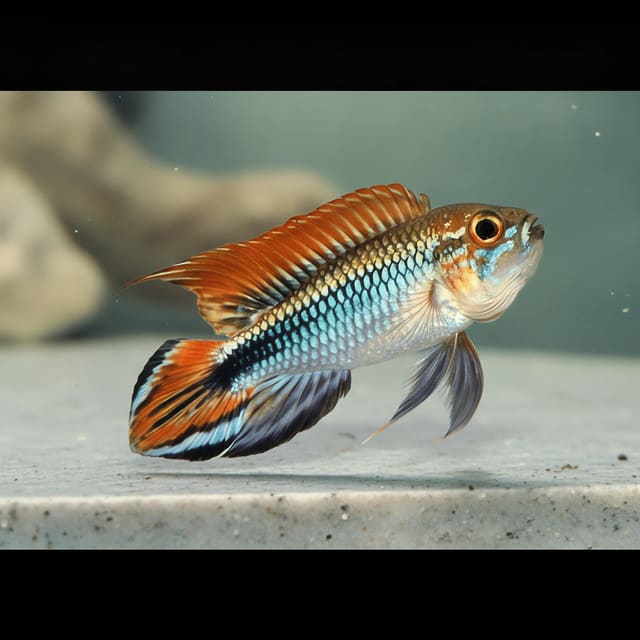
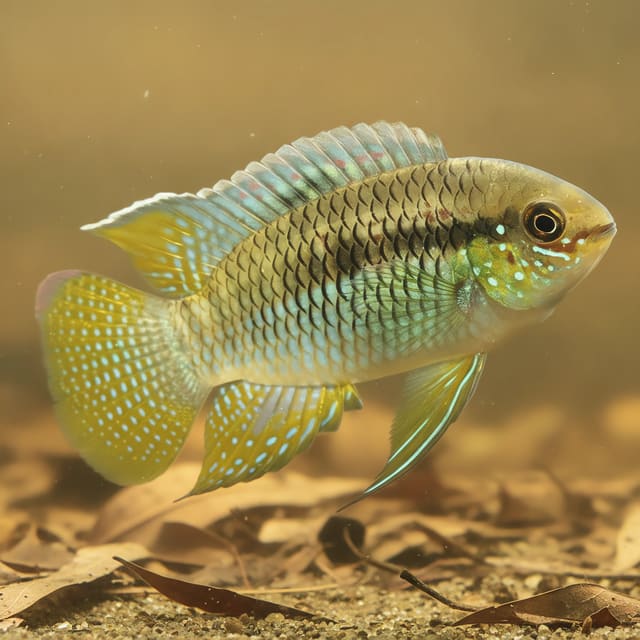
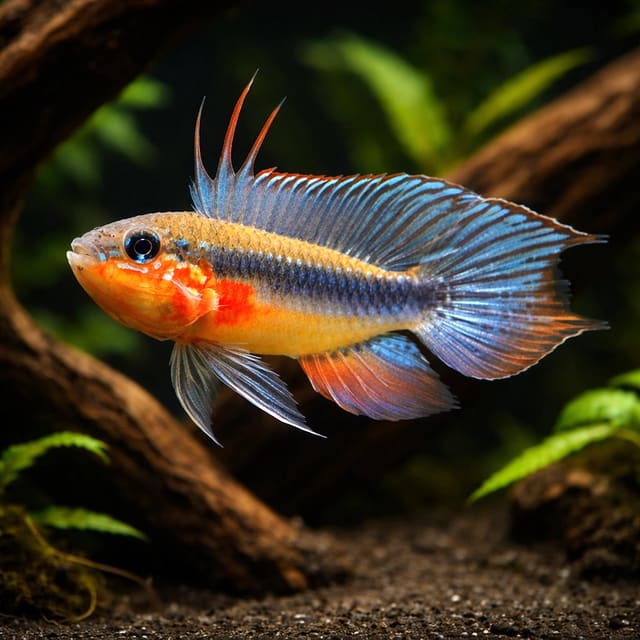
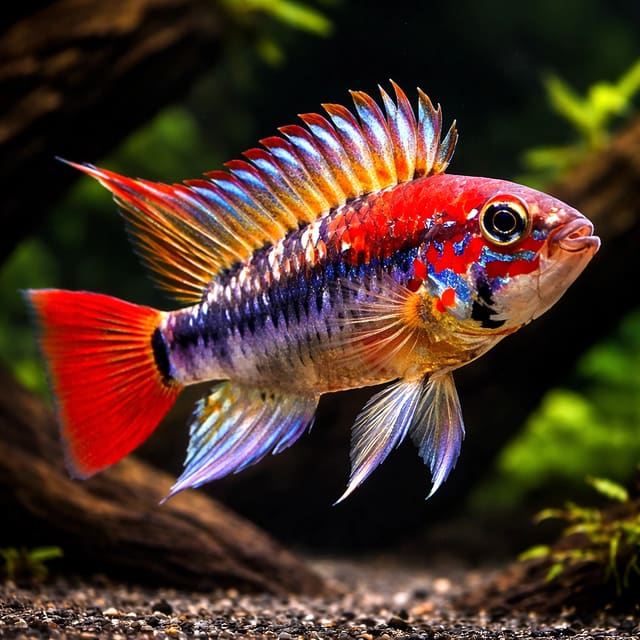
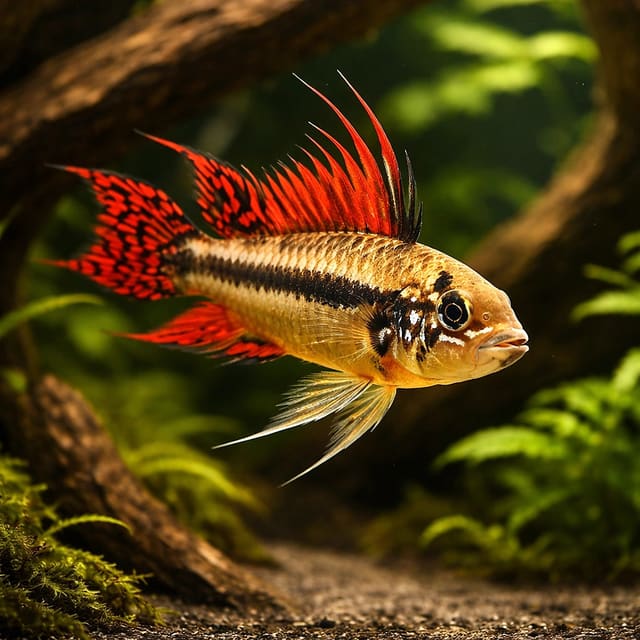
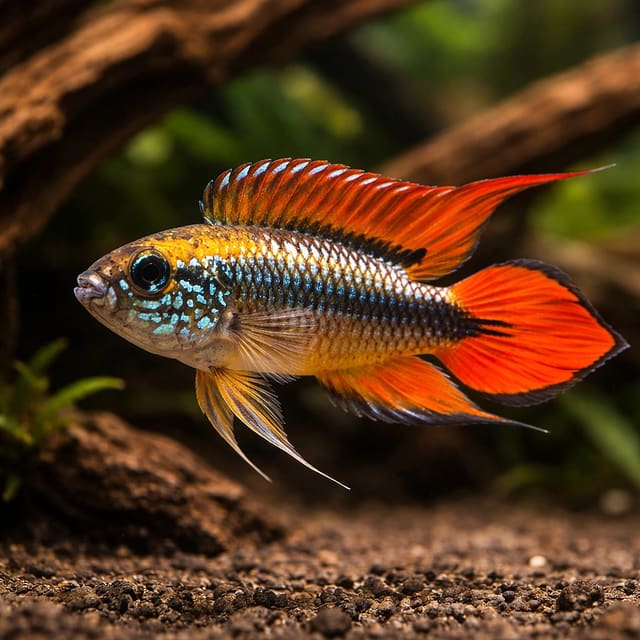
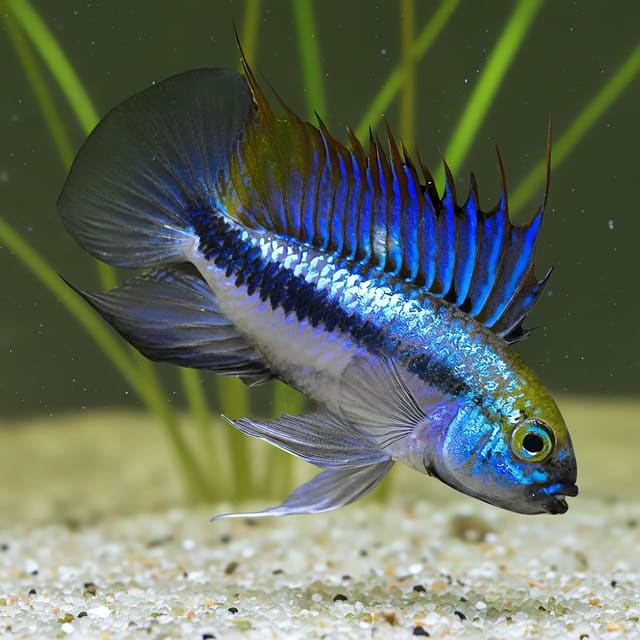
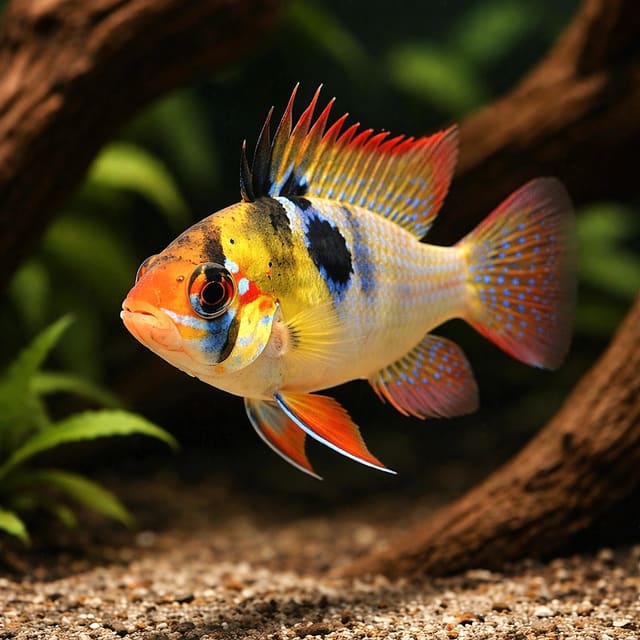
The gallery images are representative of this type of animal rather than photographs of the exact animal supplied, so colours can look slightly different from the live animal.
The gallery shows the characteristic elongated cichlid shape, dark checkerboard blotches, blue facial markings and a spotted, spade-shaped tail in a planted aquarium. Use that scene to understand the overall type of fish, while allowing for natural differences in colour and markings between individuals.
You can compare related aquarium types in our South American cichlid collection.
Plan on an aquarium base of 60 × 30 cm and a volume of about 68 litres for Dicrossus maculatus. The footprint matters because cover, caves and feeding areas must all fit without turning the entire bottom of the aquarium into one exposed space. Do not use the fish’s small dispatch length to justify a temporary bowl or undersized aquarium.
OATA’s dwarf-cichlid guidance recommends at least 60 litres for a pair and at least 80 litres when dwarf cichlids are mixed with other fish. These are group guidance; the species profile’s 60 × 30 cm base and approximately 68-litre setup remain the starting point for this fish.
| Keeping plan | Space decision |
|---|---|
| One fish | Use the 60 × 30 cm, approximately 68-litre species setup. |
| Compatible pair | Retain the species footprint and provide several separate shelters. |
| Community aquarium | Start from OATA’s at least 80-litre figure, then check every companion’s water needs. |
| Additional cichlids | Increase floor space and shelter rather than relying only on extra height. |
A larger aquarium makes temperature and water quality more stable, but extra volume does not replace useful structure. A tall open aquarium can still leave a shy or chased fish without a retreat. Set the plants and caves out before adding livestock, then view the aquarium from the front to ensure that several sheltered areas are present.
If this is your first mature aquarium, follow our first tropical aquarium guide before planning livestock. The aquarium should have an established biological filter and measured ammonia and nitrite of zero before this cichlid is introduced.
Use a heavily planted aquarium with plenty of cover and caves that have small entrances. Seriously Fish specifically recommends that arrangement for D. maculatus. Dense structure gives the fish somewhere to retreat and lets a community companion move away if territorial behaviour appears during breeding.
Choose aquarium sand or gravel for the substrate. OATA also names live plants, suitable artificial plants, plant pots, model caves, wood and leaf litter as useful forms of shelter for dwarf cichlids. Combine several of these rather than relying on one central ornament that every fish must approach.
Tiny cave entrances are useful only when they remain accessible to the fish and can be checked during maintenance. Position removable shelters so trapped waste can be siphoned from around them. Keep plants and ornaments clear of filter intakes and make sure they do not prevent routine inspection of the aquarium.
Observe how the fish uses the structure after introduction. A fish that repeatedly remains hidden may be settling, avoiding a companion or responding to water conditions. Do not remove all the cover to force it into view. Check chemistry and behaviour first, then adjust the arrangement only when you can preserve several secure retreats.
When two fish repeatedly meet at the same cave, add separation between shelters rather than placing another entrance beside the disputed one. The aim is not to create a guaranteed territory but to give each fish more than one route between cover, food and open water.
Keep the aquarium at 26–30°C, pH 4.8–5.4 and 0–1 dGH. Seriously Fish gives 26–30°C, pH 3.4–5.4 and 0–1 dGH for aquarium care. The narrower pH instruction of 4.8–5.4 is the overlap of that aquarium range and FishBase’s recorded environmental pH of 4.8–6.0.
FishBase records 22–25°C in the wild environment, while the aquarium recommendation begins at 26°C. Use 26–30°C as the routine aquarium target rather than blending the two records into a middle range. Keep the selected value stable and check it with a reliable thermometer.
Very low hardness is a defining requirement. Test the aquarium rather than judging softness from a regional tap-water description. Read our water chemistry guide to identify the measurements you need, then use the water matcher to compare measured values with the target range.
Do not chase a single reading while ignoring ammonia, nitrite or temperature. A pH result within 4.8–5.4 is useful only when the filter is functioning and the other measured values remain suitable. OATA sets ammonia and nitrite at zero and recommends keeping nitrate no more than 20 mg per litre above the normal level in the tap water.
If your aquarium cannot remain within 0–1 dGH and acidic pH, prepare a different mature setup before introducing this fish. Consistent measured conditions are a better decision point than trying to alter an occupied aquarium repeatedly.
Run a mature biological filter continuously and keep ammonia and nitrite at zero. The RSPCA explains that biological filtration supports bacteria that convert toxic ammonia into nitrite and then into the safer nitrate. This fish should not be introduced to an aquarium before that process is established.
For an aquarium of about 68 litres, Seriously Fish gives a turnover of four to five times the volume each hour and a filter rating of approximately 270–340 litres per hour. Treat the manufacturer’s rating as a starting point, then check that plants and caves do not block circulation or trap visible waste.
Test ammonia, nitrite and nitrate at least weekly. OATA recommends a partial water change of 25% at least once each week, with replacement tap water treated to remove chlorine or chloramine. Match the replacement water to the aquarium’s intended chemistry and temperature before it enters the fish’s living space.
A visible drop in flow is a reason to inspect the filter, not to compensate by feeding less indefinitely. Conversely, a strong flow reading does not replace water tests. The filter deals with waste biologically, while water changes remove accumulated material and let you inspect the aquarium closely.
Increase stocking slowly. OATA warns that beneficial bacteria need time to respond when more fish and food increase the waste load. Adding several companions at once can leave the filter unable to process ammonia and nitrite quickly enough, even when the aquarium looked stable beforehand.
Feed a variety of good-quality frozen foods as the staple. Seriously Fish makes that the main dietary recommendation for D. maculatus and adds that live foods may be vital when bringing the fish into breeding condition. Use small items that the fish can take cleanly and watch to confirm that it eats.
Suitable small live or frozen foods named in OATA’s dwarf-cichlid guidance include daphnia, brine shrimp and tubifex. Rotate suitable foods instead of relying on one item continuously. Variety broadens the feeding routine while keeping the species profile’s frozen-food emphasis intact.
Feed once a day and offer only what can be eaten within a few minutes. That schedule and portion rule come from OATA. Stop adding food when the fish loses interest or pieces begin settling uneaten, because decomposing excess food adds waste to the aquarium.
| What you observe | What to do |
|---|---|
| Food is eaten promptly | Keep the same small portion and continue rotating suitable foods. |
| Food remains after a few minutes | Reduce the next portion and remove accessible leftovers. |
| Companions take everything first | Reassess the stocking mix and place food where this cichlid can reach it. |
| Interest in food declines | Test water and compare swimming, breathing and colour with the fish’s normal behaviour. |
Feeding is also a daily observation point. Watch the whole fish rather than only whether food disappears. Normal intake combined with steady swimming and breathing is more useful than adding a larger portion to encourage a reluctant fish.
For a breeding project, live food is one part of preparation rather than a substitute for extremely acidic, high-quality water. Keep routine portions restrained even when conditioning fish, because extra food also increases the load on the filter.
Be present to receive the parcel because live fish must not be left unattended. Tropical Fish Co hand-bags live fish in pure oxygen and uses an insulated poly box, adding a heat pack when the weather calls for it. A licensed live-animal courier carries the parcel.
Before receipt, confirm that the prepared aquarium is running at 26–30°C, pH 4.8–5.4 and 0–1 dGH. OATA advises checking that ammonia and nitrite are zero before any fish is introduced.
When the parcel arrives, follow the current delivery and Live Arrival Guarantee policy.
OATA advises increasing livestock numbers slowly. That protects the established filter from a sudden increase in waste and makes it easier to distinguish an arrival issue from a stocking or water-quality problem.
During the first week, keep the established daily feeding schedule and check whether the fish reaches food within a few minutes. Record temperature and inspect the fish at the same time each day. A consistent routine makes changes in appetite, posture, breathing or hiding easier to notice.
After transfer, observe swimming and breathing without adding more livestock at the same time. The fish enters the prepared system after the 20–30 minute float, while the bag water remains separate.
Plan for a maximum recorded adult size of 5.3 cm standard length. FishBase and Seriously Fish both give 53 mm standard length, so use 5.3 cm consistently for long-term space planning. The fish’s approximately 1–2 cm dispatch measurement must not be used to infer sex, adult colour or compatibility.
Do not sex this species by body size alone. Seriously Fish reports that females may be a similar size to males or larger. Females tend to be less vivid, while males can show a striking blue sheen on the sides of the head and gill plates. Observe these traits as the fish develops without treating one visible feature as certainty.
Breeding is a demanding separate project. The species requires extremely acidic water for eggs to hatch, and high water quality is especially important at such low pH. Live foods may help bring the fish into breeding condition, but extra feeding must remain within the filter’s ability to process waste.
Know the individual fish’s usual swimming, colour, breathing, hiding and feeding behaviour. OATA identifies hanging at the surface, sitting on the bottom, erratic swimming, unusual darkening or paling, changed aggression, increased hiding, faster or slower gill movement, white spots, fluffy growths, damaged fins or scales, altered body condition and reduced feeding as signs that need attention.
If one of these changes appears, test temperature, ammonia, nitrite, nitrate, pH and hardness first. Compare the result with the aquarium’s normal written readings and correct husbandry problems carefully. Contact us for further guidance when health changes persist or the fish’s condition is worsening.
Keep breeding observations separate from routine health decisions. Increased territorial behaviour around a spawning site may be reproductive, but poor breathing, damaged tissue or loss of appetite still warrants immediate water testing and close assessment.
Choose peaceful non-conspecific fish that can live at 26–30°C, pH 4.8–5.4 and 0–1 dGH without dominating food or the covered lower areas. Seriously Fish describes D. maculatus as very peaceful towards non-conspecifics, but that statement does not remove the need to match water chemistry and space.
OATA recommends shoals of dither fish for dwarf cichlids because their open-water movement can give the cichlids a sense of security. Seriously Fish specifically mentions small shoaling fish such as tetras in connection with mature D. maculatus. Treat tetras as a kind to assess, not as a universal compatibility promise.
When breeding is intended, avoid tank mates that may disturb spawning sites or eat fry. That is the specific exclusion supported by OATA. Outside that situation, assess companions by shared water needs, peaceful behaviour, feeding access and space instead of relying on a fixed list.
Compatibility with invertebrates requires an individual assessment of the species, size, water range and use of the aquarium floor. Do not assume that the word “peaceful” guarantees every fish–invertebrate combination. For a specific stocking and compatibility assessment, ask us with the aquarium dimensions, measured water values and existing livestock.
Allow extra room around caves before breeding behaviour begins. OATA notes that dwarf cichlids can become territorial when breeding and that even settled pairs will often chase one another. Multiple shelters and planted divisions give fish somewhere to move without leaving the entire aquarium.
A peaceful fish can still defend a breeding area. Judge the aquarium by what happens at caves, feeding points and routes between cover. Brief movement away from a shelter is different from one fish being repeatedly prevented from feeding or resting.
| What you see | Decision |
|---|---|
| Fish share the aquarium and feed normally | Continue observing without changing a stable arrangement. |
| Chasing begins around one cave | Check that alternative shelters and clear escape routes remain usable. |
| One fish monopolises food | Reassess the companion mix and feeding access. |
| A spawning site is repeatedly disturbed | Revise the stocking plan if breeding is the aim. |
| Fins, breathing or appetite change | Test water and assess health as well as social pressure. |
Do not assume that buying two individual fish creates a compatible pair. Sex is not guaranteed, and size is not an accurate sexing method for this species. Build the aquarium so each fish has cover regardless of how the social relationship develops.
When adding peaceful shoaling fish, retain open swimming room without removing the caves and planting required by the cichlid. The community must work for both kinds of fish: the shoal needs adequate space, while D. maculatus needs access to covered lower areas and food.
Keep uncertainty in the plan. Individual behaviour can change around breeding, so observe the actual fish after every stocking change rather than treating a peaceful species description as a permanent guarantee.
FishBase records a maximum of 5.3 cm standard length. Plan the aquarium around that adult figure rather than the fish’s smaller dispatch measurement.
Plan a 60 × 30 cm base and a volume of about 68 litres. An aquarium of at least 80 litres is required when dwarf cichlids are mixed with other fish.
For a compatible pair, OATA’s dwarf-cichlid guidance recommends at least 60 litres; use the species plan of about 68 litres with several shelters and assess every additional fish individually.
It best suits a keeper who can maintain a mature aquarium at Seriously Fish’s 26–30°C and 0–1 dGH, with pH 4.8–5.4 as the overlap of Seriously Fish and FishBase, while keeping ammonia and nitrite at zero.
Feed varied good-quality frozen foods as the staple. Small live or frozen daphnia, brine shrimp and tubifex add variety; offer only what is eaten within a few minutes once daily.
Keep it at Seriously Fish’s 26–30°C and 0–1 dGH, with pH 4.8–5.4 as the overlap of Seriously Fish’s aquarium range and FishBase’s recorded wild range.
Seriously Fish describes it as very peaceful towards non-conspecifics, while OATA notes that dwarf cichlids may become territorial when breeding. Treat fin-nipping risk as uncertain and monitor fins, chasing and feeding access.
Consider peaceful non-conspecific fish sharing its very soft, acidic water; shoaling dither fish such as tetras are specifically named. When breeding is intended, avoid animals that may disturb spawning sites or eat fry.
Tropical Fish Co hand-bags the fish in pure oxygen, uses an insulated poly box and adds a heat pack when the weather calls for it. Be present, start filming before opening the parcel, float the bag for 20–30 minutes and keep bag water out of the aquarium.
No reviews for this item yet. Bought one? Honest reviews only, good or bad.
What customers say about ordering from us
Easy website plenty of info on fish your buying great to pick a time slot
TRACEY DURRANT · 7 Oct 2026
Got some lovely fish thank you
Kevin Mackie · 7 Oct 2026
Reviews of our shop, collected by Judge.me, an independent third-party review collector. Newest first.