Asia Form Ram Cichlid (Mikrogeophagus ramirezi)
27–30°C · pH 4–7 · 54L
£5.99
Mikrogeophagus ramirezi — Black is a dark ram form for a mature, warm and very clean aquarium. One unsexed fish is supplied in the chosen 2.5–5 cm grade; plan around the species' 4.2 cm recorded standard length, 27–30°C water, fine sand, gentle flow and peaceful companions that will not outcompete it.
Adult size is the maximum length this species reaches at full maturity (scientific sources). The livestock you receive will be younger and smaller — pick a size above for the actual shipping size. Product-photo provenance and any image-specific limitations are stated on the listing.
Mikrogeophagus ramirezi
Save when buying multiple fish. Each quantity is one fish; sex and pair formation are not guaranteed unless the selected variant explicitly states them.
Mikrogeophagus ramirezi — Black is a dark ram form for a mature, warm and very clean aquarium. One unsexed fish is supplied in the chosen 2.5–5 cm grade; plan around the species' 4.2 cm recorded standard length, 27–30°C water, fine sand, gentle flow and peaceful companions that will not outcompete it.
Adult size is the maximum length this species reaches at full maturity (scientific sources). The livestock you receive will be younger and smaller — pick a size above for the actual shipping size. Product-photo provenance and any image-specific limitations are stated on the listing.

Cichlids are a family of roughly 1,800 accepted species, not one care type. Before buying, identify the exact species and source, then compare adult measurement, usable tank dimensions, social system, territory, tested water, diet and an exit plan. No family-wide minimum tank, water range or tank-mate list is safe.
Maintain these water conditions for optimal health and vibrant colors
The Black Ram is the dark trade form supplied under the historical name Papiliochromis ramirezi. The accepted scientific name used here is Mikrogeophagus ramirezi; FishBase treats Papiliochromis ramirezi as a synonym, and the specialist profile documents the same naming history. “Black” remains outside the scientific name because it describes the shop's form, not a separate species. No claim is made about the genetic lineage, breeding establishment or provenance of an individual fish.
This is a genuinely small South American cichlid from the Orinoco basin's llanos in Venezuela and Colombia. FishBase records 4.2 cm standard length, while Seriously Fish lists 4 cm standard length. Small size does not make it casual community stock: the species profile says it needs pristine water, competes poorly and should never be added to a new or biologically immature aquarium. Warmth, stability, gentle feeding competition and mature filtration are the central decisions.
One purchase supplies one live fish. The recurring grades are 2.5–3 cm, 3–3.5 cm, 3.5–4 cm, XL labelled 4–4.5 cm and XXL labelled 4.5–5 cm. The size you select is the size supplied, not the adult size. Supplier grades are commercial measurements and do not state whether each number is standard or total length, so a larger grade label is not used to rewrite the species' published standard-length record.
| Suits | Think carefully if |
|---|---|
| You can maintain a mature, very clean aquarium at 27–30°C. | The tank is new, unstable or run at a typical cooler community temperature. |
| You want a pair-forming dwarf cichlid in a quiet, structured display. | You need an assertive fish that can compete with boisterous feeders. |
| You can offer soft sand, cover, gentle flow and careful feeding. | Your water is hard, the flow is forceful or the substrate is coarse and sharp. |
| You can separate fish if adult pairs form incompatible territories. | You expect several unsexed juveniles to remain one peaceful group indefinitely. |
The store care assessment is intermediate. The fish is compact and the specialist profile gives a modest minimum footprint, yet its need for mature biology, warm water and low competitive pressure leaves little room for careless stocking. A keeper who can test water, protect filter bacteria and notice feeding or social stress will find it much more manageable than someone choosing it only for colour.
Mikrogeophagus ramirezi identifies the species. Black identifies the ornamental form offered on this parent listing. The name does not promise a particular shade, spot pattern, sex, age, bloodline or breeding outcome. FishBase and Seriously Fish support the species identity and published biology, but neither source establishes the history of this shop's individual animal. That distinction matters because a recognised trade form is not evidence about one specimen's provenance.
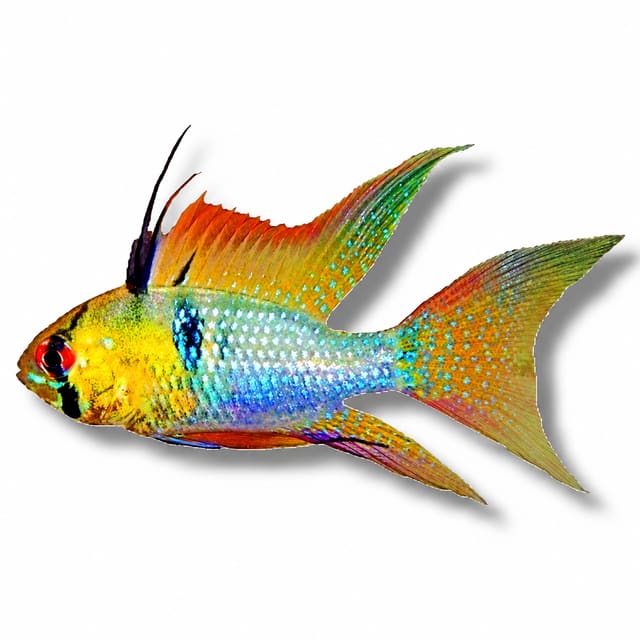
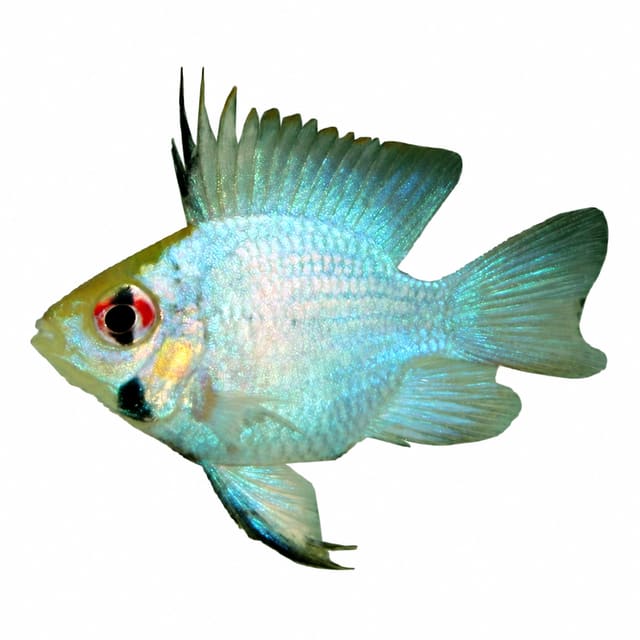
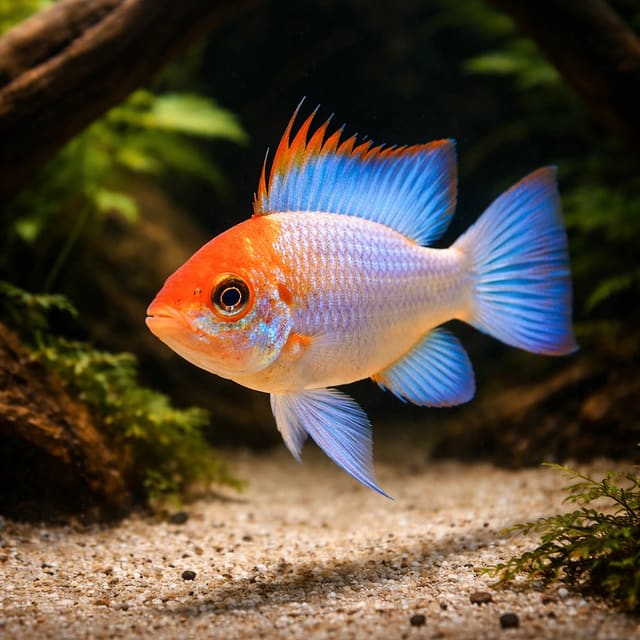
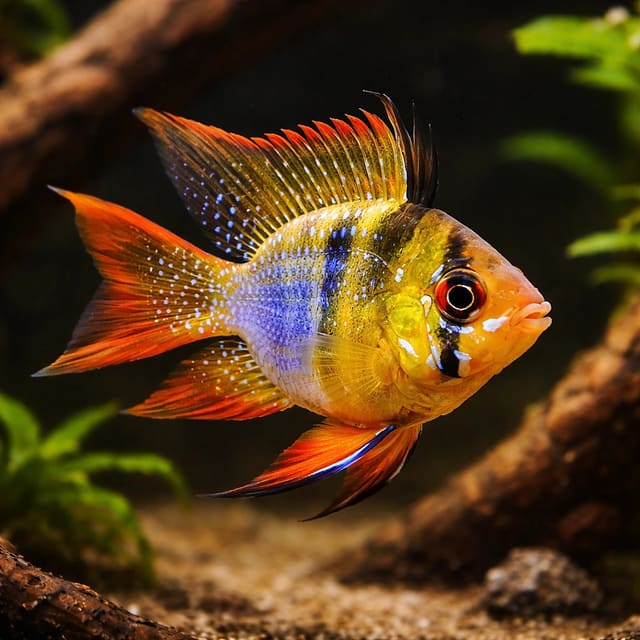
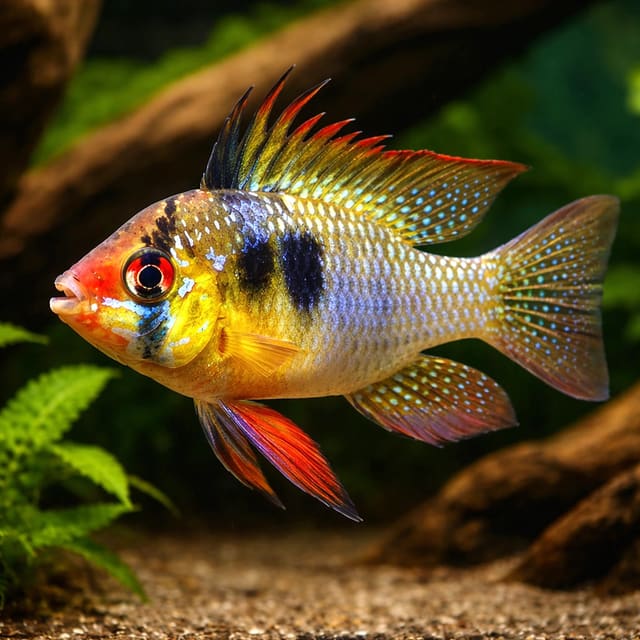
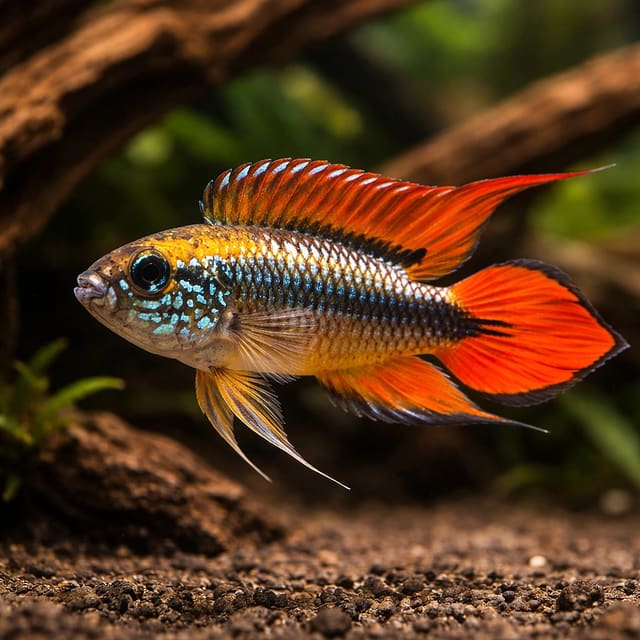
The inspected hero shows one dark blue-black cichlid with blue iridescent spotting in side view in a planted aquarium. It is useful as a visual guide to the form, not a choose-this-fish photograph. Natural colour, body markings and fin appearance vary with maturity, condition, mood and lighting. Make the purchase decision from the selected dispatch grade and husbandry fit rather than expecting every animal to duplicate the photograph pixel for pixel.
For most buyers the decisive question is whether the existing aquarium is already suitable. Confirm a mature filter, a steady 27–30°C reading, measured soft-water chemistry, fine sand, gentle flow and a community that leaves food for a small bottom-oriented cichlid. Those conditions are more important than moving from one size grade to the next. If they are absent, preparing the aquarium first is the responsible choice.
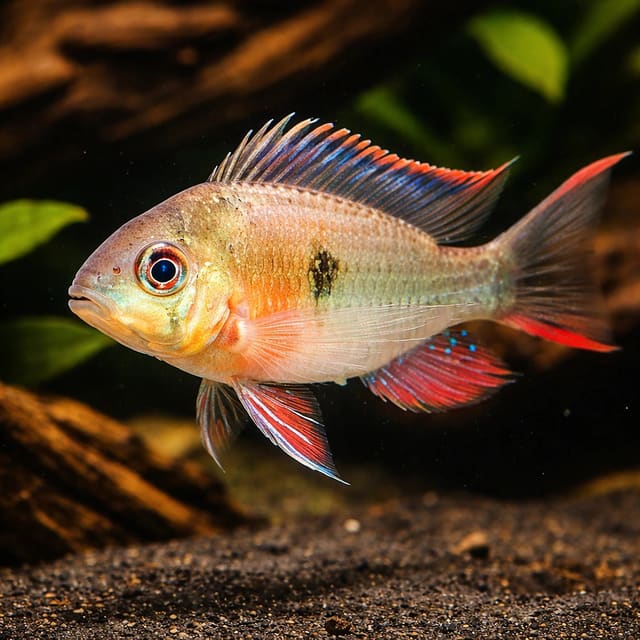
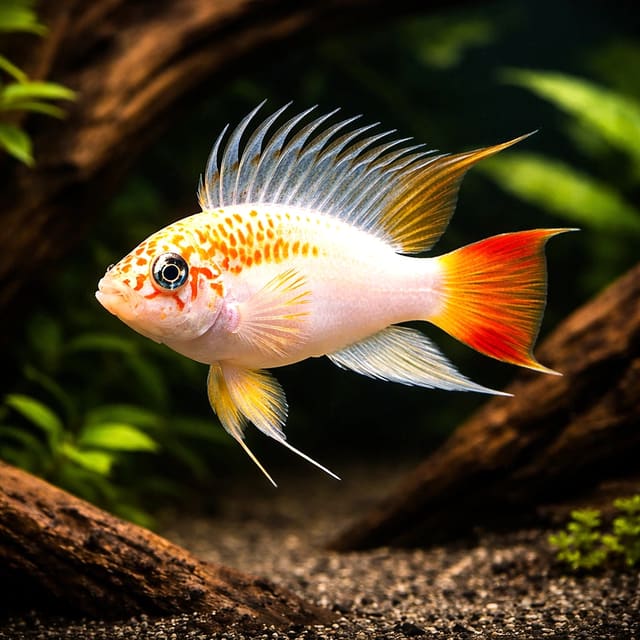
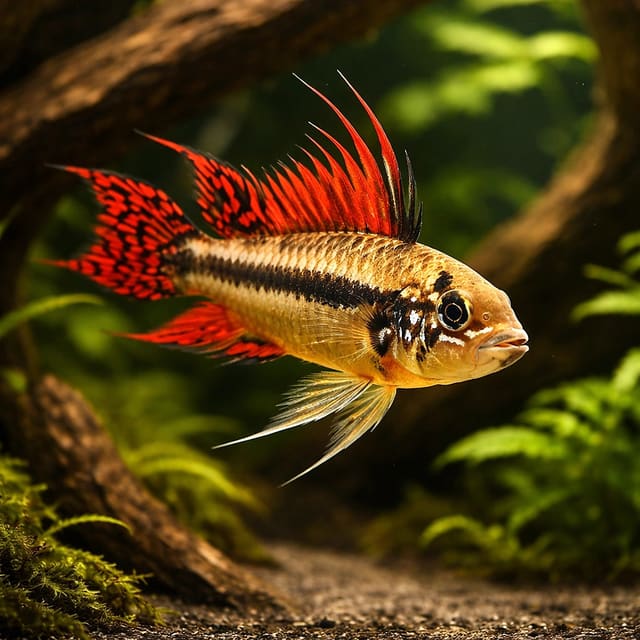
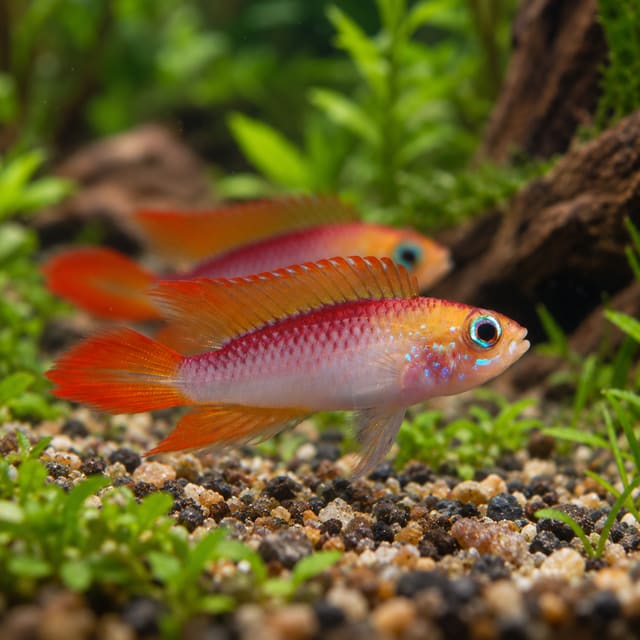
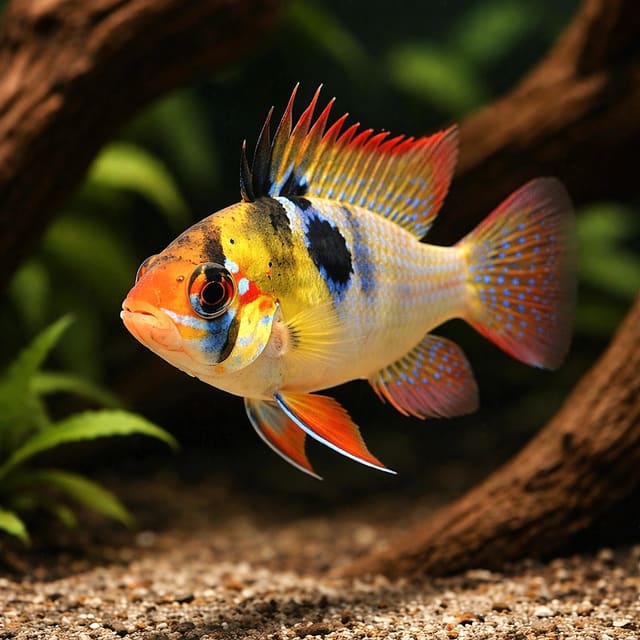
Sex is guaranteed only when the selected option explicitly states male or female. This Papiliochromis ramirezi black listing has no sex-guaranteed option. Adult traits described for the species do not establish the sex of a juvenile or ornamental individual, and the gallery is not used to select a specimen. Gallery images have been digitally enhanced to improve image quality. Natural colour, pattern, size and maturity can vary between live animals.
The dark body in the gallery shows why the form stands apart visually, but colour should be the last step in the decision. First confirm that the aquarium can hold 27–30°C, that pH and hardness can remain in range, that the filter is already mature and that the intended companions are peaceful, warm-water fish. Alternative ram forms can be compared in the related-products field, while broader options sit in the South American cichlid collection; neither is a compatibility recommendation.
The most important equipment for a Black Ram is not a decorative cave or premium light but a working biological filter. The RSPCA explains that beneficial bacteria convert toxic ammonia to nitrite and then nitrate. Seriously Fish specifically warns that M. ramirezi should never be added to a new or otherwise biologically immature aquarium. A tank can look clear while still lacking the bacterial capacity to process waste, so appearance is not a substitute for ammonia and nitrite tests.
If you are building the aquarium now, follow the first tropical aquarium guide, complete the cycle and confirm zero ammonia and zero nitrite before considering livestock. Add fish gradually. OATA's complete dwarf-cichlid introduction section warns that rapid stocking can outpace the filter bacteria and cause new tank syndrome. For a species described as susceptible when conditions deteriorate, that is a preventable risk.
Once established, keep a simple log of temperature, pH, ammonia, nitrite and nitrate. Include hardness when first assessing the tap supply and whenever the source or treatment method changes. Trends matter: a sequence of small shifts can reveal a heater, filter or maintenance problem before the fish shows severe signs. The water-chemistry guide explains the readings, while the water matcher can compare measured values with the stated range.
Seriously Fish gives a 60 × 30 cm base, about 54 litres, as sufficient for a single pair. FishBase likewise records a 60 cm minimum aquarium size for pair keeping. Treat the footprint as the key measurement. Rams use the lower part of the aquarium, sift substrate and defend a breeding territory, so extra height cannot replace floor area.
OATA's broad dwarf-cichlid sheet recommends at least 60 litres for a pair and at least 80 litres when mixing the group with other fish. These figures support a useful planning distinction: a species-only pair and a community do not ask the same thing of the floor. More room creates feeding stations, cover and escape routes. It also buffers temperature and water chemistry, although no volume excuses an immature filter.
One fish can be kept while the keeper plans any future companion, but a single purchase does not include a pair and buying two unsexed fish does not guarantee one. Juveniles are described as gregarious; as they mature, pairs form and each breeding pair can command a territory around two feet across. A group of young fish therefore needs a future separation plan, not just enough room for their current small bodies.
The specialist aquarium range is 27–30°C, pH 4.0–7.0 and hardness 1–10 dGH. FishBase records wild/environment values of 27–30°C, pH 5.0–6.0 and 5–12 dH. Together these describe a warm-water species associated with soft, often acidic conditions. The care card uses the aquarium profile's range because it is written for captive maintenance; the narrower FishBase figures remain natural-history context.
OATA's group sheet lists 22–27°C, pH 6.0–8.0 and 4–12 dGH for dwarf cichlids as a whole. Those numbers cover many different fishes and are not suitable as the primary target here. In particular, 22–26°C would be below the species-level aquarium range. Choose companions and plants that tolerate the Ram's 27–30°C requirement instead of cooling the aquarium to fit a generic community.
Do not chase a precise pH with repeated chemical corrections. If the source water can be kept stably within the species range, consistency is valuable. Very soft water has little buffering, so careless additions can move pH rapidly. Match new water thoughtfully and measure changes. The practical goal is stable warm, clean water, not an impressive-looking single reading.
Temperature affects oxygen and metabolism. Use an accurately sized heater, a separate thermometer and enough surface movement for gas exchange. At the same time, the species profile advises that flow should not be very strong. A broad return or spray bar can distribute heat and oxygen without creating a jet through the lower territory.
The five options describe dispatch grades: 2.5–3 cm, 3–3.5 cm, 3.5–4 cm, XL labelled 4–4.5 cm and XXL labelled 4.5–5 cm. They help the buyer choose the size being supplied. They are not five varieties, five ages or five promises about adult growth. The supplier packet does not say whether those commercial measurements use standard length, total length or another grading convention, so they cannot be compared directly with a scientific record without that qualification.
FishBase records 4.2 cm standard length and Seriously Fish gives 4 cm standard length. Standard length stops at the base of the tail and is therefore different from a measurement that includes the tail fin. This page keeps the scientific record and shop grades in their own scopes. It does not trim a valid XXL sales option merely because its label is numerically larger, and it does not use that label to invent a five-centimetre standard-length adult.
Choose among the offered grades for the aquarium and stocking plan in front of you, not in the hope that a larger animal will tolerate immature water or unsuitable companions. Every grade belongs to the same warm-water, soft-water species and needs the same mature biological filtration. A smaller fish still needs adult territory planning, while a larger dispatch grade still requires gentle introduction and protected feeding access.
A prepared first week has fewer moving parts. Complete routine maintenance before dispatch day, confirm that the heater and filter are operating normally, and leave the layout stable. After introduction, use the existing test routine and watch the fish at feeding time. The purpose is to learn its normal breathing, posture, appetite and shelter use, so a change can be noticed rather than guessed from a single moment.
Do not respond to normal caution by repeatedly moving décor, changing chemistry or adding several new tank mates. A Ram may need cover and time before feeding in the open. Offer suitable food where it can reach it, remove obvious waste, and use water tests to separate a husbandry problem from ordinary settling behaviour. If ammonia or nitrite appears, that is evidence of a filtration or stocking issue requiring prompt correction, not a reason to conceal the reading with extra food or cosmetic additives.
Keep a simple written baseline: dispatch grade, arrival date, temperature, pH, hardness, ammonia, nitrite, nitrate and the foods accepted. Record the aquarium's actual base dimensions as well as its advertised litres. This makes later decisions about a partner, open-water companions or a larger layout concrete. It also prevents the small body size from becoming the only stocking calculation.
Rams are benthophagous: they take mouthfuls of substrate, sift edible material and expel the remainder through the mouth and gill openings. Fine, clean sand supports that natural feeding action better than coarse sharp gravel. Keep the sand shallow enough to maintain and leave accessible patches where sinking food can be found.
The species profile allows practical artificial shelters such as ceramic flowerpots and pipe, or a natural arrangement of sand, wood roots, branches, shaded areas, caves and one or two flat rocks. Dried leaf litter can add natural structure and support microbial growth useful to fry, while tannins help simulate natural conditions. Leaf litter still needs observation; remove material if it accumulates foul debris or interferes with maintenance.
Plants can be used. The profile mentions Microsorum, Taxiphyllum, Cryptocoryne and Anubias as practical genera that can attach to décor, while noting they are not all native to South America. The welfare purpose is cover and shade, not a claim of geographic authenticity. Arrange plants and wood so the fish can withdraw without being trapped and so the keeper can still see feeding and condition.
In nature, Mikrogeophagus takes edible particles from substrate and browses surfaces as well as taking food from the water. In the aquarium, Seriously Fish recommends a variety of live and frozen foods such as bloodworm, Artemia, Daphnia and grindal worm, supplemented with good-quality small sinking dried foods. The key words are variety, small size and access at the bottom.
Fast tetras can clear the water column before a Ram eats. Deliver part of the ration near the fish and watch it feed. Use more than one feeding point in a community so a pair does not have to leave its territory to compete. A small sinking food should be small enough to swallow and should not disappear into inaccessible gaps in the hardscape.
OATA's group guide advises one daily feed limited to what dwarf cichlids finish within a few minutes. That is a reasonable broad starting routine, not a measured species law. Adjust portions to body condition, age, food type and the actual number of fish. Remove obvious excess. Uneaten food undermines the pristine water this species needs and can make a feeding problem look like a filtration problem.
Do not use heavy feeding to force colour or rapid growth. The Black form is selected for appearance, but a stable body condition, active foraging and steady appetite are better goals than maximal darkness. Colour intensity can vary with age, mood, light and background, and it is not proof of health or sex on its own.
Rotate foods instead of relying on a single rich frozen item. Live or frozen invertebrates can encourage natural feeding, while a suitable sinking prepared food provides a repeatable staple. Thaw and portion frozen food so the aquarium does not receive unnecessary liquid and excess fragments. Observe the fish swallowing food; pecking at sand or hovering near a feeding point does not by itself prove that enough was eaten.
Body condition should be assessed over time. A fish that remains interested in food but gradually becomes thin may be losing the competition, receiving pieces too large to swallow or living with social pressure. Solve access and compatibility before simply increasing the total ration. More food scattered through the aquarium can raise waste while the intended fish still misses its share.
Seriously Fish recommends regular 10–15% water changes and avoiding very large changes. OATA gives 25% at least weekly for dwarf cichlids as a broad group routine. For this species, begin with the species guidance, test the aquarium and adjust frequency if nitrate or waste accumulates. Small, careful changes suit a fish that values stability, but “small” must not become an excuse to let water quality deteriorate.
Condition replacement tap water to neutralise chlorine or chloramine and bring it close to the aquarium's temperature. Do not run filter media under the tap because chlorine or chloramine may kill beneficial bacteria; rinse it lightly in removed aquarium water when flow is reduced. Avoid replacing all media at once. Preserve the mature biology that makes the system safe.
Vacuum accessible debris without stripping every surface. Check the filter inlet, outlet and heater, and make sure the thermometer still agrees with the setting. In a warm aquarium, a failed heater or blocked filter can become urgent quickly. Keep a lid fitted around equipment and secure hardscape so maintenance cannot create a collapse.
Prepare before the parcel arrives: aquarium mature, temperature stable, tests satisfactory and no major aquascape work underway. Before opening the sealed parcel, start one continuous unboxing video showing the outer box, the opening and the fish still in the sealed bag. Retain it if a Live Arrival Guarantee claim is needed, inspect the animal on the day of arrival and contact Tropical Fish Co that day if something is wrong.
Float the sealed bag for 20–30 minutes as the current store instructions specify. Temperature matching is only the first part for a soft-water fish. OATA's full introduction method then says to add small amounts of aquarium water gradually for up to 20 minutes. This reduces the abruptness of differences in pH and hardness. Release the fish while introducing as little bag water to the aquarium as practical, then dispose of the remaining bag water.
Monitor closely during the first week, paying particular attention to water quality, breathing, appetite and whether established fish allow the newcomer to eat. Do not add further animals immediately. The current courier, receipt, unboxing and claim terms are on the delivery and Live Arrival Guarantee page; read that page before arrival because policy details can change separately from this care guide.
OATA lists clear eyes, undamaged fins and scales, normal swimming and steady breathing as reassuring signs. Watch for clamped fins, flicking, shaking, colour change, altered breathing, persistent hiding, abnormal swimming, weight loss or reduced feeding. These signs are not diagnoses. They are reasons to test water, inspect the social environment and seek qualified help when necessary.
The species profile notes susceptibility to a condition resembling head and lateral line erosion when conditions deteriorate. The useful response is prevention: mature filtration, clean water, stable warmth and an appropriate diet. This page does not turn that risk into a treatment recipe. Random medication without diagnosis can add stress and may affect the biological filter.
Social stress can look like illness. A poor competitor may become thin while water tests remain perfect, or a pair may prevent another fish from leaving cover. Observe actual feeding rather than assuming food added to the tank was eaten by everyone. Separation can be the correct welfare response when one fish cannot withdraw or feed.
Change one husbandry variable at a time where welfare permits, then observe and test. If nitrate is climbing, review stocking, feeding, detritus removal and water-change frequency rather than making an unexplained jump in pH or temperature. If flow is too forceful, redirect or diffuse the outlet while preserving surface movement and biological filtration. A measured correction is easier to evaluate than several simultaneous adjustments.
Replacement water should be prepared consistently. Match temperature, use the appropriate conditioner for the supply and do not run established filter media under the tap. Very soft source or prepared water deserves particular attention to stability because it has less buffering. The target is not chemically perfect water for one test; it is repeatably suitable water through ordinary weekly care.
If any item is missing, correct the aquarium before buying the fish. Waiting is safer than trying to repair biological maturity or compatibility after a sensitive Ram has arrived.
The specialist profile is unusually clear: M. ramirezi is often sold as a community fish, but it is not recommended for a general community because it requires pristine water and competes poorly. That does not mean it must live alone. It means the community must be designed around the Ram's warmth, water quality and quiet feeding rather than expecting the fish to adapt to whatever is already present.
Groups of peaceful, open-water characids or similar fishes are specifically recommended. Their movement can help a shy Ram feel that the area is safe, provided they are not such forceful feeders that the cichlid goes hungry. Every candidate must tolerate 27–30°C and the same soft-water range. Research the exact species, not just the family name.
Avoid territorial or aggressive fishes, including most other cichlids, and avoid species that require harder water. A hard-water livebearer community cannot be made ideal for a soft-water Ram simply by choosing a compromise pH. Likewise, a large aggressive fish can stress a Ram without ever biting it by controlling food and space.
Very active bottom dwellers may repeatedly enter the pair's territory, while boisterous midwater fish may take every meal. Slow, delicate fish can also be poor partners if the Ram begins defending a spawning surface. Compatibility must account for space use and feeding as well as overt aggression.
Juveniles are gregarious, but adults form pairs. Each breeding pair can command a territory around two feet across. If starting with young fish, use enough floor area and cover to let pairs become visible, then separate them rather than waiting for prolonged conflict. This listing does not guarantee sex, so no purchase quantity promises a pair.
The species is a biparental substrate spawner. Both parents care for the brood, and the profile recommends a dedicated setup if breeding is the goal. In a community, tank mates can disturb the site or prey on eggs and fry, while the pair's defence can stress other fish. A separate breeding aquarium is safer than expecting a modest community to absorb every stage.
Two species can occupy the same aquarium without visible fighting while one slowly loses condition. Watch the Black Ram take food at several meals. If it hangs back while quicker fish clear the ration, change the delivery method or the community. Sinking food placed near cover can help, but it does not fix a fundamentally overactive or overstocked tank.
Check companions at different times of day. A fish that appears calm under bright light may become territorial at feeding or around a spawning site. Repeated chasing, a resident held at the surface, missed meals, torn fins or rapid breathing after pursuit are signs that the arrangement needs intervention.
Begin with temperature. A companion that merely survives brief warmth is not a good choice for a permanent 27–30°C aquarium. Then compare pH and hardness, adult size, activity and feeding position. A peaceful label cannot compensate for a cooler temperature requirement or a hard-water preference. The overlap needs to be suitable for every resident through ordinary long-term care.
Next map where each fish lives. Open-water companions that remain above the pair's territory are closer to the species profile's recommendation than another cichlid competing for the same floor. Even then, leave clear routes between cover and open water. A resident should not have to cross a defended spawning surface to reach food or shelter.
Finally run a feeding test. Place an appropriate sinking portion where the Ram can take it and watch the result. If upper-water fish seize every piece, change the feeding method or stocking plan before weight is lost. If several residents repeatedly crowd the same lower station, extra food alone may increase waste without solving access. Compatibility is successful only when the fish can eat and withdraw as well as avoid injury.
Use all six questions. A product label such as community fish or peaceful fish is not enough. The best arrangement is one in which the Ram can feed, withdraw and form normal social behaviour without forcing every other resident into unsuitable water.
FishBase records Mikrogeophagus ramirezi at 4.2 cm standard length and the specialist aquarium profile lists 4 cm standard length. The shop's larger dispatch labels are sale grades, not a new biological adult-size claim.
The species profile gives a 60 × 30 cm base, about 54 litres, as sufficient for a single pair. Choose more floor area for companions or multiple territories; OATA's broader dwarf-cichlid guide uses at least 80 litres when mixing the group with other fish.
Adult Mikrogeophagus ramirezi forms pairs and each breeding pair defends a territory. This listing supplies one unsexed fish per purchase, not a bonded pair; juveniles may be sociable, but a group needs enough space and a plan to separate pairs as they form.
Its small size is approachable, but the requirement for a mature aquarium, very clean warm water and gentle competition makes this an intermediate store choice. It suits a careful keeper who already tests water and can maintain stable conditions better than a rushed first aquarium.
Offer varied live and frozen foods such as bloodworm, Artemia, Daphnia or grindal worm, supported by good small sinking dried foods. Rams naturally sift substrate for edible particles, so use fine sand and make sure food reaches them without faster fish taking it first.
Use the species aquarium range of 27–30°C, pH 4.0–7.0 and 1–10 dGH. Keep ammonia and nitrite at zero and avoid sudden changes; the cooler 22–27°C figures in the OATA dwarf-cichlid sheet are broad group guidance, not the target for this warm-water species.
Rams are not robust bullies, but mature pairs defend a breeding territory. The greater risk in an ordinary community is often that this fish loses food or is stressed by boisterous companions, so avoid territorial or aggressive species and watch feeding closely.
The species profile recommends peaceful open-water characids or similar fish that tolerate 27–30°C and the same soft-water range. Avoid most other cichlids, hard-water species and forceful feeders; every companion still needs individual checking for adult size and behaviour.
Tropical Fish Co hand-bags live fish in oxygen, uses an insulated poly box and a heat pack when conditions call for one, and sends them with a licensed live-animal courier. Be present, film one continuous unboxing before opening, inspect the fish in the sealed bag, then follow the current arrival and claim instructions.
FishBase: Mikrogeophagus ramirezi supports the accepted name, the synonym bridge from Papiliochromis ramirezi, native range, wild environment, pair keeping and recorded standard length.
Seriously Fish: Ram supports the aquarium footprint, mature-tank warning, décor, routine water range, feeding, compatibility and adult pair behaviour.
OATA: dwarf cichlid care is used only as broad group guidance for testing, introduction and maintenance. RSPCA fish environment guidance supports mature biological filtration.
No reviews for this item yet. Bought one? Honest reviews only, good or bad.
What customers say about ordering from us
Easy website plenty of info on fish your buying great to pick a time slot
TRACEY DURRANT · 7 Oct 2026
Got some lovely fish thank you
Kevin Mackie · 7 Oct 2026
Reviews of our shop, collected by Judge.me, an independent third-party review collector. Newest first.