Moderate
Assorted Ram Cichlid (Mikrogeophagus ramirezi)
27–30°C · pH 5.5–7 · 60L
From £5.94Some sizes on sale

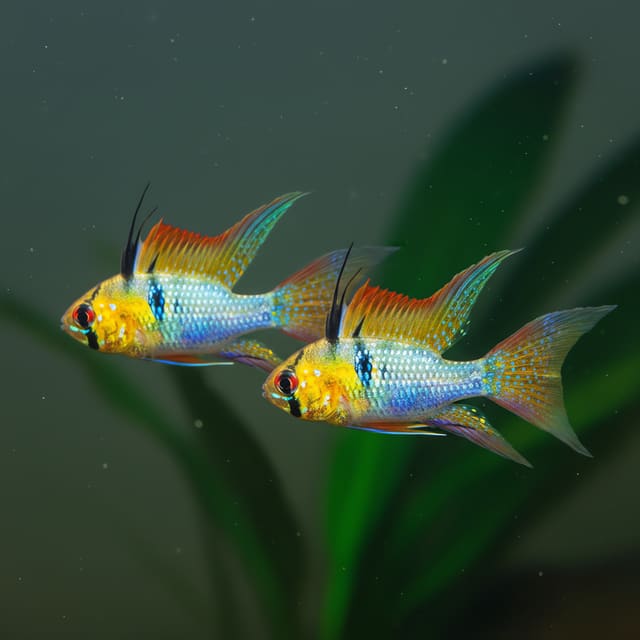
Two gold rams (Mikrogeophagus ramirezi), the yellow-gold bred form of the ram cichlid, packed together at 3–3.5 cm. Supplied as two fish, not a guaranteed male-female pair. Adults reach about 4 cm standard length and need a mature, soft-water tank of at least 60 cm kept at 27–30 °C.
Adult size is the maximum length this species reaches at full maturity (scientific sources). The livestock you receive will be younger and smaller. Product-photo provenance and any image-specific limitations are stated on the listing.
Mikrogeophagus ramirezi
Two gold rams (Mikrogeophagus ramirezi), the yellow-gold bred form of the ram cichlid, packed together at 3–3.5 cm. Supplied as two fish, not a guaranteed male-female pair. Adults reach about 4 cm standard length and need a mature, soft-water tank of at least 60 cm kept at 27–30 °C.
Adult size is the maximum length this species reaches at full maturity (scientific sources). The livestock you receive will be younger and smaller. Product-photo provenance and any image-specific limitations are stated on the listing.

Cichlids are a family of roughly 1,800 accepted species, not one care type. Before buying, identify the exact species and source, then compare adult measurement, usable tank dimensions, social system, territory, tested water, diet and an exit plan. No family-wide minimum tank, water range or tank-mate list is safe.
Maintain these water conditions for optimal health and vibrant colors
Order this listing and two gold rams come to you in the same parcel, each one 3–3.5 cm long when we pack it. That measurement describes the fish on the day it leaves us; it is not the size it will reach. They are sold as two fish, not as a guaranteed male-female pair. We put that up front because rams are pair-forming cichlids, and the sexes of your two fish decide how they will share a tank. There is a full section on that further down this page.
A gold ram is a colour form of the ram cichlid, Mikrogeophagus ramirezi, not a species of its own. Wikipedia groups gold and electric blue rams together as xanthic morphs, the term for forms in which yellow pigment dominates, and Seriously Fish lists gold among the ornamental strains produced for the hobby, alongside long-finned, electric blue, pearl and balloon fish. Everything the scientific sources say about the species applies to a gold ram: the warmth, the soft water, the pairing behaviour and the need for a mature, very clean aquarium.
The ram was first described in 1948 by Myers and Harry as Apistogramma ramirezi, and Wikipedia credits the species name to Manuel Ramirez, one of the first people to collect and import it for aquarists. It has since passed through several genera. Older books and labels use Papiliochromis ramirezi or Microgeophagus ramirezi, and our own stock records still list this fish as Papiliochromis ramirezi 'gold'. FishBase treats Mikrogeophagus ramirezi as the accepted name, and Seriously Fish notes that Mikrogeophagus is now generally accepted as correct. So if you have been searching for gold Apistogramma rams, this is the fish, but it is no longer placed in Apistogramma.
If you would rather have a mix of colours, the 2 × Assorted Ram Cichlids pack is the same species in assorted forms, and there is also an Assorted Ram Cichlid listing.
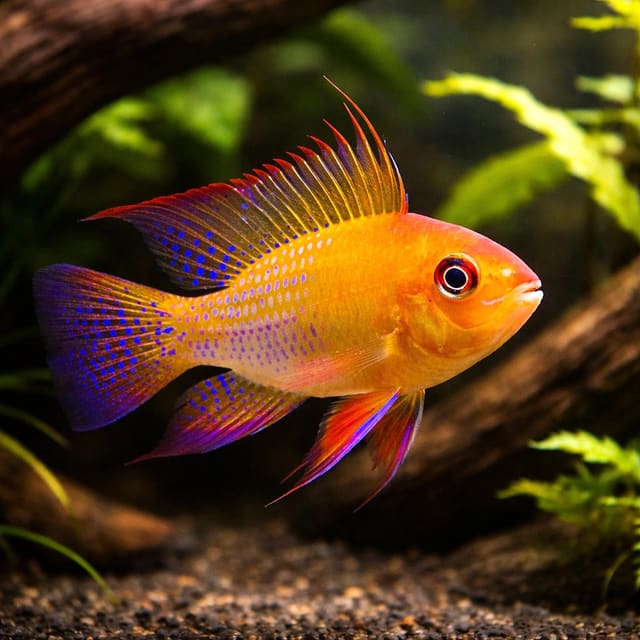
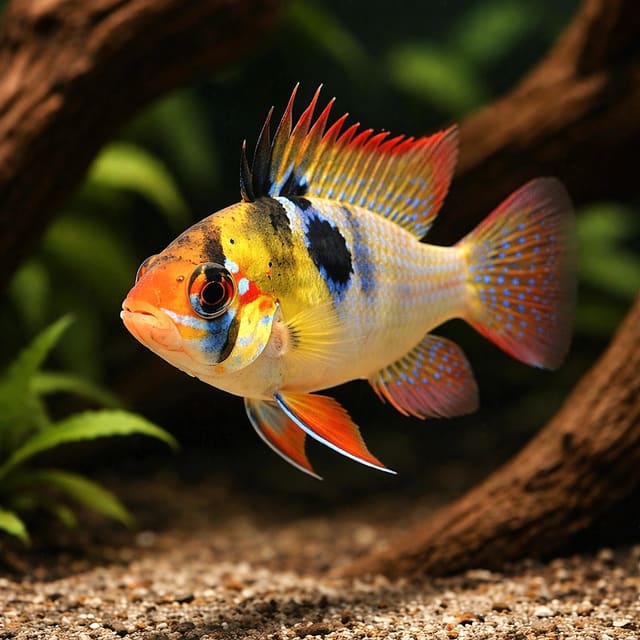
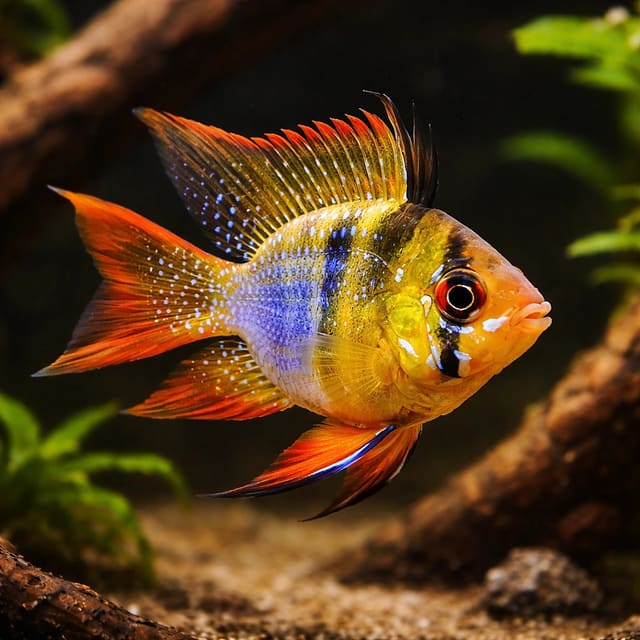
The gold ram pictured on this page shows the features that set this form apart. Its body is a warm yellow-gold that deepens towards orange across the head and face, and the eye is ringed in orange-red around a dark centre. Small violet-blue spots are scattered along the rear half of the flank and repeat in rows over the dorsal fin, the anal fin and the tail. The fins themselves are pale and washed with yellow. The front rays of the dorsal fin are drawn out into long, fine points well above the rest of the fin. Just as striking is what is missing: the dark spot below the dorsal fin that Wikipedia describes in the species is not visible on this fish.
Gold, like electric blue, is a bred form, and individual fish may not match the one pictured exactly. Seriously Fish also notes that farmed rams are generally raised on dried foods high in carotenoid pigments, which are used to intensify colour, so the depth of gold you see can reflect diet as well as breeding.
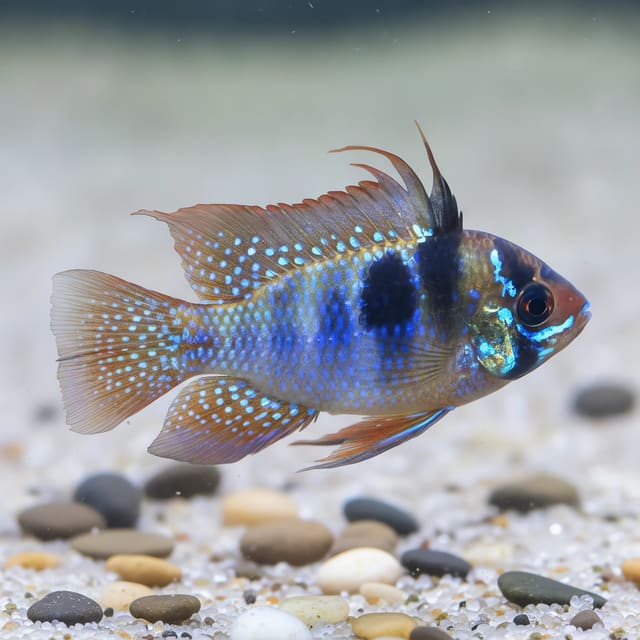
Rams are tiny by cichlid standards. FishBase records a maximum standard length of 4.2 cm for males and unsexed fish; Seriously Fish gives 40 mm, again as standard length; and Wikipedia puts adult males at 34–40 mm, with females a little smaller. Standard length stops at the base of the tail and leaves the tail fin out, so an adult measured from snout to tail tip comes out longer than those numbers.
Your two fish arrive at 3–3.5 cm. Because dispatch sizes and standard length are different measurements, it is hard to say exactly how much growing each fish has left, but you are buying young rams with some filling out still to do, not finished adults. That has an upside: you see them colour up and, if you are lucky with the sexes, start to pair.
Sexing any ram is easier once the fish are adult, and gold rams remove one of the most useful clues. Here is what the sources describe, and how each cue holds up in the gold form:
| Cue | What the source says | In gold rams |
|---|---|---|
| Size and fins | Seriously Fish: adult males grow larger, carry slightly longer fins and are more intensely coloured. | Still useful in adults, once both fish have grown. |
| Long front dorsal rays | Wikipedia: typical of males, but selective breeding has given some females the same extension. | Suggestive at best; the fish pictured has them. |
| Pink belly | Seriously Fish: most females show a pinkish belly patch, but this may not hold in some ornamental strains. Wikipedia notes a pink or red blush as a female nears spawning. | Worth watching for, but not guaranteed in a bred form. |
| Blue scales in the black spot | Wikipedia: females often show a blue sheen or a few blue scales in the upper half of the dark spot below the dorsal fin; males lack this. | Of little help if your fish, like the one pictured, show no clear dark spot. |
The honest summary is that two 3–3.5 cm gold rams cannot be reliably sexed by eye, which is exactly why this pack is not sold as a pair.
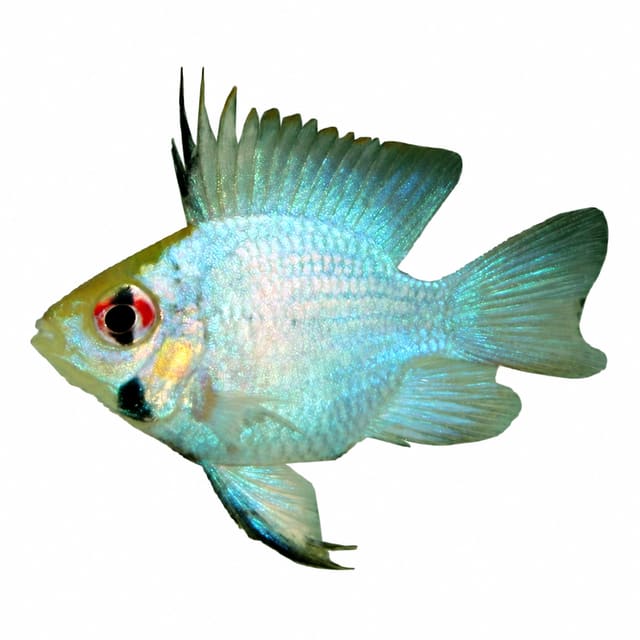
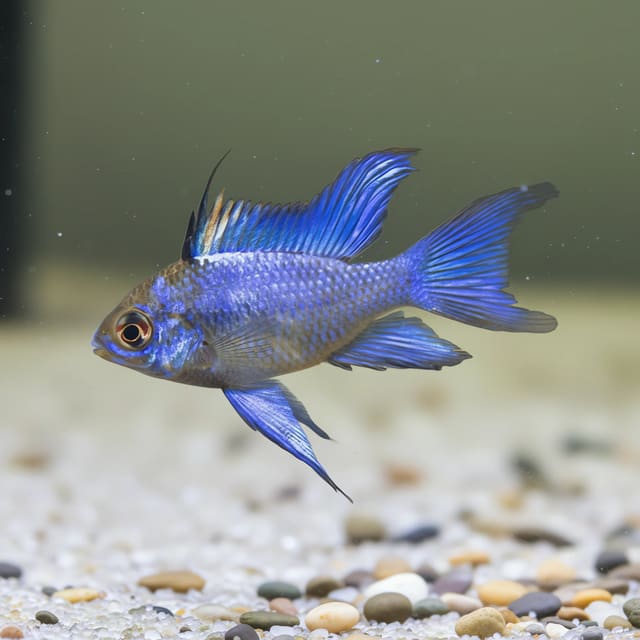
If you like the species but want a different colour, the Electric Blue Ram is the other xanthic form Wikipedia mentions, and the 2 × Longfin Ram Cichlids pack offers two fish with extended finnage. All of them share the gold ram's water needs and the same rule that males do not get on with other males.
Yes. Keeping rams in twos is exactly what FishBase recommends, and a settled pair is the best way to see the species at its most interesting. The catch is that "two rams" and "a pair of rams" are not the same thing, and with an unsexed pack you need to understand the difference before the fish arrive.
Seriously Fish describes young rams as gregarious. As they reach maturity they start to form pairs, and a pair that is breeding will defend a patch of tank roughly two feet across. Wikipedia adds that the species forms monogamous pairs before spawning and that males do not tolerate other males. Put those facts together and you can predict the possible outcomes for a pack of two.
The safe approach is to set up for the awkward case and enjoy it if you get the good one. Give the two fish more room than the bare minimum, break up sight lines with wood and planting so one fish can get out of the other's view, and keep a spare tank or a plan for rehoming if one is clearly being bullied. Watch them most closely as they mature, since that is when Seriously Fish says pairing behaviour begins.
For most keepers the answer is two: one pair to a tank of at least 60 cm, with a shoal of small peaceful fish for company. A single ram can live perfectly well with suitable companions, though it will never show pair behaviour. More than two rams calls for a longer tank with clear, separate territories, because each pair that forms will want its own two-foot patch. Simply adding more rams to a 60 cm tank does not give them more company; it gives them more to fight over.
Gold rams are bred in captivity, but their needs were set long ago in the wild. FishBase gives the species' range as the Orinoco River basin, in the llanos of Venezuela and Colombia, and Wikipedia describes it as endemic there. Seriously Fish mentions one specimen reportedly taken from the rio Purus in Brazil, but the Orinoco llanos are the ram's home.
Seriously Fish paints the llanos as tropical savannah: grassland, forest and plains that flood each year, close to 600,000 square kilometres in all, with a sharp wet and dry season and heat all year. Wikipedia describes the ram's water there as warm at 25.5–29.5 °C, acidic at pH 5.2–6.7, slow-moving and low in dissolved minerals, sometimes clear and sometimes stained dark with tannins, with plants providing cover. FishBase classes the fish as benthopelagic: it lives on and just above the bottom.
Of all the points in this guide, this is the one that matters most. Seriously Fish states that rams need pristine water and must never be placed in a new or biologically immature aquarium. It also suggests regular water changes of 10–15% in preference to occasional large ones, so the chemistry stays steady. When water quality slips, the same source warns that rams become prone to a condition resembling head and lateral line erosion, better known as hole-in-the-head in other species.
A routine that suits a pair of gold rams:
Hard tap water is the usual stumbling block. Blending it with reverse osmosis water to a fixed ratio, and using that same blend for every change, gives you soft water that stays consistent from week to week. Sort this out, and test it, before the rams are ordered.
FishBase gives 60 cm as the minimum aquarium for the species, kept in pairs. Seriously Fish is more specific: a footprint of 60 × 30 cm, about 54 litres, will house a single pair. That makes 60 cm the starting point for this two-fish pack, and a longer tank a sensible upgrade if there is any chance your two turn out to be males.
| Feature | What to use | Why rams need it |
|---|---|---|
| Substrate | Soft, fine sand | Rams feed by taking in mouthfuls of the bottom and sifting them; Seriously Fish recommends soft sand. |
| Plants | Java fern (Microsorum), mosses such as Taxiphyllum, Anubias and Cryptocoryne | Seriously Fish suggests these because they can be grown attached to the décor, out of the way of sand-sifting fish. |
| Cover | Wood roots and branches, ceramic pots, short lengths of pipe | Seriously Fish recommends plenty of shade and cave-like spots. |
| Spawning surfaces | One or two flat stones | Suggested by Seriously Fish as potential spawning sites; Wikipedia records eggs laid on flattened stones. |
| Leaf litter | A scatter of dried leaves | Seriously Fish says it supports beneficial microbes and gives fry a secondary food source. |
| Filtration | Gentle flow | Seriously Fish advises against strong filtration or water movement. |
| Heating | Thermostatic heater plus a separate thermometer | To hold 27–30 °C steadily, day and night. |
Because you cannot know in advance whether your two gold rams will pair, design the layout so it works either way. Put wood and planting in two or three separate clumps rather than one central heap, so the tank divides into zones and a fish chased out of one area can disappear into another. Leave open sand between the clumps for feeding and display. Set a flat stone near each clump. If the fish do pair, they will pick one; if they are two males, each has somewhere to stake a claim without living nose to nose.
Light-coloured sand shows off gold fish nicely, and the shade from wood and leaves gives them somewhere to retreat when they want to. Tannins from wood and leaves will tint the water, which is normal for the species in the wild.
Run the tank, with its filter and heater working, until it is fully mature and your water tests are steady before you order. A ram added to a tank that is still settling is going against the clearest advice in every source we used.
Seriously Fish does not recommend rams for a general community aquarium, for two reasons: they need pristine water and they are poor competitors. That rules out a busy mixed tank, but it does not mean a gold ram should live alone. The right companions actually help.
"Dither fish" are calm, visible fish that swim in the open and signal to a shy species that it is safe to come out. Seriously Fish makes the same point for rams: groups of peaceful, open-water characins are particularly recommended, because the presence of small shoaling fish appears to be taken as a sign that there is no immediate threat. A relaxed shoal overhead can therefore help a ram feel safe enough to stay in view.
Keep it simple: your two gold rams on the bottom, and one modest shoal of a suitable small characin in the middle of the water. Resist adding a third or fourth species. Every extra fish is more waste for a tank that has to stay spotless, and more competition at feeding time for two small cichlids that do not push to the front.
Seriously Fish describes the ram as benthophagous, a bottom feeder by nature. It scoops up mouthfuls of substrate, sorts out what it can eat, and pushes the rest out through its mouth and gills. It will also pick at solid surfaces and take food straight from the water. Feeding a pair of gold rams well means making sure food actually reaches the sand where they look for it.
The foods Seriously Fish lists are bloodworm, Artemia (brine shrimp), Daphnia and grindal worm, live or frozen, backed up by good sinking dried foods. It also mentions gelatine-bound home-made foods mixing dried fish food with puréed shellfish, fruit and vegetables. A straightforward rotation might look like this:
| Food | How often | Notes |
|---|---|---|
| Sinking micro-pellets or granules | Most days | The everyday base; choose a size small enough for 3–4 cm fish. |
| Frozen bloodworm | A couple of times a week | Thaw first and feed only what disappears quickly. |
| Frozen or live brine shrimp | A couple of times a week | Good variety alongside bloodworm. |
| Daphnia | Weekly | Live or frozen. |
| Grindal worm | When available | Feed live whenever you have a culture going. |
Seriously Fish calls rams poor competitors. With quick tetras sharing the tank, much of what you drop in can vanish in mid-water. Drop sinking food where the rams usually forage, wait until it settles, and check that both gold rams are eating rather than one fish taking it all. If one is pushed off, feeding at two points at once usually spreads the fish out.
Give what is cleared in a couple of minutes and no more. Leftovers rot in the sand and push up ammonia and nitrate in a tank that has to stay pristine. Lean feeding does a ram far less harm than polluted water.
Because farmed rams are commonly raised on high-protein dried foods rich in carotenoid pigments, as Seriously Fish notes, a good sinking food is the obvious thing to offer first when your fish arrive. Over the following weeks, bring in the frozen and live foods above to give them the varied diet the species takes.
Rams have a name for being delicate, and with bred forms in particular the sources agree there is some truth in it. Knowing why helps you keep your gold rams well.
Seriously Fish says the artificially reared forms of the ram, gold among them, tend to be genetically weak, more prone to disease, shorter-lived and less vigorous breeders than wild fish, and that hormones may be used to raise production. Wikipedia makes a similar point: many of the cultivated varieties show lower fertility, health problems or weaker brood care than wild-type rams. Wild-caught fish are described by Seriously Fish as genetically superior but more demanding, and arguably best left to experienced keepers.
None of this means a gold ram is a poor buy. It means a gold ram has less margin for error, so it pays to get the basics right from day one.
Seriously Fish links falling water quality to a condition in rams like head and lateral line erosion, where pits form on the head and along the flanks. If you see pitting appear, look at your water and maintenance before anything else.
If you already have fish, settling the two gold rams in a quarantine tank first protects your main aquarium and gives the newcomers a quiet start. Seed its filter with mature media, match its temperature and water chemistry to the main tank, and give the rams somewhere to hide.
These are general signs of trouble in any aquarium fish. If you see them, test the water first:
We could not find a lifespan figure for the species in FishBase, Seriously Fish or Wikipedia, so we will not invent one. What Seriously Fish does say is that artificially reared forms show shortened life-spans compared with wild fish. The steady, clean, warm, soft conditions described above are the best thing you can give a gold ram for a long life.
If your two fish turn out to be a male and a female and they bond, you may see them breed. Seriously Fish calls the ram a biparental substrate spawner in which both sexes share brood care equally, and Wikipedia also describes both parents tending the eggs and defending the territory. FishBase, by contrast, says the female cares for the eggs and larvae. Two of our three sources describe shared care, and that is the pattern this guide follows.
Seriously Fish suggests starting with microworm, infusoria and other microscopic foods for the first two or three days of free swimming, then moving on to newly hatched Artemia nauplii. Leaf litter in the tank helps, because the microbial life it supports gives the fry something extra to graze.
If you get a spawn, keep the water stable, the tank quiet and the other fish few, and be patient. A pair that fails the first time may well succeed the next.
Please read our delivery and live-arrival information before ordering. Two small cichlids are relying on you to have everything in place before the courier knocks.
The rams travel in oxygen-filled bags inside insulated packaging, with heat packs added when the conditions call for them, carried by a tracked courier licensed for live animals. You will receive the confirmed delivery date and tracking by email.
Before you cut the tape, start recording one continuous video, and keep the camera rolling as you open the box and show both fish while the bags are still sealed. Should either fish arrive dead, dying or clearly in poor condition, email hello@tropicalfishco.co.uk on the day of delivery, quoting your order number and attaching that video. Photographs on their own do not satisfy the policy. Accepted claims are settled by a replacement with your next order or a refund for the affected fish, under the terms of the guarantee.
Keep the lighting low for the remainder of the first day. The two gold rams may tuck themselves into the cover for a while; that is what the wood and plants are for. Once they are moving around, offer a small pinch of sinking food and take out whatever is left.
Check breathing, appetite and behaviour every day through the first week. Good signs are fish sifting the sand, feeding readily and swimming with fins spread. Because the pack is not sexed, pay particular attention to how the two rams treat each other: occasional sparring is one thing, but if one fish is being chased constantly and kept from food, separate them. Hold off adding any other fish until both rams are clearly settled, and keep up your small weekly water changes from the start.
The species facts on this page come from the three references below. Each is worth reading in full if you want more detail on rams.
No reviews for this item yet. Bought one? Honest reviews only, good or bad.
What customers say about ordering from us
I have a small group of long finned mountain minnows. So was delighted to be able to order ten of this variety to increase the genetics in my tank . The ones I recieved are healthy but it’s to early to give a verdict on wether they are of a long finned type since they are small currently.
Gordon Walker · 23 Sept 2026
100% success travel and "installation". Pleased with quality of purchase. The Siamese fighter a bit "shy" so have not yet seen him at his best yet but looking good. Happy customer. GG
George E Garratt · 21 Sept 2026
Reviews of our shop, collected by Judge.me, an independent third-party review collector. Newest first.