Advanced
Rubricatochromis exsul
£12.99

One live Albino Red Kribensis (Pelvicachromis pulcher) in the selected size. This West African dwarf cichlid needs mature freshwater housing, cave choices and a plan for territorial pair behaviour.
Pelvicachromis pulcher
Save when buying multiple fish. Each quantity is one fish; sex and pair formation are not guaranteed unless the selected variant explicitly states them.
One live Albino Red Kribensis (Pelvicachromis pulcher) in the selected size. This West African dwarf cichlid needs mature freshwater housing, cave choices and a plan for territorial pair behaviour.

Cichlids are a family of roughly 1,800 accepted species, not one care type. Before buying, identify the exact species and source, then compare adult measurement, usable tank dimensions, social system, territory, tested water, diet and an exit plan. No family-wide minimum tank, water range or tank-mate list is safe.
Maintain these water conditions for optimal health and vibrant colors
Albino Red Kribensis (Pelvicachromis pulcher) is the albino red trade form of a West African dwarf cichlid, with the cave-centred habits that make Kribensis so interesting to keep. It is a fish for an established aquarium with cover, clear feeding access and room for territories. A settled animal can be absorbing to watch as it explores the lower aquarium, but its manageable size should not disguise the change in behaviour that can come with breeding.
Each purchase quantity supplies one live fish in the selected size. The two size grades are approximately 4–5 cm and 6–7 cm. The size you select is the size supplied, not the adult size. Choose the grade that fits the existing residents and the aquarium you have prepared, and use the live selector for the purchase choice.
Sex is guaranteed only when the selected option explicitly states male or female. This Albino Red Kribensis listing has no sex-guaranteed option. Ordering two fish does not create a bonded pair. Pair formation and social compatibility are biological matters, so anyone planning to keep more than one needs suitable space and a practical separation plan.
The scientific name is Pelvicachromis pulcher, in the family Cichlidae. Albino Red describes the traded form rather than a separate species. The species is native to eastern Benin, southern Nigeria and western Cameroon. This geographical background describes the wild distribution; it does not identify the birthplace or breeding history of the individual fish supplied.
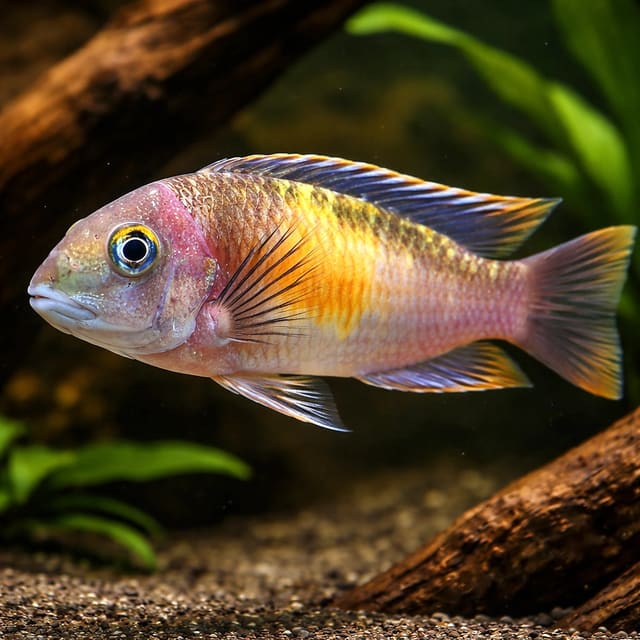
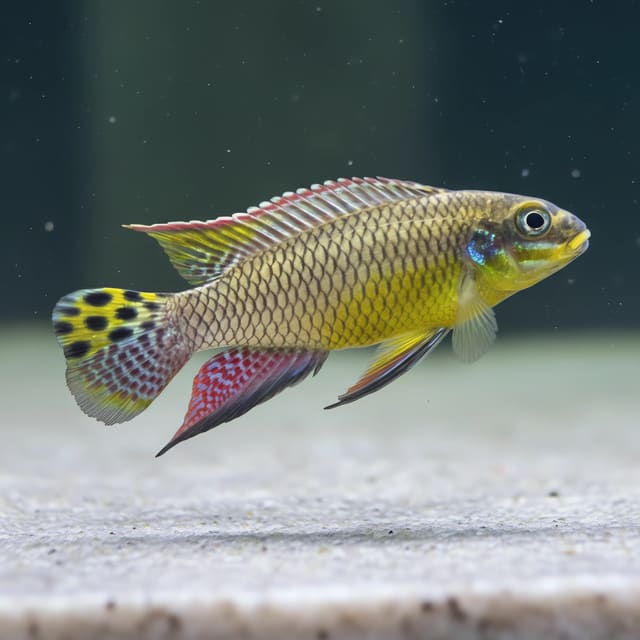
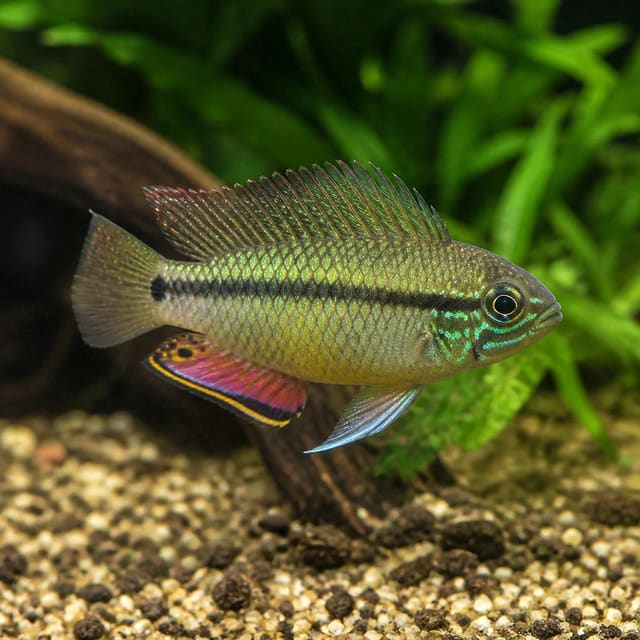
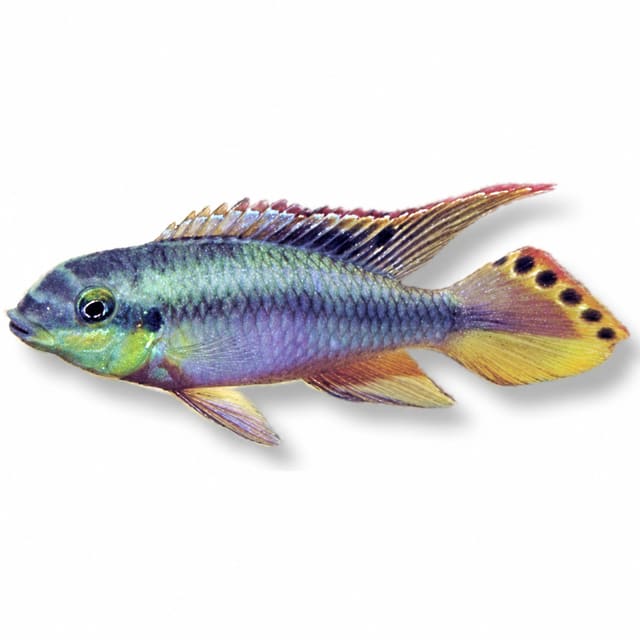
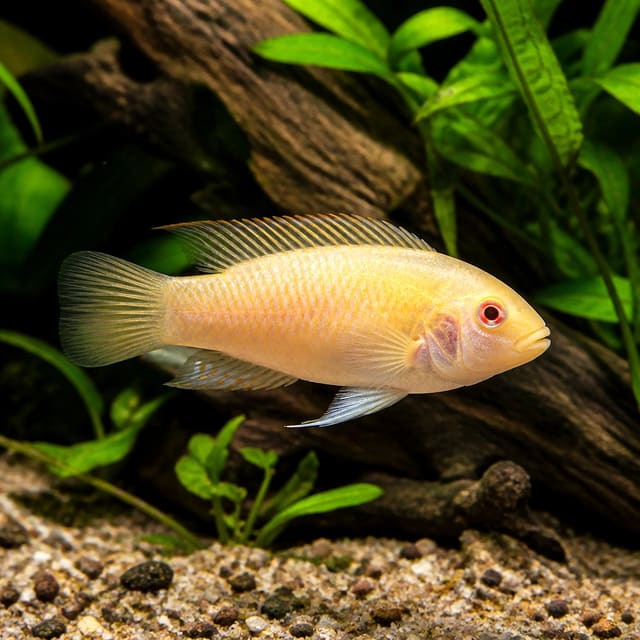
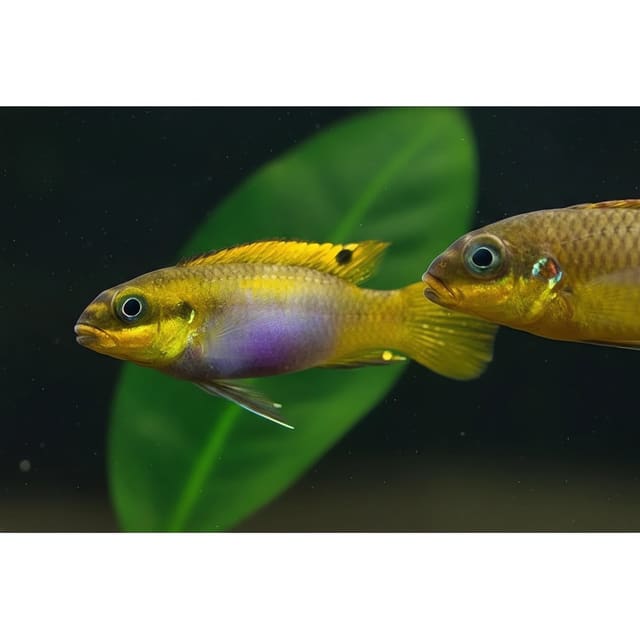
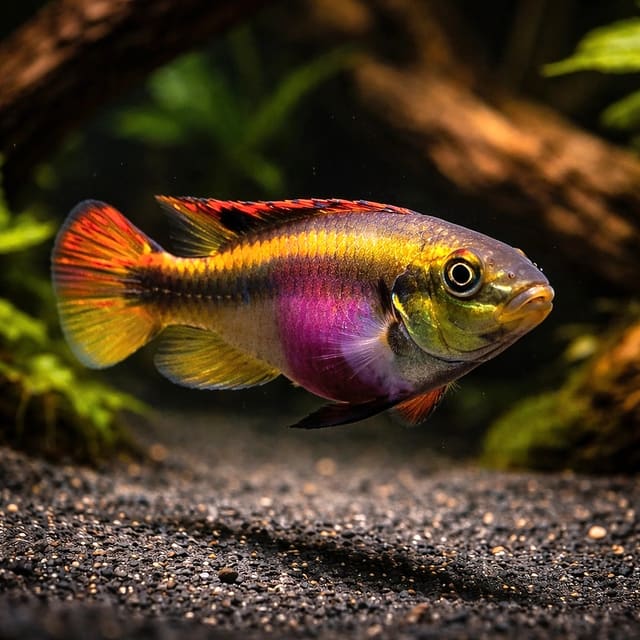
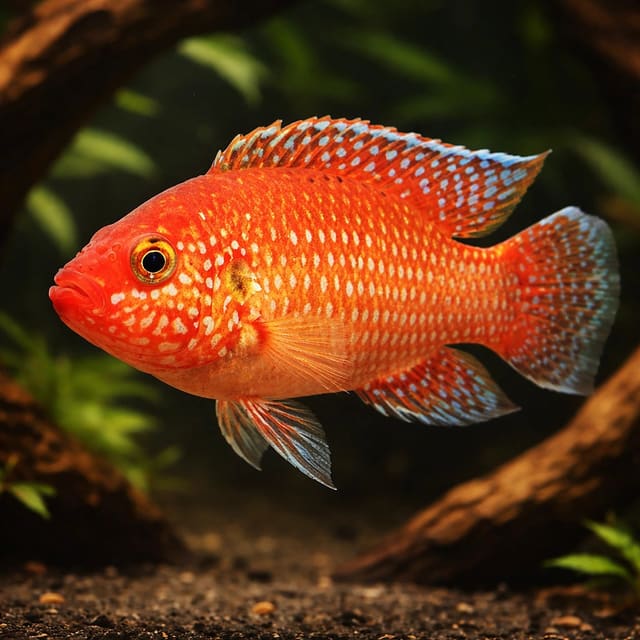
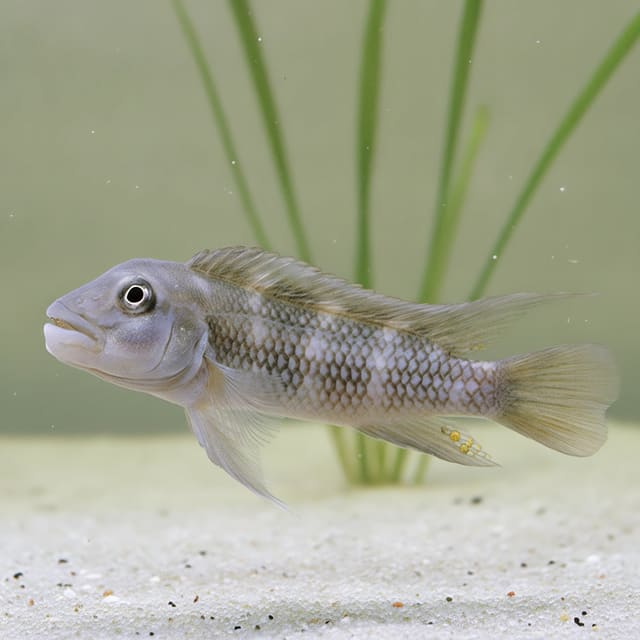
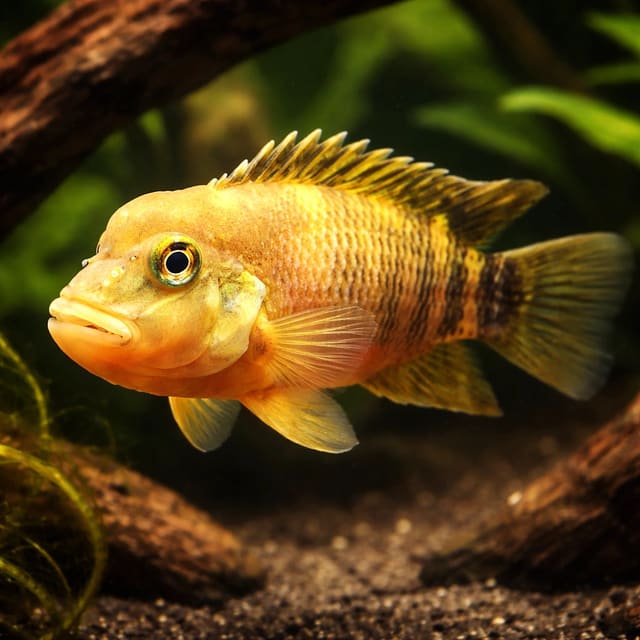
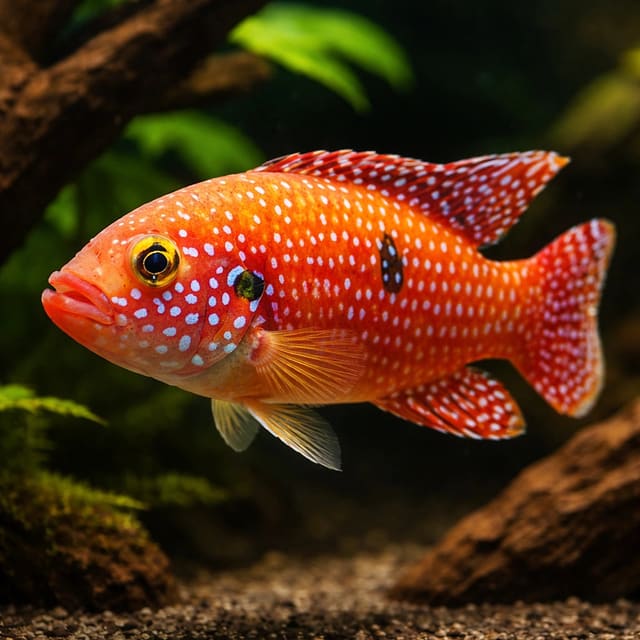
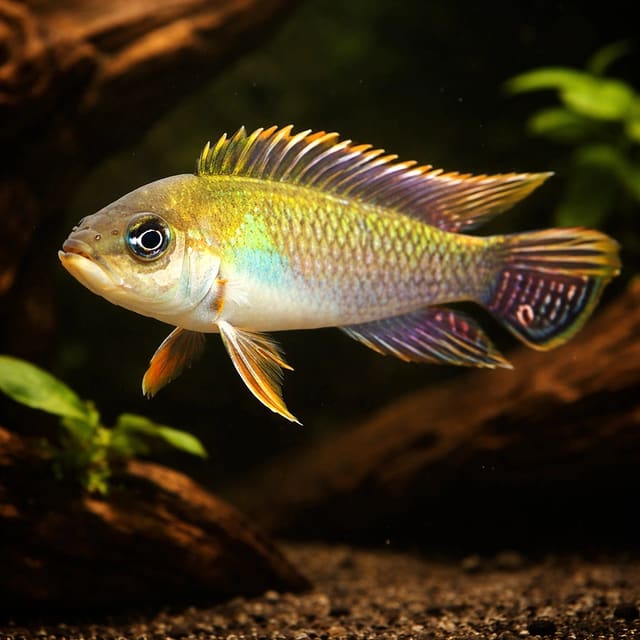
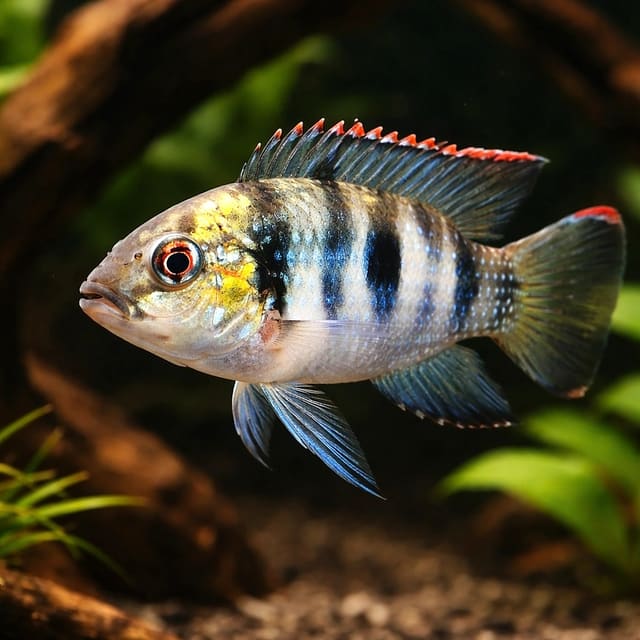
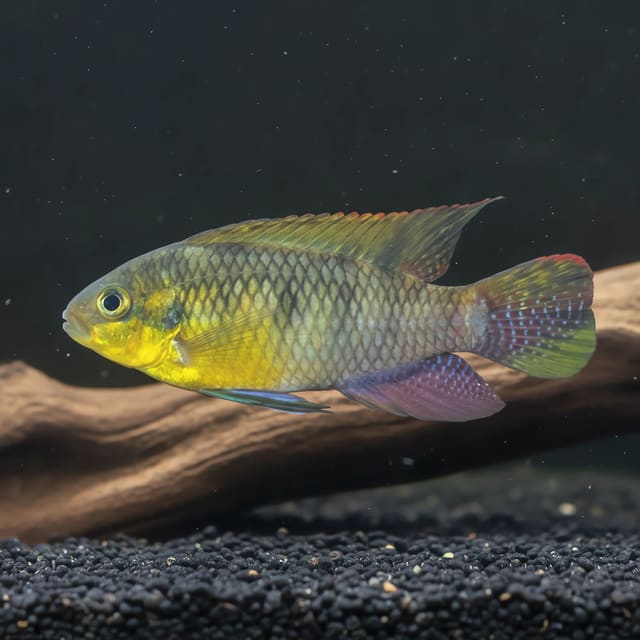
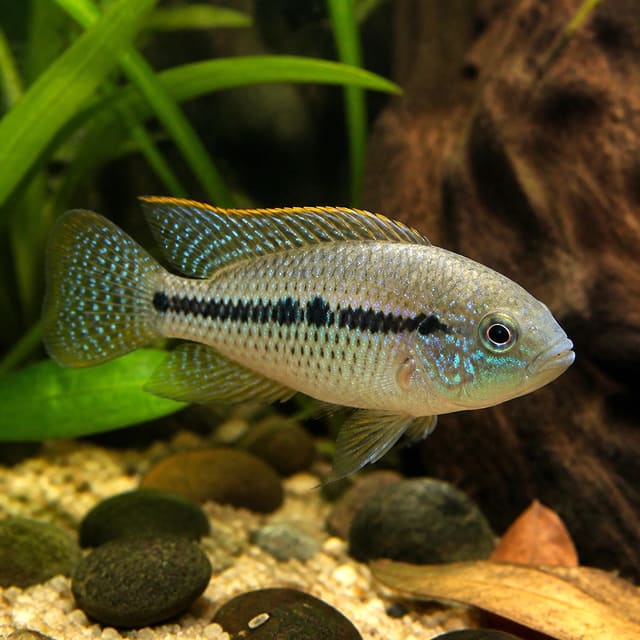
The present gallery shows a pale gold fish with a red eye, red colour across the belly and darker detail through the raised fins, against a rock background. These visible features introduce the form without promising an identical shade or pattern in every fish. The gallery images are representative of this type of animal rather than photographs of the exact animal supplied, so colours can look slightly different from the live animal.
FishBase records 11 cm total length for male/unsexed fish. Total length includes the tail. Seriously Fish gives a separate 100 mm standard-length figure, measured without the tail. Keep those measurement conventions distinct: the useful conclusion is to plan for an adult cichlid and its territory, rather than assuming a small dispatch grade will stay that size.
For planning, use an established aquarium at least 80 cm long, reflecting the FishBase aquarium-length guidance, and assess the usable floor area as well as its volume. A community needs enough room for all residents to withdraw from a defended cave. More than one pair requires a much larger arrangement with separate territories; adding another cave in the same cramped corner does not create independent space.
| Decision | What to plan for |
|---|---|
| Best fit | A mature aquarium with calm, suitably chosen companions and a keeper ready to manage territorial behaviour. |
| Main layout | Sand or fine gravel, several cave choices, wood or roots and optional plants for cover. |
| Water guidance | 24–27°C, pH 5.0–7.5 and hardness 0–12 dGH from the species aquarium profile. |
| Feeding | A good cichlid pellet as a staple, with appropriately sized live or frozen variety. |
| Important social change | A breeding pair can become strongly territorial even in a previously calm community. |
If you want to compare another listing of the same species, see the Kribensis Cichlid. Compare the offer and gallery separately while keeping the same species-level questions about caves, pair compatibility and water. A different colour presentation does not remove those needs or make two individual fish automatically suitable together.
The wider African cichlid collection can help you compare options, but the geographical category contains fish with different requirements. Start with the aquarium you can provide, then choose the animal that fits it. Kribensis suits someone who enjoys close observation and a thoughtful layout, especially the way a small fish uses and defends its own part of the aquarium.
FishBase gives 80 cm as a minimum aquarium length for this species. Seriously Fish separately describes a single-pair aquarium example as 71 litres with dimensions of 60 × 37.5 × 30 cm. These are different published housing recommendations. For this listing, take the longer 80 cm aquarium as the starting point and make the final stocking decision from its floor area, layout and residents. A volume alone cannot show whether a territorial fish has enough useful space.
The single-pair example is not a community stocking allowance. Once other fish use the same floor, or more than one pair is involved, extra territory and escape routes are needed. A tall aquarium can hold a reasonable amount of water while offering little horizontal separation between a cave and its neighbours. Look at where the fish can actually travel, rest and feed rather than relying on the tank label.
Before arranging decor, identify a sheltered area, an open feeding area and a route between them. Other residents should be able to move across the aquarium without having to pass immediately in front of the cave entrance. That simple layout check can reveal a problem that is difficult to see from a front-on photograph of a beautifully planted tank.
Seriously Fish recommends clay pots, caves, roots and driftwood as hiding places and potential spawning sites. Provide choices in separate parts of the aquarium instead of clustering every entrance together. A fish driven from a favoured shelter needs another refuge it can reach; the number of ornaments matters less than their placement and accessibility.
Check each cave for rough edges and trapping points, and make rock or wood structures stable. The species excavates pits when breeding, which makes secure hardscape particularly useful. Do not rely on loose substrate to support a structure that could shift when the fish digs beneath it. Set up the aquarium so that its everyday behaviour does not create a hazard.
Plants are optional but provide welcome cover. Use them to divide sightlines while keeping enough open space to observe feeding and carry out maintenance. A dense wall of foliage that hides all the fish and traps food can make husbandry harder. The aim is to give the animals a choice of privacy, with enough access for you to check that every resident is doing well.
Sand or fine gravel is the species recommendation. This lets the fish work around its shelter without encountering large sharp pieces. Keep the substrate surface free from accumulating uneaten food, particularly where it meets wood and cave entrances. If digging exposes a sheltered pocket, check that equipment or hardscape has not become unstable.
Allow some flexibility in the final appearance. A cichlid that chooses a cave may move substrate in ways that do not match your original design. An aquarium can remain attractive without putting every grain back each day. Respond to changes that affect safety, cleaning or access, while leaving harmless digging alone.
A useful layout can evolve as the fish grow. Replace a cramped cave before it becomes a problem and reassess routes when plants thicken. Keep alternative cover in place while making a change, then observe how the residents use the new arrangement. Their movement through the aquarium is the best practical test of whether the space works.
Seriously Fish gives 24–27°C, pH 5.0–7.5 and hardness 0–12 dGH for aquarium care. These are the species husbandry ranges used for planning. FishBase lists a broader environmental envelope, including pH 5.0–8.0 and hardness 5–19 dH, with 24–25°C recorded in its environment section. Wild environmental records and aquarium recommendations answer different questions; use the practical care range when assessing the home aquarium.
The hardness range includes very soft water, but that does not mean you should rapidly remove minerals from a settled aquarium or aim automatically for the lowest figure. Work with measured, stable conditions and prepare replacement water consistently. If your supply falls outside the guidance, discuss the complete water results and your preparation method before buying the fish.
Use the water chemistry guide to understand the difference between pH, general hardness and carbonate hardness. A pH test alone cannot tell you everything about the water. Record the values in the aquarium and in the water you use for changes, particularly if a mix is prepared rather than using a single consistent supply.
| Test or observation | How to use it |
|---|---|
| Temperature | Maintain stable conditions within the 24–27°C species aquarium guidance. |
| pH | 5.0–7.5 in the aquarium profile; avoid abrupt corrections in an occupied tank. |
| General hardness | 0–12 dGH in the species aquarium profile; assess alongside pH and your water-change method. |
| Ammonia and nitrite | Both zero mg/l, following OATA's general dwarf-cichlid welfare guidance. |
| Nitrate | OATA's group guidance is no more than 20 mg/l above the normal tap-water level. |
Some wild populations are associated with brackish conditions, but the ordinary aquarium care described here is freshwater husbandry. The presence of brackish habitats in a species record is not an instruction to add salt to your aquarium. Match the care plan to the fish and the established system, and ask for advice before changing its water preparation.
A working biological filter is essential. As the RSPCA explains, fish waste produces toxic ammonia; established bacteria process it through nitrite and then nitrate. An aquarium can look clean before those bacteria are ready to handle new livestock. Test ammonia and nitrite to confirm the system is functioning rather than judging readiness from clear water or new equipment.
The first tropical aquarium guide is a useful starting point when preparing a new tank. Increase stocking gradually, because the waste load changes whenever fish and food are added. A quiet, mature aquarium gives you a much better starting point for interpreting the behaviour of a newly introduced cichlid.
Seriously Fish describes naturally still or slow-moving, often vegetated water. Arrange circulation so that the aquarium is well maintained and the surface moves, while the caves remain comfortable refuges. The fish should be able to rest without constantly holding position against a concentrated filter jet. Check that shelter areas also remain accessible for cleaning.
Warm-water aquariums benefit from attention to filter operation, surface movement and sensible stocking. If the behaviour of several residents changes together, check the equipment and water promptly. A territorial dispute may affect one fish, while a filtration problem can affect the whole aquarium. Keeping those possibilities separate helps you respond to what is actually happening.
The water matcher can support a comparison using your test results. Use it alongside the care details for every intended resident. Matching the Kribensis water range is only part of creating a community; the other fish also need their own appropriate conditions, social groups and space.
A good-quality cichlid pellet can form the staple, with regular live or frozen variety as recommended by Seriously Fish. Choose a particle size the fish can take easily, especially for the smaller dispatch grade. A large pellet that repeatedly drops from the mouth or breaks into uneaten fragments may be an awkward choice even if the food itself is suitable.
FishBase describes adults feeding on worms, crustaceans and insects, with a Nigerian river study also recording diatoms, algae, higher plants and detritus. This supports thinking about the species as a flexible feeder rather than providing a menu made solely of rich animal foods. Use balanced prepared food and appropriate variety instead of copying the contents of one wild-diet observation directly into a home feeding schedule.
OATA's dwarf-cichlid guidance includes small live or frozen foods such as daphnia and brine shrimp. Introduce variety in portions you can monitor. There is no benefit in offering several different foods at once if the fish cannot finish them and leftovers collect around the cave.
Kribensis can be shy around very vigorous residents. Food reaching the aquarium does not prove that every fish receives a fair share. Observe the animal taking food and check whether it can approach the feeding area without being chased. This is especially useful after a new introduction or when a pair begins defending a territory.
If one resident controls a single feeding point, distribute the meal so that the quieter fish has a separate opportunity to feed. Choose positions where you can still check consumption and remove leftovers. Placing food deep inside an inaccessible cave may hide a problem rather than solve it.
OATA's general dwarf-cichlid advice is to feed once a day and offer only what is eaten within a few minutes. Use this as a broad routine and adjust portions to actual consumption and body condition. The presence of fry or a separate breeding project calls for its own feeding plan; ordinary adult guidance should not be stretched to cover every life stage.
Uneaten food breaks down and adds to the load on the filter. If appetite drops, remove leftovers and investigate instead of repeatedly topping up. Check water readings, recent social changes and whether the food is an appropriate size. A fish that is being excluded from its feeding area needs a social solution as well as a suitable diet.
Keep a steady routine while a new fish settles. It is easier to notice a change when feeding takes place in a familiar way. Look for normal interest in food, swallowing, and maintained body condition rather than expecting the fish to rush into open water immediately on arrival.
Body shape should be considered over time. A single photograph of a rounded abdomen cannot explain the cause, and belly colour is not a feeding chart. If appetite, breathing or condition changes persistently, test water and seek advice with a clear account of what has changed. Avoid guessing at an illness from one sign alone.
Both FishBase and Seriously Fish describe keeping this species in pairs. The important word is compatible: two fish placed together are not automatically a functioning pair. Seriously Fish explicitly warns that even a male and female may reject one another and that an unwilling partner can be seriously harmed. Watch the relationship, rather than assuming that a purchase quantity has settled it.
A breeding pair may clean and defend a cave or another sheltered spawning site. FishBase describes the species as a cave-spawning substrate brooder, and the aquarium profile emphasises the territorial change during breeding. This is useful behaviour to recognise because it can alter the whole community before an owner has noticed eggs or fry.
If one fish is persistently driven away, loses feeding access or cannot rest, intervene. Provide a safe separation route that is ready to use, such as suitable spare mature accommodation or an appropriate divider arrangement. The purpose is to stop continued exclusion before visible injury or declining condition develops.
OATA notes that even well-settled dwarf-cichlid pairs will often chase each other, which is why cover matters. A brief encounter followed by both fish returning to normal activity is different from relentless pursuit. Look at the outcome: can each animal use shelter, eat and move away, or is one confined to an exposed corner?
Adult sexual differences are described in the species literature, including larger males with more pointed fins and rounder females with a coloured belly in spawning condition. Those general descriptions are not a reliable basis for assigning the sex of an unexamined retail animal from one photograph. Treat behaviour and welfare as the priorities when deciding how the aquarium should be arranged.
A deliberate breeding project needs a plan for territorial adults, fry and spare accommodation. A community aquarium can change quickly when brood care begins, and other bottom-dwelling fish may disturb a spawning area. Decide what you can manage before attempting to encourage breeding, rather than responding only after the available floor space has become contested.
Spend a little time watching the aquarium when it is quiet as well as during feeding. Note where each fish rests, the routes it uses and how it reacts to its neighbours. This makes later changes much easier to recognise. A fish that suddenly abandons a familiar cave may be responding to another resident or to a change in the layout.
Changes in breathing, appetite, fin condition, colour and swimming can all be useful warning signs. Test water promptly if you are concerned and check the filter and temperature. If illness is suspected, seek appropriate advice; a territorial explanation should not be used to dismiss abnormal breathing or a deteriorating physical condition.
OATA recommends a partial water change of 25% at least weekly for dwarf cichlids, with water testing at least weekly. This is general group guidance to support a regular routine. Use your aquarium's test results, feeding and stocking to assess whether the routine is controlling waste. A heavily occupied aquarium and a lightly stocked species tank need not accumulate waste at the same rate.
Condition replacement water to remove chlorine or chloramine and prepare it consistently. Siphon accessible waste from the substrate, especially around feeding points and the edges of shelters. Work calmly around an occupied cave and avoid repeatedly dismantling the territory unless there is a practical reason to do so.
Check filters for blockage and maintain their established biological media. OATA advises rinsing media lightly in water removed from the aquarium during a water change, not under the tap. Preserve the useful bacteria while restoring flow. A maintenance routine should leave the aquarium biologically stable as well as visibly tidy.
Make sure someone will be available to receive the parcel on the confirmed delivery date. Tropical Fish Co's delivery and Live Arrival Guarantee policy explains the current terms. Fish are hand-bagged with pure oxygen, protected in an insulated box and carried by a licensed live-animal courier; a heat pack is used when weather requires it. Tracking and the confirmed date are sent by email.
Inspect the parcel and fish on the day of arrival. For a Live Arrival Guarantee claim, keep a continuous unboxing video that starts with the parcel still sealed, shows you opening it and shows the fish still in the sealed bag. The policy also requires someone to receive the parcel, same-day inspection and contact with the team that day if there is a problem. Include the order number when contacting the team.
Have the aquarium and suitable cover ready before opening the box. Follow the current store acclimatisation guidance; the store guidance includes floating the bag for 20–30 minutes to equalise temperature and acclimatising slowly. Transfer the fish without pouring the transport water into the aquarium.
Give the fish time to find a retreat and avoid chasing it into view for a photograph. Watch its breathing and the reactions of existing residents. A new fish needs access to the aquarium, not simply an empty space into which it can be released. Check that another cichlid is not immediately controlling its only route to shelter.
Continue observing feeding and water quality after introduction. Keep notes if the fish repeatedly hides at meals or is chased from a particular area. An early adjustment to a feeding point or separation of an incompatible resident can prevent a longer period of stress. Resist changing the entire aquarium repeatedly when a smaller, clearly targeted adjustment will address the problem.
Seriously Fish lists small characins, barbs, danios, rasboras, Corydoras, gouramis and Loricariids as possible companions, while warning against very vigorous or large species. Treat these as groups to investigate, not universal approvals. Compare the actual species' adult size, water requirements, social needs and feeding behaviour before adding it.
Calmer residents that can use other parts of the aquarium may make a better fit than fish that constantly crowd the lower level. A shoaling species still needs its own proper group and swimming space. Do not reduce that group to make a crowded stocking plan appear to fit; revise the overall plan instead.
Corydoras and Loricariids are named as possible companions, but their presence near the substrate makes the cave layout especially relevant. Keep enough space between resting areas and watch whether the Kribensis begins defending a route that another fish regularly uses. A combination may be manageable before breeding and unsuitable once a pair starts guarding a wider area.
Other cichlids, including West African dwarf cichlids, need enough space for separate territories. Several fish cannot all own the same cave cluster. A second pair calls for a substantially larger aquarium and careful observation, with a way to separate animals if the arrangement stops working.
| Situation | Decision rule |
|---|---|
| Calm community fish | Check the actual species' water needs, size, social group and ability to avoid the defended area. |
| Other bottom dwellers | Provide independent resting and feeding access; watch cave competition. |
| Very vigorous or large fish | Avoid combinations that overwhelm a shy Kribensis. |
| Breeding pair | Reassess the community immediately if other residents lose access to shelter or food. |
Compatibility is an ongoing observation, not a one-time label. If every fish can feed, retreat and move normally, the arrangement is functioning. If one animal spends its time evading pursuit or repeatedly misses meals, act even when no fin damage is visible. Good stocking leaves you room to respond to those changes.
FishBase records 11 cm total length for male/unsexed fish. Total length includes the tail. Seriously Fish separately gives 100 mm standard length, excluding the tail. Plan for the adult fish and its territory, keeping those different measurement conventions distinct.
Use at least 80 cm aquarium length as a planning baseline, following FishBase. Seriously Fish describes a separate 71-litre single-pair example. A community or several pairs needs more floor space and independent territories; a litre figure alone cannot establish suitability.
Species guidance recommends compatible pairs. Two fish are not automatically compatible, and persistent pursuit can seriously harm an unwilling partner. More than one pair needs a much larger aquarium with separate territories and a practical separation plan.
It can suit a well-prepared keeper learning about cichlids, with mature filtration, measured water conditions and a plan for territorial behaviour. Its small size does not make it suitable for an uncycled aquarium or a crowded community.
Use a good-quality cichlid pellet as a staple and provide appropriately sized live or frozen variety. Small foods such as daphnia and brine shrimp are included in OATA's dwarf-cichlid advice. Watch the fish eat and remove leftovers.
Seriously Fish gives species aquarium guidance of 24–27°C, pH 5.0–7.5 and hardness 0–12 dGH. Maintain stable conditions and keep ammonia and nitrite both at zero mg/l.
It can work in a carefully planned community but becomes very territorial when breeding. Provide cover and space for other fish to withdraw. Persistent pursuit, missed meals or confinement to a corner means the arrangement needs changing.
Small characins, barbs, danios, rasboras, Corydoras, gouramis and Loricariids are conditional possibilities in the species profile. Check each species' needs and cave-space competition. Avoid very vigorous or large fish that overwhelm it.
Tropical Fish Co uses oxygen-filled bags, insulated packaging and a licensed live-animal courier, with a heat pack when weather requires it. Receive and inspect the parcel on the confirmed day. A Live Arrival Guarantee claim needs continuous video from the sealed parcel through opening to the fish in its sealed bag, plus same-day contact and the order number.
FishBase: Pelvicachromis pulcher covers identity, natural distribution, labelled length, wild diet and the 80 cm aquarium-length recommendation. Seriously Fish: Kribensis covers species aquarium conditions, shelter, feeding, pair compatibility and breeding-related territorial behaviour.
OATA's dwarf-cichlid care sheet provides broad group welfare and maintenance guidance. RSPCA aquarium environment advice explains filtration and water-quality fundamentals.
No reviews for this item yet. Bought one? Honest reviews only, good or bad.
What customers say about ordering from us
I have a small group of long finned mountain minnows. So was delighted to be able to order ten of this variety to increase the genetics in my tank . The ones I recieved are healthy but it’s to early to give a verdict on wether they are of a long finned type since they are small currently.
Gordon Walker · 23 Sept 2026
100% success travel and "installation". Pleased with quality of purchase. The Siamese fighter a bit "shy" so have not yet seen him at his best yet but looking good. Happy customer. GG
George E Garratt · 21 Sept 2026
Reviews of our shop, collected by Judge.me, an independent third-party review collector. Newest first.