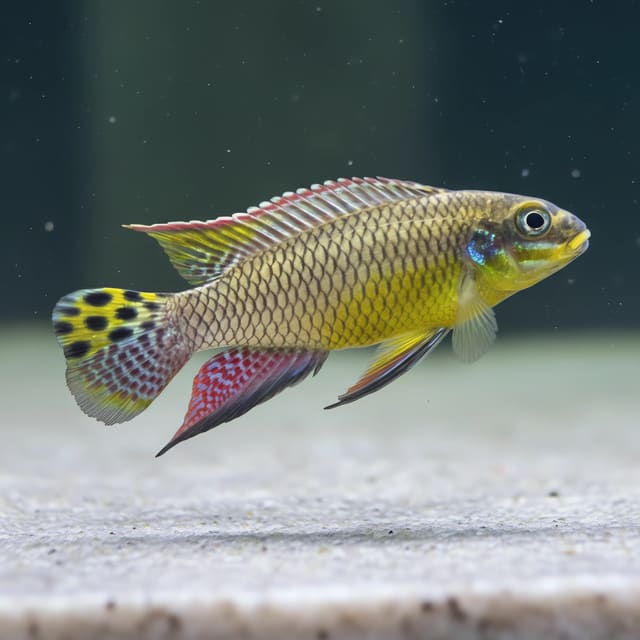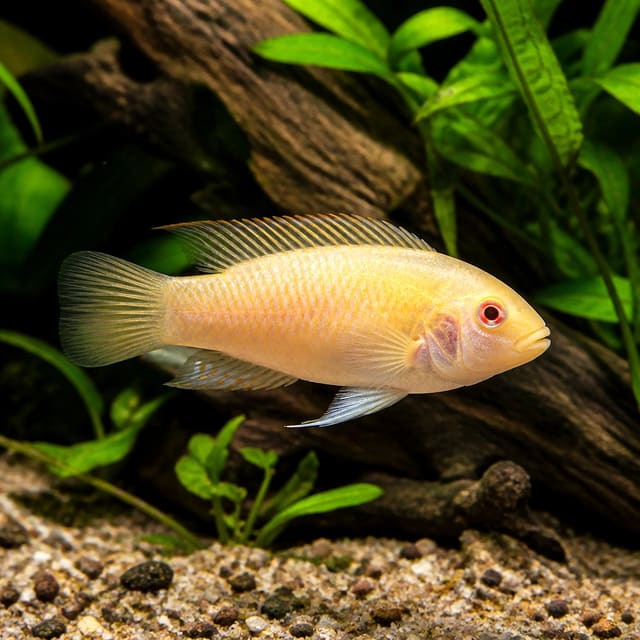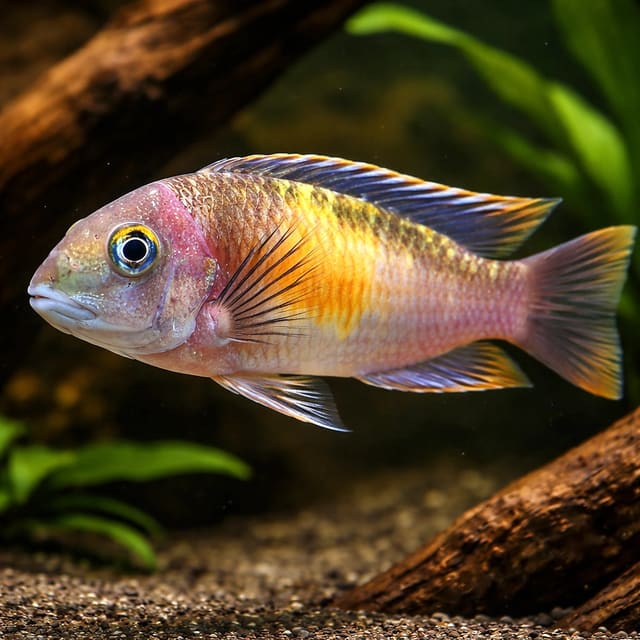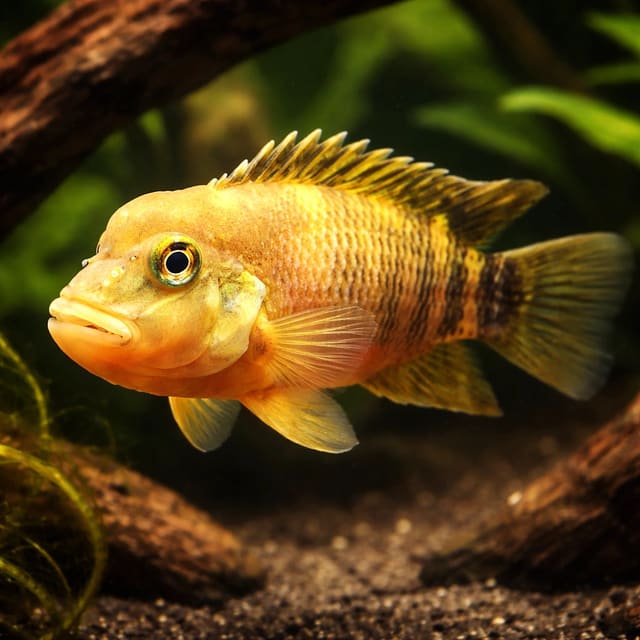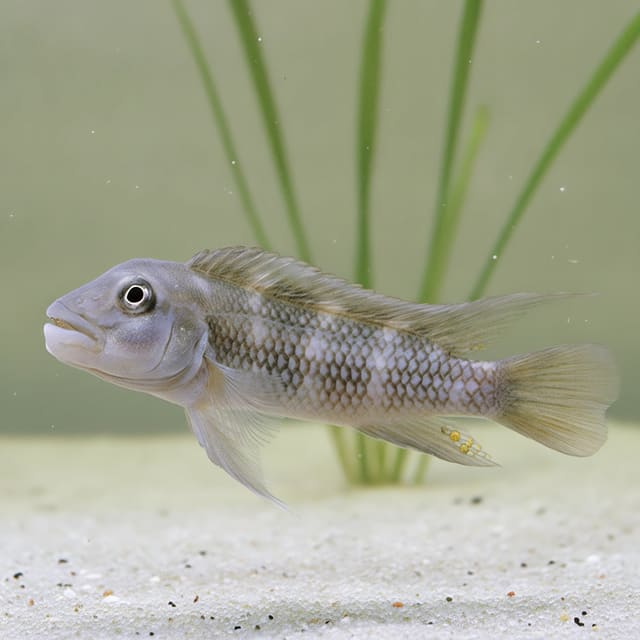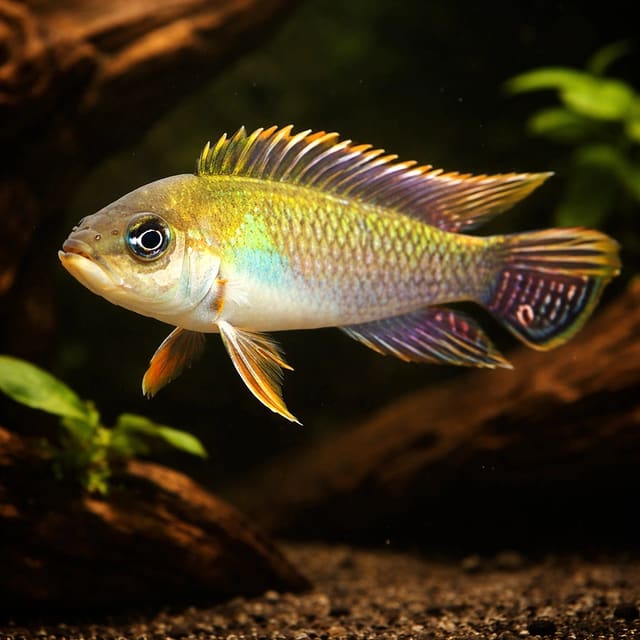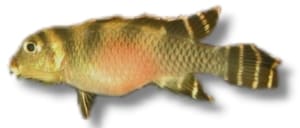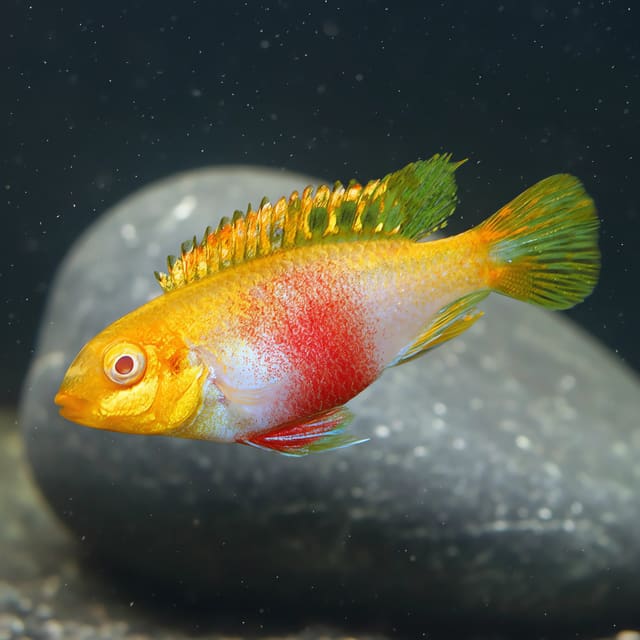
Albino Red Kribensis (Pelvicachromis pulcher)
24–27°C · pH 5–7.5
£10.99

Nigeria Green form of Pelvicachromis taeniatus in selectable size variants. Moderate care: 23-25°C, an 80 cm+ footprint, caves and careful pair or community planning.
Adult size is the maximum length this species reaches at full maturity (scientific sources). The livestock you receive will be younger and smaller — pick a size above for the actual shipping size. Product-photo provenance and any image-specific limitations are stated on the listing.
Pelvicachromis taeniatus
Save when buying multiple fish. Each quantity is one fish; sex and pair formation are not guaranteed unless the selected variant explicitly states them.
Nigeria Green form of Pelvicachromis taeniatus in selectable size variants. Moderate care: 23-25°C, an 80 cm+ footprint, caves and careful pair or community planning.
Adult size is the maximum length this species reaches at full maturity (scientific sources). The livestock you receive will be younger and smaller — pick a size above for the actual shipping size. Product-photo provenance and any image-specific limitations are stated on the listing.
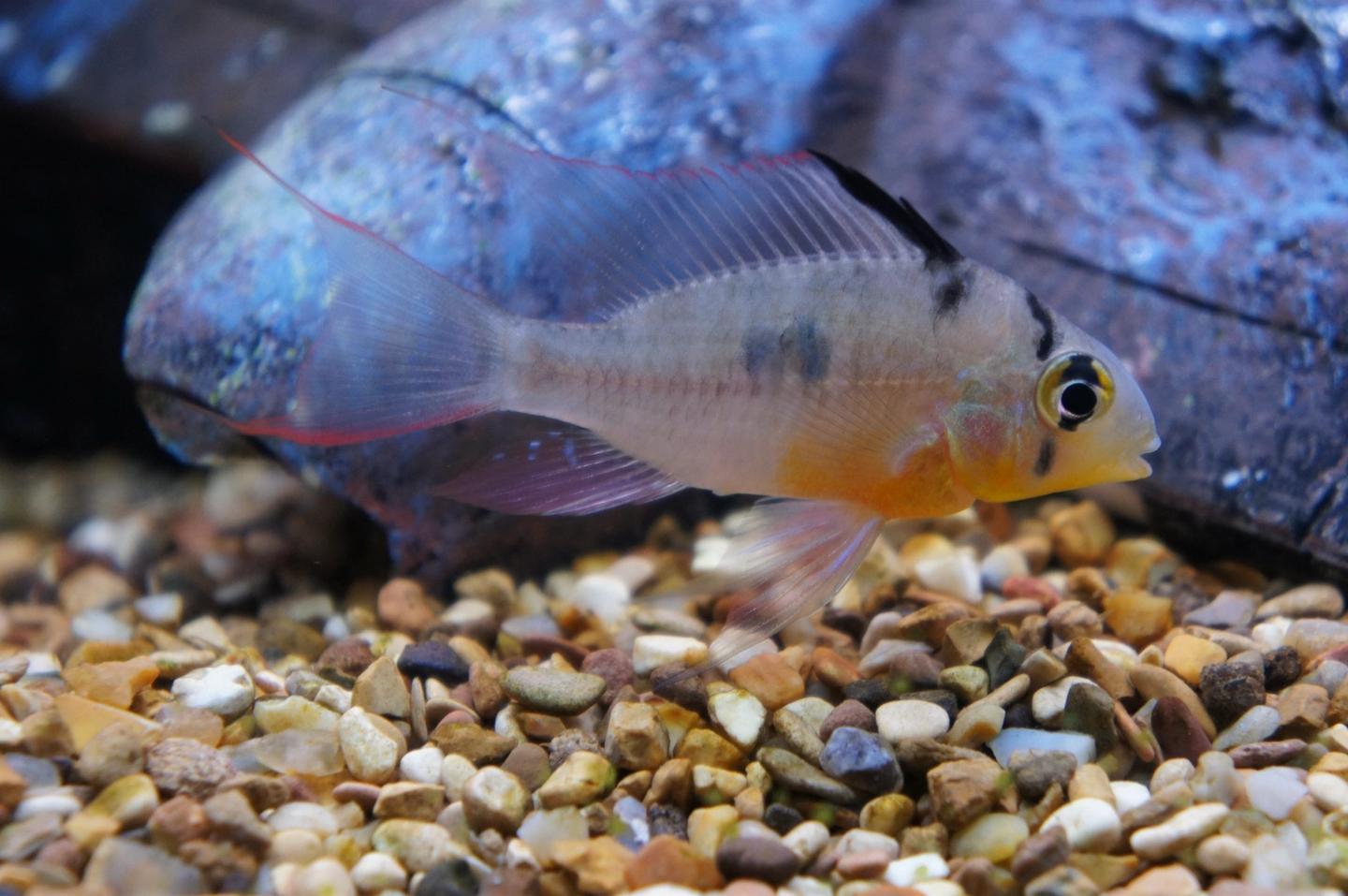
Cichlids are a family of roughly 1,800 accepted species, not one care type. Before buying, identify the exact species and source, then compare adult measurement, usable tank dimensions, social system, territory, tested water, diet and an exit plan. No family-wide minimum tank, water range or tank-mate list is safe.
Maintain these water conditions for optimal health and vibrant colors
Nigerian Green Kribensis is the aquarium-trade name used here for the Nigeria Green form of Pelvicachromis taeniatus. It is a small West African cichlid with a horizontal flank stripe, iridescent green and turquoise details, warm fin colour and pronounced differences between mature males and females. It is related to the familiar common kribensis, but it is not simply a green version of Pelvicachromis pulcher.
This product may offer more than one size option. The 4-5 cm option is the standard-size choice; an XL option may appear separately when stocked. Each cart quantity is one fish unless the selected option explicitly says otherwise. Sex, a bonded pair and an exact colour pattern are not guaranteed by the product name or image. Check the selected variant, current availability and price in the buy box before ordering.
This is a manageable cichlid, not an automatically placid community fish. It can be reserved outside breeding but becomes territorial around caves, eggs and free-swimming fry. Its best home has an 80 cm or longer footprint, stable warm water, several secure shelters, a mature filter and enough visual separation for other fish to avoid the breeding territory. A larger aquarium is preferable for a community or an unproven pair.
| Trade name | Nigerian Green Kribensis; Nigeria Green striped krib |
|---|---|
| Accepted species | Pelvicachromis taeniatus (Boulenger, 1901) |
| Supplier label | Pelvicachromis taeniatus nig. green; "nig. green" is a trade abbreviation, not a formal subspecies |
| Family | Cichlidae |
| Verified range | Coastal freshwater systems from eastern Benin to Nigeria, including the Niger Delta |
| Current sale size | Choose the displayed variant; the standard option is listed at 4-5 cm |
| Adult size | Allow for about 8 cm; FishBase records 7.1 cm standard length |
| Temperature | 23-25°C for this supplier form; avoid routine exposure above the verified range |
| pH | 6.0-7.5 for this supplier form |
| General hardness | About 5-12 dGH is a useful species reference range; stability matters |
| Minimum footprint | At least 80 cm long for a compatible pair; use more space for a community or breeding territory |
| Care level | Moderate: straightforward feeding, but pairing and territorial behaviour need planning |
| Temperament | Reserved to moderately territorial; substantially more defensive when breeding |
| Diet in captivity | Varied omnivore diet using complete prepared food plus suitable frozen or live foods |
| Breeding | Cave-spawning species; pair behaviour varies |
| Purchase unit | One fish per cart quantity unless the selected option explicitly states a pair |
The temperature, pH, sale size and approximate maximum size above are taken from the current trade specification. FishBase and the modern taxonomic revision provide the wider species context. Aquarium dimensions, tank mates and pair behaviour still require judgement for the actual fish and setup.
Nigeria Green is a locality or colour-form name used in the aquarium trade. It helps distinguish this stock from Nigerian Red and other named forms, but it is not a formally described subspecies. The correct zoological species name is Pelvicachromis taeniatus; the form name is best written in plain text or quotation marks rather than as part of the italic scientific name.
A 2014 revision of the Pelvicachromis taeniatus group restricted true P. taeniatus to populations from Benin and Nigeria. Historic aquarium literature often applied the same name to forms from Cameroon and Bioko, but those populations were reassigned to Pelvicachromis kribensis or Pelvicachromis drachenfelsi. That is why old care pages and supplier lists can appear to disagree. The Nigerian origin of this trade form is consistent with the currently accepted use of P. taeniatus.
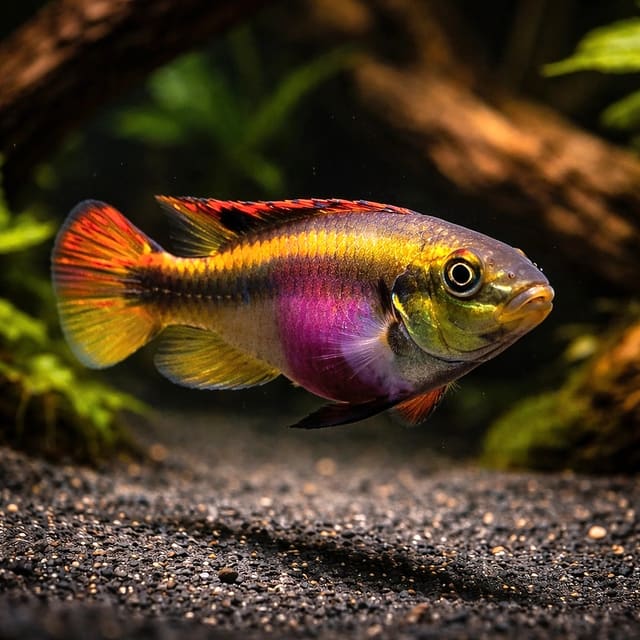
Common kribensis or rainbow kribensis is usually Pelvicachromis pulcher, a separate species. Both are small West African cave-spawning cichlids, but their identification, distribution and colour forms should not be merged. This listing therefore uses Nigerian Green Kribensis for search clarity while keeping the accepted species name visible for precise identification.
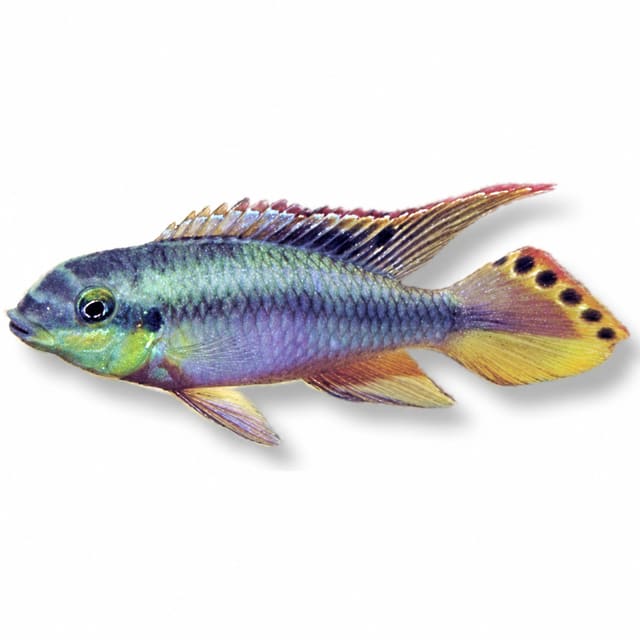
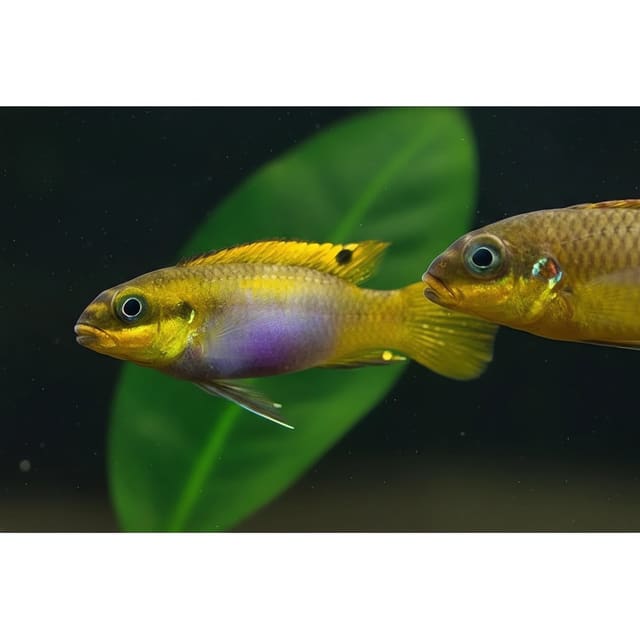
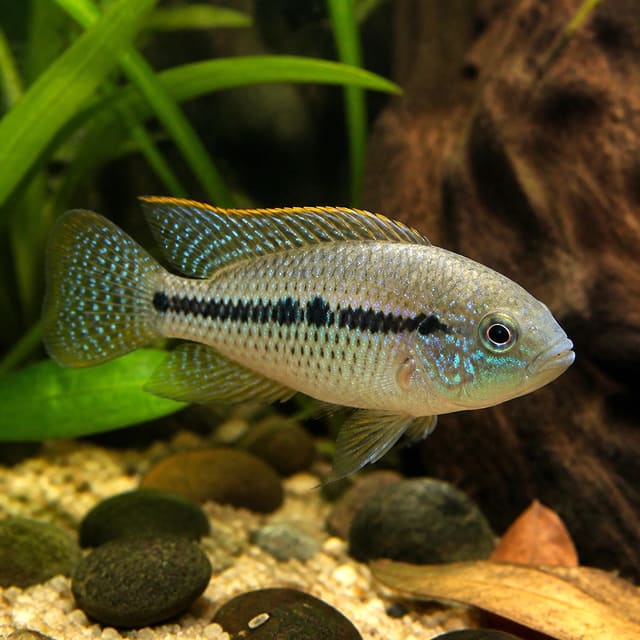
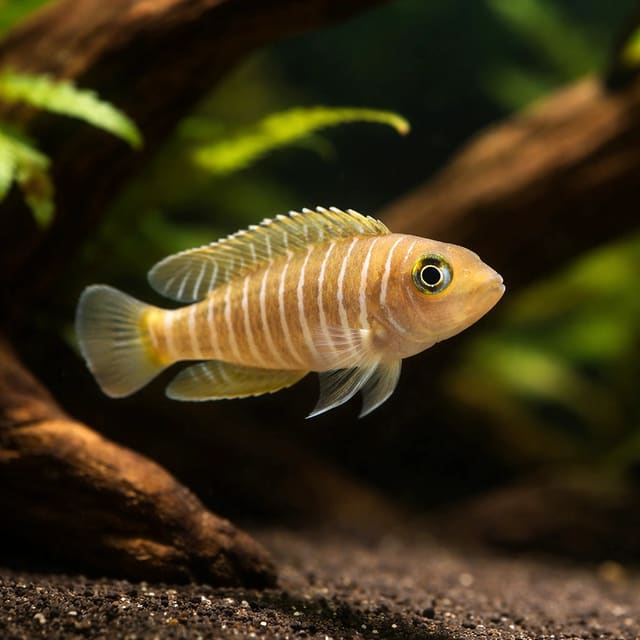
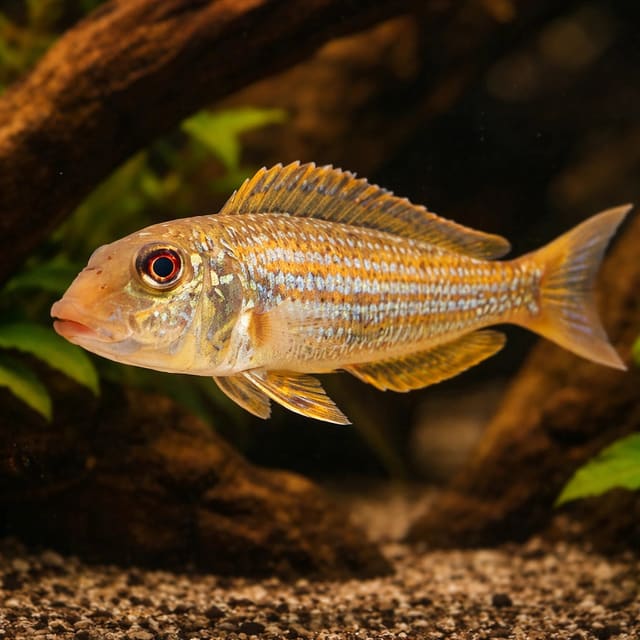
A settled fish typically shows a dark lateral stripe over an olive, gold or grey-green body, with iridescent colour around the face and fins. Mature males are usually longer and more streamlined, with more extended dorsal and anal fins. Mature females are generally shorter and deeper-bodied and can develop a stronger violet or reddish abdominal patch when reproductively active. Individual pattern, fin spots and colour intensity vary with sex, age, genetics, social state, lighting and stress.
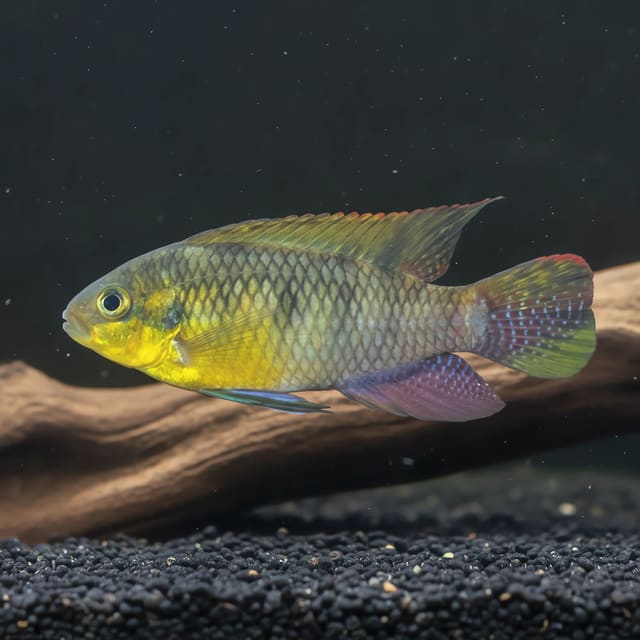
The word "Green" identifies the trade form; it does not promise a uniformly bright green fish. Newly transported animals may look pale, keep their fins close to the body or hide while settling. Colour should be assessed only after the fish is feeding and behaving normally in stable water. The product image is a representative aquarium view, not a guarantee of the exact fish, sex, maturity or breeding dress that will arrive.
Sexing a 4-5 cm juvenile can be uncertain. Fin shape and body depth become more useful as the fish matures, but no visual cue is infallible at every age. Unless the selected option specifically promises a sexed or bonded pair, plan the purchase as an individual fish. Two fish sold together are not automatically compatible, and a male and female may still reject one another.
Current references place Pelvicachromis taeniatus in freshwater near the West African coast from eastern Benin through Nigeria, including the Niger Delta. It is a demersal fish, spending much of its time close to the substrate and cover rather than in exposed open water. Fine-scale habitat conditions vary between drainages and seasons, so a home aquarium should copy the useful structural principles without claiming to recreate one unknown collection point.
Build the lower half of the tank around shelter and sight breaks. Smooth wood, rounded stone, robust plants, leaf-style cover and caves can create shaded routes through the aquarium. Leave enough open substrate for feeding and observation. A dark background and floating plants can reduce visual exposure, but cover must not obstruct water circulation or trap large pockets of waste.
Use sand or smooth fine gravel that can be cleaned without sharp edges. Caves should be stable, aquarium-safe and large enough for the fish to enter and turn without becoming trapped. Place several entrances in different directions so an unproven pair has choices and a subordinate fish is not forced past one defended doorway. Never balance rocks where digging could undermine them.
FishBase gives an 80 cm minimum aquarium size reference. That linear footprint is more useful than the old 80-litre statement because two aquariums with the same volume can have very different floor areas. In practical terms, roughly 100 litres is a sensible conservative starting point for a typical 80 cm aquarium, but length, width, cave placement and territorial separation are more important than volume alone.
An 80 cm tank can house a compatible pair without other bottom territories when filtration and maintenance are adequate. A community, an unproven pair or a breeding setup benefits from a longer and wider aquarium. Do not add more bottom-dwelling fish simply because the water volume appears large; the defended cave and surrounding floor space are usually the limiting resources.
Use mature biological filtration with gentle to moderate current. The outlet should keep the surface moving and prevent stagnant areas, but it should not blast directly into the cave entrance or force the fish to fight continuous flow. A guarded intake is useful where fry may be present. Check that the guard does not clog and reduce circulation.
Judge filtration by test results and behaviour, not an invented turnover number. Ammonia and nitrite should remain at zero in a stocked aquarium, and nitrate should be controlled through stocking, feeding, plants and water changes. If fish breathe rapidly, gather at the surface or remain pinned behind decor, test the water and inspect the entire filtration path.
Plants are useful because they separate lines of sight and make midwater companions feel secure. Attach epiphytes to wood, plant the rear and side zones, and keep access around caves for inspection. Provide more than one shelter, especially when introducing two unproven fish. A cave should offer privacy without creating a dead zone that cannot be cleaned.
| Setup element | Purpose | What to avoid |
|---|---|---|
| 80 cm or longer footprint | Allows a pair to establish a lower-level territory | Short, tall tanks with little usable floor area |
| Several stable caves | Provides choice and reduces competition for one entrance | Sharp, unstable or inaccessible shelters |
| Wood and planting | Breaks sight lines and supports confident behaviour | A completely bare tank with constant visual exposure |
| Mature filter | Processes waste and maintains oxygenated water | Strong jets at the cave or an uncycled emergency setup |
| Open feeding area | Makes appetite and waste easy to observe | Dense clutter that traps uneaten food |
The trade specification for this stock gives 23-25°C, pH 6.0-7.5 and a broad hardness tolerance. FishBase lists 22-25°C, pH 6.0-8.0 and 5-12 dGH for the species. For this stock, use 23-25°C, pH 6.0-7.5 and roughly 5-12 dGH as the working care range. The old 24-28°C recommendation was unnecessarily warm at its upper end and has been removed.
Do not chase a precise midpoint with repeated chemical adjustment. Stable water inside the supported range is safer than daily swings caused by buffers or inconsistent mixing. If your tap water falls outside the range, prepare replacement water consistently and change parameters gradually. Temperature, pH and hardness are only part of water quality; ammonia, nitrite, nitrate, oxygen and dissolved waste also matter.
Follow the live-fish acclimation instructions supplied with the order and minimise unnecessary delay. Keep aquarium lights low, prevent shipping water entering the display where instructed, and observe breathing and balance. Avoid feeding heavily immediately after transport. Give the fish cover and time to settle before judging its final colour or social behaviour.
Use a varied omnivore diet built around a complete small cichlid pellet, quality flake or another prepared food that reaches the lower half of the aquarium. Suitable frozen or live foods can add variety, but they should complement rather than replace a nutritionally complete staple. Choose pieces the fish can swallow without repeated spitting or struggling.
Offer modest portions and watch the fish eat. The correct amount depends on fish size, temperature, competition and the energy density of the food, so a rigid number of feeds or seconds is not universally reliable. Remove obvious leftovers before they decay around the cave. A fish that is consistently outcompeted may need targeted feeding rather than a larger general feed that pollutes the tank.
| Food role | Examples | Use |
|---|---|---|
| Complete staple | Appropriately sized cichlid pellet or quality flake | Provides the nutritional base; choose food that reaches the fish |
| Frozen variety | Suitable brine shrimp, daphnia or similar aquarium food | Rotate in modest portions and thaw according to the product instructions |
| Live variety | Clean cultured live foods of an appropriate size | Use only from a trusted source to limit contamination risk |
| Fry feeding | Fine fry food followed by newly hatched brine shrimp where appropriate | Match particle size to the fry and protect water quality |
Do not use colour intensity alone as a feeding target. Overfeeding can produce a rounded abdomen while degrading water quality. Monitor body condition, appetite, waste and growth together. If the fish stops eating, test water first and look for social exclusion, transport stress or disease rather than adding increasingly rich foods.
Nigerian Green Kribensis can share a carefully designed aquarium, but "peaceful" is too simple. A non-breeding individual may be shy or tolerant, while a breeding pair can defend a cave and chase fish across the lower tank. Compatibility depends on aquarium footprint, shelter, the individual fish, breeding state and whether another species occupies the same zone.
Calm midwater schooling fish are usually easier to combine than other cave users. Choose species whose temperature and water requirements overlap at 23-25°C. Avoid treating any list as a guarantee: observe actual behaviour and have a separation plan if one fish is repeatedly pinned, injured or excluded from food.
| Companion type | Assessment | Reason |
|---|---|---|
| Calm midwater tetras or rasboras | Often suitable in a larger structured tank | They use a different zone, but water requirements and adult size must match |
| Small peaceful barbs or danios | Case by case | Choose non-nipping species and provide enough swimming room |
| Corydoras and other bottom fish | Caution, especially during breeding | They can repeatedly enter the defended cave territory and may be chased |
| Otocinclus and small loricariids | Caution | Generally calm, but they still use surfaces near a breeding territory |
| Other Pelvicachromis or dwarf cichlids | Avoid in smaller aquariums | Competing cave territories create persistent conflict |
| Aggressive Rift Lake cichlids | Avoid | Aggression, diet and water chemistry are usually incompatible |
| Shrimplets and very small fry | Predation risk | A dwarf cichlid may hunt animals small enough to eat |
| Slow, long-finned fish | Usually avoid | They may be unable to leave a defended area quickly |
Use the cichlid care guide for wider territory-planning principles. Browse the freshwater fish collection only after comparing adult size, water range and swimming zone; a product being labelled a community fish does not prove compatibility with a breeding cichlid.
A single fish can be kept when the aquarium meets its care needs. A compatible pair shows more courtship and parental behaviour, but pairing carries risk. Do not assume that any male and female will bond. Introductions need multiple shelters, broken sight lines and close observation. If one fish cannot leave cover, feed or rest without being attacked, separate them.
Adding a second fish to an established territory can be more difficult than introducing both to a neutral layout. Rearranging decor may reduce ownership cues, but it is not a guarantee. A divider or second cycled aquarium is safer than waiting for serious injury. Never buy an extra fish solely to "fix" aggression without first checking sex, space and the existing territory.
Territoriality commonly increases before and after spawning. Midwater fish may be driven away from the cave, while bottom fish receive repeated attention because they cross the nest zone. Give every companion an open escape route and shelter outside the cichlid territory. More caves help only when the aquarium is large enough for them to create genuinely separate areas.
FishBase records Pelvicachromis taeniatus as a cave-spawning species. That supports providing a secure shelter, but it does not justify promising a fixed division of parental roles for this retail fish. Pair behaviour can vary, and an unproven pair should be observed carefully rather than assumed to be compatible.
Use mature filtration, stable water and at least one secure cave with a manageable entrance. A dedicated aquarium is easier to supervise than a busy community if spawning begins. Provide visual barriers before introducing a possible partner, guard filter intakes if fry could reach them, and avoid repeatedly moving a chosen shelter.
Deeper colour, display, digging or increased interest in a cave can accompany reproductive behaviour, but none proves that eggs are present. Do not lift or dismantle a cave simply to check. Watch whether both fish can feed and retreat; persistent exclusion or injury means the pairing needs intervention.
Keep temperature and water chemistry stable, avoid abrupt maintenance, protect intakes and prepare food small enough for fry. Observe the adults rather than assuming they will follow a fixed care pattern. Tank mates should not be expected to remain safe once a cave area becomes defended.
Most long-term problems begin with unstable water, social stress, poor nutrition or an unsuitable introduction. Observe the fish before feeding so appetite does not hide abnormal behaviour. Compare breathing rate, posture, colour, fin position and territory use with the fish's normal pattern rather than relying on one generic symptom list.
| Observation | First checks | Response |
|---|---|---|
| Rapid breathing or surface gathering | Ammonia, nitrite, temperature, oxygen and filter flow | Correct an environmental emergency promptly and increase aeration where appropriate |
| Persistent hiding with missed feeds | Aggression, new surroundings, water quality and visible injury | Add safety only if it does not trap the fish; separate an aggressor when needed |
| Clamped or damaged fins | Chasing, sharp decor and signs of infection | Remove the cause and seek an accurate diagnosis before medication |
| White spots, excess mucus or flashing | Recent arrivals, other affected fish and water conditions | Isolate where practical and use a species-safe treatment only after diagnosis |
| Swelling, weight loss or abnormal waste | Diet, feeding access, parasites and internal disease | Do not guess with multiple medicines; obtain aquatic-veterinary or experienced specialist advice |
Change water according to measured waste and stocking rather than an arbitrary percentage copied between tanks. Match replacement temperature and chemistry, clean mechanical media without destroying the whole biological filter, and siphon trapped debris around caves. Never add medication as a routine preventative treatment; check the label for the fish, plants and invertebrates actually present.
Quarantine is valuable when a separate cycled system and appropriate observation are available. It should reduce disease risk without exposing a new fish to unstable water. Equipment shared between tanks should be cleaned and managed carefully. If a fish is seriously unwell, professional aquatic-veterinary advice is more reliable than a product page.
A useful routine combines short observations with measured maintenance. Look at the fish before touching the tank: where it rests, whether both members of a pair can feed, how fast it breathes and whether a cave has become strongly defended. Behavioural change can reveal a filter problem, deteriorating water or pair conflict before a calendar task becomes due.
| When | Check | Why it matters |
|---|---|---|
| At each feed | Appetite, access to food, breathing and obvious injury | A subordinate fish can miss meals long before severe weight loss is visible |
| Daily | Temperature, filter flow, surface movement, equipment and escape gaps | Heater or filter failure can affect a warm, covered aquarium quickly |
| Regularly | Ammonia, nitrite and nitrate according to the tank's maturity and risk | Testing confirms whether biological filtration and maintenance are adequate |
| During water changes | Debris around caves, intake guards and concealed dead zones | Bottom territories can collect waste where it is difficult to see |
| After adding or moving fish | Chasing, blocked routes, feeding access and use of shelters | Territory boundaries can change within hours of a social change |
| During breeding | Safe distance for companions, intake protection and fry food readiness | Breeding activity can increase both territoriality and filtration risk |
Clean one part of the filtration system at a time when possible and preserve established biological media. Rinse reusable mechanical media according to the equipment instructions, restore normal flow and check for leaks before leaving the tank. A water change should be large enough to control measured waste without causing a sudden shift in temperature, pH or hardness.
Keep a simple record of unusual behaviour, test results and maintenance. This is especially helpful with a pair because courtship, spawning and conflict can look similar at first. A dated note makes it easier to distinguish a short breeding chase from a worsening pattern in which one fish is continually excluded.
The closest sales comparison is the Nigerian Red Pelvicachromis taeniatus. Both are Nigerian trade forms of the same accepted species, but colour and pattern should not be promised from the name alone. Keep locality forms separate if maintaining a known line; mixing them removes provenance and makes future identification less reliable.
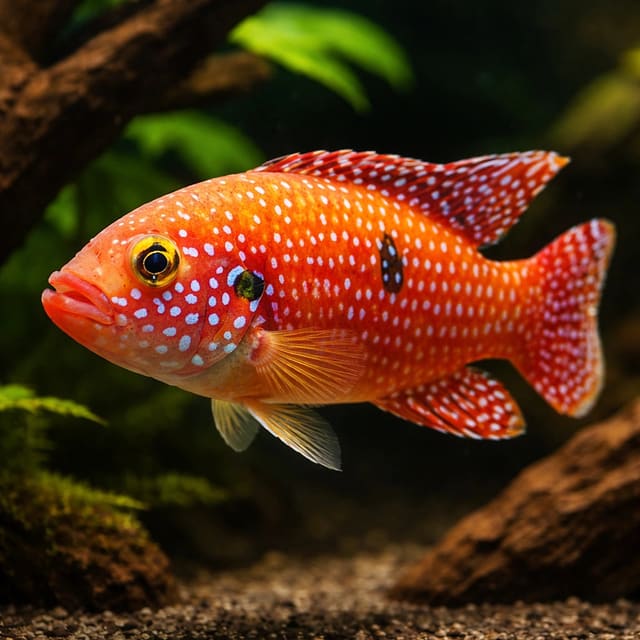
The common Kribensis Pelvicachromis pulcher and Albino Red Kribensis are P. pulcher listings, not Nigeria Green P. taeniatus. The Matadi Violet Ocellated Kribensis is Pelvicachromis subocellatus. These related products can differ in adult appearance, behaviour and exact water needs, so read each page rather than transferring this care table unchanged.
| Listing | Species shown | Key distinction |
|---|---|---|
| Nigerian Green Kribensis | Pelvicachromis taeniatus | Nigeria Green trade form; this product |
| Nigerian Red Kribensis | Pelvicachromis taeniatus | Different Nigerian trade form of the same accepted species |
| Common or Albino Red Kribensis | Pelvicachromis pulcher | Separate species commonly sold as the standard kribensis |
| Matadi Violet Ocellated Kribensis | Pelvicachromis subocellatus | Separate Pelvicachromis species |
Price, inventory, delivery dates and eligibility are shown dynamically and may change. The care content does not replace the terms displayed at checkout or on the delivery page.
| Mistake | Why it is risky | Better interpretation |
|---|---|---|
| Calling every kribensis Pelvicachromis pulcher | It merges distinct species and can misdirect care or breeding records | Nigeria Green is sold here as P. taeniatus; common kribensis is usually P. pulcher |
| Writing "nig. green" as a formal subspecies | The supplier abbreviation looks scientific but has no formal rank | Use Pelvicachromis taeniatus with Nigeria Green as the trade-form name |
| Including Cameroon in the modern species range | Older sources used P. taeniatus broadly before the group was revised | Current taxonomy restricts true P. taeniatus to Benin and Nigeria |
| Using 28°C as a routine upper temperature | It exceeds the supplier's 23-25°C range and FishBase's 22-25°C reference | Keep this stock stable at 23-25°C |
| Choosing any 80-litre aquarium | A short, tall tank can have too little floor area for a cave territory | Start with an 80 cm or longer footprint; roughly 100 litres is a practical proxy, not the deciding measure |
| Assuming two fish will form a pair | Sex can be uncertain and a male and female may still be incompatible | Provide choices, monitor closely and maintain a safe separation option |
| Calling Corydoras automatically safe tank mates | They repeatedly enter the lower territory and may be chased during breeding | Treat bottom companions as conditional and provide substantially more floor space |
| Expecting a uniformly green specimen | Form names do not control sex, age, stress or individual colour pattern | Assess the fish after it has settled; expect natural variation |
| Using the photograph as a sex or colour guarantee | The image is representative and an individual fish may differ | Select by verified identity and care needs, then allow normal appearance to develop |
Correct identification improves more than search accuracy. It helps keep locality records meaningful, prevents accidental mixing of distinct species and gives future keepers a clearer account of what they are receiving. Retain the trade form with the accepted species name rather than replacing one with the other.
Transport, a new water chemistry and a new territory can temporarily change colour, appetite and confidence. Start with low light and ready-made cover. Follow the supplied acclimation instructions, then allow the fish to find shelter without repeated netting or photography. Do not add a potential partner or rearrange the whole aquarium on the same day unless an immediate safety issue requires it.
Confirm balanced swimming and steady breathing before focusing on colour. Watch whether existing fish crowd the newcomer and whether food reaches the lower water. A shy fish that emerges briefly and returns to cover can be settling normally; a fish that rolls, gasps, is pinned continuously or cannot reach food needs immediate investigation.
Test the aquarium after introduction because the added bioload and transport stress can expose a marginal filter. Offer an appropriately sized familiar staple once the fish is ready, and keep portions small enough to remove if uneaten. Rich food cannot compensate for ammonia, nitrite, low oxygen or aggression.
Wait until the first fish is healthy and the aquarium is demonstrably stable. Use a neutral layout with multiple caves where practical, and supervise the introduction. Courtship includes display and short pursuit, but continuous ramming, torn fins, blocked access to food or one fish trapped in a corner is not a bond forming safely.
Colour can strengthen as stress falls and social context develops. It can also intensify during courtship or aggression. Read colour together with posture, feeding and movement. A vivid fish is not necessarily comfortable, and a pale newly arrived fish is not automatically ill.
Sources checked 27 July 2026. The trade specification identifies this sale form as "Pelvicachromis / taeniatus nig. green" at 4-5 cm, with 23-25°C, pH 6.0-7.5 and an approximate 8 cm maximum. Scientific sources describe the species; they do not certify the sex, exact locality, colour or pairing of an individual retail fish.
No reviews for this item yet. Bought one? Honest reviews only, good or bad.
What customers say about ordering from us
I have a small group of long finned mountain minnows. So was delighted to be able to order ten of this variety to increase the genetics in my tank . The ones I recieved are healthy but it’s to early to give a verdict on wether they are of a long finned type since they are small currently.
Gordon Walker · 23 Sept 2026
100% success travel and "installation". Pleased with quality of purchase. The Siamese fighter a bit "shy" so have not yet seen him at his best yet but looking good. Happy customer. GG
George E Garratt · 21 Sept 2026
Reviews of our shop, collected by Judge.me, an independent third-party review collector. Newest first.