Easy
Pelvicachromis taeniatus — Lobe
22–26°C · pH 5–7.5 · 71L
£18.99
Pelvicachromis taeniatus kienke is a cave-spawning West African dwarf cichlid from eastern Benin to Nigeria that reaches 7.1 cm standard length. It suits a carefully planned pair aquarium at 22–26°C, pH 6.0–7.5 and 5–12 dGH, with at least 71 litres and an aquarium at least 80 cm long. Sold individually.
Adult size is the maximum length this species reaches at full maturity (scientific sources). The livestock you receive will be younger and smaller. Product-photo provenance and any image-specific limitations are stated on the listing.
Pelvicachromis taeniatus
Save when buying multiple fish. Each quantity is one fish; sex and pair formation are not guaranteed unless the selected variant explicitly states them.
Pelvicachromis taeniatus kienke is a cave-spawning West African dwarf cichlid from eastern Benin to Nigeria that reaches 7.1 cm standard length. It suits a carefully planned pair aquarium at 22–26°C, pH 6.0–7.5 and 5–12 dGH, with at least 71 litres and an aquarium at least 80 cm long. Sold individually.
Adult size is the maximum length this species reaches at full maturity (scientific sources). The livestock you receive will be younger and smaller. Product-photo provenance and any image-specific limitations are stated on the listing.
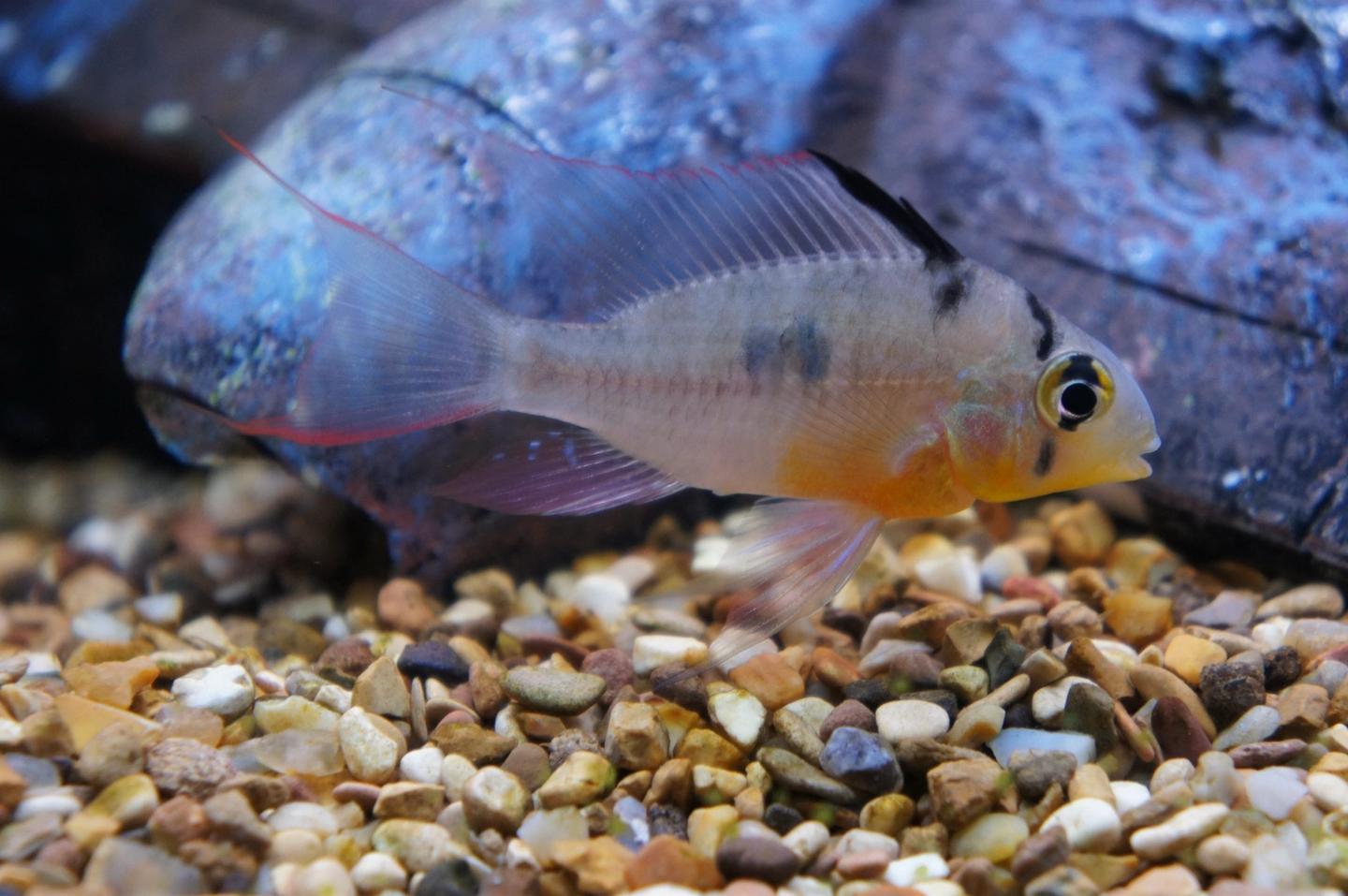
Cichlids are a family of roughly 1,800 accepted species, not one care type. Before buying, identify the exact species and source, then compare adult measurement, usable tank dimensions, social system, territory, tested water, diet and an exit plan. No family-wide minimum tank, water range or tank-mate list is safe.
Maintain these water conditions for optimal health and vibrant colors
Pelvicachromis taeniatus is a freshwater dwarf cichlid from West Africa, and Kienke is one of the named forms associated with the species. It has the compact shape, marked scales and colourful fins that make this branch of the cichlid family distinctive, but its behaviour should guide the aquarium plan as much as its appearance. This is generally a shy, retiring fish that uses cover for security and becomes territorial when breeding.
FishBase lists Pelvicachromis taeniatus in the family Cichlidae and describes it as a cave-spawning substrate brooder. The species occurs from eastern Benin to Nigeria, including the Niger delta, in freshwater regions near the coast. Reports from Cameroon and Bioko are assigned there to Pelvicachromis kribensis, so plan for this fish as the Kienke named form of P. taeniatus rather than assigning it a separate Cameroonian range.
One purchase supplies one animal. Pair care is recommended for the species, but two individually purchased fish are not automatically a compatible pair.
Sex is guaranteed only when the selected option explicitly states male or female. This Pelvicachromis taeniatus kienke listing has no sex-guaranteed option.
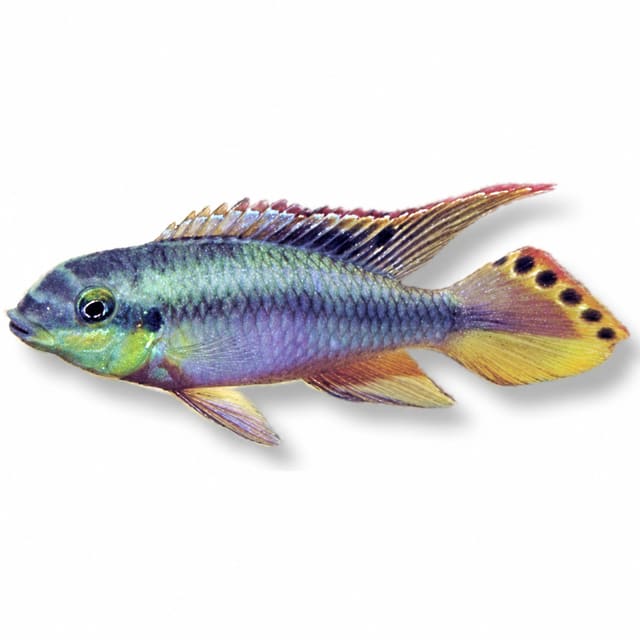
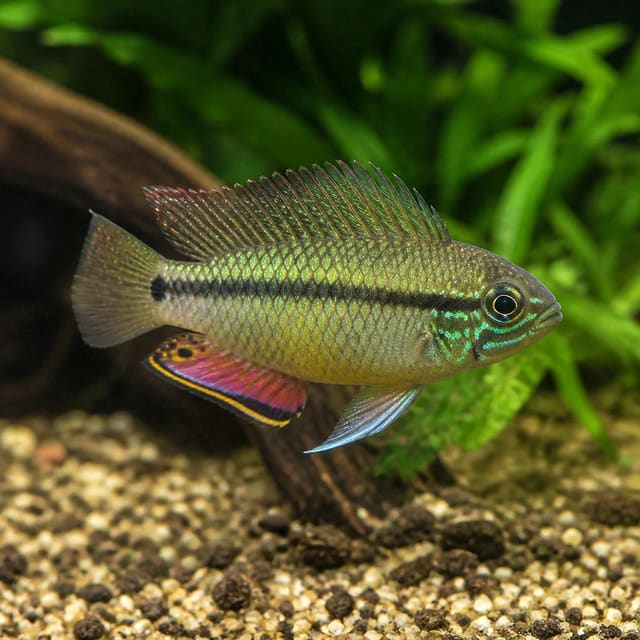
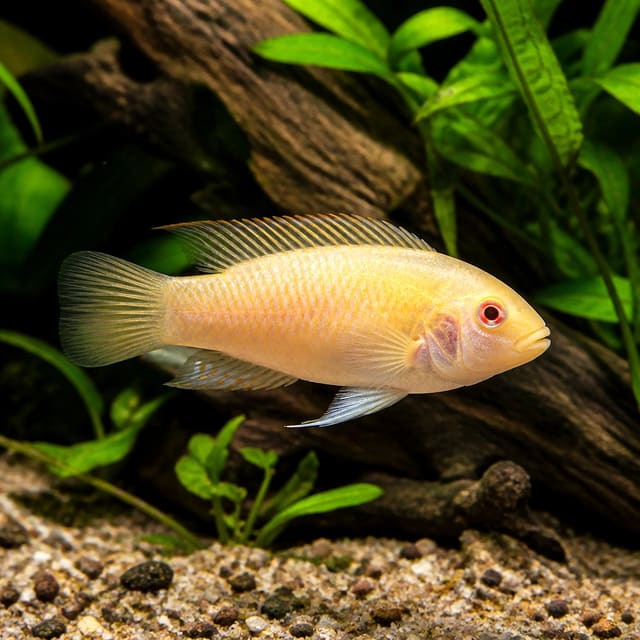
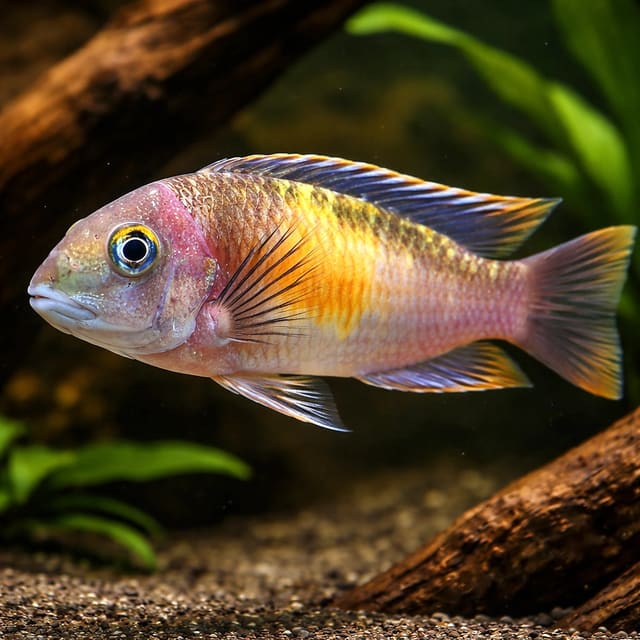
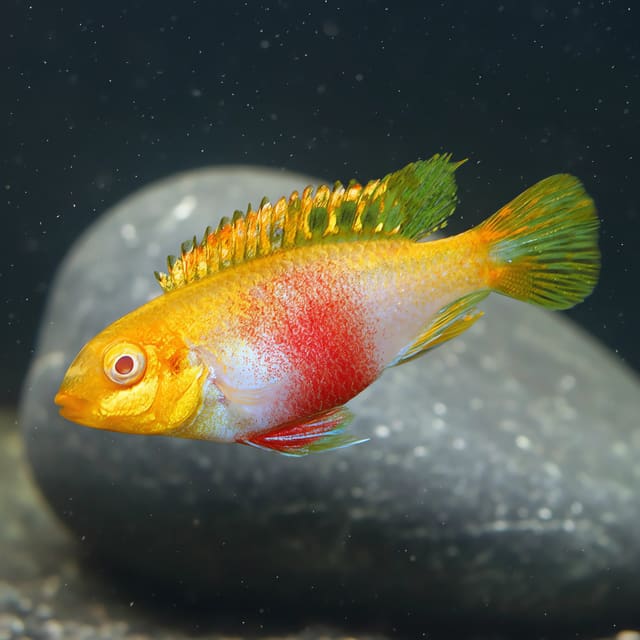
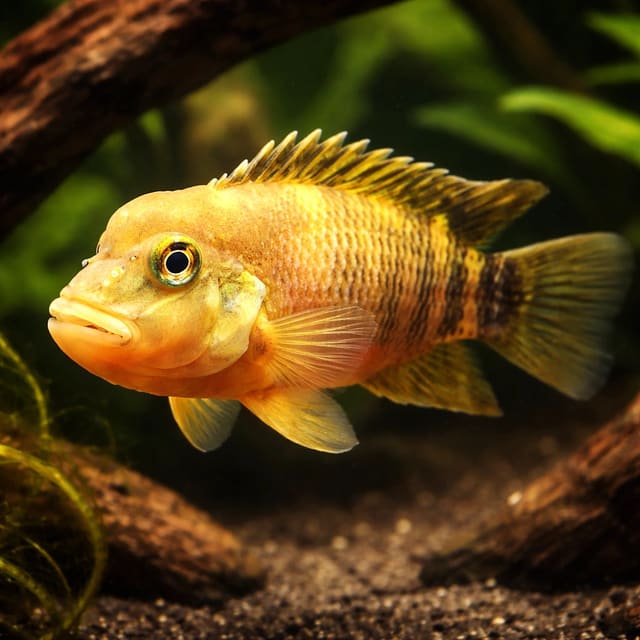
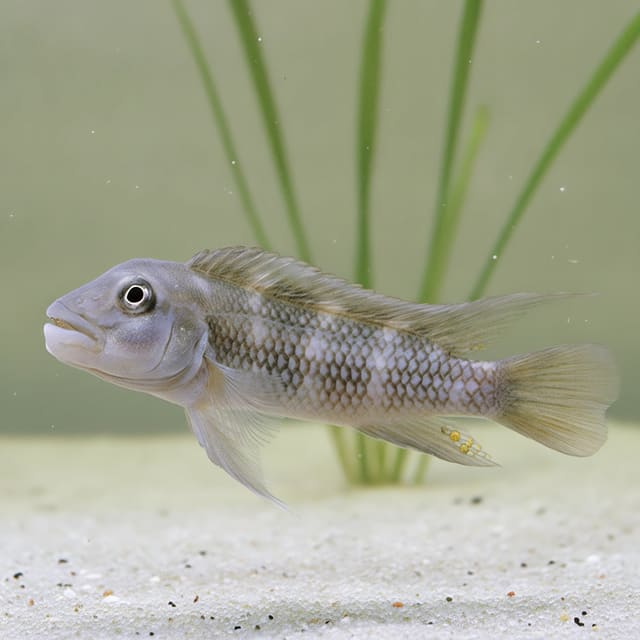
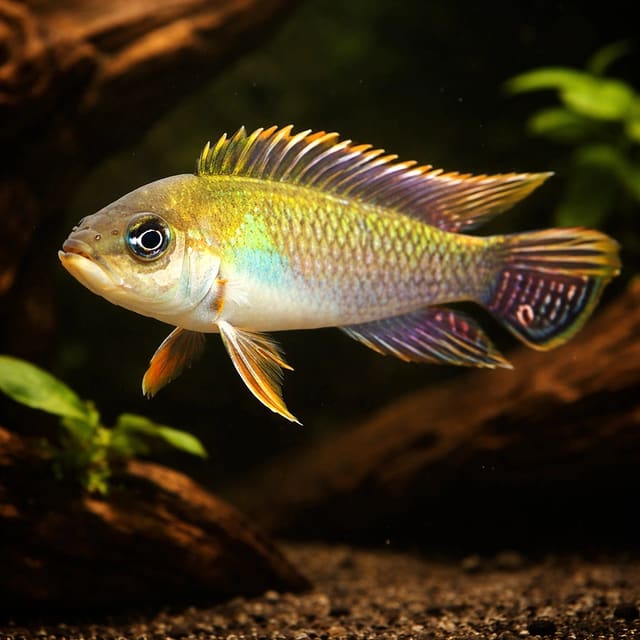
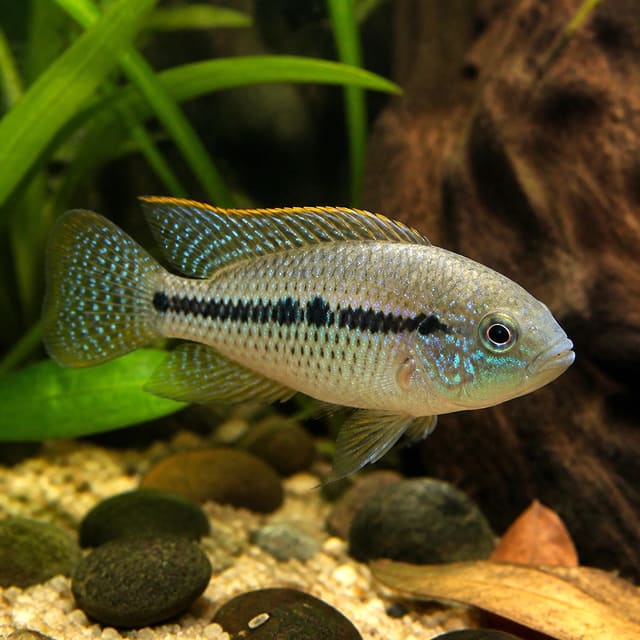
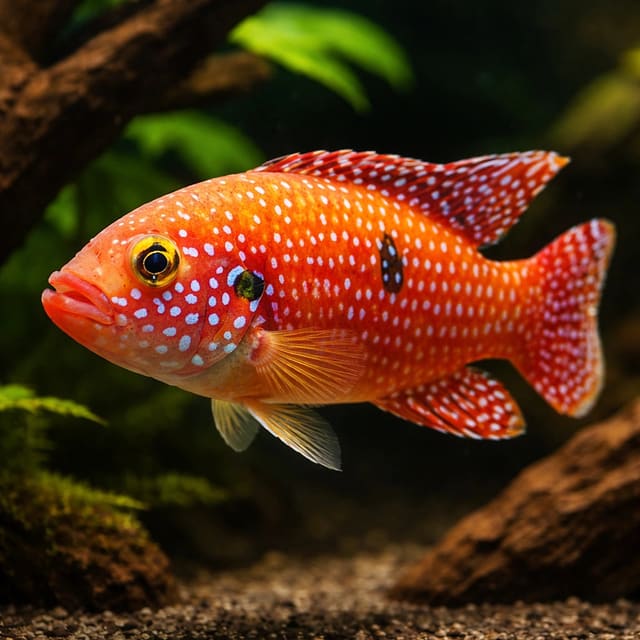
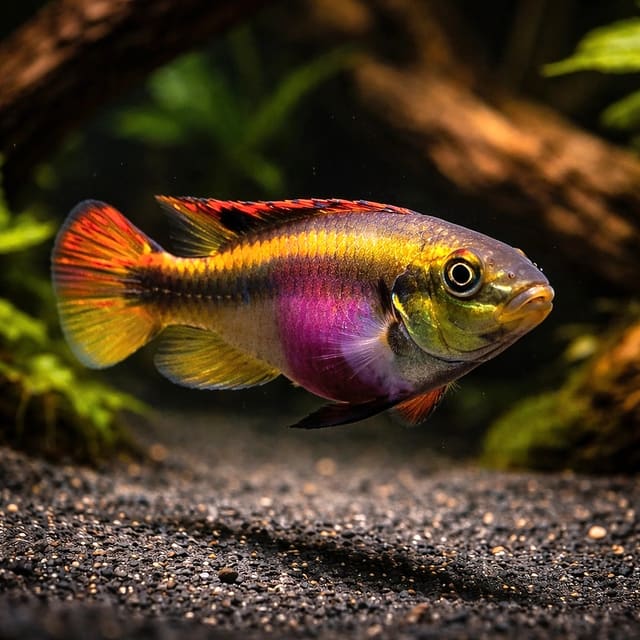
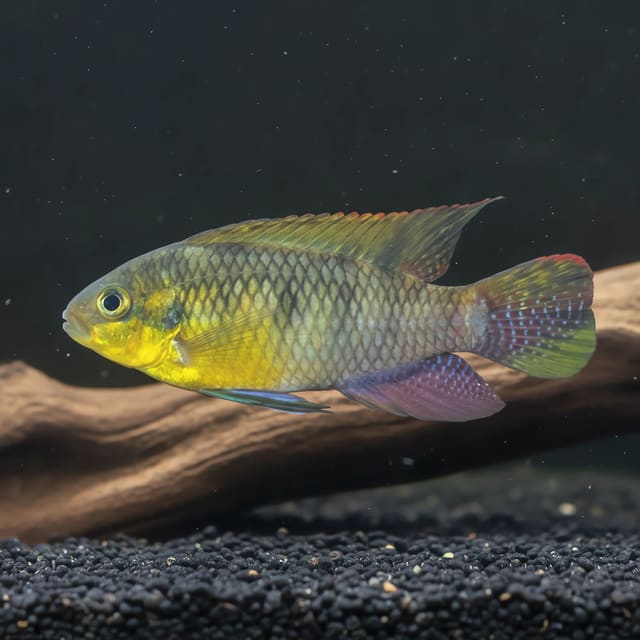
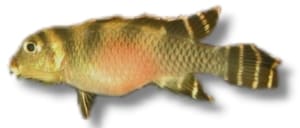
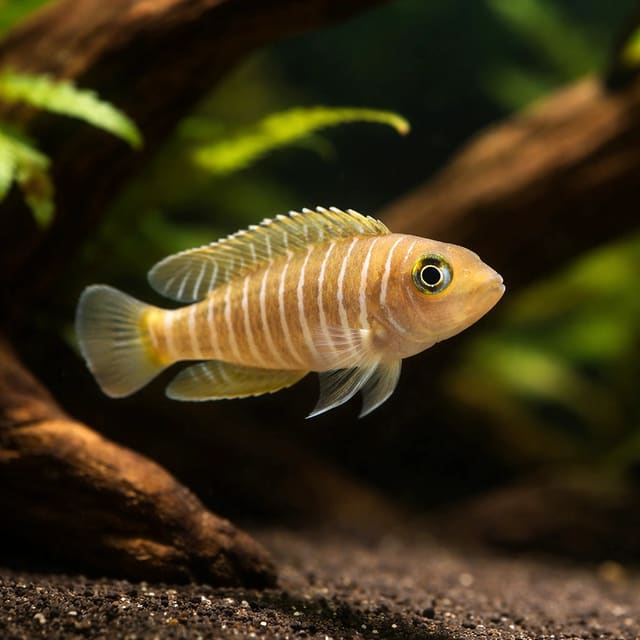
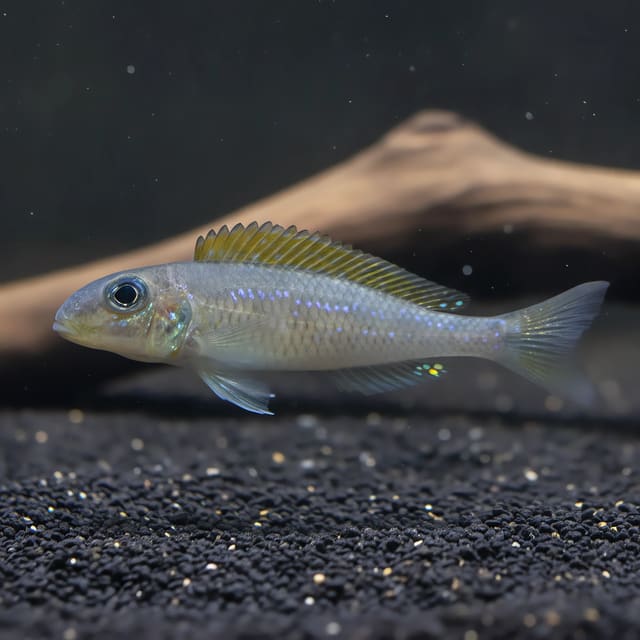
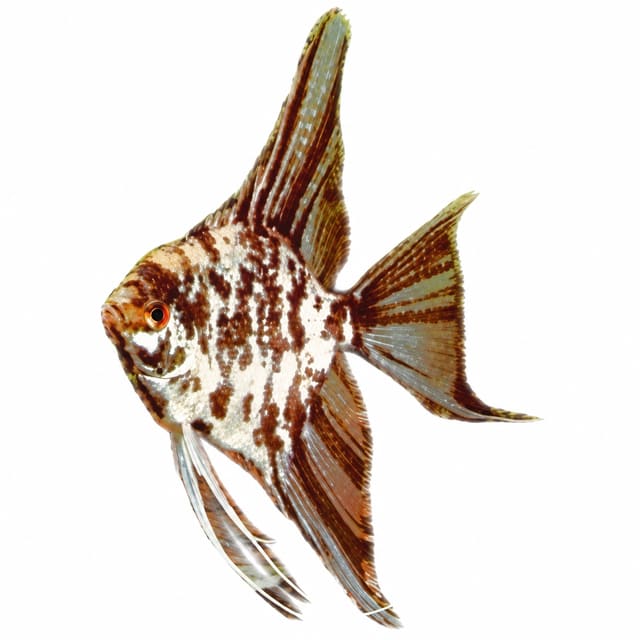
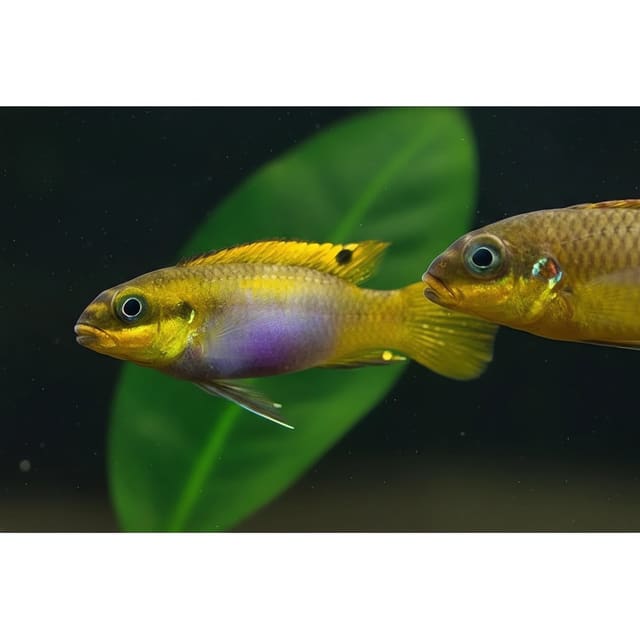
The gallery images are representative of this type of animal rather than photographs of the exact animal supplied, so colours can look slightly different from the live animal.
The pictured markings are useful for understanding the general Kienke appearance, but colour should not be used to infer the sex or life stage of the animal selected. You can also browse our African cichlid collection when comparing body shape, territorial behaviour and aquarium requirements across related choices.
| Suits | Not suited to |
|---|---|
| Pair-focused aquariums with several caves and covered retreats | Plans involving very vigorous or large species |
| Aquariums of at least 71 litres and at least 80 cm long for a pair | Layouts without enough shelter for each fish |
| Stable water at 22–26°C, pH 6.0–7.5 and 5–12 dGH | Aquariums outside the routine water range |
Use adult dimensions and territorial behaviour to choose the aquarium. FishBase gives a maximum recorded length of 7.1 cm standard length, while the Seriously Fish species profile uses 8 cm standard length as its aquarium-planning reference. Use 7.1 cm standard length as the adult-size figure while arranging caves, open ground and routes between shelters.
| Decision | Planning figure |
|---|---|
| Single pair | At least 71 litres |
| Aquarium length | At least 80 cm |
| Community plan | At least 80 litres, then increase space for territories |
| Adult size | 7.1 cm standard length |
Seriously Fish considers 71 litres suitable for a single pair, while FishBase recommends a minimum aquarium length of 80 cm. Meet both considerations by choosing a tank of at least 71 litres with an 80 cm or longer footprint. OATA says an aquarium of at least 80 litres will be needed when dwarf cichlids are mixed with other fish; treat that as the minimum community volume while also allowing enough territory for the proposed occupants.
Seriously Fish gives 22–26°C, pH 5.0–7.5 and 5–12 dGH for aquarium care. OATA’s dwarf-cichlid sheet supplies group guidance rather than a species-specific optimum: 22–27°C, pH 6.0–8.0 and 4–12 dGH. Use the overlap for routine care: 22–26°C, pH 6.0–7.5 and 5–12 dGH.
These figures suit an aquarium that is biologically mature, filtered and arranged with several secure retreats. Stable conditions matter more than repeatedly altering the water to hit a single number within the range.
Build the aquarium around several hiding places and potential cave sites before introducing the fish. Clay pots, purpose-made caves, roots and pieces of driftwood are all suitable ways to create sheltered areas. Several choices are better than one prized cave because a fish can move away from pressure instead of being trapped beside the only retreat.
Plants are not essential for this species, but the added cover can help a shy fish feel secure. Where live plants are not used, artificial plants and suitable ornaments can perform the same screening role. Cover should create separation without filling every part of the floor, because the fish also needs accessible feeding ground and clear routes between shelters.
Look across the tank at fish level before filling it. If every cave entrance is visible from the opposite end, add another piece of wood or a plant group between them. If one shelter can be entered only by passing another cave, move it so the entrance has an independent route. This simple check turns decoration into functional territory planning.
A well-divided footprint is particularly important for a pair because even settled fish will often chase each other. It also gives community fish somewhere to pass without crossing directly in front of a guarded cave. Extra water volume helps stability, but it does not replace separated cover and usable floor space.
Use sand or fine gravel because Pelvicachromis taeniatus may excavate pits when breeding. A fine surface lets the fish move material without negotiating large, sharp pieces, and it makes uneaten food and solid waste easier to spot during routine checks.
Position the main shelters securely and check that they do not rock when the surrounding substrate is moved. The fish may shift material around an entrance, so a cave should remain stable even if a shallow pit develops beside it. Build the firm structure first, then arrange the sand or fine gravel around it rather than relying on a loose mound to hold it in place.
Roots and driftwood can provide both overhead cover and visual separation. Check that each piece remains stable and that its placement leaves a clear route around it. Avoid creating narrow gaps where a fish can enter but cannot turn or leave easily.
Plants add useful cover, but the fish may alter the substrate near a cave. Place important roots away from the most obvious entrances and observe whether new pits expose them. If a plant repeatedly loosens, move it to a quieter area instead of rebuilding the same spot after every disturbance.
| If you see | Do this |
|---|---|
| A pit forming by a cave | Leave it unless the shelter becomes unstable |
| An exposed plant root | Move or resecure the plant away from the entrance |
| Waste collecting behind wood | Siphon that pocket during the weekly water change |
| A cave starting to rock | Stabilise it before the fish resumes using the area |
Excavation is a reason to make the layout resilient, not to keep rebuilding every change the fish makes. Preserve safe structures, clear waste traps and allow harmless pits to remain part of the territory.
Prepare a mature aquarium and confirm the water values before choosing an introduction date. If this is your first setup, follow our first tropical aquarium guide so the biological filter is established before livestock is added.
| Measurement | Routine target |
|---|---|
| Temperature | 22–26°C |
| pH | 6.0–7.5 |
| General hardness | 5–12 dGH |
| Ammonia | 0 mg/l |
| Nitrite | 0 mg/l |
| Nitrate | No more than 20 mg/l above the normal tap-water level |
Read our water chemistry guide if you need help distinguishing pH, hardness and nitrogen-waste measurements. Test the aquarium itself rather than assuming it matches the tap. Decor, substrate, biological activity and water changes can all influence what the fish experiences.
If the temperature is 24°C, pH is 7.0, hardness is 8 dGH and ammonia and nitrite are both 0 mg/l, the readings sit inside the routine targets. If pH is 7.8, do not add the fish and then make a sudden correction around it; establish a stable approach that brings the aquarium within 6.0–7.5 first. If ammonia or nitrite is detectable, pause the introduction regardless of the other readings.
The water matcher can compare your measured values with these targets. Write down the results and test at the same time of day where practical, because a short sequence is more useful than a single isolated reading.
Keep the temperature, pH and hardness steady within range rather than repeatedly adjusting them towards a supposed perfect point. A stable reading of pH 7.0 is preferable to sharp movement between 6.2 and 7.4 caused by frequent intervention.
A working filter is essential. The RSPCA explains that biological filtration supports beneficial bacteria that convert toxic ammonia to nitrite and then to the safer nitrate. That process only protects the fish when the filter is mature, running continuously and maintained without killing the bacterial population.
Do not rinse filter media under the tap. Chlorine or chloramine may damage the beneficial bacteria that make the filter effective. If media needs cleaning, rinse it lightly in aquarium water removed during the partial water change.
| Result | Action |
|---|---|
| Ammonia above 0 mg/l | Pause further stocking and address water quality immediately |
| Nitrite above 0 mg/l | Treat it as an urgent filter or loading problem |
| Nitrate rising quickly | Review feeding, waste removal and water-change consistency |
| Reduced filter output | Check for a blockage before flow deteriorates further |
Add fish gradually because every addition increases waste and feeding. The bacterial population must expand to process that extra load. Adding too many animals at once can overwhelm the filter and lead to new tank syndrome, even when the aquarium looked clear beforehand.
Clear water is not the same as safe water. Ammonia and nitrite require testing, and small amounts can stress dwarf cichlids before cloudiness or visible waste appears.
Pelvicachromis taeniatus accepts a range of aquarium foods, but live and frozen varieties should form the bulk of its diet. Use a good-quality flake or granule as supporting variety, then rotate suitably small live or frozen foods such as daphnia, brine shrimp or tubifex.
Feed once a day and offer only what the fish can finish within a few minutes. Start with a small amount, watch it being taken, and add a little more only while the fish is actively eating. Remove or siphon persistent leftovers rather than leaving them to break down.
| Feeding observation | Next decision |
|---|---|
| Food is eaten promptly | Keep the next ration similar |
| Food remains after a few minutes | Reduce the next ration and remove leftovers |
| Other fish take everything first | Spread a small ration near separate covered areas |
| Interest in food drops | Test water and check for other behavioural changes |
For example, if a small first pinch disappears quickly but a second sits on the substrate, the useful ration is closer to the first amount. Do not interpret begging or movement at the front glass as proof that another full feed is needed.
Uneaten food decomposes and adds to the waste the biological filter must process. Overfeeding therefore affects more than body condition: it can contribute to rising ammonia, nitrite or nitrate and increase the amount of debris held between substrate grains and behind wood.
In a community, check that the dwarf cichlid receives food rather than judging the ration only by how fast active tank mates eat. Place small portions where the fish emerges from cover, while keeping the total amount within the few-minute limit. This gives a shy fish access without turning hidden corners into waste traps.
Arrange for someone to receive the parcel and prepare the aquarium before opening it. The filter should be running, the temperature should be stable within 22–26°C, and recent tests should show ammonia and nitrite at 0 mg/l.
These steps follow our delivery and Live Arrival Guarantee policy, which also explains the current delivery process and what is required if a claim is needed.
A newly introduced dwarf cichlid may move towards cover. Check breathing, balance and swimming, then give it space to orient itself. Do not dismantle the layout to force the fish into view unless an immediate welfare concern requires intervention.
Test the water if breathing becomes unusually fast, the fish hangs at the surface, swims erratically or loses balance. Confirm temperature, ammonia and nitrite first because those readings lead directly to practical action. Avoid making several unrelated water adjustments at once; identify the out-of-range value and deal with that problem while keeping the rest of the environment stable.
Introduce any later fish slowly. Each addition increases the biological load, so the filter and water tests—not the visual emptiness of the aquarium—should determine the pace.
Learn the individual fish’s normal pattern over the first week: where it shelters, when it emerges, how strongly it feeds and how it responds to nearby tank mates. A shy fish using cover is different from a sudden increase in hiding accompanied by rapid breathing, poor feeding or colour change.
| Change to watch | First action |
|---|---|
| Hanging at the surface | Test temperature, ammonia and nitrite |
| Erratic swimming | Check water and look for pursuit by tank mates |
| Much darker or paler colour | Compare behaviour, breathing and feeding with normal |
| Faster or slower gill movement | Test water promptly |
| White spots or fluffy growth | Separate observations from diagnosis and seek guidance |
| Lost fins or scales | Check decor, cave disputes and tank-mate pressure |
| Reduced food intake | Test water and review access to the feeding area |
Start with water because ammonia and nitrite should always be 0 mg/l and a temperature outside 22–26°C requires attention. Also inspect the filter for blockage and check whether food or solid waste is collecting behind shelters.
Occasional movement away from another fish can occur, especially around caves. Act when one individual is repeatedly driven from every shelter, prevented from feeding, held in a corner or forced to remain at the surface. Add or rearrange visual cover only after checking that the new layout will not collapse or remove every established retreat at once.
Colour and fin shape can differ between sexes in mature fish: males are described as larger with pointed dorsal and anal fins, while females may become rounder and develop a pink flank flush in spawning condition. These traits explain natural variation, but they should not be used to promise the sex of an individual animal.
Keep dated notes when something changes. A short sequence of water readings, feeding responses and photographs of a visible health change is more useful than relying on memory. If abnormal breathing, swimming, appetite or external marks persist, contact us for health guidance.
Pelvicachromis taeniatus can live in a carefully planned general community, but it is generally shy and becomes territorial when breeding. Avoid very vigorous or large species. They can dominate feeding, keep the dwarf cichlid inside cover or make it difficult for a pair to hold a cave without continual conflict.
| Question | Decision |
|---|---|
| Is the proposed fish very large or vigorous? | Avoid the combination |
| Will it monopolise food? | Choose a calmer alternative or separate feeding areas |
| Does it repeatedly enter caves? | Treat it as a spawning-site conflict risk |
| Can every fish leave a defended area? | Proceed only with clear routes and spare cover |
| Is the aquarium only just above the minimum? | Keep the stocking plan simpler |
Seriously Fish names small characins, barbs, danios, rasboras, Corydoras, gouramis and loricariids as possible companions. Those names are a screening starting point, not a universal promise. The aquarium must still have enough room, suitable water, compatible adult sizes and calm enough feeding behaviour for the exact animals involved.
Other cichlids require particular care because both fish may need territories. West African dwarf cichlids can be considered where the aquarium has enough floor space and separated shelters, but do not assume that sharing a region or family makes two species compatible.
OATA says an aquarium of at least 80 litres will be needed when dwarf cichlids are mixed with other fish. A community also has to satisfy the 80 cm minimum aquarium length associated with this species and provide several retreat choices. Increase space when the proposed occupants use the same lower areas, caves or feeding ground.
Compatibility beyond these conditions remains dependent on the individual fish, aquarium dimensions and territory layout. Monitor feeding access and pursuit after every addition, and be ready to separate fish if one animal cannot use shelter or open water normally.
The recommended social plan is a pair, but buying two fish does not guarantee that they will form a compatible pair. Even a male and female may reject one another, and this offer does not select animals by guaranteed sex. Build the aquarium so each fish can use a separate retreat from the beginning.
Respond to excessive pressure by separating the fish rather than waiting for visible injury. Adding one small ornament rarely fixes a layout where the dominant fish can still see every cave. Effective changes create genuinely separate sheltered areas with independent entrances.
More than one pair requires a large aquarium with enough territory for each pair. Do not calculate the requirement by simply multiplying 71 litres while ignoring the shape of the tank. Floor length, cave spacing and broken sight lines determine whether separate territories can function.
When breeding behaviour develops, territoriality may extend beyond the cave entrance. Tank mates that investigate spawning sites or may prey on fry should be avoided in a breeding plan. In a general display, watch whether ordinary movement past the cave causes brief displacement or sustained pursuit across the aquarium.
A useful checkpoint is whether every fish can feed within a few minutes without entering another animal’s defended shelter. If one individual consistently misses food, change the stocking arrangement or separate it; do not compensate by adding excess food that will decay in hidden areas.
It is the Kienke named form of a West African dwarf cichlid. The species is a freshwater, cave-spawning substrate brooder in the family Cichlidae.
One purchase supplies one animal. Pair care is recommended, but purchasing two animals does not ensure that they will form a compatible pair.
It reaches 7.1 cm standard length, which is the adult-size figure to use when planning the aquarium.
Plan at least 71 litres for a pair and an aquarium at least 80 cm long, with sand or fine gravel, several caves, roots or wood and broken sight lines.
Pair care is recommended. Give each fish separate cover, and use a much larger aquarium with distinct territories if considering more than one pair.
Keep this fish at 22–26°C, pH 6.0–7.5 and 5–12 dGH, the overlap between the Seriously Fish species range and OATA’s dwarf-cichlid group guidance; keep ammonia and nitrite at 0 mg/l.
Feed once daily, making small live and frozen foods the bulk of the diet, with good-quality flake or granule as variety. Offer only what is eaten within a few minutes.
Start filming before opening the sealed parcel, keep one continuous take through opening and showing the fish in the sealed bag, then float the bag for 20–30 minutes before release and do not pour bag water into the aquarium.
Consider small characins, barbs, danios, rasboras, Corydoras, gouramis or loricariids only after checking space, water and feeding behaviour. Avoid very vigorous or large species, and provide enough room for breeding territory.
No reviews for this item yet. Bought one? Honest reviews only, good or bad.
What customers say about ordering from us
Easy website plenty of info on fish your buying great to pick a time slot
TRACEY DURRANT · 7 Oct 2026
Got some lovely fish thank you
Kevin Mackie · 7 Oct 2026
Reviews of our shop, collected by Judge.me, an independent third-party review collector. Newest first.