Moderate
Map Blue Angelfish (Pterophyllum scalare) – Blue Pattern Colour Form
24–28°C · pH 6–7.5 · 150L
£12.99

The Platinum White Angelfish (Pterophyllum scalare) is a freshwater cichlid from the Amazon basin that reaches 15 cm. It suits a prepared intermediate keeper planning a compatible pair in roughly 200 litres or a group of five or more with extra space; Tropical Fish Co uses the FishBase–OATA overlap of 24–27°C, pH 6.5–8.0 and 5–12 dGH. Sold individually in dispatch sizes from 2.5–3 cm to XL 7–8 cm.
Adult size is the maximum length this species reaches at full maturity (scientific sources). The livestock you receive will be younger and smaller — pick a size above for the actual shipping size. Product-photo provenance and any image-specific limitations are stated on the listing.
Pterophyllum scalare
Save when buying multiple fish. Each quantity is one fish; sex and pair formation are not guaranteed unless the selected variant explicitly states them.
The Platinum White Angelfish (Pterophyllum scalare) is a freshwater cichlid from the Amazon basin that reaches 15 cm. It suits a prepared intermediate keeper planning a compatible pair in roughly 200 litres or a group of five or more with extra space; Tropical Fish Co uses the FishBase–OATA overlap of 24–27°C, pH 6.5–8.0 and 5–12 dGH. Sold individually in dispatch sizes from 2.5–3 cm to XL 7–8 cm.
Adult size is the maximum length this species reaches at full maturity (scientific sources). The livestock you receive will be younger and smaller — pick a size above for the actual shipping size. Product-photo provenance and any image-specific limitations are stated on the listing.
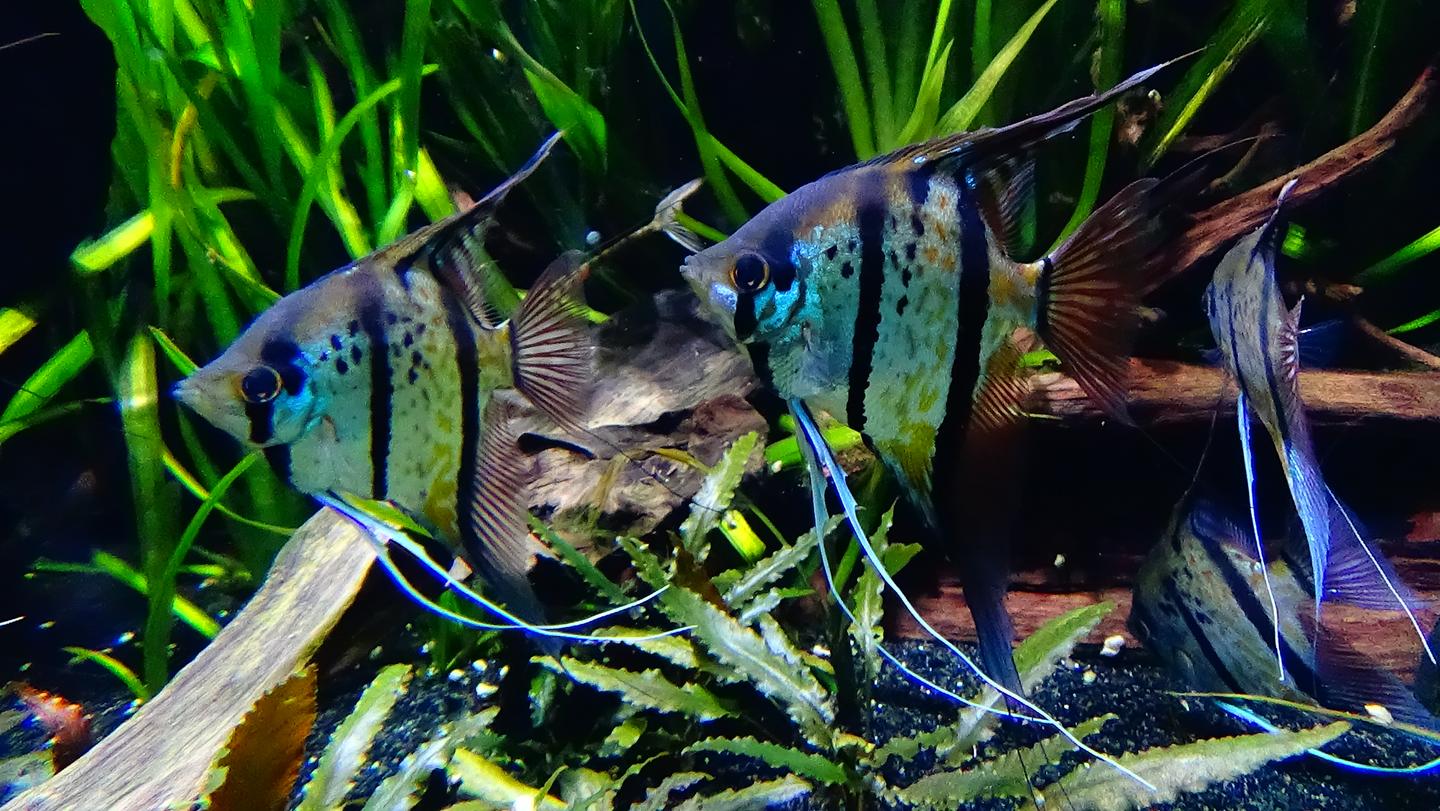
Freshwater angelfish are tall South American cichlids, not small community fish. OATA gives 120 litres as an industry floor for a compatible pair and says the aquarium must be sufficiently tall. We prefer planning around roughly 200 litres, a 100 × 40 cm footprint and about 50 cm height for an adult pair, with more space and an exit plan for a group.
Maintain these water conditions for optimal health and vibrant colors
The Platinum White Angelfish is a domestic colour form of Pterophyllum scalare, a freshwater cichlid from the Amazon basin that reaches approximately 15 cm. Platinum describes its colour rather than a separate species, locality or additional part of its scientific name. It suits a prepared intermediate keeper who can provide a large, tall aquarium, stable warm water and active management of changing cichlid relationships.
FishBase places Pterophyllum scalare in the cichlid family Cichlidae. It describes wild adults living among dense aquatic and river-edge vegetation in swamps and flooded ground, where the water may be clear or silty. That natural history makes tall plants, roots and upright wood sensible layout inspiration, while leaving open water for turning and feeding.
The wild species occurs across parts of the Amazon basin in Peru, Colombia and Brazil, with further records from French Guiana and Guyana. Eschmeyer’s Catalog of Fishes recognises Pterophyllum scalare as the accepted name. The platinum aquarium form should not be treated as a distinct wild population or assigned a separate geographical origin.
Adult-size figures use different measurements. FishBase carries a 15 cm total-length maximum from an aquarium reference as well as a current 10.5 cm total-length field maximum. Our angelfish guidance therefore plans around approximately 15 cm total length, while the extended dorsal and anal fins may produce an overall height of about 20–25 cm. Individual proportions can vary, but a shallow aquarium chosen around the dispatch measurement is not an adult plan.
This is an intermediate-care fish in our range. The individual jobs are straightforward—test the water, feed measured portions and maintain the filter—but the aquarium must be large and tall enough before purchase. The keeper must also recognise exclusion, fin damage and territorial defence early enough to separate fish safely.
| Suits | Not suited to |
|---|---|
| A prepared keeper with roughly 200 litres and about 50 cm usable height for an adult pair | A short or shallow aquarium planned around the dispatch size |
| A compatible pair or managed group with backup accommodation | Permanent solitary keeping by default or two random fish assumed to be a pair |
| Stable warm freshwater with established filtration | An immature aquarium with detectable ammonia or nitrite |
| Calm companions screened for adult size, fins, water and feeding | Very small prey-sized fish, persistent fin-nippers or highly aggressive companions |
One purchase supplies one animal of the selected size. Use the live size selector to choose the dispatch label that suits your established aquarium and feeding plan. The labels are 3,5-4 cm, 5,5 - 6 cm, 3-3,5 cm, 2.5-3 cm, 6-7 cm, 4.0-4.5 cm and XL 7-8 cm.
The size you select is the size supplied, not the adult size. Every choice needs the same permanent provision for a tall adult angelfish. A larger dispatch measurement does not identify sex, guarantee a pair bond or reduce the need to manage future territorial behaviour. Choose food particles the fish can take cleanly and make sure filter intakes, gaps in decor and access to food are suitable for the selected size.
Sex is guaranteed only when the selected option explicitly states male or female. This Platinum White Angelfish listing has no sex-guaranteed option.
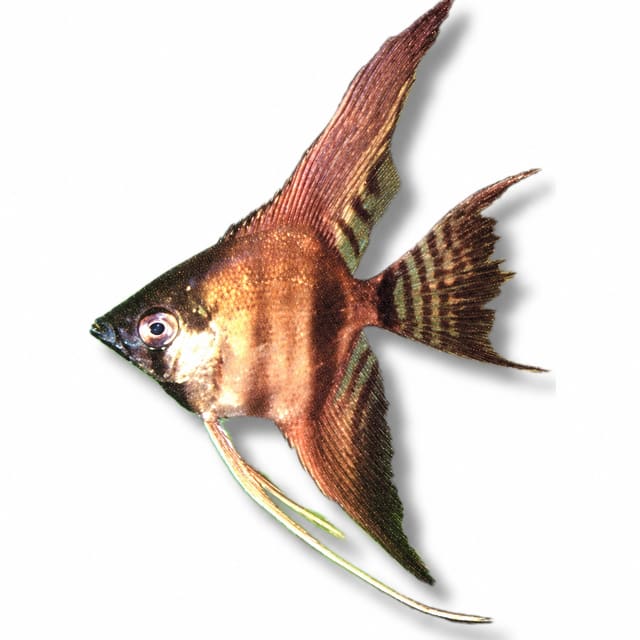
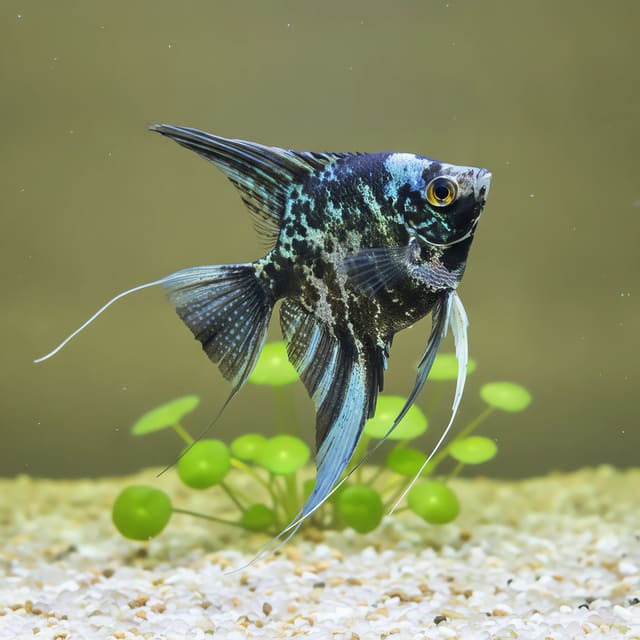
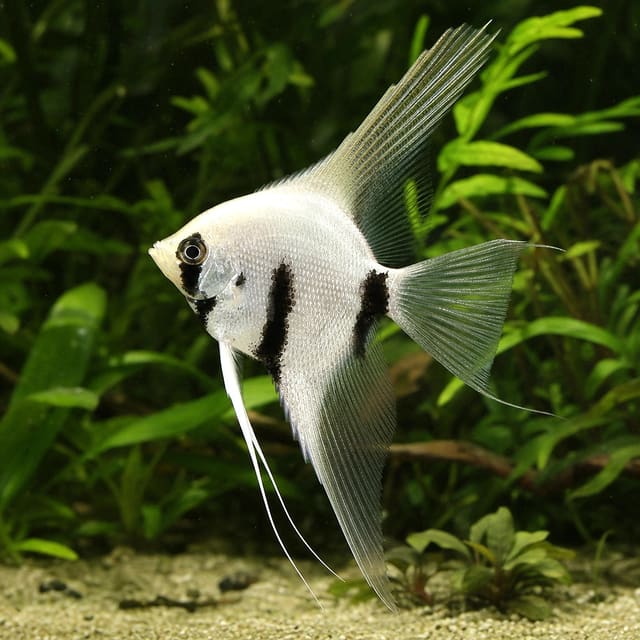
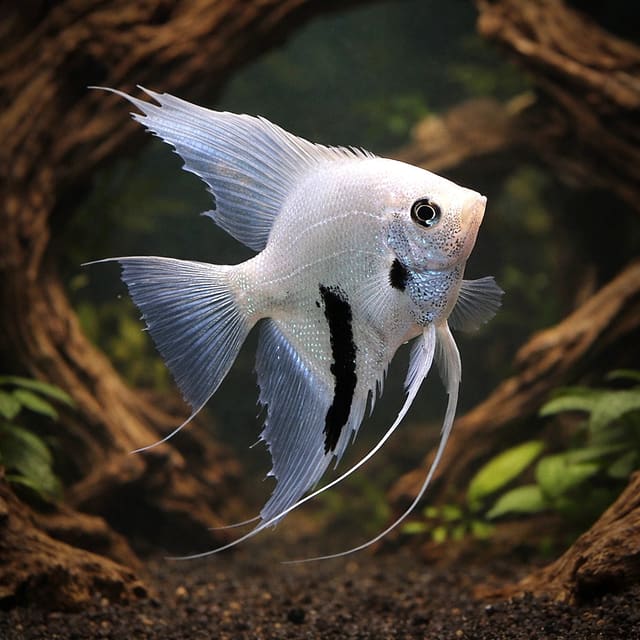
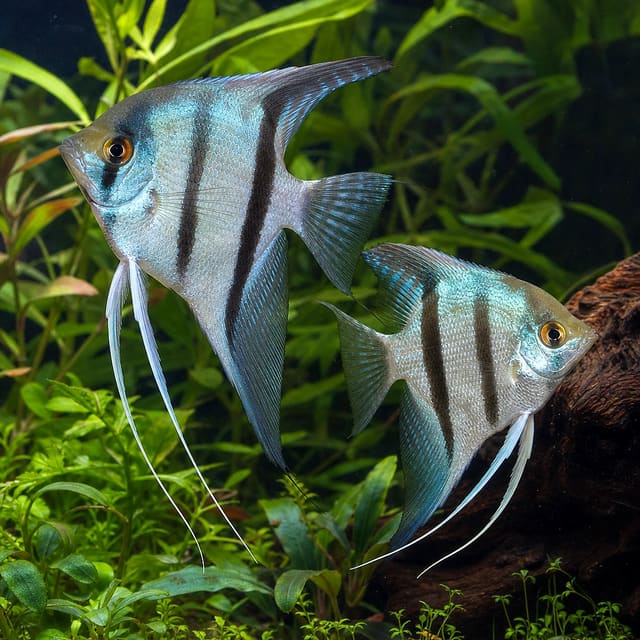
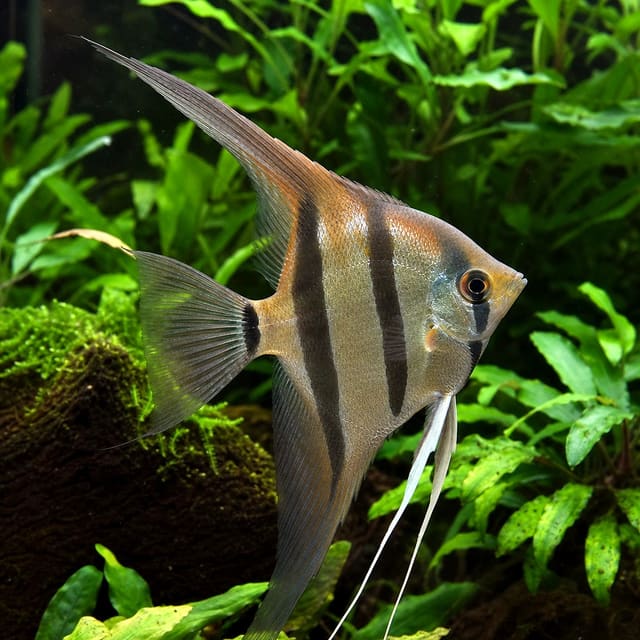
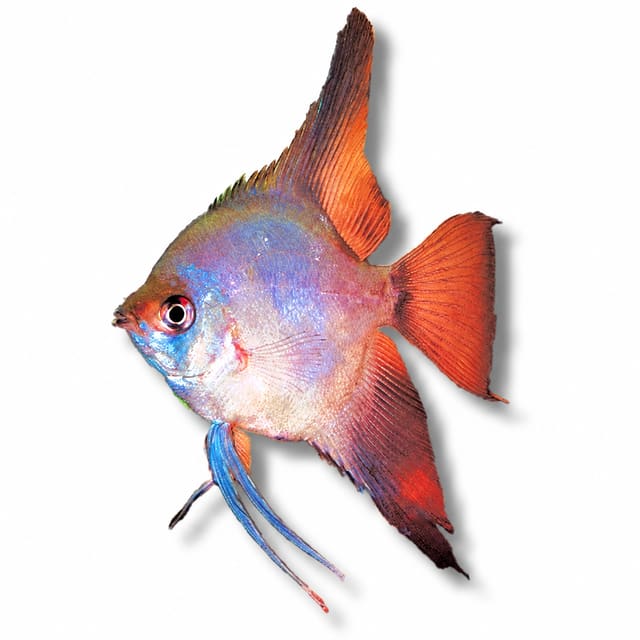
The gallery images are representative of this type of animal rather than photographs of the exact animal supplied, so colours can look slightly different from the live animal. The visible example shows the platinum form’s pearly-white body and long translucent fins, but individual appearance can vary. Compare other forms through the angelfish collection only after settling the adult space and social plan.
Our complete freshwater angelfish care guide recommends roughly 200 litres, a footprint of about 100 × 40 cm and around 50 cm usable height for an adult pair. Seriously Fish likewise gives approximately 200 litres and 100 × 40 × 50 cm as the smallest aquarium it would consider. More space is needed for a group or community, and dimensions remain as important as the nominal volume.
OATA’s broad American-cichlid guidance gives at least 120 litres for a compatible pair of smaller species, requires sufficient height for angelfish and advises a pair or group at minimum. We use the more conservative 200-litre planning point for an adult pair. Routine water targets are 24–27°C, pH 6.5–8.0 and 5–12 dGH, chosen within the angelfish ranges and OATA guidance.
| Before selecting | Decision |
|---|---|
| Permanent aquarium | Plan roughly 200 litres and 100 × 40 × 50 cm for an adult pair. |
| Social arrangement | Do not assume two randomly selected fish are compatible. |
| Community | Allow extra territory and screen every companion at adult size. |
| Backup | Prepare suitable separation before aggression appears. |
Use roughly 200 litres, a 100 × 40 cm footprint and about 50 cm of usable height as the planning point for an adult pair. Usable height means the clear swimming depth after allowing for substrate, decor, equipment and the space beneath the lid. A nominally tall aquarium can still be unsuitable if hardscape leaves the fish unable to turn or extend its fins freely.
The 100 cm length and 40 cm width provide horizontal movement and territory as well as volume. Height alone is not enough: a narrow column may accommodate the fins vertically while denying an adult adequate turning room. Conversely, a long but shallow aquarium can restrict the dorsal and anal fins despite carrying a large litre figure.
A group needs substantially more room than an adult pair because several fish must be able to feed, retreat and avoid uninterrupted pursuit. Litres alone cannot calculate that provision. Group size, pair formation, aquarium shape, decor, filtration and the size of other inhabitants all change how much usable territory remains.
| If the aquarium has | Then check |
|---|---|
| A deep substrate | Whether about 50 cm of open vertical water remains. |
| Large branching wood | Whether every route leaves fin-safe turning clearance. |
| A territorial pair | Whether another fish can retreat without being cornered. |
| A community | Whether adult stocking still leaves feeding and resting space. |
Do not use the smallest fish label to justify a temporary aquarium with no adult route. Moving a growing angelfish later depends on another suitable, mature aquarium being ready at the right time. Establishing the permanent dimensions first removes that risk and lets the fish settle into a stable layout.
Maintain 24–27°C, pH 6.5–8.0 and approximately 5–12 dGH as the routine target. These values sit within FishBase’s 24–30°C, pH 6.0–8.0 and 5–13 dGH range and within the compatible part of the American-cichlid guidance. Seriously Fish gives 24–30°C, pH 6.0–7.4 and 0–15 dGH for aquarium care. The pH target follows the FishBase–OATA overlap and our store guidance; Seriously Fish uses a narrower upper limit of 7.4.
| Measurement | Routine target |
|---|---|
| Temperature | 24–27°C |
| pH | 6.5–8.0 |
| General hardness | 5–12 dGH |
| Ammonia | Zero detectable |
| Nitrite | Zero detectable |
Measure the aquarium before introducing the fish and record the result rather than adjusting water towards a guessed ideal. Use a thermometer as well as the heater setting. Test pH and hardness before making any change to tap-water preparation, because the same recipe can produce different results in different homes.
The water chemistry guide explains how pH, GH and KH relate to aquarium stability. Once you have measured values, use the water matcher to compare the aquarium with the stated range. The purpose is to identify a mismatch before the animal is introduced, not to encourage repeated adjustments to a stable aquarium that already sits within range.
Stability does not mean ignoring harmful waste. It means avoiding unnecessary swings in temperature, pH or hardness while acting promptly on detectable ammonia or nitrite. Make elective chemistry changes gradually and base them on repeated measurements rather than appearance, postcode or a fixed mixing ratio.
Use a fully established biological filter before introducing the angelfish. The RSPCA explains that fish release toxic ammonia, which a working biological filter converts first to nitrite and then to the safer nitrate. Both ammonia and nitrite must remain at zero detectable levels.
A calendar date does not demonstrate that the filter can process waste. Test the aquarium and confirm its performance before adding livestock. If this is your first setup, follow the steps for a prepared and mature first aquarium before choosing a dispatch size.
Seriously Fish uses a turnover of four to five times the aquarium volume each hour as a practical reference for an approximately 200-litre setup, equivalent to a filter rating around 800–1000 litres per hour. Ratings are planning figures rather than a promise of actual flow once media, pipework and head height are included. Arrange the outlet so it supports oxygen exchange without making the fish struggle continuously against a harsh current.
For a worked example, a 200-litre aquarium multiplied by four gives 800 litres per hour, while multiplying by five gives 1000 litres per hour. That calculation is a starting point for choosing equipment. The final layout must still provide gentle areas where an angelfish can hold position and rest while maintaining circulation through the whole aquarium.
Increase livestock gradually because every added animal and every increase in feeding raises the waste load. Test after a stocking change instead of assuming the existing bacterial population will adjust immediately. Detecting a rise early gives you a chance to protect the fish before appetite, breathing or swimming deteriorates.
Create a mixture of upright cover and open swimming room. Tall leafy plants and vertical wood echo the densely vegetated habitats used by wild freshwater angelfish, while clear lanes let the adult turn and approach food without dragging its fins. Use smooth surfaces and remove sharp points from the routes the fish uses regularly.
Vertical structure also breaks direct lines of sight. This matters when fish establish a hierarchy or a pair starts defending part of the aquarium. A barrier works only if the pursued fish can move beyond it into usable space; a dense wall that creates a blind corner may trap the weaker animal instead.
| Layout element | Purpose |
|---|---|
| Tall plants or upright wood | Provide cover and interrupt prolonged chasing. |
| Open central or front area | Leave turning, observation and feeding room. |
| Smooth substrate and decor | Reduce the chance of damage to extended fins. |
| Secure lid | Prevent escape while preserving maintenance access. |
| Protected equipment | Keep fins and smaller dispatch sizes away from hazards. |
During the first weeks, note where the fish rests, feeds and retreats. Open fins, steady swimming and free movement through the full aquarium indicate that the layout is usable. Repeated hovering in one corner, reluctance to cross an exposed area or persistent pursuit around a barrier means the arrangement needs attention.
Broad leaves, slate, aquarium glass or another upright surface may become a spawning site. Seriously Fish describes angelfish laying eggs on vertical surfaces and guarding eggs and fry. Spawning can turn a previously shared area into defended territory, so do not interpret breeding behaviour as proof that the community still has enough room.
Secure wood, stones and other decor so digging or maintenance cannot make them fall. Leave access to siphon trapped waste and inspect the fish from more than one angle. A visually complex aquarium remains practical only when you can see whether each fish is eating, breathing regularly and keeping its fins intact.
Review the layout whenever the social pattern changes. Moving one sight-line barrier can sometimes interrupt pursuit, but persistent exclusion requires suitable separation rather than repeated rearrangement. Prepare that separate accommodation before relying on decor to resolve a serious conflict.
Do not keep a single angelfish merely because it is convenient for the aquarium. OATA advises that angelfish should be kept as a pair or group at minimum and warns that a fish kept alone may become stressed. FishBase gives five or more when keeping a group, while Seriously Fish recommends small groups because members may squabble with their own kind.
A compatible pair is not the same as two fish selected at random. Sex is difficult to determine reliably outside spawning, and even two fish of different sexes would not guarantee a stable bond. Watch how both animals share food, cover and open water rather than using purchase quantity as evidence of compatibility.
| Social route | What the plan requires |
|---|---|
| Compatible adult pair | Roughly 200 litres, tall dimensions and backup separation. |
| Group of five or more | Substantially more space, visual barriers and equal feeding access. |
| Community containing a pair | Extra territory and a response plan for spawning aggression. |
| One fish left after conflict | A prompt welfare reassessment rather than permanent isolation by default. |
When a group forms pairs, hierarchy and access can change quickly. One fish may be driven away from food, confined behind decor or repeatedly chased across open water. Torn fins, weight loss, darkened or pale colour, hiding and reduced feeding are reasons to act rather than signs that every hierarchy should be left alone.
Prepare a second mature, heated and filtered aquarium or a realistic rehoming route before conflict begins. A divider can be useful only when each side still provides adequate height, swimming room, filtration and shelter. Dividing an already marginal aquarium does not create two suitable homes.
Breeding can intensify territorial defence around eggs and fry. Both parents may guard the site, and other inhabitants may repeatedly enter the defended area. Decide in advance whether the pair will remain in a community or move to suitable dedicated accommodation; do not wait until another fish is injured.
Count feeding access as part of social care. A fish that reaches the food first is not necessarily thriving if it spends the rest of the day chasing others. Observe the whole group before and after feeding, and separate any individual facing persistent exclusion.
Freshwater angelfish are omnivorous. Seriously Fish notes that wild fish feed predominantly on zoobenthos such as small crustaceans and other aquatic invertebrates, while aquarium fish accept pellet or flake food and live or frozen items. Use that biology to provide a complete staple with suitable variety rather than relying on one rich treat.
Feed a nutritionally complete cichlid pellet, granule or suitable flake in a particle size the selected fish can swallow cleanly. Add appropriate frozen or freeze-dried foods such as daphnia, brine shrimp or bloodworm for variety. OATA advises feeding once a day and offering only what the fish consume within a few minutes.
A controlled study of different feed types in freshwater angelfish found that feed composition affected growth and reproductive performance. It supports taking diet quality seriously, but it does not turn one tested feed into a universal household menu.
| Food decision | How to use it |
|---|---|
| Complete pellet, granule or flake | Use as the measured nutritional staple. |
| Frozen or freeze-dried variety | Add suitable items without replacing the complete diet. |
| Particle size | Choose pieces the fish can take without repeated spitting. |
| Daily portion | Offer only what is eaten within a few minutes. |
| Uneaten food | Remove it before it breaks down into waste. |
Watch the whole pair or group rather than the quickest animal. If one fish blocks access, distribute a measured portion across more than one feeding point while staying within the few-minute limit. Confirm that subordinate fish take food instead of assuming that food disappearing means everyone has eaten.
Overfeeding creates excess faeces and uneaten food, increasing the load on the filter and contributing to toxic waste. If food remains after a few minutes, remove it and reduce the next measured portion. If appetite falls suddenly, test water and inspect breathing, swimming, body condition and social access before offering repeated alternatives.
Bloodworm, brine shrimp and other attractive foods are additions rather than complete diets by themselves. Maintain a consistent staple and use variety to complement it, not to reward selective feeding or conceal a continuing appetite problem.
Start with a partial water change of 25% at least once a week, as advised for American cichlids by OATA. Treat that percentage as a practical starting routine. Test results, stocking, feeding, filter performance and accumulated waste determine whether the aquarium needs adjustment.
For a 200-litre aquarium, 25% of the nominal volume is 50 litres. The actual water volume may be lower after substrate and decor, so consistency and measurements matter more than false precision. Prepare replacement water with tap-water conditioner to address chlorine or chloramine and match temperature closely before adding it.
A regular record lets you see gradual changes that are easy to miss from day to day. Note the readings, water-change amount, filter flow and any change in feeding or aggression. If nitrate rises faster from one week to the next, examine stocking, feeding, trapped waste and filtration rather than automatically making a chemistry adjustment.
| If you find | Do this |
|---|---|
| Detectable ammonia or nitrite | Act urgently to protect water quality and obtain qualified guidance. |
| Reduced filter flow | Check inlets, pipework and dirty mechanical media. |
| Uneaten food | Remove it and reduce the measured portion. |
| Rapid nitrate rise | Review waste load and increase measured maintenance as needed. |
| A large pH difference | Identify the cause before making a major water change. |
Do not wait for cloudy water or distressed behaviour before maintaining the aquarium. Equally, avoid replacing all filter media or making abrupt elective changes during routine work. The goal is a stable environment with predictable waste control.
Have the mature, heated and filtered aquarium ready before the animal arrives. Confirm 24–27°C, zero detectable ammonia and nitrite, suitable pH and hardness, secure decor and a protected filter intake. Keep the social plan settled so the new fish is not introduced while the aquarium is being substantially rearranged.
Follow the current delivery and Live Arrival Guarantee policy. Someone must be present to receive the parcel. Film every delivery continuously from the sealed parcel onward, including the parcel being opened and the fish still inside the sealed bag. Float the bag for 20–30 minutes before releasing the fish, and never pour the bag water into the aquarium.
After release, concentrate on steady swimming, regular breathing and the ability to hold position. Do not use immediate display colour as the sole health test. The gallery is representative, and an individual fish need not match the exact brightness of the example under different aquarium lighting.
| Checkpoint | What to assess |
|---|---|
| Water | Temperature, ammonia, nitrite and any unexpected pH change. |
| Feeding | Whether the fish takes suitable food without being excluded. |
| Breathing | Whether the gill covers move at a regular rate. |
| Fins and skin | Whether fins remain open and intact, without spots or wounds. |
| Social access | Whether the fish can reach cover, food and open water. |
Add further fish slowly because the established bacterial population must respond to every increase in waste and feeding. Do not combine a new arrival with several unrelated stocking changes if that makes water or social problems difficult to identify.
If the fish is repeatedly chased, cannot feed or is confined to one small area, use the prepared separation plan. Waiting for visible injury turns an observable access problem into a more serious welfare risk.
A settled angelfish should show steady swimming, regular breathing, clear eyes, open fins, an appropriate body profile and consistent feeding. Learn the individual’s normal pattern so a change in balance, appetite, breathing or social access is noticed promptly.
RSPCA fish-health guidance supports watching appearance and behaviour alongside water quality. Clamped or damaged fins, gasping, erratic swimming, unusual balance, white spots, fluffy growths, wounds, marked weight change, persistent hiding or sudden loss of appetite require action, but a visible sign alone is not a diagnosis.
Detectable ammonia or nitrite is urgent because even small amounts can stress American cichlids. Protect water quality promptly while avoiding abrupt elective pH, hardness or temperature changes. A waste emergency and a planned chemistry adjustment require different responses.
| Observed change | Immediate check |
|---|---|
| Fast breathing or surface hanging | Test ammonia, nitrite and temperature; inspect circulation. |
| Refusal to eat | Check water, social exclusion and other visible signs. |
| Torn fins | Assess decor and aggression, then separate where needed. |
| Persistent hiding | Check pursuit, feeding access and water measurements. |
| White spots or growths | Document the signs and obtain a diagnosis before treatment. |
Do not apply a universal temperature increase, combine medicines or use preventive medication without a diagnosis. In the UK, use only a lawful product labelled for the species and aquarium system, following its instructions or veterinary direction.
If a fish leaves the aquarium, return it to suitable water immediately using wet hands or a wet soft net, minimise handling and inspect breathing, balance and injury. Check and secure the lid, then seek fish-veterinary advice if recovery is abnormal.
Freshwater angelfish can live in a carefully planned robust community, but compatibility is conditional. Seriously Fish describes the species as generally peaceful while noting that it may squabble with its own kind and eat small fish such as tetras. OATA advises mixing calmer American cichlids only with appropriately robust companions under compatible conditions.
Avoid very small fish that an adult angelfish may swallow, persistent fin-nippers that can damage the extended fins and highly aggressive companions likely to create chronic conflict. Tiny shrimp and fry also face predation risk. These are screening categories rather than a promise about every individual encounter.
| Check | Decision question |
|---|---|
| Adult body size | Could the angelfish swallow the companion when fully grown? |
| Fin behaviour | Is the companion known to pursue or nip extended fins? |
| Temperament | Will both animals compete for the same territory? |
| Water overlap | Can both remain within 24–27°C and the planned chemistry? |
| Feeding style | Can each animal obtain food without chronic competition? |
Assess adult dimensions rather than the size seen at purchase. A fish that looks too large to swallow when young may still become prey if its adult body remains small, while a peaceful juvenile companion may develop territorial behaviour of its own. Compare permanent needs before relying on present appearance.
Different swimming levels may reduce direct competition, but they do not guarantee compatibility. Bottom-dwelling fish still need adequate floor area and matching water, and they may enter a spawning pair’s defended territory. Faster surface feeders can leave a slower or subordinate angelfish underfed even when no visible attack occurs.
Observe feeding access, fin condition, breathing, hiding and use of space after any introduction. Occasional display is different from persistent pursuit that prevents another fish from eating or resting. Use suitable separation when the pattern does not settle.
For a stocking and compatibility assessment, contact us with the aquarium’s dimensions, measured water, existing species and adult quantities. The answer depends on the whole aquarium rather than a universal tank-mate list.
Angelfish relationships can change as a pair forms or breeding begins. A fish that previously shared open water may start defending a vertical spawning surface and the surrounding territory. This change can affect other angelfish as well as community fish that repeatedly cross the defended area.
Do not assume another angelfish colour form is automatically a compatible addition. The fish share the same general body shape, swimming space and potential interest in vertical territory. Crowding several forms into a pair-sized aquarium does not create a stable display and may leave a subordinate fish with nowhere to retreat.
| What you see | Required response |
|---|---|
| Brief display with normal feeding | Continue close observation of access and fin condition. |
| Repeated pursuit across the aquarium | Add effective sight-line breaks and prepare separation. |
| One fish confined behind decor | Separate it into suitable accommodation. |
| Food blocked by a dominant fish | Use more than one feeding point and reassess the group. |
| Torn fins or wounds | Separate promptly and assess health and water quality. |
A sight-line barrier should give the pursued fish access to a genuine refuge, not merely conceal it from the keeper. Check behind plants and wood during feeding. If one animal remains hidden, loses condition or cannot cross the aquarium safely, the social plan is failing even if the dominant fish appears healthy.
Keep backup accommodation fully mature, heated and filtered. A temporary uncycled container may exchange aggression for poor water quality. Make sure the separated fish still has appropriate height, turning room, cover and access to food.
When planning a group of five or more, provide substantially more space than the adult-pair figure and expect the arrangement to change if pairs form. There is no single litre multiplier that accounts for aquarium shape, visual barriers, individual temperament and community stocking. The safe decision is to preserve surplus territory and a realistic route for moving fish.
Compatibility must be reassessed rather than declared permanent. Recheck after introductions, growth, layout changes and spawning behaviour. A pairing that worked for months may require a different arrangement once territory or feeding access changes.
A Platinum White Angelfish reaches approximately 15 cm total length, while its extended fins can produce an overall height of about 20–25 cm.
Plan roughly 200 litres, a 100 × 40 cm footprint and about 50 cm usable height for an adult pair; a group or community requires more room and a separation plan.
Keep a compatible pair or a deliberately managed group; FishBase gives five or more for a group, which needs substantially more space and backup accommodation.
Pterophyllum scalare is an intermediate-care fish suited to a prepared keeper who can maintain a mature tall aquarium and respond promptly to territorial conflict.
Feed a complete cichlid pellet, granule or suitable flake once daily, offering only what is eaten within a few minutes and adding appropriate frozen or freeze-dried variety.
Tropical Fish Co uses the FishBase–OATA overlap of 24–27°C, pH 6.5–8.0 and 5–12 dGH, with zero detectable ammonia and nitrite.
It is generally peaceful but may squabble with its own kind and defend a spawning territory; the main fin risk described for its community is exposure to persistent fin-nipping companions.
Choose calm, robust companions too large to swallow, with compatible water, territory and feeding behaviour; avoid very small fish, tiny shrimp and fry at predation risk, persistent fin-nippers and highly aggressive companions.
Start filming every delivery continuously while the parcel is still sealed. Someone must be present to receive it; film the parcel being opened with the fish still in the sealed bag, float the bag for 20–30 minutes, acclimatise slowly and never pour the bag water into the aquarium.
No reviews for this item yet. Bought one? Honest reviews only, good or bad.
What customers say about ordering from us
I have a small group of long finned mountain minnows. So was delighted to be able to order ten of this variety to increase the genetics in my tank . The ones I recieved are healthy but it’s to early to give a verdict on wether they are of a long finned type since they are small currently.
Gordon Walker · 23 Sept 2026
100% success travel and "installation". Pleased with quality of purchase. The Siamese fighter a bit "shy" so have not yet seen him at his best yet but looking good. Happy customer. GG
George E Garratt · 21 Sept 2026
Reviews of our shop, collected by Judge.me, an independent third-party review collector. Newest first.