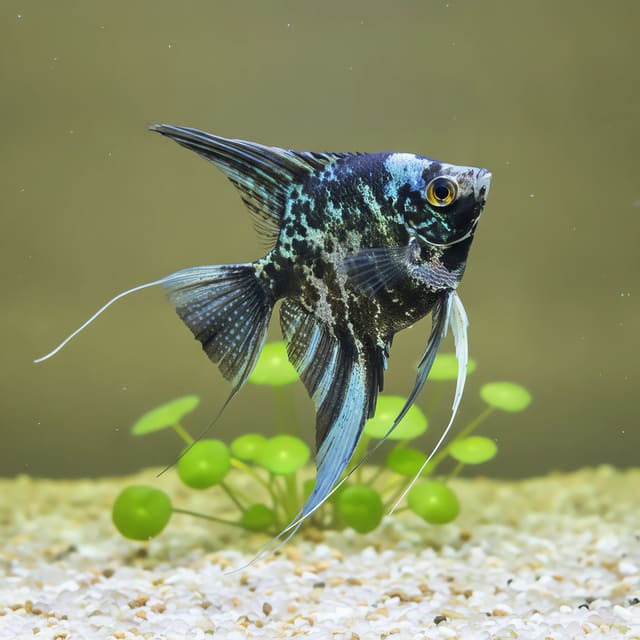
Moderate
Platinum White Angelfish (Pterophyllum scalare)
24–27°C · pH 6.5–8 · 200L
£14.99

The Smoke Angelfish (Pterophyllum scalare) is a domestic freshwater cichlid form of an Amazon-basin species that reaches 10.5 cm. It suits prepared keepers planning a compatible pair around roughly 200 litres at 24–27°C, pH 6.5–7.4 and 5–12 dGH, the overlap of FishBase, Seriously Fish and OATA guidance. Sold individually in sizes from 1 cm to XXL (>7.5 cm).
Adult size is the maximum length this species reaches at full maturity (scientific sources). The livestock you receive will be younger and smaller — pick a size above for the actual shipping size. Product-photo provenance and any image-specific limitations are stated on the listing.
Pterophyllum scalare
Save when buying multiple fish. Each quantity is one fish; sex and pair formation are not guaranteed unless the selected variant explicitly states them.
Minimum of 2 per order.
The Smoke Angelfish (Pterophyllum scalare) is a domestic freshwater cichlid form of an Amazon-basin species that reaches 10.5 cm. It suits prepared keepers planning a compatible pair around roughly 200 litres at 24–27°C, pH 6.5–7.4 and 5–12 dGH, the overlap of FishBase, Seriously Fish and OATA guidance. Sold individually in sizes from 1 cm to XXL (>7.5 cm).
Adult size is the maximum length this species reaches at full maturity (scientific sources). The livestock you receive will be younger and smaller — pick a size above for the actual shipping size. Product-photo provenance and any image-specific limitations are stated on the listing.
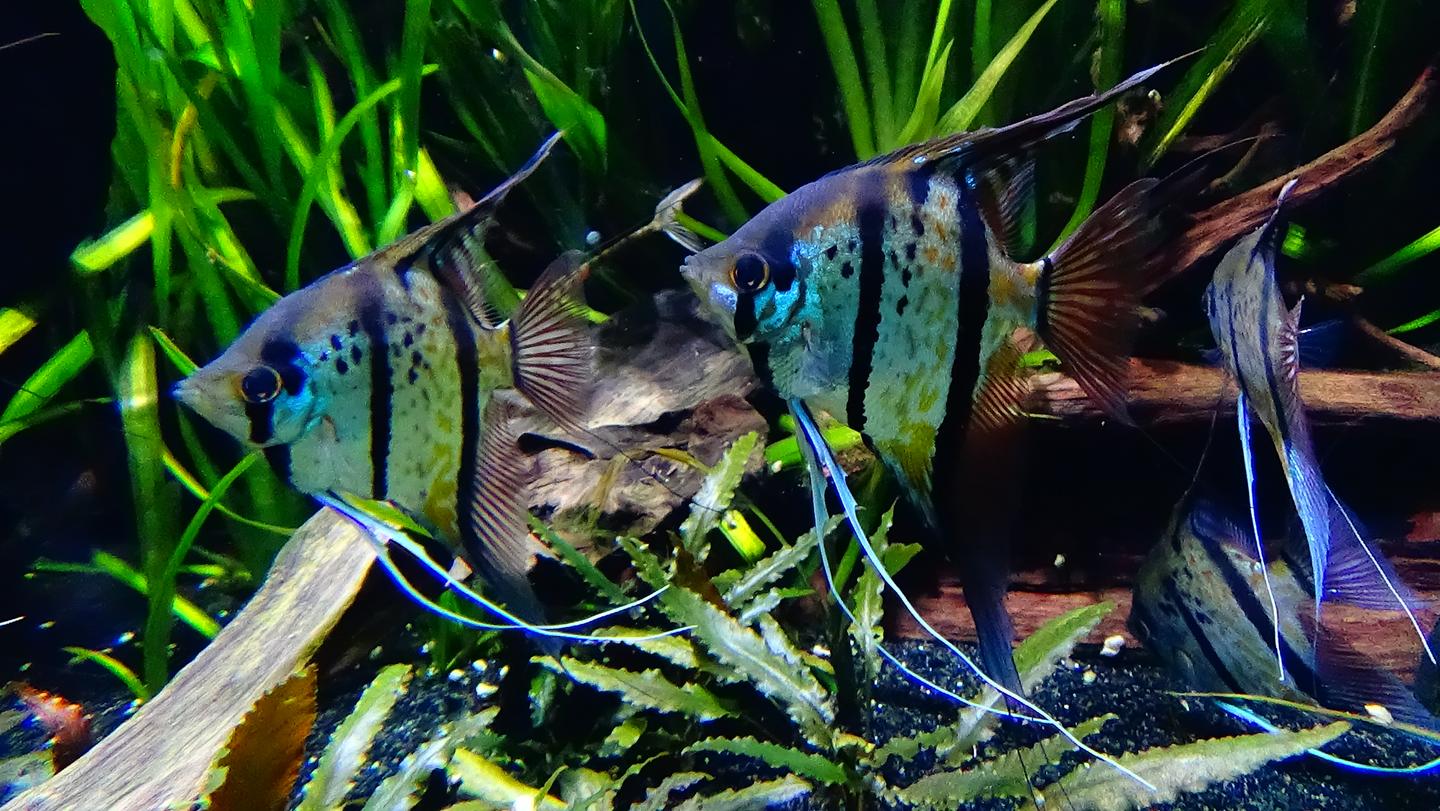
Freshwater angelfish are tall South American cichlids, not small community fish. OATA gives 120 litres as an industry floor for a compatible pair and says the aquarium must be sufficiently tall. We prefer planning around roughly 200 litres, a 100 × 40 cm footprint and about 50 cm height for an adult pair, with more space and an exit plan for a group.
Maintain these water conditions for optimal health and vibrant colors
Smoke Angelfish is a domestic colour strain of Pterophyllum scalare, a freshwater cichlid from the Amazon basin in Peru, Colombia, Brazil, French Guiana and Guyana. FishBase records a maximum of 10.5 cm total length. It suits a prepared keeper who can provide a mature, filtered and sufficiently tall aquarium, stable warm water, a compatible pair or carefully managed group, and a plan for territorial behaviour.
Eschmeyer’s Catalog of Fishes recognises Pterophyllum scalare as the accepted name. “Smoke” describes this domestic colour form rather than a separate species or place of origin.
| Suits | Not suited to |
|---|---|
| A mature, filtered and sufficiently tall aquarium | A shallow aquarium chosen around a small dispatch size |
| A compatible pair or deliberately managed group | One isolated fish by default or two random fish treated as bonded |
| Calm companions screened at adult size | Prey-sized fish, persistent fin-nippers or highly aggressive competitors |
| Stable measured water and a complete staple food | Abrupt chemistry changes or one treat used as the whole diet |
We class this fish as intermediate because the keeper must plan for adult height, social change and occasional aggression rather than simply match a temperature. Read our complete freshwater angelfish care guide when designing the permanent aquarium.
One purchase supplies one animal in the size selected. The size choices are 1 cm, 1.5–2 cm, 2.5–3 cm, 3–3.5 cm, 4–5 cm, 5–5.5 cm, L (5.5–6 cm), XL (6–7 cm) and XXL (>7.5 cm). Use the live size selector when ordering.
The size you select is the size supplied, not the adult size. A smaller fish still needs an aquarium and social plan based on adult dimensions. Buying one fish is also separate from its long-term social needs.
Sex is guaranteed only when the selected option explicitly states male or female. This Smoke Angelfish listing has no sex-guaranteed option.
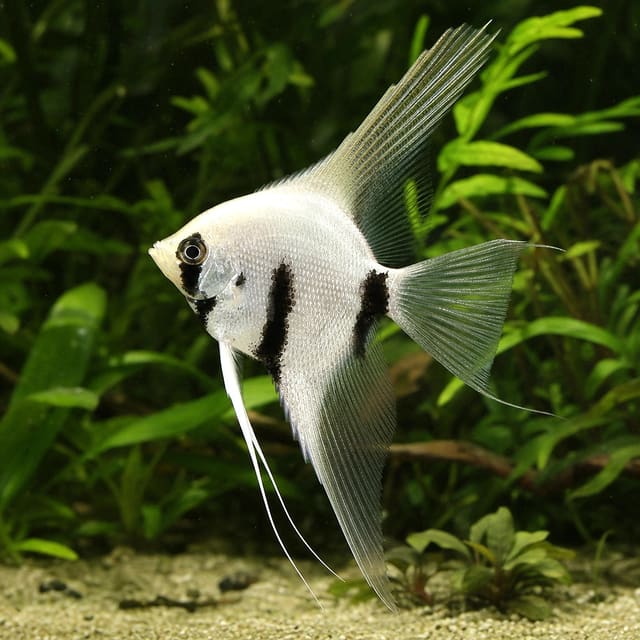
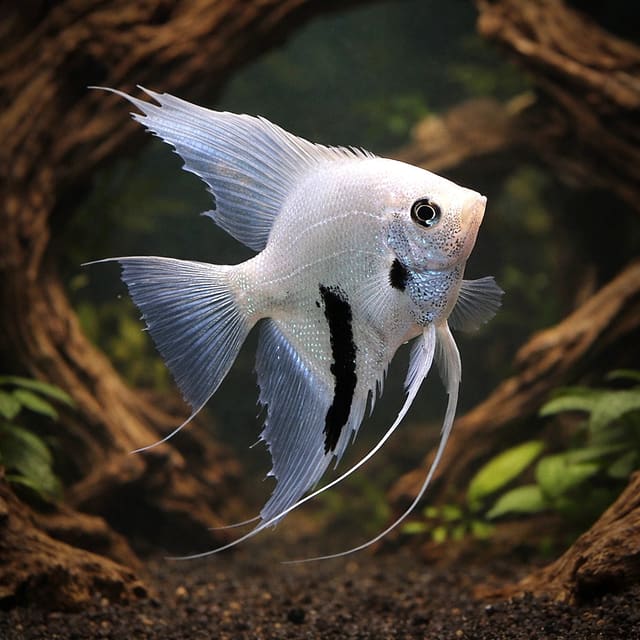
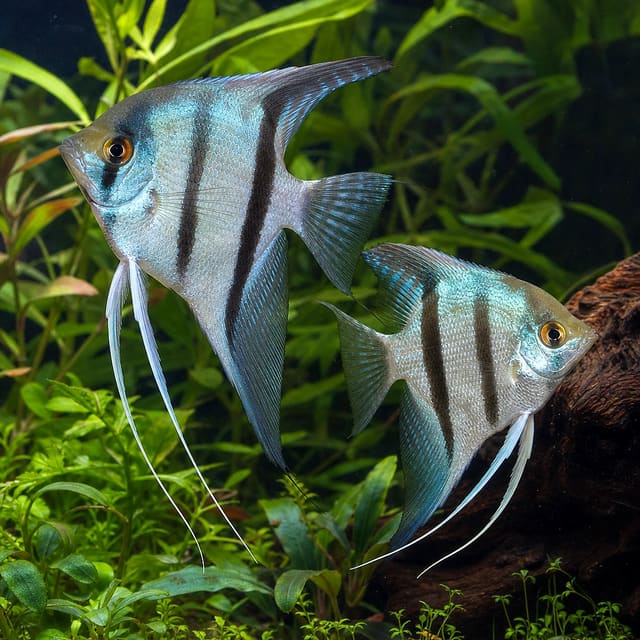
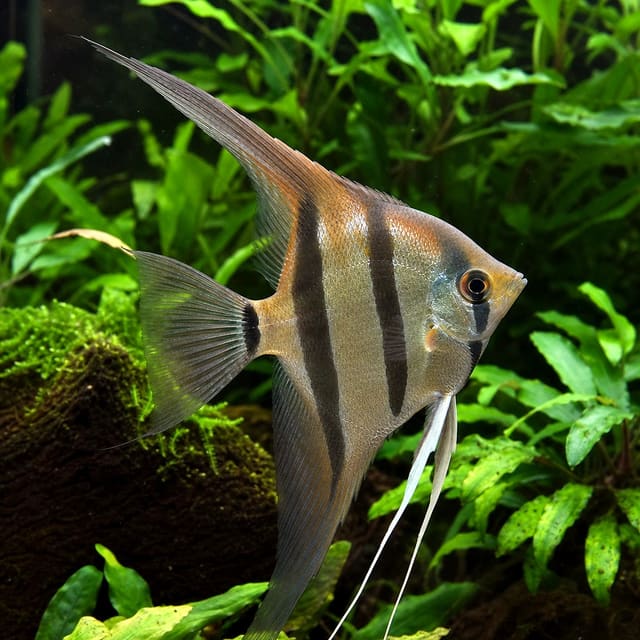
The gallery images are representative, based on reference photographs of this species, so colours can look slightly different from the live animal.
You can compare angelfish forms in the collection without treating colour as a care rating. Before arranging receipt, read the delivery and Live Arrival Guarantee policy for its packing, receipt, acclimatisation and claim terms.
Length figures need their measurement attached. FishBase records a maximum of 10.5 cm total length, while the Seriously Fish species profile gives 15 cm standard length. Our adult planning guide uses around 15 cm total length and often 20–25 cm from extended dorsal-fin tip to anal-fin tip. These references differ, and tank height cannot be inferred from nose-to-tail length alone.
| Decision | Planning point |
|---|---|
| Adult pair | Roughly 200 litres |
| Footprint | About 100 × 40 cm |
| Usable height | About 50 cm |
| Routine temperature | 24–27°C |
| Routine pH | 6.5–7.4 |
| Routine hardness | About 5–12 dGH |
The 200-litre point is our preferred adult-pair plan and agrees with the species profile’s approximately 200-litre, 100 × 40 × 50 cm aquarium. A group or mixed community needs more room because nominal volume cannot show territory shape, visual barriers, feeding competition or whether two adults are genuinely compatible.
Choose this fish when you can provide useful height without sacrificing horizontal turning room. Stable water, a mature biological filter and a response plan for pair formation are as decisive as the litre figure.
OATA’s American-cichlid guidance is broad group guidance: it recommends at least 120 litres for a pair of smaller American cichlids and says an adult angelfish aquarium must be sufficiently tall. Treat that 120-litre figure as an industry floor, not a promise that every tank bearing that volume has suitable dimensions for every pair.
We prefer roughly 200 litres with a footprint around 100 × 40 cm and about 50 cm of usable height. Measure usable internal space after allowing for substrate, wood, equipment and the water line. A tall nominal tank loses much of its benefit if hardscape fills the turning area or if long fins must pass sharp edges.
Vertical structure gives fish choices: an individual can leave another fish’s direct view, a pair can occupy a defined area, and a subordinate fish can reach cover. Cover must not become a substitute for adequate volume. Repeated chasing from one end of the aquarium to the other means the territorial plan is failing even when several hiding places exist.
The species profile favours gentle flow. Position outlets so there are calmer zones without permitting stagnant water, and maintain surface movement for gas exchange. Watch how the fish holds position: continually fighting the current calls for outlet adjustment, while rapid breathing requires immediate checks of water quality, temperature and system function.
Use 24–27°C, pH 6.5–7.4 and about 5–12 dGH as the routine aquarium target. This is the overlap of FishBase environmental values of 24–30°C, pH 6.0–8.0 and 5–13 dGH, Seriously Fish values of 24–30°C, pH 6.0–7.4 and 0–15 dGH, and OATA’s American-cichlid range of 22–27°C, pH 6.5–8.0 and 4–12 dGH.
Stability matters more than pushing the aquarium towards one edge of a range. Measure the fish’s holding water and the destination aquarium, then make elective temperature, pH or hardness changes gradually. Do not choose a fixed tap-water and reverse-osmosis recipe by percentage alone because the starting GH, KH and pH determine the result.
| Observation | Action |
|---|---|
| Temperature differs from the intended target | Confirm it with a thermometer and correct gradually unless water quality creates an emergency |
| pH changes between tests | Measure KH and review source water before adding pH-altering products |
| Hardness is unfamiliar | Test GH and KH rather than assuming local tap-water values |
| Ammonia or nitrite is detectable | Treat it as urgent and prioritise water quality rather than elective chemistry adjustment |
Our water chemistry guide explains what GH, KH and pH measure. Once you have actual test results, use the water matcher to compare the aquarium with the stated routine range.
Check the thermometer rather than relying only on the heater dial. A heater setting describes its control position, while the thermometer shows what the aquarium reached. Record results consistently enough to recognise a trend before a behavioural change becomes severe.
A working biological filter is essential. The RSPCA’s aquarium filtration guidance explains that fish release toxic ammonia, which established filter bacteria convert first to toxic nitrite and then to safer nitrate. A calendar cannot demonstrate that this bacterial process is working; measured ammonia and nitrite results can.
If this is your first setup, follow the steps for a mature first tropical aquarium before choosing livestock. Waiting a particular number of days without testing can leave a tank vulnerable to new tank syndrome.
OATA recommends testing at least weekly and completing a 25% partial water change at least once a week. It also advises keeping nitrate no more than 20 mg per litre above the normal tap-water level. Adjust the routine using measured waste, stocking, feeding, plant growth and filter performance rather than waiting for cloudy water.
Treat replacement tap water with a conditioner suitable for chlorine or chloramine before it enters the aquarium. Match temperature closely enough to avoid an abrupt swing. Siphon solid waste from accessible substrate while leaving useful cover and territory intact.
Check media for blockages, but do not run it under the tap. Lightly rinse it in water removed during a partial change so chlorine or chloramine does not kill much of the bacterial population. At roughly 200 litres, the species profile illustrates four to five turnovers per hour with an 800–1000 lph filter rating; actual flow must still remain gentle enough for the fish and account for media, pipework and outlet placement.
Use a nutritionally complete cichlid pellet, granule or suitable flake as the staple, choosing a particle size the fish can swallow cleanly. The species profile describes freshwater angelfish as omnivorous and notes that wild fish feed predominantly on zoobenthos such as small crustaceans and other aquatic invertebrates. Aquarium feeding should still begin with a complete prepared food rather than trying to reproduce one wild item.
OATA’s schedule is once daily, offering only what the fish can eat within a few minutes. Add suitable frozen or freeze-dried foods such as daphnia, brine shrimp or bloodworm for variety. Treat these items as supplements rather than allowing one attractive food to replace the complete staple.
A controlled angelfish feeding study found that feed composition affected growth and reproductive performance. Its practical lesson is that diet quality and variety matter; it does not turn one experimental feed into a universal household menu.
| What you see | What to do |
|---|---|
| One fish repeatedly misses food | Check competition, territory and food distribution |
| Food remains after a few minutes | Reduce the next portion and remove the excess |
| Appetite changes suddenly | Test water and check breathing, swimming and appearance |
| One treat is eagerly accepted | Keep the complete food as the staple |
Freshwater angelfish are social, but social does not mean that any two individuals will form a peaceful pair. OATA advises keeping angelfish as a pair or group at minimum and warns that a singleton may become stressed. The species profile favours small groups while noting that fish may squabble with their own kind.
A group of six juveniles is sometimes used when the aim is to let a pair form, but it is not a universal stocking formula. Tank dimensions, existing inhabitants, sex, individual behaviour and territory shape can change the result. More fish can increase both social choice and competition.
Brief displays or occasional chasing can occur, particularly as fish mature or pair. Intervene when one fish is repeatedly trapped, cannot reach food, remains hidden, develops fin damage or is pursued throughout the aquarium. Those signs show that the present arrangement is not giving every fish workable space.
Have the separation plan ready before adding a group. A second mature aquarium or a realistic rehoming route is far safer than improvising after a pair controls the tank. A temporary divider must still preserve suitable filtration, swimming room and water quality on both sides.
Angelfish may clean and lay adhesive eggs on vertical surfaces such as broad leaves, slate or aquarium glass, and both parents may guard eggs and young. Pair formation and spawning can intensify aggression. Treat that change as a reason to reassess space and companions, not as proof that the existing community will remain settled.
Prepare the permanent aquarium before the fish arrives. Confirm zero ammonia and nitrite, stable temperature, suitable pH and hardness, an operating filter and secure decor. Check that the selected dispatch size cannot enter an uncovered intake, while keeping every guard suitable for the larger adult.
Measure the aquarium rather than assuming it matches the fish’s holding water. Compare temperature and, where practical, pH, GH and KH. Make the transition gradually when values differ while avoiding prolonged exposure to unstable transport water.
Do not combine introduction day with elective chemistry experiments or a large jump in livestock load. Adding fish and increasing feeding both raise the demand on the biological filter, so introduce livestock slowly and keep testing.
| Checkpoint | What to assess |
|---|---|
| Before transfer | Ammonia, nitrite, temperature, filter operation and safe territory |
| Early observation | Breathing, balance, swimming and immediate harassment |
| First week | Feeding access, fin position, hiding, chasing and test results |
| First month | Body profile, social position, growth, territory and maintenance trend |
Calm surroundings can reduce disturbance while the fish settles, but observation must remain possible. Do not interpret hiding by itself as a disease diagnosis. Pair it with breathing rate, swimming control, appetite, fin condition and water results.
If an established fish blocks food or pursues the newcomer continually, use the prepared separation route rather than waiting for injury. If ammonia or nitrite appears, treat water quality as urgent. Where behaviour changes without a clear water problem, review adult compatibility, territory and feeding access before adding more fish.
Healthy fish normally show steady swimming, regular breathing, clear eyes, open undamaged fins, intact scales, a consistent body profile and reliable feeding. The RSPCA’s fish health guidance supports watching visible condition and investigating changes promptly.
Warning signs include hanging at the surface, sitting unusually on the bottom, erratic swimming, faster or slower gill movement, clamped fins, colour change, persistent hiding, weight change, white spots, fluffy growths, wounds or sudden loss of appetite. These signs help describe the problem; they do not identify one cause by themselves.
Do not respond to abnormal swimming, white spots or head lesions with a universal medicine or temperature recipe. The correct action depends on the fish, diagnosis, aquarium, water and lawful product. In the UK, use only a treatment labelled for the species and system, following its instructions or fish-veterinary direction.
Preventive medication can expose fish and filter bacteria without resolving husbandry problems. Water results, recent changes, new livestock, feeding and social conflict give a qualified adviser a more useful history than a symptom name alone.
Return it to suitable aquarium water immediately using wet hands or a wet, soft net, minimise handling and monitor breathing, balance and visible injury. Check and secure the lid. Seek specialist fish-veterinary advice when breathing, skin or swimming remains abnormal.
Freshwater angelfish may live in a robust community, but compatibility depends on the adult animals and the actual aquarium. They remain cichlids and may defend a partner, feeding area or spawning surface. No companion category creates a universal guarantee because individual behaviour and pair formation can change.
| Check | Why it matters |
|---|---|
| Adult body size | Very small fish may be swallowed even when the angelfish began at a small dispatch size |
| Fin behaviour | Persistent fin-nippers can damage extended dorsal, anal and ventral fins |
| Temperament and territory | Highly aggressive or territorial fish may compete for the same space |
| Water overlap | A calm fish is still unsuitable when its temperature or chemistry needs conflict |
| Feeding speed and level | Fast competitors can leave slower or subordinate fish underfed |
Avoid very small prey-sized fish, persistent fin-nippers and highly aggressive competitors. Approach other territorial cichlids cautiously because both species may attempt to control the same vertical structure or floor area. Also examine the aquarium at adult occupancy rather than assuming juveniles will continue to share space in the same way.
Calm, appropriately sized shoaling fish with overlapping water needs may suit a well-planned community. Bottom-oriented fish are sometimes considered because they use another level, but that separation is incomplete: floor space, night-time movement, food competition and shared water still matter.
Screen the exact species rather than relying on broad labels such as tetra, catfish or cichlid. A group name can contain animals with very different adult sizes, temperatures and behaviour. The decision remains conditional until adult size, numbers, tank dimensions and existing inhabitants are assessed together.
Compatibility work continues after the fish enter the same aquarium. Watch who reaches food, which routes remain open and whether one animal controls all tall cover. A community that looks calm between meals can still create chronic feeding exclusion, while a previously settled group can change when a pair forms.
| If you see | Do this |
|---|---|
| Brief display with both fish feeding | Continue close observation and check fin condition |
| Repeated pursuit into a corner | Separate using the prepared route and reassess territory |
| One fish missing meals | Change food distribution and review competition |
| New defence around a vertical surface | Assume pair or spawning territory may be developing and reassess the community |
| Damaged fins or wounds | Separate where safe, test water and seek qualified health advice |
For a stocking assessment, provide the aquarium’s litres, dimensions, usable height, measured water, filtration, established inhabitants and intended numbers. Those details support a welfare decision far better than a list of common names alone.
Plan around the FishBase recorded maximum of 10.5 cm total length, while allowing about 50 cm usable aquarium height because its extended dorsal and anal fins make this a tall-bodied fish.
Plan a compatible adult pair around roughly 200 litres, a 100 × 40 cm footprint and about 50 cm usable height. A group or community needs more room and a separation or rehoming plan.
OATA advises a pair or group at minimum and warns that a singleton may become stressed; Seriously Fish favours small groups. Two randomly selected fish are not automatically a compatible pair.
We class it as intermediate because the keeper must manage a mature tall aquarium, stable measured water, social changes and possible territorial aggression.
Feed a complete cichlid pellet, granule or suitable flake once daily in a portion eaten within a few minutes, then add suitable frozen or freeze-dried daphnia, brine shrimp or bloodworm for variety.
Keep it at 24–27°C, pH 6.5–7.4 and about 5–12 dGH, the overlap of FishBase, Seriously Fish and OATA guidance. Keep ammonia and nitrite at zero.
It is generally peaceful but may squabble with its own kind and become territorial during pair formation or breeding. Its extended fins are vulnerable to persistent fin-nippers.
Calm, appropriately sized larger shoaling fish with overlapping water needs may suit a robust community. Avoid very small prey-sized fish, persistent fin-nippers and highly aggressive competitors.
Start filming every delivery continuously while the parcel is still sealed, then record it being opened with the fish still inside the sealed bag. Someone must be present to receive the parcel; float the bag for 20–30 minutes before releasing the fish, and never pour the bag water into the aquarium.
No reviews for this item yet. Bought one? Honest reviews only, good or bad.
What customers say about ordering from us
I have a small group of long finned mountain minnows. So was delighted to be able to order ten of this variety to increase the genetics in my tank . The ones I recieved are healthy but it’s to early to give a verdict on wether they are of a long finned type since they are small currently.
Gordon Walker · 23 Sept 2026
100% success travel and "installation". Pleased with quality of purchase. The Siamese fighter a bit "shy" so have not yet seen him at his best yet but looking good. Happy customer. GG
George E Garratt · 21 Sept 2026
Reviews of our shop, collected by Judge.me, an independent third-party review collector. Newest first.