Moderate
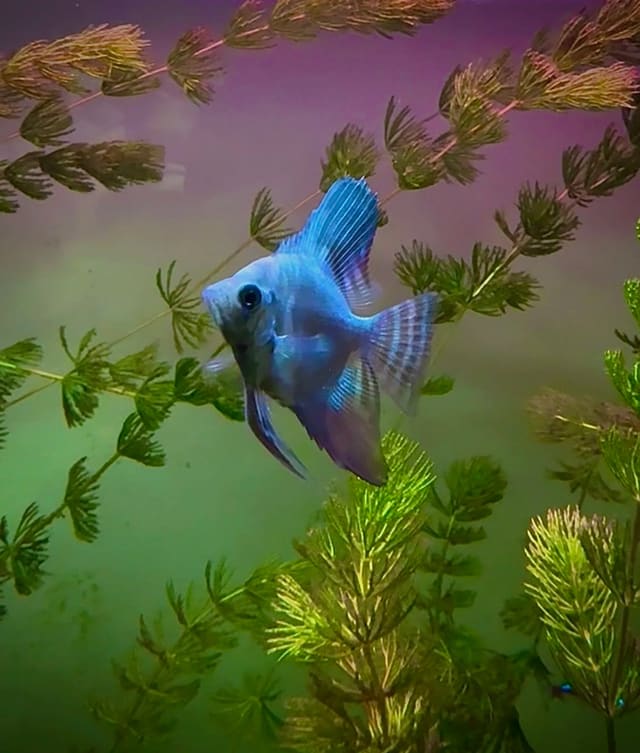
Map Blue Angelfish (Pterophyllum scalare) – Blue Pattern Colour Form
24–28°C · pH 6–7.5 · 150L
£12.99

Koi Angelfish is a domestic colour strain of Pterophyllum scalare for an intermediate keeper with a tall, mature aquarium. Plan around 200 litres for a compatible adult pair, choose companions for adult size and fin behaviour, and prepare for territoriality as fish mature.
Adult size is the maximum length this species reaches at full maturity (scientific sources). The livestock you receive will be younger and smaller — pick a size above for the actual shipping size. Product-photo provenance and any image-specific limitations are stated on the listing.
Save when buying multiple fish. Each quantity is one fish; sex and pair formation are not guaranteed unless the selected variant explicitly states them.
Minimum of 2 per order.
Koi Angelfish is a domestic colour strain of Pterophyllum scalare for an intermediate keeper with a tall, mature aquarium. Plan around 200 litres for a compatible adult pair, choose companions for adult size and fin behaviour, and prepare for territoriality as fish mature.
Adult size is the maximum length this species reaches at full maturity (scientific sources). The livestock you receive will be younger and smaller — pick a size above for the actual shipping size. Product-photo provenance and any image-specific limitations are stated on the listing.
Freshwater angelfish are tall South American cichlids, not small community fish. OATA gives 120 litres as an industry floor for a compatible pair and says the aquarium must be sufficiently tall. We prefer planning around roughly 200 litres, a 100 × 40 cm footprint and about 50 cm height for an adult pair, with more space and an exit plan for a group.
Maintain these water conditions for optimal health and vibrant colors
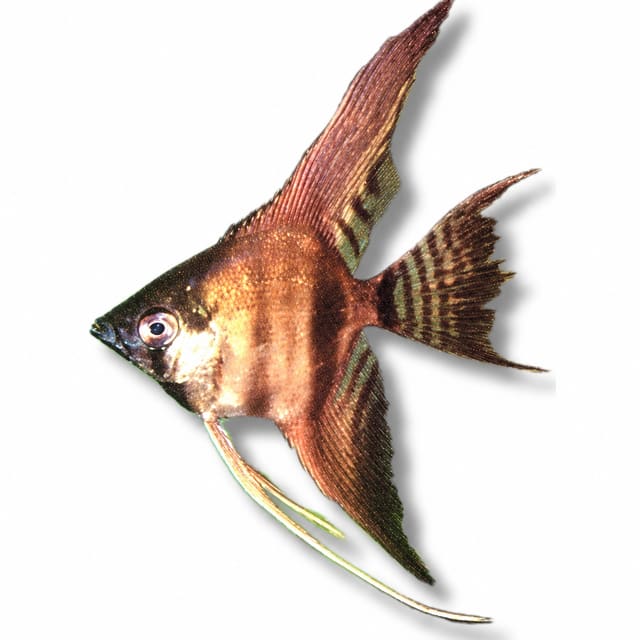
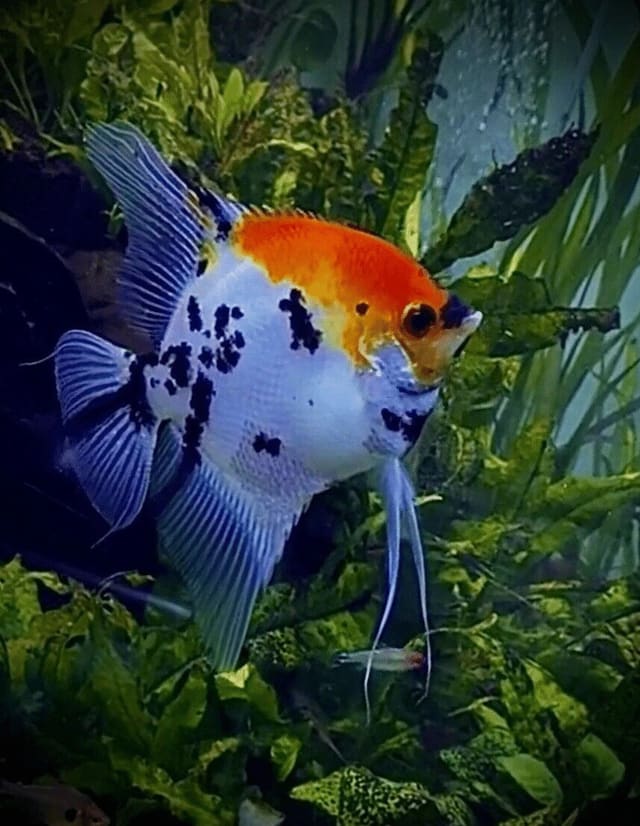
Koi Angelfish is a domestic colour strain of Pterophyllum scalare, the freshwater angelfish. The orange, white and dark marbling is a colour-form characteristic; the care plan still belongs to the species. An angelfish grows upward as well as forward, may form territories as it matures and can swallow very small fish. It is therefore a centrepiece cichlid to plan around, not a small decorative fish to add wherever a juvenile happens to fit.
One purchase supplies one Koi Angelfish in the size chosen. The recurring dispatch grades run from 1 cm to over 7 cm across nine size choices. The size you select is the size supplied, not the adult size. A small dispatch grade still needs an adult aquarium plan before purchase.
Tropical Fish Co’s reviewed care guidance prefers roughly 200 litres, a 100 × 40 cm footprint and about 50 cm of usable height for a compatible adult pair. A group needs more space, visual barriers and a realistic plan for separating or rehoming fish if a pair claims territory. That combination of space, social judgement and long-fin compatibility is why we assess Koi Angelfish as intermediate care.
Sex is guaranteed only when the selected option explicitly states male or female. This Koi Angelfish listing has no sex-guaranteed option.
Pterophyllum scalare belongs to the cichlid family Cichlidae. FishBase records its native distribution across the Amazon basin in Peru, Colombia and Brazil, with further records from French Guiana and Guyana. Adults inhabit densely vegetated swamps or flooded ground with clear or silty water. That supports the use of vertical planting, roots and structured cover as layout inspiration without turning one plant species or substrate into a biological requirement.
Adult measurements online often mix total length, standard length, body depth and fin-tip height. FishBase’s current field record is 10.5 cm total length, while it also retains a 15 cm total-length value from an aquarium reference. The store’s reviewed guide therefore uses around 15 cm total length as a practical planning figure and notes that extended dorsal and anal fins can make an adult roughly 20–25 cm tall. Seriously Fish separately gives 150 mm standard length. Keep those measurement types distinct.
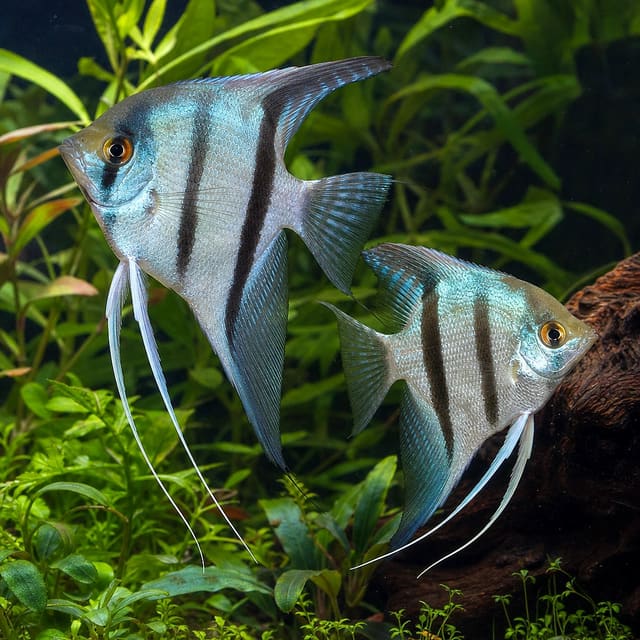
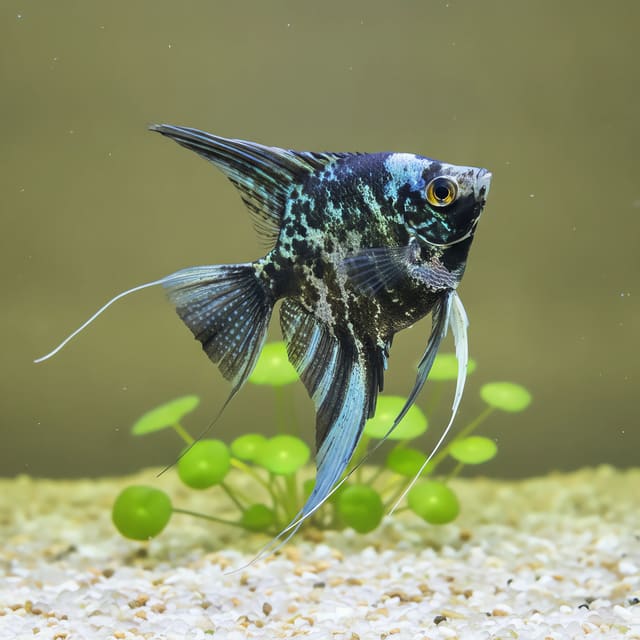
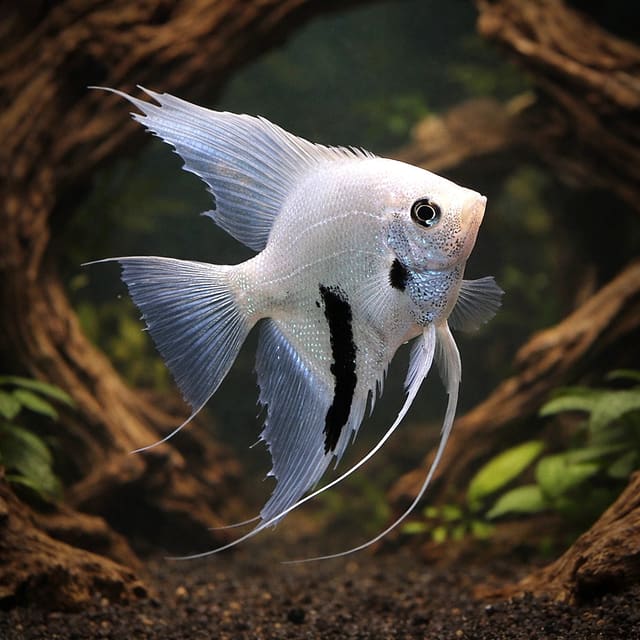
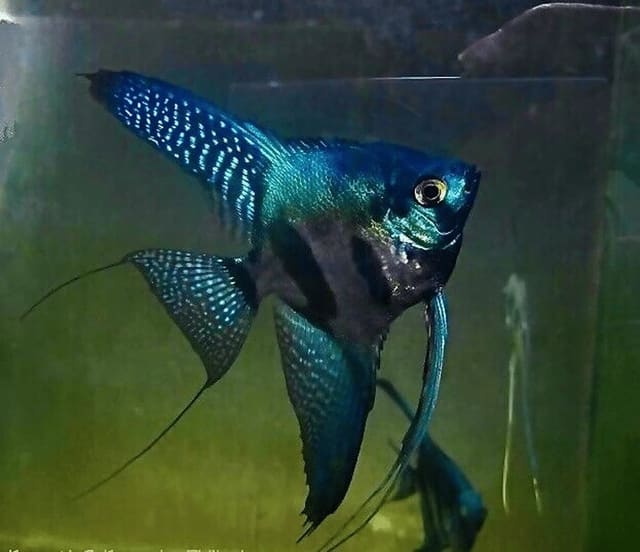
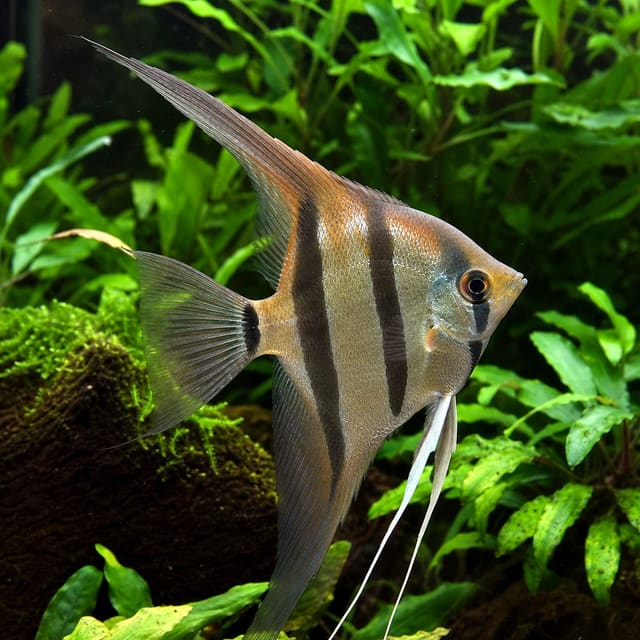
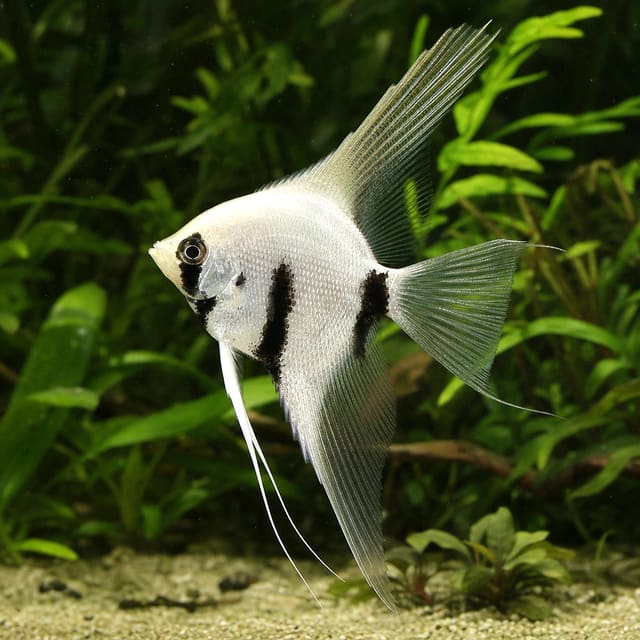
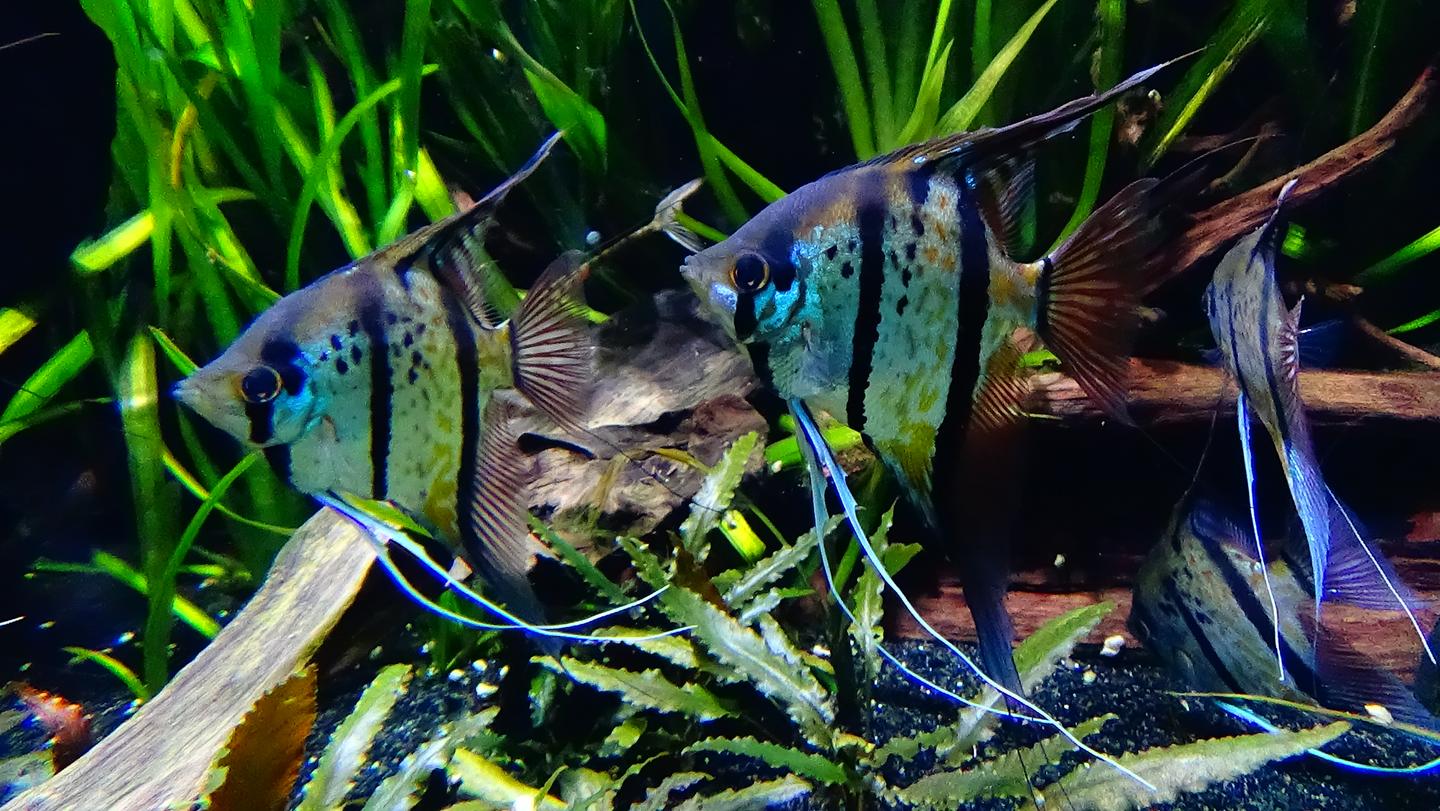
The gallery shows orange, white and black-patterned angelfish with tall dorsal and anal fins. Those visible features help a customer understand the colour form and body shape, but individual pattern placement can vary. Gallery images have been digitally enhanced to improve image quality. Natural colour, pattern, size and maturity can vary between live animals.
For the full species care rationale, read the freshwater angelfish care guide. The South American cichlid collection is useful for comparing different aquarium plans; it is not a list of automatic tank mates.
| A reasonable match | Change the plan first |
|---|---|
| A mature aquarium with zero detectable ammonia and nitrite | A new tank judged only by how many weeks it has been running |
| About 200 litres, a 100 × 40 cm footprint and around 50 cm usable height for an adult pair | A shallow starter tank sized around the fish’s dispatch grade |
| A compatible pair, or a group with substantially more space and an exit plan | One isolated fish by default, or two random fish assumed to be bonded |
| Calm, suitably sized companions with overlapping water needs | Tiny prey-sized fish, persistent fin nippers or highly aggressive competitors |
| A complete staple food plus measured variety | One attractive frozen food used as the whole diet |
This is a decision framework rather than a universal stocking calculator. Pair compatibility, individual temperament, aquarium dimensions, filtration, visual barriers and the other residents can change the outcome at the same nominal volume.
OATA gives 120 litres as a general UK industry floor for a compatible pair of smaller American cichlids and says an angelfish aquarium must be sufficiently tall. Tropical Fish Co uses a more conservative adult-pair planning point: roughly 200 litres, a 100 × 40 cm footprint and about 50 cm of usable height. Seriously Fish independently describes the same 100 × 40 cm base, 50 cm height and about 200 litres as the smallest aquarium it would consider.
Height protects the extended dorsal and anal fins, but height alone is not enough. The fish also needs horizontal room to turn, move away from another angelfish and feed without being pinned against décor. A tall narrow column can look generous on paper while offering poor territory and turning space.
Choose the adult aquarium before buying a small grade. Moving a growing cichlid from temporary tank to temporary tank adds repeated changes in water, hierarchy and territory. A permanent tank also lets the biological filter mature around the intended feeding and stocking load.
If this is a new system, follow the first tropical tank guide and prove the cycle with tests. A calendar date, clear water or a running filter does not by itself show that ammonia and nitrite can be processed safely.
OATA advises a pair or group at minimum and warns that a single angelfish may become stressed. That does not mean any two fish will become a compatible pair. A genuine pair is a social relationship observed over time; two randomly chosen fish can fight, and a pair that begins to breed may defend a much larger area than it used before.
A juvenile group can allow pair formation, but adult hierarchies create unequal access to space and food. There is no evidence-backed number that works in every aquarium. More fish means more opportunities for pair formation, but also more waste, more social pressure and a greater need for barriers and spare accommodation.
Watch who eats, who uses the open water and who is repeatedly pushed behind a filter or plant. Short displays and occasional chasing are different from persistent exclusion, torn fins or a fish that stops feeding. Intervene while the targeted fish is still in good condition. A mature spare aquarium or a realistic rehoming route is part of responsible group planning, not an afterthought.
Rearranging some vertical structure can break established sight lines when introductions or pair formation alter the hierarchy, but avoid a complete disruptive rescape without cause. Preserve clear turning room and secure every branch or stone so digging and rapid movement cannot destabilise it.
Tropical Fish Co’s routine target is 24–27°C, pH 6.5–8.0 and about 5–12 dGH. It deliberately overlaps FishBase and OATA guidance and is the single aquarium recommendation used across this listing. Match the water in which the fish is currently held, acclimatise gradually and avoid chasing an exact midpoint with repeated chemical changes.
FishBase lists a broader 24–30°C, pH 6.0–8.0 and 5–13 dGH environmental range. OATA’s American-cichlid sheet gives general group guidance of 22–27°C, pH 6.5–8.0, 4–12 dGH and 3–10 dKH. Those values explain the overlap chosen for the store target; they are not additional competing targets to switch between.
Confirm zero detectable ammonia and nitrite before fish are added. OATA’s group guidance says nitrate should not rise more than 20 mg/l above the normal tap-water level. Use a thermometer as well as the heater setting, and test often enough to see a trend before the fish’s breathing or appetite changes.
The water chemistry guide explains pH, GH, KH and nitrogen tests. The water matcher can compare measured values with the stated target. Measure tap and aquarium water before adding buffers, minerals or reverse-osmosis water; a copied mixing recipe cannot account for every household supply.
| Routine target | Value |
|---|---|
| Temperature | 24–27°C |
| pH | 6.5–8.0 |
| General hardness | 5–12 dGH |
| Ammonia and nitrite | Zero detectable |
Seriously Fish recommends tall leafy plants, gentle water flow and an aquarium at least 50 cm high for adults. Vertical leaves and branches echo the structure used for cover and spawning, while open water gives the fish a clear place to turn. Use several sight breaks rather than one central object that a territorial pair can dominate from every side.
Secure wood and hard décor, cover hazardous intakes and avoid sharp edges around extended fins. Angelfish can investigate narrow gaps, and a frightened fish can move quickly. Leave access to siphon waste and inspect the base instead of filling every centimetre with decoration.
Gentle flow means the fish should not have to brace continuously against a jet; it does not mean stagnant water. Aim for reliable biological filtration, surface movement and oxygen exchange, then position the outlet to leave calmer zones. A filter with a high nominal rating still needs suitable media, maintenance and a flow pattern that works in the actual aquarium.
The RSPCA’s general guidance explains the biological role of the filter: toxic ammonia is converted to nitrite and then to safer nitrate by beneficial bacteria. Protect that colony. OATA advises rinsing filter media lightly in removed aquarium water instead of under the tap, where chlorine or chloramine may kill beneficial bacteria.
Pterophyllum scalare is omnivorous, while wild fish feed heavily on small crustaceans and other aquatic invertebrates. Captive-bred angelfish readily accept suitable pellets or flakes and relish live or frozen foods. Use a nutritionally complete cichlid pellet, granule or suitable flake as the staple, in a size the fish can swallow.
Add appropriate frozen or freeze-dried foods for variety. Bloodworm, brine shrimp and daphnia can be useful additions, but one attractive treat should not become the whole diet. A controlled angelfish feeding study supports the importance of feed composition; it does not create a single household menu that suits every age and system.
OATA’s general American-cichlid guidance recommends a portion eaten within a few minutes once daily and warns that overfeeding creates excess faeces and uneaten food that breaks down into toxic waste. Use that as a group-level starting point. Adjust the amount by body profile, feeding access and water tests rather than by how enthusiastically the dominant fish begs.
Feed across enough space for subordinate animals to reach food. Watch each fish swallow at least some of the staple, remove excess and track body condition over time. Do not use fasting, peas, vitamins or medicated food as a diagnosis for unusual swimming or appetite loss.
OATA recommends a partial water change of about 25% at least weekly as a general starting routine for American cichlids. Test results, stocking, feeding, plant growth and filter performance should refine that schedule. Treat replacement water with conditioner where required and match temperature closely enough to avoid an abrupt swing.
Check filter flow and intakes, siphon settled waste and inspect décor for loose or sharp areas. Avoid replacing all biological media at once. Clear water can still contain ammonia or nitrite, so measured results should lead the routine.
A settled angelfish normally shows steady swimming, regular breathing, clear eyes, open fins, a consistent body profile and reliable feeding. Warning signs include clamped or damaged fins, gasping, flashing, white spots, wounds, unusual balance, isolation or a sudden appetite change. These signs need investigation rather than a guessed disease name.
Test ammonia, nitrite, nitrate, temperature and relevant chemistry first. Compare the results with the fish’s established conditions, document what changed and obtain qualified aquatic advice. Isolate only in a mature, suitable setup that will not create a second welfare problem. Use medicines only when the diagnosis, species, system and lawful product instructions support them.
If a fish jumps, return it promptly to suitable aquarium water using wet hands or a wet soft net, minimise handling and monitor breathing, balance and visible injury. Check the lid and seek specialist help when recovery is abnormal.
Prepare the mature heated aquarium, tests and secure lid before the delivery date. Tropical Fish Co’s policy says fish are hand-bagged in pure oxygen, placed in an insulated poly box and supplied with a heat pack when the weather calls for it. A tracked licensed live-animal courier carries the parcel on the confirmed Thursday or Friday date sent by email, so someone needs to be present.
Open and inspect the parcel on the day it arrives. The policy advises floating the bag for 20–30 minutes and acclimatising slowly before release. Keep lights and activity calm while the fish begins to orientate, and avoid changing décor or adding unrelated livestock at the same time.
The unboxing video is evidence for a Live Arrival Guarantee claim, not a biological care step. If something is wrong, make one continuous recording showing the sealed parcel and outer box, the opening, and the fish still in the sealed bag. Contact the team the same day with the order number before release.
After introduction, watch breathing, balance, fin position and whether each fish can reach a quiet area. Do not judge success only by an immediate feeding response. Transported fish may need time to settle, while gasping, loss of balance or obvious injury calls for prompt water checks and advice.
Judge the fish and the plan together. Check the stated dispatch grade against the adult aquarium, then look for steady swimming, clear eyes, open undamaged fins, a normal body profile and reliable feeding. Ask for the temperature and water chemistry in which the fish is held so the acclimation plan starts from measured conditions rather than assumptions.
Confirm whether the animal is being held as part of a group or pair, while remembering that retail proximity does not prove a lasting pair bond. Pattern is a visual preference, not a care rating. Choose the fish by welfare fit and condition rather than assuming that koi, marble, gold, black, platinum or another domestic colour form is universally hardier or calmer.
Prepare a mature quarantine aquarium with separate equipment before purchase. The reviewed care guide relays veterinary guidance of at least 30 days, giving time to observe breathing, balance, appetite, body condition and fins without exposing an established community. Quarantine is observation and separation, not permission for preventive medication without a diagnosis.
Keep notes on the source water, arrival date, food accepted and any visible change. That record makes gradual acclimation, health advice and the eventual move into the main aquarium more precise.
Sexing freshwater angelfish is difficult. Seriously Fish notes that a male’s smaller pointed genital papilla may be visible during spawning and that breeding males can be more territorial, but these are not dependable juvenile sex tests. Forehead shape, fin angle, colour and boldness should not be sold as guarantees.
A compatible pair may clean a vertical surface such as broad leaf, slate or aquarium glass and lay adhesive eggs there. Both parents can guard the eggs and young. Pair choice matters, and the reviewed care guide cites research supporting serial monogamy under captive conditions; “mates for life” is too absolute.
Breeding can sharply increase territorial defence. A separate mature setup gives a pair and any fry more control than a crowded community aquarium. Clutch size, hatch timing and parental success vary, so laboratory observations should not be turned into promises for a home tank.
Condition adults with a complete diet and suitable variety rather than a single rich food. Do not use preventive medication recipes as routine breeding practice. The first priority remains a stable compatible pair, measured water and a safe response if aggression escalates.
Koi Angelfish can sometimes live in a robust community, but they remain cichlids. Mature fish may squabble with their own kind, a pair may defend a spawning site and very small fish may be swallowed. The right question is not whether two species are both sold as “community fish”; it is whether their adult size, fins, water, feeding and territory can coexist.
| Check | Why it matters |
|---|---|
| Adult body size | A fish small enough to swallow may become prey even if both animals were bought as juveniles. |
| Fin behaviour | Persistent fin nippers can damage the long dorsal, anal and ventral fins. |
| Temperament and territory | Breeding pairs and other territorial cichlids may compete for the same space. |
| Water overlap | Calm behaviour cannot compensate for incompatible temperature or chemistry. |
| Feeding speed | Fast competitors can leave a slower or subordinate angelfish underfed. |
OATA says calmer American cichlids such as angelfish can be mixed with appropriately robust larger shoaling fish when conditions match. Treat that as a category for assessment, not a guaranteed species list.
Avoid tiny prey-sized fish and fry. Seriously Fish specifically warns that angelfish may eat small fish such as tetras. Adult body size matters more than the companion’s size on the day it is purchased.
Avoid persistent fin nippers. Long dorsal, anal and ventral fins are vulnerable to repeated bites, and damaged tissue can become a continuing welfare issue even when the attacker is much smaller. Highly aggressive cichlids are also poor default companions because they may contest the same midwater territory.
Very fast or forceful feeders can create a quieter problem: an angelfish that looks outwardly calm may lose condition because it rarely reaches a complete meal. Use several feeding points and observe actual intake. Shrimp and very small invertebrates remain at predation risk.
Corydoras and bristlenose plecos are often considered because they use other levels of the aquarium, but level alone is not a guarantee. Check the exact species, adult size, floor space, temperature and water requirements before deciding. Keep a separation plan for any mixed setup.
Compatibility can change as an angelfish grows, chooses a partner or begins spawning. A community that worked with juveniles is not proof that every adult stage will remain calm. Watch for a pair controlling a vertical surface, another fish hiding continuously, torn fins, missed meals or repeated high-speed chases.
Respond by checking water first, then reassessing territory and feeding. Add or reposition sight breaks without sacrificing turning space. If one fish remains excluded, separate it into a mature suitable aquarium or use the planned rehoming route. Do not wait for severe injury to confirm that the arrangement has failed.
Related angelfish colour forms shown elsewhere on this page are alternatives for comparison, not automatic companions. Two fish sharing the same scientific species can still be incompatible individuals, particularly when a territory or pair is involved.
Plan around 15 cm total length and roughly 20–25 cm height including extended fins. FishBase also has a 10.5 cm total-length field record, while Seriously Fish gives 150 mm standard length, so measurement type and source matter.
Tropical Fish Co prefers roughly 200 litres with a 100 × 40 cm footprint and about 50 cm usable height for a compatible adult pair. A group or community needs more space, barriers and an exit plan for aggression.
Plan a compatible pair or a deliberately managed group. OATA warns that a singleton may become stressed, but two random fish are not automatically a pair and a group needs substantially more room.
It suits a prepared intermediate keeper who can provide a mature tall aquarium, stable measured water and a response plan for territorial behaviour. It is not a shortcut around cycling, compatibility or adult-size planning.
Use a complete cichlid pellet, granule or suitable flake as the staple, then add appropriate frozen or freeze-dried variety such as bloodworm, brine shrimp or daphnia. Feed measured portions and confirm every fish eats.
Use the store’s routine target of 24–27°C, pH 6.5–8.0 and about 5–12 dGH. Match the water in which the fish is held, acclimatise gradually and keep ammonia and nitrite at zero detectable.
They are generally calmer than many cichlids but may squabble, form hierarchies and defend a pair or spawning site. Their own long fins are vulnerable to persistent fin nippers, so watch adult behaviour in both directions.
Calm, appropriately sized, robust shoaling fish with overlapping water needs can be considered. Avoid tiny prey-sized fish, persistent fin nippers and highly aggressive cichlids, and check feeding speed and territory before mixing species.
Tropical Fish Co hand-bags fish in pure oxygen, packs them in an insulated poly box and adds a heat pack when weather calls for it, then uses a tracked licensed live-animal courier. Read the delivery and Live Arrival Guarantee policy; a qualifying claim needs same-day contact and a continuous unboxing video that starts with the sealed parcel.
FishBase: Pterophyllum scalare supports identity, family, native distribution, habitat context, environmental values and its labelled length records.
Eschmeyer’s Catalog of Fishes supports the accepted name, authorship, family placement, type locality and distribution summarised by the reviewed care guide.
Seriously Fish: Pterophyllum scalare supplies species-level aquarium guidance for dimensions, water, planting, flow, diet, behaviour, sexing and spawning.
OATA’s American cichlid care sheet is broad group guidance used for the UK floor, social context, water-quality routine, maintenance, feeding and compatibility checks.
Kasiri, Farahi and Sudagar’s angelfish feeding study supports the statement that diet composition matters without being treated as a universal household schedule. RSPCA environment guidance and RSPCA fish-health guidance support general filtration, visible health signs and water-quality-first escalation.
Independently collected by Judge.me from customers who bought this item. All reviews are shown.
Healthy and doing fine e
Reply from Tropical Fish Co
<p>Thank you Tracey. Koi Angels are one of the more variable patterns - the black and orange markings shift quite a bit as they grow, so the fish you have at six months often looks noticeably different to the one that arrived. Worth photographing now to compare later. Glad it's doing well. - Tropical Fish Co</p>