Moderate
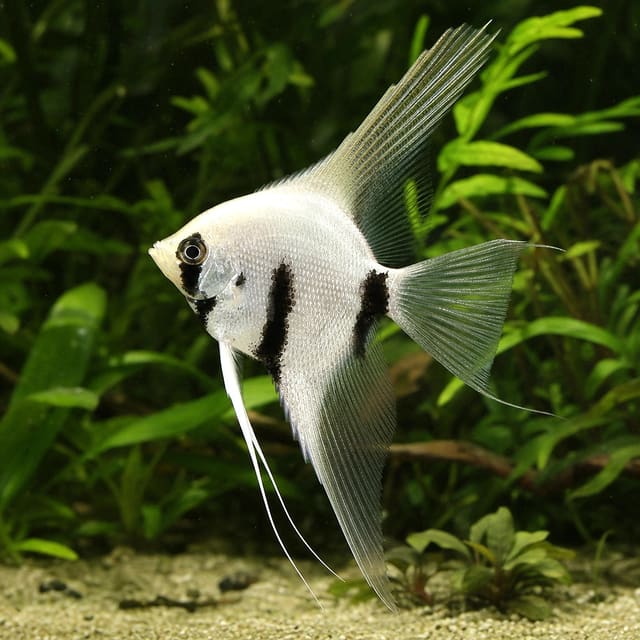
Pterophyllum scalare platinum panda
24–27°C · pH 6.5–7.4 · 200L
£14.99
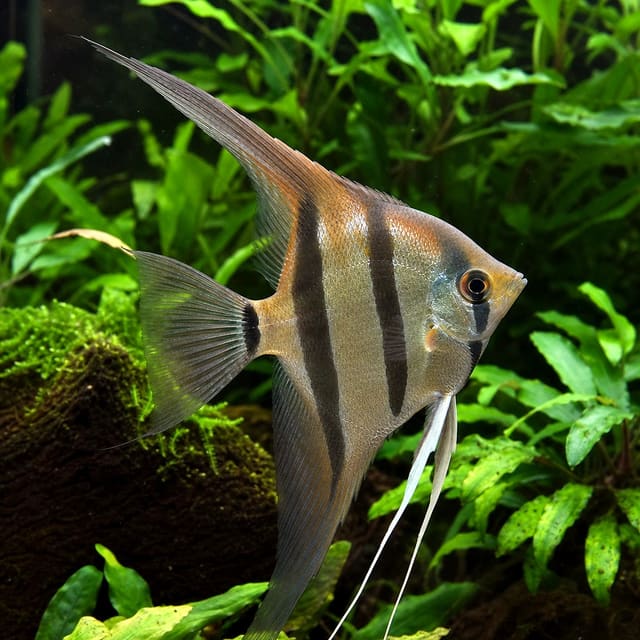
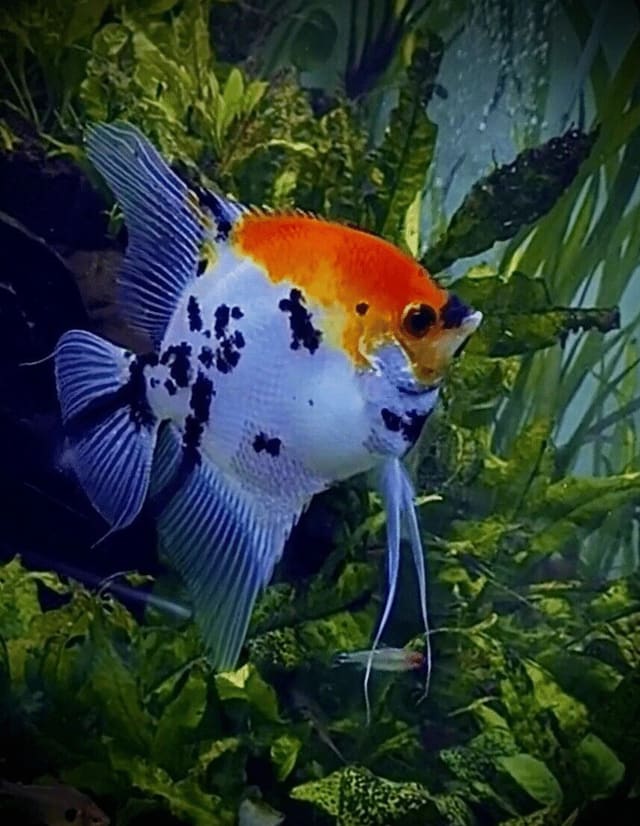
Scalar common blue is a blue colour form of the freshwater angelfish, Pterophyllum scalare, sold as one live fish in the size you choose, from 1 cm to over 7 cm. Adults reach about 15 cm long and stand far taller with their fins, so plan a tall, mature aquarium of around 200 litres and a pair or planned group.
Adult size is the maximum length this species reaches at full maturity (scientific sources). The livestock you receive will be younger and smaller — pick a size above for the actual shipping size. Product-photo provenance and any image-specific limitations are stated on the listing.
Pterophyllum scalare
Save when buying multiple fish. Each quantity is one fish; sex and pair formation are not guaranteed unless the selected variant explicitly states them.
Minimum of 2 per order.
Scalar common blue is a blue colour form of the freshwater angelfish, Pterophyllum scalare, sold as one live fish in the size you choose, from 1 cm to over 7 cm. Adults reach about 15 cm long and stand far taller with their fins, so plan a tall, mature aquarium of around 200 litres and a pair or planned group.
Adult size is the maximum length this species reaches at full maturity (scientific sources). The livestock you receive will be younger and smaller — pick a size above for the actual shipping size. Product-photo provenance and any image-specific limitations are stated on the listing.
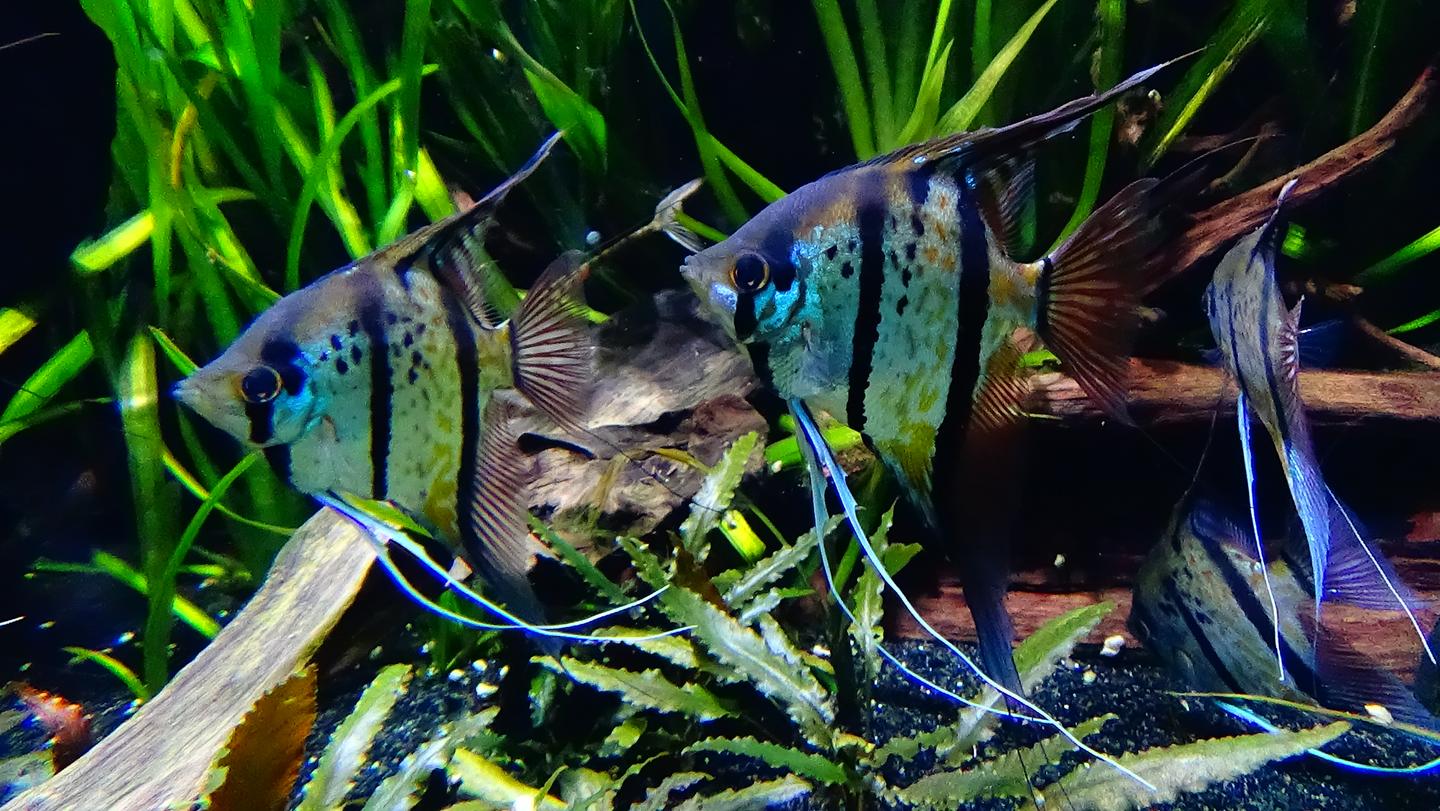
Freshwater angelfish are tall South American cichlids, not small community fish. OATA gives 120 litres as an industry floor for a compatible pair and says the aquarium must be sufficiently tall. We prefer planning around roughly 200 litres, a 100 × 40 cm footprint and about 50 cm height for an adult pair, with more space and an exit plan for a group.
Maintain these water conditions for optimal health and vibrant colors
Scalar common blue is a blue colour form of the freshwater angelfish, Pterophyllum scalare, a tall-bodied cichlid from the Amazon basin. Each purchase is one live fish in the size you select, from 1 cm juveniles to fish of more than 7 cm. Whichever size arrives, plan for the adult: FishBase records a maximum of 15 cm in total length, and the long fins make a grown angelfish taller than it is long, so it needs a tall, mature aquarium of around 200 litres and the company of its own kind.
The species is well documented. FishBase places it in the cichlid family Cichlidae, describes it as one of the most popular of all tropical aquarium fish and gives its IUCN status as Least Concern. "Scalar common blue" is the trade name for this blue form, and there is no evidence that one colour form is hardier or calmer than another, so the care on this page applies to the species as a whole.
The title follows a simple rule: the scientific name in brackets identifies the species, and the words before it describe the form you are buying. Colour names such as "common blue" belong to domestic strains rather than to the scientific name, which is why silver, marble, koi and blue angelfish all share the name Pterophyllum scalare and the same care.
| Suits | A tall, mature aquarium of about 200 litres with calm companions too large to be eaten |
|---|---|
| Supplied | One live fish per purchase, in the size you select |
| Adult size | About 15 cm long and roughly 20–25 cm tall including the fins |
| Social needs | A compatible pair or a planned group, not a single fish |
| Routine water | 24–27 °C, pH 6.5–8.0, about 5–12 dGH |
| Diet | Omnivore: complete cichlid pellet or granule plus frozen foods |
| Care level | Intermediate, in our assessment |
The size you select is the size supplied, not the adult size. Nine sizes appear on this listing: 1 cm, 1.5–2 cm, 2.5–3 cm, 3–3.5 cm, 4–5 cm, 5–5.5 cm, L (5.5–6 cm), XL (6–7 cm) and XXL (more than 7 cm). Sizes sell out and return, so the size menu is the place to see what can be ordered.
Smaller fish are younger, and they need exactly the same adult-sized plan because they will grow into it. They are also small enough to be eaten by larger tank mates, so keep them away from big or boisterous fish until they have grown. Larger sizes bring you closer to the adult, but even an XL fish has a long way to grow before it reaches full length and height.
Each purchase supplies one fish, so order two or more if you are starting a pair or group. Because young angelfish cannot be sexed reliably, two juveniles bought together may not become a pair. Seriously Fish suggests growing on a group of six juveniles if you want a pair to form naturally, which works only if you have the room, or a rehoming route, for the fish that do not pair off.
To compare other colour forms of the same species, browse our angelfish collection.
Sex is guaranteed only when the selected option explicitly states male or female. This Scalar common blue listing has no sex-guaranteed option. Angelfish are difficult to sex until they spawn, so a pair cannot be picked reliably from young fish.
Gallery images have been digitally enhanced to improve image quality. Natural colour, pattern, size and maturity can vary between live animals.
The accepted name is Pterophyllum scalare (Schultze, 1823). Eschmeyer's Catalog of Fishes places it in the family Cichlidae and records the lower Amazon in Brazil as its type locality. FishBase gives its native distribution as the Amazon River basin in Peru, Colombia and Brazil, along the Ucayali, Solimões and Amazon rivers, together with rivers of Amapá in Brazil, the Rio Oyapock in French Guiana and the Essequibo River in Guyana.
FishBase describes adults living in swamps and flooded ground where aquatic and riverside vegetation is dense and the water is either clear or silty, and notes that the fish's colour is deeper in clear water. Those records describe a wild habitat rather than a recipe for an aquarium, but they explain why angelfish look at home among tall plants and upright wood.
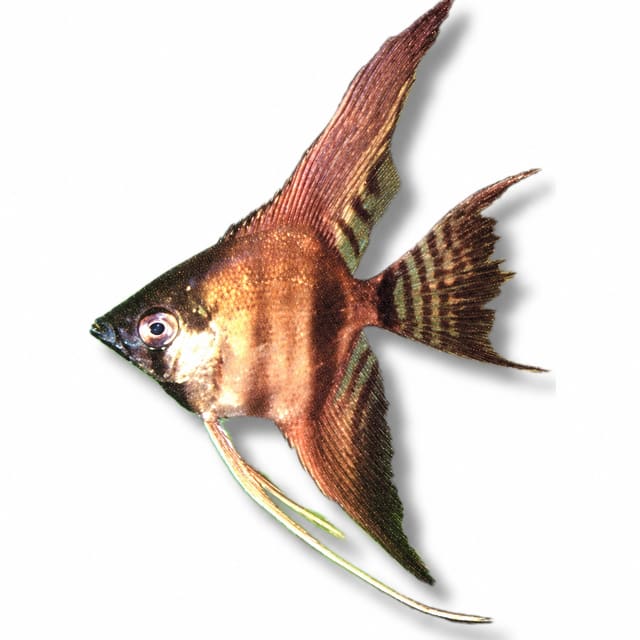
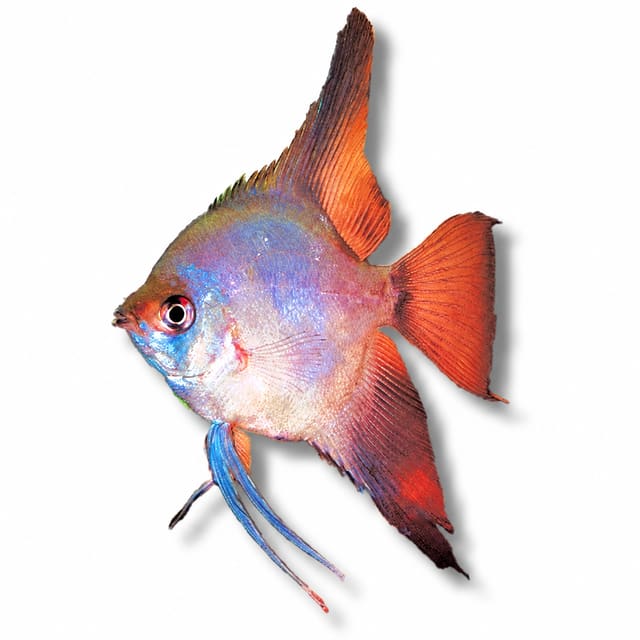
Domestic angelfish are kept in many colour and fin forms. Seriously Fish mentions black, gold and koi strains alongside the standard silver, and our angelfish care guide lists marble, platinum, zebra, smokey and long-fin forms among others. "Scalar common blue" is the trade name for a blue form of the same species. Choose an individual fish for its health and your aquarium for its adult needs; colour makes no difference to either.
It is worth knowing that the altum angelfish, Pterophyllum altum, is a separate species rather than a colour form, so its care should not be assumed to match this fish.
FishBase gives a maximum length of 15 cm total length in its biology notes and lists 10.5 cm total length for males or unsexed fish in its length record; Seriously Fish quotes 150 mm standard length. For planning, use about 15 cm. Length is only half the story, though: the tall dorsal and anal fins can make an adult roughly 20–25 cm from fin tip to fin tip, and individual fish and domestic strains vary.
Height matters as much as volume. OATA's care sheet for American cichlids recommends at least 120 litres for a pair of the smaller species under 15 cm and adds that angelfish need an aquarium that is sufficiently tall when they are fully grown. Seriously Fish treats 100 × 40 × 50 cm, about 200 litres, as the smallest aquarium to consider and recommends at least 50 cm of height for adults, while FishBase gives a minimum aquarium length of 100 cm.
Our freshwater angelfish care guide sets out the store's planning point: roughly 200 litres, a 100 × 40 cm footprint and about 50 cm of usable height for an adult pair, with more room and an exit plan for a group. OATA also suggests allowing 40 litres per adult when stocking shoaling species such as angelfish, which is a useful cross-check on numbers but says nothing about the height an adult needs.
For its 200-litre recommendation, Seriously Fish suggests a filter rated at around 800–1,000 litres per hour, a turnover of four to five times the tank volume each hour, and roughly 200–275 W of heating in a room of about 20 °C. It also notes that angelfish prefer gentle water flow, so position outlets to avoid a strong current across the open water. Choose filtration for water quality and oxygen exchange, cover any intake that could catch a long fin, and fit a secure lid.
Seriously Fish recommends a well-planted tank with tall, leafy plants such as Amazon swords. Upright plants and wood break the tank into separate areas and interrupt long lines of sight between rivals, while open water lets an adult turn without catching its fins. OATA's American cichlid sheet recommends fine gravel or sand because many species will dig or sift the substrate when feeding or breeding, so bed heavy décor firmly on the base and avoid sharp edges near those long fins.
Mature the filter before any fish arrive, and confirm by testing rather than by the calendar that ammonia and nitrite read zero. Our guide to setting up and maturing a first tropical tank walks through the process. Check the temperature with a thermometer rather than relying on the heater dial alone.
Published water values for angelfish differ because they describe different things, from recorded wild conditions to general trade guidance. Seeing them side by side makes the routine target easier to understand.
| Source | Values given |
|---|---|
| FishBase recorded environment | 24–30 °C, pH 6.0–8.0, 5–13 dH |
| Seriously Fish aquarium profile | 24–30 °C, pH 6.0–7.4, 0–15 dGH |
| OATA broad guide for American cichlids | 22–27 °C, pH 6.5–8.0, 4–12 °dH |
| Routine target on this page | 24–27 °C, pH 6.5–8.0, about 5–12 dGH |
The routine target keeps to the ground where FishBase's species ranges and OATA's group guidance overlap, the same approach our care guide takes. The top of FishBase's temperature range describes the environment the species has been recorded in, not a temperature to hold all year, and the OATA care sheet for American cichlids presents its figures as a general guide for a whole group of fish. Staying inside the overlap leaves you a margin on both sides.
Match the water the fish comes from as closely as you reasonably can, acclimatise gradually and avoid abrupt changes. OATA stresses that American cichlids can be stressed by even the smallest amounts of ammonia, so ammonia and nitrite must stay at zero and nitrate no more than 20 mg per litre above your tap water.
If you do need to adjust pH or hardness, do it slowly and by measurement. Tap water and reverse-osmosis water vary too much for a fixed mixing recipe, so measure GH, KH and pH before and after any change. Keep such adjustments for planned changes; they are never the fix for an ammonia or nitrite problem, which needs urgent attention and advice instead.
Suppose your tap water tests at pH 7.6 and 10 dGH, and your heater holds 25 °C. Every value sits inside the routine target, so leave the chemistry alone and concentrate on keeping it steady from one water change to the next. If the same water tested at 16 dGH instead, it would sit above both OATA's guide and the routine target; softening it would mean measured mixing with reverse-osmosis water, planned and settled before the fish arrive rather than carried out around them.
Our guide to testing aquarium water and reading GH, KH and pH explains each measurement. Once you have your own results, the water parameter matcher gives a quick comparison, but keep the angelfish target above as your guide.
Angelfish are omnivores. Seriously Fish notes that wild fish feed predominantly on small crustaceans and other aquatic invertebrates, while tank-bred fish will accept pellet or flake food and relish live or frozen foods. OATA adds that American cichlids often prefer meaty foods. A complete cichlid pellet or granule, or a suitable flake, sized so every fish can swallow it, makes the staple; frozen or freeze-dried daphnia, brine shrimp and bloodworm add variety.
Feed only what the fish eat within a few minutes, once a day, as OATA recommends for American cichlids. These fish can eat large amounts in one sitting, so take care not to overfeed: uneaten food and extra waste break down and release toxic compounds into the water. Remove leftovers after each meal, and watch that every fish, including quieter or lower-ranking ones, gets its share.
A controlled study of freshwater angelfish by Kasiri, Farahi and Sudagar (2012) compared different feed types and found that they affected growth and reproductive performance. That supports offering a varied, good-quality diet, but it does not set a single household menu. Treat bloodworm and other favourites as part of the mix rather than the whole diet.
If you choose one of the smallest sizes, the same rules apply with smaller particles. Crumble or choose food fine enough for the fish to take whole, and watch body shape over the following weeks: a steady, rounded profile tells you the portions are right, while a pinched belly or leftovers on the substrate tell you to adjust.
The right water-change volume also depends on how many fish you keep, how much you feed, the plants and the filter, so treat OATA's 25% as a starting routine and let your test results guide any adjustment.
A healthy angelfish swims steadily, breathes at an even rate, has clear eyes, holds its fins open and undamaged, keeps a normal body shape and feeds reliably. The RSPCA's fish health and welfare advice covers the same visible signs and puts water quality first whenever something changes.
OATA's watch list covers changes in swimming (hanging at the surface, sitting on the bottom or moving erratically), colour, temperament, breathing rate, appearance (white spots, fluffy growths, loss of fins or scales), body condition and appetite. Clamped fins, gasping, flashing, wounds and poor balance also deserve attention. Treat all of these as signals to investigate, not as a diagnosis.
Avoid copying temperature-raising or medication recipes found online: the right response depends on a confirmed problem, the fish and the water.
Our care guide recommends having a mature quarantine set-up, with its own equipment, before adding new fish to an established community. If an angelfish ever jumps out, return it to aquarium water straight away using wet hands or a wet, soft net, handle it as little as possible and watch its breathing, balance and skin for injury. Then check the lid, and get fish-vet advice if recovery looks abnormal.
The RSPCA's aquarium environment guidance explains that no fish should be kept without a well set up and maintained filter. Fish release ammonia, which is toxic; beneficial bacteria in a working filter convert it to nitrite, which is also toxic, and then to nitrate, which is safer. Keeping that bacterial population healthy is the core of every routine above.
Angelfish are difficult to sex. Seriously Fish explains that males have a smaller, pointed genital papilla, but this can usually be seen only when the fish are spawning, and that behaviour may be a better clue, because males in breeding condition are likely to be more aggressive and territorial. Forehead shape, fin angle and general temperament are not reliable ways to sex young fish. OATA makes the wider point that some American cichlids show no visible difference unless they are breeding.
If you intend to breed, Seriously Fish suggests starting with a group of six juveniles so that a pair can form. Research on the species supports serial monogamy under captive conditions, which means a pair may separate and re-pair rather than stay together for life.
Angelfish lay adhesive eggs on a vertical or firm surface such as slate, a broad leaf or even the aquarium glass. Condition a pair with live foods such as bloodworm and brine shrimp. Both parents may guard the eggs and then the fry, but keep the adults well fed, as they are known to eat their young at times. Seriously Fish notes that fry can take newly hatched brine shrimp once they have absorbed their yolk sacs, usually after about two days, before moving on to a commercial fry food.
Breeding sharpens territorial defence, so a pair that spawns in a community tank can make life difficult for everything else in it. A separate, mature breeding set-up is the safer plan if you want to raise young.
Your angelfish is hand-packed by our team and bagged in pure oxygen inside an insulated poly box, with a heat pack when the weather calls for it. We email the tracking number and your confirmed delivery date, and a licensed live-animal courier delivers the parcel. Someone must be at home to receive it, because live fish cannot be left unattended. Our delivery and Live Arrival Guarantee policy has the full details.
Each new fish adds waste that the filter's bacteria must catch up with, which is why OATA advises raising numbers slowly. Stocking too quickly can bring on new tank syndrome, with unhealthy levels of ammonia and nitrite that may cause fish to become ill and die. Test more often than usual for the first few weeks, feed modestly and add any further fish gradually.
If you are building a pair or group, watch the fish closely as they settle. Short displays are normal cichlid behaviour, but a fish that is repeatedly chased from food or pinned in a corner needs separating before it is harmed.
Angelfish should not be kept alone. OATA notes that they are social and that those kept singly may become stressed, and it recommends a group or, at minimum, a pair. FishBase suggests keeping them in groups of five or more. The complication is that angelfish, although generally peaceful, may squabble with their own kind, as Seriously Fish points out, and adults sort themselves into a social order that affects who eats first and who gets chased.
Whichever route you take, have a second tank or a realistic rehoming route ready before trouble starts. A fish that is persistently kept away from food or cover has a welfare problem that needs acting on.
OATA describes angelfish and severums as calmer American cichlids that can share a robust community aquarium with larger shoaling species. Corydoras and bristlenose plecos are often considered because they spend their time at a different level of the tank, but that is a starting point for research rather than an assurance: check each fish's adult size, floor space needs and water range against your aquarium.
OATA's allowance of 40 litres per adult angelfish means five adults would fill a 200-litre aquarium on their own, with no margin left for companions. That is why our care guide treats about 200 litres as the plan for an adult pair, and asks for more room and an exit plan for a group. In practice, a tank of that size suits a pair of angelfish with a modest number of larger, peaceful shoaling fish, added gradually as the filter keeps pace.
| Check | What to ask |
|---|---|
| Adult size | Could a grown angelfish swallow it, or could it harm the angelfish? |
| Fin behaviour | Is it known for nipping long fins? |
| Territory | Will it compete with a pair for the same spawning space? |
| Water overlap | Do its needs fit 24–27 °C and pH 6.5–8.0? |
| Feeding speed | Will it take food before slower angelfish can reach it? |
If a companion fails any one of these checks, choose something else. A calm, well-matched community is easier to keep healthy than one that needs constant watching.
Plan for about 15 cm in total length, the maximum FishBase records for Pterophyllum scalare, with the long fins making an adult roughly 20–25 cm tall. Size the aquarium around the adult fish rather than the juvenile you receive.
Plan on about 200 litres with at least 50 cm of height for adults. Seriously Fish gives 100 × 40 × 50 cm as the smallest aquarium to consider, and OATA's general floor of 120 litres for a pair of smaller American cichlids comes with a warning that angelfish need a sufficiently tall tank.
Keep a compatible pair or a planned group rather than a single fish; OATA notes that angelfish kept singly may become stressed. FishBase suggests groups of five or more, but adults may squabble with their own kind, so a group needs more space and a plan for separating fish.
It suits a prepared keeper rather than a first set-up. We rate its care as intermediate: it needs a mature, tall aquarium, tested water and a plan for aggression within pairs or groups.
Pterophyllum scalare is an omnivore that often prefers meaty foods. Use a complete cichlid pellet, granule or suitable flake as the staple, add frozen or freeze-dried daphnia, brine shrimp and bloodworm for variety, and feed only what is eaten within a few minutes, once a day.
Aim for a routine 24–27 °C, pH 6.5–8.0 and about 5–12 dGH, where FishBase's species ranges overlap OATA's broad guidance for American cichlids. Keep conditions stable and make any change gradually.
They are generally peaceful cichlids but may squabble with their own kind, and pairs defend territory more strongly when breeding. Their own long fins are a target, so avoid persistent fin-nippers as tank mates.
OATA says calmer American cichlids such as angelfish can share a robust community aquarium with larger shoaling species. Corydoras and bristlenose plecos are often considered, but check their adult size, floor space and water needs. Very small tetras, shrimp and fry are at risk of being eaten.
It is hand-packed, bagged in pure oxygen inside an insulated poly box, with a heat pack when the weather calls for it, and carried by a licensed live-animal courier. Be in to receive it, film a continuous unboxing video from the sealed parcel onwards, then float the sealed bag for 20–30 minutes before releasing the fish without the bag water.
The identity, care and welfare information on this page draws on these public sources.
No reviews for this item yet. Bought one? Honest reviews only, good or bad.
What customers say about ordering from us
Easy website plenty of info on fish your buying great to pick a time slot
TRACEY DURRANT · 7 Oct 2026
Got some lovely fish thank you
Kevin Mackie · 7 Oct 2026
Reviews of our shop, collected by Judge.me, an independent third-party review collector. Newest first.