Moderate
Marble Angelfish (Pterophyllum scalare)
24–27°C · pH 6.5–8 · 200L
£3.99

The XL Mix Angelfish (Pterophyllum scalare) is a freshwater cichlid from the Amazon basin in Brazil, Colombia and Peru, with further records from rivers in French Guiana and Guyana, that reaches 15 cm. It suits prepared intermediate keepers planning a compatible pair or, following FishBase’s aquarium note, a group of at least five; the FishBase, Seriously Fish and OATA overlap is 24–27°C and pH 6.5–7.4. Sold individually at a 6–7 cm dispatch grade.
Pterophyllum scalare
Save when buying more.
The XL Mix Angelfish (Pterophyllum scalare) is a freshwater cichlid from the Amazon basin in Brazil, Colombia and Peru, with further records from rivers in French Guiana and Guyana, that reaches 15 cm. It suits prepared intermediate keepers planning a compatible pair or, following FishBase’s aquarium note, a group of at least five; the FishBase, Seriously Fish and OATA overlap is 24–27°C and pH 6.5–7.4. Sold individually at a 6–7 cm dispatch grade.
Maintain these water conditions for optimal health and vibrant colors
The XL Mix Angelfish (Pterophyllum scalare) is a freshwater cichlid from the Amazon basin in Brazil, Colombia and Peru, with further records from rivers in French Guiana and Guyana. It reaches 15 cm and develops a tall profile formed by its body and extended dorsal and anal fins. This fish suits an intermediate keeper prepared to provide a mature, tall aquarium, measured water conditions and a plan for changing social behaviour.
FishBase records the freshwater angelfish in the family Cichlidae and describes adults living among dense aquatic and riverbank vegetation in swamps and flooded ground. That habitat supports a layout with plants, roots and vertical structure, while its adult dimensions make usable height and turning room more important than the juvenile’s present size.
Eschmeyer’s Catalog of Fishes retains Pterophyllum scalare as the accepted scientific name. “Mix” is part of the offer’s trade name, not part of the binomial.
| Suits | Not suited to |
|---|---|
| A mature, filtered and sufficiently tall aquarium | A shallow aquarium chosen around the dispatch size |
| An intermediate keeper who tests water regularly | A setup without a mature biological filter |
| A compatible pair or planned group with an exit plan | Assuming two fish will automatically form a pair |
| Larger robust companions sharing the same conditions | Prey-sized fish, persistent fin-nippers or highly aggressive competitors |
One purchase supplies one live XL Mix Angelfish at the 6–7 cm dispatch grade. That measurement helps describe the fish at dispatch; it is not an adult-size claim and does not establish age, sex or sexual maturity. Prepare the adult aquarium before introducing the fish rather than relying on a later upgrade.
Sex is guaranteed only when the selected option explicitly states male or female. This XL Mix Angelfish listing has no sex-guaranteed option. Two fish should therefore never be treated as a promised compatible, bonded or breeding pair. Angelfish can be difficult to sex outside active spawning, and behaviour can change as individuals mature or enter breeding condition.
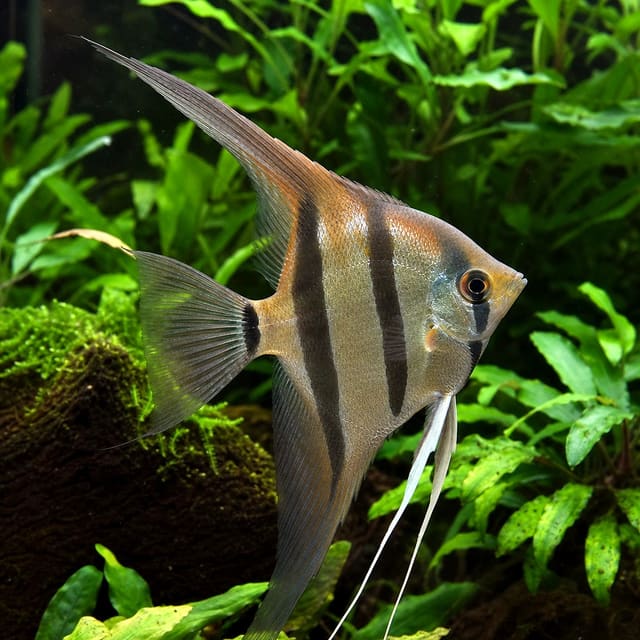
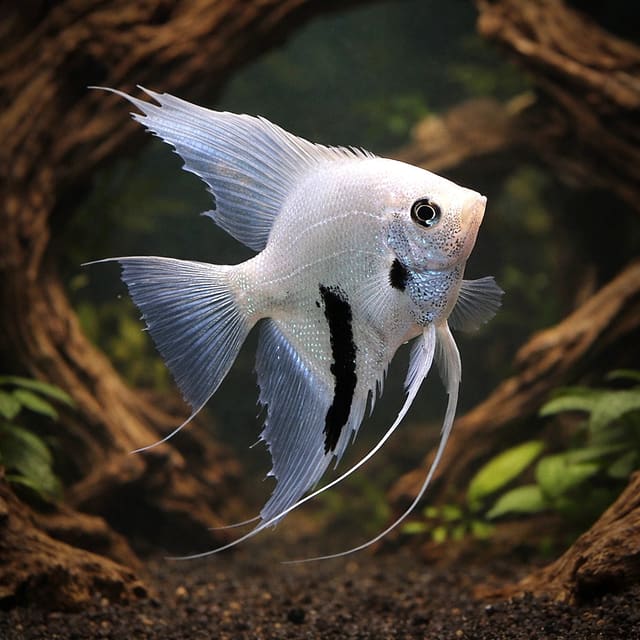
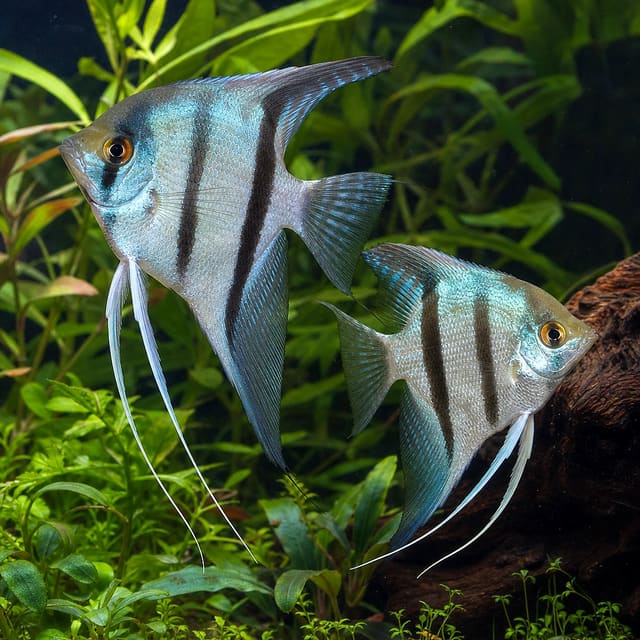
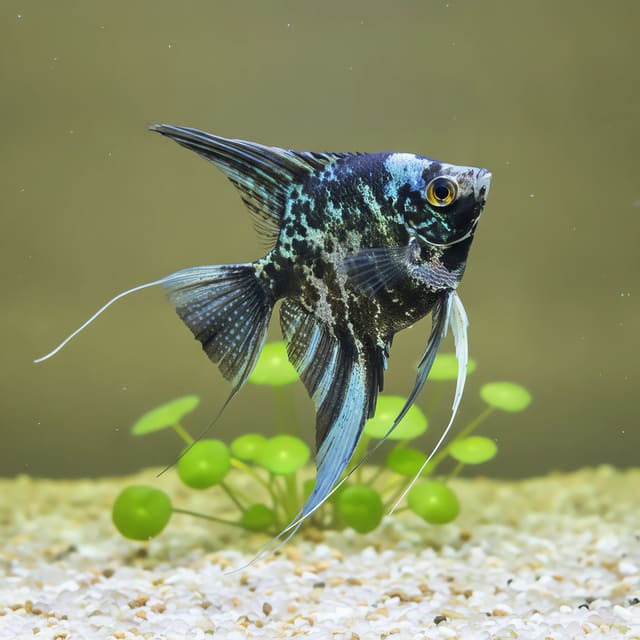
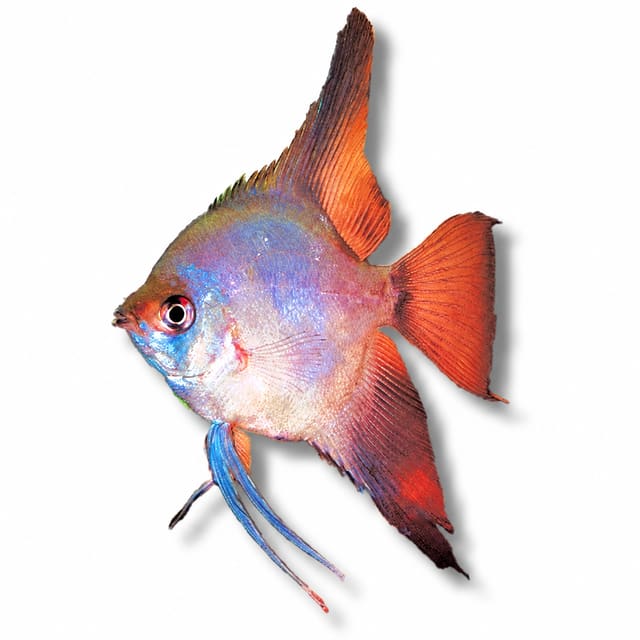
The gallery images are representative of this type of animal rather than photographs of the exact animal supplied, so colours can look slightly different from the live animal. Use the gallery to understand the characteristic tall body and extended fins, not to select one exact pattern.
| Offer detail | What to plan for |
|---|---|
| One fish per purchase | Build the social plan separately; sale quantity does not create compatibility |
| 6–7 cm dispatch grade | Allow for growth to 15 cm and a much taller fin profile |
| “Mix” in the trade name | Expect individual differences in colour and markings |
| No sex-guaranteed option | Do not base the aquarium plan on receiving a particular sex |
Use the angelfish collection to compare other angelfish products after deciding whether this species’ adult space, water and social requirements fit your aquarium.
Plan for an adult length of 15 cm and an overall height that may reach about 20–25 cm across the extended fins. FishBase gives a maximum length of 15 cm TL, the figure the Tropical Fish Co guide also uses. Use 15 cm consistently when assessing adult turning room, stocking and filtration.
Seriously Fish recommends that a 100 × 40 × 50 cm aquarium, approximately 200 litres, should be the smallest considered. Its maintenance guidance also recommends a well-planted aquarium with tall leafy plants, gentle flow and at least 50 cm of height for adults. Our complete freshwater angelfish care guide uses roughly 200 litres, a 100 × 40 cm footprint and about 50 cm of usable height as the preferred adult-pair plan.
OATA’s American-cichlid guidance gives at least 120 litres for a pair of smaller species and says adult angelfish need sufficient height. That is a broad group floor. The 200-litre plan gives more useful room for adult dimensions, territories, planting and maintenance access.
A nominally tall aquarium can still be cramped if hardscape divides it into narrow channels. Stand in front of the completed layout and trace a full turn through the middle water. If the projected 20–25 cm fin profile would touch decor or leave no retreat from another angelfish, revise the layout before adding livestock.
Keep this angelfish at 24–27°C, pH 6.5–7.4 and 5–12 dGH. These routine values are the overlap of FishBase’s 24–30°C, pH 6.0–8.0 and 5–13 dGH species record, Seriously Fish’s 24–30°C, pH 6.0–7.4 and 0–15 dGH aquarium range, and OATA’s broad American-cichlid guidance of 22–27°C, pH 6.5–8.0 and 4–12 dGH.
The shared range is more useful for a routine community plan than selecting the edge of one wider range. For example, pH 7.6 lies within FishBase and OATA figures but outside the Seriously Fish aquarium range, so it is not part of this listing’s shared target. Hold a steady value inside the shared range rather than repeatedly chasing one exact number.
Test the aquarium and replacement water before adjusting pH or hardness. The water chemistry guide explains GH, KH and pH, while the water matcher helps compare measured aquarium values with the stated range. Do not copy a fixed tap-water and reverse-osmosis recipe without measuring both the starting water and intended result.
| Measurement | Action |
|---|---|
| Temperature | Hold 24–27°C and confirm it with a thermometer |
| pH | Keep 6.5–7.4 without abrupt elective adjustment |
| General hardness | Keep 5–12 dGH and measure prepared replacement water |
| Ammonia and nitrite | Maintain zero detectable mg/l |
| Nitrate | OATA says no more than 20 mg/l above the normal tap-water level |
If ammonia or nitrite is detected, treat the result as urgent rather than delaying action to preserve a pH or hardness target. Check the biological filter, feeding, stocking and recent changes. For routine maintenance, prepare conditioned replacement water with closely matched temperature and measured chemistry so the correction itself does not create another abrupt change.
Give the fish vertical structure around the sides and rear, open middle water for turning, and filtered movement that does not force it to fight a concentrated jet. FishBase places adults in densely vegetated swamps and flooded ground, while Seriously Fish recommends tall leafy plants and gentle flow. Those descriptions support plants, roots and upright wood as practical layout features without making one plant species or substrate compulsory.
Use tall plants or stable wood to interrupt long sight lines between angelfish. A subordinate fish needs a route out of view, not merely an ornament behind which it remains trapped. Keep the centre open enough for feeding and turning, and leave clear space around long dorsal, anal and ventral fins. Smooth edges reduce the chance of physical damage when a fish turns quickly or is chased.
Secure decor against digging and routine maintenance. Broad leaves and upright surfaces may also become spawning sites, so avoid arranging the entire aquarium around one central feature that a pair could defend against every other inhabitant.
The RSPCA explains that aquarium filters are vital because fish release toxic ammonia. A working biological filter houses bacteria that convert ammonia to nitrite and then to the safer nitrate. Prepare and test the filter before livestock arrives; the first tropical aquarium guide covers the maturation process.
Seriously Fish suggests four to five aquarium volumes of turnover per hour for a roughly 200-litre setup, equivalent to a nominal 800–1000 litres per hour. Treat that as a filtration-planning figure rather than a demand for a narrow high-speed current. Spread the return flow, preserve surface movement for gas exchange and leave calmer feeding and resting areas.
Keep angelfish as a compatible pair or as a deliberately planned group rather than treating an isolated fish as the default. OATA advises a pair or group at minimum and warns that a singleton may become stressed. FishBase’s aquarium note says groups of five or more, while Seriously Fish says the species is best kept in small groups because individuals may squabble with their own kind.
For a group plan, use at least five as the stated FishBase starting number and provide more room than the roughly 200-litre adult-pair plan. Group size alone does not settle the decision: footprint, height, visual barriers, feeding access, sex, pair formation and the presence of other territorial fish all affect the outcome.
Two randomly selected angelfish may focus aggression on one individual. A functioning pair is shown through continuing compatible behaviour, not created by purchase quantity. Watch whether both fish can feed, rest, move through the aquarium and leave each other’s immediate space without repeated pursuit.
Pair formation and spawning can change a previously calm aquarium. Seriously Fish describes eggs being placed on vertical surfaces such as slate, broad leaves or aquarium glass, with adults guarding eggs and fry. Territorial defence around that site may displace group members or community fish even when earlier interactions were peaceful.
| What you observe | What to do |
|---|---|
| Brief display with both fish feeding normally | Continue close observation and preserve several visual routes |
| One fish always driven from food | Spread food across separate areas and prepare separation |
| Repeated cornering, torn fins or loss of condition | Separate the aggressor or affected fish into a suitable mature setup |
| A pair defending a vertical site | Increase distance from other fish and use the planned exit arrangement |
A divider or second aquarium helps only when it provides appropriate volume, filtration, heat and water quality. Do not move a bullied fish into an immature container that replaces aggression with poor water conditions.
Use a nutritionally complete cichlid pellet, granule or suitable flake as the staple, in pieces the fish can swallow. Seriously Fish describes Pterophyllum scalare as omnivorous and notes that wild fish feed predominantly on zoobenthos, including small crustaceans and other aquatic invertebrates. Its aquarium guidance says the fish accepts pellet or flake foods and relishes live or frozen food.
Add suitable frozen or freeze-dried variety rather than turning one treat into the whole diet. OATA names daphnia, brine shrimp and bloodworm among foods used for smaller American cichlids. The controlled angelfish feeding study supports the importance of feed composition and diet variety, but it does not set one universal home-aquarium menu.
OATA advises feeding American cichlids once a day, offering only what they can eat within a few minutes. Start with a measured portion, watch every fish and remove leftovers. Uneaten food and excess waste increase the load on the biological filter and can contribute to rising ammonia, nitrite or nitrate.
| Observation | Response |
|---|---|
| Food remains after a few minutes | Remove it and reduce the next portion |
| One fish controls the feeding point | Distribute the same measured portion across separated areas |
| A fish repeatedly spits out large pieces | Use a smaller suitable food format |
| Appetite drops suddenly | Test water and assess breathing, behaviour and social pressure |
| Body condition declines despite feeding | Confirm access to food and seek a fish-health assessment |
Judge the routine from body profile, feeding response, waste and water-test trends rather than feeding more whenever the fish approaches the front. Approach behaviour can reflect learned food anticipation and is not, by itself, a reason to increase portions.
Change about 25% of the water at least weekly as a starting routine, using conditioned replacement water with closely matched temperature and measured chemistry. OATA also advises testing at least weekly, checking the filter for blockages and rinsing filter media lightly in water removed from the aquarium, never under the tap. Adjust the routine from test results, stocking, feeding and waste rather than waiting for cloudy water.
After introduction, compare observations over time rather than relying on one reassuring day. Confirm that every fish reaches food, that no individual is repeatedly displaced, and that ammonia and nitrite remain at zero as the filter responds to the additional waste load.
Warning signs include hanging at the surface, sitting unusually on the bottom, erratic swimming, faster or slower gill movement, hiding, changed aggression, white spots, fluffy growths, damaged fins, altered body condition or reduced feeding. RSPCA fish-health guidance supports using visible condition and behaviour to recognise when action is needed.
Immediately test ammonia, nitrite, nitrate and temperature, then compare pH where relevant with the established conditions. Correct detectable ammonia or nitrite urgently and assess filtration, oxygen exchange, recent additions and feeding. Isolate a fish only when the separate setup is mature, heated and suitable. Speak to a fish vet when breathing, balance, skin, wounds or feeding remains abnormal; signs alone do not identify one disease or justify a fixed medication recipe.
Before arrival, OATA advises checking that ammonia and nitrite are zero and that the aquarium water is suitable. Have the mature aquarium running with its temperature and water chemistry already measured.
The delivery and Live Arrival Guarantee policy also explains that fish are hand-bagged in oxygen and placed in an insulated poly box, with a heat pack when weather conditions call for one. Read the policy before the parcel is due so its receipt and claim requirements are clear.
Acclimatisation cannot compensate for an immature filter or incompatible tank mates. OATA requires zero ammonia and nitrite, while the adult aquarium and social plan should already be in place. If an established angelfish immediately begins repeated chasing, use the separation plan rather than allowing the newcomer to remain cornered.
Choose companions by adult size, temperament, water overlap, feeding behaviour and territory rather than relying on a universal community list. OATA says calmer American cichlids such as angelfish may live in a robust community with larger shoaling species. Seriously Fish also calls the species a generally peaceful community cichlid, while warning that it may squabble with its own kind and eat small fish such as tetras.
Individual behaviour and pair formation leave honest uncertainty in every community plan. A combination that appears calm before breeding can change once a pair defends a vertical site. Assess the whole adult community and keep a suitable separation route ready.
| Screening check | Decision rule |
|---|---|
| Adult body size | Avoid fish small enough to be swallowed; juvenile size can be misleading |
| Fin behaviour | Avoid persistent fin-nippers that can damage extended fins |
| Temperament | Avoid highly aggressive competitors and plan around territorial pairs |
| Water requirements | Use companions that can remain within the FishBase, Seriously Fish and OATA overlap of 24–27°C, pH 6.5–7.4 and 5–12 dGH |
| Feeding speed | Check that every angelfish can reach food without constant competition |
| Territory and level | Confirm that different swimming levels still have enough footprint and retreat space |
Before choosing companions, list the aquarium dimensions, measured water values, filtration, and the adult identities and numbers of all current inhabitants. Litres alone cannot show whether territories, feeding access and adult body sizes fit together.
Add livestock only after tests show zero ammonia and zero nitrite. OATA advises increasing the number of fish slowly because the beneficial bacterial population must respond whenever stocking and feeding rise. Adding too many fish too quickly can leave the filter unable to process the extra waste.
After introduction, watch for steady swimming, regular breathing, open fins and access to food. Brief displays can occur between cichlids, but repeated cornering, exclusion from food, torn fins, hiding and loss of body condition require action. Rearranging one sight line may help where fish can still use the whole aquarium; sustained attacks call for physical separation into a suitable filtered setup.
A bonded pair may claim a broad leaf, slate or aquarium pane as a spawning surface. Recheck whether community fish can move between feeding and resting areas without crossing the defended zone. If one pair controls the centre of the aquarium or blocks access to food, the layout and stocking plan are no longer working even if the litre total has not changed.
Do not answer conflict by placing another angelfish into the aquarium in the hope that aggression will spread harmlessly. Group keeping needs adequate space and deliberate management; adding fish can intensify competition and increase biological load. Use the prepared separation or rehoming route when persistent exclusion develops.
The XL Mix Angelfish reaches 15 cm, with extended fins that may create an overall height of about 20–25 cm. Plan the aquarium around that adult size rather than the 6–7 cm dispatch grade.
Plan roughly 200 litres with a 100 × 40 cm footprint and about 50 cm usable height for an adult pair. Seriously Fish says a 100 × 40 × 50 cm aquarium should be the smallest considered; plan more room for a group.
Plan a compatible pair or a managed group. FishBase’s aquarium note says five or more when keeping a group, while OATA advises a pair or group at minimum and warns that a singleton may become stressed.
The XL Mix Angelfish is an intermediate-care choice suited to a prepared keeper with a mature, tall aquarium, regular water testing and a separation plan for territorial behaviour.
Pterophyllum scalare is omnivorous. Feed a complete cichlid pellet, granule or suitable flake once daily, with suitable frozen or freeze-dried variety, offering only what it can eat within a few minutes.
Keep it at 24–27°C, pH 6.5–7.4 and 5–12 dGH. This range overlaps FishBase and Seriously Fish species figures with OATA’s broad American-cichlid guidance.
It is generally peaceful but may squabble with its own kind and become territorial during pair formation or breeding. Avoid persistent fin-nippers because they can damage its long fins.
Larger robust shoaling fish with matching conditions may work. Avoid very small tetras, which may be eaten, small shrimp and fry, which are at predation risk, and aggressive cichlids, which OATA says must be kept alone or with equally aggressive cichlids; Corydoras and bristlenose plecos need species-by-species checks.
It is hand-bagged in oxygen and placed in an insulated poly box, with a heat pack when weather calls for one, then carried by a tracked licensed live-animal courier. Someone must be present to receive it; start filming before opening the parcel, showing it still sealed and the fish still inside the bag, then float the bag for 20–30 minutes before releasing the fish.
No reviews for this item yet. Bought one? Honest reviews only, good or bad.
What customers say about ordering from us
I have a small group of long finned mountain minnows. So was delighted to be able to order ten of this variety to increase the genetics in my tank . The ones I recieved are healthy but it’s to early to give a verdict on wether they are of a long finned type since they are small currently.
Gordon Walker · 23 Sept 2026
100% success travel and "installation". Pleased with quality of purchase. The Siamese fighter a bit "shy" so have not yet seen him at his best yet but looking good. Happy customer. GG
George E Garratt · 21 Sept 2026
Reviews of our shop, collected by Judge.me, an independent third-party review collector. Newest first.