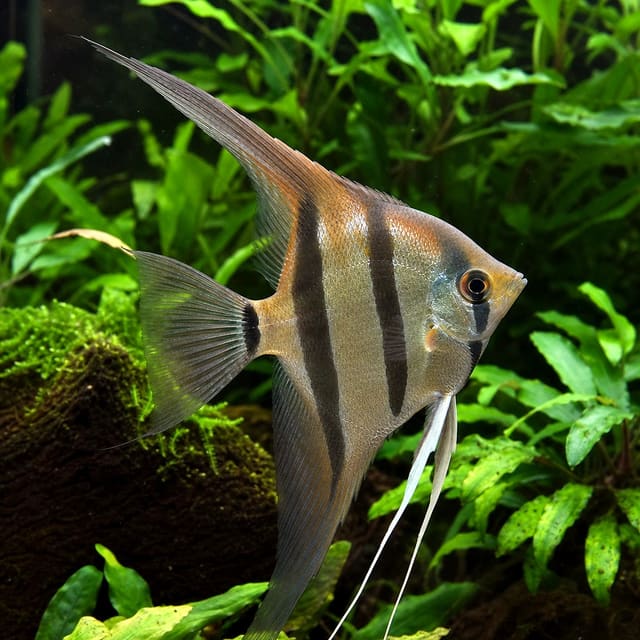
Moderate
California Angelfish (Pterophyllum scalare)
24–27°C · pH 6.5–8
£10.99

Blue Angelfish (Pterophyllum scalare) is a tall South American cichlid supplied as one live fish at the dispatch size chosen. Plan a mature aquarium around 200 litres for an adult pair, with useful height, calm companions and a clear response if territorial behaviour develops.
Adult size is the maximum length this species reaches at full maturity (scientific sources). The livestock you receive will be younger and smaller — pick a size above for the actual shipping size. Product-photo provenance and any image-specific limitations are stated on the listing.
Pterophyllum scalare
Save when buying multiple fish. Each quantity is one fish; sex and pair formation are not guaranteed unless the selected variant explicitly states them.
Blue Angelfish (Pterophyllum scalare) is a tall South American cichlid supplied as one live fish at the dispatch size chosen. Plan a mature aquarium around 200 litres for an adult pair, with useful height, calm companions and a clear response if territorial behaviour develops.
Adult size is the maximum length this species reaches at full maturity (scientific sources). The livestock you receive will be younger and smaller — pick a size above for the actual shipping size. Product-photo provenance and any image-specific limitations are stated on the listing.
Freshwater angelfish are tall South American cichlids, not small community fish. OATA gives 120 litres as an industry floor for a compatible pair and says the aquarium must be sufficiently tall. We prefer planning around roughly 200 litres, a 100 × 40 cm footprint and about 50 cm height for an adult pair, with more space and an exit plan for a group.
Maintain these water conditions for optimal health and vibrant colors
The Blue Angelfish is a blue domestic form of Pterophyllum scalare, the familiar freshwater angelfish. It combines a deep, laterally compressed body with tall dorsal and anal fins and fine trailing ventral fins. The result is an elegant fish that uses far more vertical room than its shop size suggests. It is still a cichlid, however: calm behaviour is common in a suitable community, but pair formation and spawning can bring determined territorial defence.
One purchase supplies one live fish in the size chosen: 2.5–3 cm, 3–3.5 cm or 4–5 cm. The size you select is the size supplied, not the adult size. These are dispatch grades, so build the aquarium and social plan around an adult rather than around the juvenile that arrives.
| Suits | Reconsider if |
|---|---|
| An intermediate keeper with a mature, tested aquarium | The aquarium is new, shallow or chosen only for a juvenile |
| An adult-pair plan around 200 litres, about 100 × 40 cm and roughly 50 cm usable height | There is no room for an adult to turn and extend its fins |
| A compatible pair or deliberately managed group with an exit plan | Two random fish are being assumed to form a peaceful pair |
| Calm, suitably sized companions with overlapping water needs | The proposed community includes tiny prey-sized fish or persistent fin-nippers |
| A varied diet based on a complete cichlid food | One treat food is expected to provide the whole diet |
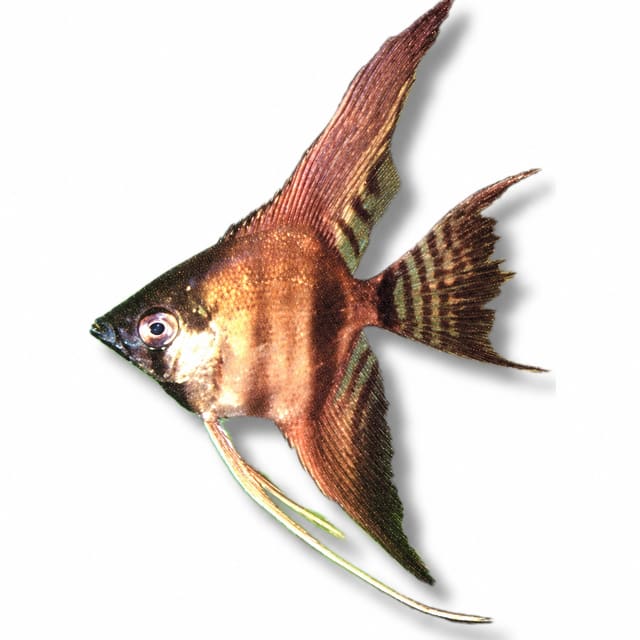
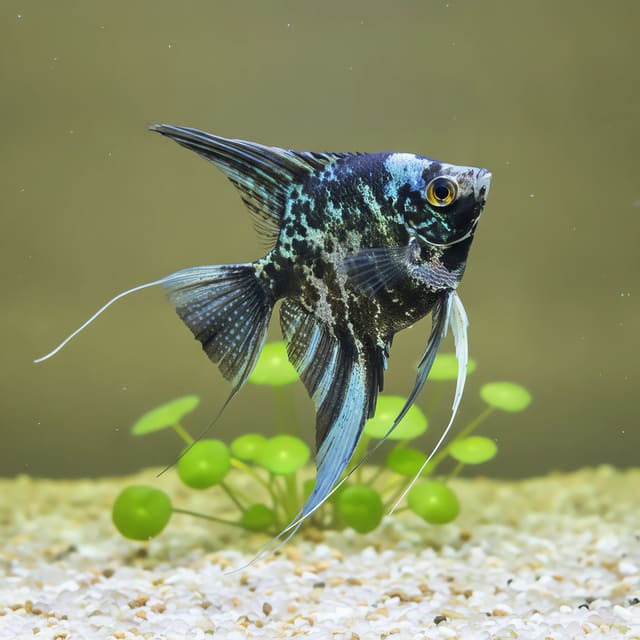
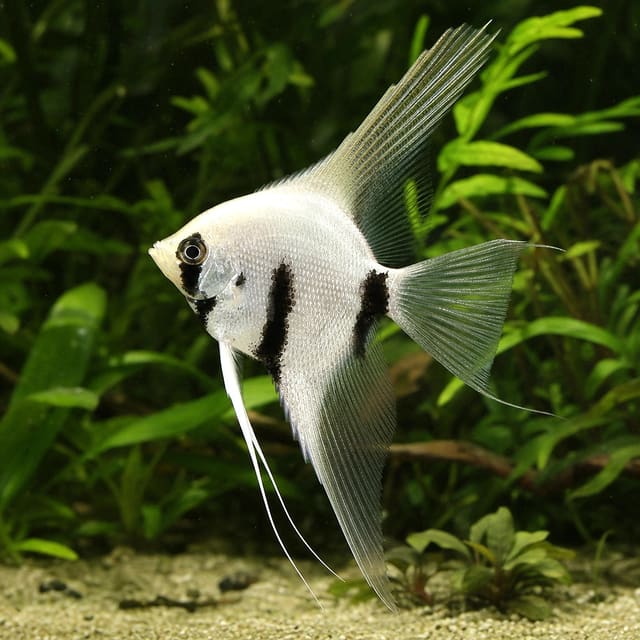
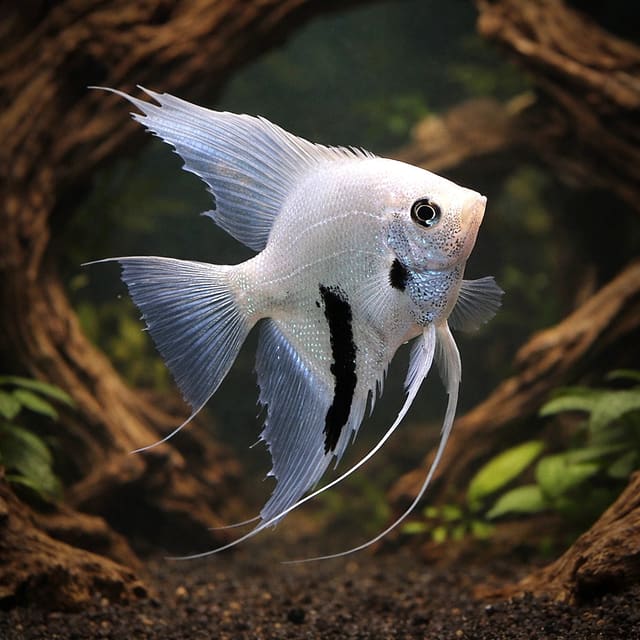
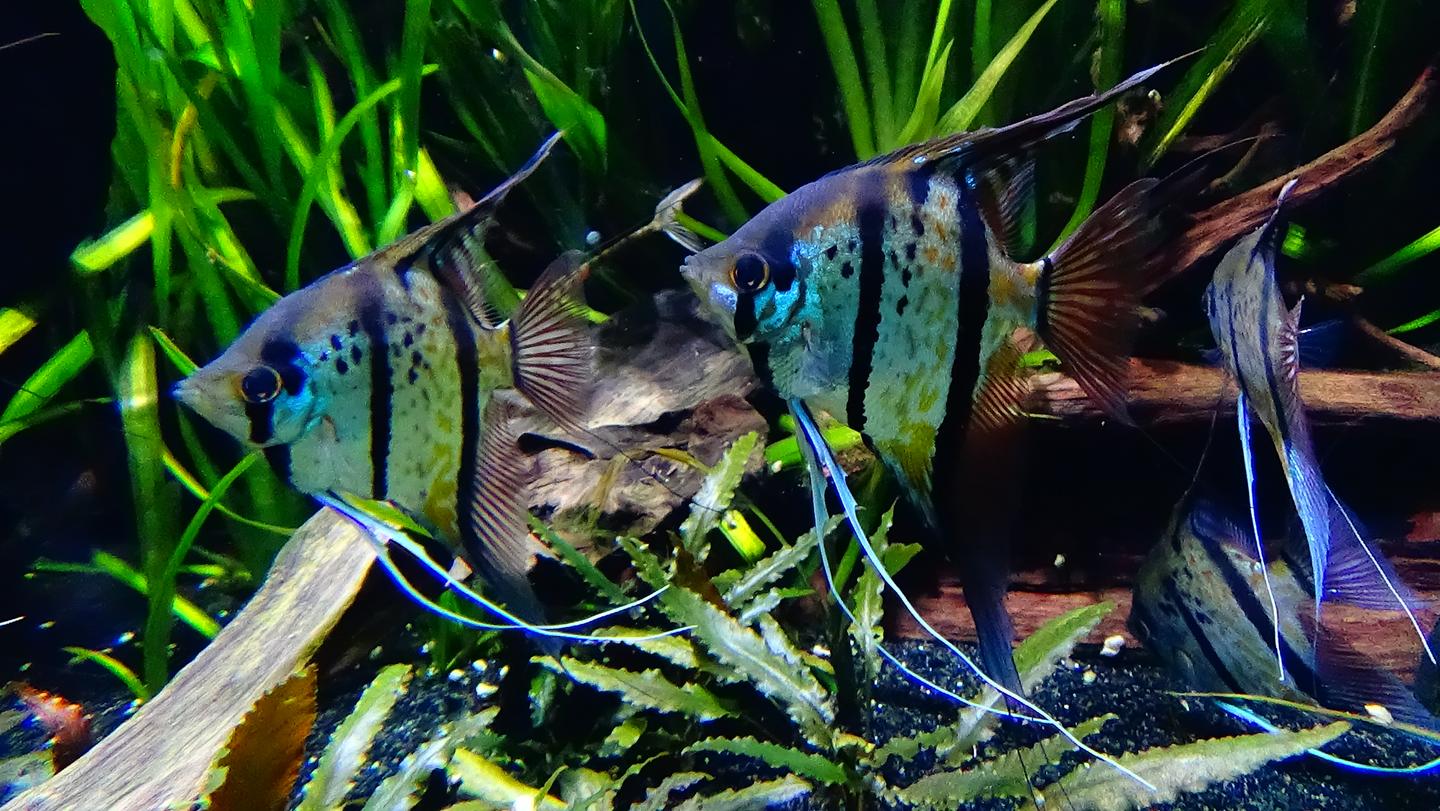
The blue colour is a trade form within Pterophyllum scalare, not a separate species with a different care sheet. Its adult dimensions, social behaviour, feeding needs and water-quality requirements should be planned as freshwater-angelfish needs. Natural colour and pattern vary between individuals, and apparent colour also changes with lighting, background and maturity. The gallery shows two blue-silver angelfish with dark vertical bars and long fins in a planted aquarium; it does not establish the sex of either fish.
Gallery images have been digitally enhanced to improve image quality. Natural colour, pattern, size and maturity can vary between live animals.
Published records describe around 15 cm as a useful maximum-length planning figure, while the extended fins can make an adult roughly 20–25 cm tall. Different references measure length in different ways and FishBase also carries a smaller current field maximum, so false precision is unhelpful. The practical conclusion is clear: choose a tall aquarium with meaningful front-to-back room, not a shallow tank that merely accommodates a small juvenile.
For an adult pair, Tropical Fish Co prefers planning around 200 litres, a footprint close to 100 × 40 cm and about 50 cm of usable height. This is a conservative store recommendation supported by a species-focused aquarium profile; it is not a promise that litres alone determine welfare. A group or mixed community needs more room, broken sight lines and a realistic way to separate or rehome fish if one is persistently excluded.
A sensible routine target is 24–27 °C, pH 6.5–8.0 and about 5–12 dGH. Stability, a fully functioning biological filter and a careful match to the water in which the fish is currently held matter more than chasing a single ideal number. Keep ammonia and nitrite at zero, observe nitrate trends, and make changes gradually unless a toxic-water emergency requires immediate expert help.
Freshwater angelfish are often described as peaceful cichlids, which is useful shorthand but not a guarantee. They can squabble with their own kind, may swallow very small fish, and can defend a spawning area. Choose companions for adult size, fin behaviour, feeding speed, water overlap and territory rather than trusting a generic community label.
Sex is guaranteed only when the selected option explicitly states male or female. This Pterophyllum scalare blue listing has no sex-guaranteed option.
Compare the welfare plan with the complete freshwater angelfish care guide before deciding on tank dimensions and social structure. If this form is not the right fit, the angelfish collection is useful for comparing current forms and dispatch sizes; the care requirements still need to be checked for the exact species offered.
An angelfish aquarium needs height, footprint and volume working together. A tall but narrow tank can restrict turning room; a long but shallow tank can leave the dorsal and anal fins cramped. For an adult pair, use roughly 200 litres, about 100 × 40 cm of footprint and approximately 50 cm of usable height as the preferred planning point. Allow more space for a group or a community because each additional fish changes territory, feeding access and waste production.
OATA gives at least 120 litres as a broad industry floor for a compatible pair of smaller American cichlids and specifically says an angelfish aquarium must be sufficiently tall. The 200-litre plan is deliberately more conservative and aligns with the species-focused profile. Neither number replaces judgement about dimensions, filter capacity, decor and the actual fish. Two randomly selected juveniles are not automatically a compatible adult pair.
Place the aquarium on a level, load-bearing surface away from temperature swings and direct sun. Fit a secure lid: tall fins do not prevent a startled fish from leaving the water. Leave enough clear space above hardscape for fin extension and enough room at the front for feeding, inspection and maintenance.
Freshwater angelfish come from a lineage associated with vegetated and structurally complex waters. Tall plants, vertical wood and planted margins can provide cover and interrupt long lines of sight. Keep open turning and swimming space between these features. Smooth surfaces are kinder to extended fins than sharp rock points or rough plastic edges, and stable hardscape is essential where digging or maintenance could undermine it.
Broad leaves and upright surfaces can become spawning sites. That can be interesting to observe, but it may also concentrate territorial defence in one part of a community aquarium. Arrange several visual barriers instead of one single prized territory, then watch how all fish use the layout. A subordinate angelfish that remains hidden, misses meals or is repeatedly driven into a corner needs intervention rather than more decor piled around it.
Flow should keep the aquarium clean and well oxygenated without pinning the fish in a strong jet. Use guarded filter intakes and distribute the return so there are calm zones as well as circulation. Gentle-flow preference does not mean stagnant water. The RSPCA notes that a working biological filter is fundamental because fish waste produces toxic ammonia, which the filter community converts through nitrite to nitrate.
A mature aquarium is demonstrated by water tests and filter performance, not by a calendar. Before adding the fish, confirm zero detectable ammonia and nitrite, a stable temperature and a nitrate level controlled by stocking, plants and water changes. The first tropical aquarium guide explains the biological-filter sequence and the checks to complete before livestock arrives.
Add livestock gradually so the bacterial population can respond to the increased waste load. A large jump in feeding and stocking can overwhelm a filter even when an aquarium has previously tested well. Do not replace all mature filter media at once. When media needs cleaning, rinse it lightly in water removed from the aquarium rather than running it under the tap, which can damage the beneficial bacterial population.
For ordinary home care, target 24–27 °C, pH 6.5–8.0 and roughly 5–12 dGH. This store range lies within the published FishBase, specialist-profile and OATA ranges; it is a practical routine target, not a claim that wild fish occupy one uniform chemistry. FishBase describes a wider wild environmental range, and specialist aquarium references also publish broader tolerances. Do not use those outer values as a reason to make abrupt changes.
Measure the source aquarium and destination aquarium before transfer. A heater dial is not a thermometer, and a postcode is not a water report. GH, KH and pH interact, so avoid fixed recipes such as an arbitrary tap-water and RO-water percentage. The water-chemistry guide explains what the values mean, while the water matcher can help compare measured conditions with the stated range. Make any elective chemistry adjustment gradually and monitor the result.
Temperature should be stable within the chosen routine range. Warmer water holds less oxygen and can accelerate metabolism, so a high setting is not automatically better. Very cool water can suppress normal activity and digestion. Check the thermometer daily, protect the heater from impact and use adequate surface movement, particularly in warm weather.
OATA suggests regular testing and roughly a 25% weekly water change as a broad starting routine for American cichlids. Adjust the routine according to test results, stocking, feeding, plant growth and filter performance rather than waiting for cloudy water or strong odour. Condition replacement tap water for chlorine or chloramine and match temperature closely enough to avoid a sudden swing.
During maintenance, siphon visible waste from accessible areas, clean glass without leaving chemical residue, inspect equipment and confirm that water still moves through the filter. Keep a simple log of ammonia, nitrite, nitrate, pH and temperature when the aquarium is new or whenever behaviour changes. A trend is more useful than an isolated number. Never clean the entire biological system and make a large chemistry change on the same day unless a genuine emergency leaves no safer choice.
Use a nutritionally complete cichlid pellet, granule or suitable flake as the staple, choosing a particle size the fish can swallow cleanly. Add appropriate frozen or freeze-dried foods for variety. Angelfish readily take foods such as brine shrimp and bloodworm, but an attractive treat should not become the whole diet. A controlled feeding study shows that feed composition affects growth and reproduction; it does not create one universal household schedule.
Offer measured portions that are eaten promptly and watch each fish, not just the most confident one. Territorial or faster individuals can monopolise food while a subordinate fish loses condition. Spread food across more than one point if that improves access, then remove uneaten material before it decays. Review body profile and feeding response over time rather than responding to every eager approach with another meal.
A sudden refusal to eat is information, not a diagnosis. Check water quality, temperature, breathing, balance, body condition and social pressure. Avoid immediately adding medication or changing several variables at once. Record what changed and seek qualified advice when the cause is unclear.
Read the current delivery and Live Arrival Guarantee policy before the arranged day and make sure someone is present to receive the fish. Prepare a mature aquarium or suitable quarantine setup, a clean net or transfer container, a thermometer and the relevant water tests in advance.
Temperature equalisation is only one part of a transfer. Where source and destination chemistry differ, avoid a sudden change and follow competent, situation-specific acclimation advice. Do not prolong confinement in opened transport water while copying a generic drip duration; the safe approach depends on travel time, water chemistry and the condition of the fish.
A separate mature quarantine aquarium reduces the chance of introducing a problem to an established community and makes feeding and observation easier. Use dedicated equipment and avoid sharing wet nets, siphons or filter media between systems. The quarantine aquarium must itself be heated, filtered, covered and appropriate for the fish; an uncycled bare container is not a welfare improvement.
During the first days, look for steady swimming, regular breathing, clear eyes, open fins and reliable feeding. Give the fish cover and a predictable day-night cycle, but do not leave it unobserved. Check whether current residents block access to food or territory. A newly introduced juvenile can appear peaceful simply because it is intimidated or still recovering from transport.
Clamped or damaged fins, gasping, flashing, white spots, wounds, unusual balance, isolation or a sudden appetite change are warning signs. Test ammonia, nitrite, nitrate, temperature and relevant chemistry immediately. Detectable ammonia or nitrite requires urgent action and competent advice; it is not a reason to make an unrelated pH swing.
Photograph visible signs, record the timeline and isolate affected fish only when the separate setup is mature and suitable. Do not use a universal heat, salt, pea, antibiotic or medicated-food recipe as a substitute for diagnosis. In the UK, use only a lawful product labelled for the species and system, following its instructions or veterinary direction. If the fish jumps, return it to suitable water promptly with wet hands or a wet soft net, minimise air exposure and monitor breathing and injury.
A compatible pair may clean and lay adhesive eggs on a broad leaf, slate or aquarium glass, and both parents can guard eggs and young. Pair choice matters; two fish bought together are not automatically bonded, and research does not justify saying angelfish pair for life. Breeding can make otherwise manageable adults much more territorial.
If breeding is intended, use a mature setup with enough space to protect the pair and any other fish. Plan for fry food, water quality and rehoming before a clutch appears. Avoid preventive medication recipes. If breeding is not intended, the keeper still needs a separation plan because pair formation and spawning behaviour can occur in a community aquarium.
Dispatch size helps you choose the fish that arrives, but it should not postpone the adult plan. A juvenile angelfish can grow while its social relationships are changing. Starting in an undersized aquarium and promising to upgrade later leaves little margin if growth, pair formation or territorial behaviour develops sooner than expected. Prepare the long-term aquarium first, including its biological filter, heater, lid, layout and contingency space.
If the aim is to keep a pair, remember that compatibility cannot be selected by colour or body size alone. Two juveniles may coexist at first and become incompatible as they mature. If the aim is to begin with a group, calculate the adult space and filtration load for the group rather than for two fish, and decide what happens when a pair claims a territory. A spare mature aquarium is more useful than an empty emergency container because it already has stable heat and biological filtration.
Household practicalities are part of welfare. The aquarium must remain accessible for water changes, filter servicing and close observation. Keep a safe place for removed aquarium water, enough conditioned replacement water for routine maintenance and a way to inspect the fish without dismantling the entire layout. If separation becomes necessary, moving one fish should not depend on improvising an unheated, unfiltered vessel.
Core equipment is straightforward, but every item has a purpose. An appropriately sized biological filter manages nitrogenous waste; a heater and separate thermometer maintain and verify temperature; a secure lid prevents escape; and water tests show whether the aquarium is actually ready. Keep conditioner, a dedicated siphon and aquarium-only buckets available. Cleaners, sprays and residues used elsewhere in the home should not come into contact with aquarium tools.
Filter capacity should be judged by the stocked aquarium rather than the headline flow figure alone. Media volume, flow through the media, oxygen exchange and ease of maintenance all matter. Position the return so waste reaches the filter without producing one relentless current across the tank. Check that long fins cannot be drawn against an intake, and inspect guards regularly rather than assuming they remain clear.
A thermometer supplies an independent check on the heater, while a test kit makes invisible waste measurable. Record normal behaviour and normal results while the fish is healthy; that baseline helps distinguish a real change from a one-off observation. Equipment cannot replace daily attention, but it can turn a vague concern into useful information before a problem becomes severe.
Reassess the aquarium as body depth, fin height and confidence increase. A route that a small fish can pass through may become a trap for an adult. Plants and wood may change the available territory as they grow or are moved. Other inhabitants also mature, so a community that appears spacious today can become crowded without any new additions.
Use feeding time as a daily welfare check. Confirm that each angelfish approaches food, holds its place without relentless chasing and maintains a normal body profile. Then observe again away from food, when territorial patterns may be clearer. Early intervention is kinder than waiting for torn fins or severe weight loss. The best long-term plan combines adequate dimensions, measured water quality, suitable companions and a realistic willingness to separate fish when individual behaviour demands it.
A brief routine record makes care more consistent. Note temperature, recent ammonia and nitrite results, nitrate trend, water-change date, feeding response and any change in breathing, posture, fins or social position. Photographs taken from the same side of the aquarium can help show gradual loss of condition or fin damage that is easy to miss from day to day.
Keep observation separate from diagnosis. Darker colour, hiding or reduced appetite can accompany several different problems, including social pressure and poor water quality. Test the water first, check whether every fish can reach food and review any recent maintenance or new addition. If the signs persist, share the measurements, photographs and timeline with a specialist aquatic retailer or fish vet.
This habit is particularly useful during growth and pair formation. Record which fish feeds first, which areas are defended and whether one individual is repeatedly displaced. A pattern across several days is more informative than one brief chase. Intervene promptly when exclusion is persistent, because a stressed fish may deteriorate before a dramatic injury appears.
Blue Angelfish can live in a well-planned community, but the word community does not cancel cichlid behaviour. An individual may be composed for months and become territorial when a pair forms or a spawning surface is chosen. Compatibility should therefore include a response plan, not just a shopping list.
Start with adult size and body shape. A tiny companion can become prey even if it is too large for a juvenile angelfish to swallow today. Long, exposed fins make the angelfish vulnerable to persistent nipping, while its own tall body and deliberate swimming style can be disadvantaged by very fast, competitive feeders. Water and temperature must overlap without forcing either species to the edge of its range.
| Check | Decision to make |
|---|---|
| Adult body size | Is the companion safely beyond prey size when fully assessed, not just today? |
| Fin behaviour | Does the species have a record of persistent nipping or chasing long fins? |
| Temperament | Will territories overlap, particularly if either species breeds? |
| Water needs | Do temperature, pH and hardness overlap as routine care values? |
| Feeding | Can every fish obtain suitable food without chronic competition? |
| Space | Are there open swimming areas, floor space and broken sight lines for all adults? |
OATA advises keeping angelfish as a pair or group rather than making solitary keeping the routine plan. That does not mean every number works in every aquarium. A genuine compatible adult pair is different from two random fish. A juvenile group can allow pair formation, but as fish mature the group needs much more space, visual barriers and close observation.
Watch feeding access, fin condition, hiding, chasing and use of space. Brief displays and occasional displacement can occur, but persistent exclusion, injury or loss of condition requires action. Have a second suitable aquarium or realistic rehoming route before adding a group. Adding one more fish to spread aggression can simply add another target and more waste.
Calm, suitably sized community fish with overlapping water requirements may work in a spacious aquarium. OATA refers to larger robust shoaling fish as possible companions for calmer American cichlids such as angelfish. This describes a kind of fish to assess; it is not a universal safe list. Species, adult size, group needs and feeding behaviour still decide the outcome.
Bottom-oriented fish such as some Corydoras or bristlenose plecos are often considered because they use a different level of the aquarium. Level separation reduces some competition but does not guarantee compatibility. Check adult size, temperature, floor space, diet and territorial use for the exact species. Never add an algae eater as a maintenance tool without meeting its own feeding and space needs.
Avoid very small fish that an adult angelfish can swallow, persistent fin-nippers and highly aggressive competitors. Fry and small shrimp are at obvious predation risk. Be cautious with other territorial cichlids because both fish may claim the same vertical structure or breeding area. A calm juvenile does not establish a calm adult outcome.
Quarantine new fish first. Before introduction, rearrange suitable decor if that can reduce established territorial ownership, confirm water overlap and feed residents normally rather than heavily. Add fish when there is time to observe them; do not introduce immediately before leaving the aquarium unattended.
Observe both obvious aggression and quiet exclusion. A fish that remains behind the filter, feeds only after lights-out or keeps its fins clamped may be struggling even without visible injury. Separate early when one fish cannot escape pressure. Compatibility is a continuing welfare judgement because pair bonds, body size, breeding and aquarium layout change over time.
No companion is perfect, guaranteed safe or immune to individual behaviour. A useful recommendation explains the conditions under which a pairing may work and the signs that should end the attempt. For Blue Angelfish, the core rule is to combine adult-size assessment, fin behaviour, overlapping water, enough territory and a practical separation plan.
Plan for about 15 cm in length and roughly 20–25 cm in total height when the extended fins are included. Published records use different measurements and FishBase also reports a smaller current field maximum, so tank planning should allow the larger familiar adult form. The dispatch size is not the adult size.
For an adult pair, Tropical Fish Co prefers roughly 200 litres with about a 100 × 40 cm footprint and around 50 cm of usable height. OATA gives 120 litres as a broad floor for a compatible pair of smaller American cichlids, but litres alone do not guarantee adequate height, turning room or territory. A group or community needs more space.
Use a compatible pair or a deliberately planned group rather than assuming one fixed number suits every aquarium. Two random fish are not automatically a pair, while a juvenile group can change as pairs and territories form. Provide more space, broken sight lines and a separation or rehoming plan for persistent aggression.
It is best treated as an intermediate fish. A prepared new keeper can succeed with a mature, tested and sufficiently tall aquarium, but adult size, social management, feeding access and cichlid territoriality all require more planning than a small peaceful community fish.
Use a complete cichlid pellet, granule or suitable flake as the staple, with appropriate frozen or freeze-dried foods for variety. Feed measured portions that are eaten promptly, make sure subordinate fish get access, and remove uneaten food. Bloodworm or brine shrimp is a supplement, not a complete diet by itself.
Use 24–27 °C, pH 6.5–8.0 and about 5–12 dGH as the routine store target. These values sit within wider published species and group ranges. Match the water in which the fish is held, test the destination aquarium and make elective changes gradually rather than chasing one perfect number.
It is a cichlid that is often calm in a suitable community but can squabble with its own kind and defend a pair or spawning site. Its main fin-related risk is often being kept with persistent fin-nippers. Watch for chasing, hiding, missed meals and damaged fins, and separate fish if pressure becomes persistent.
Calm, suitably sized fish with overlapping water needs may work, including carefully assessed larger robust shoaling fish. Some bottom-oriented catfish may use different space, but the exact species still needs its own adult-size, temperature, floor-space and diet check. Avoid tiny prey-sized fish, small shrimp, persistent fin-nippers and highly aggressive competitors.
Tropical Fish Co hand-packs live fish in oxygenated bags inside an insulated box and uses a licensed live-animal courier. Be present to receive the parcel. Before opening it, record a continuous unboxing video showing the sealed parcel, then the fish in its sealed bag; keep this evidence if a Live Arrival Guarantee claim is needed. Inspect on arrival, float the sealed bag for 20–30 minutes and release slowly without adding transport water to the aquarium.
Water values and aquarium dimensions above are presented with their scope. Wild environmental records describe where the species has been recorded; specialist aquarium guidance and the store’s conservative planning policy are used for routine home care.
No reviews for this item yet. Bought one? Honest reviews only, good or bad.
What customers say about ordering from us
I have a small group of long finned mountain minnows. So was delighted to be able to order ten of this variety to increase the genetics in my tank . The ones I recieved are healthy but it’s to early to give a verdict on wether they are of a long finned type since they are small currently.
Gordon Walker · 23 Sept 2026
100% success travel and "installation". Pleased with quality of purchase. The Siamese fighter a bit "shy" so have not yet seen him at his best yet but looking good. Happy customer. GG
George E Garratt · 21 Sept 2026
Reviews of our shop, collected by Judge.me, an independent third-party review collector. Newest first.