Moderate
Blue Angelfish (Pterophyllum scalare)
24–27°C · pH 6.5–8 · 200L
£9.99

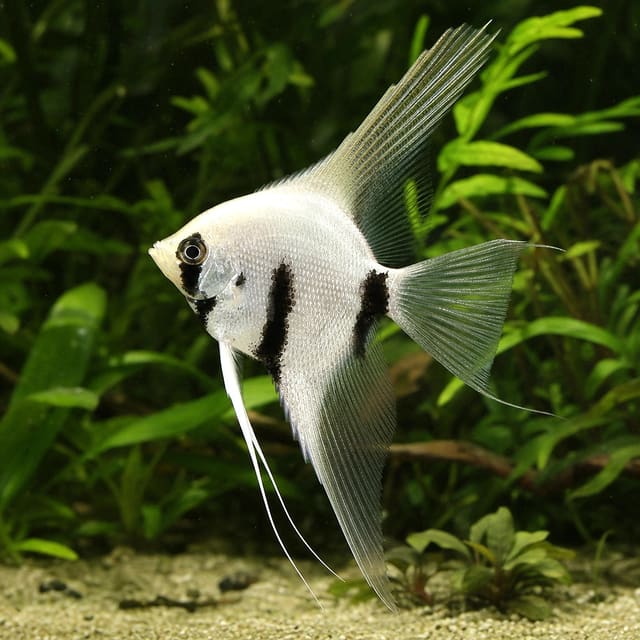
One live, unsexed Blue Diamond Angelfish (Pterophyllum scalare) in the selected approximate size. A silver-blue domestic freshwater angelfish for a tall, mature aquarium.
Pterophyllum scalare
Save when buying multiple fish. Each quantity is one fish; sex and pair formation are not guaranteed unless the selected variant explicitly states them.
Confirm your email, then we’ll send an availability message for this exact item if it returns within 180 days.
This request is only for this product—no newsletter or other promotions. A mail-provider retry may very rarely duplicate the same availability message. Unconfirmed addresses are removed after 48 hours. See our privacy policy.
One live, unsexed Blue Diamond Angelfish (Pterophyllum scalare) in the selected approximate size. A silver-blue domestic freshwater angelfish for a tall, mature aquarium.
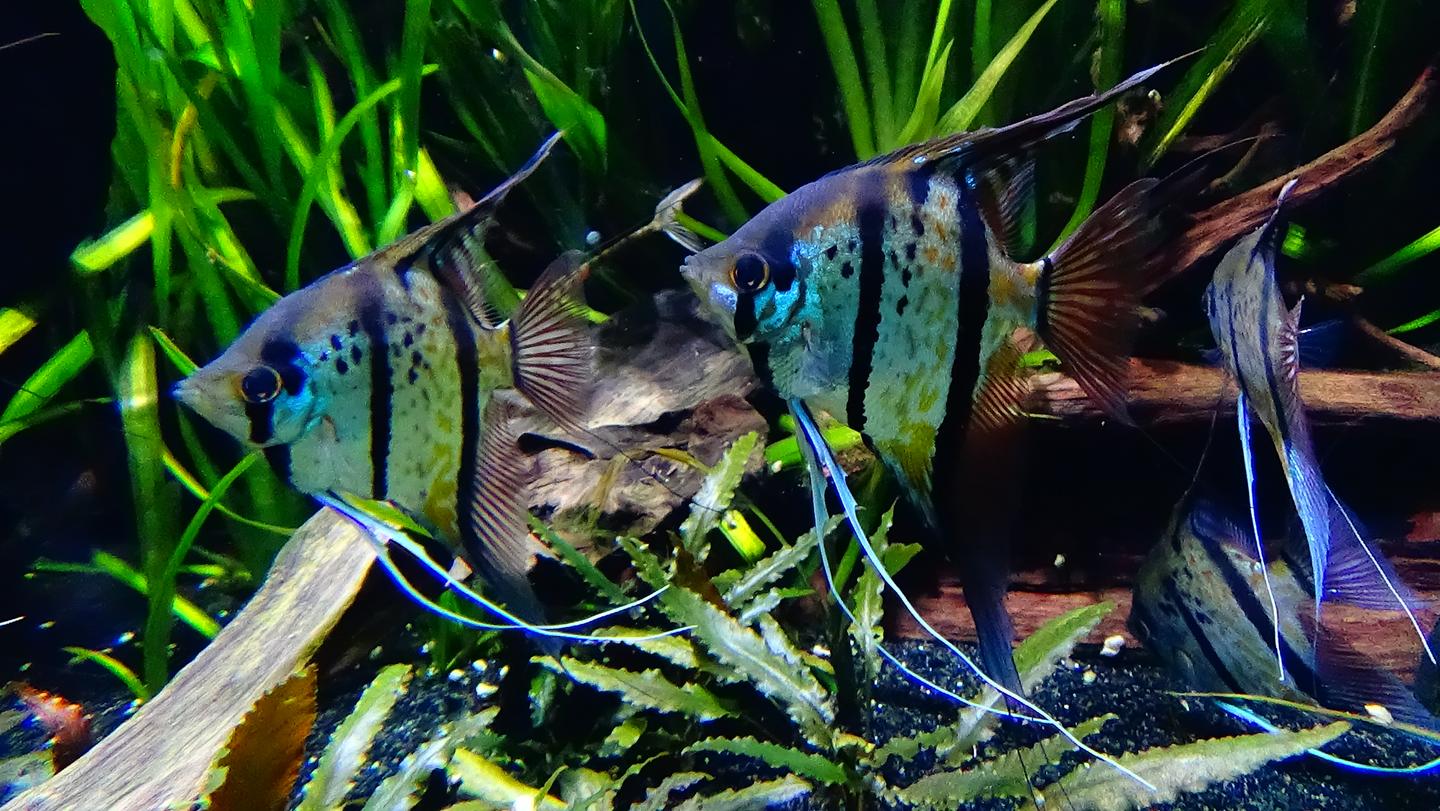
Freshwater angelfish are tall South American cichlids, not small community fish. OATA gives 120 litres as an industry floor for a compatible pair and says the aquarium must be sufficiently tall. We prefer planning around roughly 200 litres, a 100 × 40 cm footprint and about 50 cm height for an adult pair, with more space and an exit plan for a group.
Maintain these water conditions for optimal health and vibrant colors
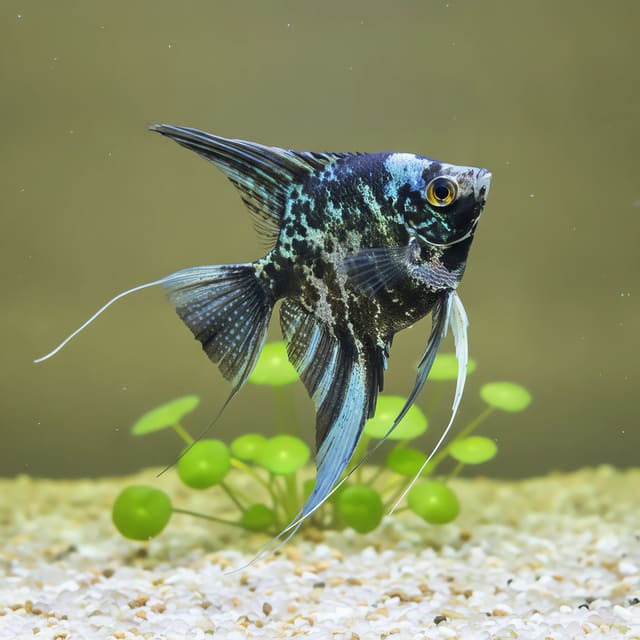
One live, unsexed Blue Diamond Angelfish is supplied in the approximate size selected on this page. This domestic Pterophyllum scalare colour strain combines the unmistakable tall angelfish profile with silver-blue iridescence, dark vertical markings and long, graceful fins. Select the size that suits your established aquarium; each quantity is one fish, not a pair or group, and neither sex nor an exact measurement can be chosen.
This is a centrepiece cichlid for a warm, mature freshwater aquarium with real height, calm visual structure and carefully chosen companions. A juvenile may arrive very small, but the long-term plan must allow for an adult's deep body, extended fins, social hierarchy and territorial behaviour when a pair forms. Shopify's live size selector remains the source of truth for current availability and price.
| Quick fact | Practical answer |
|---|---|
| Scientific name | Pterophyllum scalare |
| Trade strain | Blue Diamond Angelfish |
| Family | Cichlidae |
| Sale unit | One live, unsexed fish in the selected approximate size |
| Available size bands | Use the live selector; listed grades run from very small juveniles to larger fish |
| Published maximum length | 10.5 cm total length in FishBase |
| Vertical planning envelope | Allow roughly 20-25 cm overall height for a mature domestic angelfish with extended fins |
| Care level | Moderate |
| Temperament | Semi-aggressive cichlid; often calm with suitable fish, territorial when pairing or spawning |
| Social plan | A properly sized group of at least five, or one established compatible adult/pair with a separation plan |
| Practical aquarium | About 180 litres, 100 cm long and 50 cm tall for one established adult or compatible pair; 250 litres or more for a group |
| Temperature | 24-28°C practical captive range |
| pH | 6.0-7.5 practical captive range |
| Hardness | 5-13 dGH |
| Diet | Omnivore with a strong animal-food component |
| Tank region | Middle water and among tall structure |
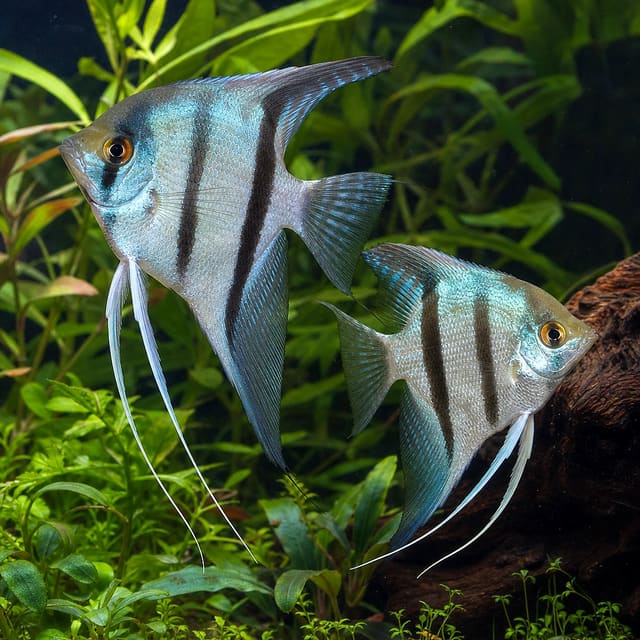
Quantity one means one live fish. The sale unit does not become a pair because one gallery scene shows two fish, and it does not become a social group because angelfish can benefit from companions in the right aquarium. Build any intended group through the basket quantity and check the complete stocking plan before ordering.
No male, female or bonded pair can be selected. Juvenile freshwater angelfish are not reliably sexed from ordinary external appearance, and even adults can be difficult to confirm outside spawning condition. Ordering two does not guarantee one of each sex, compatibility or future pairing.
The selector uses approximate size bands. Natural posture, fin position, growth and normal grading variation mean a fish may sit near either edge of its band. The listed number is not a precision-cut dimension and does not establish age, sex, maturity or future adult size.
This page can remain visible as a detailed care resource while every option is unavailable. Use the option selector and basket as the transactional truth. The description avoids fixed stock and price claims because inventory and supplier grades can change independently.
The supplier has not provided a breeder certificate, genetic record, locality, Philippine Blue pedigree or captive-bred statement for this batch. Blue Diamond is used as the established trade-strain name and visual identity, not as a promise of a particular genotype or breeding line.
| Your choice | What you receive | What is not guaranteed |
|---|---|---|
| Any one size option | One live fish in that approximate grade | An exact millimetre, age or maturity |
| Quantity two | Two unsexed fish | A male and female, bonded pair or peaceful pair |
| Small juvenile grade | A small fish needing size-matched care | Immediate compatibility with large adults |
| Larger grade | A larger unsexed fish | A breeding adult or particular sex |
| Visible product page | Current information and selector | That stock is presently available |
The biological species is Pterophyllum scalare, a South American cichlid from the Amazon drainage. Domestic aquarium strains can look very different from wild-type fish, but the underlying care obligations remain those of a deep-bodied, social and potentially territorial cichlid.
Blue Diamond is an aquarium trade name for a selected blue-silver appearance. Commercial lines may develop stronger blue iridescence with maturity and may show reduced wild-type barring, but there is no universal certificate behind the name. This listing uses the supplier-matched visual reference rather than promising an idealised solid-blue result.
Those bars are real evidence for this listing, so the copy does not erase them merely because some market descriptions emphasise reduced striping.
Blue intensity and bar contrast can change with age, genetics, social state, lighting, background, transport stress and health. A newly arrived fish may look pale or display stronger stress bars before settling. Stable care supports normal colour expression, but no food or lighting setup can guarantee an exact shade.
Despite the word "angel", this is not a marine angelfish. It requires a heated freshwater aquarium and must not be placed in saltwater or brackish conditions. Browse the dedicated freshwater Angelfish range when comparing other Pterophyllum colour forms.
Freshwater angelfish have a thin side-to-side profile and an unusually deep body. The tall dorsal and anal fins make the fish appear much larger vertically than a simple nose-to-tail length suggests. Aquarium height is therefore a welfare feature, not a decorative extra.
The dorsal, anal and thread-like pelvic fins can be damaged by sharp decor, cramped routes or persistent nipping. Leave broad passages between wood, plants and equipment. Inspect holes and ornaments from the perspective of the adult fish rather than the juvenile being purchased today.
The reference phenotype combines orange-red eyes with dark body bars and reflective blue-silver scales. The bars may become more or less visible according to mood and environment. That is normal within the appearance range and not evidence that a fish has changed species or strain.
The gallery is representative of the product identity and expected form; it is not a set of photographs of the exact individual that will be dispatched. Natural differences in bar width, blue intensity, fin extension, body depth and size should be expected.
Four protected gallery images are representative scenes made to follow the product reference. The fifth is the original reference photo. The scene with two fish illustrates social context only: this listing sells one fish per selected quantity and does not promise a pair.
FishBase records a maximum published total length of 10.5 cm for Pterophyllum scalare. Total length is a horizontal fish measurement and should not be mistaken for the complete top-to-bottom space required by an adult with extended fins.
For aquarium planning, allow roughly 20-25 cm of overall vertical envelope for a mature domestic angelfish. This is conservative husbandry guidance rather than a quoted scientific maximum. A tank around 50 cm tall gives the fish useful clearance above and below its body after substrate and decor are considered.
A 1 cm, 2 cm or 3 cm juvenile is not a permanent nano fish. Growth rate varies with genetics, temperature, food, water quality and health, but every size option needs an adult-sized plan before purchase. Delaying the upgrade until fins appear cramped creates avoidable risk.
Supplier size bands are practical livestock grades and may not be measured by one universal scientific method. Compare the selected grade with the receiving aquarium and tank mates, but do not use it as a precise forecast of body depth, age or date of maturity.
| Selected stage | Main care implication | Common mistake to avoid |
|---|---|---|
| Very small juvenile | Fine food, frequent observation and protection from larger fish | Adding it directly to an adult community |
| Small juvenile | Size-matched companions and several modest meals | Assuming the current size is permanent |
| Medium juvenile | Adult tank footprint should already be available | Buying for a shallow temporary aquarium |
| Larger fish | More immediate territorial and compatibility planning | Assuming larger size proves sex or pairing |
| Mature planning | Allow horizontal territory and substantial vertical clearance | Using body length alone to size the tank |
The fish readily accepts prepared food and can thrive in a well-run community, but its adult size, social hierarchy, long fins and breeding territoriality make "easy beginner fish" too broad a label. Moderate care means the keeper should test water, observe feeding and have a response plan for conflict.
Add livestock only after the biological filter can maintain ammonia and nitrite at 0 mg/l under the intended load. Calendar age, bottled bacteria and clear-looking water do not replace test results. Very small juveniles are especially vulnerable to sudden instability.
Check breathing, balance, fin position, appetite, colour and social access to food. A subordinate fish that stays dark, hides continuously or misses meals may be under pressure even when no dramatic fight is seen. Early layout or stocking changes are easier than treating injuries later.
Plan for the adult aquarium, future hierarchy and the possibility that two fish pair and defend a site. A spare mature tank, divider or rehoming route is responsible preparation when keeping several cichlids. The product page cannot guarantee that every individual combination will remain compatible.
Use about 180 litres or more, around 100 cm long and 50 cm tall, as a practical starting point for one established adult or a genuinely compatible pair. The FishBase minimum aquarium length is 100 cm. Volume and height are conservative Tropical Fish Co planning guidance for domestic display fish.
For a group of five to six, plan around 250 litres or more, about 120 cm long and 50-60 cm tall. More room is needed where decor divides the footprint, other cichlids are present or the community already uses the same middle-water territory.
Juvenile angelfish form social hierarchies. Scientific studies have linked social rank with aggression, activity and feeding opportunity. Space alone cannot remove hierarchy, but longer sight lines, several feeding positions and visual breaks can reduce constant pressure on one subordinate fish.
A forming pair may claim a vertical leaf, wood face or other spawning site and drive tank mates away. That change can happen after a previously calm juvenile period. Be ready to separate the pair or the pressured fish; do not wait for serious fin damage.
A shallow tank compresses the space above and below the fish once substrate, wood and surface clearance are included. It can also force long fins through narrow routes. Choose dimensions around the adult body shape rather than relying only on the litre label.
| Long-term plan | Practical starting point | Important condition |
|---|---|---|
| One established adult | About 180 L, 100 cm long, 50 cm tall | Compatible community and no cramped territory |
| One established compatible pair | About 180 L or larger | Pair must be genuinely compatible; spawning defence still needs management |
| Five to six juveniles/adults | About 250 L+, 120 cm long, 50-60 cm tall | Visual breaks, several feeding points and backup separation |
| Mixed cichlid display | Larger than the group minimum | Territories and adult behaviour assessed species by species |
| Temporary grow-out | Size-matched, mature and stable | Adult aquarium already planned and available on time |
Broad-leaved plants, tall stems and upright wood suit the fish's natural movement and provide visual cover and separation. Structure should divide lines of sight without filling every route. Secure all decor so a territorial chase cannot dislodge it.
Leave a broad middle-water corridor where adults can turn without brushing fins against wood or glass. A beautifully planted aquarium still needs usable swimming space. Trim dense growth before it narrows the route below the adult fin span.
Pairs often clean and use vertical leaves or other upright surfaces for eggs. Providing such surfaces is not a request to breed and does not guarantee spawning, but it can explain sudden site defence. If breeding is not intended, the keeper still needs to manage the territorial response.
Do not use ornaments with rough edges, tight holes or rigid points in common flight paths. Long fins can tear during an abrupt turn or chase. Run a hand over decor and judge every opening against the eventual adult, not the smallest listed grade.
Use a secure lid and leave a normal air gap. Moderate lighting with shaded areas usually supports more settled behaviour than an exposed, intensely lit layout. Choose light for plant health and observation rather than trying to force stronger blue colour.
FishBase gives a broader 24-30°C range. This listing uses 24-28°C as a practical captive band that overlaps many suitable community fish while retaining oxygen margin. Select one stable point appropriate to the complete stocking plan.
FishBase reports pH 6.0-8.0. A stable 6.0-7.5 is used here as conservative retail guidance. Avoid repeated chemical corrections to chase a decimal; understand source-water buffering and make necessary changes gradually.
The documented hardness range is 5-13 dH. Test the receiving water and avoid sudden movement between very different mineral levels. Stable, suitable hardness is more important than selecting one supposedly perfect value from within the range.
Both should remain at 0 mg/l. Any measurable result calls for prompt water testing, a partial water change appropriate to the situation and investigation of filtration, feeding, dead livestock or recent disruption. Do not add new fish while the cause remains unresolved.
Keep nitrate low and stable through sensible stocking, plant growth where appropriate and regular partial water changes. A clear aquarium can still contain excessive dissolved waste. Compare results with prepared source water so the maintenance plan is based on real numbers.
Warm water carries less dissolved oxygen. Maintain surface movement and do not let a clogged intake or heavy plant respiration reduce overnight gas exchange. Rapid breathing by several fish requires immediate checks of temperature, oxygen, ammonia and nitrite.
| Parameter | Working guidance | Priority |
|---|---|---|
| Temperature | 24-28°C practical range | Stable, with adequate oxygen |
| pH | 6.0-7.5 practical range | Avoid rapid corrections |
| General hardness | 5-13 dGH | Match and acclimate gradually |
| Ammonia | 0 mg/l | Any detection needs action |
| Nitrite | 0 mg/l | Any detection needs action |
| Nitrate | Low and stable | Control with stocking, feeding and maintenance |
Use the water matcher to compare your tested aquarium values with the working range. A numerical overlap is only one part of suitability; adult size, temperament, feeding and tank shape still matter.
Size filtration for the adult community and feeding load. Preserve established biological media during routine cleaning and avoid replacing every mature component at once. A larger filter does not excuse overstocking, but a fragile biofilter makes a territorial cichlid community less forgiving.
Provide enough circulation to prevent dead zones without forcing the fish to brace continuously. A broad return or spray bar can distribute movement. Keep at least one calmer area among plants or wood where a subordinate fish can pause outside the strongest current.
Very small grades can approach intake slots that pose no risk to adults. Fit an appropriate pre-filter where necessary and keep it clean so flow does not collapse. Check behind heaters and filter hardware after introduction.
Use water of compatible temperature and chemistry. The exact schedule depends on stocking, feeding, plant load and test results, but consistency matters. Sudden major environmental changes can disturb social behaviour as well as water chemistry.
Remove trapped food and waste from accessible areas while leaving the filter biology intact. Dense plant roots and wood can hide debris, so inspect low-flow zones. A clean floor also lets the keeper see whether the smallest fish receives food.
Angelfish often glide calmly and can coexist with carefully chosen community fish, but they are still cichlids. Territorial display, chasing and hierarchy are normal possibilities. "Peaceful-looking" should never be translated into guaranteed peaceful behaviour.
FishBase recommends groups of five or more, and behavioural research commonly studies clear hierarchies within juvenile groups. A suitable group can distribute social interaction, but it also needs enough territory and feeding access. Simply adding numbers to a small tank increases pressure.
Watch for one individual that remains behind decor, eats last, loses condition or shows damaged fins. Add sight breaks and multiple feeding points, then separate fish if pressure continues. The absence of a dramatic attack does not prove that every fish is thriving.
Two fish that select each other may exclude other angelfish from part of the tank. Spawning can intensify defence. A pair is not automatically compatible forever, and the remaining group may need relocation even in a previously stable display.
Strain name, size and sex do not predict every temperament outcome. History, territory, health and the exact companion mix all affect behaviour. Introduce fish with observation time available and keep a practical separation option.
Suitable companions are calm, too large to be swallowed, unlikely to nip fins and comfortable in the same warm water. Compare adult dimensions and feeding style rather than the small size seen in a shop. No species list overrides observation of the actual aquarium.
Many medium tetras, deeper-bodied rasboras and calm rainbowfish can work where their water needs overlap. Keep their own group requirements and leave enough open space. Tiny fish introduced to adult angelfish may be treated as food.
Cory-type catfish and a carefully chosen bristlenose can often occupy a different level, but they still add waste and need fair access to food. The Blue Angelfish listing provides another strain comparison; use the full community plan, not colour, to judge compatibility.
Tiger barbs and other persistent nippers can target the extended fins. A large shoal may alter nipping frequency but does not make every individual or setup safe. Do not use a vulnerable angelfish as the test.
Large predatory fish, highly territorial cichlids and companions that dominate every feeding point are poor choices. Very small shrimp, shrimplets, fry and tiny fish may be eaten. This is not a suitable centrepiece for a breeding aquarium where every small animal must survive.
| Compatibility group | Examples or context | Main check |
|---|---|---|
| Often suitable | Calm medium tetras, deeper-bodied rasboras, peaceful warm-water community fish | Adult size, group needs and no fin nipping |
| Often suitable with planning | Cory-type catfish, selected plecos, calm rainbowfish | Food access, waste load and water overlap |
| Use caution | Other angelfish and calm dwarf cichlids | Territory, pair formation and separation capacity |
| Avoid | Persistent fin nippers and aggressive cichlids | Long-fin injury and chronic stress |
| Avoid as prey risk | Tiny fish, shrimplets and minute fry | An adult may swallow them |
Compare other established colour forms such as the Pinoy Black Angelfish, Platinum White Angelfish, Manacapuru Red Back Angelfish and Koi Angelfish. Similar species identity does not guarantee that unfamiliar adults can be combined safely.
Use a complete, quality angelfish or cichlid flake, soft granule or appropriately sized pellet as the nutritional foundation. Add measured frozen or live foods such as brine shrimp, daphnia, mysis and bloodworm where suitable. Variety should improve nutrition, not become uncontrolled overfeeding.
Offer what the fish can consume without leaving a heavy residue. Watch each individual rather than assuming food entering the tank equals food eaten. A dominant fish may intercept floating food while a subordinate remains thin.
The smallest grades need fine foods that fit the mouth and several modest feeds rather than one large adult portion. Filtration and maintenance must keep pace with the higher feeding frequency. Remove uneaten food promptly.
Larger grades can accept bigger granules and frozen items, but should not live on one rich food. Rotate a complete staple with controlled variety. Avoid feeder fish because they add welfare, parasite and nutritional risks without being necessary.
Good nutrition supports normal condition and colour expression, but no supplement can guarantee a solid blue adult or erase normal bars. Be cautious with claims that one colour food will transform strain genetics.
| Fish stage | Food approach | Observation priority |
|---|---|---|
| Very small juvenile | Fine complete food, finely sized frozen/live variety, several small feeds | Every fish swallows food; intake is protected |
| Small to medium juvenile | Small granules or flakes plus measured variety | Growth is even and no subordinate is excluded |
| Larger juvenile/adult | Complete cichlid staple plus varied frozen/live foods | Body condition without excess waste |
| Community feeding | Use more than one position and suitable sinking foods for bottom fish | All levels receive an appropriate diet |
A fish around the smallest listed grade needs a mature, filtered rearing-style setup, gentle protected flow and fine food. It should not be released among large adult angelfish or companions able to swallow it. Choose this grade only when the receiving system is designed for tiny juveniles.
Large differences increase feeding and predation risk. Even a normally calm adult may consume a tiny fish that fits its mouth. Grow-out groups should be monitored and graded where one individual begins to dominate food or space.
The receiving aquarium needs established biological filtration and stable water. A bare or simple layout can help observation, but it must not be biologically immature. Cover heater access and filter intakes before the fish arrives.
Crush or select a complete food fine enough to be swallowed, and verify ingestion. Powder drifting into the filter is not a meal. Several restrained feeds can support growth while avoiding a large pulse of waste.
Choose a larger available size when the established community contains robust medium fish, stronger current or competitive feeders. The larger option still needs compatibility review; it simply reduces some of the special risks associated with a very small juvenile.
A newly arrived fish may hide, darken its bars, reduce blue sheen or ignore the first meal. Keep lighting low and the environment quiet. Improvement in posture, breathing and feeding over the settling period is more useful than judging colour in the transport bag.
Look for fins held normally rather than clamped, smooth swimming, even balance and no fresh tearing. Long fins can reveal conflict early. Persistent damage requires investigation of decor, tank mates and water quality rather than cosmetic treatment alone.
Rapid gill movement, surface hanging or several fish breathing hard can indicate oxygen or water-quality trouble. Test temperature, ammonia and nitrite immediately and check circulation. Do not assume every breathing change is transport stress.
Record whether each fish eats and maintains a gently filled profile. A subordinate that repeatedly misses food may need a different feeding point or separation. Sudden appetite loss combined with abnormal posture, faeces or breathing warrants qualified aquatic-veterinary advice.
Good husbandry reduces preventable stress but cannot guarantee immunity from disease. Do not medicate a community without diagnosis and dose checks for every resident. Quarantine new livestock where facilities and experience allow.
| Observation | Possible context | First responsible check |
|---|---|---|
| Paler blue after arrival | Transport and environmental change | Lighting, breathing, water match and quiet settling |
| Strong dark bars | Normal pattern variation, mood or stress display | Whole behaviour and environment, not colour alone |
| Torn fins | Nipping, chasing or sharp decor | Tank mates, routes, water quality and separation |
| One fish misses meals | Hierarchy or unsuitable food size | Multiple feeding points and body condition |
| Several fish breathe rapidly | Heat, low oxygen, ammonia or nitrite | Immediate tests and circulation check |
Test the aquarium, confirm heater operation, protect intakes and review tank mates before dispatch. Do not order first and begin cycling later. The selected grade must have a safe space immediately on arrival.
On delivery, follow the current Live Arrival Guarantee instructions and record any concern within the stated terms. Keep the bag sealed while checking fish position and water temperature. Do not discard packaging before any required evidence is complete.
Float the sealed bag only for the appropriate time needed to reduce temperature difference. Avoid prolonged floating under strong aquarium light. Opening the bag changes gas balance and can alter the toxicity of accumulated waste, so do not turn acclimation into an unnecessarily long process.
Use the method suited to the measured difference and the current delivery instructions. A short, controlled transfer is often safer than hours in shipping water. Never add bag water to the aquarium unless the current guidance specifically requires it.
Introduce with lights low, provide cover and prevent established fish from immediately surrounding a small newcomer. Rearranging limited territory can sometimes interrupt ownership, but it does not guarantee acceptance. Observe from a distance before leaving the aquarium.
Do not use a heavy meal as a test on arrival. Once breathing and posture are settled, offer a small appropriate food and remove leftovers. The smallest juveniles may need an earlier fine-food opportunity than a large adult, but water quality still comes first.
The acclimation timer can support the process, but measured water difference, fish condition and the current livestock instructions remain more important than following a clock without observation.
External sex differences are unreliable in juveniles and often ambiguous in non-spawning adults. Breeding tubes can help experienced keepers during spawning condition, but this listing supplies unsexed stock. Size, forehead shape or fin length alone is not a dependable customer guarantee.
Placing two fish together does not create a compatible pair. Groups of juveniles are often raised to allow natural pair formation, but that approach needs substantial space and a plan for the remaining fish. It should not be attempted by simply filling a small display with juveniles.
Pairs commonly clean a vertical leaf or other firm surface before laying eggs. Both parents may defend the site and care for the clutch. Those behaviours are scientifically documented, but they do not guarantee successful breeding in a home aquarium.
Spawning can turn a calm community into a divided aquarium. Monitor the full footprint and remove pressured fish before injuries accumulate. A divider or second mature system is more useful than assuming the conflict will disappear after the eggs are gone.
An order does not guarantee sex ratio, fertility, pair bond, egg production, hatch rate, colour inheritance or saleable offspring. The trade-strain name is not a breeding certificate.
The related Blue Angelfish page may offer another blue-appearance option. Compare the live images, size bands and availability. Do not assume two blue trade names are genetically identical or visually interchangeable.
The Pinoy Black Angelfish emphasises a darker body rather than this page's silver-blue reference appearance. Care overlap is substantial because both are domestic Pterophyllum scalare, while exact colour and line provenance remain product-specific.
The Platinum White Angelfish is a pale alternative for keepers choosing by display contrast. A colour choice does not reduce adult space, social or territorial needs.
The Manacapuru Red Back Angelfish carries a different locality-style trade identity and visual emphasis. Read that product's evidence rather than transferring provenance claims from one listing to another.
The Koi Angelfish offers a warm patchwork colour form. Compare appearance, grade and live stock, while planning every Pterophyllum scalare option around the adult tank.
The Fresh Water Fish > Angel Fish category and Angelfish shop are the best places to compare the current range. Those hubs target broad shopping intent; this page focuses on the specific Blue Diamond trade form.
All listed grades can be unavailable while this indexed care page remains online. Select the intended size and check the current basket state. Do not infer stock from an old search snippet or gallery image.
Live-fish delivery may be adjusted around weather, courier or welfare conditions. Review the current delivery information before ordering and ensure someone can receive and acclimate the fish without delay.
Eligible UK livestock orders are covered by the Live Arrival Guarantee when the current terms and evidence requirements are followed. Read those terms before delivery day so packaging, timing and contact steps are handled correctly if help is needed.
WELCOME10 gives eligible first-time customers 10% off under the current terms. Enter it at checkout and rely on the live basket to confirm eligibility. The code does not change livestock suitability or delivery obligations.
Confirm adult tank dimensions, current cycling test results, temperature, pH, hardness, companion adult sizes, intake safety and a conflict plan. For the smallest grade, confirm fine food and a protected grow-out environment as well.
Choose this fish when you have a tall, mature, warm freshwater aquarium; want a graceful centrepiece; can provide compatible companions; and will manage hierarchy or pairing if behaviour changes. It suits keepers who observe individuals rather than relying on a generic compatibility list.
Do not choose it for a nano tank, shallow aquarium, uncycled setup, tiny-fish display, shrimp-breeding project, persistent fin-nipping community or system without a separation option. The smallest juvenile grade is also a poor choice for a robust adult community.
One live, unsexed Blue Diamond Angelfish is supplied per selected quantity in the approximate size chosen from the live selector.
No. The two-fish gallery scene is representative social context. Quantity one is one fish, and quantity two is two unsexed fish without a pair guarantee.
No. The stock is unsexed, and ordinary juvenile appearance does not support a reliable sex promise.
FishBase records a maximum published total length of 10.5 cm. Because the fins create far more vertical depth, allow roughly 20-25 cm overall height as conservative aquarium-planning guidance.
Use about 180 litres, 100 cm length and 50 cm height or more for one established adult or compatible pair. Plan around 250 litres or more and about 120 cm length for a group of five to six.
FishBase recommends groups of five or more, especially relevant to juveniles. An established compatible adult or pair can be managed separately, but unfamiliar fish should not simply be combined in a cramped tank.
It can live in a carefully planned warm-water community, but it is a semi-aggressive cichlid. Avoid fin nippers, tiny prey-sized fish and aggressive territorial companions.
Adult angelfish can eat fish small enough to fit in the mouth. Choose medium, deeper-bodied schooling fish and assess their adult size rather than relying on the shop size.
No complete safety can be promised. Adult shrimp may sometimes coexist in dense cover, but shrimplets and vulnerable small shrimp can be eaten.
Use a practical 24-28°C, pH 6.0-7.5 and 5-13 dGH, with ammonia and nitrite at 0 mg/l. Stable, clean water matters more than chasing one exact number.
Use a complete angelfish or cichlid staple with measured frozen or live variety. Match particle size and feeding frequency to the selected juvenile grade.
That cannot be guaranteed. Blue intensity and bar visibility vary with genetics, age and environment, and the reference photo visibly shows dark bars.
No. They are representative of the product identity. Four scenes are from the product reference, and the original reference photo is retained as the fifth image.
Usually not without a dedicated risk assessment. A very small juvenile needs fine food, protected filtration and size-matched companions; adults or larger fish may swallow or outcompete it.
There is no sex, compatibility or breeding guarantee. Angelfish often select their own partner, and a successful pair may become territorial.
The care and comparison information remains useful and indexable. The live selector and basket show whether any size can currently be ordered.
WELCOME10 gives eligible first-time customers 10% off under the current terms. The live checkout confirms whether it applies to the order.
Core size, water and group guidance is grounded in the FishBase species record for Pterophyllum scalare. Social-hierarchy, feeding-rank, territoriality and parental-care statements were checked against published behavioural and reproductive studies. Practical volume and height recommendations are deliberately identified as conservative Tropical Fish Co husbandry judgement where the literature does not prescribe a retail aquarium volume.
Read the Angelfish care guide for broader setup help, then return to this product for the Blue Diamond appearance, size choices and live availability. Species-level guidance cannot replace the exact stocking calculation for your aquarium.
This page does not invent a pedigree, genotype, sex, pair, breeder, locality, captive-bred status, exact colour, exact dispatched measurement or review score.
No reviews for this item yet. Bought one? Honest reviews only, good or bad.
What customers say about ordering from us
I have a small group of long finned mountain minnows. So was delighted to be able to order ten of this variety to increase the genetics in my tank . The ones I recieved are healthy but it’s to early to give a verdict on wether they are of a long finned type since they are small currently.
Gordon Walker · 23 Sept 2026
100% success travel and "installation". Pleased with quality of purchase. The Siamese fighter a bit "shy" so have not yet seen him at his best yet but looking good. Happy customer. GG
George E Garratt · 21 Sept 2026
Reviews of our shop, collected by Judge.me, an independent third-party review collector. Newest first.