
Moderate
Rio Nanay Angelfish (Pterophyllum scalare)
25–28°C · pH 6–7.5 · 150L
£19.99

One unsexed California Long-Fin Angelfish (Pterophyllum scalare) in the selected size. A domestic long-fin cultivar for a mature, tall aquarium with a planned pair or group and calm, non-nipping tank mates.
Pterophyllum scalare
Save when buying multiple fish. Each quantity is one fish; sex and pair formation are not guaranteed unless the selected variant explicitly states them.
Confirm your email, then we’ll send an availability message for this exact item if it returns within 180 days.
This request is only for this product—no newsletter or other promotions. A mail-provider retry may very rarely duplicate the same availability message. Unconfirmed addresses are removed after 48 hours. See our privacy policy.
One unsexed California Long-Fin Angelfish (Pterophyllum scalare) in the selected size. A domestic long-fin cultivar for a mature, tall aquarium with a planned pair or group and calm, non-nipping tank mates.
25–28°C · pH 6–7.5 · 150L

24–27°C · pH 6.5–8 · 200L
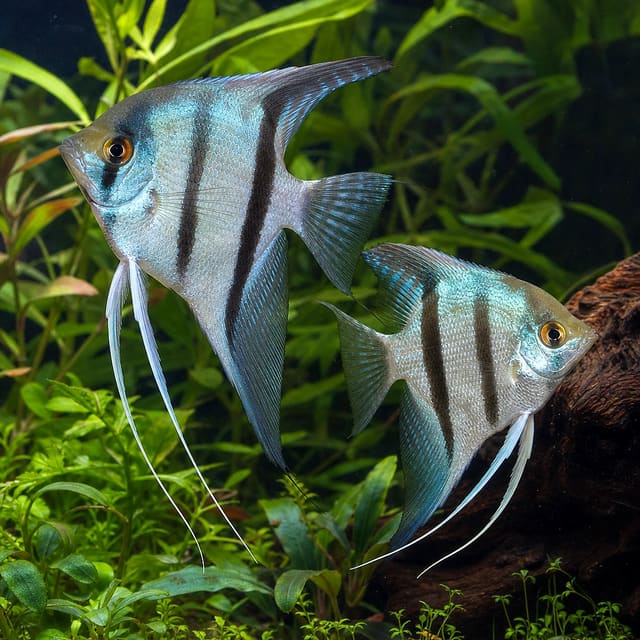
24–27°C · pH 6.5–8 · 200L

24–27°C · pH 6.5–8 · 200L
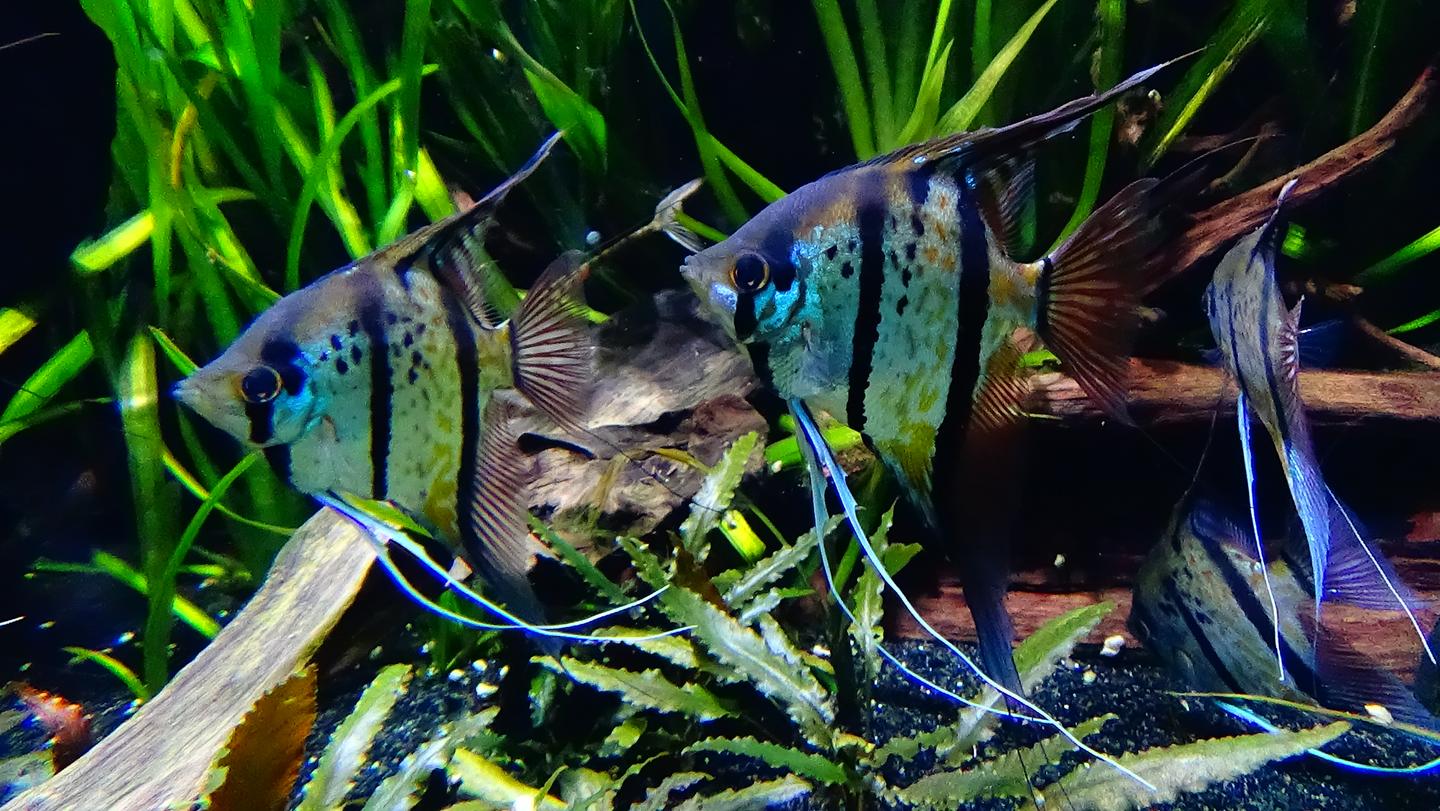
Freshwater angelfish are tall South American cichlids, not small community fish. OATA gives 120 litres as an industry floor for a compatible pair and says the aquarium must be sufficiently tall. We prefer planning around roughly 200 litres, a 100 × 40 cm footprint and about 50 cm height for an adult pair, with more space and an exit plan for a group.
Maintain these water conditions for optimal health and vibrant colors
California Long-Fin Angelfish is the customer-facing trade name for this domestic freshwater angelfish. The supplier lists the fish as Pterophyllum scalare / california l.f.; that supports the California and long-fin labels, but it is not a breeding certificate and it does not establish one fixed colour pattern. The useful promise is therefore precise: this is a California-labelled, long-fin Pterophyllum scalare, sold in the size selected on this page, with the individual markings of a living fish allowed to vary.
Each quantity is one unsexed fish in the selected approximate size. The product has several size options so the option selector and checkout, not a sentence in the description, are the source for current size availability, price and stock. Sex, a compatible pair, an exact pattern, colour intensity, lineage, fertility and the exact fish dispatched are not certified.
Choose this angelfish for a mature, genuinely tall freshwater aquarium with stable warm water, open mid-water turning space, vertical cover and calm companions that will neither nip its long fins nor fit into an adult angelfish's mouth. Plan a compatible pair or properly managed social group; do not assume that two unsexed juveniles will automatically form a peaceful pair.
| Planning point | Reviewed guidance | Important boundary |
|---|---|---|
| Species | Pterophyllum scalare, a South American freshwater cichlid | California Long-Fin is a domestic trade cultivar label, not a separate species. |
| Sale unit | One unsexed fish in the selected approximate size | A quantity of two does not certify a male-female pair or compatibility. |
| Adult planning | Roughly 10-15 cm body length, with much greater total height from the fins | The supplier's 25 cm figure is treated as a height or fin-span guide, not a 25 cm body-length claim. |
| Care level | Moderate | Juveniles are manageable, but adult height, social behaviour and fin-safe compatibility need planning. |
| Temperament | Social, usually calm to semi-territorial | Pairing and spawning can produce strong defence and chasing. |
| Water | 24-28°C, pH 6.0-7.8, supplier hardness 0-20 dGH | Stable, mature water matters more than repeatedly correcting toward an endpoint. |
| Aquarium | Start around 150 litres for a compatible pair; 200 litres or more for a group or community plan | Use a tall footprint with retreat space; litres alone cannot prove suitability. |
| Diet | Varied omnivore diet based on a complete quality staple | Small measured feeds protect condition and water quality better than heavy treats. |
| Photography | No exact approved product photograph is currently available | No borrowed or generated image is used to imply colour, pattern, sex or size. |
California is a cultivar name used in the ornamental angelfish trade. A specialist account from Aquarium Glaser describes California as a variable side line of marble angelfish and notes the alternative name map angel. It also says that the cultivar's original creation is not known. That is a valuable boundary: the name is real and useful for shopping, but a retailer should not turn it into an invented geographical origin or a guaranteed family tree.
The supplier adds the abbreviation l.f. to this stock. On this product it is retained as the long-fin trade descriptor, while the original supplier label remains in the structured source record. Because no breeder certificate accompanies the fish, the page does not claim a named long-fin gene, a pure line or a guaranteed fin measurement. Long fins also develop with growth, so a young fish may not show the full adult silhouette at dispatch.
The species identity is Pterophyllum scalare. The NCBI Taxonomy database records it as the current freshwater angelfish species in the cichlid family. California is not a marine angelfish from the Gulf of California, and adding the scientific name to the page helps both customers and search systems keep those unrelated fishes separate.
California or map-type angelfish can vary in the position and amount of dark and light patterning. Age, stress, social status, lighting, background and diet also affect how a fish looks. The trade name identifies the stock line; it does not make every individual visually identical.
One quantity adds one unsexed California Long-Fin Angelfish in the selected size option. The options are supplier size bands rather than precision measurements of a photographed individual. Small differences are normal in live stock, and the supplier does not state whether each band is standard length or total length. Ask before dispatch if a narrow present-size requirement is essential for an existing group.
| Option label | Life-stage context | Planning note |
|---|---|---|
| 1 cm | Very small juvenile | Needs gentle feeding access, stable mature water and tank mates that cannot swallow or outcompete it. |
| 1.5-2 cm | Small juvenile | Still vulnerable to intake gaps, predation and fast feeders. |
| 2.5-3 cm | Growing juvenile | Provide frequent observation and correctly sized complete food. |
| 3-3.5 cm | Growing juvenile | Plan for the adult aquarium now rather than buying for a temporary small tank. |
| 4-5 cm | Established juvenile | Body depth and finnage will continue to develop. |
| 5-5.5 cm | Larger juvenile | Social hierarchy and territorial behaviour may become more visible. |
| L, 5.5-6 cm | Large juvenile or young adult stage | Needs the final tall aquarium and adult-compatible companions. |
| XL, 6-7 cm | Substantial young fish | Do not confuse present body length with total adult fin height. |
| XXL, over 7.5 cm | Large supplied size | Allow extra transport recovery time and assess established territories before introduction. |
Option availability changes. An unavailable option remains part of the protected product structure so it can return without creating a duplicate listing. The live selector is the source for what can be ordered today; this guide explains how to choose responsibly rather than making a static stock promise.
Angelfish measurements are often confusing because the fish is much taller than it is long. FishBase reports a published maximum of 10.5 cm total length for Pterophyllum scalare. Aquarium references often plan around roughly 10-15 cm of body length, while the extended dorsal, anal and ventral fins can create a total vertical presence approaching 20-25 cm. A long-fin fish may need still more clear height to carry its fins without constant contact with decor.
Our stock records give 25 cm as the adult-size value. This page preserves that useful number as an approximate height or fin-span planning guide, because interpreting it as a 25 cm body length would conflict with species-level length data. This distinction is also why a low, wide tank with an attractive litre figure can still be unsuitable.
Tropical Fish Co recommends beginning around 150 litres for a compatible pair in a genuinely tall aquarium, with about 90 cm or more of usable length and around 45 cm or more of water height as a practical starting geometry. Use 200 litres or more for a group, an angelfish-led community or a layout that loses significant volume to wood and planting. These are conservative retail welfare recommendations, not published biological minimums and not a promise that any two fish will coexist.
The OATA American cichlid care sheet recommends at least 120 litres for a pair of smaller American cichlids, says fully grown angelfish need a sufficiently tall aquarium and advises extra volume per adult for social species. The higher starting point used here accounts for long fins, usable retreat space, real decor and the likelihood that buyers will keep companions rather than a bare species tank.
A small size option does not make this a nano fish. The correct aquarium is the one that can support the adult's height, turning circle, social behaviour and water quality for the long term.
The supplier range for this stock is 24-28°C, pH 6.0-7.8 and 0-20 dGH. FishBase gives a species-level environmental range of 24-30°C, pH 6.0-8.0 and 5-13 dGH. The overlap supports warm freshwater care with broad adaptability, but the outer limits are not a reason to swing between them. For routine keeping, a stable 25-28°C and a consistent pH suited to the fish and its companions is more useful than daily chemical correction.
Use a fully cycled aquarium with ammonia and nitrite at zero and nitrate controlled through stocking, filtration, planting where appropriate and regular partial water changes. Test source water as well as the aquarium so a water change does not introduce a sudden pH, hardness or temperature jump. A separate thermometer is valuable because heater dials are not precision instruments.
Long fins make chronic poor conditions easy to see: edges may clamp, split or erode when water quality, aggression or decor is wrong. Fin damage should trigger a review of ammonia, nitrite, nitrate trend, temperature, flow, sharp surfaces and tank-mate behaviour. Medication cannot compensate for an unsafe environment.
California Long-Fin Angelfish mainly use the middle water around vertical structure. Their body shape suits slow river margins, flooded vegetation and root-like cover better than an exposed high-flow layout. Build a clear central turning lane, then place tall plants, smooth wood or vertical roots toward the back and sides so fish can retreat without becoming trapped.
Use smooth decor and inspect every opening from the perspective of a deep-bodied fish with trailing fins. Narrow caves designed for bottom fish can catch an angelfish that tries to turn inside. Sharp artificial plants, rough rock and exposed wire can tear fins. Keep filter intakes guarded for the smallest size option and leave enough distance around heaters and outlets for the fish to turn safely.
Moderate circulation and good surface movement are appropriate, but avoid forcing the fish to swim against a concentrated jet all day. Diffuse the return or provide quieter zones while maintaining oxygenation. A long-fin angelfish should be able to feed, rest and cross the tank without being pushed sideways or having its fins held in constant flow.
| Zone | Useful design | Avoid |
|---|---|---|
| Middle water | Open turning lanes with broken sightlines | A dense wall of decor that leaves no body-width passage |
| Vertical cover | Tall plants, broad leaves and smooth upright wood | Sharp plastic leaves or splintered branches |
| Surface | Good gas exchange with calmer feeding areas | A sealed mat of floating plants or a powerful narrow outlet |
| Bottom | Accessible substrate and calm bottom-dweller routes | Waste traps, unstable stones and caves too narrow for safe turning |
Freshwater angelfish are social cichlids, but social does not mean passive. OATA advises a group or at least a pair, while scientific work on the mating system of Pterophyllum scalare documents competition for territory and mates, courtship, pair bonds and aggression toward intruders around breeding. Both facts matter when planning a home aquarium.
A known compatible adult pair can work in a well-sized, structured aquarium. Two unsexed retail fish are not automatically such a pair: they may be the same sex, may not choose each other or may form a hierarchy in which one fish cannot escape. A juvenile group can allow natural pair formation, but it needs substantially more space, multiple retreat zones and a plan to separate or rehome fish as pairs form.
Keeping one angelfish is sometimes used when an individual rejects companions or a keeper inherits a lone fish, but it should not be the default shortcut for avoiding social planning. Observe appetite, exploration and stress, and obtain experienced advice for the actual fish. The sale of one fish per quantity defines the transaction; it does not prescribe solitary long-term housing.
Persistent chasing, blocking access to food, pinning a fish behind equipment or forcing it to the surface is not harmless display. A cycled spare aquarium or full-support divider is part of responsible cichlid keeping.
Good companions share warm freshwater conditions, remain too large to be swallowed and do not investigate trailing fins. Deep-bodied peaceful tetras of suitable adult size, calm medium community fish, Corydoras and a suitably sized peaceful bristlenose-type catfish may work in an appropriately large aquarium. Compatibility is always conditional on adult size, group numbers, water, feeding access and the temperament of the individual fish.
Avoid very small tetras, tiny rasboras, fry and ornamental shrimp if their loss would be unacceptable. Adult angelfish are cichlids with a mouth large enough to take small prey. Also avoid tiger barbs and other confirmed fin nippers, highly active fish that repeatedly rush the angelfish, aggressive cichlids and territorial species that need the same middle-water space.
| Candidate | Default assessment | Why |
|---|---|---|
| Calm, deep-bodied tetras of suitable adult size | Often suitable | They can share mid-water if the shoal is large enough, the aquarium is spacious and no fish fits in the angelfish's mouth. |
| Corydoras | Often suitable | They use a different region, but still need their own group, feeding access and compatible temperature. |
| Peaceful bristlenose-type catfish | Possible | Different space use can help; provide wood, caves and food without crowding the angelfish. |
| Other angelfish | Plan carefully | Social benefits are real, but pairing, sex, hierarchy and breeding territories can change behaviour. |
| Neon-sized fish, fry and shrimp | Avoid when loss is unacceptable | They may become prey as the angelfish grows. |
| Tiger barbs and known fin nippers | Avoid | Long fins attract repeated nipping and chronic stress. |
| Aggressive or boisterous cichlids | Avoid in a routine community | Competing territories and feeding pressure can cause injury. |
Use our angelfish tank-mates guide to build a shortlist, then assess the exact aquarium rather than treating any list as a guarantee. The freshwater angelfish collection is useful for comparing forms, but two products appearing in one category does not prove they should share a tank.
Pterophyllum scalare is an adaptable omnivorous cichlid. Use a complete, high-quality angelfish or tropical staple in a particle size the selected fish can swallow. Add controlled variety with foods such as brine shrimp, daphnia, mysis or bloodworm where appropriate. Frozen or live foods are additions to a balanced routine, not a reason to abandon complete nutrition or overload the filter.
A controlled study of feed types in freshwater angelfish compared prepared granulated feed with several invertebrate diets and found differences in growth and reproduction. It supports dietary variety and the species' ability to use both prepared and invertebrate foods, but the experiment involved breeding pairs under defined conditions. It does not prove that one rich food should become the universal daily diet in a community aquarium.
Feed modest portions that all fish can reach and remove leftovers. Smaller juveniles may benefit from more frequent small feeds than adults, while every schedule should respond to body condition, temperature and water quality. Spread food across more than one area if fast companions monopolise the surface. A fish that begs is not evidence that the tank needs another heavy meal.
| Food role | Suitable approach | Avoid |
|---|---|---|
| Daily staple | Complete quality flake, granule or small pellet suited to fish size | One unbalanced treat as the entire diet |
| Variety | Measured brine shrimp, daphnia, mysis or bloodworm as appropriate | Large rich feeds that leave food behind decor |
| Juveniles | Small portions with close observation of every fish | Particles too large to swallow or competition from much faster tank mates |
| Water protection | Stop when fish have eaten and siphon leftovers | Feeding until interest disappears |
The California cultivar is associated with variable map or marble-style patterning, but this product does not have an exact approved photograph. The source record contains no supplier photo, image ID or usable source URL, and Shopify currently has no gallery media for the product. Related California angelfish images belong to other products and are not reused here.
This is deliberate accuracy, not an invitation to imagine that every fish looks alike. No generated image or borrowed photograph is being used to promise dark patches, silver coverage, fin length, sex, present size or the fish that will be packed. If a precise visual trait is essential, contact us before ordering and wait for current-stock confirmation rather than relying on a generic angelfish picture elsewhere.
Long-finned fish also change as they grow. Juveniles may show a shorter, less dramatic silhouette; mature finnage depends on genetics, condition and an environment that prevents repeated tearing. Clean water, smooth decor, suitable flow and non-nipping companions support the natural form, but no food or lighting product can guarantee a catalogue pose.
There simply is no verified source image for this exact product. Image-led recommendations and appearance matching should remain cautious until an owner-approved exact reference becomes available.
The standard-fin California Angelfish is the closest named comparison. Choose this page when the supplier's long-fin stock is specifically wanted; compare the standard form if extended finnage is not essential. In both cases, individual patterning can vary and the aquarium must be planned for an adult Pterophyllum scalare.
For other looks, compare the Rio Nanay Angelfish, Platinum White Angelfish and Pinoy Green Ghost Angelfish. These links help with appearance and availability research; they are not promises of cross-strain compatibility or proof that every individual will match a representative name.
The broader angelfish types guide explains common domestic forms, while the freshwater angelfish guide covers the species before a colour or fin form is chosen. Start with adult care, then select the appearance that fits the aquarium rather than reversing that order.
Sex is not guaranteed. Juvenile head shape, fin shape, colour and behaviour are not reliable retail sex certificates. Mature breeding tubes can help an experienced keeper, but they are most apparent around spawning and still do not make an unverified product listing a male or female sale.
Angelfish are substrate spawners. A pair may clean a broad leaf, slate, pipe or other vertical surface, lay adhesive eggs and defend the site. Scientific and species-level sources describe biparental guarding and cichlid parental behaviour. In a community aquarium, this can convert a previously calm pair into a forceful territory holder.
Breeding requires a chosen compatible pair, excellent water, appropriate conditioning food, a protected spawning site and a plan for eggs, fry and unsuccessful pair dynamics. Buying two fish does not guarantee opposite sexes, a bond, fertility or a brood. If a group is used to allow natural pair formation, the aquarium must have room for hierarchy and a way to remove fish that cannot remain safely.
A settled angelfish should hold itself upright, breathe steadily, use the aquarium confidently and eat without being permanently excluded. Transport can temporarily reduce colour and appetite, so judge the whole picture: posture, respiration, fin position, skin, eyes, faeces, feeding and social access. Long fins make damage visible but do not identify the cause on their own.
| Observation | Check first | Immediate priority |
|---|---|---|
| Rapid breathing | Temperature, ammonia, nitrite, oxygenation and recent transport | Restore safe water and gas exchange while seeking a diagnosis. |
| Clamped or torn fins | Tank mates, sharp decor, flow, water quality and handling | Stop continuing damage before adding remedies. |
| One fish hides constantly | Chasing, blocked routes, feeding access and illness signs | Separate if it cannot rest or eat safely. |
| Food refusal | Water, transport stress, bullying, mouth injury and disease signs | Do not keep adding rich food; identify the cause. |
| White spots, excess mucus or rubbing | New introductions, temperature and skin or gill signs | Quarantine and diagnose before indiscriminate treatment where practical. |
Do not combine medicines simply because a fish looks stressed. Many signs have environmental, social and infectious causes. Correct dangerous water first, isolate when appropriate and obtain qualified aquatic-veterinary or experienced specialist advice for persistent or severe signs. Protect filter bacteria and follow every product label exactly.
Quarantine new livestock in a fully cycled, heated and filtered aquarium that suits the selected fish's size. Use separate equipment, observe feeding and faeces, and confirm normal breathing and fin condition before moving the fish into an established community. A bare unfiltered container is not a quarantine system.
Before introduction, compare the quarantine and display water, inspect the final aquascape and decide how a failed social introduction will be handled. Add the fish when you can watch for an extended period. Keep lighting subdued, feed lightly and observe established residents as closely as the newcomer; the resident fish may be the source of pressure.
A fixed quarantine duration cannot eliminate every pathogen, so use observation and a reasoned protocol rather than relying on a calendar alone. If signs appear, the observation period effectively restarts after recovery. Avoid preventive medicine mixtures without a diagnosis or a protocol appropriate to the fish and system.
Prepare the mature aquarium or quarantine system before ordering. Check the live option selector for current size, price and availability, then review our livestock delivery information for destination coverage, dispatch timing and packing details. Someone should be available to receive and inspect live fish promptly.
On arrival, keep lighting low and follow the current acclimation instructions for the difference between transport and aquarium water. The acclimation timer can help organise the process, but water testing and the instructions supplied with the order take priority over a generic duration. Do not pour transport water into the aquarium unnecessarily.
Eligible first orders can use WELCOME10 for 10% off under the current promotion terms. Eligible livestock orders are protected by our Live Arrival Guarantee when the current delivery, inspection, evidence and timing conditions are followed. Checkout remains the source for discount eligibility, price, stock and delivery choices.
No. It is a domestic trade cultivar of the freshwater angelfish Pterophyllum scalare. California describes the aquarium form and long-fin describes the supplier's fin-form label.
Specialist trade evidence associates California with variable marble or map-style patterning. Individuals need not have identical markings, and this product has no exact approved photograph from which to promise colour placement.
No. One quantity is one unsexed fish in the selected approximate size. Ordering two does not guarantee opposite sexes, a compatible pair or successful breeding.
You receive the approximate size selected on the live product page. The supplier uses size bands and does not state the measurement method, so contact us before dispatch if a narrow present-size requirement is essential.
Plan around roughly 10-15 cm of body length and a much taller total profile. The supplier's 25 cm adult figure is treated as an approximate height or fin-span guide, not a 25 cm body-length claim.
Begin around 150 litres for a compatible pair in a genuinely tall aquarium, and use 200 litres or more for a group or community plan. Length, water height, decor displacement, filtration and retreat space matter as much as the litre figure.
Angelfish are social, so a planned pair or managed group is the preferred starting context. Some individuals may ultimately need to live separately because of incompatibility, but buying one should not replace consideration of long-term social needs.
Possibly, but two unsexed juveniles are not a guaranteed pair. Watch hierarchy, feeding access and chasing, provide broken sightlines and have a complete separation option.
The supplier gives 24-28°C and pH 6.0-7.8. Keep conditions stable within a range suitable for every tank resident and avoid abrupt corrections toward an endpoint.
The supplier gives a broad 0-20 dGH range and FishBase reports 5-13 dGH for species context. Test the actual water, prioritise stability and choose companions that suit the same chemistry; do not change hardness rapidly.
Use a complete quality angelfish or tropical staple with measured variety such as brine shrimp, daphnia, mysis or bloodworm where appropriate. Feed portions every fish can finish without leaving waste.
Adult angelfish may eat very small fish and shrimp. If loss would be unacceptable, choose larger adult-sized companions and do not use ornamental shrimp or tiny fish as tank mates.
Avoid confirmed fin nippers, very small prey-sized fish, aggressive cichlids and boisterous species that monopolise food or repeatedly disturb the long-finned angelfish.
Not reliably for a retail guarantee, especially in juveniles. Sex is not certified on this product and becomes clearer only around mature breeding condition.
Our stock records have no exact photo, image ID or usable source URL, and Shopify has no existing gallery media for this product. No related fish image or generated substitute has been used because it could misrepresent pattern, colour, fin development or size.
WELCOME10 is the registered active 10% first-order code, subject to the current promotion and checkout terms. Eligibility can change, so checkout and the special-offers page are the live sources.
Eligible livestock orders are covered when the current delivery, inspection, evidence and timing requirements are followed. Read the live guarantee terms before dispatch and document any arrival concern immediately.
This listing separates four kinds of evidence. Supplier data supports the trade label, size bands and supplied water ranges. FishBase and NCBI support species identity and biological context. OATA supports UK ornamental-fish welfare planning. The cited feeding and behaviour studies support narrow claims under their reported conditions; they are not stretched into promises about the exact retail fish.
No source proves the cultivar's original breeder, a pure lineage, one fixed map pattern, the sex of current stock or a 25 cm body length. Those claims are therefore not made. This approach keeps the page useful for search while making uncertainty visible to the customer instead of filling gaps with confident-sounding copy.
Compatibility is individual and layout-dependent. No quantity, sex ratio, tank volume or introduction method guarantees safety. Provide broken sightlines, feeding access, observation and a complete cycled separation option.
Always research specific species before adding them to your tank. Consider:
No reviews for this item yet. Bought one? Honest reviews only, good or bad.
What customers say about ordering from us
I have a small group of long finned mountain minnows. So was delighted to be able to order ten of this variety to increase the genetics in my tank . The ones I recieved are healthy but it’s to early to give a verdict on wether they are of a long finned type since they are small currently.
Gordon Walker · 23 Sept 2026
100% success travel and "installation". Pleased with quality of purchase. The Siamese fighter a bit "shy" so have not yet seen him at his best yet but looking good. Happy customer. GG
George E Garratt · 21 Sept 2026
Reviews of our shop, collected by Judge.me, an independent third-party review collector. Newest first.