Moderate
Albino Diamond Angelfish (Pterophyllum scalare)
24–27°C · pH 6.5–8 · 200L
£12.99
Map Angelfish (Pterophyllum scalare map.) is a tall freshwater cichlid sold as one animal per purchase. Plan roughly 200 litres, a 100 × 40 cm footprint and about 50 cm usable height for an adult pair, with routine water at 24–27°C, pH 6.5–8.0 and 5–12 dGH.
Adult size is the maximum length this species reaches at full maturity (scientific sources). The livestock you receive will be younger and smaller. Product-photo provenance and any image-specific limitations are stated on the listing.
Pterophyllum scalare
Save when buying multiple fish. Each quantity is one fish; sex and pair formation are not guaranteed unless the selected variant explicitly states them.
Map Angelfish (Pterophyllum scalare map.) is a tall freshwater cichlid sold as one animal per purchase. Plan roughly 200 litres, a 100 × 40 cm footprint and about 50 cm usable height for an adult pair, with routine water at 24–27°C, pH 6.5–8.0 and 5–12 dGH.
Adult size is the maximum length this species reaches at full maturity (scientific sources). The livestock you receive will be younger and smaller. Product-photo provenance and any image-specific limitations are stated on the listing.
Freshwater angelfish are tall South American cichlids, not small community fish. OATA gives 120 litres as an industry floor for a compatible pair and says the aquarium must be sufficiently tall. We prefer planning around roughly 200 litres, a 100 × 40 cm footprint and about 50 cm height for an adult pair, with more space and an exit plan for a group.
Maintain these water conditions for optimal health and vibrant colors
Map Angelfish is the trade name used here for Pterophyllum scalare, a freshwater angelfish in the cichlid family Cichlidae. The “map.” wording identifies this particular trade presentation without changing the species-level care plan. Its tall, laterally compressed body, pointed dorsal and anal fins and long pelvic filaments create a very different space requirement from that of a similarly long, torpedo-shaped fish.
FishBase records Pterophyllum scalare from the Amazon basin and adjoining South American river systems in Peru, Colombia, Brazil, French Guiana and Guyana. Adults inhabit swamps and flooded ground where aquatic and riverbank vegetation is dense, in clear or silty water. Use that natural setting as inspiration for vertical cover and broken sight lines rather than trying to reproduce one rigid habitat formula.
FishBase lists the species as Least Concern, but that conservation category does not replace the keeper’s responsibility to provide suitable adult space, stable water and a workable social plan.
| Suits | Not suited to |
|---|---|
| A mature, filtered aquarium with roughly 200 litres, a 100 × 40 cm footprint and about 50 cm usable height for a compatible adult pair. | A shallow aquarium sized only around a young fish or its body length. |
| Routine water held steadily at 24–27°C, pH 6.5–8.0 and 5–12 dGH. | An uncycled aquarium or one with detectable ammonia or nitrite. |
| A compatible pair or deliberately managed group with visual barriers and a separation plan. | An isolated fish by default or two randomly selected fish assumed to be compatible. |
| An intermediate keeper prepared to test water and respond to territorial behaviour. | A keeper seeking a small, conflict-free community fish that needs no adult-space planning. |
This angelfish suits a mature, filtered aquarium with enough height for fully extended fins and enough footprint for turning, feeding and territory. It is not a shortcut around cycling or compatibility planning. The decisive questions are whether the aquarium works at adult dimensions, whether every fish can feed without persistent exclusion and whether another suitable arrangement is ready if pair formation changes the group.
One purchase supplies one Map Angelfish. Plan its aquarium around the mature body, extended fins and social arrangement rather than a temporary holding setup. A smaller fish still needs an aquarium chosen for its adult needs.
Sex is guaranteed only when the selected option explicitly states male or female. This Map Angelfish listing has no sex-guaranteed option.
Angelfish can be difficult to sex reliably outside active spawning. Forehead shape, fin angle, colour and assertive behaviour should not be treated as guarantees. If the intended setup depends on a compatible pair, plan for the possibility that two individually selected fish may not form one and may need separation.
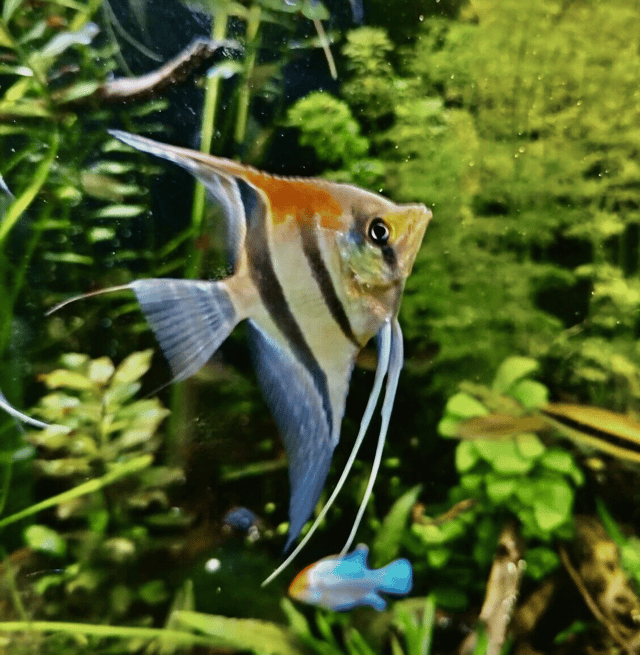
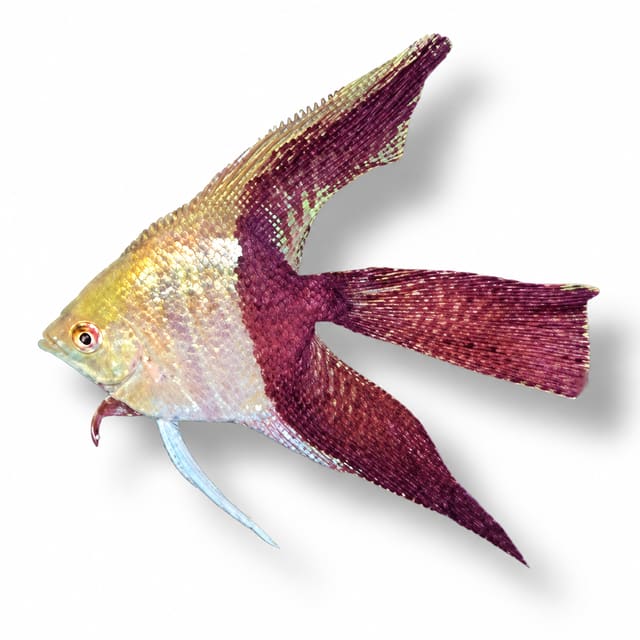
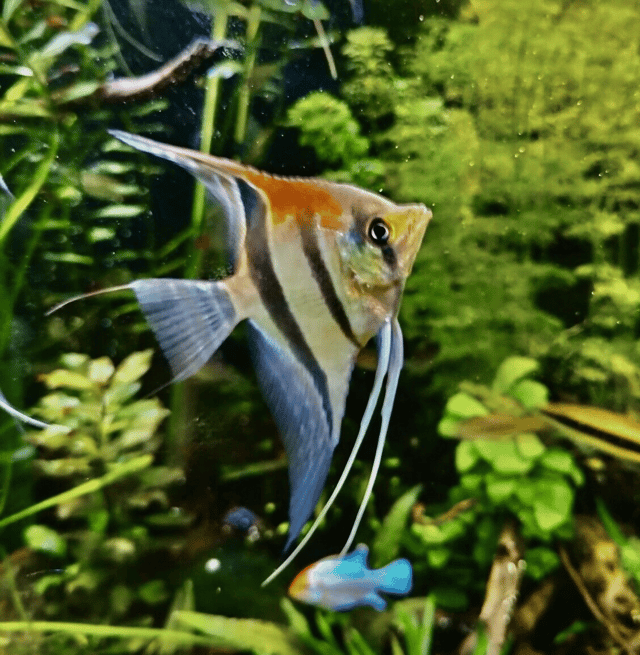
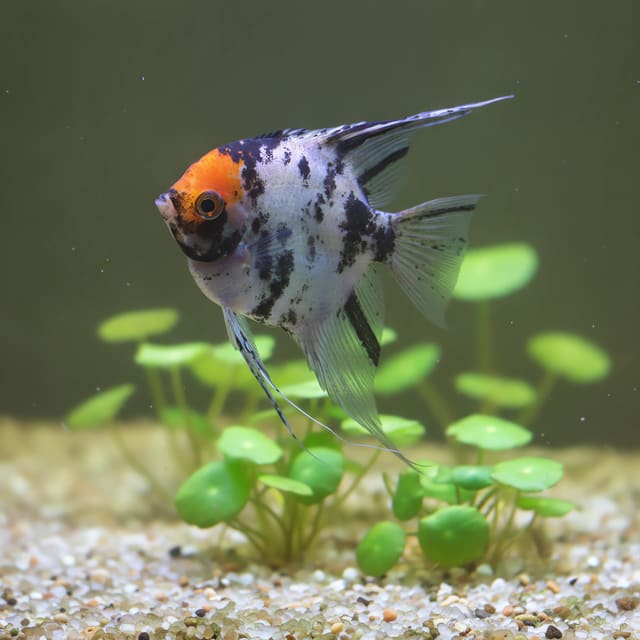
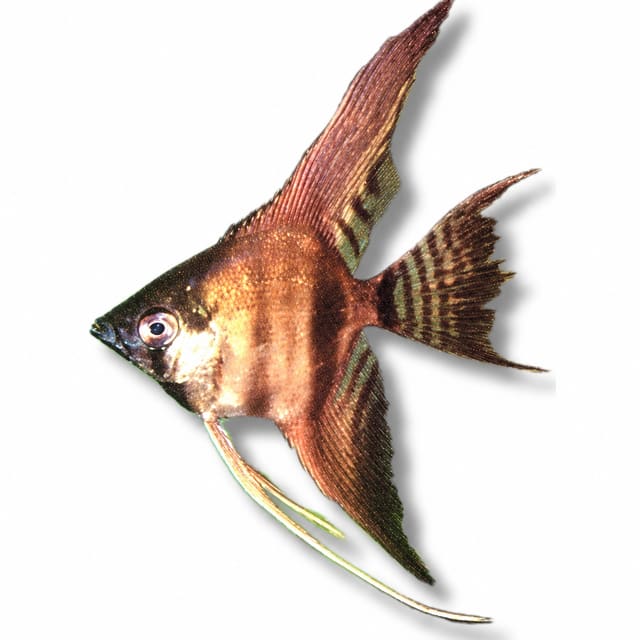
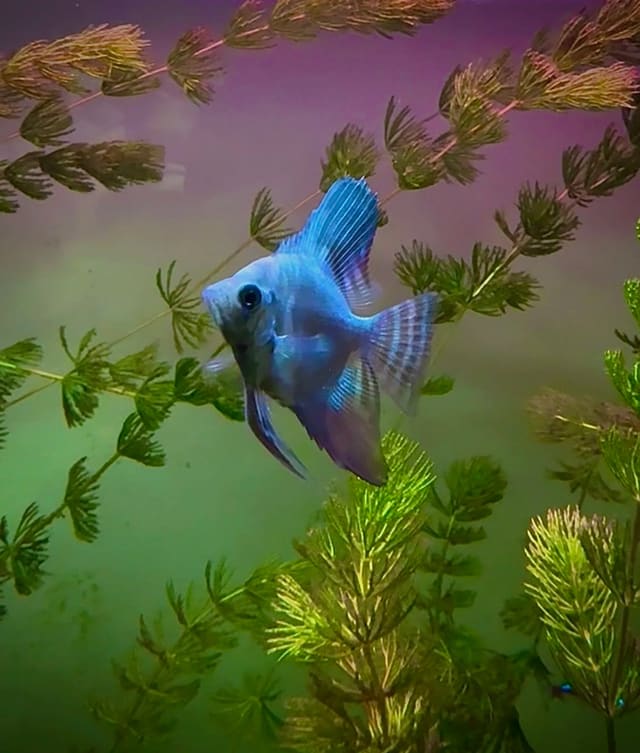
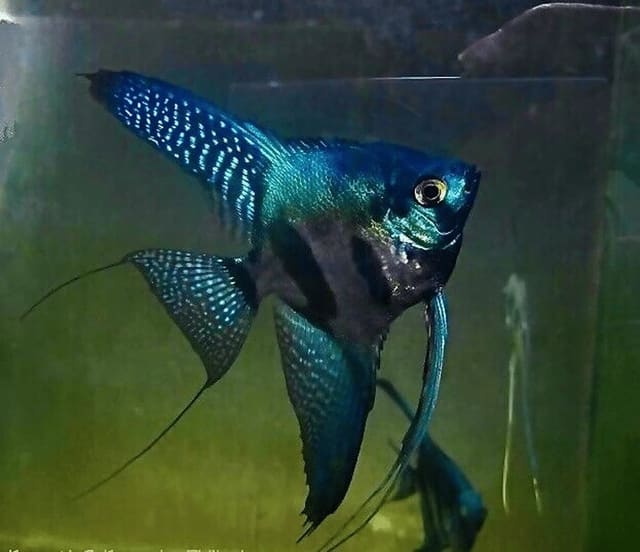
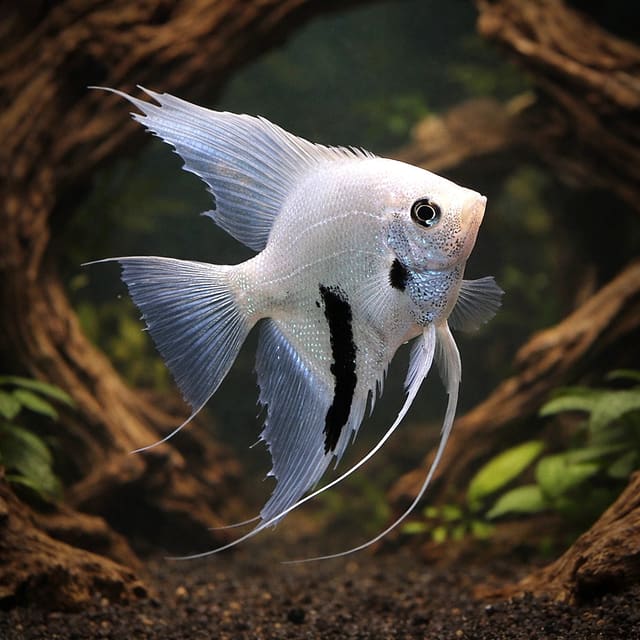
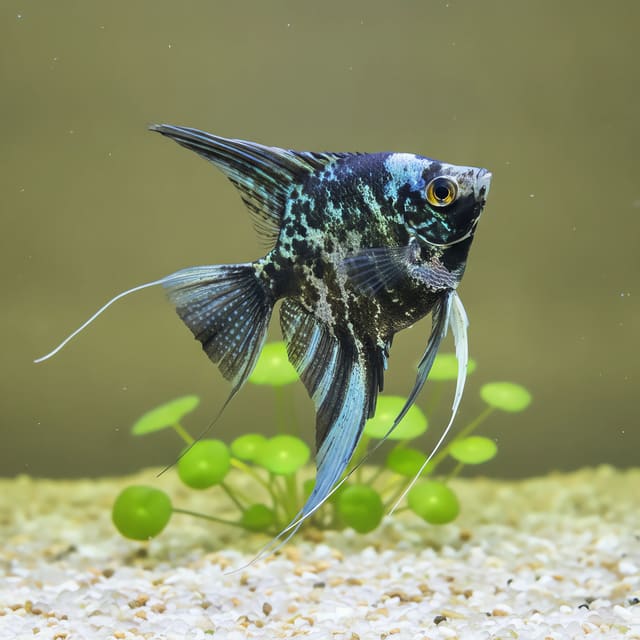
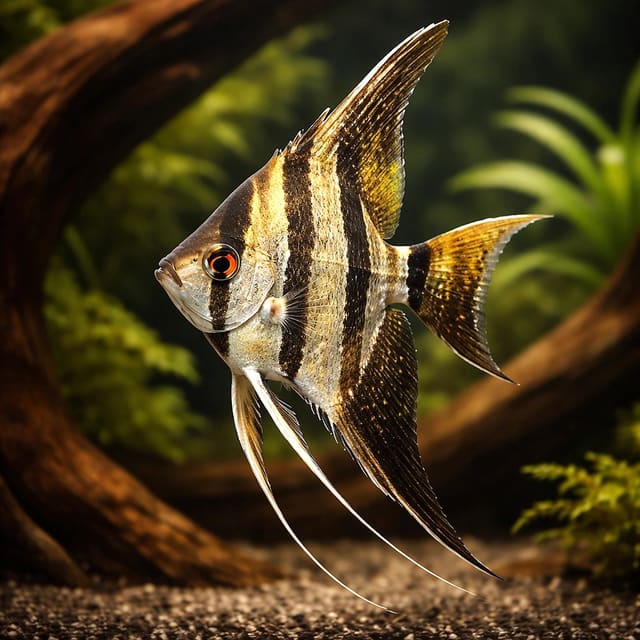
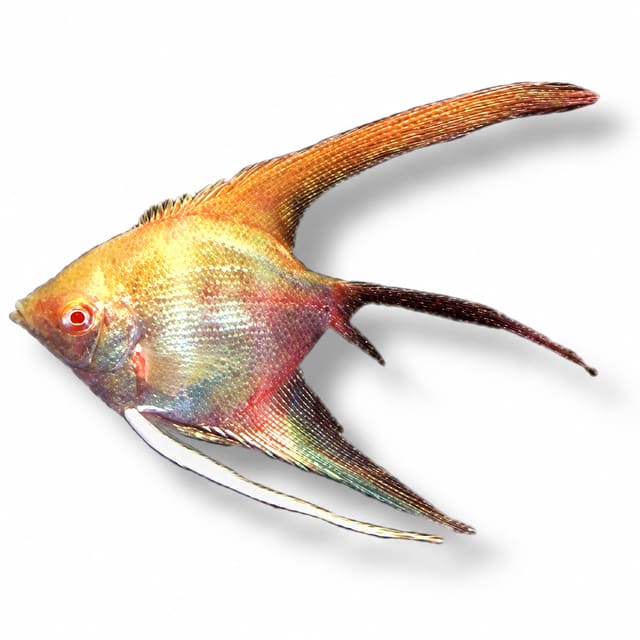
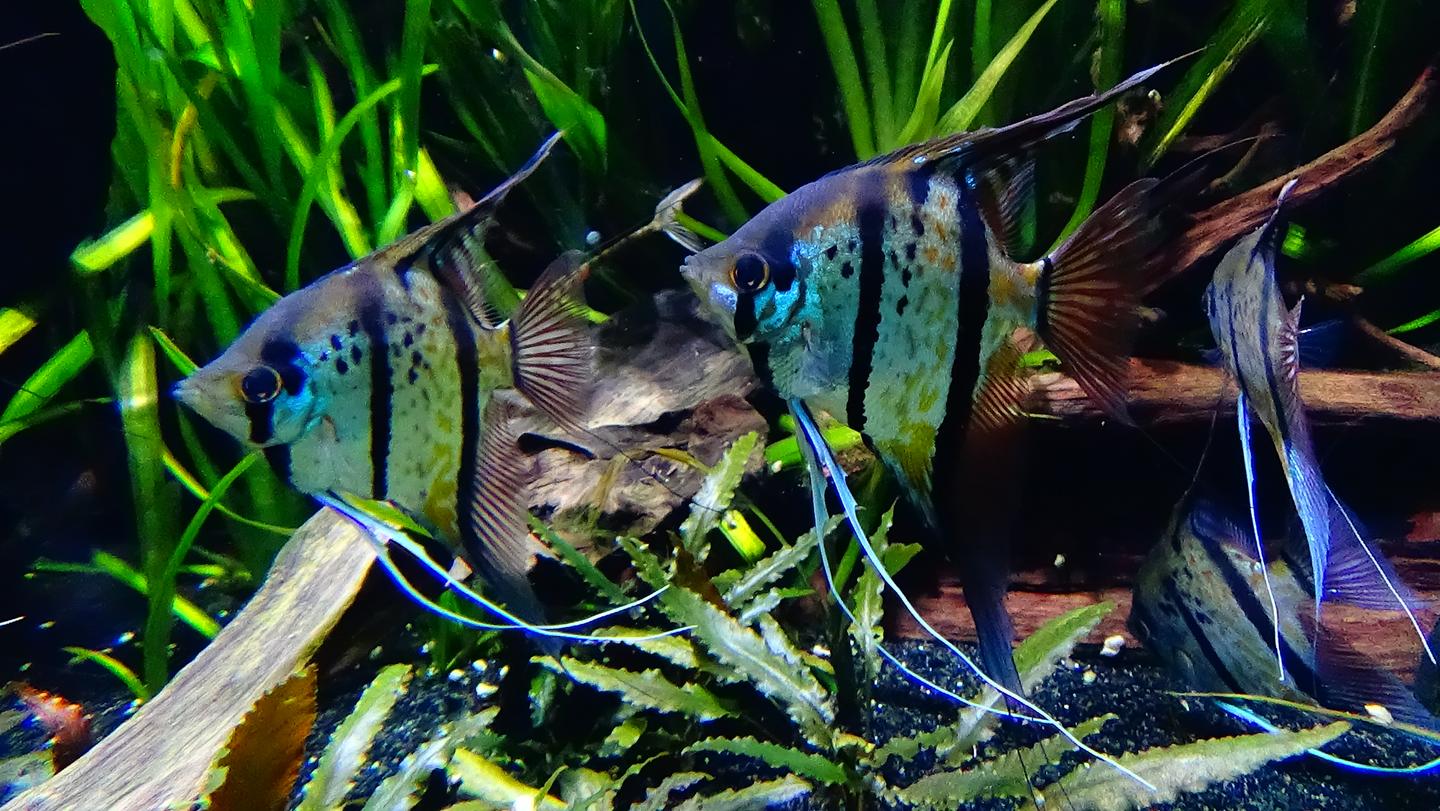
The gallery images are representative of this type of animal rather than photographs of the exact animal supplied, so colours can look slightly different from the live animal.
The image shows the characteristic deep body, tall fins and mottled map-like presentation used to identify the offer. Individual pattern placement and colour intensity can vary, so choose the aquarium for the species’ adult form and behaviour rather than relying on one photograph as a precise preview of an individual fish.
The best buying decision starts with the final aquarium rather than a temporary holding arrangement. Allow vertical clearance, open turning space and room for visual barriers from the outset.
Freshwater angelfish grow upward as well as forward. FishBase contains both a current field maximum of 10.5 cm total length and an older aquarium-reference maximum of 15 cm total length. For practical planning, allow around 15 cm total length and often 20–25 cm from the tips of the extended dorsal and anal fins. That larger vertical dimension explains why a shallow aquarium can fail even when its stated volume looks generous.
Seriously Fish recommends an aquarium measuring at least 100 × 40 × 50 cm, or approximately 200 litres. Its 50 cm height recommendation is especially important once the fins are fully extended. Measure usable internal height after allowing for substrate, decor, the water line and any equipment that intrudes into the swimming area.
OATA gives at least 120 litres as a broad industry floor for a compatible pair of smaller American cichlids and says an angelfish aquarium must be sufficiently tall. Our complete freshwater angelfish care guide uses a more conservative planning point of roughly 200 litres, a 100 × 40 cm footprint and about 50 cm usable height for an adult pair. A group or mixed community needs more room and a response plan for territorial conflict.
| If the plan is… | Make this decision |
|---|---|
| One compatible adult pair | Start around 200 litres with the stated footprint and height, then assess decor and other inhabitants. |
| Two randomly selected fish | Do not assume they are a pair; prepare to separate them if chasing becomes persistent. |
| A juvenile group | Provide substantially more space, visual barriers and another suitable arrangement before pair formation. |
| A community aquarium | Count the territory, adult size and feeding needs of every inhabitant, not only the angelfish. |
A nominal litre figure cannot show whether an adult can turn, whether long fins touch sharp decor or whether a pair can defend the whole footprint. Use volume, dimensions and layout together. If the aquarium falls short in usable height or turning room, change the aquarium plan rather than postponing the decision.
FishBase records 24–30°C, pH 6.0–8.0 and 5–13 dGH for Pterophyllum scalare. Seriously Fish also gives 24–30°C, with pH 6.0–7.4 and hardness up to 15 dGH. These ranges describe different reference points, so routine aquarium care should use a stable overlap rather than moving between the extremes.
OATA’s American-cichlid guidance gives 22–27°C, pH 6.5–8.0 and 4–12 dGH for the group. Our store guide sets the routine target at 24–27°C, pH 6.5–8.0 and about 5–12 dGH, within FishBase’s recorded range and OATA’s American-cichlid guidance; Seriously Fish gives a narrower pH upper limit of 7.4. Keep the fish near established conditions and make elective changes gradually.
| Measurement | Routine decision |
|---|---|
| Temperature | Hold 24–27°C and confirm it with a thermometer rather than relying only on the heater dial. |
| pH | Aim for a stable 6.5–8.0; do not chase a decimal with abrupt chemical changes. |
| General hardness | Keep about 5–12 dGH and measure source water before blending or altering it. |
| Ammonia | Maintain zero detectable ammonia. |
| Nitrite | Maintain zero detectable nitrite. |
| Nitrate | OATA advises no more than 20 mg/l above the normal tap-water level. |
If GH, KH and pH are unfamiliar, read our water chemistry guide before altering tap or reverse-osmosis water. Then use the water matcher to compare measured aquarium values with the routine range. A fixed tap-to-RO recipe is unreliable because source waters differ.
Stability does not mean ignoring toxic waste. Detectable ammonia or nitrite requires immediate action, while elective pH, hardness and temperature changes should be measured and gradual. Record results so that a trend becomes visible before the fish shows distress. The useful target is a repeatable, clean environment, not constant adjustment in pursuit of a single “perfect” reading.
A mature biological filter is essential because fish release ammonia, which is toxic. Beneficial bacteria convert ammonia to nitrite and then to the less harmful nitrate. The RSPCA’s aquarium guidance explains why a well-set-up and maintained filter is central to fish welfare. elapsed time alone cannot show that this bacterial process is ready; water tests must show zero detectable ammonia and nitrite.
For an aquarium of about 200 litres, Seriously Fish suggests turnover of four to five times the aquarium volume each hour, equivalent to a filter rated around 800–1000 litres per hour. Rated flow is a starting point rather than the current the fish must experience directly. Arrange the outlet so that it supports oxygen exchange and waste collection without forcing an angelfish to fight a harsh jet continually.
OATA recommends testing at least weekly and using a partial water change of about 25% each week as a starting routine. Treat replacement tap water with a suitable conditioner before it enters the aquarium. Match temperature closely enough to avoid an abrupt swing, and siphon accumulated solid waste from accessible areas.
If the filter needs cleaning, do not run it under the tap. Instead, rinse it lightly in the tank water removed during a partial water change, as this reduces the amount of bacteria lost.
Adjust maintenance from test results, stocking, feeding and filter performance. Increasing food or adding fish increases waste and can outpace the bacterial population. If ammonia or nitrite appears, reduce the immediate waste burden, protect oxygenation and obtain prompt advice rather than waiting for cloudiness or distressed behaviour.
Use tall plants, secure wood or other smooth vertical structures to divide the aquarium into usable areas. FishBase describes adults living among dense aquatic and riverbank vegetation in swamps and flooded ground, while Seriously Fish recommends a well-planted aquarium with tall leafy plants. These features give cover and interrupt direct sight lines without removing the open water needed for turning.
Long dorsal, anal and pelvic fins need clearance. Run a hand or soft cloth over decor before installation and remove pieces with sharp points or abrasive edges. Leave a broad route through the aquarium so an adult can turn without brushing both sides of a narrow gap. Cover hazardous filter intakes where necessary and secure heaters or equipment that could trap trailing filaments.
| Layout feature | Reason for using it |
|---|---|
| Vertical plants or wood | Breaks sight lines and reflects the structured habitat used by wild adults. |
| Open turning area | Allows the deep body and extended fins to change direction safely. |
| Fine gravel or sand | Fits OATA’s general American-cichlid setup guidance and makes solid waste easier to locate. |
| Secure decor | Prevents digging or investigation from destabilising heavy pieces. |
| Gentle distributed current | Maintains circulation without making the fish hold position against a concentrated jet. |
A planted appearance is useful only when the remaining swimming space still works. Dense decor across the entire footprint can create narrow channels and reduce turning room. Place taller structures towards the back or sides, then observe whether each fish can move between cover and feeding areas without entering another fish’s territory every time.
Provide water movement and surface exchange even though angelfish prefer gentler flow. Gentle does not mean stagnant. Direct a strong outlet against glass, decor or a spray bar if the fish continually leans into the current, hides only in dead spots or struggles to hold a normal position.
Reassess the layout when social behaviour changes. A structure that divides juvenile sight lines may become a defended spawning surface later. If one fish controls the feeding area or forces another into a corner, rearranging decor may help interrupt established territories, but persistent aggression still requires separation rather than repeated cosmetic changes.
Map Angelfish are omnivorous. Seriously Fish describes wild Pterophyllum scalare as feeding predominantly on zoobenthos, including small crustaceans and other aquatic invertebrates. In the aquarium, use a nutritionally complete cichlid pellet, granule or suitable flake as the staple, choosing a piece size the fish can swallow comfortably. Add suitable frozen or freeze-dried foods for variety.
OATA advises feeding American cichlids once a day and offering only what they consume within a few minutes. Start with a small measured portion, watch every fish, and stop before food accumulates on the substrate or enters the filter. Remove obvious leftovers because uneaten food and excess faeces break down and add to the waste the biological filter must process.
A controlled angelfish feeding study shows that feed composition can affect growth and reproductive performance, but it does not establish one universal household menu. The practical response is to use a complete staple consistently and treat bloodworm, brine shrimp or another attractive food as variety rather than the whole diet.
Fast feeding by one individual does not show that the whole group has eaten. Watch subordinate fish and use more than one feeding point where necessary. If a fish repeatedly hangs back, determine whether aggression, current, food size or illness is blocking access.
Avoid compensating for poor water or unexplained abnormal swimming with fasting, peas, vitamins or medicated food. Test ammonia, nitrite, nitrate and temperature first. A complete, measured diet supports routine care, but food should not be used as a substitute for diagnosis.
Prepare the aquarium before the parcel arrives. Confirm the intended aquarium is mature and filtered, record temperature and water chemistry, and make sure someone can receive the fish. Keep nets and a clean container ready so the transfer can be completed calmly without searching for equipment while the bag is open.
Follow the delivery and Live Arrival Guarantee policy for the applicable claim steps and delivery details. Film every delivery from the sealed parcel onward. Float the bag for 20–30 minutes before releasing the fish, and do not pour transport water into the aquarium.
Acclimatisation reduces an immediate difference; it cannot make unsuitable target water safe. The aquarium should already sit within the routine 24–27°C, pH 6.5–8.0 and 5–12 dGH plan, with zero detectable ammonia and nitrite. Match established water as closely as practical and avoid using arrival day for an unnecessary pH or hardness correction.
During the first day, distinguish quiet settling from worsening distress. A newly transferred fish may spend time near cover, but gasping, loss of balance, uncontrolled swimming, obvious wounds or a rapidly deteriorating condition require immediate water tests and a prompt response. Check that filter flow is not pinning the fish in one area.
Across the first week, confirm that the angelfish reaches food, uses more than one part of the aquarium and is not being persistently chased. Record temperature and nitrogen-waste results rather than relying on appearance alone. Add no further fish merely because the first introduction looks calm; the biological filter and social arrangement need time to reveal whether the increased load is manageable.
A settled angelfish should show steady swimming, regular breathing, clear eyes, open fins, an intact body surface and consistent interest in food. Judge changes against that individual’s usual pattern. One behaviour rarely identifies a disease, but a sudden shift gives you a reason to test the environment and inspect the fish closely.
The RSPCA’s fish-health guidance supports a water-quality-first response. Test ammonia, nitrite, nitrate and temperature immediately, then compare pH where a chemistry change may be involved. Detectable ammonia or nitrite is urgent because both are toxic; do not wait for every fish to show symptoms.
| If you see… | Do this first |
|---|---|
| Gasping or faster gill movement | Test water immediately and check filtration, surface movement and temperature. |
| Clamped or damaged fins | Inspect for aggression and sharp decor while checking water quality. |
| White spots or fluffy growths | Document the signs and seek a diagnosis before choosing treatment. |
| Loss of balance or erratic swimming | Check temperature and toxic waste, then reduce avoidable disturbance. |
| Sudden refusal of food | Test water, observe breathing and check whether another fish blocks feeding access. |
| Persistent hiding or exclusion | Assess territorial aggression and prepare safe separation if needed. |
Isolate an affected fish only when the separate aquarium is mature, suitable and less stressful than leaving it in place. A bare, uncycled container can turn one problem into ammonia exposure. Photograph visible signs, note when they began and record water results before contacting us or a fish vet.
Do not apply a universal heat, salt or medication recipe to an unidentified problem. Temperature changes alter oxygen demand and may affect disease processes, while treatments can harm fish or biological filtration when used incorrectly. In the UK, use only a lawful product labelled for the species and aquarium system, following its instructions or veterinary direction.
If the fish jumps out, return it to suitable aquarium water immediately using wet hands or a wet, soft net. Keep air exposure and handling brief, check the lid, and monitor breathing, balance and visible injury. Abnormal recovery warrants fish-veterinary advice.
Angelfish are social cichlids, but social does not mean conflict-free. FishBase recommends aquarium groups of five or more, Seriously Fish favours small groups, and OATA advises a pair or group at minimum because a singleton may become stressed. These statements describe workable starting structures rather than a guarantee that every combination will remain peaceful.
A compatible adult pair can be a practical plan in roughly 200 litres with suitable dimensions and layout. Two fish selected at random are not automatically compatible, and sex cannot be inferred reliably from colour, forehead shape or fin angle. If they do not form a pair, one may control food, cover or the entire aquarium.
A juvenile group can allow pair formation, but growth and breeding condition can reorganise the hierarchy. Provide substantially more room than the adult-pair plan, use vertical barriers and keep another suitable aquarium or rehoming route ready. FishBase’s group of five or more is not permission to place five adults into the 200-litre pair layout.
Rearranging decor can interrupt an established territory, but it is not a complete response to sustained aggression. The excluded fish still needs safe water, food and room while the social plan is changed. A divider is useful only if each side retains suitable dimensions, filtration and access to resources.
Do not keep one angelfish merely because it simplifies stocking. If circumstances leave an individual alone, monitor feeding, hiding and activity closely while arranging a suitable long-term social plan. The goal is not a prescribed head count at any cost; it is a stable arrangement in which every fish can feed, rest and move without persistent fear or injury.
Map Angelfish can live in a robust community, but compatibility remains conditional. Seriously Fish describes the species as generally peaceful while warning that it may squabble with its own kind and eat small fish such as tetras. OATA recommends calmer American cichlids such as angelfish only with appropriately robust, larger shoaling fish and compatible conditions.
Avoid very small fish that may be swallowed and persistent fin-nippers that can damage the extended dorsal, anal and pelvic fins. Use caution with highly aggressive or territorial species, much faster feeders and any fish likely to compete for the same vertical structure or spawning area. A different swimming level can reduce direct competition, but it does not guarantee safety.
| Compatibility screen | Question to answer |
|---|---|
| Adult body size | Will either fish become small enough to swallow or large enough to dominate the other? |
| Fin behaviour | Does the proposed companion nip or pursue slow fish with extended fins? |
| Temperament | Can both species hold territory without continuous chasing or injury? |
| Water overlap | Can both live routinely at 24–27°C and within the planned pH and hardness? |
| Feeding speed | Can every fish obtain a complete diet before faster competitors take it? |
Assess adult behaviour rather than shop size. A tiny companion may become prey as the angelfish grows, while a peaceful-looking juvenile cichlid may become territorial at maturity. Likewise, a calm community can change when an angelfish pair begins defending eggs or a chosen vertical surface.
Very small tetras, shrimp and fry remain at predation risk. Fin-nipping species can cause repeated damage even when they are too large to swallow. Highly aggressive fish may force the angelfish away from food or cover, and very fast feeders may create chronic underfeeding without obvious fighting.
No named companion is universally safe. Compare the exact species, adult dimensions, group needs, feeding method and water range, then observe the actual individuals after introduction. For a mixed setup, contact us with the aquarium dimensions, measured water, existing inhabitants and their adult sizes so the stocking risk can be assessed as one system.
It is a tall freshwater cichlid sold here under the Map trade label, with a deep body, extended fins and an adult care plan based on freshwater angelfish.
One purchase supplies one fish.
Plan for around 15 cm total length and often 20–25 cm fin-tip height; choose the aquarium around these adult dimensions.
For a compatible adult pair, plan roughly 200 litres with a 100 × 40 cm footprint, about 50 cm usable height, mature filtration and gentle distributed flow.
Use a compatible pair or a deliberately planned group; FishBase recommends five or more, while a group needs more space and a separation plan than the adult-pair setup.
Use a stable routine range of 24–27°C, pH 6.5–8.0 and 5–12 dGH, with zero detectable ammonia and nitrite.
Feed a complete cichlid pellet, granule or suitable flake once daily, add suitable frozen or freeze-dried variety, and limit the portion to what is eaten within a few minutes.
Start filming before opening the sealed parcel and continue in one take until the fish is shown inside the sealed bag. Then float the bag for 20–30 minutes before releasing the fish without pouring bag water into the aquarium.
Choose companions with compatible adult size, water, temperament and feeding speed; avoid very small fish that may be swallowed and persistent fin-nippers.
No reviews for this item yet. Bought one? Honest reviews only, good or bad.
What customers say about ordering from us
Easy website plenty of info on fish your buying great to pick a time slot
TRACEY DURRANT · 7 Oct 2026
Got some lovely fish thank you
Kevin Mackie · 7 Oct 2026
Reviews of our shop, collected by Judge.me, an independent third-party review collector. Newest first.