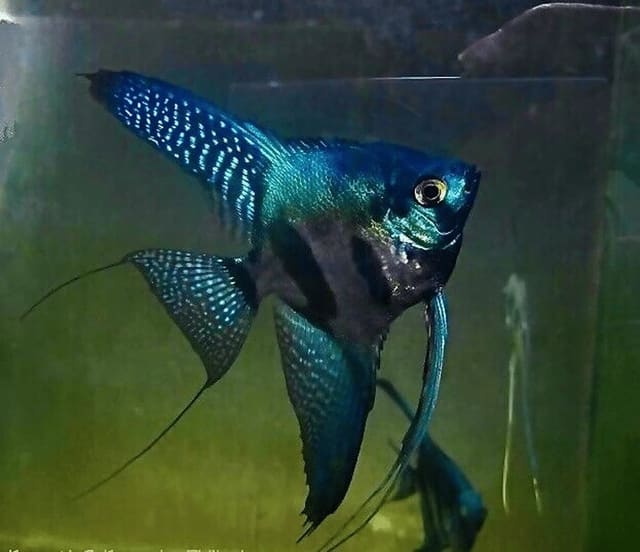
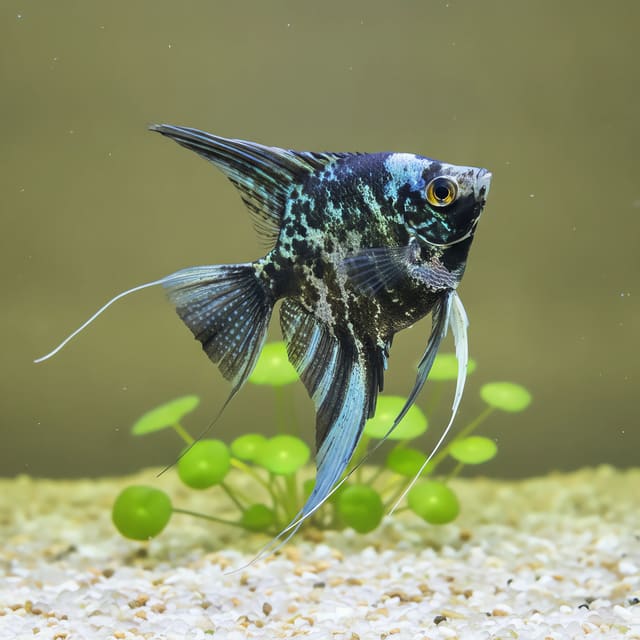
Moderate
Marble Angelfish (Pterophyllum scalare)
24–27°C · pH 6.5–8 · 200L
£3.99
Photo coming soon
The size, price and care details on this page are for this listing.
Pterophyllum scalare gold Kopf is a gold-headed domestic form of the freshwater angelfish; Kopf is German for head. Sold as one fish per unit at 3-3.5 cm or 4-5 cm, sex not stated. Adults reach about 15 cm long and 20 cm or more tall, so plan a tall tank of about 200 litres at 24-30 C and pH 6.0-8.0.
Adult size is the maximum length this species reaches at full maturity (scientific sources). The livestock you receive will be younger and smaller — pick a size above for the actual shipping size. Product-photo provenance and any image-specific limitations are stated on the listing.
Pterophyllum scalare
Save when buying multiple fish. Each quantity is one fish; sex and pair formation are not guaranteed unless the selected variant explicitly states them.
Pterophyllum scalare gold Kopf is a gold-headed domestic form of the freshwater angelfish; Kopf is German for head. Sold as one fish per unit at 3-3.5 cm or 4-5 cm, sex not stated. Adults reach about 15 cm long and 20 cm or more tall, so plan a tall tank of about 200 litres at 24-30 C and pH 6.0-8.0.
Adult size is the maximum length this species reaches at full maturity (scientific sources). The livestock you receive will be younger and smaller — pick a size above for the actual shipping size. Product-photo provenance and any image-specific limitations are stated on the listing.
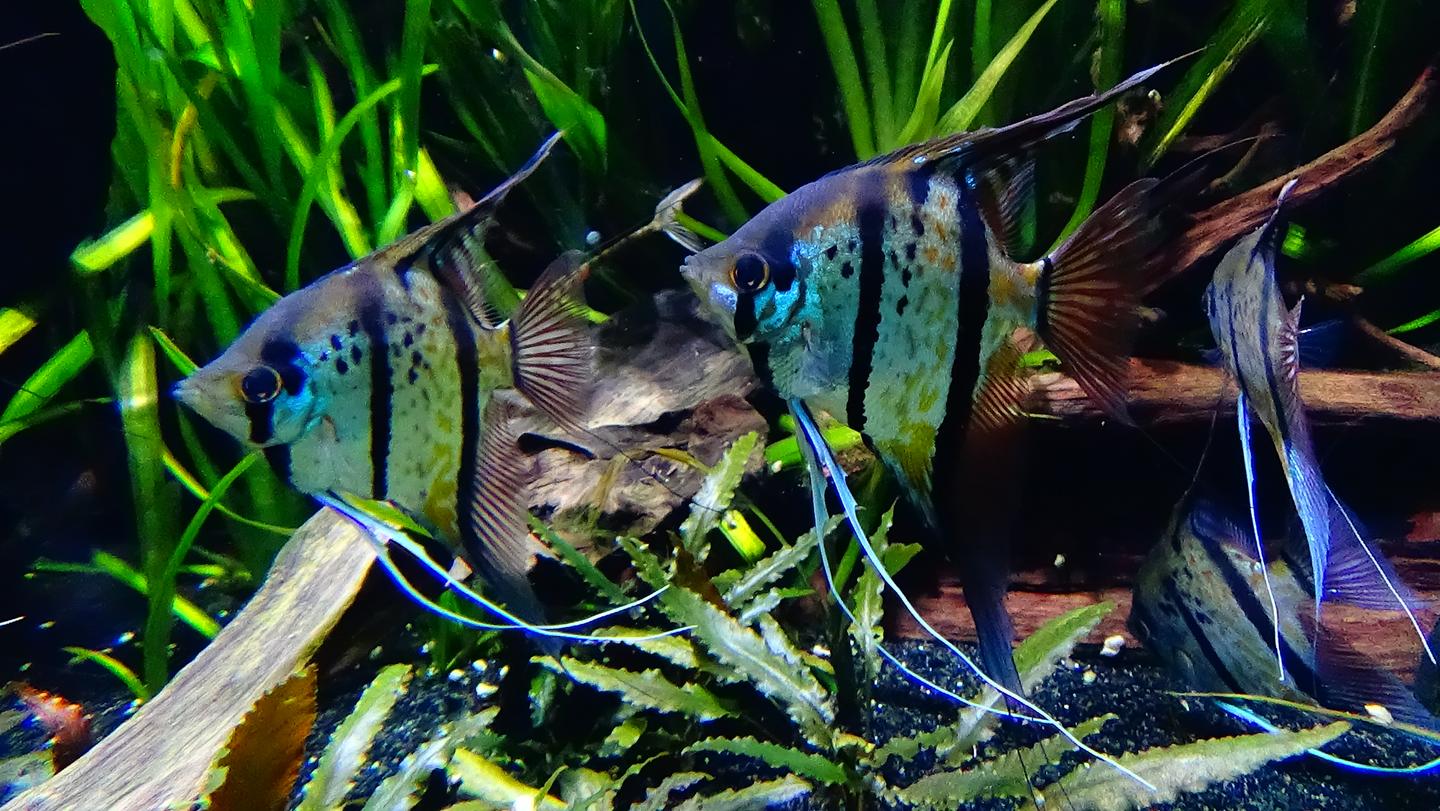
Freshwater angelfish are tall South American cichlids, not small community fish. OATA gives 120 litres as an industry floor for a compatible pair and says the aquarium must be sufficiently tall. We prefer planning around roughly 200 litres, a 100 × 40 cm footprint and about 50 cm height for an adult pair, with more space and an exit plan for a group.
Maintain these water conditions for optimal health and vibrant colors
Pterophyllum scalare gold Kopf is a domestic colour form of the freshwater angelfish, the tall, disc-shaped South American cichlid first described by Schultze in 1823. The label mixes Latin with German. Kopf is simply the German word for head, so in plain English the name reads "gold head". We have kept the label exactly as it stands on our stock records instead of swapping in an English trade name, because we could not find one settled UK name for this form and we are not prepared to invent one.
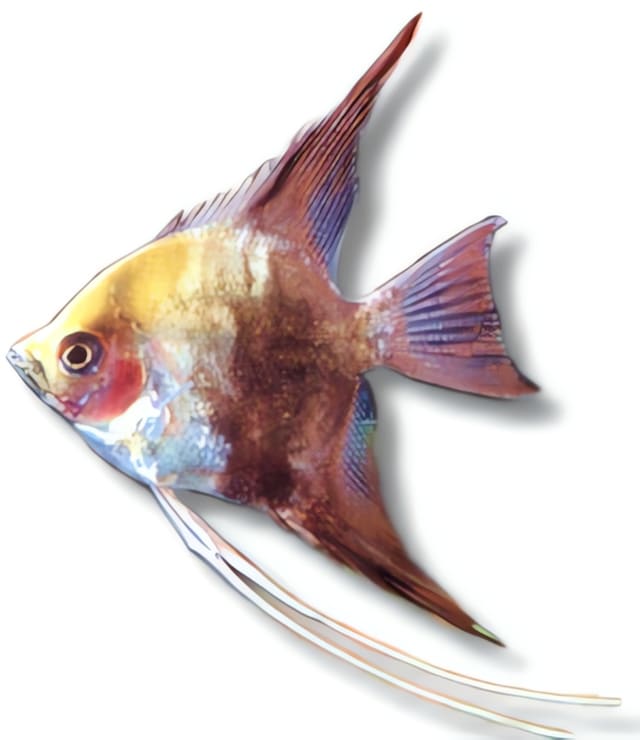
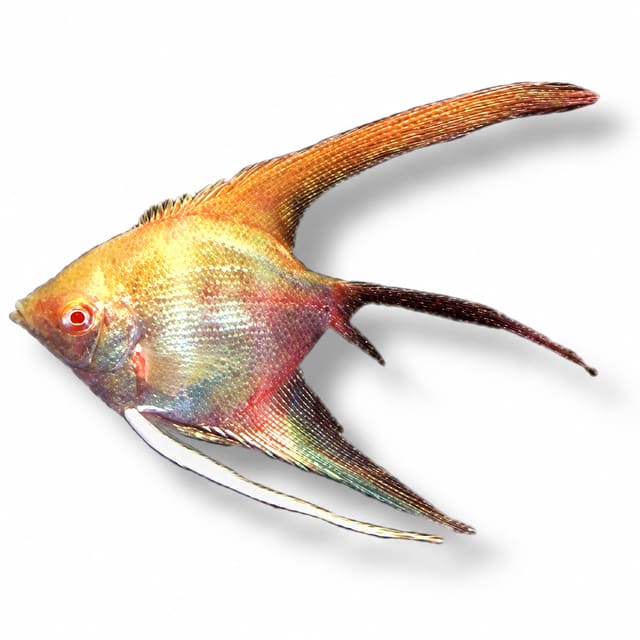
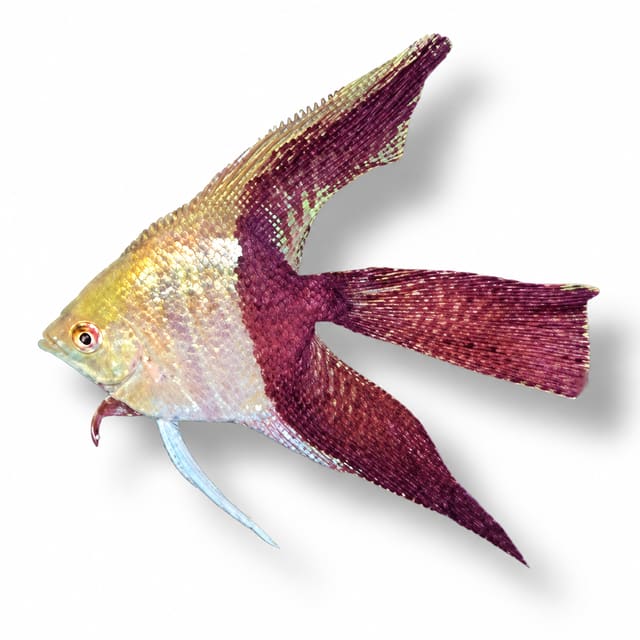
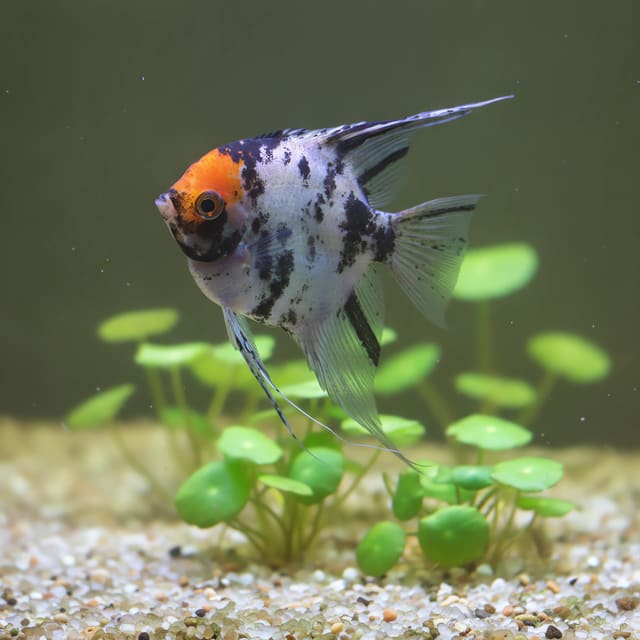
German shops sell it as the Goldkopf-Skalar, Skalar being the German name for the angelfish. Interaquaristik, a German retailer, describes its Goldkopf-Skalar as having a shimmering golden head section and a silvery-white body, on the high, disc-like outline all angelfish share. That is the look the name points to: gold concentrated on the head, with a paler body behind it.
We hold no photograph of this stock, and our records give the name and the two sizes, nothing else. So we will not promise how much gold a particular fish shows, how far back it reaches, or whether the body carries any extra markings. FishBase records that wild angelfish colour more deeply in clear water than in silty water, which is a useful reminder that colour is not fixed; judge it once the fish has settled in clean water, not on the day it comes out of the bag.
Underneath the gold, the animal is ordinary Pterophyllum scalare. Wikipedia's list of domestic varieties runs from silver, gold and zebra through marble, koi, leopard and ghost to albino, all forms of this one species, and the gold Kopf belongs in the same family tree. Every piece of care advice below is therefore species advice. The colour changes how the fish looks in your tank, not what it needs from you.
That matters when you shop, because angelfish names multiply quickly. A label such as gold Kopf, gold, marble or koi tells you about appearance; the scientific name tells you about the animal. If you see Pterophyllum scalare on two listings, you are looking at the same fish in different colours, with the same adult size, the same water needs and the same social habits.
This listing has two size options, 3–3.5 cm and 4–5 cm, and each unit is a single angelfish. Both options are juveniles with nearly all of their growing still to do. The figure describes the fish when we pack it. Our stock records do not say whether the measurement runs from the snout to the base of the tail or to its tip, so read it as a guide rather than a precise length, and expect the small differences you always see between living fish of the same batch.
Choosing between them is mostly about your plans. The 3–3.5 cm fish make sense if you are starting a fresh group and want everyone to begin at the same size, so that no single fish has a head start in the pecking order. The 4–5 cm fish are a little larger, easier to keep an eye on at feeding time, and a better fit if they are joining a calm planted community of fish already too large to be eaten. Neither size changes the tank you need, which is the one the adult will live in.
The sex of the fish is not stated. At this age it cannot be told reliably by anyone. Seriously Fish explains that the male's genital papilla is smaller and more pointed than the female's, but that the difference normally shows only at spawning time, and Wikipedia's article on the genus says it is very difficult to sex an angelfish accurately until it is nearly ready to breed. Two units are two angelfish; they are not a matched pair, and they may well turn out to be the same sex.
If a breeding pair is the goal, a group is the honest route. Seriously Fish recommends beginning with six juveniles and letting a pair form among them, and FishBase records the species being kept in groups of five or more. The fish choose their own partners, so the more candidates they have, the better the odds.
The wild ancestor of every gold Kopf comes from the rivers of northern South America. FishBase places it across the Amazon basin in Peru, Colombia and Brazil, along the Ucayali, the Solimões and the Amazon itself, and further east in rivers of the Brazilian state of Amapá, the Oyapock of French Guiana and the Essequibo of Guyana. Seriously Fish's list of range countries also includes Suriname.
FishBase classes the species as benthopelagic, living in the lower and middle layers of the water rather than at the surface, and describes the adults' home as swamps and flooded land where water plants and bankside vegetation grow densely, in water that may be clear or silty. Wikipedia gives natural values of roughly pH 7.0 falling to almost 6.0, at 26 to 30°C. Warm, slow, thickly vegetated water is the natural setting, and Seriously Fish's aquarium advice of tall leafy plants and a gentle current reflects that.
Wild angelfish hunt small prey. Seriously Fish says they feed chiefly on zoobenthos, the small crustaceans and other invertebrates that live among plants and on the bottom, and Wikipedia's list of wild foods takes in fish fry, young fish, shrimps, crabs, prawns, worms, mosquito larvae and water bugs. Hold on to that list; it explains a good deal about which tank mates are safe.
On the IUCN Red List the species is classed as Least Concern, last assessed on 20 November 2020. FishBase also notes that it is a major commercial species in the aquarium trade and describes it as one of the most popular tropical aquarium fish of all.
Your gold Kopf did not come from any of those rivers. Seriously Fish points out that wild angelfish are now unusual in the hobby and that most are mass-bred in the Far East and Eastern Europe, and colour forms like this one are products of selective breeding. Our records do not say where this fish was raised, so we make no claim about a farm or country. The wild habitat is still the best guide to what the fish needs: warmth, clean and stable water, upright cover and a calm current.
Anyone who looks up the species on FishBase meets two different figures, and it is worth explaining them. The size section of the FishBase summary gives a maximum of 10.5 cm total length for males or unsexed fish, from one published reference. The biology notes on the same page give a maximum length of 15 cm total length, from another. Seriously Fish puts the maximum standard length, measured without the tail, at 150 mm, and adds that adults reach about 20 cm or more in height.
The earlier version of this listing used the 10.5 cm figure. We now plan around the larger number, about 15 cm long, because it is the maximum FishBase itself records and it agrees with Seriously Fish. Planning a tank for a fish smaller than it may become is the more expensive mistake, since the only cure is a bigger tank later.
| Source | Figure | What is measured |
|---|---|---|
| FishBase, size section | 10.5 cm | Total length, males or unsexed fish |
| FishBase, biology notes | 15 cm | Maximum total length |
| Seriously Fish | 150 mm | Maximum standard length, tail excluded |
| Seriously Fish | about 20 cm or more | Adult height, fin tip to fin tip |
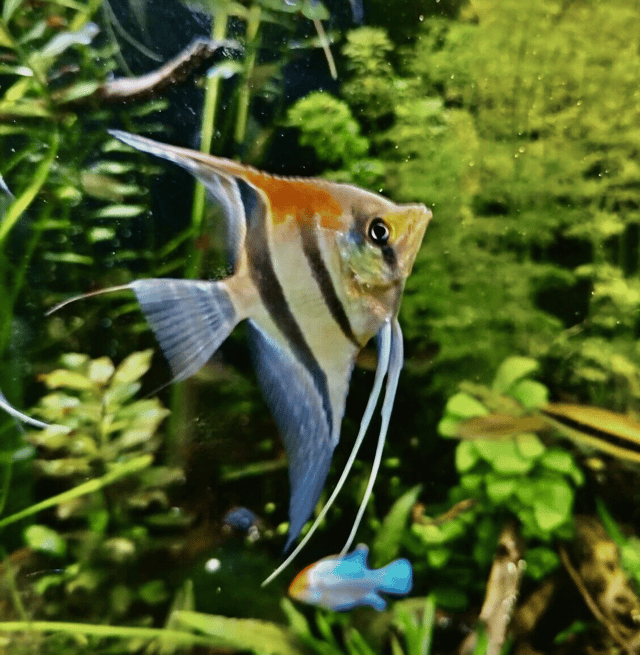
Height is the number that decides your aquarium. An angelfish stands taller than it is long, because its dorsal and anal fins extend well above and below the body. Wikipedia describes the outline as strongly compressed from side to side and round, with long triangular dorsal and anal fins. A fish 20 cm from top to bottom needs a good depth of open water to turn without its fins touching the gravel or breaking the surface.
The fish you receive will be 3 to 5 cm. That gap between dispatch size and adult size is easy to underestimate. Set the aquarium up for the 15 cm, 20 cm tall adult from the beginning, and the small fish will simply have more room to grow into.
Seriously Fish's recommendation for the species is a tank base of 100 × 40 cm, giving roughly 200 litres, and a tall tank with at least 50 cm of height for adult fish. FishBase quotes a minimum aquarium length of 100 cm. Interaquaristik asks for at least 120 cm of length for its Goldkopf-Skalar. We treat 100 cm by 40 cm, 50 cm deep, as the starting point and a longer tank as an improvement, especially for a group.
Depth deserves particular attention. Plenty of tanks reach 200 litres by being long and low, and those suit angelfish poorly. Measure the height of the water column, not just the cabinet, and allow for the substrate and the gap below the lid.
Seriously Fish advises a well-planted tank with tall, leafy plants such as Amazon swords, and a gentle flow of water. Interaquaristik's notes point the same way: dense planting with open areas for swimming. In practice that means grouping tall plants and upright pieces of smooth wood towards the back and sides, where the fish can shelter and break each other's line of sight, and keeping the centre clear so they can cruise and turn.
| Planning point | Our suggestion |
|---|---|
| Footprint | At least 100 × 40 cm; longer if you keep a group |
| Height | 50 cm or more, measured as water depth where possible |
| Planting | Tall broad-leaved plants such as Amazon swords, grouped at the back and sides |
| Wood and stone | Smooth, upright pieces; nothing sharp or crumbly |
| Current | Gentle and spread out, with steady surface movement for oxygen |
| Spare capacity | A second cycled tank or a divider for disputes and pairs |
Decor should be smooth. Angelfish fins are long even on standard forms, and rough rock, snapped plastic leaves or tight bottom-dweller caves can split them. Diffuse a strong filter outlet through a spray bar or point it at the glass, and keep heaters and intakes where the fish cannot wedge themselves against them. At 3 to 5 cm the fish are small enough to be pulled against an unguarded intake, so a sponge pre-filter is worth fitting while they grow.
Get the tank running well before the fish are due. Fill it, set the heater, start the filter and cycle it, either fishlessly or by seeding it with media from a mature filter, testing every few days until ammonia and nitrite both read zero and nitrate has begun to show. Plant it at the same stage so the roots are taking hold while the bacteria build up. A tank only counts as ready when those readings have held for several days; looking finished and being biologically ready are not the same thing.
Think about the group before the tank is full. FishBase gives groups of five or more as the way the species is kept, and Seriously Fish suggests small groups, so a 100 cm tank for one gold Kopf is not really the plan. Leave space in the stocking for the other angelfish, and have a spare tank or divider available, because pairs that form inside a group can become territorial.
FishBase gives the species a temperature range of 24 to 30°C, a pH range of 6.0 to 8.0 and hardness of 5 to 13 dGH, and those are the figures this listing uses. Seriously Fish agrees on 24 to 30°C but gives a narrower pH of 6.0 to 7.4 and hardness of 0 to 15 dGH. Wild waters measured in the species' range sit at 26 to 30°C and about pH 6 to 7, according to Wikipedia, while Wikipedia's article on the genus suggests about 27°C with soft, acidic water below pH 6.5 as ideal.
| Source | Temperature | pH | Hardness |
|---|---|---|---|
| FishBase (used for this listing) | 24–30°C | 6.0–8.0 | 5–13 dGH |
| Seriously Fish | 24–30°C | 6.0–7.4 | 0–15 dGH |
| Wild habitat, per Wikipedia | 26–30°C | near 6.0 to 7.0 | not given |
| Genus ideal, per Wikipedia | about 27°C | below 6.5 | soft |
The ranges are wide, and that is good news, but they are tolerances rather than a menu. Pick a temperature towards the middle, around 26 to 27°C, which also sits close to the genus ideal, set the heater, confirm it with a separate thermometer and leave it alone. The same goes for pH. Domestic angelfish cope with a moderate pH inside the ranges above, and a steady reading matters more than a perfect one. Water that keeps shifting because it is being adjusted is the thing to avoid.
Before the fish are ordered, test the water that comes out of your tap for pH, general hardness and carbonate hardness. If you find it is far harder than the ranges above, mixing in reverse-osmosis water is the usual way to soften it, but make the mix the same every time so that water changes do not swing the chemistry. If your water company publishes hardness as milligrams of calcium carbonate per litre rather than in German degrees, use this rough guide: 13 dGH, the top of the FishBase range, works out at around 230 mg/l.
None of these numbers matter if the tank is not cycled. Ammonia and nitrite must read zero before the angelfish go in, and nitrate should be kept low with partial water changes on a regular schedule. Treat new water with a dechlorinator and bring it to tank temperature before it goes in. Keep a test kit and a written note of results; a change in the pattern often warns you of a problem before the fish do.
In the aquarium this is an easy fish to feed, as long as you remember what it eats in nature. Seriously Fish describes the species as an omnivore whose wild diet is mostly small crustaceans and other invertebrates, and says aquarium fish accept pellets and flake and relish live or frozen foods. Wikipedia mentions frozen, freeze-dried and live foods, including bloodworm and brine shrimp.
A good routine starts with a quality angelfish or tropical flake, or a small sinking or slow-sinking pellet, as the main food. For 3 to 5 cm fish, crumble flake finely or choose a micro pellet so every mouthful is manageable. Several times a week, replace one of those meals with thawed frozen brine shrimp or bloodworm, rinsed first so the juice from the pack does not end up in the tank. Live foods from a clean source make a good occasional extra.
For young angelfish, small meals spread through the day work better than one big one, perhaps three light feeds, while an adult manages well on one or two. Offer what is cleared within a couple of minutes, and lift out anything that drifts into the plants. A tank that is fed generously looks lively for a week, then the water quality pays the price.
| When | Young fish, 3–5 cm | Adults |
|---|---|---|
| Most days | Three small feeds of fine flake or micro pellet | One or two feeds of flake or small pellet |
| Two or three days a week | One feed swapped for rinsed frozen brine shrimp | One feed swapped for frozen brine shrimp or bloodworm |
| Now and then | Live food from a clean source | Live food from a clean source |
| Every feed | Lift out leftovers after a couple of minutes | Lift out leftovers after a couple of minutes |
Watch each fish at mealtimes. Expect the gold Kopf to start feeding once it has settled; if it has not after a few days, test the water and look for bullying. If one fish keeps missing out because faster tank mates get there first, feed at both ends of the tank so the competition is split. Remember too that angelfish hunt. Wikipedia includes fish fry and young fish among wild foods, and Seriously Fish warns that angelfish may eat small fish such as tetras. A well-fed gold Kopf can still swallow a small companion, so feeding generously is never a substitute for choosing tank mates carefully.
Seriously Fish's verdict on the species is a generally peaceful cichlid that may squabble with its own kind and is best kept in small groups. It calls the angelfish a good community fish with one clear warning, that it may eat small fish such as tetras, and reminds keepers that some cichlid aggression is to be expected now and then, with males more aggressive and territorial. Wikipedia's article on the genus describes angelfish as generally peaceful when they are not mating.
Keep a group rather than a single fish or a casual pair. FishBase gives five or more as the usual way to keep the species. Within a group, tiffs over position are shared out rather than falling on one unlucky fish, and pairs can form by choice. Watch for the exception: a fish that is chased without a break, kept from food or confined to one corner needs moving to a spare tank before stress and torn fins set in.
Companions should be peaceful, too big to be swallowed by an adult angelfish, happy in the same warm water, and not inclined to nip. The tiger barb is the classic mismatch. Seriously Fish describes it as notorious for biting the fins of other fishes, especially in small groups or cramped tanks, and says it is not an ideal companion for slow-moving or long-finned species, including many cichlids. Angelfish fit that description, so leave tiger barbs and other nippy species out.
| Good choice | Think twice | Leave out |
|---|---|---|
| Other Pterophyllum scalare in a group of five or more | Small tetras and similar small fish | Tiger barbs and other fin-nippers |
| Peaceful fish too large to be eaten | Fast, greedy feeders | Ornamental shrimp and fish fry |
| Calm bottom-dwellers that keep to the lower water | A spawning angelfish pair in a busy tank | Aggressive fish that chase slow swimmers |
Shrimps appear on Wikipedia's list of wild angelfish foods, so ornamental shrimp are best kept elsewhere, and fish fry are on the same list. Peaceful bottom-dwellers make sense because they spend their time in a different layer of the tank from the angelfish.
The easiest companions of all are other angelfish, and colour makes no difference to that. A group can mix gold Kopf with other forms of the same species, such as the Gold Angelfish, the Marble Angelfish or the Koi Angelfish; all three are Pterophyllum scalare and need exactly the same care. Add the group together if you can, so that no fish arrives to find territories already claimed.
Angelfish settle into pairs of their own choosing. Wikipedia states that every Pterophyllum species forms monogamous pairs, and FishBase notes that the male courts the female in the breeding season. You cannot buy that bond ready-made, which is why we keep pointing towards a group of juveniles rather than two fish.
Once a pair has formed, they pick and clean a spawning surface. Seriously Fish lists vertical surfaces such as slate, broad-leaved plants and even the aquarium glass; Wikipedia mentions submerged logs, flat leaves and, in aquariums, filter pipes. FishBase records that the eggs are attached to the surface of vegetation in a nest area and that both parents guard them. Wikipedia gives a spawn size of 100 to more than 1,200 eggs and describes the parents taking turns to fan the eggs with their pectoral fins, keeping fresh water flowing over them.
Hatching follows within a few days. For the first stage the fry remain stuck to the spawning surface, feeding on what is left of the yolk sac, and at around one week they let go and start to swim, according to Wikipedia. Seriously Fish recommends newly hatched brine shrimp once the yolk sacs are used up.
Results vary. Wikipedia notes that while P. scalare is relatively easy to breed in aquariums, generations of inbreeding mean many domestic strains have lost much of their instinct to rear young, so eggs and fry are sometimes eaten by their own parents. Seriously Fish agrees that it happens and advises keeping the parents well fed; a well-conditioned pair, it says, usually needs little interference.
Breeding also changes the mood of a community tank. Seriously Fish notes that males become more aggressive during breeding, and a pair with eggs to defend will drive other fish away from its site. Have a divider or separate tank ready if the guarding becomes too much for the other residents.
To be clear about this listing: the sex of each fish is not stated, we cannot say whether any two will pair, and fertility and breeding success are not promised. Young fish kept well, in a group and in a suitable tank, give a pair the best opportunity to form.
Have the tank running before you place the order: cycled filter working, water tested and the heater holding the temperature you have chosen. Live animals have to be handed to a person, so make sure somebody will be at the address on the delivery day. Our delivery and live-arrival page explains how this works; please read it before buying.
The fish is packed in an oxygen-filled bag within insulated packaging, with heat packs added when the conditions need them, and travels with a tracked courier licensed to carry live animals. You will receive an email with the confirmed delivery date and tracking.
Before the box is opened, start recording one continuous unboxing video. Open the parcel in that same recording and show the fish inside the still-sealed bag. Should a fish arrive dead, dying or obviously compromised, send that video and your order number to hello@tropicalfishco.co.uk on the same day the parcel is delivered. Photos alone are not enough under the policy. We then replace the affected fish with your next order or refund it, subject to the guarantee terms.
For acclimation, rest the sealed bag on the water surface for 20 to 30 minutes so the temperature inside comes into line with the tank. This step evens out temperature but not pH or hardness, so ask us for advice if your water is very different from the figures on this page. After that, net the fish out of the bag and release it into the aquarium. The water from the bag goes down the sink, never into the tank.
Dim the lights for the rest of the day and let the gold Kopf explore in its own time. Over the first week, keep an eye on three things: breathing, appetite and behaviour. Steady breathing, fins held open, an upright posture and interest in food are what you want to see. Keep feeds small for the first few days.
| Sign | Sensible first step |
|---|---|
| Breathing quickly or gasping near the surface | Test ammonia and nitrite, check the heater and make sure the surface is moving |
| Fins folded tight against the body | Test the water and look for anything that has changed in the tank |
| Torn or frayed fins | Look for a nipping tank mate, sharp decor or a current that is too strong |
| Hiding, or not eating after the first few days | Watch for bullying by other angelfish, then test the water |
| White spots, cloudy patches or scratching on objects | Isolate the fish if you can, and ask for advice before treating |
When something looks wrong, resist the urge to dose straight away. Write down your test results, then watch the tank for half an hour to see whether another fish is causing the trouble. If a treatment is needed, use one at a time at the dose on its label, and ask an aquatic vet or an experienced keeper if the fish does not pick up. Putting the water and the company right does more than any bottle.
If you already keep fish, a separate quarantine tank, cycled, heated and filtered, is the safest first home for any newcomer. A few weeks there lets you watch the gold Kopf eat and behave normally before it meets the main tank, and the same tank serves as a refuge later if a fish is bullied.
Looked after well, this is a long-term companion. Wikipedia notes that freshwater angelfish with good genetics are known to live about 12 years in captivity, so the gold Kopf you buy at 3 to 5 cm may be with you for a long time.
We used the following sources for the facts in this guide.
No reviews for this item yet. Bought one? Honest reviews only, good or bad.
What customers say about ordering from us
Easy website plenty of info on fish your buying great to pick a time slot
TRACEY DURRANT · 7 Oct 2026
Got some lovely fish thank you
Kevin Mackie · 7 Oct 2026
Reviews of our shop, collected by Judge.me, an independent third-party review collector. Newest first.