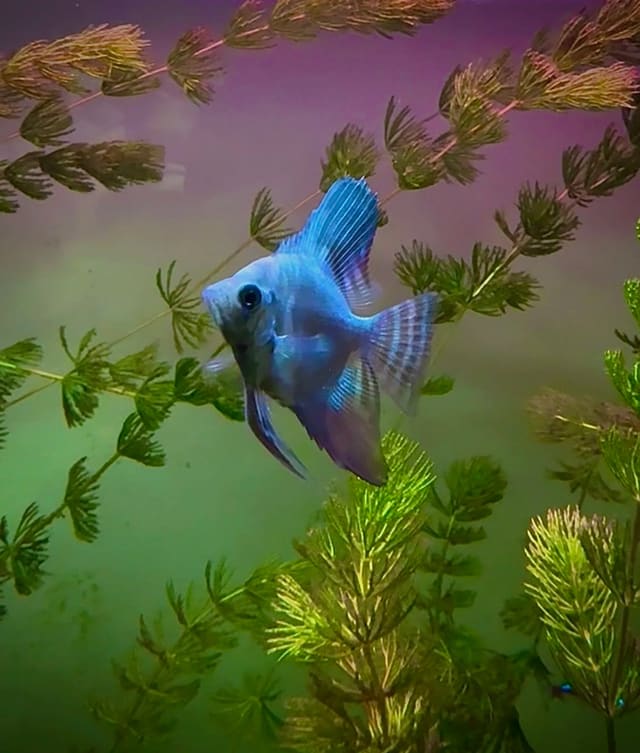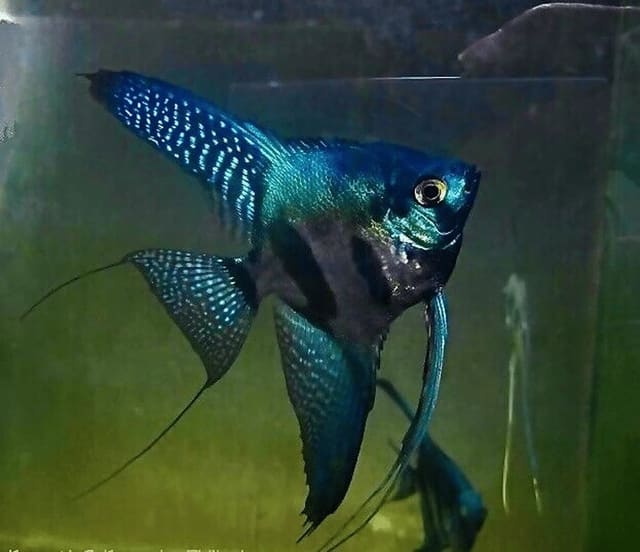
Moderate
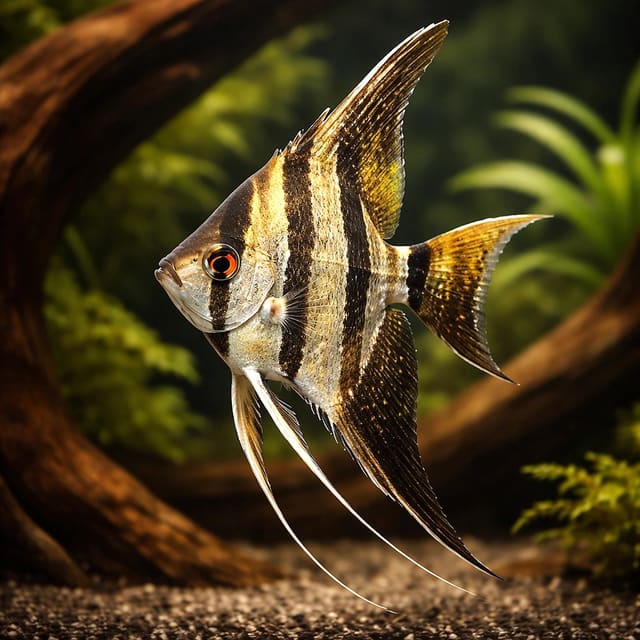
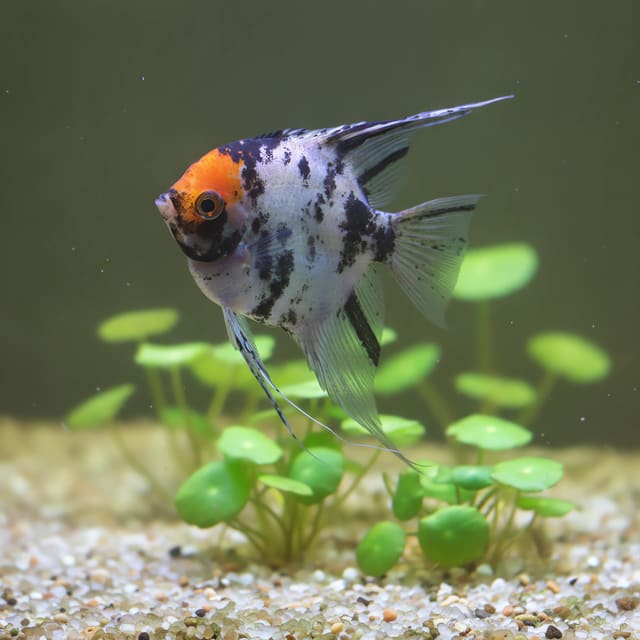
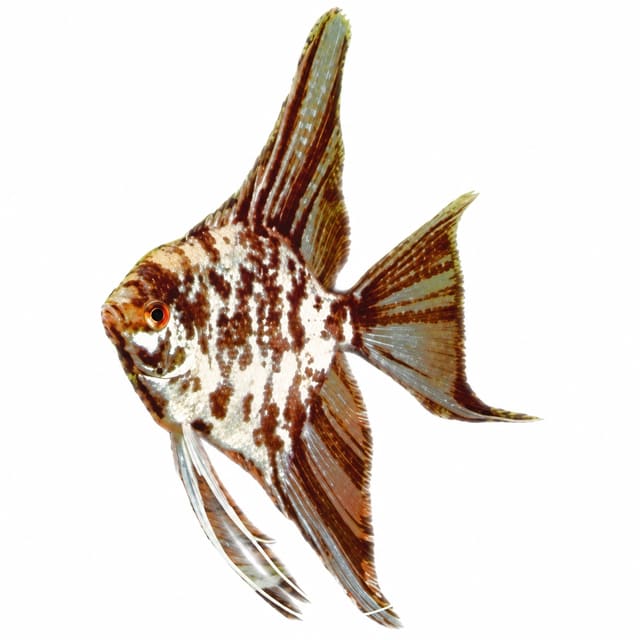
Marble Angelfish (Pterophyllum scalare)
24–27°C · pH 6.5–8 · 200L
£3.99
Photo coming soon
The size, price and care details on this page are for this listing.
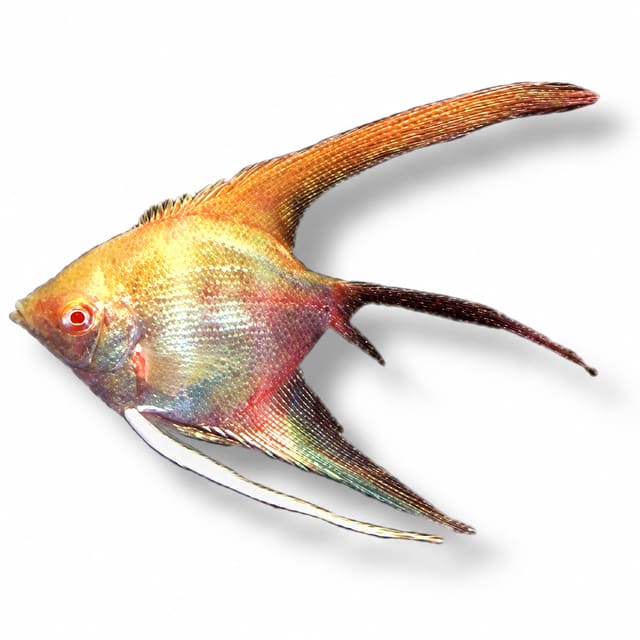
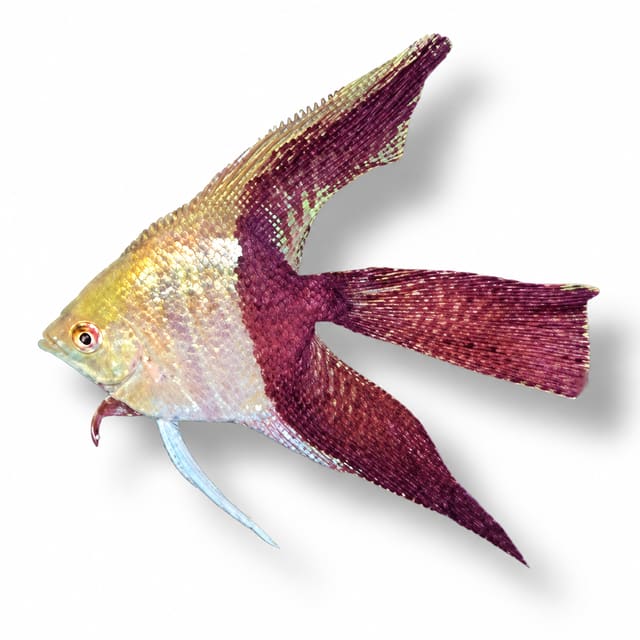
One young angelfish of the Essequibo red spotted form, named after Guyana's Essequibo River and kept at genus level because two angelfish species are recorded there. Choose 3–3.5, 4–5 or 5–6 cm, and plan for a tall tank of about 200 litres with soft, slightly acidic water at 24–29 °C.
Adult size is the maximum length this species reaches at full maturity (scientific sources). The livestock you receive will be younger and smaller — pick a size above for the actual shipping size. Product-photo provenance and any image-specific limitations are stated on the listing.
Pterophyllum sp.
Save when buying multiple fish. Each quantity is one fish; sex and pair formation are not guaranteed unless the selected variant explicitly states them.
One young angelfish of the Essequibo red spotted form, named after Guyana's Essequibo River and kept at genus level because two angelfish species are recorded there. Choose 3–3.5, 4–5 or 5–6 cm, and plan for a tall tank of about 200 litres with soft, slightly acidic water at 24–29 °C.
Adult size is the maximum length this species reaches at full maturity (scientific sources). The livestock you receive will be younger and smaller — pick a size above for the actual shipping size. Product-photo provenance and any image-specific limitations are stated on the listing.
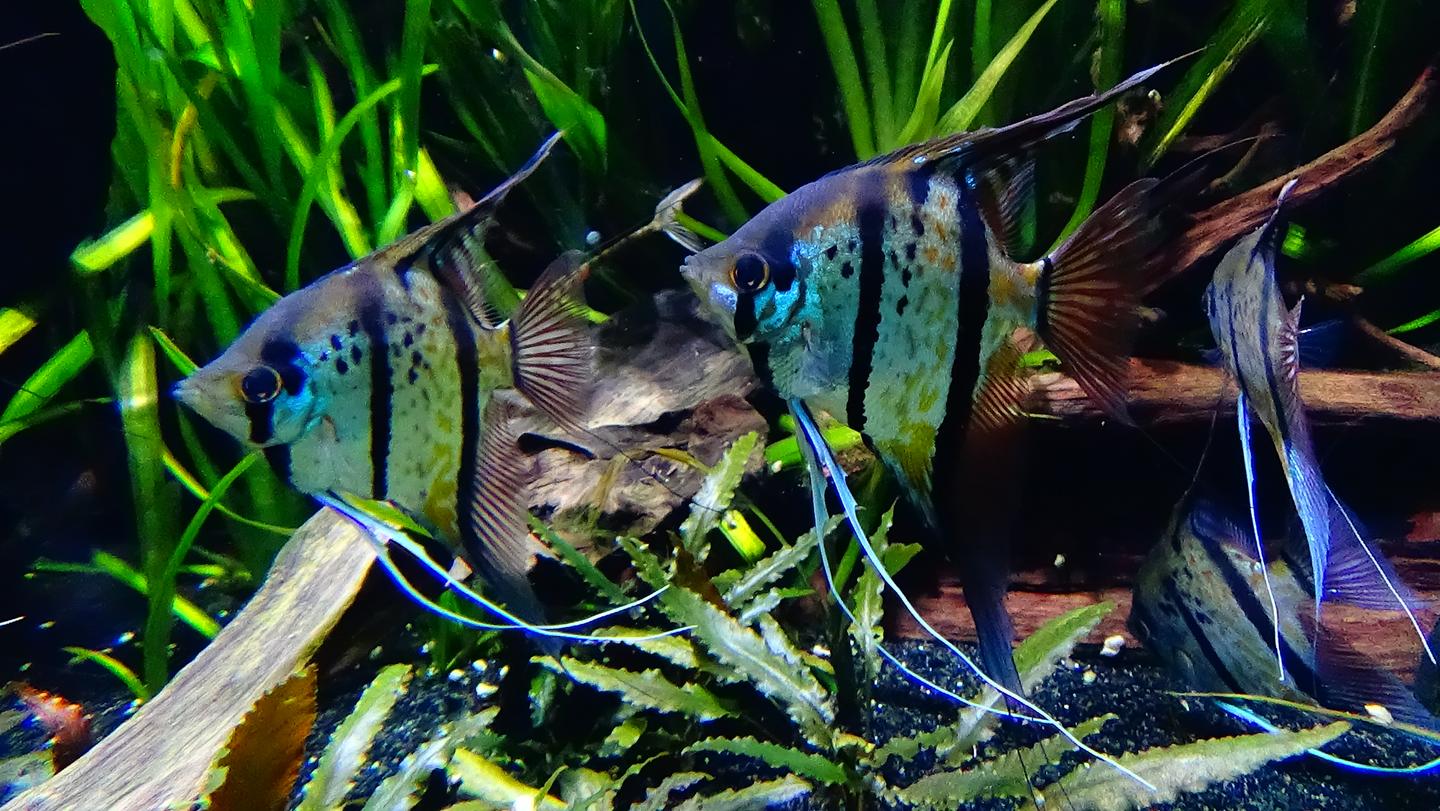
Freshwater angelfish are tall South American cichlids, not small community fish. OATA gives 120 litres as an industry floor for a compatible pair and says the aquarium must be sufficiently tall. We prefer planning around roughly 200 litres, a 100 × 40 cm footprint and about 50 cm height for an adult pair, with more space and an exit plan for a group.
Maintain these water conditions for optimal health and vibrant colors
This listing is for one young angelfish of the form we list as Pterophyllum sp. Essequibo red spotted Guyana. You choose the size band when you order: 3–3.5 cm, 4–5 cm or 5–6 cm. That is the size of the fish when it leaves us, not the size it will reach; the sections below give the adult sizes to plan for. Each one you add to the basket is a single fish, so a group simply means choosing a quantity.
The name is long because it carries several pieces of information at once. Pterophyllum is the angelfish genus, the small group of South American cichlids that gave the hobby its silver, black, gold and koi angels. "Essequibo" and "Guyana" tie the form to the Essequibo River in Guyana. "Red spotted" is the colour description the form is known by. What the name leaves out is a species epithet, and that is on purpose: the next section explains why we have left the species open instead of guessing.
We don't sell these angelfish as males or females, and at 3 to 6 cm nobody can sex them honestly. According to Seriously Fish, the dependable difference between the sexes is the genital papilla, smaller and pointed in males, and it is mainly visible when the fish are spawning. Its advice to anyone hoping for a pair is to start with about six young fish and let them choose partners for themselves. If a breeding pair is the goal, that is what we would suggest as well.
We also won't promise how much red a particular youngster will show on the day it arrives. The name describes the form, not each individual, and we would rather you judged it by the adult you raise than by our adjectives.
So who is it for? Someone with a tall, mature aquarium, a reliable way of providing soft and slightly acidic water, and a real interest in an angelfish sold under a river name rather than a colour-strain name. Seriously Fish notes that most angelfish in the hobby today are captive-bred fish produced in large numbers, so if you would like a domestic angel for a first community tank, a strain such as our Marble Angelfish is the more usual place to begin. If angelfish named after a place are what interest you, the Rio Nanay Angelfish and the Peruvian Altum Angelfish are two others we list under a locality.
The Essequibo is the largest river in Guyana. It rises in the Acarai Mountains near the border with Brazil and runs about 1,014 km north to the Atlantic, and Wikipedia describes it as the largest river between the Orinoco and the Amazon. Its basin is unusually rich in fish: more than 300 species are known from it, almost 60 of them found nowhere else. Among its left-bank tributaries is the Rupununi, and that name matters for an angelfish buyer.
Two described angelfish species are recorded from this drainage. FishBase includes the Essequibo River in Guyana within the range of Pterophyllum scalare, the species behind most aquarium angels, alongside the Ucayali, Solimões and Amazon, the rivers of Amapá in Brazil and the Oyapock in French Guiana. FishBase also records Pterophyllum leopoldi from the Rupununi River in the Essequibo drainage, as well as from the Solimões–Amazon between roughly Manacapuru and Santarém. Wikipedia and Seriously Fish both list the Essequibo and Rupununi for P. leopoldi too. The third recognised species, P. altum, belongs to the Orinoco basin and the upper Rio Negro, so it isn't part of the question.
A fish named after the Essequibo could therefore belong to either of two species on locality alone. Our stock records give the place and the colour form but not the species, and we won't invent one, which is why the listing reads Pterophyllum sp. If you raise these fish to adulthood and want to look more closely, the FishBase and Seriously Fish pages listed under further reading are the right places to start. We would rather send you there than hand you a confident label we can't support.
The name leaves something else unsaid as well. It tells you which river the form is associated with; on its own it doesn't tell you whether a particular fish was netted there or bred from fish that were. We are not going to fill that gap with a story. Whatever an individual's history, a fish sold under a river name is best kept to that river's conditions, and our advice below follows the published habitat notes for both candidate species rather than the wider ranges published for P. scalare alone.
The two species also differ in ways that affect keeping. Seriously Fish describes P. leopoldi as reportedly one of the more aggressive members of the genus towards its own kind, and gives it a softer, more acidic water range than P. scalare. Both points shape the advice on group size and water further down, and both are reasons we treat this form with a little more care than a farmed silver angel.
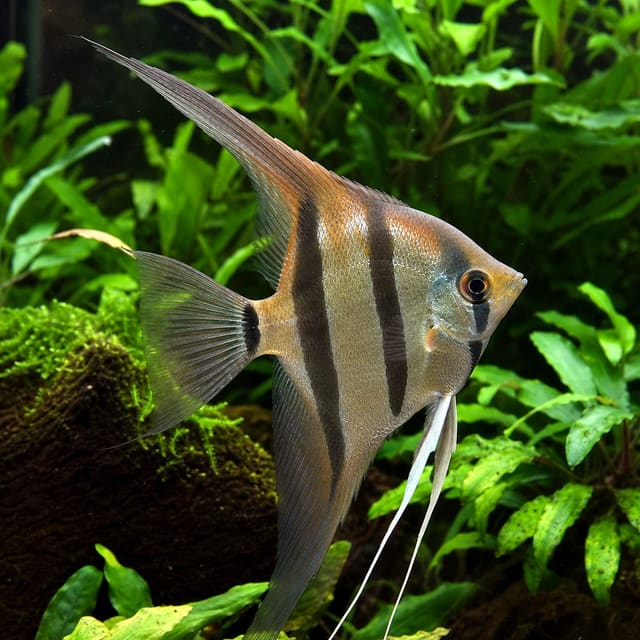
We don't attempt to separate the species on fish of dispatch size, and there is nothing useful for you to check on the day they arrive either. As they mature, though, you can compare them with what Seriously Fish publishes for P. leopoldi. It says the species can be told from other angelfish by up to 11 vertical stripes, a dark patch over the gill cover and the "roman nose" profile of the head, and that adults typically carry a red or maroon hue over the back and fins.
Treat that as a guide for comparison, not a test you can pass or fail at home. A single feature seen on one fish proves little on its own, so look at the whole fish and, ideally, the whole group. If you do keep a group to adulthood and photograph them side on in good light, you will have far better material to compare against the published descriptions than any label on a listing can give you. We'd be genuinely interested to see the results.
FishBase describes adult P. scalare as living in swamps or flooded ground where aquatic and riverside vegetation is dense and the water is either clear or silty. Seriously Fish places P. leopoldi in slower-flowing water, often under rooty overhangs and floating vegetation, in both clear and tannin-stained water with a pH that is virtually always below 7. Different words, the same picture: quiet water, heavy cover, roots and plants to hang among, and no strong current.
The body shape fits that life. Wikipedia describes angelfish as greatly compressed from side to side, with round bodies and long, triangular dorsal and anal fins, a build that lets them slip in among roots and plant stems, often holding against a vertical surface. Wild angelfish typically wear transverse bars that work as camouflage. They are ambush predators that take small fish and macroinvertebrates, which is worth keeping in mind when you choose tank mates.
For water, Wikipedia gives native conditions for P. scalare as running from a neutral pH of 7.0 down to near 6.0, with a hardness of 3 to 10 °dH and temperatures between 26 and 30 °C. The figures Seriously Fish gives for P. leopoldi are softer and more acidic still. That is the water this form is named after, and it is why we point buyers towards a soft-water set-up rather than straight hard tap water.
Turned into an aquarium, the habitat notes ask for a calm, partly shaded tank with upright structure: tall plants, wood standing more or less vertically, some floating cover to soften the light, and gentle filtration. A bare display tank with a strong pump is the opposite of what these fish come from. You don't need to copy a Guyanese riverbank leaf for leaf, but if you keep the three ideas of cover, calm water and soft chemistry in mind, the rest of the set-up tends to fall into place.
Because the species is open, we plan for the larger of the two possibilities. FishBase gives P. scalare a maximum of 10.5 cm total length in its main record and 15 cm total length from an aquarium reference, and Seriously Fish puts its maximum standard length at 150 mm, adding that adults can stand 20 cm or more tall once the fins are counted. P. leopoldi is smaller: FishBase lists 5.0 cm standard length, while Seriously Fish gives 100 mm. The two figures for the same species don't agree, which is one more reason to plan generously rather than tightly.
In practice, buy the tank for a fish of up to about 15 cm in length and around 20 cm from the tip of the dorsal fin to the tip of the anal fin. With angelfish, height matters as much as length.
| Source | Suggested minimum | Notes |
|---|---|---|
| Seriously Fish, P. scalare | 100 × 40 × 50 cm, about 200 litres | At least 50 cm tall for adults |
| Seriously Fish, P. leopoldi | 90 × 30 × 45 cm, about 122 litres | A 120 cm tank is ideal for a group |
| FishBase, P. scalare | 100 cm aquarium | Groups of five or more; pairs can be kept in smaller tanks for breeding |
| Our planning figure for this form | 100 × 40 × 50 cm, about 200 litres | 120 cm long if you are keeping a group of five or six |
Fish of 3 to 6 cm will look lost in a 200-litre tank at first. That's fine. Setting up the adult tank once is simpler than rehousing a settled group later, and young angels will use every bit of the extra space once they start forming pairs and marking out territories.
A tight-fitting lid is sensible with any cichlid, and a heater guard stops a large, flat-bodied fish from resting against the element. Allow the tank to run and mature fully before the fish arrive; fish added to a new tank with an unproven filter are exposed to ammonia and nitrite while the filter catches up.
Water is the part of this fish's care that needs the most thought. The published ranges for the two candidate species overlap, but not completely, so we have chosen targets that sit inside the softer of them.
| Source | Temperature | pH | Hardness |
|---|---|---|---|
| FishBase, P. scalare | 24–30 °C | 6.0–8.0 | 5–13 dH |
| Seriously Fish, P. scalare | 24–30 °C | 6.0–7.4 | 0–15 dGH |
| Wikipedia, native P. scalare water | 26–30 °C | 6.0–7.0 | 3–10 dH |
| Seriously Fish, P. leopoldi | 22–29 °C | 5.0–7.0 | 0–6 dGH |
| Our target for this form | 24–29 °C | 6.0–7.0 | 3–6 dGH |
The temperature target sits inside both Seriously Fish ranges, and Wikipedia's genus page suggests that around 27 °C is ideal for aquarium angelfish, with soft, acidic water below pH 6.5. The pH target sits inside every range above. The hardness target is the overlap between Wikipedia's native-water figures and Seriously Fish's range for P. leopoldi. If your fish turns out to be the P. scalare type it would tolerate harder water than this, but nobody can tell you that on the day it arrives, so soft is the safe choice.
Test your tap water for general hardness, carbonate hardness and pH before you order, not after. If the general hardness reads well above 6 dGH, you'll need a softer water source, most often reverse-osmosis water mixed back with a little tap water until you hit your figure. Make up change water the same way every time and match its temperature to the tank, so each water change is a small, gentle event rather than a jolt.
Seriously Fish stresses that P. leopoldi needs soft, acidic conditions for long-term health and that imported fish in particular do best when their natural water is reproduced. In practice that means steady readings week to week. A tank that sits at pH 6.6 and 5 dGH every time you test is better than one that swings between targets.
If your water is very different from these targets and you are unsure how to bridge the gap, ask us before ordering. We would rather talk it through first than send fish into a tank that isn't ready for them.
In the wild, angelfish feed opportunistically on small animals. Wikipedia lists tiny fish fry and young fishes, shrimps, crabs and prawns, worms, mosquito larvae, water bugs and small insects that have fallen onto the water among the foods of P. scalare, and describes the genus as ambush predators of small fish and macroinvertebrates. Seriously Fish sums up the wild diet as zoobenthos, meaning small crustaceans and other aquatic invertebrates.
In an aquarium, that translates into a varied diet built around small, meaty foods. Seriously Fish says tank-bred angels accept pellets and flake as well as live and frozen foods, and Wikipedia mentions frozen, freeze-dried and live foods such as bloodworm, brine shrimp and daphnia, adding that variety matters both for health and for matching natural feeding habits. Seriously Fish's note on dry foods is about tank-bred angels, so have frozen foods ready in case a newcomer ignores pellets at first.
Feed small amounts that are eaten within a couple of minutes, and remove anything left on the substrate. With young fish we prefer several small meals across the day to one large one. In soft water, where there is little buffering, uneaten food breaks down into waste that can shift the chemistry faster than you might expect, so it pays to be tidy.
Watch who eats. If one angel takes most of the food while another hangs back at feeding time, keep an eye on the one hanging back. Spreading the food across the surface, or feeding at both ends of the tank, gives quieter fish a chance.
Angelfish have a peaceful reputation that is only partly deserved. Seriously Fish calls P. scalare generally peaceful but says it may squabble with its own kind and that some aggression should be expected, and it describes P. leopoldi as reportedly one of the more aggressive species in the genus towards its own kind. Since this form could be either, plan for the more spirited end.
FishBase suggests keeping angelfish in groups of five or more, with pairs housed in smaller tanks for breeding. Seriously Fish recommends at least four P. leopoldi together so that one fish doesn't become the sole target of bullying, and suggests starting with six juveniles if you want a pair. Our advice follows from that: either keep a single fish as the centrepiece of a soft-water community, or keep a group of five or six in a tank of 120 cm or more. Two or three angels together is the awkward middle, where one fish can end up harassed with nowhere to go.
When a pair forms, expect them to claim a section of the tank, usually around the spawning site they've chosen, and to drive the others away from it. Seriously Fish notes that males tend to become more aggressive when the fish are in breeding condition. In a tank with plenty of tall cover and space, the rest of the group can usually live around a pair; in a cramped tank, they can't.
Seriously Fish lists medium-sized tetras, Corydoras, loricariid catfish, dwarf cichlids and similar peaceful soft-water community fish as suitable company for P. leopoldi. Loricariids are on that list, so a bristlenose such as our Super Red Bristlenose Pleco is one option to consider; as with every fish, check its own care notes against the water targets above before you add it.
The flip side is size. Seriously Fish warns that angelfish may eat small fish such as small tetras, and Wikipedia's list of wild foods includes fish fry, young fish and shrimps. A young angel will live alongside tiny fish for a while, but an adult with a mouth to match its body is a different matter. Seriously Fish does add that P. leopoldi, being the smaller species, won't treat some smaller fish as prey, but with the species open you can't count on that. Choose companions that will still be too large to swallow when the angel is fully grown, and treat dwarf shrimp as food rather than as tank mates.
With a soft-water fish, good health starts with the water. Seriously Fish's notes on P. leopoldi make the link directly: soft, acidic water for long-term health and conditions that copy the natural habitat for imported fish. A fish kept in the wrong chemistry, or in water that swings from week to week, is a stressed fish, and a stressed fish is the one that picks up whatever is going around.
White spot, caused by the parasite Ichthyophthirius multifiliis, is worth knowing about with any newly bought fish. Wikipedia describes the white spots as reaching more than 1 mm across and being easy to see on skin and fins, though harder to spot on the gills. It notes that newly introduced fish and stress can set off an outbreak, that the whole life cycle takes about seven days at 25 °C, and that treatments act on the free-living stages in the water rather than on the parasite sheltering in the fish's skin. That is why a course of treatment has to run long enough to catch each new wave as it leaves the fish.
Wikipedia's advice on the same parasite is that new warm-water fish should be quarantined for at least four weeks. If you're adding these angelfish to a tank that already holds fish you value, a separate quarantine tank with the same soft-water chemistry is the safest route. It also lets you get the newcomers feeding well without competition.
Look at your angels every day, ideally at feeding time, when you'll see them at their most active. Things to notice:
When something looks wrong, test the water first: temperature, ammonia, nitrite, nitrate, pH and hardness. In many cases the answer is there. If the numbers are fine and the fish is still unwell, contact us with a description and we will help where we can. Please don't add treatments on a guess; ask first, because the wrong medicine adds stress without fixing the cause.
All three angelfish species form monogamous pairs, according to Wikipedia, and both parents care for the eggs and young. Eggs are generally laid on a submerged log or a flattened leaf in the wild; FishBase describes the eggs being attached to the surface of aquatic vegetation in a nest area that both parents guard. Seriously Fish says aquarium pairs choose vertical surfaces such as slate, broad-leaved plants or even the glass.
Because these fish are sold unsexed, a pair comes from a group. Seriously Fish suggests starting with six juveniles and letting partners pair off naturally. For P. leopoldi it notes that males may develop longer, more elaborate fins and a small nuchal hump while females may be heavier-bodied, but that the only certain way to sex the fish is to see them spawn or to check the genital papillae when they do. Treat any guess from shape as just that.
Once two fish start keeping together and driving the others away from one spot, it is time to think about whether the rest of the group needs moving.
Seriously Fish recommends conditioning the adults with live foods, and says they will usually guard the eggs and fry, while warning that they may eat their own young, particularly if underfed. If a pair eats a brood, make sure they are well fed and left undisturbed before the next attempt. Once the fry have used up their yolk sacs, Seriously Fish suggests newly hatched brine shrimp as their first food.
We don't sell these fish as a breeding project, and nothing on this page promises that a group will produce a pair. If you do raise fry from a locality-named form, please keep them clear of other angelfish strains so the line stays as it is.
Have the aquarium ready before you place the order: filter running and mature, water tested, and the temperature set to match the target range. Someone must be at the delivery address to receive the parcel.
Your fish will travel in oxygen-filled bags inside insulated packaging, with heat packs when the weather calls for them, carried by a tracked courier licensed to carry live animals. We send the confirmed delivery date and tracking details by email. Please read our delivery and live-arrival information before ordering, so you know what to expect and what to do on the day.
Start a continuous unboxing video while the parcel is still sealed, and keep filming as you open it so the fish can be seen in their still-sealed bags. If a fish has arrived dead, dying or clearly compromised, email hello@tropicalfishco.co.uk on the day of delivery with your order number and that video. Photos alone don't meet the policy. Under the terms of our live-arrival guarantee, the resolution is a replacement with your next order or a refund for the affected fish.
Give the newcomers peace after the journey: low light, no rearranging and no crowding at the glass. Offer a little food the next day and don't worry if it is ignored at first; offering frozen brine shrimp or daphnia alongside a small pellet gives them a choice. Over the first week, keep watching breathing, appetite and behaviour, test the water more often than usual, and hold off on adding anything else to the tank until the newcomers are feeding and swimming openly.
If you've bought a group, there may be some early sorting out as the fish settle into an order. Plenty of tall cover helps, and so does patience; give them time before changing the layout.
These are the pages we used for the facts on this listing. They are worth bookmarking if you keep angelfish.
No reviews for this item yet. Bought one? Honest reviews only, good or bad.
What customers say about ordering from us
Easy website plenty of info on fish your buying great to pick a time slot
TRACEY DURRANT · 7 Oct 2026
Got some lovely fish thank you
Kevin Mackie · 7 Oct 2026
Reviews of our shop, collected by Judge.me, an independent third-party review collector. Newest first.