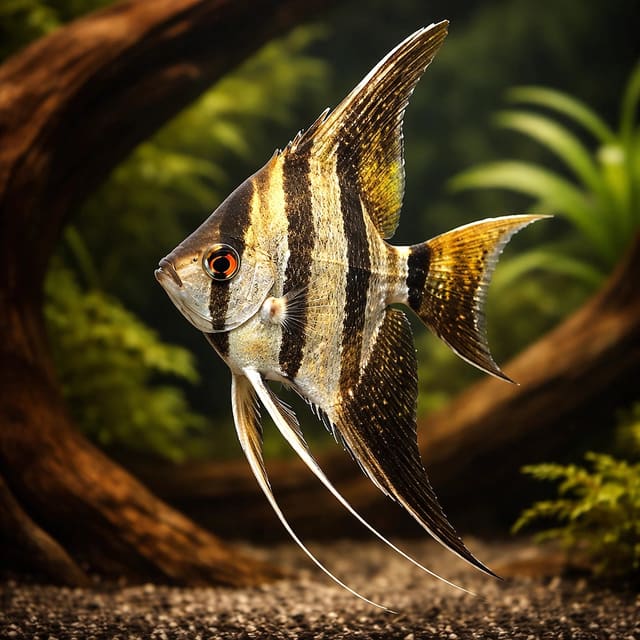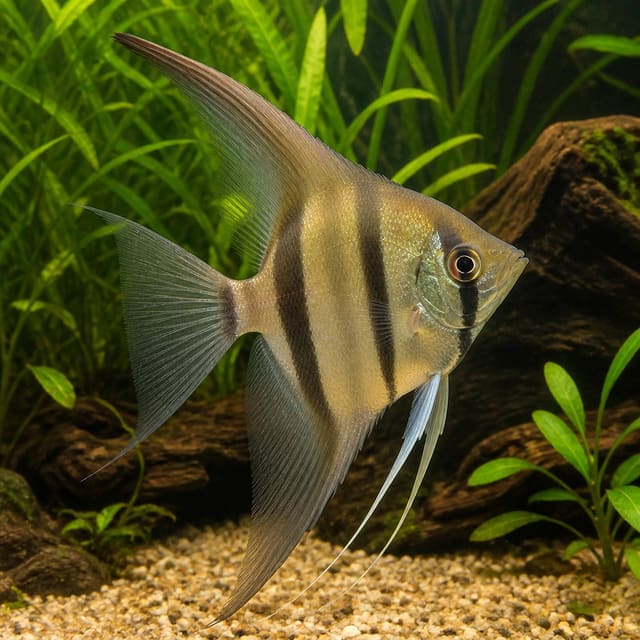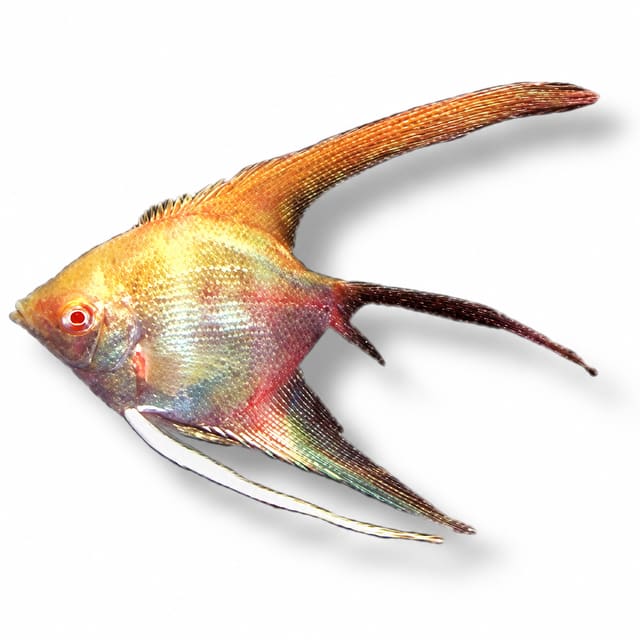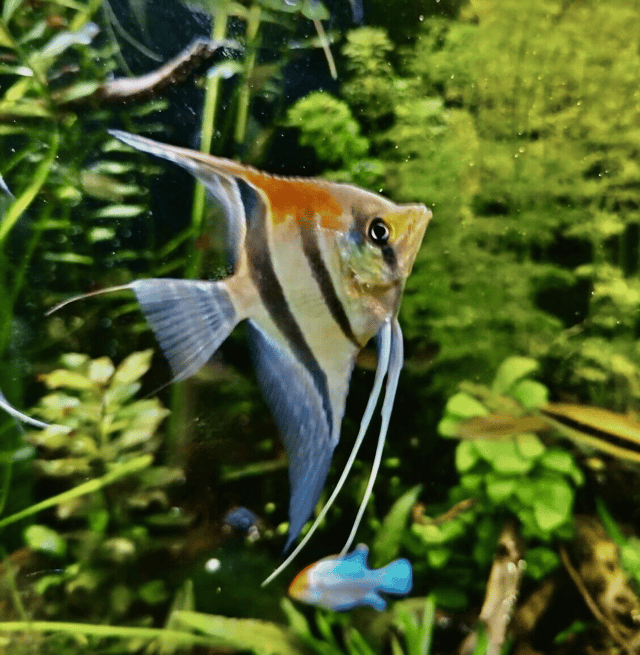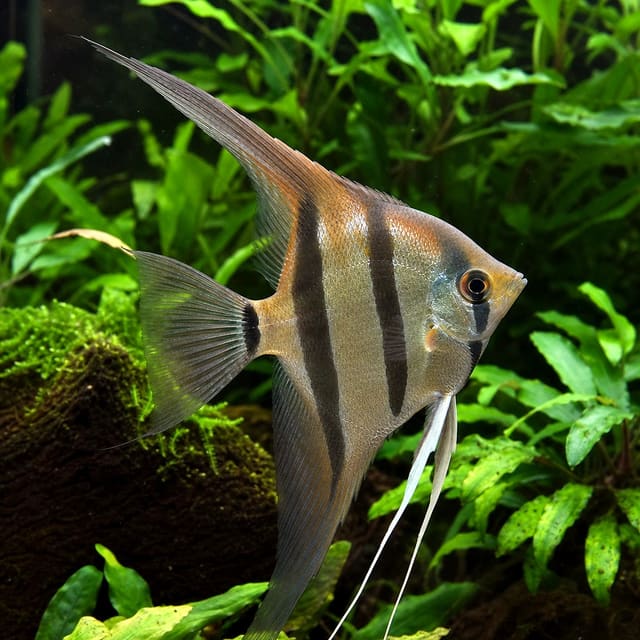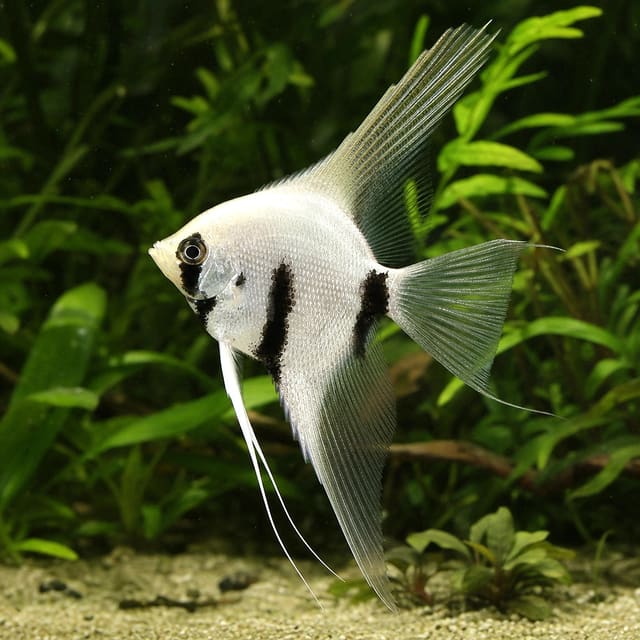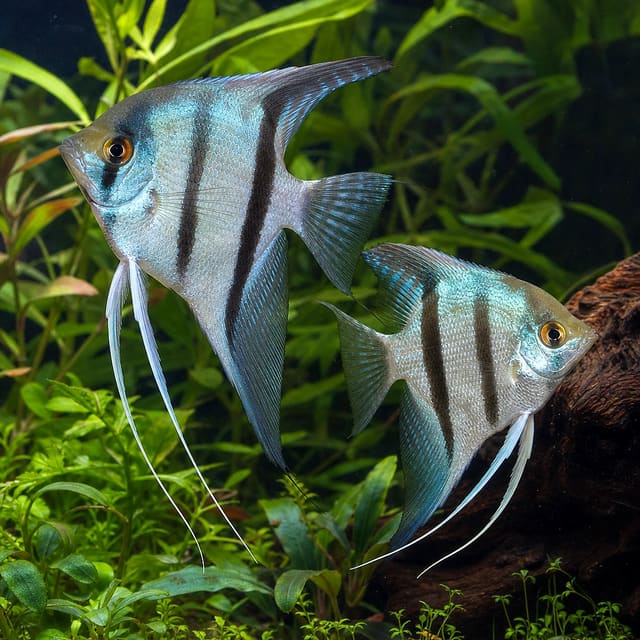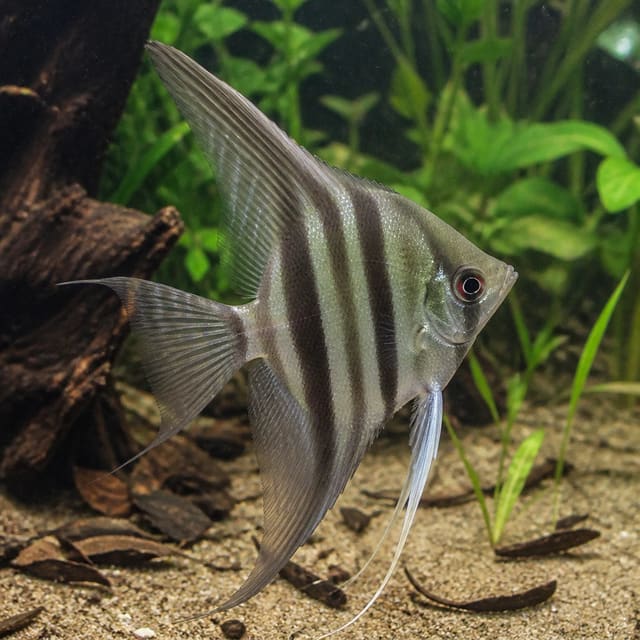
Pterophyllum altum Dantume wild form
28–31°C · pH 4.8–6.2
£10.99

Orinoco F1 Altum Angelfish (Pterophyllum altum) is a freshwater cichlid recorded at up to 18 cm total length. Sold individually in sizes from 3–4 cm to XXL (>7.5 cm). Keep it at 28–32°C in very soft, acidic water with cover, gentle flow and carefully screened companions.
Adult size is the maximum length this species reaches at full maturity (scientific sources). The livestock you receive will be younger and smaller — pick a size above for the actual shipping size. Product-photo provenance and any image-specific limitations are stated on the listing.
Pterophyllum altum
Save when buying multiple fish. Each quantity is one fish; sex and pair formation are not guaranteed unless the selected variant explicitly states them.
Orinoco F1 Altum Angelfish (Pterophyllum altum) is a freshwater cichlid recorded at up to 18 cm total length. Sold individually in sizes from 3–4 cm to XXL (>7.5 cm). Keep it at 28–32°C in very soft, acidic water with cover, gentle flow and carefully screened companions.
Adult size is the maximum length this species reaches at full maturity (scientific sources). The livestock you receive will be younger and smaller — pick a size above for the actual shipping size. Product-photo provenance and any image-specific limitations are stated on the listing.
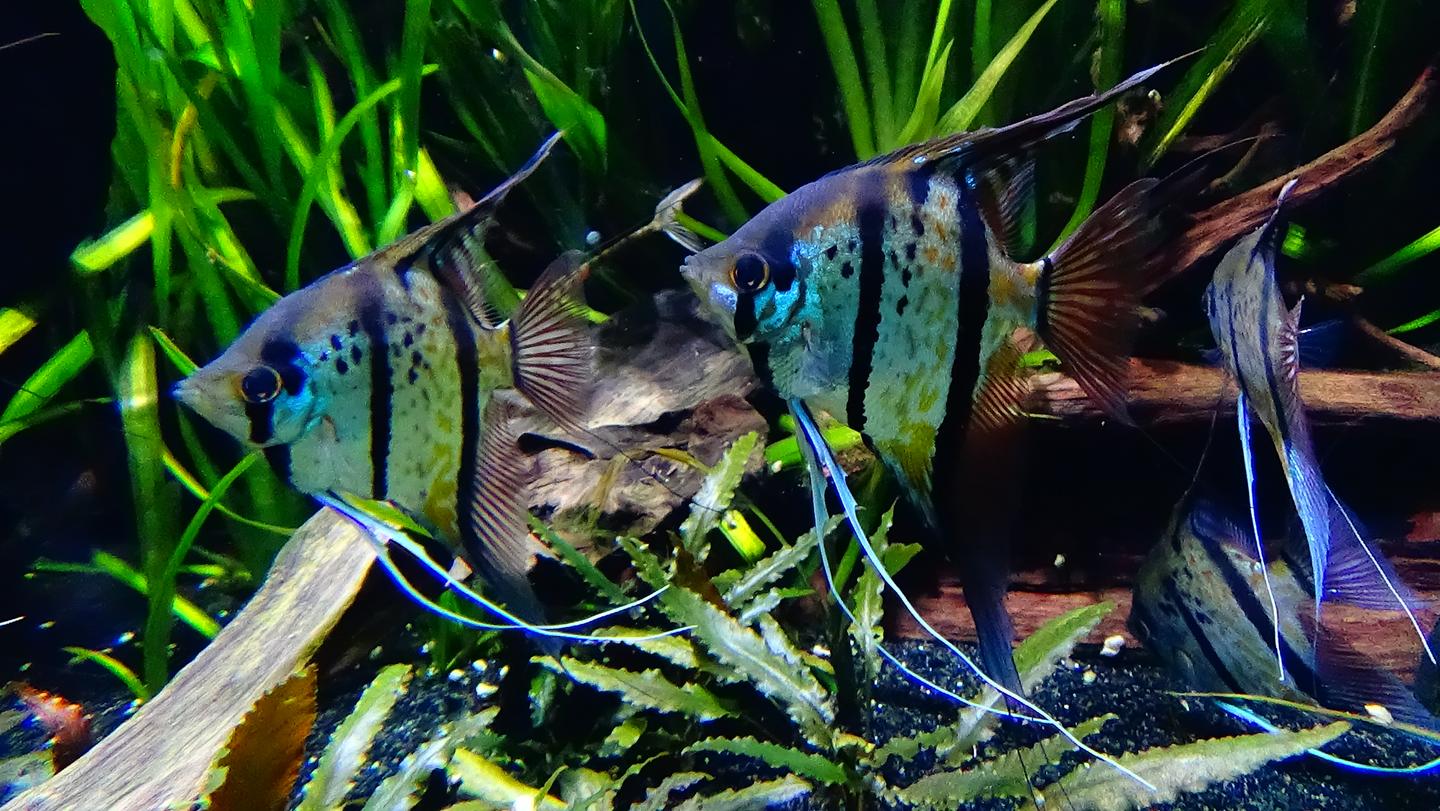
Freshwater angelfish are tall South American cichlids, not small community fish. OATA gives 120 litres as an industry floor for a compatible pair and says the aquarium must be sufficiently tall. We prefer planning around roughly 200 litres, a 100 × 40 cm footprint and about 50 cm height for an adult pair, with more space and an exit plan for a group.
Maintain these water conditions for optimal health and vibrant colors
Orinoco F1 Altum Angelfish is Pterophyllum altum, a freshwater cichlid from South America. FishBase records the species in the family Cichlidae and places it in the Amazon basin’s upper Negro drainage and the Orinoco basin, including the Inírida and Atabapo rivers. It is a distinct species from the familiar domestic angelfish, Pterophyllum scalare, so its care should be planned around Altum requirements rather than a general domestic-angelfish routine.
The decisive planning figure is a recorded maximum of 18 cm total length. This is a maximum reference for body length from FishBase, not a promise that every individual will attain precisely 18 cm. Its extended angelfish shape also makes aquarium height important, even though no fixed height measurement should be treated as a universal minimum. Choose a tank with generous vertical swimming room and judge its usable space after allowing for substrate, wood, plants and the normal air gap at the top.
| Suits | Not suited to |
|---|---|
| Experienced keepers prepared for demanding water and feeding decisions | Beginners seeking an undemanding cichlid |
| Aquariums maintained at 28–32°C, pH 4.8–6.2 and 0–5 dGH | Systems that cannot hold very soft, acidic water |
| Tall, well-covered aquariums with gentle-flowing areas | Shallow layouts or strong flow across the whole swimming area |
| Carefully screened communities of peaceful larger fish | Communities containing prey-sized or aggressive fish |
Seriously Fish recommends 28–32°C, pH 4.8–6.2 and 0–5 dGH for aquarium care. It describes very soft water as mandatory and warns that the fish usually fares poorly in less acidic conditions. Those narrow requirements, combined with potential feeding difficulty and sensitivity to deteriorating water quality, make this an advanced store suitability assessment rather than a beginner choice.
Build the aquarium for steady long-term conditions before choosing the fish. Warmth alone is not enough: pH, hardness, biological filtration, feeding access, shelter and compatible social stocking must work together. A large aquarium filled with unsuitable water is no better than a smaller aquarium with inadequate swimming room, so assess the complete system rather than relying on one headline measurement.
One purchase quantity supplies one Orinoco F1 Altum Angelfish in the selected option. The live size selector is the place to check the choices presented for ordering. The size choices are 3–4 cm, 4–5 cm, 5–5.5 cm, XL (6–7 cm) and XXL (>7.5 cm). The size you select is the size supplied, not the adult size.
Use the dispatch grade to plan immediate feeding access and the safest introduction, but use the 18 cm maximum recorded length to plan the permanent aquarium. A smaller grade does not indicate sex, adult size, life stage or final temperament. It also does not justify a temporary long-term setup that lacks the water volume, height or biological capacity required as the fish develops.
OATA’s American-cichlid guidance recommends an aquarium of at least 300 litres for species over 15 cm and says angelfish need a sufficiently tall aquarium when fully grown. This is OATA’s group guidance rather than an Altum minimum. Treat 300 litres as an initial planning floor, then increase space where a group, existing community, large pieces of wood or limited vertical room would reduce usable territory.
Sex is guaranteed only when the selected option explicitly states male or female. This Orinoco F1 Altum Angelfish listing has no sex-guaranteed option.
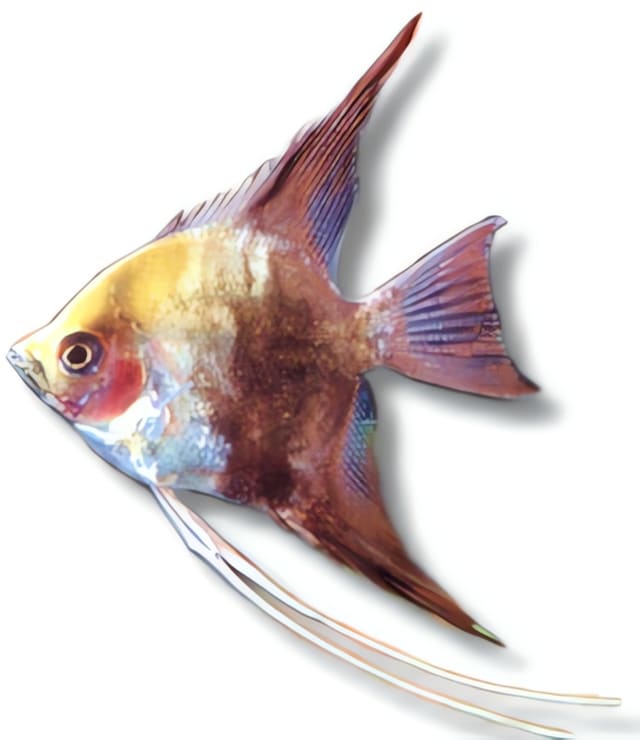
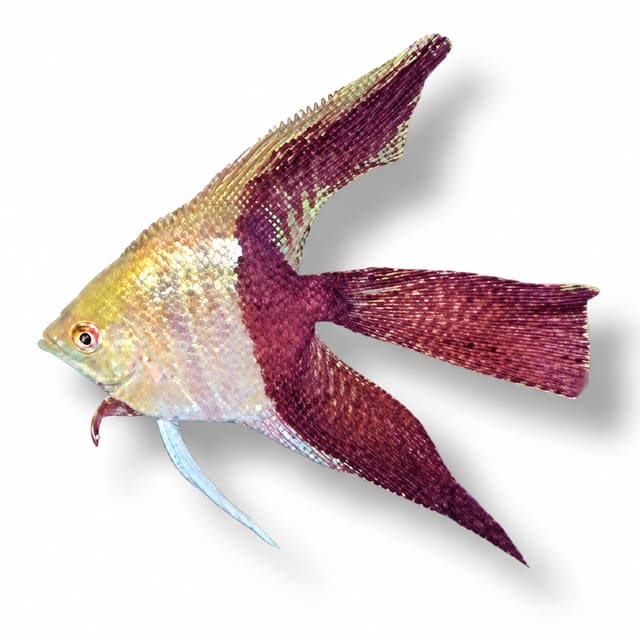
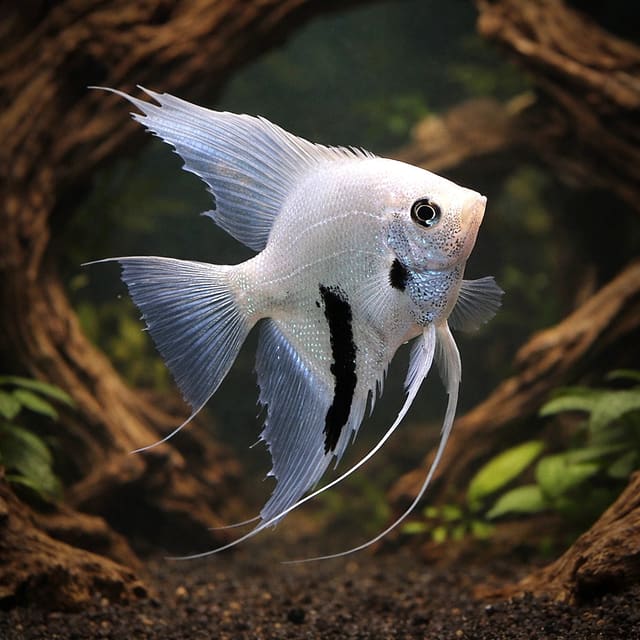
The gallery images are representative, based on reference photographs of this species, so colours can look slightly different from the live animal.
Browse the current angelfish collection when comparing identities and care demands. Before arranging receipt, read our delivery and Live Arrival Guarantee policy for the current dispatch, receiving and claim terms.
Use a tall, well-covered aquarium with a layout that combines shelter and uninterrupted swimming room. Dense planting, floating plants and broad-leaved plants help dim the light. Pieces of wood arranged like roots or overhanging branches add overhead structure without filling every part of the tank. Keep some open water between these features so the fish can move through the aquarium without being funnelled into one narrow route.
Very slow-flowing rivers are part of the husbandry direction given for this fish. That does not mean abandoning filtration or surface movement. Separate the two jobs: use an effective filter to process waste, then direct or diffuse its return so the Altum is not forced to swim against a strong current everywhere. Wood, plants and careful outlet positioning can break up flow while leaving the filter operating normally.
| If the layout causes this | Change this |
|---|---|
| The fish must face the outlet continuously | Redirect or diffuse the return and add a sheltered lane |
| Food races past before it is taken | Feed in a calm zone and reassess outlet direction |
| Floating plants cover the whole surface | Open an access area for observation and maintenance |
| Wood leaves little turning room | Remove or reposition a piece rather than accepting cramped movement |
| Waste settles behind décor | Create cleaning access without stripping away all cover |
Subdued does not mean invisible. Arrange the aquarium so you can still see breathing, body condition, fins and feeding response every day. Shelter should give the fish choices while preserving the keeper’s ability to notice a change early.
Maintain 28–32°C, pH 4.8–6.2 and 0–5 dGH for routine aquarium care. Very soft, acidic water is a core requirement rather than an optional attempt to reproduce a decorative blackwater appearance. FishBase’s natural-environment figures are 27–31°C, pH 4.8–6.2 and 1–5 dH, while the aquarium husbandry range used here is the 28–32°C, pH 4.8–6.2 and 0–5 dGH recommendation from Seriously Fish.
Measure the aquarium rather than judging softness or acidity by appearance. Clear water can be acidic or alkaline, and dark water can still sit outside the required range. Our water chemistry guide explains what the principal measurements mean, while the water matcher helps compare measured values with the target range.
| Reading | Practical response |
|---|---|
| Below 28°C | Correct the heating plan and confirm stable operation before introduction |
| Above 32°C | Identify the heat source and restore the aquarium to the stated range |
| Above pH 6.2 | Do not treat the aquarium as suitable until the preparation method is reliably corrected |
| Above 5 dGH | Revise the water source or preparation plan before choosing the fish |
| Values moving between tests | Find the cause rather than repeatedly chasing each reading |
A stable reading matters because livestock, food, replacement water, décor and biological processes can alter conditions over time. Stability must still occur inside the stated range; a consistently unsuitable pH or hardness is not made appropriate merely by remaining unchanged. Prepare the system to hold the target without abrupt intervention.
A working biological filter is essential. The RSPCA explains that fish release toxic ammonia, which established filter bacteria convert first to toxic nitrite and then to safer nitrate. A filter must therefore be set up and maintained before the Altum is introduced; running equipment for a short time is not the same as demonstrating that the biological system can process fish waste.
Keep ammonia at zero mg per litre and nitrite at zero mg per litre. OATA’s American-cichlid maintenance values also say nitrate should not exceed 20 mg per litre above the normal level in the tap water. Test at least weekly and whenever feeding, breathing, colour, swimming or hiding changes unexpectedly. A reading is more useful when compared with the tank’s normal pattern, so write down the result rather than relying on memory.
Do not combine every cleaning task into one disruptive session. Replacing or over-cleaning biological media while making a large change to décor and stocking can remove stability from several directions at once. Preserve established filter bacteria, keep the normal sheltered layout and make measured adjustments when a test identifies a problem.
| Result | Immediate decision |
|---|---|
| Ammonia above zero | Stop adding fish, test again and act to restore safe water |
| Nitrite above zero | Treat the result as urgent and reduce further pressure on the filter |
| Nitrate rising faster than normal | Review feeding, waste removal, stocking and water-change consistency |
| Filter flow reduced | Check for a blockage while preserving the biological media |
| Food remains after feeding | Remove it and reduce the next portion |
Warm aquariums still need disciplined waste control. The aim is not forceful current through the swimming area, but dependable biological filtration paired with gentle water movement where the fish lives.
Complete the aquarium before the fish arrives. The filter should be mature, the layout secure and the water already holding 28–32°C, pH 4.8–6.2 and 0–5 dGH. Ammonia and nitrite must both read zero. If this is your first setup, follow the steps in our first tropical aquarium guide before planning livestock.
Avoid using the arrival day to change substrate, replace filter media, rearrange every piece of wood or correct a major chemistry mismatch. Each of those jobs can alter the environment at the point when the Altum needs calm, predictable conditions. Finish structural work first and demonstrate through repeated measurements that the aquarium remains within range.
| Checkpoint | Pass condition |
|---|---|
| Water | 28–32°C, pH 4.8–6.2, 0–5 dGH, zero ammonia and zero nitrite |
| Equipment | Heater and filter operating consistently, with a calm swimming zone |
| Community | No resident small enough to be prey and no unsuitable aggressive competitor |
Increase aquarium stocking slowly. Adding several fish and increasing food together raises the load on beneficial filter bacteria. OATA warns that stocking too quickly can lead to new tank syndrome because the bacterial population cannot process the extra waste. For this fish, that risk is particularly important because the husbandry account describes Altums as weak against nitrate build-up and prone to stress-related illness.
A quiet first week is not a period without observation. Watch from enough distance to see normal movement, then check the fish closely during feeding. The useful signs are whether it remains upright, uses more than one sheltered area, breathes consistently and begins taking food. If any of those change, move first to water testing and a review of flow, tank mates and feeding access.
Start with a quality dried food that is an appropriate size for the fish, but be prepared to use live foods regularly if the Altum does not establish a feeding response. Seriously Fish reports that wild Altums can be difficult to feed and may refuse food even when live items are offered, while tank-bred fish may accept dried food, including flake. The F1 wording should not be used as permission to assume that a particular individual will accept every food immediately.
When a fish feeds on live food but ignores frozen food, mix the two at feeding time and gradually use the frozen component as the next step. Watch the fish take the food rather than assuming that disappearing food has been eaten by the intended animal. In a community, faster residents may intercept the entire portion while the Altum remains sheltered.
Feed once a day and offer only what the fish can eat within a few minutes. This schedule comes from OATA’s American-cichlid guidance and controls waste while appetite is being assessed. A smaller dispatch-grade fish may need food presented where it can reach it, but dispatch size does not justify leaving excess food in the aquarium.
| What you observe | What to do next |
|---|---|
| Dried food is taken promptly | Continue small measured portions and monitor body condition |
| Live food is taken but frozen is ignored | Mix live and frozen food at the same feeding |
| Other fish take everything | Feed in a sheltered calm zone and reassess competition |
| Food remains after a few minutes | Remove it and reduce the following portion |
| Interest in food declines | Test water and review temperature, flow, disturbance and tank mates |
OATA describes American cichlids generally as omnivorous fish that often prefer meaty foods. Its examples for smaller cichlids include daphnia, brine shrimp and bloodworm, with specialised cichlid pellets and granules as dried options. Apply those examples to portion and variety while giving priority to the Altum-specific transition from live food to frozen or dried food.
Do not use heavy feeding as the only response to a shy fish. More food cannot correct unsuitable pH, excessive hardness, strong flow or intimidation, and uneaten material adds waste. Establish access first, offer a measured portion, observe the response and keep a simple note of what was accepted.
Decide the social plan and the permanent aquarium together. OATA’s angelfish advice says angelfish should be kept in groups or at least a pair and that individuals kept alone may become stressed. It also suggests allowing 40 litres per adult fish for shoaling angelfish. For Pterophyllum altum, combine that arithmetic with the larger-fish planning floor of at least 300 litres, the need for a tall aquarium and the species’ narrow water requirements.
The 40-litre allowance is not a stand-alone tank recommendation. For example, two adults would produce 80 litres by simple multiplication, but the over-15 cm group benchmark points to at least 300 litres. A six-fish calculation produces 240 litres, which again remains below that 300-litre starting point. In both cases, the larger benchmark governs before décor, established residents, territories and usable height are considered.
One purchase supplies one animal, so the quantity chosen must be considered against the intended social arrangement. Adding companions later also increases the biological load later. Make sure the filter can adapt and add livestock gradually rather than completing a large social group in one unmeasured step.
Pairing can alter how cichlids use space. Avoid promising that a chosen set of young fish will form a harmonious pair or stable group. Observe access to shelter and food, and ensure no individual is consistently displaced into the strongest flow or confined to one corner. The more fish and hardscape the aquarium contains, the less useful its headline volume becomes as a complete description of space.
Do not infer sex from dispatch size, colour, body outline or a photograph. Altums are difficult to sex, and the profile notes that a male’s nuchal hump may appear only around breeding time. That observation is not a practical guarantee for selecting or pairing the animal offered here.
Learn the normal pattern for the individual after it settles: where it rests, how quickly it approaches food, how fast the gill covers move and how it responds to other fish. A change is more useful than a generic picture of health because individual fish vary. Daily observation lets you connect a new behaviour with a recent feeding, maintenance, temperature, stocking or flow change.
| Change noticed | First action |
|---|---|
| Hanging at the surface or sitting on the bottom | Test water and check filter and heater operation |
| Erratic swimming | Test water and inspect the aquarium for flow or social pressure |
| Faster or slower breathing | Measure water values promptly and review recent changes |
| Darker or paler colour | Check water, shelter, disturbance and interactions |
| More hiding or aggression | Review usable space and the social plan |
| Reduced food intake | Test water, confirm temperature and observe feeding competition |
| White spots, fluffy growths or damaged scales | Separate observation from guesswork and seek health guidance |
Begin with measured water values because ammonia and nitrite are toxic, nitrate can build as waste is processed and temperature strongly affects this fish’s care. Confirm 28–32°C, pH 4.8–6.2, 0–5 dGH, zero ammonia and zero nitrite. Compare nitrate with its usual level and the OATA guidance that it should remain no more than 20 mg per litre above normal tap-water nitrate.
Next, check whether the filter is blocked, whether an outlet has shifted, whether food has accumulated and whether another fish controls the sheltered feeding area. Correct the identified cause without stripping the aquarium of all cover or washing biological media under the tap.
If a health change persists, contact us for guidance after noting the symptoms, test results, temperature, recent maintenance and feeding response. Those details allow a more useful assessment than a symptom name alone. Avoid applying a breeding or disease-treatment recipe simply because it mentions Altums; diagnosis and treatment must fit the actual condition.
Continue observing after any change. A corrected test result is important, but recovery also needs to appear in breathing, posture, movement and appetite. Keeping a short dated log makes it easier to see whether the fish is improving or merely changing from one abnormal behaviour to another.
Screen companions against the Altum’s adult mouth size, not the dispatch grade selected today. Seriously Fish warns that anything fitting into an Altum’s mouth can be treated as prey. It specifically includes Neon Tetras, Guppies and Pygmy Rasboras among the examples. Avoid those fish and other similarly small residents rather than assuming that peaceful behaviour prevents predation.
The important comparison is the size and shape of the companion when the Altum grows, together with whether the smaller fish can enter its mouth. A resident that looks proportionate beside a 3–4 cm or 4–5 cm dispatch fish may become vulnerable as the cichlid develops. Do not use an uneventful first week as proof that a long-term combination is safe.
| Proposed companion | Decision |
|---|---|
| Neon Tetra | Avoid because it is named as a prey-size example |
| Guppy | Avoid because it is named as a prey-size example |
| Pygmy Rasbora | Avoid because it is named as a prey-size example |
| Another very small fish | Avoid when its body can fit into the Altum’s mouth |
| A larger peaceful fish | Continue to the water, temperament, space and feeding screens |
Being too large to swallow only passes the first test. It does not settle whether the companion tolerates 28–32°C, pH 4.8–6.2 and 0–5 dGH, whether it competes aggressively at feeding time or whether the aquarium gives every fish enough usable room. Compatibility remains conditional until all of those requirements align.
Do not add small fish as a feeding response for an Altum that is reluctant to eat. Use the live-to-frozen transition described in the feeding plan, observe direct food intake and protect water quality. A compatibility decision should not be turned into an improvised feeding method.
After excluding prey-sized fish, select peaceful, larger companions that can live within the Altum’s warm, very soft and acidic water. Seriously Fish says Altums can live with other peaceful larger fish and specifically notes Discus as a possible match because of similar water requirements. That is a conditional starting point, not a universal guarantee for every Discus, Altum or aquarium.
OATA says calmer American cichlids such as angelfish may be mixed in a robust community with larger shoaling species, while aggressive American cichlids may need to live alone or with equally aggressive cichlids. For this Altum, prioritise peaceful behaviour. Do not combine it with an aggressive fish merely because both belong to the same family or originate from South America.
| Screen | Pass condition |
|---|---|
| Predation | The companion is not small enough to fit into the adult Altum’s mouth |
| Water | Its normal care overlaps 28–32°C, pH 4.8–6.2 and 0–5 dGH |
| Temperament | It is peaceful and does not force the Altum away from shelter |
| Feeding | Both fish can take suitable food without one monopolising each meal |
Space is the fifth practical check. At least 300 litres is the OATA larger-cichlid planning floor, but an existing community, a pair or group of Altums and substantial décor may require more. Look at where fish can actually turn, rest and feed. If all residents depend on the same shaded corner or calm-water lane, the nominal volume is not solving the conflict.
Observe the community at feeding time and during quiet periods. A combination may appear calm when food is absent yet fail because a faster fish takes every meal. It may also look peaceful in open water while one individual is repeatedly excluded from cover. Respond to repeated displacement, appetite loss, unusual hiding or aggression by reassessing the combination rather than simply adding more food or décor.
For a stocking and compatibility assessment, contact us with the aquarium dimensions, measured water values, filter status, current residents and planned number of Altums. Honest uncertainty remains where the exact species, size, temperament or aquarium arrangement has not been assessed together. The reliable rule is to reject prey-sized and aggressive candidates, then require complete overlap in water, space and feeding access.
It is Pterophyllum altum, a freshwater South American cichlid recorded at up to 18 cm total length. It requires advanced planning for warm, very soft, acidic water, gentle flow and a tall aquarium.
One purchase quantity supplies one fish in the size chosen through the live selector. Plan the quantity against the intended pair or group and the permanent aquarium’s capacity.
The selector contains 3–4 cm, 4–5 cm, 5–5.5 cm, XL (6–7 cm) and XXL (>7.5 cm) dispatch grades. Plan permanent space around the recorded maximum of 18 cm total length.
Use a tall, mature, well-covered aquarium with plants, floating cover, root-like wood, sand or fine gravel and gentle flow. OATA’s American-cichlid guidance gives at least 300 litres as a starting point for fish over 15 cm.
OATA’s angelfish guidance recommends a group or at least a pair because solitary angelfish may become stressed. Combine that social plan with at least 300 litres, generous height and adequate territory.
Keep it at 28–32°C, pH 4.8–6.2 and 0–5 dGH. Ammonia and nitrite should remain at zero mg per litre, with nitrate no more than 20 mg per litre above normal tap-water nitrate.
Offer a quality dried food in a portion eaten within a few minutes once daily. If it will not feed, offer live foods and mix them with frozen food as the next transition step.
Prepare the mature aquarium first, with 28–32°C water, pH 4.8–6.2, hardness of 0–5 dGH and zero ammonia and nitrite. Keep the established layout calm and monitor feeding, breathing and swimming closely.
Avoid fish small enough to fit into its mouth; named prey-size examples include Neon Tetras, Guppies and Pygmy Rasboras. Larger peaceful fish still need matching water, space, temperament and feeding access.
No reviews for this item yet. Bought one? Honest reviews only, good or bad.
What customers say about ordering from us
I have a small group of long finned mountain minnows. So was delighted to be able to order ten of this variety to increase the genetics in my tank . The ones I recieved are healthy but it’s to early to give a verdict on wether they are of a long finned type since they are small currently.
Gordon Walker · 23 Sept 2026
100% success travel and "installation". Pleased with quality of purchase. The Siamese fighter a bit "shy" so have not yet seen him at his best yet but looking good. Happy customer. GG
George E Garratt · 21 Sept 2026
Reviews of our shop, collected by Judge.me, an independent third-party review collector. Newest first.