 By Tropical Fish Co Editorial Team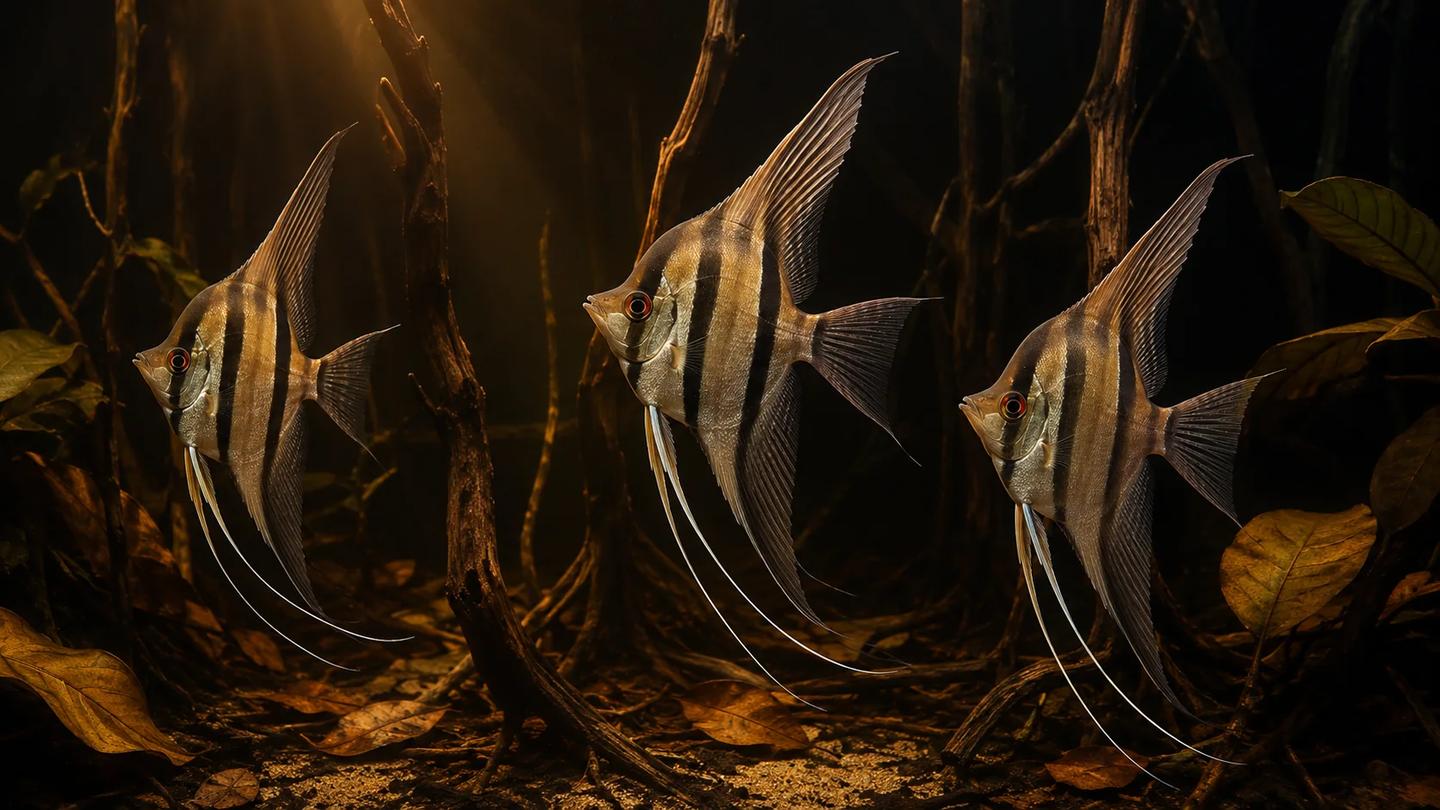
The answer before the romance
An Altum angelfish is Pterophyllum altum, not every tall striped angelfish and not every fish sold with “Altum” somewhere in its trade name. The current Catalog of Fishes recognises P. altum as valid, with its type locality at Atabapo in the Río Orinoco and a current catalogue distribution in the Orinoco basin of Colombia and Venezuela [1]. A specimen-based Smithsonian review recognises it separately from P. scalare [3].
That distinction matters before tank advice. “Peruvian Altum”, “Dantum”, “wild form”, “Orinoco” or a dramatic photograph can be useful seller information, but none alone proves species, generation or capture locality. Molecular work confirms an exact P. altum record exists for genus-level comparison; it does not turn a shop photograph into a genetic identification [5].
If the current evidence says only “angelfish”, begin with the broader freshwater angelfish care guide. If the exact product identifies P. altum, use this page to plan the aquarium, then check the live Angelfish category for the current photographed animal, provenance wording, sale unit, size, price, stock and checkout.
A striking head profile is a screening clue, not a certificate. Ask what evidence supports the scientific name and every locality, wild, F1 or captive-bred statement on the exact current product page. If the seller cannot separate a trade name from a scientific identity, pause the purchase.
True Altum identity: what the evidence can and cannot show
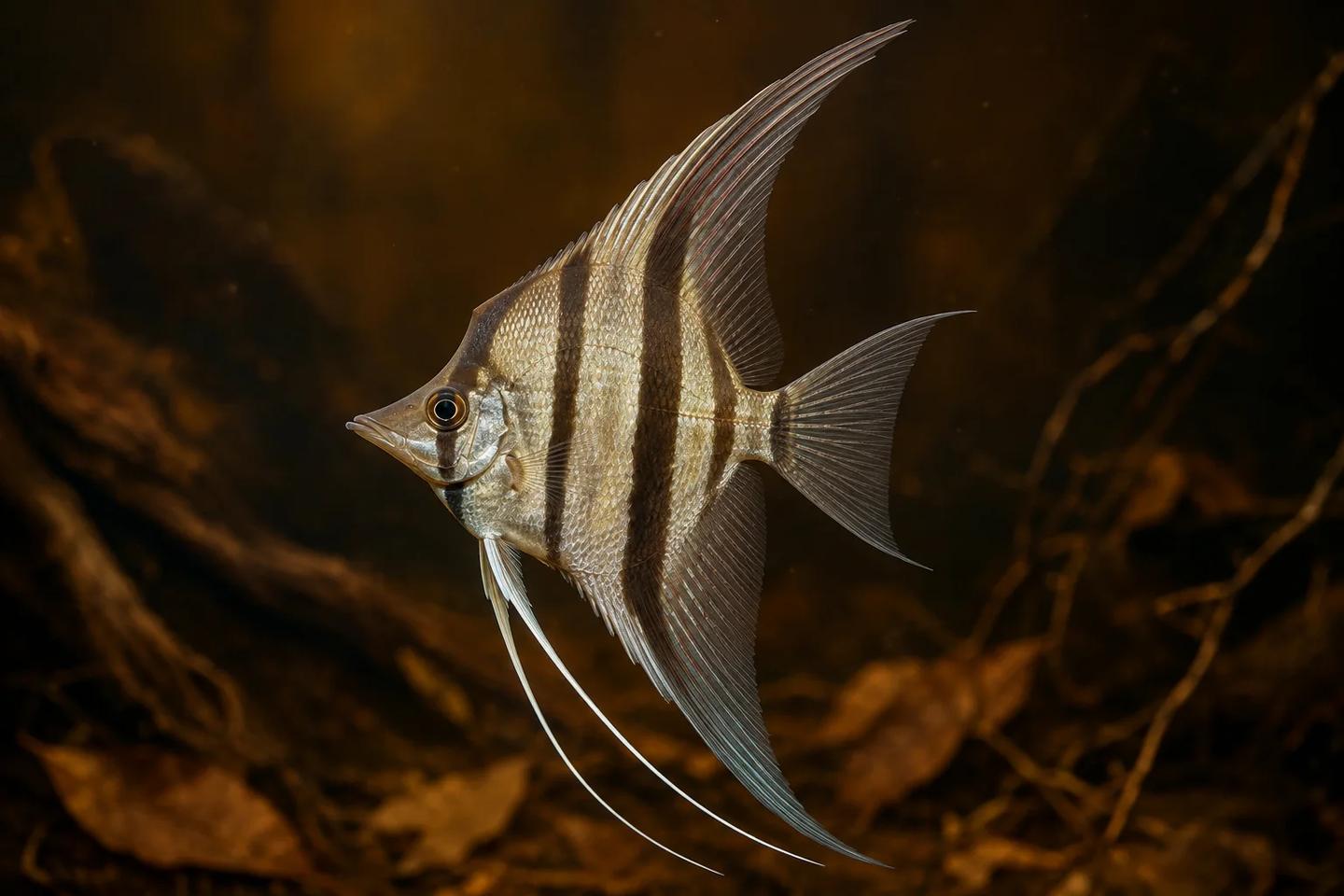
A tall body, long dorsal and anal fins, strong vertical bars and a pronounced forehead contour are useful comparison features. They do not prove the fish's locality, generation, sex, age, health or sale size.
The old page contrasted Altum and common angelfish with confident visual language but did not cite the exact taxonomic work. Schultz examined type and comparative material and recognised three freshwater angelfish species [3]. That makes species separation defensible; it does not create a one-feature home identification key.
Use a three-part check:
- Name: the exact listing states Pterophyllum altum, not only Altum-like, Peru Altum, Dantum or wild form.
- Visible form: the current fish is tall and laterally compressed, with extended dorsal and anal fins, long pelvic filaments, vertical bars and the expected head contour—without treating one angle as proof.
- Traceability: the seller explains locality, wild/F1/captive-bred and source statements separately, or clearly marks what is unknown.
The trade can mix names faster than taxonomy changes. This guide therefore does not silently convert a product title into a biological claim, and it does not freeze any current SKU into evergreen copy.
Orinoco, upper Negro and an honest range disagreement
The authoritative sources do not draw the range identically. The current Catalog of Fishes states Orinoco basin, Colombia and Venezuela [1]. FishBase includes the upper Negro drainage as well as upper-Orinoco tributaries including the Inírida and Atabapo [2]. A modern Amazon-fish synthesis also lists P. altum among species shared by the Negro and Orinoco [4].
We do not erase that disagreement. The practical consequence is simple: a basin word is not enough to verify a shop fish. Retain the seller's exact provenance wording, ask what record supports it, and do not expand “upper Negro” into all of the Amazon or “Orinoco” into every tributary.
Habitat wording needs the same restraint. FishBase identifies P. altum as a freshwater, benthopelagic river fish. Upright roots, branches, subdued light and tannin colour can make a useful aquarium design, but an aquarium scene is not proof of one wild microhabitat. Build around the fish's shape, retreat options and water stability rather than a decorative biotope label.
Size: separate length, height and sale size
FishBase records 18 cm maximum total length for male or unsexed P. altum and says the species may reach about 20 cm in height [2]. Total length includes the tail fin. Height and length are different axes, so one must never be substituted for the other.
The previous page claimed 25–30 cm fin-to-fin without supporting that number. Search results contain still larger figures, but repetition does not validate them. This revision uses the checked record and leaves individual variation explicit.
Sale size is a third measurement. A 5 cm product might mean body length, standard length, total length or an approximate supplier band. Before ordering, ask exactly how the current seller measures the fish. Then plan for the documented adult form, not the juvenile shipping measurement.
Tank size: litres are only the first gate
No source in this review establishes one experimental home-aquarium minimum for P. altum. OATA's UK American-cichlid guide recommends at least 300 litres for species over 15 cm and says angelfish need an aquarium tall enough when fully grown [7]. That is a useful conservative starting gate, not a species-specific approval or a litres-per-fish equation.
Before purchase, write down the aquarium's internal water height after substrate and air gap, length, front-to-back depth, hardscape intrusions, mature filtration capacity and intended adult group. The fish needs to turn, pass one another and extend its fins without repeatedly striking substrate, wood, braces or the surface. A nominally large tank can still fail if tall wood consumes the only open water.
Prioritise:
- clear vertical fin room and open midwater;
- a long, deep footprint that supports retreat and line-of-sight breaks;
- mature filtration sized for the complete adult community;
- secure heating and oxygenation at the selected warm temperature;
- calm cover without a maze of sharp or trapping hardscape;
- a separate mature option if hierarchy, injury or health makes separation necessary.
The RSPCA likewise stresses adequate dimensions, fishless cycling, filtration, thermostatic heat, testing and stability [11]. A tall empty volume is not ready until its biofilter and water plan are proven.
Water for a UK aquarium
FishBase compiles 27–31°C, pH 4.8–6.2 and 1–5 dH for P. altum [2]. OATA's American-cichlid page publishes broader group parameters, while explicitly warning readers to check species-specific requirements [7]. For this species, do not replace the exact record with the broader table.
These numbers are screening bounds, not instructions to chase a decimal or push a newly arrived fish quickly to an extreme. Ask for the current holding temperature, pH and hardness; measure the established aquarium; choose a stable compatible plan; and avoid sudden changes. Temperature also changes oxygen demand, so warm water requires dependable circulation, gas exchange and observation.
Hard UK tap water and softened water
UK water varies by geology, supply and local blending. The Drinking Water Inspectorate recommends asking the local water company for an accurate hardness value, but the supplier number is still not a substitute for testing the aquarium [10]. Use the water chemistry guide to keep pH, GH and KH separate.
A domestic ion-exchange softener replaces calcium and magnesium with sodium [10]. That is not the same as reverse-osmosis water and does not automatically make hard tap water suitable for P. altum. If source-water modification is necessary, use a controlled measured method and get species-aware advice; never improvise a rapid pH drop in a stocked tank.
OATA recommends routine testing of ammonia, nitrite, nitrate, pH and hardness, with ammonia and nitrite at zero [9]. Record trends and investigate causes rather than treating a single strip colour as the whole diagnosis.
Group size, hierarchy and startle room
The previous page prescribed five or six fish as though an exact P. altum study proved that number. It did not. OATA's broad angelfish guidance favours a group or at least a pair, but its page discusses American cichlids generally and names P. scalare, not a controlled P. altum group-size experiment [7].
The useful decision is not “five or six?” in isolation. Ask how the current fish are housed, whether they are an established pair or a compatible group, how large every fish may become, and where a bullied or injured individual could be separated. Do not buy a singleton casually, but do not build an overcrowded group just to hit an unsupported number.
Use vertical branches and plants to interrupt long sight lines while preserving open movement. Observe feeding access, fin position, colour, hiding, chasing and injuries across the whole group. A fish that is merely alive behind wood is not necessarily coping well.
Feeding: observe the fish, not just the food
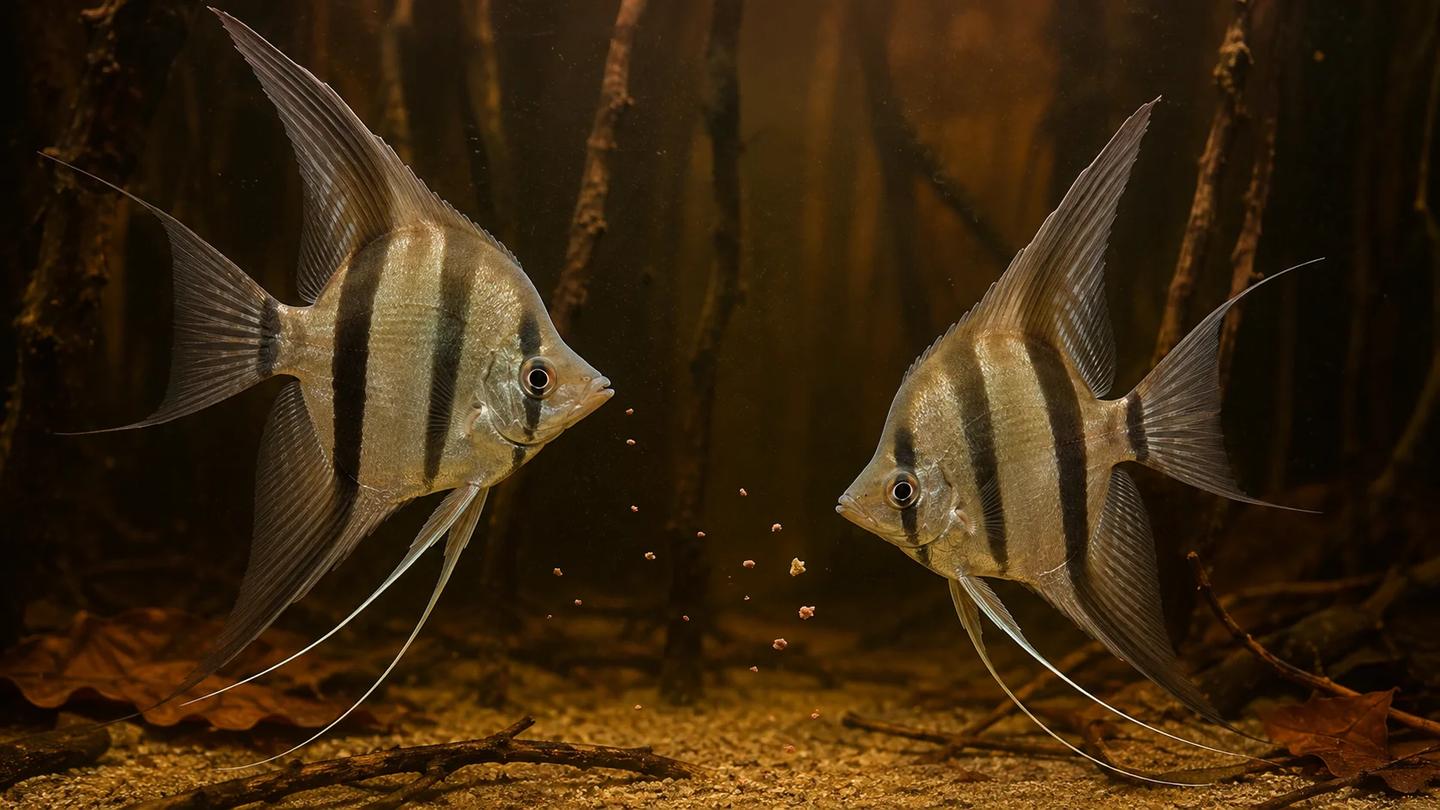
A small amount of food in open water makes access easy to observe. The image does not establish a complete diet, portion or schedule.
OATA advises a suitable prepared food and variety for American cichlids, with care not to overfeed [7]. Exact P. altum larval research has tested first-feeding diets under study conditions, but those larval results do not become an adult home-aquarium menu [6].
Use an appropriate complete cichlid staple in a size and presentation the fish accepts, add suitable variety, distribute food so subordinates can reach it and watch every fish eat. Remove persistent excess. A new fish refusing food needs a review of water, transport, source history, social pressure and health—not an escalating pile of rich foods or an invented medicine recipe.
Tank mates and predation risk
There is no universal “safe tank mate” list. Screen each candidate against:
- the chosen measured temperature, pH, hardness and oxygen plan;
- adult size and whether either fish can swallow the other;
- fin-nipping, territorial and startle behaviour;
- feeding speed and access at every level;
- total adult biomass, filtration and usable space;
- a realistic separation plan.
Very small fish, shrimp, shrimplets, eggs, fry and tiny snails are not proven risk-free. Nor is every Corydoras suitable for the full 27–31°C FishBase screening range. If breeding small fish or shrimp is the aim, a fish-free system is the lower-predation choice.
The angelfish tank-mate guide offers a decision framework, not a compatibility guarantee. The cichlid care guide explains why territory and social context can change as fish mature.
Arrival, quarantine and health changes
OATA's general freshwater guidance centres a mature aquarium, suitable measured water, low-stress transport and close observation after arrival [8]. It does not support one universal 20-, 30- or 45-minute acclimation timer. Compare bag and aquarium conditions and follow a current, context-specific transfer plan.
The MSD Veterinary Manual recommends documenting species, number and size of fish, housing, recent additions, quarantine and previous medication; it prioritises water assessment, examination and diagnostics [12]. For a valuable or uncertain-source fish, a separate mature quarantine system and dedicated equipment reduce avoidable risk.
If breathing, balance, appetite, colour, fins, eyes, skin or behaviour changes, test water promptly and review heat, oxygenation, equipment, maintenance, food, social pressure and recent arrivals. Isolate when appropriate and seek knowledgeable aquatic-retailer or aquatic-veterinary help. This page gives no salt, heat, antibiotic, half-dose or symptom-to-drug recipe.
How to buy Altum angelfish without stale promises
Use the live Angelfish category, then inspect the exact product page. Check:
- the current photograph and whether the visible fish matches the stated species;
- the accepted scientific name, not only a trade label;
- the evidence behind Orinoco, Rio Negro, Peruvian, Dantum, wild, F1 or captive-bred wording;
- the sale unit and measurement convention for sale size;
- current holding temperature, pH and hardness where supplied;
- feeding response and visible condition;
- current price, availability, delivery eligibility and livestock-support terms.
This article contains no fixed SKU, price, stock, source, dispatch-day, heat-pack or live-arrival promise. Those changing facts belong to current commerce. Purchase and revenue are final ecommerce outcomes; add-to-cart and checkout are diagnostic steps. Contact, correction feedback, email and newsletters are not leads or ecommerce conversions.
Editorial method and corrections
The Tropical Fish Co editorial team compared current nomenclatural, scientific, peer-reviewed, UK trade-body, government, welfare and veterinary sources. Species evidence, general cichlid guidance and retailer decisions are labelled separately. Where the Catalog of Fishes and FishBase describe distribution differently, both scopes remain visible.
The three active visuals are distinct original reference-informed editorial assets checked against more than seven independent real exact-subject image references. They are not photographs of current stock. If a claim appears wrong or a source changes, use contact with the exact sentence and supporting evidence. Feedback is a correction route, not a lead or ecommerce conversion.