By Tropical Fish Co Editorial Team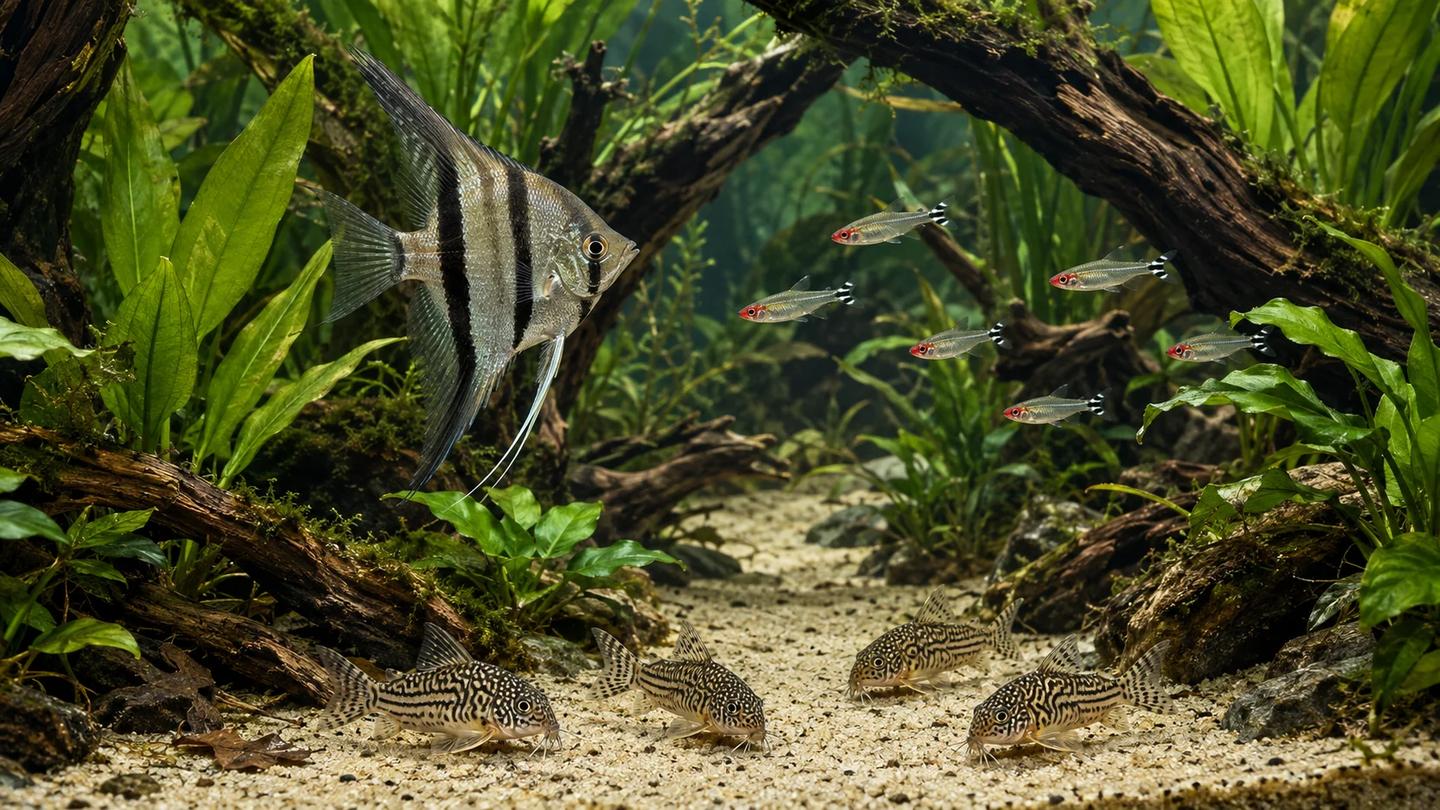
Quick answer: what works with angelfish?
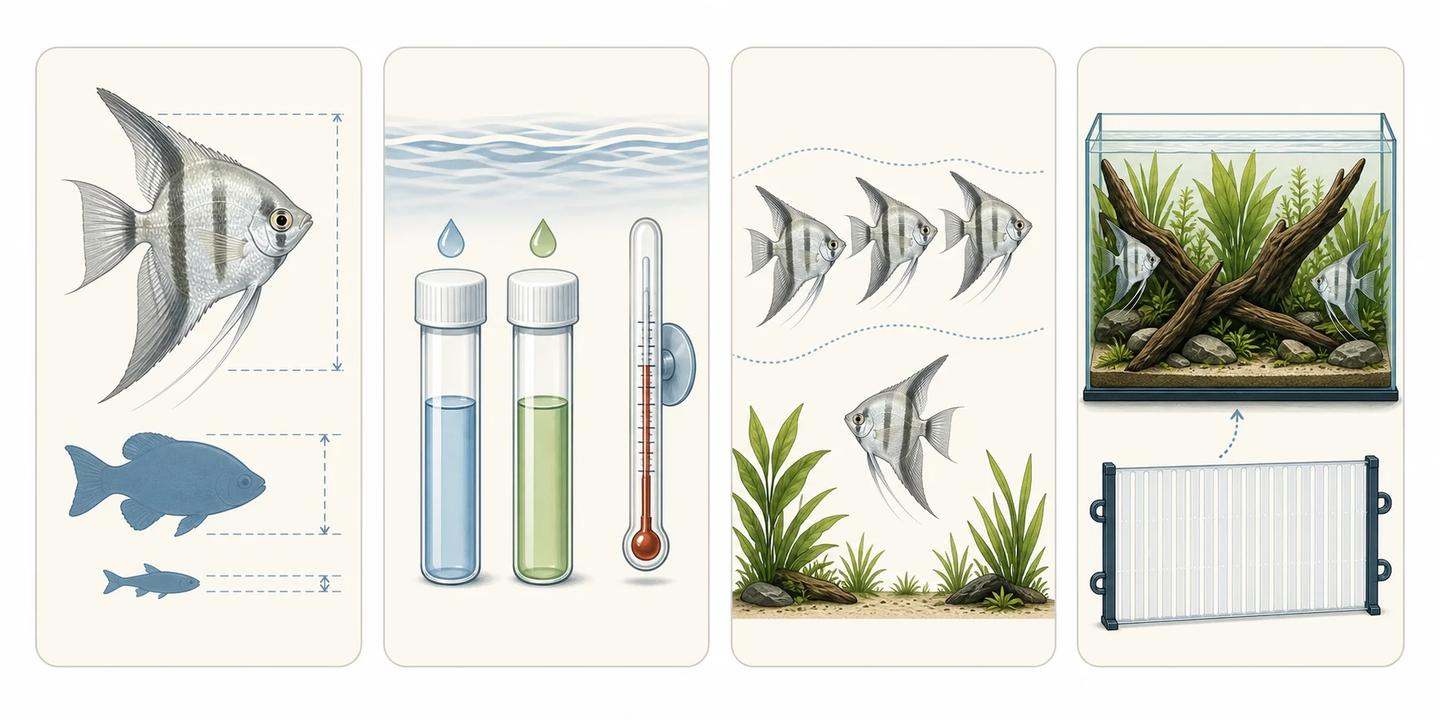
There is no single fish that is safe with every freshwater angelfish. A sensible candidate must pass four checks together: adult size, measured water, behaviour and social needs, and the space available after every animal reaches adult size. You also need a way to separate fish immediately if the relationship changes.
That is why this guide does not repeat the familiar “ten best tank mates” formula. Freshwater angelfish are social cichlids whose rank, feeding and reproductive behaviour can change with context [3][4]. A combination that appears settled with juveniles can become unsuitable as fish mature or an angelfish pair claims an area.
If you are still planning the angelfish itself, read the freshwater angelfish care guide first. Current animals, sale size, price and availability belong on the live Angelfish shop, not in a static compatibility article.
“Corydoras”, “pleco”, “tetra” and “gourami” each cover animals with different adult sizes, water needs and behaviour. Check the exact species and current individual fish. A green row in somebody else's chart cannot replace that work.
The four checks to run before buying
1. Compare the adult fish, not today's juvenile
Record the proposed companion's reliable adult size, body depth, fin shape and feeding style. Then compare those with an adult angelfish—not the small fish photographed in a shop tank. FishBase compiles morphology and aquarium ranges for Pterophyllum scalare, but it does not prove that one companion species is safe [1].
There is no truthful universal “5 cm rule”. Length alone ignores body depth, mouth shape, speed, fins and individual behaviour. Treat a clearly mouth-sized animal as a predation risk, but do not turn “larger” into “guaranteed safe”. Never buy a small fish, shrimp or fry as an experiment.
2. Match measured water, not labels
Compare the candidate's species-specific temperature, pH, general hardness and oxygen needs with:
- the water in which the seller is actually holding the fish;
- your aquarium's stable measured values; and
- the range you can maintain without abrupt correction.
UK tap water varies by supply zone. The Drinking Water Inspectorate explains that hardness is caused by dissolved calcium and magnesium, and recommends asking the water company for an accurate local figure because maps hide local variation [13]. “UK tap water” is therefore not one water type. A domestic ion-exchange softener also changes ions; do not assume its output is aquarium-ready because it feels soft.
3. Plan social behaviour and feeding access
Angelfish behaviour is not fixed. Controlled work found that social rank affected movement and feeding in P. scalare, while the wider welfare review describes social, reproductive, feeding and enrichment effects [4][3]. The practical question is not merely “are these species peaceful?” but “can every individual eat, rest, move and avoid repeated pursuit in this aquarium?”
Give every shoaling companion its own species-appropriate group. Do not split capacity across several undersized groups just to add more colours. Do not assume a bottom-dweller is invisible to an angelfish, or that armour prevents chronic stress. Some barbs can nip fins; OATA advises against mixing those fish with slow, timid or long-finned companions [6].
4. Budget usable space and prepare an exit
OATA recommends at least 120 litres for a pair of smaller American cichlids and says a fully grown angelfish needs sufficient height [2]. That is a broad UK industry floor, not proof that every 120-litre tank can support an angelfish community.
Our more cautious starting plan for an adult compatible pair is roughly 200 litres, about a 100 × 40 cm footprint and around 50 cm of usable height—before adding another species' full adult group and waste load. This is a disclosed store policy, not a scientific minimum. Footprint, height, filtration, oxygen, decor and sightlines can make two aquariums with the same litres function very differently.
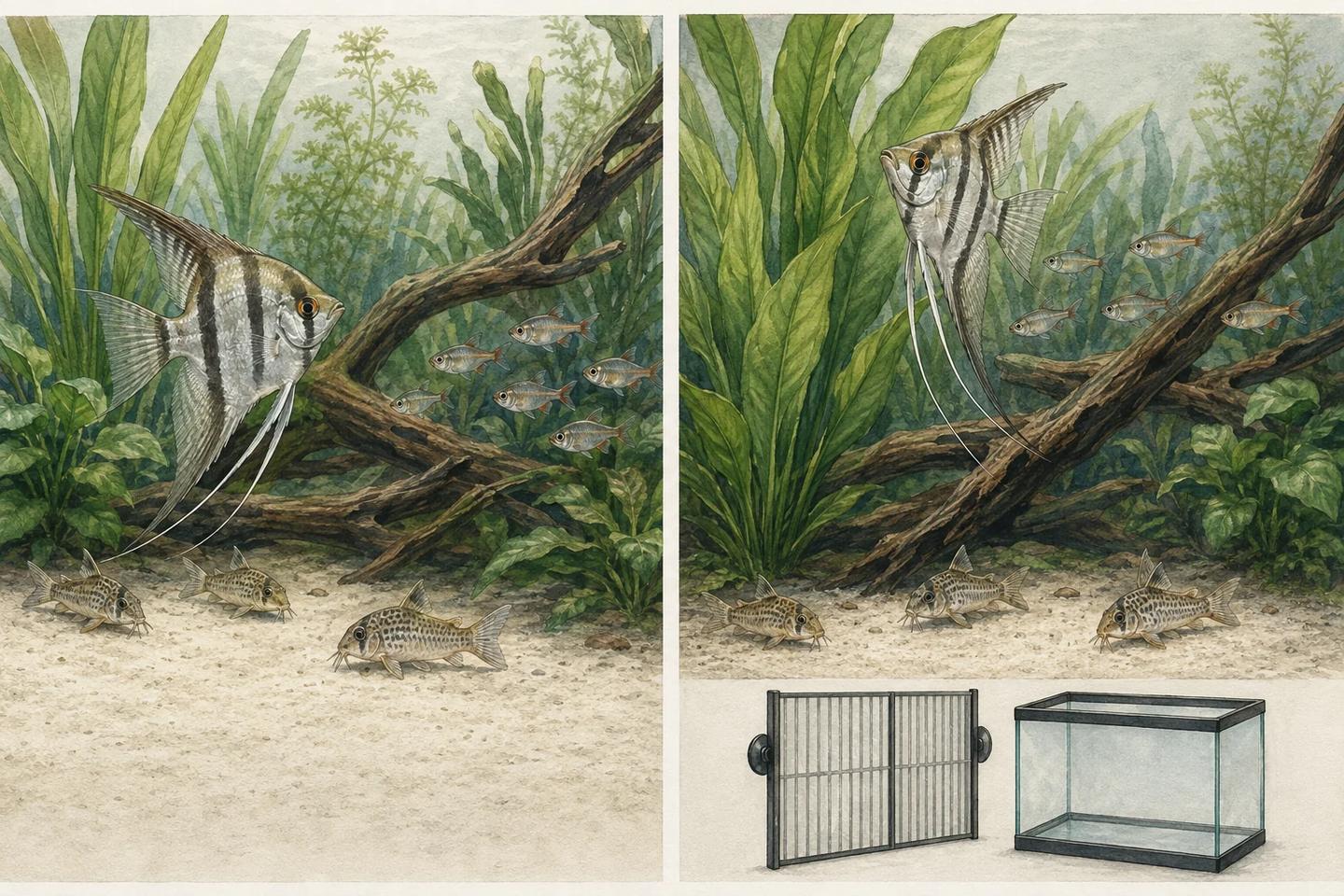
Have a fitted divider or mature separate aquarium ready. A spare empty glass box without mature filtration is not an instant rescue system.
Common candidates: investigate, do not assume
The table is a screening tool. “Possible candidate” means the animal may be worth researching for a sufficiently large, mature aquarium. It does not mean safe, recommended for every keeper or currently stocked.
| Candidate | Why people consider it | What must be checked before a yes | Reasons to decline or stop |
|---|---|---|---|
| An exact Corydoras species | Different body shape and much of its activity near the substrate | Species-level temperature and water; adult group size; soft substrate; feeding access; full footprint | Aquarium too warm for that species; undersized group; poor substrate; repeated displacement or missed food |
| Bristlenose catfish (Ancistrus trade forms) | Robust adult body and use of wood, cover and lower surfaces | Exact identity where possible; adult size; oxygen, diet, wood/caves, waste load and territorial space | Bought as a “cleaner”; cramped caves; food competition; unsuitable flow or water; aggression around shelter |
| Medium-bodied shoaling characins | A cohesive group can use open midwater | Exact adult body size; full group; fin behaviour; water and feeding overlap; enough open length | Mouth-sized adults; nipping; frantic competition; too little room for both shoal and angelfish territory |
| Gouramis | Similar warm-water community appeal | Exact species, sex plan, surface access, long fins, territorial behaviour and complete adult space | Overlapping display territory, pursuit, fin damage, timid feeding or unsuitable water |
| Mollies and other livebearers | Commonly available and visibly robust | Measured hardness and pH at source and home; sex and population plan; adult group and waste load | Water mismatch, uncontrolled reproduction, crowding or persistent competition |
| Other cichlids | Similar visual centrepiece | Exact species, adult territory, water, pair status and a specialist separation plan | Overlapping territories, breeding aggression, different water or too little footprint |
| Shrimp or snails | Often marketed as “clean-up crew” | Species identity, complete diet, mineral/water needs, adult size and predation risk | Bought as tools, obvious predation risk, antenna harassment, missing animals or unsuitable water |
| Small tetras, fry or very small invertebrates | Colour and movement | There is no responsible live trial; assess adult angelfish mouth risk before purchase | Treat obvious predation risk as a no rather than hoping the fish will remain peaceful |
| Fin-nipping taxa or individuals | Active shoal | Exact species, adequate same-species group and observed behaviour | Long-finned angelfish plus persistent nipping is a poor-risk combination |
| Goldfish and other coldwater plans | Familiar availability | Compare stable temperature, oxygen, adult size and waste needs | Decline when the basic environmental requirements do not overlap |
For catfish detail, use the Corydoras care guide and Bristlenose Pleco care guide. OATA's catfish material stresses how diverse the group is, while its bristlenose guidance covers cover, wood and complete husbandry rather than treating the fish as equipment [8][9].
Direct answers to the questions UK searchers ask
What fish should not be put with angelfish?
Say no when any one of these is unresolved:
- the stable water requirements do not overlap;
- the companion is an obvious adult mouth-size or predation risk;
- it persistently nips long fins or prevents feeding;
- both animals need the same defended territory;
- the complete adult groups do not fit the usable footprint and filtration;
- you have no immediate separation option.
This is safer than a blacklist because individual behaviour and exact species matter. It also avoids the opposite error of calling one entire genus safe.
How many angelfish should go together?
There is no universal evidence-backed number. OATA says angelfish should be kept in a group or at least a compatible pair [2]. Scientific work confirms that social rank matters, but it does not validate a simple “six-plus always works” rule [4]. Pair formation can also change behaviour; the cited mating study describes serial monogamy under its study conditions, not a lifelong guarantee [5].
Plan the actual adult pair or group, not an arithmetic litres-per-fish shortcut. If buying juveniles before sex or compatibility is known, the plan must include where displaced or incompatible adults will go.
Can two angelfish live in a 10 gallon tank?
No. Ten US gallons is about 38 litres. That is far below OATA's broad 120-litre pair floor and lacks the adult height, footprint and stability expected for a pair [2]. Our preference is the more cautious roughly 200-litre adult-pair plan described above.
Can mollies live with angelfish?
Not as a default recommendation. OATA's current broad guidance places guppies and mollies at pH 7.0–8.0 and medium-hard 8–18°dH water, which may not overlap with a particular angelfish plan [7]. Compare the exact fish, supplier water and your stable aquarium readings. Even when the numbers overlap, assess adult group size, reproduction, feeding and temperament before deciding.
Can angelfish live with neon tetras?
Treat the combination as carrying predation and chronic-stress risk as the angelfish matures. Juvenile coexistence is not evidence that the adult community will remain suitable. Do not use neons as a test; choose a candidate that passes adult-size, water, social and space checks from the beginning.
Build the community on paper first
Use one row per exact species. If a cell is unknown, research it before buying rather than filling the gap with a generic care-chart value.
| Field to record | Angelfish plan | Candidate plan | Decision question |
|---|---|---|---|
| Exact identity | Pterophyllum scalare | Scientific or best-supported trade identity | Are we comparing the correct animals? |
| Adult size and shape | Adult total length plus tall fins | Reliable adult dimensions and body depth | Is predation or physical intimidation plausible? |
| Stable water | Measured aquarium and supplier readings | Species-specific temperature, pH, hardness and oxygen | Is there a genuine overlap without abrupt adjustment? |
| Social unit | Compatible pair or deliberately planned group | Exact species' proper group and sex plan | Can both social systems fit? |
| Usable space | Tall open water plus broken sightlines | Full adult footprint and refuge needs | Is space left after decor, territories and every full group? |
| Feeding | Observe every angelfish eating | Diet, position and feeding speed | Can every individual feed without repeated competition? |
| Warning signs | Pursuit, hiding, missed food, fin or breathing changes | The same individual-level observations | What exact observation triggers separation? |
| Exit | Mature separate system or suitable divider | Destination and equipment ready | Can you act today, not after injury? |
The water chemistry guide explains how to interpret pH, hardness, ammonia and nitrite without chasing a number. If the aquarium is not mature yet, start with the First Tropical Tank guide.
Introduce and monitor without a magic timer
Quarantine protects an established community from avoidable disease transfer. The Merck Veterinary Manual recommends quarantine and dedicated nets, buckets and siphons, while also making clear that not every pathogen can be excluded by quarantine alone [12]. Use a mature, appropriately sized quarantine system and obtain qualified advice for illness; do not medicate a new fish “just in case”.
Before transfer:
- confirm ammonia and nitrite are zero and record temperature, pH and hardness;
- compare the seller's current water and shipment instructions with your aquarium;
- make sure the planned social group can be introduced without overloading the filter;
- put the divider or mature backup system within reach;
- record a short baseline video of normal breathing, fins, colour and feeding.
There is no universal 20-minute float or 45-minute drip that is safest for every shipment. Temperature, transport time, bag chemistry and source-water difference matter. Follow the seller's current method for that shipment and avoid pouring transport water into the display aquarium. RSPCA and OATA both emphasise measured water quality, gradual stocking and close observation after introduction [11][2].
Repeated pursuit, one fish being pinned to a corner or surface, loss of feeding access, persistent hiding, clamped or damaged fins, colour change or abnormal breathing are intervention signs. Test water, document what changed and separate animals safely. “They need to work it out” is not a welfare plan.
Normal display or a developing problem?
Brief posturing with space to disengage is different from repeated pursuit. Judge the pattern across the whole day:
| Observation | What to check now | Safer response |
|---|---|---|
| One brief display, both fish resume normal activity | Feeding, spacing, fins and water | Keep observing; do not call one calm moment proof |
| Repeated chase along the same route | Territory, sightlines and pair formation | Add no more fish; prepare separation and reassess the layout |
| One fish misses food or stays hidden | Rank, competition, illness and water | Separate if access cannot be restored promptly; seek qualified help if health is uncertain |
| Torn fins, contact attacks or cornering | Immediate welfare risk | Separate now; do not rely on extra decor as an emergency treatment |
| Fast breathing or several species affected | Ammonia, nitrite, oxygen, temperature and contamination | Test water immediately and escalate appropriately; compatibility may not be the primary problem |
OATA lists changes in aggression, hiding, feeding, breathing, colour and fin condition among signs worth investigating [2]. The RSPCA likewise treats companionship as species-dependent rather than assuming every tropical fish wants company [10].
Five common mistakes this page corrects
- Calling a fish “safe”. Compatibility is conditional and can change.
- Using a juvenile-size cutoff. Adult proportions and behaviour matter.
- Treating catfish, shrimp or snails as cleaners. They add welfare, diet and waste requirements.
- Using litres alone. Height, footprint, filtration, sightlines and complete social groups all consume capacity.
- Buying first and planning separation later. The exit system must be ready before the introduction.
Choose the right Angelfish page
- Full care: Freshwater Angelfish Care UK owns adult planning, water, feeding, health and breeding context.
- Colour and fin forms: Angelfish Types UK explains trade names without turning colour into a different care species.
- Different species: Altum Angelfish UK covers Pterophyllum altum, whose identity, size and warm soft-water plan should not be merged into this P. scalare guide.
- Live commerce: Shop Angelfish is the current source for products, sale size, price, availability and delivery.
This page is intended to become the primary informational owner for the query “angelfish tank mates”. Search Console shows that an older blog article overlaps with this intent. That secondary URL remains live until it receives its own separate retirement audit and release; this page update does not claim that consolidation has happened. Search engines control recrawl and rankings, so stronger content and clearer ownership do not guarantee clicks or position.
How this guide is sourced
The main claims use FishBase, peer-reviewed angelfish behaviour research, current OATA UK care material, RSPCA welfare guidance, the Drinking Water Inspectorate and the Merck Veterinary Manual. Each source is used within its limit: group-level care sheets are not presented as species experiments, laboratory behaviour is not turned into a universal household formula, and a drinking-water classification is not called an aquarium target.
If your fish behave differently from this framework, use the page's correction form to share the exact species, aquarium dimensions, measured water and observed behaviour. An anecdote can identify a question to investigate; it does not by itself prove that a combination is safe for everyone.
Corrections, feedback, contact forms, email and newsletter actions are support signals—not leads or ecommerce conversions. Only add-to-cart, begin-checkout, purchase and revenue belong in this page's ecommerce-outcome review.