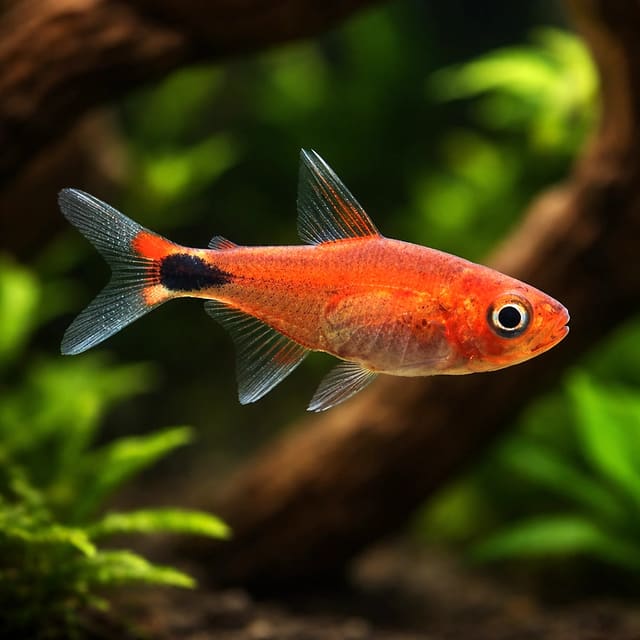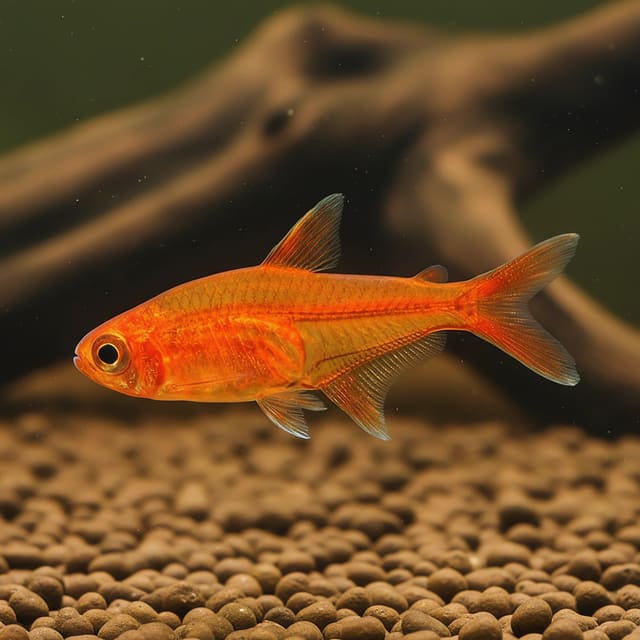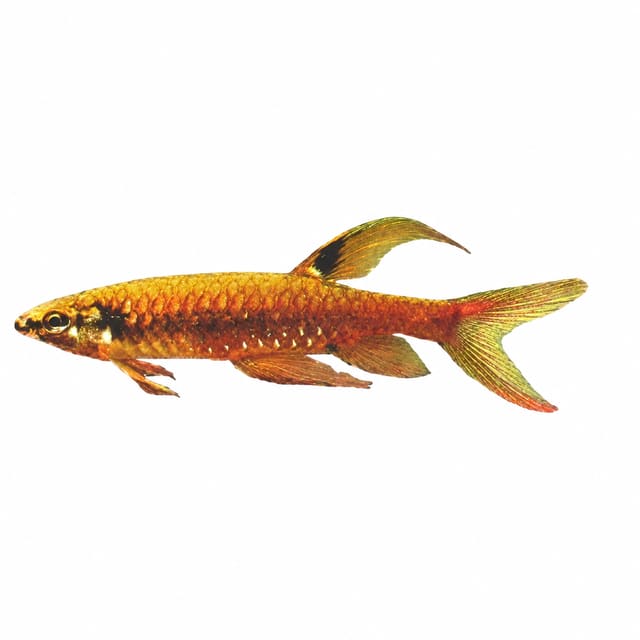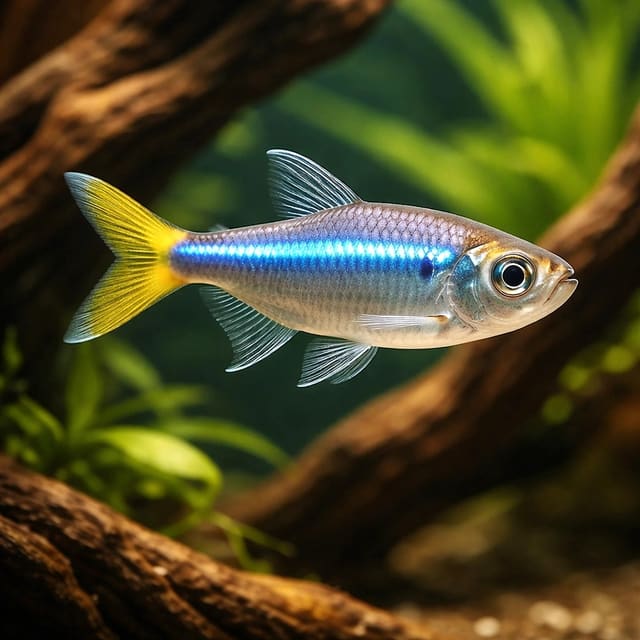
Yellow-Tailed African Tetra (Alestopetersius caudalis)
22–26°C · pH 6.5–7.5 · 108L
£8.99

Congo tetras (Phenacogrammus interruptus) are peaceful African schooling fish from the Congo basin. Males reach about 8 cm with long, feathery fins. Choose a size grade from 2-3 cm up to XL over 6 cm, and keep six or more in a long, planted tank at 23-28 °C.
Adult size is the maximum length this species reaches at full maturity (scientific sources). The livestock you receive will be younger and smaller — pick a size above for the actual shipping size. Product-photo provenance and any image-specific limitations are stated on the listing.
Phenacogrammus interruptus
Shoaling fish: kept in a group they feel safer, stay calmer and show their best colour.
Congo tetras (Phenacogrammus interruptus) are peaceful African schooling fish from the Congo basin. Males reach about 8 cm with long, feathery fins. Choose a size grade from 2-3 cm up to XL over 6 cm, and keep six or more in a long, planted tank at 23-28 °C.
Adult size is the maximum length this species reaches at full maturity (scientific sources). The livestock you receive will be younger and smaller — pick a size above for the actual shipping size. Product-photo provenance and any image-specific limitations are stated on the listing.
Maintain these water conditions for optimal health and vibrant colors
The Congo tetra, Phenacogrammus interruptus, is the African tetra most people have actually seen in a shop, and it is a much bigger, showier fish than the name "tetra" suggests. It belongs to the family Alestidae, the African tetras, so it is only a distant relation of the neons and cardinals that come from South America. Boulenger described the species in 1899, and Wikipedia rightly calls it a popular aquarium species.
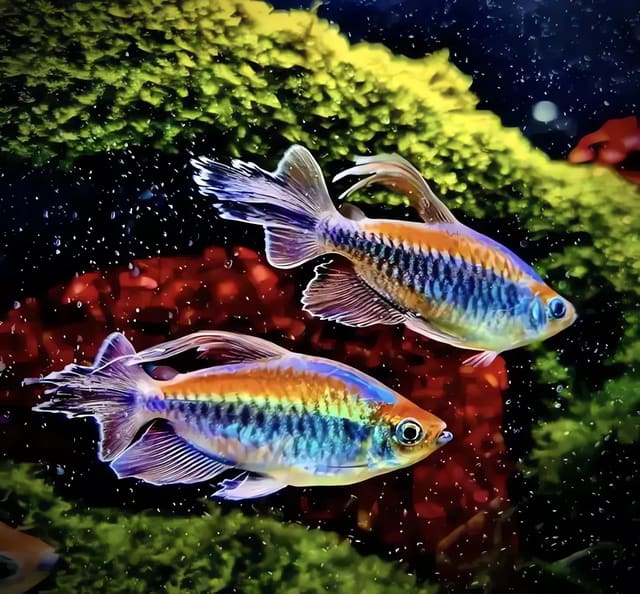
What sells it is the colour and the fins. Wikipedia describes the body as iridescent, blue along the top, shading through red in the middle to yellow-gold and then back to blue just above the belly. In practice the colour shifts as the fish turns, so a group under the lights never looks quite the same twice. Mature males carry the real finery: the dorsal fin grows long and sweeping, and the tail develops a feathery, greyish-violet extension edged in white. Females are plainer, shorter in the fin and smaller.
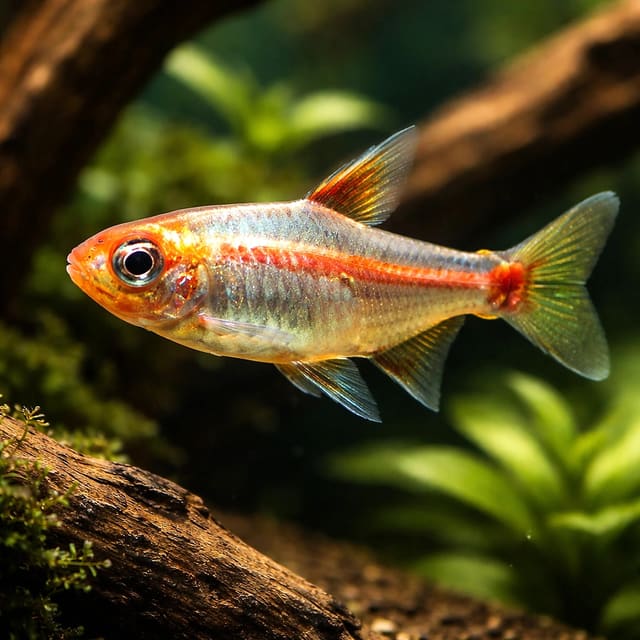
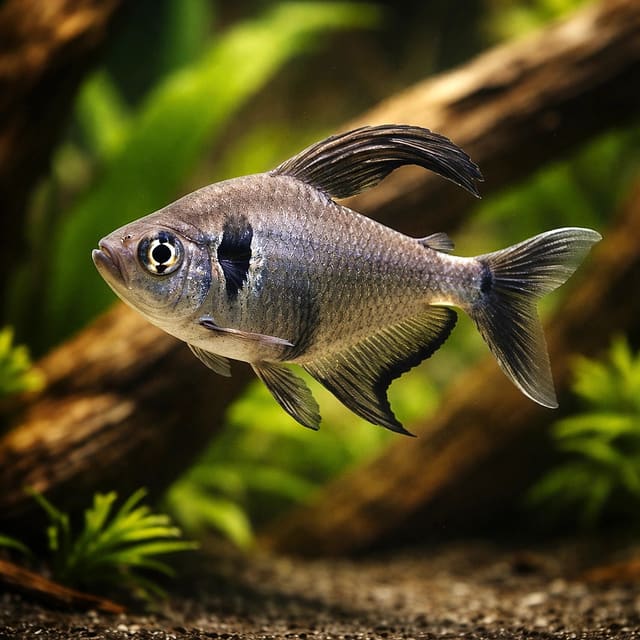
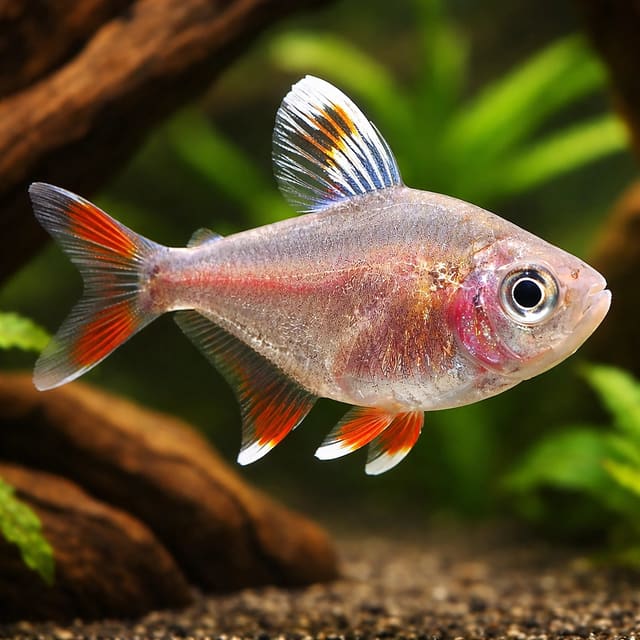
Our gallery photos show the look you are working towards: an orange-gold back, a blue band along the flank and pale, violet-tinged fins with long rays trailing from the dorsal and tail. Expect young fish to look far plainer than that. Seriously Fish describes juveniles as fairly drab, with the full colour only developing once the fish are mature and settled.
Size is the part people underestimate. FishBase gives a maximum of 8 cm total length for males and around 6 cm for females, and Seriously Fish quotes 80 mm standard length. That makes an adult male a substantial fish by tetra standards, with a deep body to match. Plan the tank around fish of that size, not around the juveniles you see in a dealer's tank.
| Quick facts | Congo tetra |
|---|---|
| Scientific name | Phenacogrammus interruptus (Boulenger, 1899) |
| Family | Alestidae (African tetras) |
| Native range | Lower and middle Congo River basin, Democratic Republic of the Congo and Republic of the Congo |
| Adult size | Males up to 8 cm total length; females around 6 cm |
| Temperature | 23-28 °C |
| pH | 6.0-7.5 |
| Hardness | 3-18 dGH |
| Group | Six or more, mixed sexes |
| Tank | 120 cm long is ideal; 150 litres or more for a group |
| Diet | Omnivore; flake plus plenty of frozen or live foods |
| Care level | Moderate |
The short version: a peaceful, active shoaling fish for a long, settled, planted aquarium. It is not a nano fish and it is not a fish for a tank that was filled last week, but in the right setting a group of Congo tetras is one of the best-looking things you can put in fresh water.
This listing sells Congo tetras by size grade. The size menu runs from 2-3 cm through 3-4 cm, 4-5 cm and 5-6 cm, up to an XL grade of fish over 6 cm. Those figures are the size of the fish when they are packed, not the size they will finish at. A 2-3 cm youngster still has most of its growing ahead of it, and even the XL fish have a little more to put on if they are males.
You choose the size, then the number of fish you want. We do not sell this listing by sex, and at the smaller grades nobody could sort them reliably anyway. Seriously Fish notes that juvenile Congo tetras are fairly drab, and the long fins that mark out a male only appear as the fish mature. A group bought young is therefore a mix whose sexes reveal themselves over the following months. Buying six or more gives you the best chance of ending up with both sexes, which is what Seriously Fish recommends for the best effect.
Our advice is to buy the whole group at one size, in one order. A shoal of similar-sized fish settles as a unit, and nobody ends up as the odd one out. If you already keep Congo tetras, pick a grade close to the size of your existing fish so the newcomers are not swamped.
If you would rather have a group made up for you, we also list five Congo tetras as a ready-made group. Five is the minimum FishBase gives for keeping this species, and we would still suggest adding to it if your tank has the room.
FishBase places the Congo tetra in the lower and middle Congo River basin, in the Democratic Republic of the Congo and the Republic of the Congo. It is a freshwater fish that FishBase classes as benthopelagic, meaning it lives and feeds near the bottom as well as up in midwater. In the wild, adults feed on worms, small insects, crustaceans and plant matter, which tells you a good deal about how to feed them at home.
The published species accounts say surprisingly little about the exact streams and backwaters the fish lives in, so we are not going to paint you a picture of a habitat nobody has properly described. What Seriously Fish does say is that the species prefers soft, acidic water with good circulation, and it suggests an African-style aquarium with driftwood branches, floating plants and Anubias. That is a practical starting point, and it suits the fish's look as well.
Congo tetras in the hobby today are mostly not wild fish. Seriously Fish reports that the bulk of the trade is commercially bred in the Far East and Eastern Europe rather than collected from the river. Whatever a fish's background, match your water to the ranges in the water section below rather than hoping it will adapt to anything.
In conservation terms, the species is listed as Least Concern by the IUCN, with the FishBase record citing an assessment from 2009. FishBase also notes that it turns up in commercial fisheries as well as the aquarium trade.
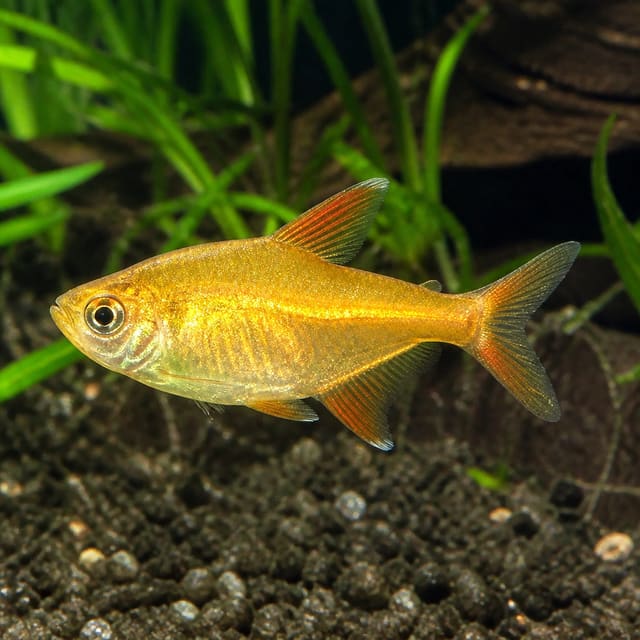
If you like the idea of an African-themed community, we also keep the Yellow-Tailed African Tetra, another member of the same family. Read its own care notes before mixing species, as we have not checked the two together against published sources here.
Length is the measurement that matters most. Seriously Fish recommends a base of at least 120 by 30 cm for adults, around 108 litres, and FishBase lists a minimum aquarium length of 100 cm. We work to 150 litres or more for a proper group of six, because the extra volume keeps water quality steadier and gives the males room to show their fins without bumping into the glass every few seconds. A 120 cm tank of 200 litres or more is where a group of eight to ten really starts to look like a shoal rather than a handful of fish.
Congo tetras are active swimmers, and Seriously Fish describes them as quite easily frightened. That combination shapes the layout. They need a long, clear swimming lane through the middle of the tank, with cover along the back and sides they can retreat into when something startles them. A tank that is all open water leaves them nervous; a tank stuffed with rock and wood from end to end leaves them nowhere to swim.
Think about where the tank stands, too. An easily frightened fish next to a busy door or a slamming kitchen cupboard will spend more time darting about than displaying. A quieter corner, and a light routine that does not switch from full brightness to darkness in an instant, help a new group settle.
To make the numbers concrete, here is the kind of setup we would happily send a group of Congo tetras to. Treat it as a template to adapt, not a shopping list.
Build it in stages. Run the tank for several weeks until the filter has cycled, add the hardier, less sensitive fish first if you are stocking a mixed community, and bring the Congo tetras in once the water has been reading clean for a while. Adding everything in a single weekend is the classic way to overload a young filter.
Finally, set the tank up and let it mature before the fish arrive. Seriously Fish describes the species as sensitive to water quality, and a group of medium-sized, active fish produces a fair amount of waste. A filter that has been running and cycling for several weeks is the single best investment you can make before ordering.
The sources agree on the broad picture and differ a little at the edges. Here is how they compare, along with the range we use on this listing.
| Parameter | FishBase | Seriously Fish | Our care range |
|---|---|---|---|
| Temperature | 23-26 °C | 23-28 °C | 23-28 °C |
| pH | 6.0-8.0 | 6.0-7.5 | 6.0-7.5 |
| Hardness | 5-19 dH | 3-18 dGH | 3-18 dGH |
If you want a single temperature to aim for, 24-26 °C sits comfortably inside both ranges. There is no benefit in pushing to the top of the range for everyday keeping; warmer water holds less oxygen, and a group of active fish uses plenty of it.
On pH and hardness, Seriously Fish describes the species' preference as soft and acidic. You do not need to chase that with chemicals, though. Steady water within the ranges above is far better for the fish than water that swings every time you add a product. If your tap water is moderately hard, Congo tetras will usually be fine. If it tests above about 18 dGH, mixing it with reverse-osmosis water is a more stable route than dosing acids, and it is worth asking us before you order if you are unsure.
Two hardness figures turn up on test kits and they are easy to mix up. General hardness (GH, measured in dGH) is the dissolved calcium and magnesium, and it is the figure the ranges above refer to. Carbonate hardness (KH) is the water's buffering capacity, which is what holds the pH steady between water changes. Water with very low KH can see its pH drift downwards as waste builds up, while water with plenty of KH resists change. For Congo tetras, moderate GH with enough KH to keep the pH stable is a comfortable middle ground, and it is far easier to live with than very soft, unbuffered water that needs constant attention.
Test your tap water before you set the tank up, not after the fish arrive. If you know what comes out of the tap, you know whether you can use it straight, whether you need to blend it, and which other fish will share the same water happily.
Seriously Fish flags the Congo tetra as sensitive to water quality, and in our experience that is where most problems start. The basics:
Good water shows in the fish. A well-kept group holds its colour, keeps its fins spread and swims as a loose shoal. Pale, clamped fish hanging near the surface or in a corner are usually telling you something about the water before anything else.
Congo tetras are omnivores. FishBase records wild adults eating worms, small insects, crustaceans and plant matter, and Seriously Fish says they accept most foods in the aquarium but should get a good proportion of live and frozen food if you want the best colour. That is a fair summary of how to feed them: a reliable dry staple, plus plenty of the small, meaty foods they would find in the wild, with some plant content alongside.
Feed small amounts once or twice a day, only as much as the group clears in a couple of minutes. Congo tetras feed mainly in midwater, so drop food where the shoal is and let it drift. Anything that sinks past them will be picked up by bottom dwellers if you keep them, or left to rot if you do not, so watch the first few feeds closely and adjust.
Fish from the 2-3 cm and 3-4 cm grades are still growing quickly, and growing fish do better on several small meals than on one big one. If your routine allows it, split the day's food into two or three light feeds, use finely crushed flake or micro pellets, and lean on small frozen foods such as daphnia and cyclops rather than whole bloodworm. As the group reaches 5 cm and beyond you can move up to adult-sized foods and settle into a once- or twice-daily rhythm.
Growth is also where good feeding pays off visibly. The long fins and iridescence that make adult males worth the wait need a decent diet behind them, and a group raised on flake alone tends to look a little flat compared with one given regular frozen and live food.
In a mixed tank, check every fish is getting its share. Fast surface feeders can take most of a meal before a nervous new group has worked out where the food is. Spreading the food across the surface, or feeding at two points at once, helps the shyer fish.
New arrivals often refuse food for the first day or so while they settle. That is normal. Offer a small amount the day after they arrive, take out anything uneaten, and expect appetite to pick up within a few days as they get their bearings.
Congo tetras are peaceful fish, but they are big and busy for a tetra, and that is the key to choosing company for them. Seriously Fish lists other tetras, rainbowfish, Corydoras and peaceful cichlids as suitable companions, and warns against fin-nippers and boisterous tank mates. It also points out that the Congo tetra's active swimming may frighten very shy species.
Treat these as categories, not guarantees. Each species needs checking on its own merits for size, temperament and water, and some fish sold as "tetras" are anything but peaceful.
FishBase gives five as the minimum group, and Seriously Fish recommends a mixed-sex shoal for the best effect. We suggest six as a minimum and eight to ten if the tank allows. A lone Congo tetra, or two or three in a short tank, will usually hide and stay pale. In a proper group the fish spread out across the middle of the tank, come together when startled, and the males show off their fins to each other and to the females.
If your tank is already stocked, look at it with fresh eyes before ordering. Count the fish that will share the middle of the tank with the new group, because that is the space Congo tetras will want, and ask whether any current resident has a habit of chasing or nipping. A fish that tolerates a few small tetras may behave very differently towards a shoal of long-finned 8 cm fish, and vice versa.
On the day, rearrange a piece of decor or two before releasing the new group. It breaks up established territories and gives the newcomers a fairer start. Feed the existing fish lightly at the far end of the tank while the Congo tetras find their feet, and keep the lights low for the rest of the day. Within a week or so you should see the group moving together through the open water rather than pressed into a corner.
When the fish are in breeding condition, FishBase describes males driving the females vigorously. In a large group in a roomy tank that energy spreads across many fish; in a small group it can fall on one unlucky female. Another reason not to skimp on numbers.
Congo tetras are egg-scatterers that give no parental care. Seriously Fish records 100 to 300 large eggs laid over several days, and FishBase notes that after vigorous driving by the male the female lays up to 300 eggs, which hatch in about six days. The breeding difficulty on our care data is moderate: it is quite achievable, but it takes a separate tank and some patience.
Choose your breeding fish once they have matured, when the males' extended dorsal fins and tail filaments make the sexes obvious. Introduce the pair or a small group to the spawning tank, and once spawning has finished, return the adults to the main aquarium.
Seriously Fish advises infusoria as the first food for the fry, followed by brine shrimp nauplii as they grow. Little and often is the rule, with very careful attention to water quality, because small tanks foul quickly when you are feeding several times a day. Gentle air-driven filtration, such as a sponge filter, avoids sucking up tiny fry.
Do not expect fry to appear in a community tank. With no parental care and plenty of hungry mouths around, eggs scattered in a busy display aquarium are unlikely to survive.
Most Congo tetra problems come down to three things: water quality, stress and tank mates. Seriously Fish describes the species as sensitive to water quality, easily frightened when not kept in numbers, and drab as juveniles but spectacular once mature and settled. Put those together and you have a fish whose colour is a good daily health check.
Young fish in particular can look washed out for a while after a move. Do not judge them on the first week. Give them stable water, a varied diet and a quiet tank, and the iridescence and fin growth will come as they mature.
None of this is specific to Congo tetras, but a species that Seriously Fish describes as sensitive to water quality rewards the keeper who does the routine jobs on time.
If you already have an established community, a separate quarantine tank for a few weeks is the safest way to add new fish. It protects your existing stock and lets you watch the newcomers feed and settle without competition. Above all, avoid sudden changes: a large, cold water change or a jump in temperature knocks back a sensitive species far more than a slightly imperfect pH ever will.
Get the aquarium ready before you place the order. The filter should be running and mature, the water tested and the temperature set, so the fish go straight into a stable home. Please read our delivery and live-arrival information before ordering, and make sure someone will be at the delivery address to receive the parcel, because live animals cannot be left on a doorstep.
Your Congo tetras travel in oxygen-filled bags inside insulated packaging, with heat packs when the weather calls for them, carried by a tracked courier licensed to carry live animals. We email your confirmed delivery date and the tracking details.
Start a continuous unboxing video while the parcel is still sealed, and open it in the same take, showing the fish in the still-sealed bag. If a fish arrives dead, dying or clearly compromised, email hello@tropicalfishco.co.uk on the day of delivery with your order number and that video. Photos alone do not meet our policy. The resolution is a replacement with your next order or a refund for the affected fish, subject to the guarantee terms.
Over the first week, watch breathing, appetite and behaviour each day. Expect the group to hang back and stay pale at first. As they find their way around the tank and realise there is nothing to fear, they will start moving as a shoal through the open water, and the colour will follow.
These are the sources behind the facts on this page. They are well worth reading if you want to go further with the species.
No reviews for this item yet. Bought one? Honest reviews only, good or bad.
What customers say about ordering from us
I have a small group of long finned mountain minnows. So was delighted to be able to order ten of this variety to increase the genetics in my tank . The ones I recieved are healthy but it’s to early to give a verdict on wether they are of a long finned type since they are small currently.
Gordon Walker · 23 Sept 2026
100% success travel and "installation". Pleased with quality of purchase. The Siamese fighter a bit "shy" so have not yet seen him at his best yet but looking good. Happy customer. GG
George E Garratt · 21 Sept 2026
Reviews of our shop, collected by Judge.me, an independent third-party review collector. Newest first.