By Tropical Fish Co Editorial Team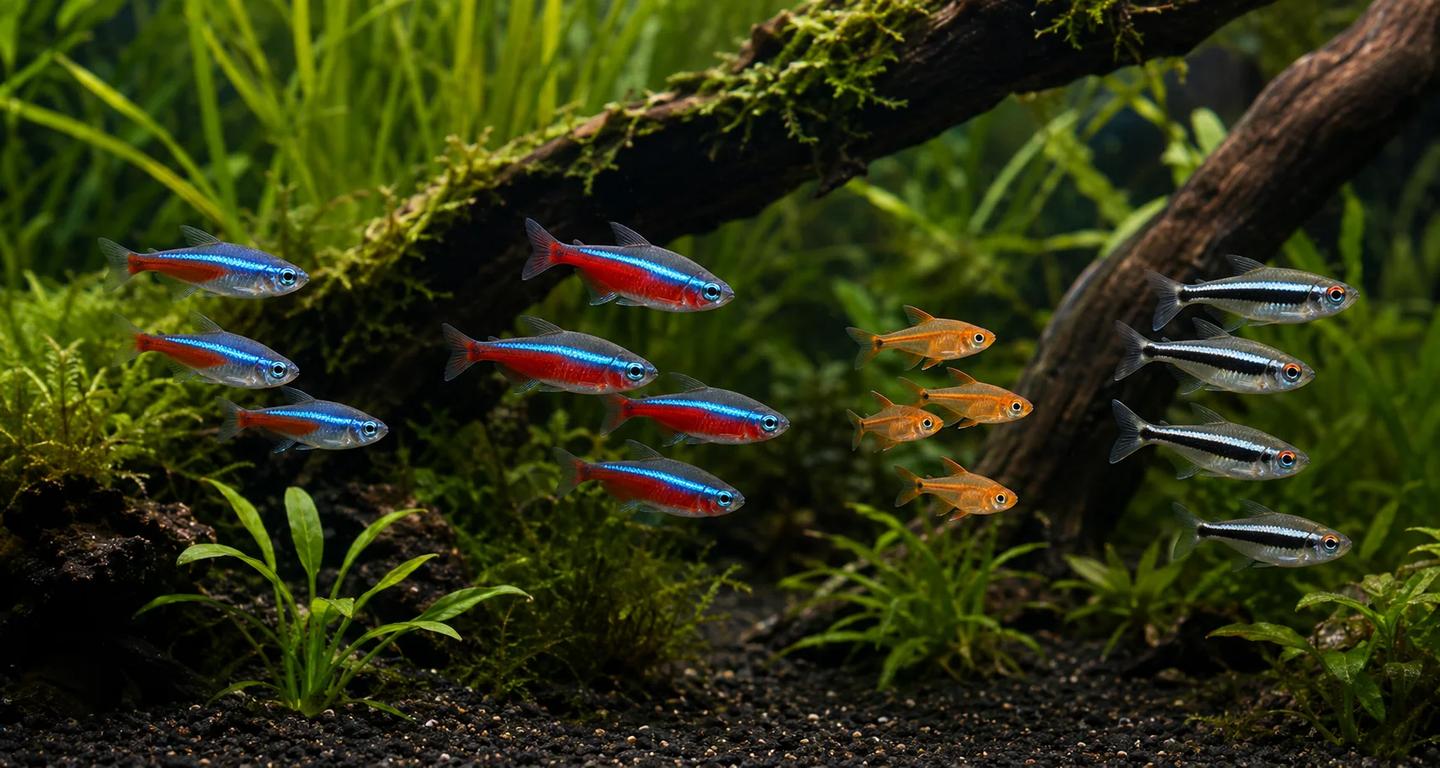
The direct answer
Tetra is not one fish with one care setting. It is a broad aquarium name used for many small characiform fishes. Even this short UK comparison spans American species currently placed in Acestrorhamphidae and the African Congo tetra in Alestidae. They differ in adult size, swimming space, water evidence and behaviour [6] [12].
Choose in this order:
- Confirm the scientific name. A colour word or shop name can cover more than one species or trade form.
- Plan the complete adult group. OATA's broad starting point is at least five of the same type and more is better; exact species guidance may be more cautious [1].
- Check swimming length as well as litres. A tall cube and a long aquarium can hold similar water volumes but offer very different mid-water space.
- Test the water you will actually use. “UK tap water” is not one chemistry.
- Screen temperament and every tank mate. “Community tetra” is not a safety guarantee.
Current FishBase records place the popular American species on this page in Acestrorhamphidae, while Congo tetra belongs to Alestidae. Older books may call many of them Characidae. That is not a reason to distrust every older care observation; it is a reason to record the scientific name and date the taxonomy you use.
Popular tetra fish types compared
This is a decision table, not a complete species list or a stocking calculator. Length abbreviations matter: SL means standard length and excludes the tail fin; TL includes it. Published maximum length is not a promised size for every individual.
| Tetra type | Useful identity clue | Published maximum | Space clue | Main buying question |
|---|---|---|---|---|
| Neon (Paracheirodon innesi) | Blue stripe; red mainly on rear half | 2.5 cm SL | FishBase: 60 cm aquarium length | Is the aquarium mature, and can it support the complete group? |
| Cardinal (Paracheirodon axelrodi) | Blue stripe; red extends much farther forward | 3.0 cm SL | FishBase: 60 cm aquarium length | Does measured water match this species and the seller's holding water? |
| Ember (Hyphessobrycon amandae) | Very small translucent orange body | 2.0 cm SL | Use the exact Ember Tetra guide, not size alone | Can a tiny fish feed and settle safely with the planned companions? |
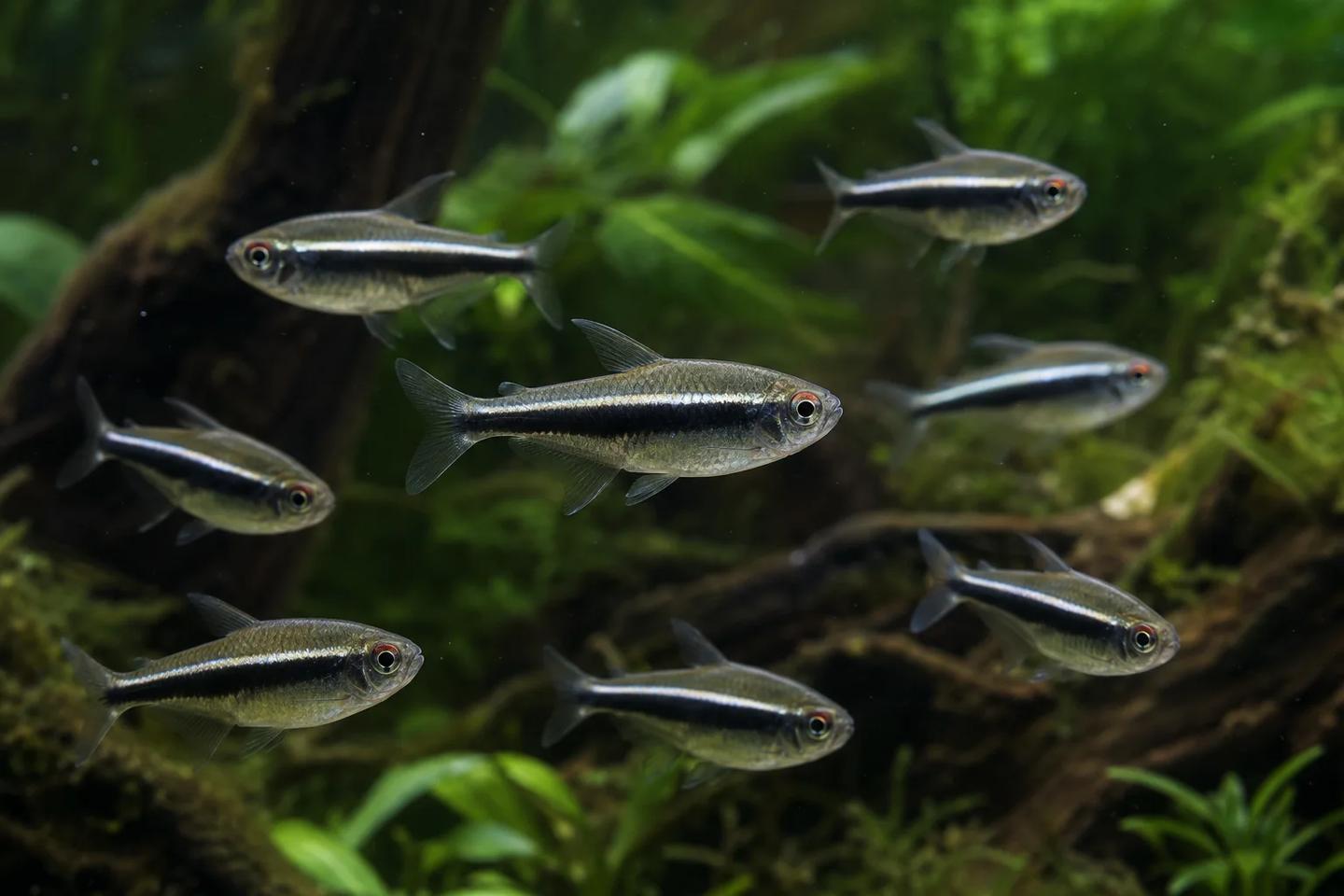
| Black neon (Hyphessobrycon herbertaxelrodi) | Black side stripe below a pale line; reddish upper iris | 3.2 cm SL | FishBase: 60 cm aquarium length | Is it being confused with a neon colour form? |
| Lemon (Hyphessobrycon pulchripinnis) | Translucent yellow-green body; red upper iris and marked fins | 3.8 cm SL | FishBase: 60 cm; our cautious species guide uses more | Does the footprint allow an active group and open mid-water? |
| Serpae / jewel (Megalamphodus eques) | Red body with dark shoulder marking; trade forms vary | Check the exact stock identity | FishBase: 60 cm aquarium length | Can you manage the recorded aggression and fin risk? |
| Congo (Phenacogrammus interruptus) | Larger African tetra; adult males develop extended iridescent fins | 8 cm TL male/unsexed; 6 cm female | FishBase: 100 cm aquarium length | Is the aquarium long enough for a larger, active adult group? |
The table uses current FishBase records for identity, scientific length and the listed aquarium-length clues [6] [7] [8] [9] [10] [11] [12]. It deliberately does not turn their widest published water ranges into one shared target.
What each shortlist entry is best used to decide
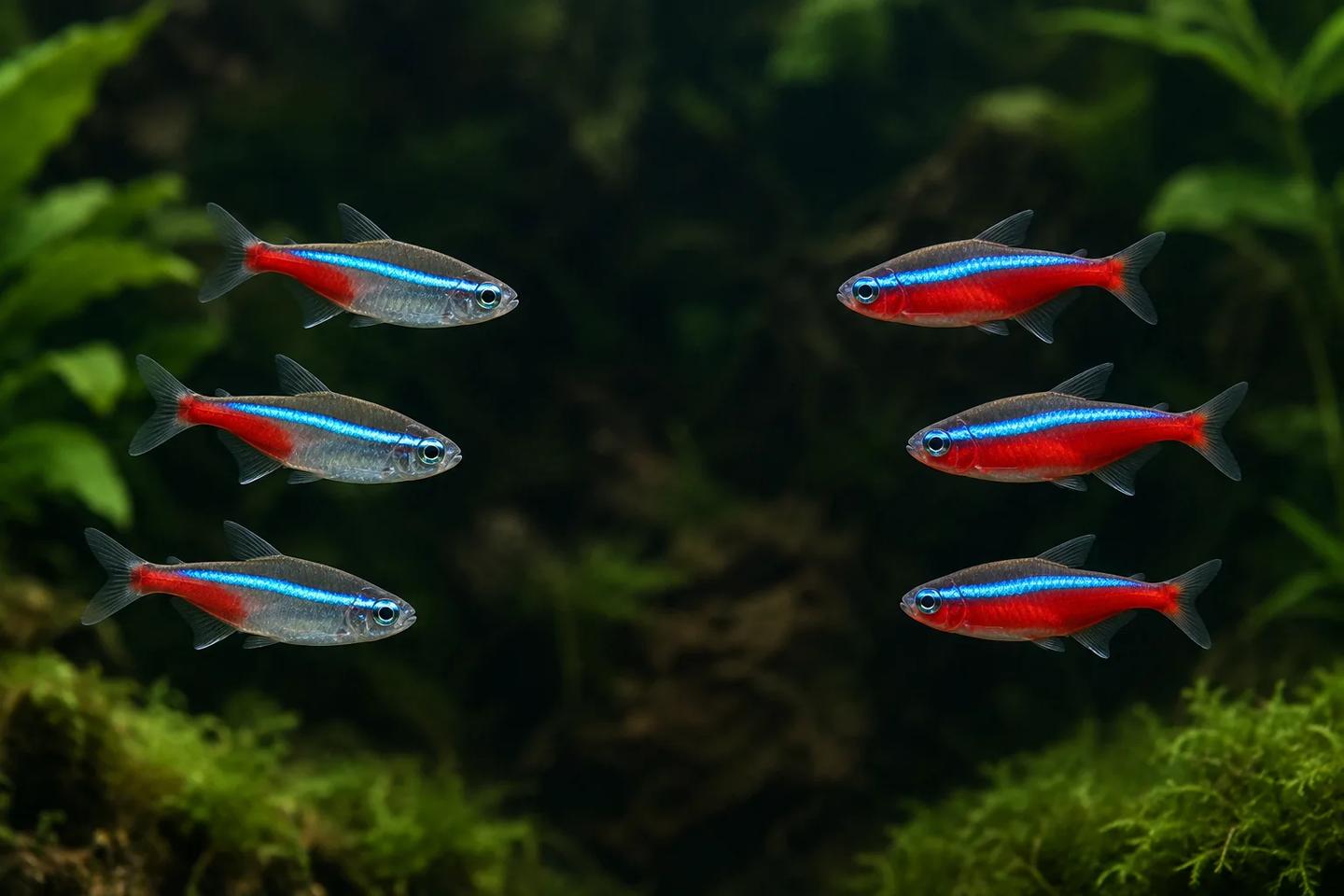
Neon tetra: compare this first when you want the familiar blue-and-red look in a planted community. Its small body does not make a new or very short aquarium suitable. FishBase's 60 cm aquarium-length clue and the mature-tank checks in our Neon Tetra guide are more useful than a generic “nano fish” label.
Cardinal tetra: compare it with the neon when a longer red lower stripe is the visual priority. Do not choose between them by colour alone. Their FishBase records differ in native distribution and compiled water evidence, and the fish offered may have travelled through different holding systems. Use measured conditions and the Cardinal Tetra guide.
Ember tetra: this is the smallest species in the selected FishBase records, at 2.0 cm maximum standard length. Tiny adult size is helpful for a carefully planned smaller community, but it does not remove the need for a complete social group, stable filtration, feeding access and a usable footprint. Our Ember Tetra guide sets out those checks.
Black neon tetra: this is Hyphessobrycon herbertaxelrodi, not a dark neon-tetra morph. It is a useful option when you want a bold horizontal contrast rather than red-and-blue colour. Confirm the scientific name because “black neon” and “black tetra” are not interchangeable shop labels.
Lemon tetra: the translucent body and red upper iris can look subtle in a sales photograph. Adult group behaviour, open mid-water and the aquarium footprint matter more than whether a single fish appears bright yellow. The Lemon Tetra guide explains why our home screen is more cautious than the broad minimum.
Serpae or jewel tetra: consider it only with the recorded aggression and blood-tetra trade complexity visible from the start. It is not an equivalent red substitute for a peaceful ember or cardinal group. Ask which scientific identity or trade form the seller is supplying and avoid companions whose fins or feeding access may be vulnerable.
Congo tetra: this is the clear larger-fish choice in the table. It belongs to a different family, reaches a larger recorded adult size and has a 100 cm FishBase aquarium-length clue. A small juvenile photograph can conceal that adult space decision.
Species, colour form or “breed”?
Searches often call tetra types “breeds”, but that word can hide several different situations:
- separate species: neon, cardinal and black neon tetras have different scientific names;
- a selected colour or fin form: a named appearance may belong to one established species;
- an ambiguous trade label: a common name may be applied inconsistently or to a complex of related forms;
- a hybrid: FishBase specifically warns that hybrids occur in the blood-tetra complex associated with serpae/jewel tetras [11].
The safe response is not to guess from a thumbnail. Ask the seller for the current scientific name and whether the fish is a species, selected form or known hybrid. Keep that answer with the order record. This protects both husbandry and search accuracy: a page about one species should not inherit the care figures or photographs of a merely similar fish.
The generated visuals on this page show identifying patterns for comparison, but they are not taxonomic vouchers and they do not depict current stock. A live product photograph can also be affected by lighting, stress, age and camera processing. Use several body and colour clues together, then rely on the seller's traceable identity.
How to choose the best tetra for your aquarium
“Best” means best matched to the aquarium you can maintain, not the most colourful thumbnail.
Start with the tank's usable footprint
Record the aquarium's internal length and width, not only the box volume. Then subtract the practical effects of hardscape, territorial fish and existing groups. Small body size does not erase the need for open mid-water swimming space.
OATA's broad UK guidance starts at 45 litres for a small group of a smaller species and 80 litres for larger types over 5 cm. It also notes that larger aquariums provide more stable temperature and water conditions [1]. RSPCA guidance similarly favours more space than a minimum and asks keepers to plan for adult size, filtration and oxygen—not a simple fish-per-litre total [3].
Species evidence can be stricter. FishBase lists a 60 cm aquarium for neon, cardinal, black neon and lemon tetras, and 100 cm for Congo tetra. Use the most cautious relevant source once you know the exact fish.
Plan one complete group before a mixed display
The popular tetras here are social fishes. OATA advises at least five, with more being better [1]. A peer-reviewed study found that neon tetras in larger groups showed less aggression and darting and spent more time shoaling—but the authors also found that responses differed by species [2].
That evidence supports two careful conclusions:
- buying one or two social tetras is not a suitable plan;
- “ten for every tetra” is not a scientifically universal rule.
Choose the exact species, decide a suitable same-species group, and calculate the whole adult community before ordering. Do not buy incomplete groups of several species and assume they will meet one another's social needs.
Match measured water, not a postcode story
OATA gives captive-bred tetras a broad group guide of 22–27°C, pH 6.5–8.0 and 4–12 dGH, while warning that species-specific requirements and wild-caught stock need separate advice [1]. FishBase records also differ among species: the selected pages do not support one universal tetra setting.
The Drinking Water Inspectorate explains that supply hardness varies with local geology and directs consumers to their water company for local information [4]. Before purchase:
- obtain a current source-water report and test the aquarium;
- ask the seller for measured holding-water temperature, pH and hardness;
- find the stable overlap for the exact fish and its companions;
- plan gradual, measured changes rather than chasing a web range overnight.
Clear water is not proof of safe water. OATA's broad tetra guidance requires zero measurable ammonia and nitrite, a mature filter and regular testing [1].
Neon vs cardinal tetra: the quick identification check
The two are easy to confuse in a moving shop group. Both show a bright blue lateral stripe. In the familiar neon tetra, red is concentrated on the rear half of the lower body; in the cardinal, the red runs much farther forward.
Use that as a clue, not the entire identification. Lighting, stress, age, camera processing and health can change colour. The reliable buying record is the scientific name: Paracheirodon innesi for neon or P. axelrodi for cardinal. Their FishBase records also differ in distribution and compiled water evidence [6] [7].
For full husbandry, use the Neon Tetra care guide or Cardinal Tetra care guide. Those pages own species-level care intent; this page owns the comparison decision.
Peaceful does not mean universally compatible
Many small tetras are sold for community aquariums, but compatibility depends on the complete setup. Screen:
- adult body and mouth size;
- temperature, pH and hardness overlap;
- swimming level and available open space;
- social group and territorial needs;
- feeding speed and whether every fish can eat;
- long fins, persistent chasing and previous injuries;
- a practical separation plan.
The serpae or jewel tetra is an important warning against the blanket “all tetras are peaceful” claim. FishBase records Megalamphodus eques as aggressive in aquarium keeping and notes that blood-tetra hybrids occur in trade [11]. A larger group and suitable space may support normal social behaviour, but neither guarantees that vulnerable tank mates will be safe.
Do not rely on a named “safe tank mate” list. A species combination that overlaps on paper can still fail because of individual behaviour, crowding, feeding competition, illness or an unsuitable layout.
Small fry, shrimplets and other small invertebrates must also be treated as potential prey where a fish can take them. No tetra is guaranteed invertebrate-safe; if maximum offspring survival matters, use a fish-free rearing aquarium.
Feeding and observing a mixed tetra community
OATA describes tetras broadly as omnivorous and recommends appropriately sized complete dry foods with suitable live or frozen variety, while warning against overfeeding [1]. A useful feeding plan is behavioural rather than brand-led:
- offer particles every fish can physically take;
- distribute food so timid fish are not excluded by faster tank mates;
- watch the whole group, including fish behind plants or hardscape;
- remove the assumption that more food compensates for poor access;
- adjust the amount to condition and water-quality results, not a fixed internet scoop.
Observe the fish before feeding as well as during it. A healthy-looking group should show species-appropriate swimming, steady breathing and intact bodies and fins. Persistent isolation, surface gasping, loss of balance, repeated rubbing, damaged fins, white spots, marked colour change or refusal to feed warrants immediate water testing and competent assessment. Those signs are not a diagnosis, and this comparison page does not recommend a medicine or dose.
Adding more fish is also not a universal treatment for chasing. First check water, space, injuries, group composition and the identity of the fish involved. Separate a persistently targeted or unwell animal when necessary and seek appropriate aquatic-veterinary or experienced retailer help.
A safer pre-purchase checklist
Before paying for a tetra group, confirm all of the following:
- Identity: common and scientific name, including any uncertain trade form.
- Adult evidence: recorded adult length and whether the source uses SL or TL.
- Group: the complete same-species number you can house now—not someday.
- Aquarium: mature filtered volume, usable length, cover and open swimming lane.
- Water: your measured aquarium values and the seller's current holding values.
- Community: every planned adult fish, group and behaviour risk.
- Health: clear eyes, intact body and fins, steady breathing and normal swimming; do not select from a system with concerning signs without competent advice.
- Arrival: the seller's current delivery coverage, packing, acclimatisation instructions and guarantee terms.
- Contingency: a cycled separation option or realistic route to competent help.
Current England seller guidance requires written information about the fish's welfare needs, including the environment and water parameters; it separately requires newly received stock to be acclimatised to its environment. It does not require one buyer-facing home timer [5]. Follow the seller's instructions for the actual consignment and compare the measured source and destination conditions.
The published lengths, volumes and group figures are screening points. They do not account for aquarium shape, filter capacity, oxygen, hardscape, territorial space, existing fish, water stability or individual health. If the full adult plan only just fits a minimum, choose fewer species or a larger aquarium—not a smaller social group.
Where care guidance ends and shopping begins
This page does not state that any species is currently available. Stock, sale unit, price, size and delivery coverage can change independently of a care guide.
Browse the live tetra shop route when you are ready to check current options. On the product or category page, verify the scientific name and current commercial details again. If those details conflict with the animal's welfare needs, pause the order and ask for clarification.
For deeper species decisions:
- Neon Tetra care guide
- Cardinal Tetra care guide
- Ember Tetra care guide
- Lemon Tetra UK guide
- Black Phantom Tetra UK guide
- Tropical aquarium water chemistry
The references below show exactly which claims came from scientific databases, peer-reviewed research and current UK welfare or seller guidance. If you spot an identity or care statement that needs correction, use the page feedback route and include the species name and supporting source.