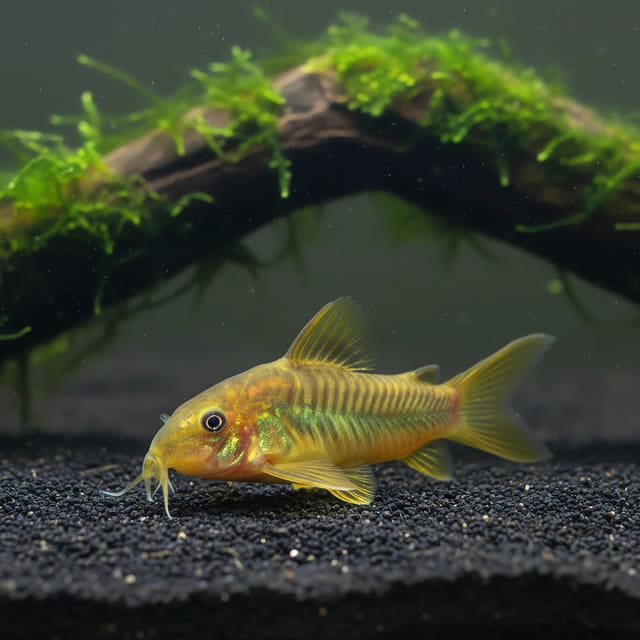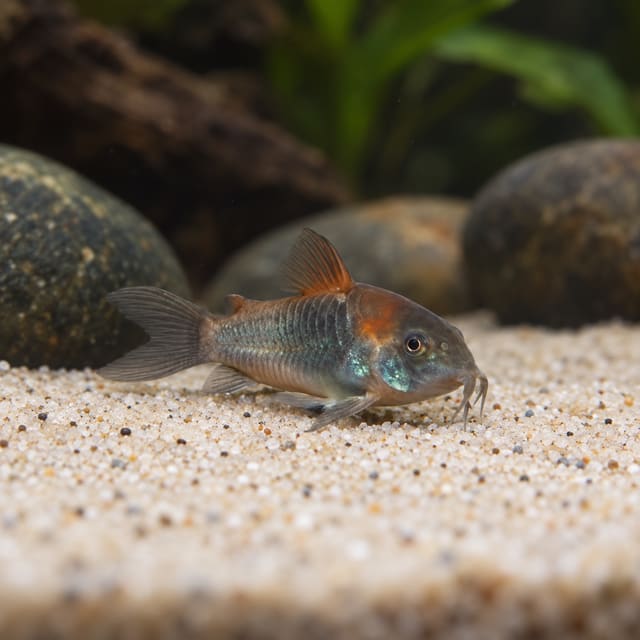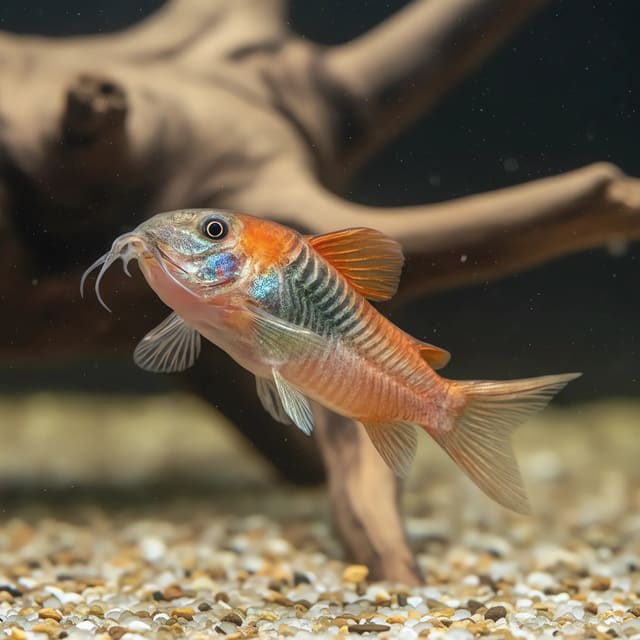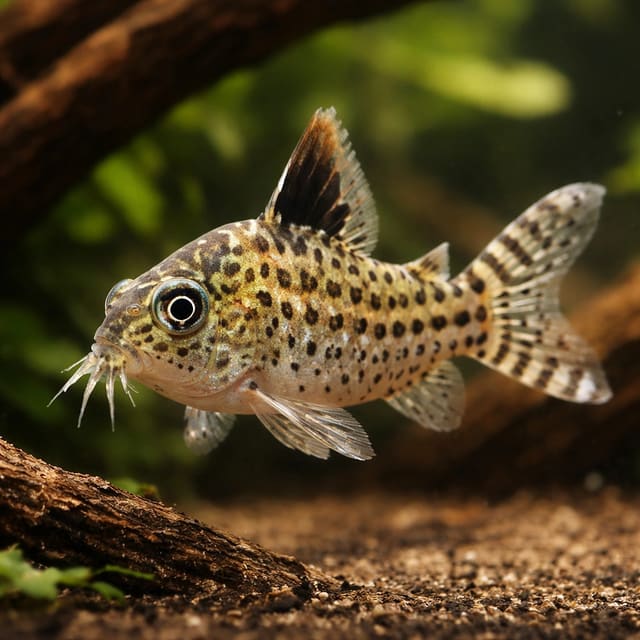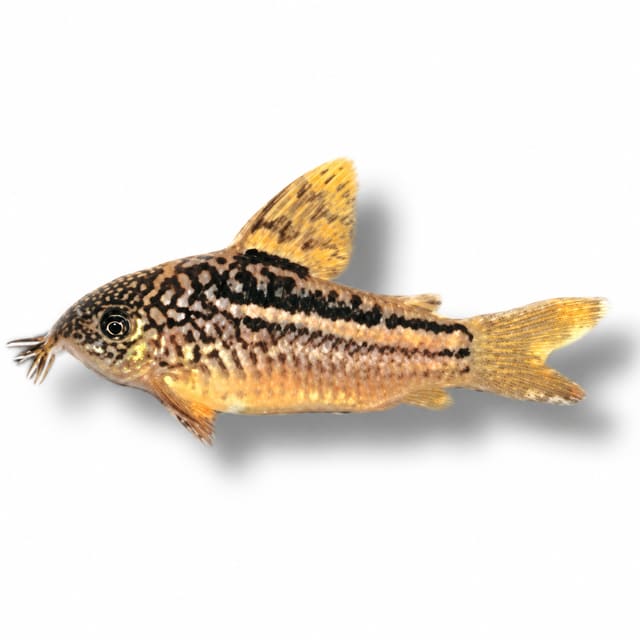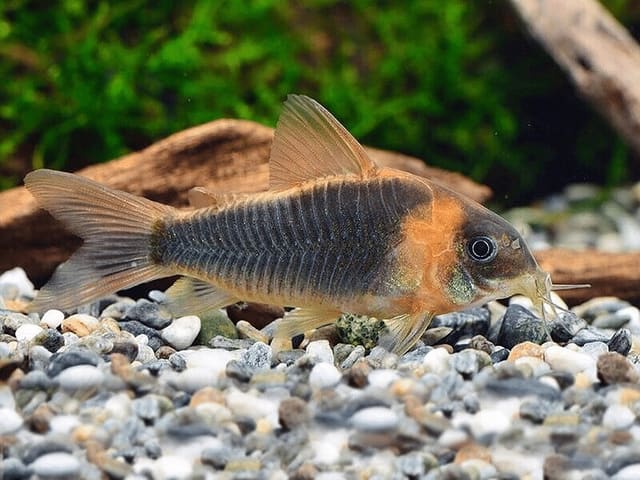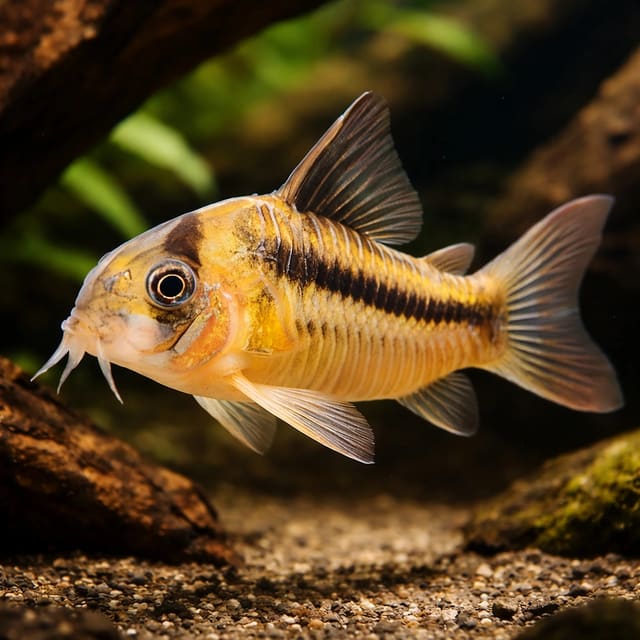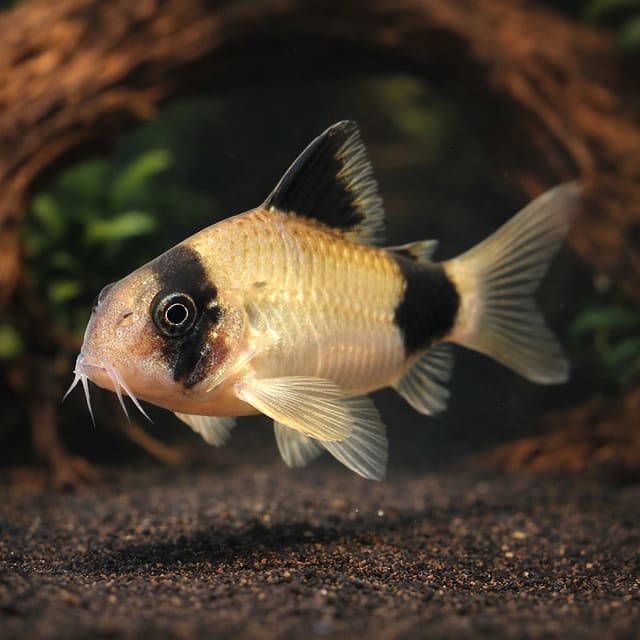
Panda Cory Catfish (Corydoras panda)
22–25°C · pH 6–7.4
£7.29
The Pigmy Corydoras (Corydoras pygmaeus) is a peaceful armoured catfish from South America's Madeira River basin that reaches 2.1 cm. It suits mature, carefully planned aquariums; keep at least six, preferably 10 or more, at 22–26°C and pH 6.4–7.4. Sold individually in sizes from 1–2 cm to 2–2.5 cm.
Adult size is the maximum length this species reaches at full maturity (scientific sources). The livestock you receive will be younger and smaller — pick a size above for the actual shipping size. Product-photo provenance and any image-specific limitations are stated on the listing.
Corydoras pygmaeus
Shoaling fish: kept in a group they feel safer, stay calmer and show their best colour.
Minimum of 2 per order.
The Pigmy Corydoras (Corydoras pygmaeus) is a peaceful armoured catfish from South America's Madeira River basin that reaches 2.1 cm. It suits mature, carefully planned aquariums; keep at least six, preferably 10 or more, at 22–26°C and pH 6.4–7.4. Sold individually in sizes from 1–2 cm to 2–2.5 cm.
Adult size is the maximum length this species reaches at full maturity (scientific sources). The livestock you receive will be younger and smaller — pick a size above for the actual shipping size. Product-photo provenance and any image-specific limitations are stated on the listing.
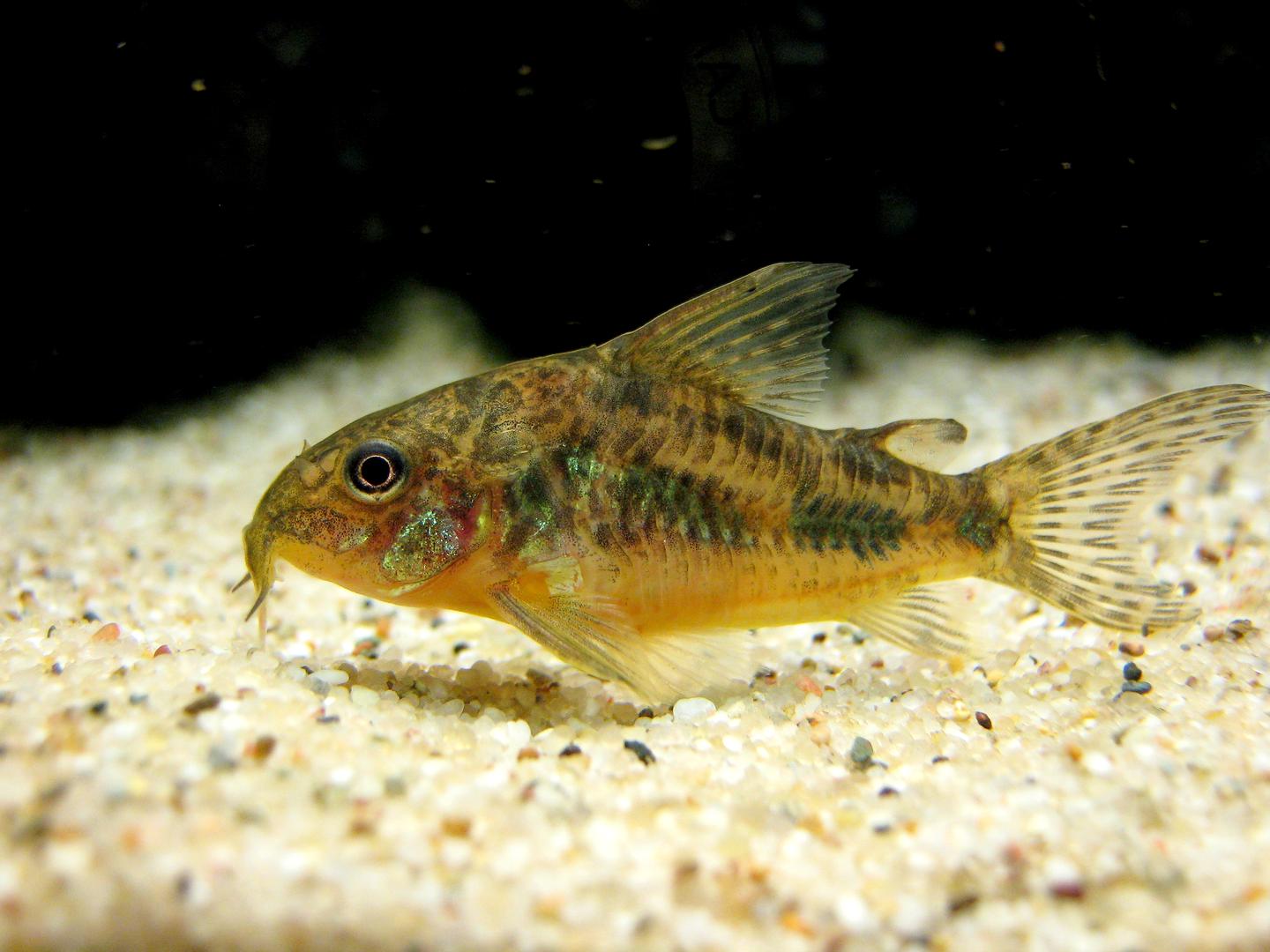
Identify the exact cory catfish before choosing care. Our starting policy for many common medium species is six compatible conspecifics, a mature 60 x 30 cm aquarium of about 60 litres, smooth fine sand and measured species-appropriate water.
Maintain these water conditions for optimal health and vibrant colors
Pigmy Corydoras is a tiny freshwater catfish from South America. FishBase places it in the armoured-catfish family Callichthyidae, records the Madeira River basin in its distribution and describes it as demersal. FishBase now lists it as Gastrodermus pygmaeus; the familiar aquarium name remains Corydoras pygmaeus.
This is not a conventional bottom-only cory. It tends to use the middle levels of the aquarium, although it also visits lower areas, and members of a settled group may shoal closely. Its peaceful manner and extremely small adult proportions make it most suitable for a carefully planned species aquarium or a community built around other tiny animals.
| Suits | Not suited to |
|---|---|
| A mature, filtered aquarium with a 45 × 30 cm base | An immature or unfiltered aquarium |
| A group of at least six, preferably 10 or more | Solitary keeping or an undersized group |
| A species aquarium or carefully screened tiny companions | Angelfish, gouramis or larger catfish that may eat it |
| Deliberate feeding with appropriately small foods | Communities where larger or faster fish take its food |
You can also browse our current Corydoras collection when comparing body size, group needs and aquarium plans.
One purchase quantity supplies one animal of the selected option. The live size selector shows the choices used for this product: 1–2 cm and 2–2.5 cm. Check that selector when ordering rather than relying on a size mentioned elsewhere on the page.
The size you select is the size supplied, not the adult size. These measurements are dispatch grades, so use them to understand the size of the fish arriving and use the adult planning references separately when designing the aquarium.
| Group plan | Purchase quantity |
|---|---|
| Minimum social group | At least 6 individual fish |
| Preferred group | 10 or more individual fish |
| Existing group | Count the fish already present, then select one purchase quantity for each additional fish |
A group of six therefore means six purchase units, while a group of 10 means 10 purchase units. Keep the aquarium’s total stocking, filtration capacity and existing inhabitants in view rather than using the social-group number as a complete stocking calculation.
Sex is guaranteed only when the selected option explicitly states male or female. This Pigmy Corydoras listing has no sex-guaranteed option.
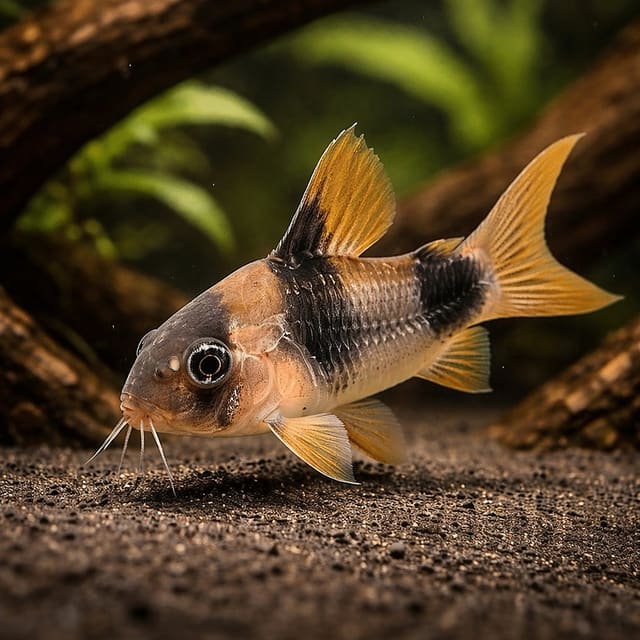
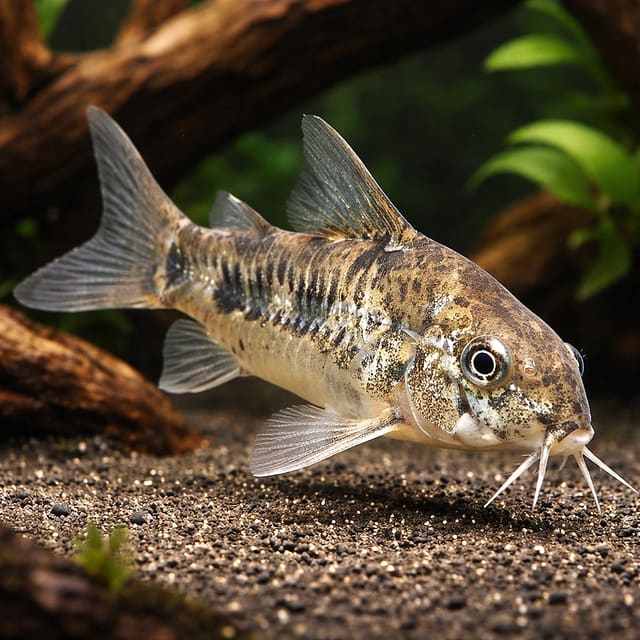
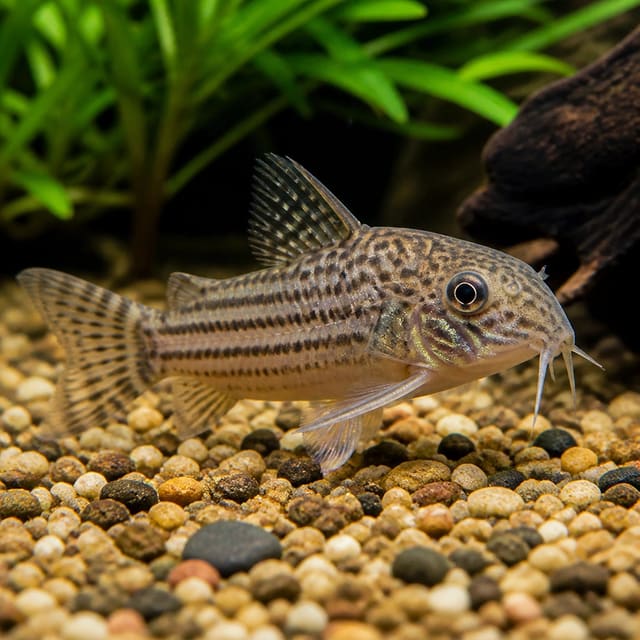
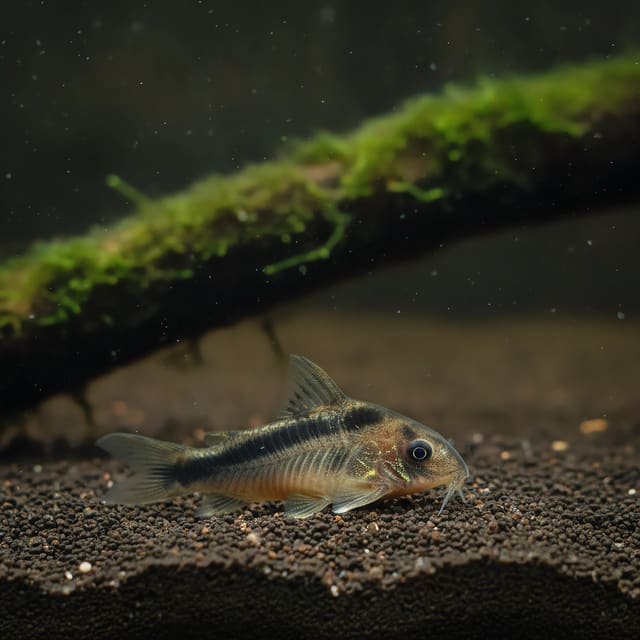
The gallery images are representative, based on reference photographs of this species, so colours can look slightly different from the live animal.
For dispatch days, arrival support and claim terms, read our current delivery and Live Arrival Guarantee policy before choosing a delivery date.
Seriously Fish gives a 30 mm standard-length aquarium planning reference, alongside a 45 × 30 cm tank base and a volume of approximately 41 litres. FishBase records a maximum of 2.1 cm standard length for male or unsexed fish. Use the 30 mm reference when allowing physical space rather than treating a dispatch grade as the final adult measurement.
| Planning point | Working figure |
|---|---|
| Aquarium base | 45 × 30 cm |
| Example volume | Approximately 41 litres in a 45 × 30 × 30 cm aquarium |
| Routine temperature | 22–26 °C |
| Routine pH | 6.4–7.4 |
| Routine hardness | 0–8 dGH |
| Social group | At least 6; preferably 10 or more |
The footprint matters because it creates room for a group to move, feed and retreat among cover. A nominal volume with a short base is not an equal substitute for the stated 45 × 30 cm base, while a larger aquarium can offer more stable temperature and water quality when it is filtered and maintained properly.
Keep the water within the aquarium range shown above and avoid sudden movement between extremes. The fish’s peaceful behaviour does not remove the need for careful feeding and companion selection: its tiny size is the decisive constraint when planning the community.
Start with a base measuring at least 45 × 30 cm. A 45 × 30 × 30 cm aquarium holds approximately 41 litres before displacement by substrate, wood and other décor, and Seriously Fish considers that footprint capable of housing a sizeable group. Use the footprint and mature filtration together rather than treating volume alone as the setup decision.
Dim lighting suits this fish. A heavily planted arrangement can combine live plants, bogwood, twisted roots and some surface vegetation to soften the light. Keep open routes between the cover so the group can move through the middle levels and reach food without being funnelled past more assertive companions.
An Amazonian-style alternative can use river sand, driftwood branches, twisted roots and dried leaves without aquatic plants. Thoroughly dry and strip the bark from beech before aquarium use; oak or beech leaves can contribute to the natural appearance. Replace ageing leaves every few weeks so they do not rot and foul the water.
A small net bag containing aquarium-safe peat may be added to the filter when intentionally simulating blackwater conditions. Treat that as an optional design choice, not a substitute for measuring pH and hardness. Any change created by peat should remain within the planned aquarium range and should be monitored rather than judged from water colour alone.
View the aquarium from above and from the front before the group arrives. Confirm that a fish can move between cover, open water and a feeding area without entering a dead end. Check that surface vegetation dims the light without obstructing the filter outlet, and make sure dried leaves cannot collect against the intake.
Place a small amount of sinking food into the prepared aquarium before livestock is introduced, then watch where it settles. If it disappears behind wood, enters dense planting or is drawn immediately towards the filter, adjust the feeding area. This dry run helps create a visible, reachable location where the whole group can be observed at meals.
Keep at least one route through the middle levels open because this species does not remain exclusively on the substrate. The finished layout should combine sheltered pauses with unobstructed movement rather than dividing the aquarium into isolated pockets.
For routine aquarium care, maintain 22–26 °C, pH 6.4–7.4 and 0–8 dGH. These figures form a practical operating range, not three isolated targets to chase each day. A stable value within each range is preferable to repeated adjustments that cause abrupt swings.
| Measurement | Decision |
|---|---|
| Temperature | Keep between 22 and 26 °C |
| pH | Keep between 6.4 and 7.4 |
| General hardness | Keep between 0 and 8 dGH |
| Ammonia | Maintain at 0 mg/l |
| Nitrite | Maintain at 0 mg/l |
Measure the aquarium before introducing the group and compare the results with your normal replacement water. Our water chemistry guide explains what the main readings mean, while the water matcher helps compare measured values with the stated ranges.
FishBase records broader environmental values of pH 6.0–8.0 and 2–25 dH for the species, but use the tighter aquarium guidance above for routine husbandry. That distinction keeps a wild environmental record from becoming a reason to move a captive aquarium rapidly across a broad range.
Take a complete set of readings while the aquarium is running normally, then repeat the measurements before introduction rather than relying on one isolated test. Compare temperature, pH and hardness with the planned routine range, and confirm ammonia and nitrite remain at 0 mg/l.
If two readings differ, inspect what changed between them. A water change, new décor, peat, increased feeding or altered filter operation can explain movement in the results. Correct the cause gradually and retest before adding livestock. Repeated measurement is more useful than making several adjustments at once because it shows whether the aquarium is settling or continuing to move.
Use the normal tap-water nitrate reading as the baseline for judging the OATA limit. For example, if tap water measures 10 mg/l nitrate, keep the aquarium reading from exceeding 30 mg/l under that guidance. The calculation does not replace the 25% water change at least once every week; it gives the test result a practical reference point.
A working biological filter is essential. The RSPCA explains that filter bacteria process toxic ammonia into nitrite and then into the safer nitrate. Give those bacteria time to establish before livestock is introduced; our first tropical aquarium guide sets out the preparation sequence.
OATA’s freshwater-catfish guidance is broad rather than species-specific; it sets ammonia and nitrite at 0 mg/l and says nitrate should not exceed 20 mg/l above the normal tap-water level. Test the aquarium rather than assuming a running filter is mature.
For an aquarium of approximately 41 litres, Seriously Fish gives a turnover of four to five times the aquarium volume per hour. That works out at a filter rating of approximately 165–205 litres per hour. Check the manufacturer’s rating, then make sure media, pipework and intake guards do not reduce actual circulation to the point that waste collects.
| Setup check | What to establish |
|---|---|
| Biological media | Mature and continuously supplied with oxygenated water |
| Flow rating | Approximately 165–205 lph for a 41-litre example |
| Intake | Clear, secure and appropriate for tiny fish |
| Water tests | 0 mg/l ammonia and 0 mg/l nitrite before introduction |
A heater of roughly 50 W is the reference given for holding 22–26 °C in the 41-litre example when the room is around 20 °C. Choose equipment by the aquarium, room conditions and manufacturer’s instructions, then confirm the result with a thermometer rather than relying on wattage alone.
Watch how the outlet moves water around the 45 × 30 cm base. The aim is continuous filtration without leaving obvious places where uneaten food and solid waste collect. Reposition the outlet, wood or roots if décor blocks circulation, but preserve calmer covered areas and open routes for the group.
Inspect the intake after adding leaves or surface vegetation because loose material can restrict flow. A filter carrying blockage still appears to be running, yet its reduced circulation may no longer match the planned turnover. Check the outlet movement as part of the weekly routine rather than relying only on motor noise.
When comparing equipment, use the rated 165–205 lph range as the starting calculation for the 41-litre example. Then account for the way media, intake protection and pipework affect operation, and confirm that the whole aquarium receives circulation without creating an unusable layout.
Pigmy Corydoras has a tiny mouth, so every item offered must be appropriately small. Fine dried food can be used, but grind down anything too large before it enters the aquarium. Add small live or frozen foods such as sifted Daphnia or Artemia nauplii as a good proportion of a varied diet to support colour and condition.
Corydoras are omnivorous catfish, but they should not be expected to survive on scraps. Use suitable sinking food to meet their needs, then vary it with the small live or frozen foods named above. Freeze-dried Artemia and freeze-dried Daphnia are additional appropriately identified options when their particle size suits the fish.
| If you see this | Do this |
|---|---|
| Food remains too large | Grind or replace it before the next feed |
| Larger fish take everything | Reassess the community and place food where the Pigmy Corydoras can feed |
| Food remains after a few minutes | Remove it and reduce the next portion |
| One fish repeatedly misses food | Observe group access and separate competing feeding routes |
Do not increase food merely because the fish are small and numerous. Portion control protects the biological filter from an avoidable waste spike, while direct observation confirms whether the chosen particle size and placement are working.
Count how many fish approach the feeding area and follow the food through the first few minutes. A portion is not successful merely because it disappears: larger or quicker animals may have taken it before every Pigmy Corydoras fed. Use more than one reachable placement when a single feeding point concentrates competition.
Watch where tiny particles travel after entering the water. Food that remains suspended or settles in an accessible area can be taken by fish using the middle and lower levels. Food drawn into the filter, trapped beneath wood or hidden in dense cover adds waste without feeding the group, so adjust placement rather than adding another portion.
Review body condition and feeding interest across the group during the weekly health check. If one individual repeatedly hangs back, first inspect particle size, companion pressure and access to cover. The feeding decision should solve unequal access without creating excess food for the filter to process.
This cory lives in groups in nature and should be kept as a social group in the aquarium. Keep at least six, with 10 or more preferred. Seriously Fish reports that larger groups shoal more tightly, show greater confidence and create a more effective display.
A fish sitting lower in the aquarium is not automatically a problem because this is still a demersal catfish. Judge a change against its usual behaviour and consider breathing, appetite, colour and the behaviour of the rest of the group at the same time.
Do not use another small species as a substitute for enough Pigmy Corydoras. The fish may school alongside other small aquarium fish, but its own group still provides the social structure for which the minimum of six is advised.
Around 41 litres with a 45 × 30 cm base is the practical starting plan for the group. A larger aquarium may make environmental conditions more stable, but only if filtration, maintenance and feeding remain appropriate. Total stocking must account for every fish and shrimp in the aquarium, not merely the Pigmy Corydoras count.
If an aquarium already contains four Pigmy Corydoras, add enough individuals to reach at least six rather than treating the existing fish as a complete group. If the plan is for 10, calculate filtration and total stocking around all 10 before adding more companions.
Observe whether established fish and newcomers can use the same cover and feeding routes without crowding. A larger number should produce a confident social display, but it also increases the food and waste handled by the aquarium. Keep the social target connected to the 45 × 30 cm footprint, mature filter and measured maintenance routine.
Use several observations across the day before deciding that a group is unusually withdrawn. Compare movement during quiet periods, feeding and interaction with companions. A sustained change across those situations is more meaningful than a brief retreat into cover.
Prepare the aquarium before the fish arrive. Confirm that the filter is mature, temperature is 22–26 °C, pH is 6.4–7.4, hardness is 0–8 dGH, and both ammonia and nitrite measure 0 mg/l. Keep the lighting subdued and make sure cover and feeding areas are already in place.
Increase the aquarium population gradually. Each addition increases feeding and waste, so the beneficial bacteria in the filter must process a greater load. Adding too many fish too quickly can create new tank syndrome, in which ammonia or nitrite rises because the bacterial population cannot yet handle the extra waste.
| Checkpoint | What to assess |
|---|---|
| On introduction | Breathing, balance, swimming and access to cover |
| At the first feeds | Interest in suitably small food and access for every fish |
| During the week | Colour, group movement, hiding and interaction with companions |
| With each water test | Ammonia, nitrite and any unexpected movement in the normal readings |
Healthy fish should have clear, bright eyes, undamaged fins, intact scales and appropriate swimming behaviour. Watch for a sustained change such as hanging at the surface, erratic swimming, unusual bottom sitting, faster or slower gill movement, darker or paler colour, increased hiding, reduced feeding, white spots, fluffy growths or loss of body condition.
If behaviour, breathing, appearance or appetite changes, test the water first because water quality can affect the entire group. Correct any measurable husbandry problem promptly and contact us for guidance about livestock health changes rather than choosing a treatment without a diagnosis.
Complete equipment and water adjustments before introduction wherever possible. Moving wood, changing filtration or altering water chemistry while the fish are settling adds several variables at once and makes a change in behaviour harder to interpret.
During the first feeds, check both appetite and access. Tiny food may be suitable in size yet still fail to reach fish sheltering behind roots or being displaced by companions. Change the placement before increasing the quantity, then remove anything left after a few minutes.
Compare each day with the group’s first settled pattern. Note whether breathing remains even, whether the fish move between cover and open routes, and whether every individual joins feeding. Pair those observations with ammonia and nitrite tests so a behavioural change can be assessed alongside the aquarium’s waste-processing performance.
Carry out a 25% partial water change at least once every week. Treat replacement tap water with a conditioner that removes chlorine or chloramine before it enters the aquarium, and keep its temperature and chemistry close enough to the aquarium to avoid a sudden shift.
If the filter needs cleaning, rinse its media lightly in aquarium water removed during the partial water change. Do not wash mature media under the tap because chlorine or chloramine may kill beneficial bacteria and reduce the filter’s ability to process ammonia and nitrite.
Write down the weekly temperature, pH, hardness, ammonia, nitrite and nitrate results. Record the group’s normal feeding speed, preferred cover and swimming pattern alongside them. A simple baseline makes a meaningful change easier to recognise than a single reading viewed without context.
Replace dried leaves every few weeks before they rot and foul the water. Check that roots, wood and surface vegetation still leave clear movement and feeding routes, and remove trapped debris during routine siphoning. Avoid stripping the aquarium of all established biological surfaces during one maintenance session.
Consistency is the aim: regular testing, a measured water change and light filter care are safer than waiting for visible deterioration and then making several large changes at once.
After each weekly water change, compare the new readings with the preceding entries rather than judging them in isolation. If ammonia and nitrite remain at 0 mg/l, nitrate stays within the stated limit and group behaviour remains steady, continue the routine without unnecessary adjustment.
If nitrate rises more quickly than before, review feeding, total stocking and the amount of solid waste removed. If circulation has weakened, inspect the intake and media path for blockages before changing equipment. When pH or hardness moves, compare replacement water and any recent peat, wood or leaf changes.
Use the written baseline to coordinate maintenance tasks. Clean only what needs attention, preserve mature biological media and avoid replacing all leaves or rearranging all cover during the same session. Small, recorded actions make their effects easier to judge at the next test.
Pigmy Corydoras is peaceful, but its small adult proportions make community selection unusually important. Larger fish may intimidate it, outcompete it at feeding time or eat it. Peaceful behaviour in a proposed companion is therefore only one part of the decision.
| Compatibility decision | Guidance |
|---|---|
| Avoid | Angelfish, gouramis and larger catfish because they may treat it as prey |
| Use caution | Any larger or faster feeder that can prevent the group reaching food |
| Consider conditionally | Similarly sized characins or cyprinids with overlapping water needs |
| Consider conditionally | Some small freshwater shrimp where size, water and feeding needs align |
| Specialist possibility | Apistogramma and other dwarf cichlid setups, with the whole aquarium assessed carefully |
A species-only aquarium is a sound choice because it removes competition from larger community fish. In a mixed aquarium, choose other tiny animals and make sure all occupants fit 22–26 °C, pH 6.4–7.4 and 0–8 dGH without requiring one species to live at the edge of its range.
For an animal not named here, treat the outcome as uncertain until those checks have been completed. Ask us for a stocking and compatibility assessment if you want the proposed species, numbers, aquarium dimensions and measured water considered together.
Begin with physical risk. If a proposed companion could swallow this tiny cory, stop the assessment even when its temperament is described as peaceful. Next compare routine water ranges; a numerical overlap should leave both animals within their normal range rather than placing either one at an extreme.
Then assess food delivery. A similarly sized companion can still be unsuitable when it takes every tiny sinking item before the cory group reaches it. Plan visible feeding routes and observe a test feed with the existing inhabitants before increasing stocking.
Finally, count every animal in the aquarium and consider the added waste load. A social group of six or 10 Pigmy Corydoras is only one part of total stocking. The mature filter, 45 × 30 cm base, cover and weekly maintenance must remain workable after all proposed companions are included.
Compatibility remains an ongoing observation rather than a one-time label. Watch the group when companions are feeding, moving through its preferred middle levels and using cover. A mix that meets the numerical water requirements can still fail if the Pigmy Corydoras cannot feed or remains intimidated.
| Observation | Response |
|---|---|
| The group reaches food and resumes normal movement | Continue the same portion, placement and observation routine |
| Faster fish take the small food first | Change feeding access and reassess whether the mix is workable |
| The cory group hides more than normal | Test water, inspect cover and observe whether companions are intimidating it |
| A companion stalks or attempts to swallow a cory | Separate the incompatible animals |
| Breathing or appetite changes across the group | Test ammonia, nitrite and the routine water values immediately |
Do not rely on the broad label “community fish”. Seriously Fish describes this species as very peaceful but also says it is not an ideal general community fish because of its tiny adult size. Build the community from the cory’s physical vulnerability and feeding needs rather than from temperament alone.
Keep at least six Pigmy Corydoras even when other shoaling fish are present. Similarly sized characins or cyprinids may school alongside them, but that interaction does not replace their own group. Small freshwater shrimp remain a conditional possibility rather than a universal recommendation because the shrimp’s size, water needs and feeding behaviour must also fit.
Review the complete stocking plan whenever another animal is added. More inhabitants increase waste and feeding pressure, so confirm that the mature filter and weekly maintenance routine can support the revised load.
Observe the aquarium during feeding, after the fish move away from food and while they use cover. These moments answer different questions: feeding shows competition, later movement shows whether the group remains confident, and use of cover shows whether shelter is accessible rather than controlled by companions.
Compare the whole group with its established baseline. One fish briefly entering cover may be normal, while repeated missed feeds, sustained hiding or altered breathing requires action. Test ammonia and nitrite whenever several fish change behaviour together, then inspect companion pressure and feeding access.
After adding another animal, repeat the compatibility screen rather than assuming an established aquarium will absorb the change. Recalculate total stocking, watch the first feeds and check whether movement routes remain open. Separate animals promptly if stalking or attempted predation occurs.
Pigmy Corydoras reaches a maximum recorded length of 2.1 cm standard length. Seriously Fish also uses a 30 mm standard-length aquarium planning reference, so plan the aquarium around the stated 45 × 30 cm base rather than the dispatch size.
Plan a mature, filtered aquarium with a base of at least 45 × 30 cm. A 45 × 30 × 30 cm example is approximately 41 litres before substrate and décor displace water.
Keep Pigmy Corydoras in a group of at least six, with 10 or more preferred. Larger groups show greater confidence and may shoal more tightly.
A beginner should choose Pigmy Corydoras only when prepared to maintain a mature biological filter, test the water, keep the full social group and make sure tiny food reaches every fish.
Offer Pigmy Corydoras tiny dried foods, grinding them when necessary, plus small live or frozen foods such as sifted Daphnia or Artemia nauplii. Feed only what the fish consume within a few minutes, once daily.
Maintain 22–26 °C, pH 6.4–7.4 and 0–8 dGH. Keep ammonia and nitrite at 0 mg/l, use a mature biological filter and test the water every week.
This fish is very peaceful, and aggression towards other species is virtually unheard of. Its main compatibility issue is vulnerability to larger fish and competition from companions that take its food.
Consider similarly sized characins, cyprinids or some small freshwater shrimp only when water and feeding needs align. Avoid angelfish, gouramis and larger catfish because they may eat it.
Start filming every delivery continuously while the parcel is still sealed, then record it being opened with the fish still in the sealed bag. Someone must be present to receive it; float the bag for 20–30 minutes before release and never pour the bag water into the aquarium.
No reviews for this item yet. Bought one? Honest reviews only, good or bad.
What customers say about ordering from us
Easy website plenty of info on fish your buying great to pick a time slot
TRACEY DURRANT · 7 Oct 2026
Got some lovely fish thank you
Kevin Mackie · 7 Oct 2026
Reviews of our shop, collected by Judge.me, an independent third-party review collector. Newest first.