By Tropical Fish Co Editorial Team
The direct answer
The lemon tetra is the small South American schooling fish Hyphessobrycon pulchripinnis. FishBase records 3.8 cm maximum standard length, a 23–28°C temperature range and a group of five or more; standard length stops before the tail fin, so a relaxed fish can look slightly longer from nose to tail tip [2] [3].
For a home aquarium, our more cautious buying screen is a mature, filtered tank with an 80 × 30 cm footprint, a group of 8–10 where the total stocking allows it, cover around the edges and open mid-water swimming space. That footprint and group come from specialist species guidance, while OATA's UK advice provides the broader tetra minimum of five [5] [6].
The most important correction is that there is no single “UK tap water” setting. FishBase, OATA and specialist guidance publish different ranges, and the Drinking Water Inspectorate says supply hardness varies locally. Test the water you will actually use, compare it with the seller's holding water and favour stability over sudden attempts to reach an internet number [8].
In a six-month aquarium study, males held temporary morning territories and females entered them for repeated short spawning acts. The species released batches across many acts rather than one simple all-at-once event. That is a useful biological insight—not a promise that a community aquarium will produce surviving fry. [4]
Is it really a lemon tetra?
The accepted name is Hyphessobrycon pulchripinnis Ahl, 1937. Current catalogues place it in Acestrorhamphidae, although older aquarium books and papers often use Characidae. The Catalog of Fishes records the historical type locality as uncertain because the description used aquarium specimens, while the accepted distribution is the Tapajós basin in Brazil [1].
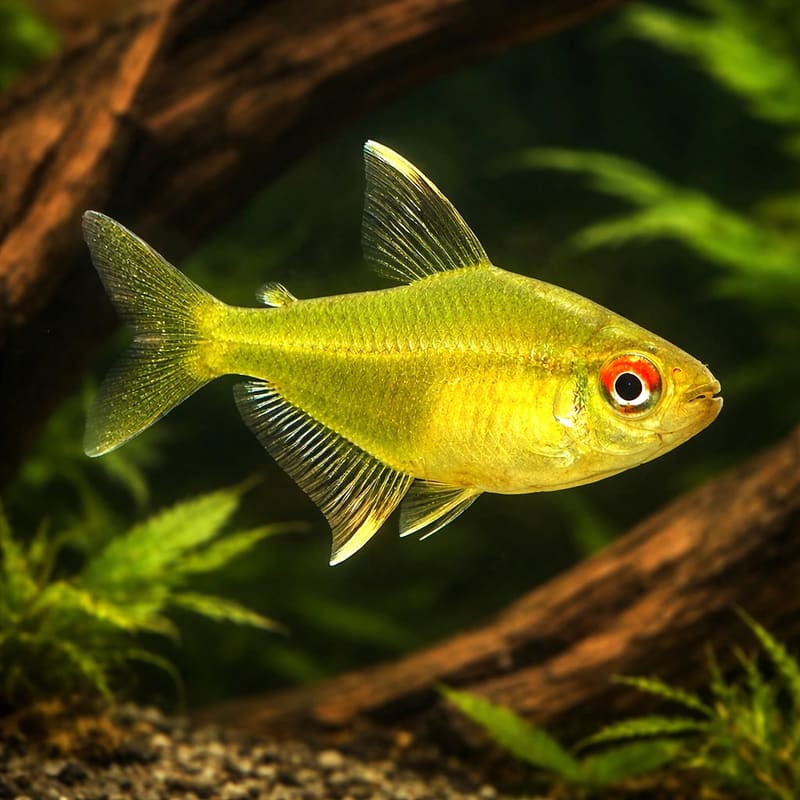
That history matters because commercial names and photographs can make identity look simpler than it is. Seriously Fish distinguishes the familiar lemon form from a more orange-red commercial form and cautions that their relationship is not fully resolved. We therefore use H. pulchripinnis for the established lemon form and do not claim that every redder shop fish is merely the same colour morph [5].
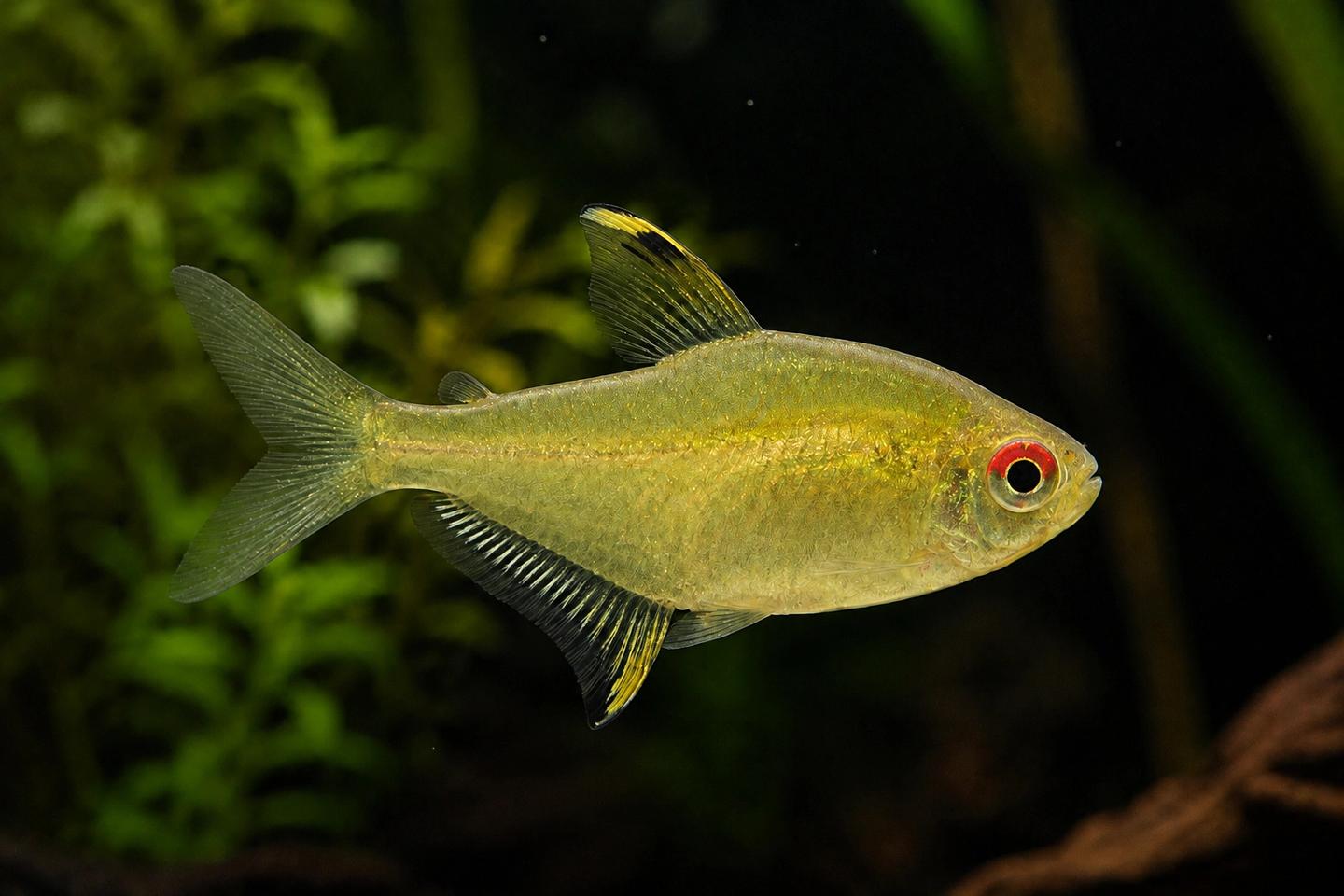
Use a combination of clues:
| Look at | Useful lemon-form clue | What it cannot prove |
|---|---|---|
| Body | Translucent, pale greenish-yellow or lemon wash | Health, age or exact lineage from colour alone |
| Eye | Orange-red is concentrated mainly in the upper iris | A bright eye is not a medical test |
| Dorsal fin | Dark anterior marking with yellowish and pale areas | Sex from one fin in one photograph |
| Anal fin | Yellowish front area with a dark edge/marking | Adult size or current shop condition |
| Tail | Mostly clear, forked tail | Exact identity without the other characters |
The close-up image in the gallery is designed to make those clues easier to compare. It is an identification aid, not a substitute for accurate supplier identity or an examined specimen.
Lemon tetra size: what 3.8 cm means
The strongest scientific size figure in the reviewed sources is 3.8 cm standard length for male or unsexed fish and 3.6 cm standard length for females in FishBase [2]. This is often repeated online as “about 4 cm,” but the measurement distinction matters: standard length excludes the tail.
Do not turn a maximum record into a ruler for judging age, sex or health. A shop fish may be younger, and body depth, tail posture and viewing angle change how large it appears. Plan the aquarium for adult dimensions before purchase rather than assuming today's sale size is final.
Tank Volume Calculator
Enter length, width, and height to get your real water volume in litres.
Open tool →Tank size and layout
A litres-only answer misses the feature these fish use most: horizontal swimming room. Seriously Fish recommends an 80 × 30 cm base for the species, while FishBase carries a broader 60 cm minimum aquarium size from an aquarium reference [5] [2]. For this page, the 80 × 30 cm footprint is the more cautious starting screen for a proper group.
That is not permission to fill every 80 cm tank with the same count. Filter capacity, real water volume after décor, maintenance, oxygen, the size of every other adult fish and the way territories overlap all matter. The RSPCA advises choosing as large an aquarium as practical and notes that wider tanks generally provide more oxygen exchange than tall tanks of the same nominal volume [7].
A useful layout has:
- planted or structured cover at the rear and sides;
- an open lane through the middle for group swimming;
- a secure lid and a correctly sized filter;
- a thermostatic heater and separate thermometer;
- gentle-to-moderate circulation without making the whole tank a high-flow channel;
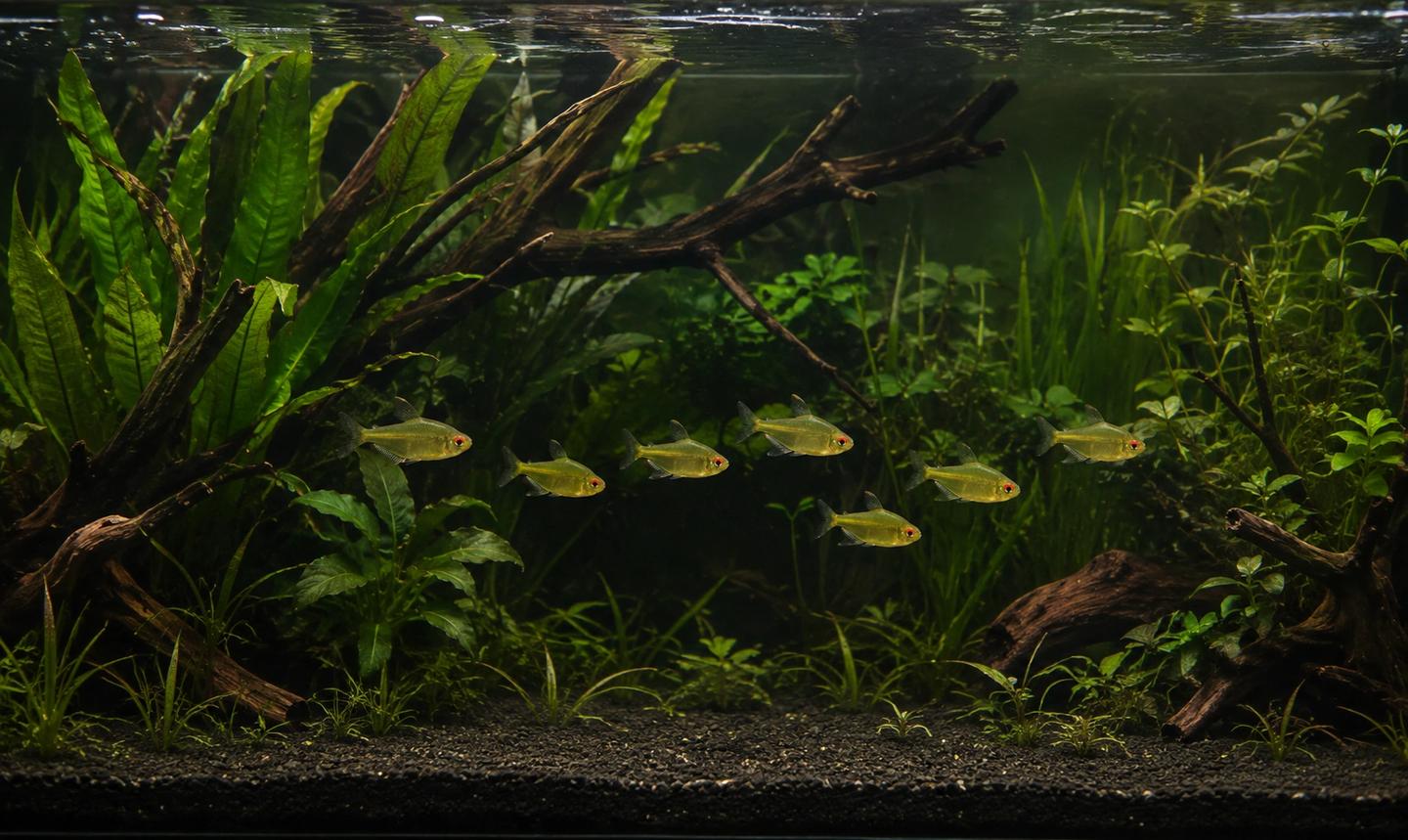
- a dark area or plant shade the fish can choose, without using darkness to hide poor welfare.
The gallery's long-tank visual shows this cover plus open lane principle. It deliberately avoids giving a fixed stocking count because a picture cannot calculate filtration, adult biomass or compatibility.
Group size: five, eight or ten?
FishBase and OATA state at least five for tetras, and OATA explains that a fish kept alone or in too small a group can become stressed [2] [6]. Specialist lemon-tetra guidance recommends 8–10, which is our cautious starting target where the aquarium can support it [5].
The numbers are not contradictory when their scope is kept clear:
- Five is the broad floor recorded in group-level sources.
- Eight to ten gives a stronger species-specific planning target.
- More is not automatically better if it creates crowding, unstable water or food competition.
If a group is hiding, pale or chasing, check water quality, recent changes, cover, light, food access and the behaviour of every tank mate before assuming “add more fish” is the only answer.
Water parameters for a UK aquarium
There is evidence for tolerance, but not for the old claim that every lemon tetra will “thrive in hard UK tap water.” The reviewed ranges are:
| Source and scope | Temperature | pH | General hardness |
|---|---|---|---|
| FishBase species compilation | 23–28°C | 5.5–8.0 | lower limit unspecified; upper record 25 dH |
| OATA captive-bred tetra group | 22–27°C | 6.5–8.0 | 4–12 dGH |
| Seriously Fish species guidance | 20–28°C | 5.0–7.5 | 1–12 dGH |
Those are evidence boundaries, not targets to bounce between. A practical decision is a stable temperature in the shared zone that also suits the other fish, with ammonia and nitrite at zero and nitrate controlled through mature filtration and maintenance. OATA specifically says its numbers are group guidance and that species-specific needs and the retailer's holding conditions should be checked [6].
For UK source water, use your water company's current postcode report as a starting point, then test the aquarium and replacement water. Kettle scale suggests minerals, but it does not give aquarium pH, GH or KH. A domestic ion-exchange softener can also replace calcium and magnesium with sodium, so “softened” household water is not automatically an aquarium solution [8].
Water Parameter Matcher
Enter your tap water readings to see if this species will thrive.
Open tool →Tank mates: a decision, not a safe list
Lemon tetras are generally peaceful mid-water fish, but “peaceful” does not guarantee every pairing. Screen the whole plan:
| Check | Better sign | Stop or rethink when |
|---|---|---|
| Adult size | Companions cannot swallow or overpower a lemon tetra | A predator can fit the tetra in its mouth |
| Water overlap | The chosen stable setting suits all species | One species is being held at the edge of its evidence range |
| Space | Separate swimming and resting zones remain available | The tank is full on litres before behaviour is considered |
| Feeding | Every fish can reach suitable food | Shy or bottom fish repeatedly miss meals |
| Behaviour | Brief display ends without injury or exclusion | Persistent pursuit, torn fins, hiding or blocked access |
| Contingency | A cycled separation option is ready | There is nowhere safe for an injured or targeted fish |
Small community tetras and rasboras, peaceful bottom dwellers and some calm dwarf species may pass that screen in a sufficiently large aquarium. Long fins, territorial breeding behaviour or very active companions add risk. Adult shrimp are not guaranteed safe, and shrimplets are potential food for small omnivorous fish.
Use our Cardinal Tetra guide, Ember Tetra guide and Corydoras guide to compare each species' evidence rather than treating their names as a compatibility promise.
Feeding and colour without miracle claims
FishBase records worms, crustaceans and plant matter in the diet [2]. In an aquarium, use appropriately sized complete dry food as a dependable base and rotate suitable frozen or live foods for variety. Feed portions the group can consume while you watch; remove leftovers and make sure quieter fish eat.
Colour is affected by genetics, age, condition, stress, social setting, diet, background and lighting. A varied diet can support normal condition, but no ingredient guarantees that a pale fish becomes yellow within a fixed number of days. Redness in the upper iris is an identity clue, not a standalone health gauge.
If colour changes suddenly, do not treat the colour itself. Check measured water, temperature, breathing, appetite, posture, fins, recent additions and whether more than one species is affected. That context is more useful than diagnosing from a photograph.
Sexing and breeding
Adult females are often described as fuller-bodied, while males may be more intensely marked, but overlap and condition make visual sexing uncertain. Do not promise a sex from one young fish or one picture.
The best primary evidence on reproduction is Burt and colleagues' aquarium study. It recorded males defending temporary territories during a morning spawning period, individual females entering those territories, brief courtship and repeated spawning near suitable substrate. The adults provided no parental care, and batches were released through many spawning acts [4].
For a keeper, the safe conclusions are modest:
- this is an egg-scattering species, not a livebearer;
- spawning behaviour does not mean eggs or fry will survive;
- adults and tank mates may eat eggs or tiny fry;
- a separate, mature breeding setup is more controllable than a community tank;
- no clutch, hatch rate, sex ratio or saleable result is guaranteed.
When something looks wrong
Pale colour, hiding, clamped fins, surface breathing and damaged fins are signs to investigate, not diagnoses. Start with measured temperature, ammonia, nitrite, nitrate, pH, oxygenation, recent maintenance, new livestock and feeding access. Observe whether one fish, one species or the whole aquarium is affected.
The MSD Veterinary Manual emphasises a full history, water-quality assessment, quarantine and diagnostic testing; it discourages prophylactic medication without a diagnosis [9]. That is why this page does not prescribe salt, heat or a medicine from a symptom table. Isolate when necessary with suitable equipment and seek a fish-experienced veterinary professional for severe, persistent or spreading signs.
For the underlying method, use our nitrogen-cycle guide before adding livestock and our new-fish acclimation guide for a context-aware arrival process. Follow the current seller instructions when they are more specific to the shipment; do not combine incompatible acclimation routines.
Buying lemon tetras without freezing stock claims
Before purchase, confirm the exact trade and scientific name, current sale size, sale unit, seller's water, group availability and arrival instructions. Look for fish that swim normally, hold their fins naturally, breathe without obvious distress and can reach food. One attractive photograph cannot prove the condition of another fish.
Check the current Lemon Tetra listing
The product page owns today's size, price, sale unit and checkout availability. This guide owns long-term identity and care, so it never promises that stock is available before the live listing confirms it.
If the product is unavailable, do not reduce the school below the planned welfare group simply to buy immediately. Wait for enough correctly identified fish or choose a different species that fits the aquarium you actually have.
How this guide was checked
Scientific identity and the accepted distribution were checked against the current Catalog of Fishes. FishBase supplies the compiled species record and explicitly labelled aquarium notes; the 1988 paper supplies the primary reproduction evidence. OATA and the RSPCA provide UK practical and welfare context, while the Drinking Water Inspectorate explains why local source water must be measured. Seriously Fish is used as specialist secondary guidance with its taxonomic cautions preserved, not as a substitute for the scientific sources.
Search Console showed that the page was already indexed and receiving UK-mobile impressions, especially for “lemon tetra,” while clicks remained low. The repair therefore focuses on an accurate size-and-tank search promise, a fast direct answer, better identification images and removal of unsupported claims. It is not an indexing fix, and no ranking or click improvement is claimed before deployment, recrawl and an equal-window comparison.
Corrections, feedback forms and email are never counted as leads or ecommerce conversions. Purchase and revenue are final commercial outcomes; add-to-cart and checkout are diagnostic ecommerce steps.
Continue planning
- Compare the broader tetras range only after checking the care page for each candidate.
- Use the planted-tank fish hub for layout-compatible ideas, not as an automatic compatibility list.
- Read the Cardinal Tetra guide and Ember Tetra guide before choosing by colour alone.
- If a larger displaying tetra is the goal, the Black Phantom Tetra guide owns that separate decision.