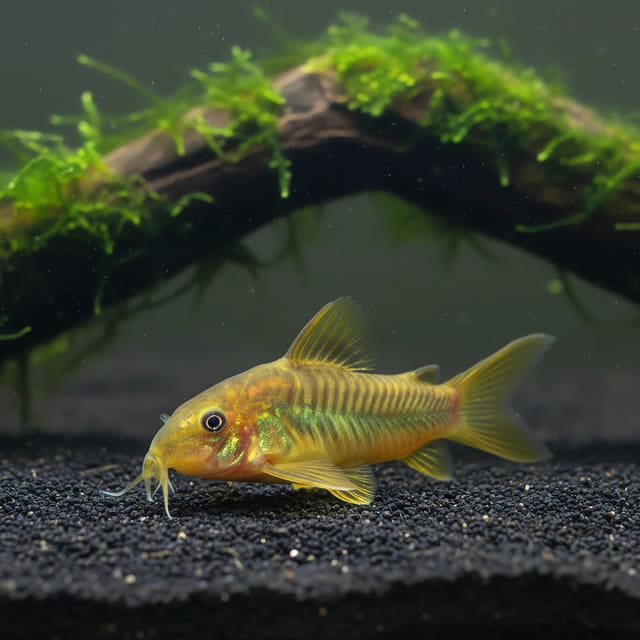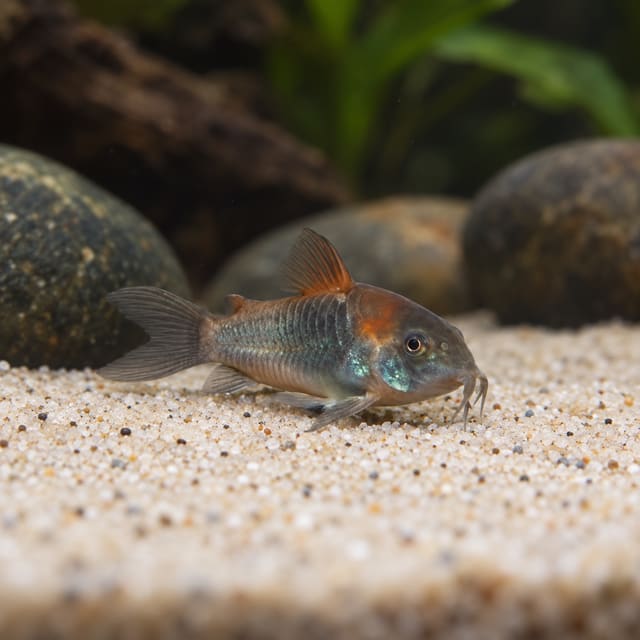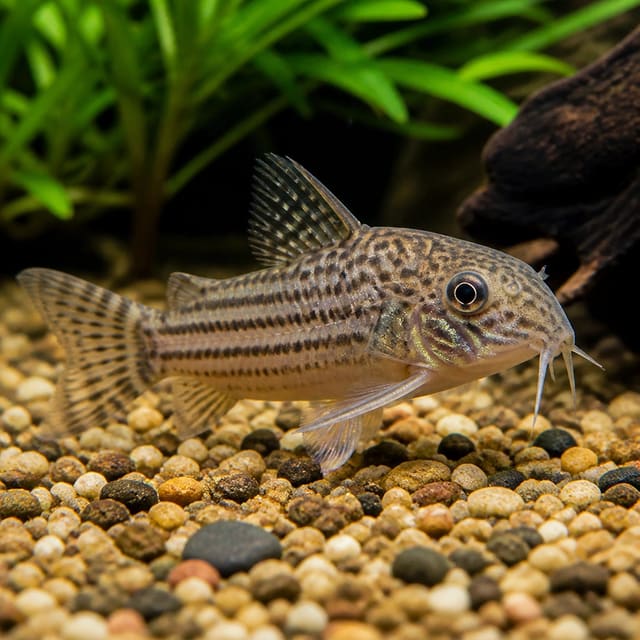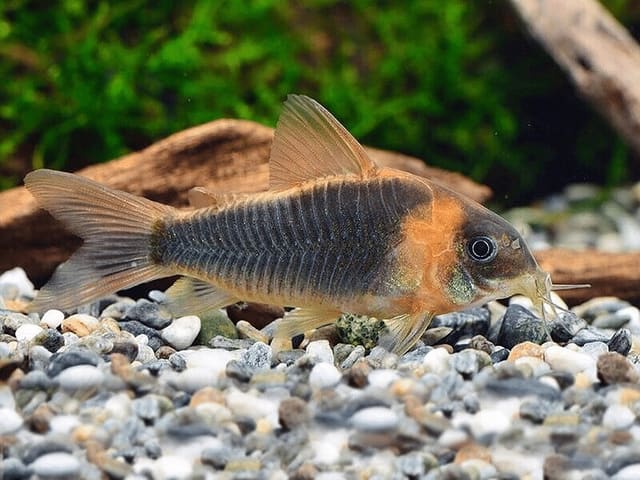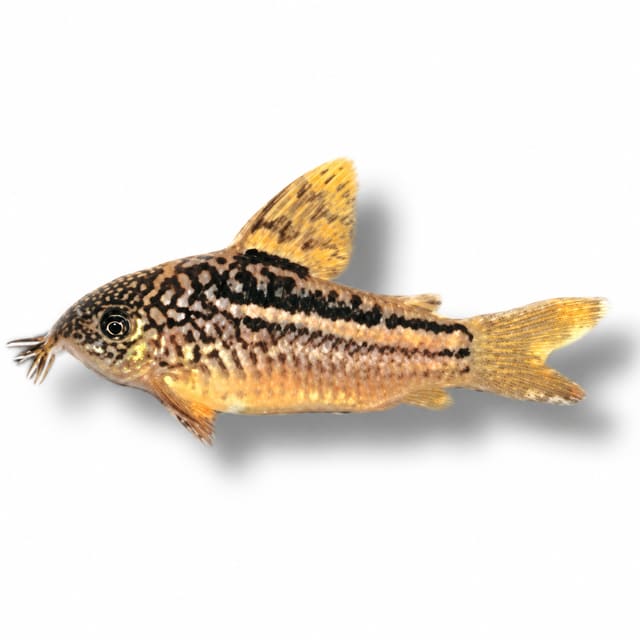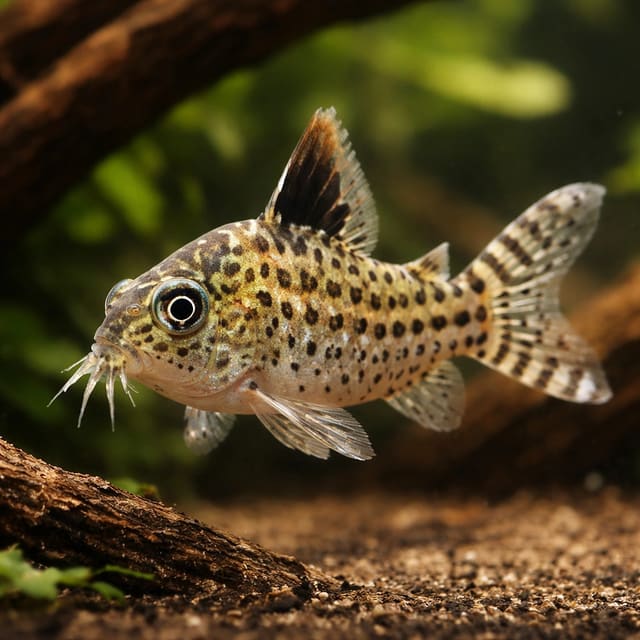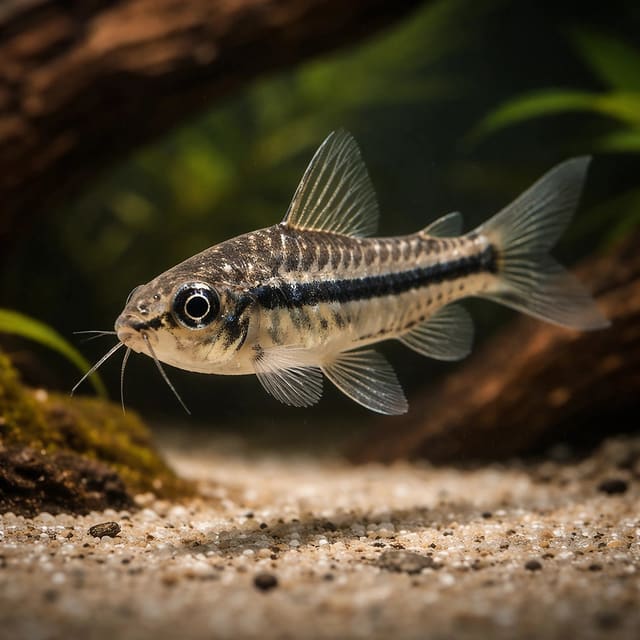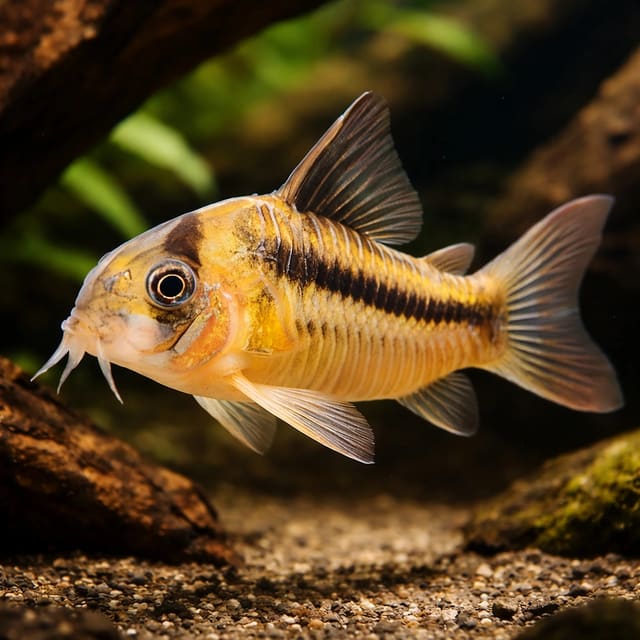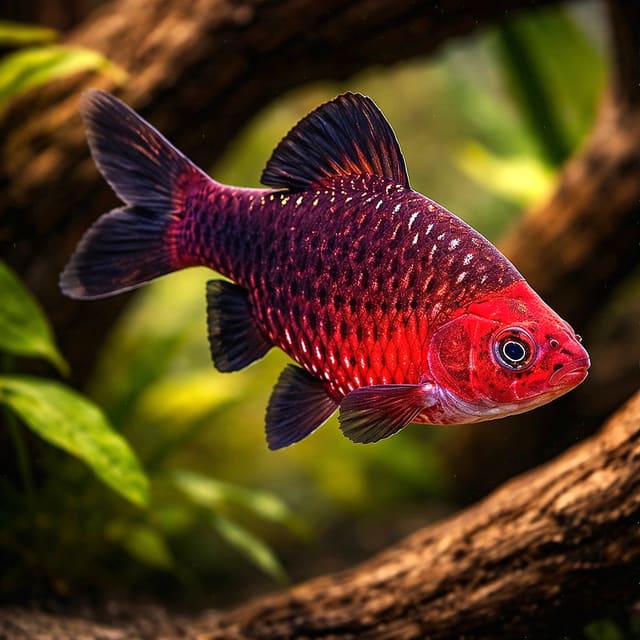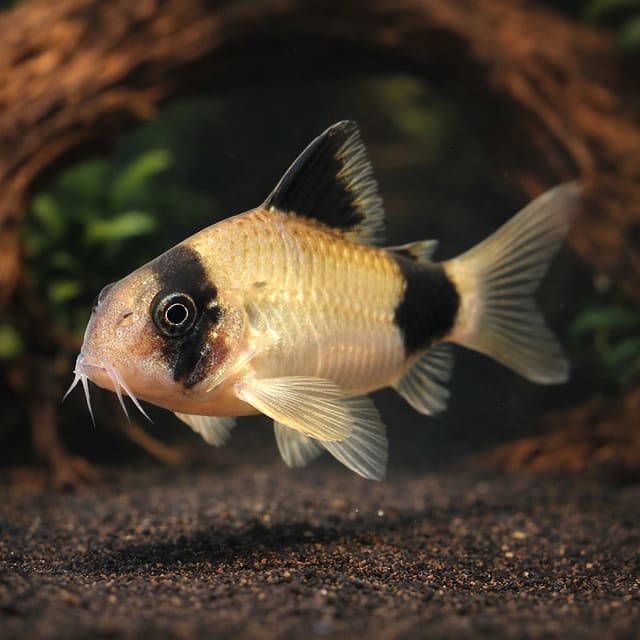
Panda Cory Catfish (Corydoras panda)
22–25°C · pH 6–7.4
£7.29
The Bronze catfish (Corydoras aeneus) is a long-finned callichthyid catfish from South America that reaches 7.5 cm standard length. It suits a peaceful community planned for at least five, with routine water at 25–27°C and pH 6.0–8.0, the overlap of FishBase, Seriously Fish and OATA guidance. Sold individually.
Adult size is the maximum length this species reaches at full maturity (scientific sources). The livestock you receive will be younger and smaller. Product-photo provenance and any image-specific limitations are stated on the listing.
Corydoras aeneus
Shoaling fish: kept in a group they feel safer, stay calmer and show their best colour.
Minimum of 2 per order.
The Bronze catfish (Corydoras aeneus) is a long-finned callichthyid catfish from South America that reaches 7.5 cm standard length. It suits a peaceful community planned for at least five, with routine water at 25–27°C and pH 6.0–8.0, the overlap of FishBase, Seriously Fish and OATA guidance. Sold individually.
Adult size is the maximum length this species reaches at full maturity (scientific sources). The livestock you receive will be younger and smaller. Product-photo provenance and any image-specific limitations are stated on the listing.
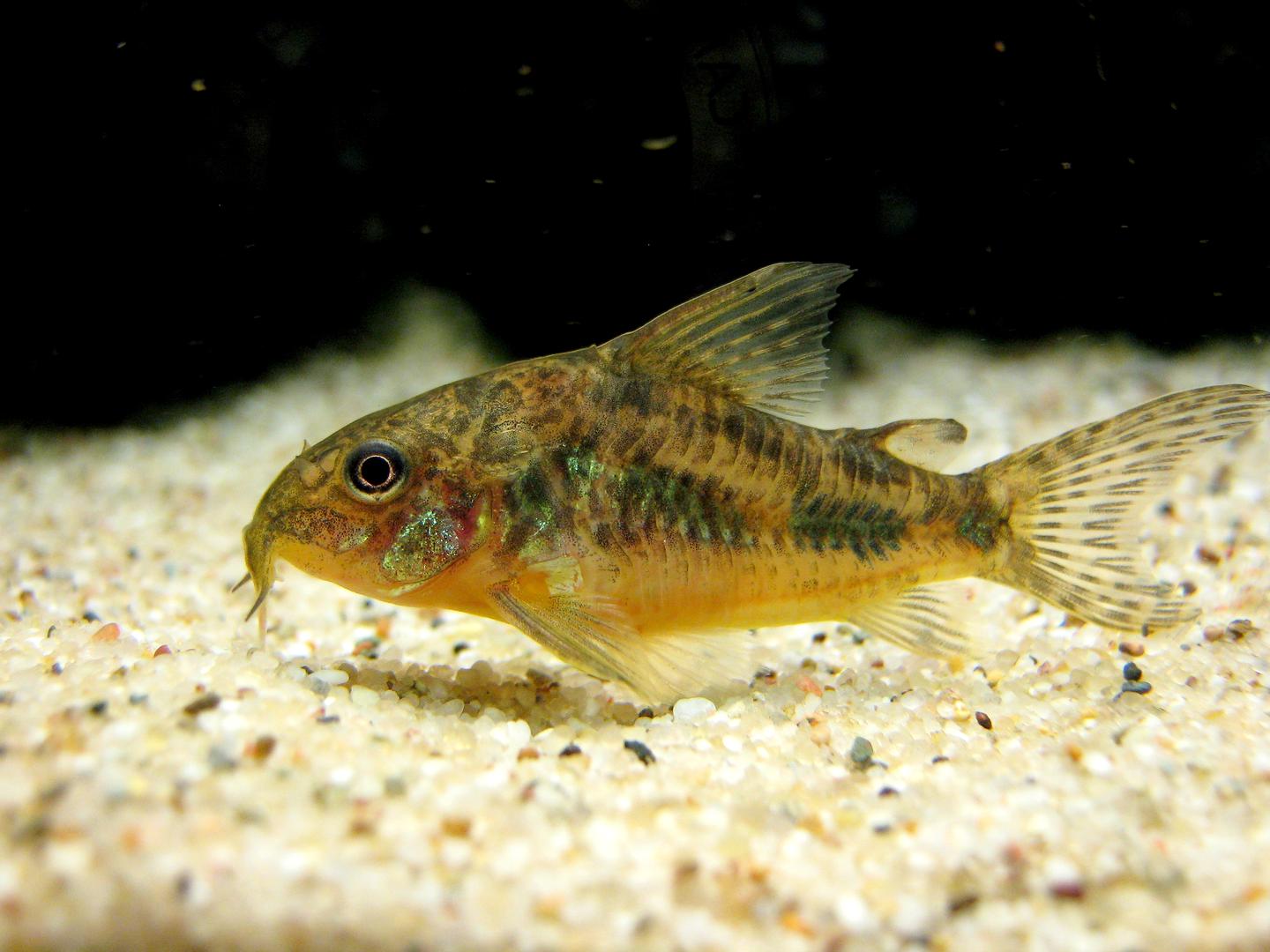
Identify the exact cory catfish before choosing care. Our starting policy for many common medium species is six compatible conspecifics, a mature 60 x 30 cm aquarium of about 60 litres, smooth fine sand and measured species-appropriate water.
Maintain these water conditions for optimal health and vibrant colors
The Bronze catfish (Corydoras aeneus) is a long-finned freshwater catfish in the Callichthyidae family. It comes from a South American species recorded from Colombia and Trinidad to the La Plata River basin east of the Andes, and it reaches 7.5 cm standard length. This peaceful, social bottom-dweller suits a mature community aquarium that has enough floor space for a group of at least five.
FishBase records the wild fish in quiet, shallow water with soft bottoms, although it also occurs in running water. It is benthic, meaning that much of its activity centres on the bottom. Adults in nature form schools of 20–30 and feed on worms, crustaceans, insects and plant matter. Those details explain why an aquarium should combine a clean, fish-safe bottom with a varied sinking diet and the company of its own kind.
FishBase now lists it as Osteogaster aenea, with Corydoras aeneus treated as a synonym. The familiar Bronze catfish and Bronze Cory trade names remain useful when discussing the fish with aquarists. The long-fin form is one of the selectively bred strains described by the Seriously Fish species profile.
Foraging along the bottom is normal behaviour, but the fish is not an aquarium-cleaning tool. Its diet must reach it directly instead of being left to chance after other fish have eaten. FishBase also describes the species as a facultative air-breather that can take air at the surface using its intestine. A surface visit therefore needs to be judged alongside breathing rate, colour, appetite, water tests and the behaviour of the whole group rather than treated as a diagnosis by itself.
Plan for a fish that combines social needs, a 7.5 cm adult length and regular bottom-level foraging. These priorities matter more than the decorative fin form. You can also browse the corydoras collection when comparing related fish, but assess each product by its own adult dimensions, group needs and water requirements.
This Bronze catfish is sold individually, so one purchase supplies one fish. The dispatch grade is 3–3.5 cm, while the recorded adult length is 7.5 cm standard length. Treat the smaller figure as the size at dispatch, not as a limit on future growth, and prepare the permanent aquarium before the fish arrives.
Sex is guaranteed only when the selected option explicitly states male or female. This Bronze catfish listing has no sex-guaranteed option.
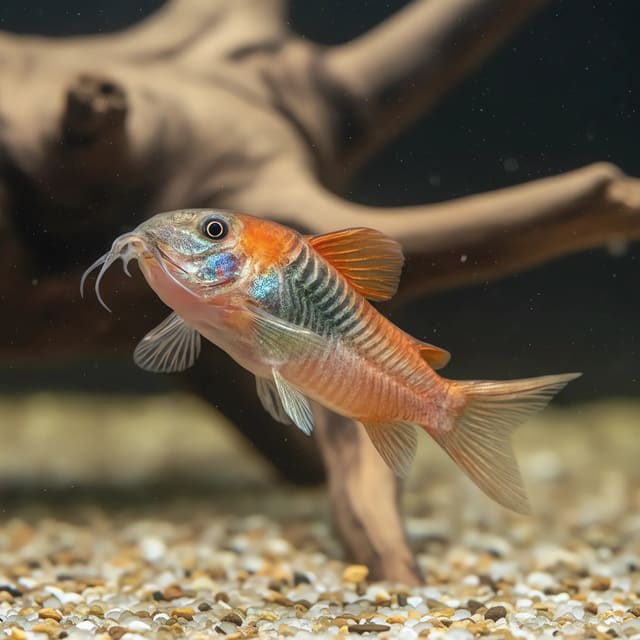
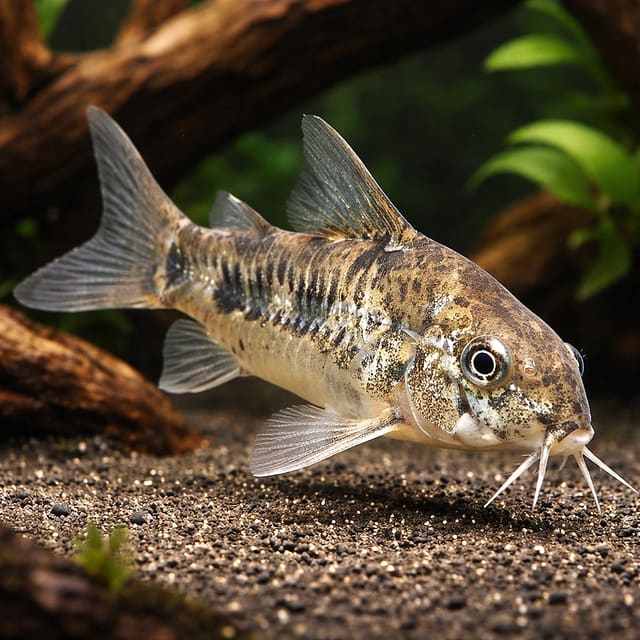
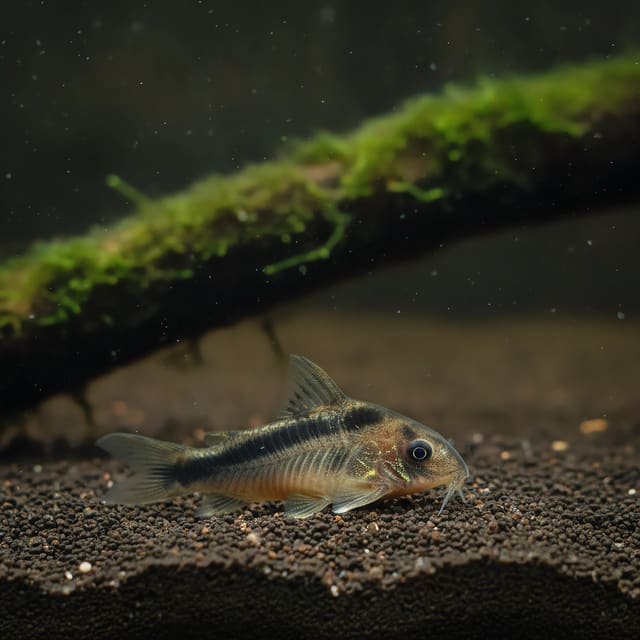
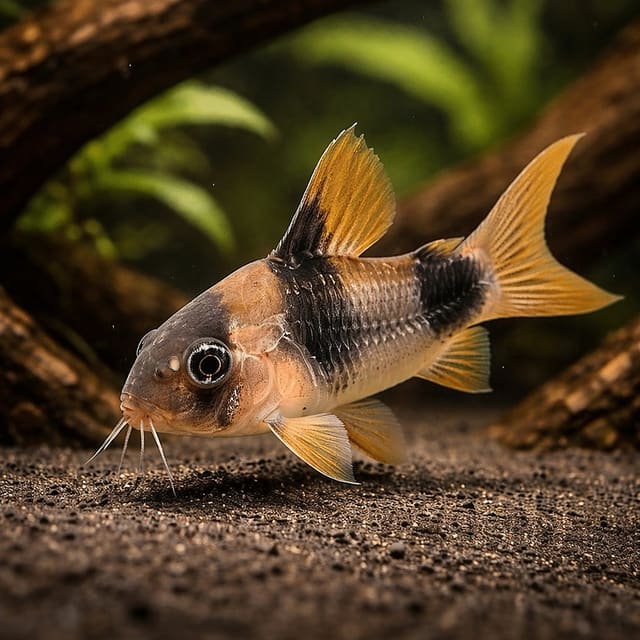
Some gallery images have been digitally enhanced to improve image quality. They show the listed type of animal rather than guaranteeing the exact markings of the individual supplied, so natural colour and pattern can vary.
| Suits | Not suited to |
|---|---|
| A peaceful community aquarium | A plan based on keeping one fish alone |
| A group of at least five Bronze catfish | A group smaller than five |
| An aquarium base of at least 80 × 30 cm or equivalent | A layout without adequate bottom area |
| A mature, filtered aquarium with zero ammonia and nitrite | An unfiltered or newly prepared aquarium |
| Direct feeding with varied sinking foods | Reliance on scraps left by other fish |
OATA’s freshwater-catfish guidance says Corydoras should be kept in groups of at least five and that undersized groups will often become stressed. Seriously Fish recommends at least 4–6, while FishBase gives five or more for aquarium keeping. Keeping at least five therefore meets the stronger common threshold.
Suitability depends on providing all of these conditions together. A large footprint does not compensate for an immature filter, and good water values do not replace the social group. Likewise, peaceful behaviour does not make every community automatically suitable; all residents still need compatible water, space, temperament and access to food.
Prepare the whole group and its long-term footprint as one decision. If the aquarium can house only a single bottom fish, choose a different animal whose social needs fit that plan instead of reducing the Bronze catfish group.
Plan for an adult length of 7.5 cm standard length and an aquarium base measuring at least 80 × 30 cm or an equivalent footprint. Seriously Fish recommends those base dimensions for long-term care and associates them with a volume of about 72 litres. The base measurement is the decisive feature because this fish forages and socialises near the bottom.
FishBase also gives a minimum aquarium length of 60 cm, but the 80 × 30 cm long-term footprint provides the clearer complete planning reference. Do not compare tanks by litres alone: two aquariums with similar volumes can have very different base dimensions. A tall, narrow aquarium may hold the same number of litres while giving the group less usable bottom area.
| Check | Decision |
|---|---|
| Base is at least 80 × 30 cm | Continue to filtration, water and stocking checks |
| Volume is about 72 litres but base is smaller | Choose a wider aquarium or equivalent footprint |
| Base meets the recommendation but is crowded with décor | Restore open foraging routes and cover |
| Other bottom fish already use the same area | Assess the combined demand on floor space and food access |
Measure the uninterrupted internal base rather than relying only on a model name. Then consider how wood, pots, plants and filter equipment divide that area. Cover is useful, but the group also needs connected routes across clean substrate. Décor that creates several dead ends can leave a nominally adequate footprint awkward to use.
Adult-size planning also affects stocking. Use 7.5 cm for each Bronze catfish when considering the mature group, rather than multiplying the dispatch measurement. A group of five represents five adult fish using the bottom, feeding and producing waste. Existing residents must be included in the same calculation.
Recheck the layout as plants grow or décor moves. If an open feeding area becomes obstructed, restore a clear patch where sinking food can be seen and removed if uneaten. This makes it easier to confirm that every group member feeds and that waste is not accumulating out of sight.
Keep routine aquarium water at 25–27°C, pH 6.0–8.0 and 5–15 dGH. These values are the overlap of FishBase’s recorded environment, Seriously Fish aquarium husbandry and OATA’s freshwater-catfish group guidance. FishBase gives 25–28°C, pH 6.0–8.0 and 5–19 dGH; Seriously Fish gives 21–27°C, pH 6.0–8.0 and 2–15 dGH; OATA gives 22–27°C, pH 6.0–8.0 and 4–18 dGH.
| Measurement | Routine instruction |
|---|---|
| Temperature | 25–27°C |
| pH | 6.0–8.0 |
| General hardness | 5–15 dGH |
| Ammonia | 0 mg/l |
| Nitrite | 0 mg/l |
| Nitrate | No more than 20 mg/l above the normal tap-water level |
Test the aquarium rather than estimating from its appearance. A clear tank can still contain ammonia or nitrite, while a stable reading gives a concrete basis for stocking and maintenance decisions. Our water chemistry guide explains what the main measurements mean, and the water matcher helps compare measured values with this range.
An aquarium at 26°C, pH 7.2 and 10 dGH sits inside all three routine ranges. It is suitable on those measurements if ammonia and nitrite are also zero and nitrate remains controlled. By contrast, water at 23°C is inside the Seriously Fish and OATA ranges but outside FishBase’s recorded 25–28°C environment, so raise it into the 25–27°C shared range before treating the aquarium as ready.
Stability remains important within the range. Do not alter temperature, pH or hardness merely to chase a central number when the aquarium is already stable inside all three limits. Make any necessary adjustment carefully, then retest so the result is measured rather than assumed.
Water compatibility applies to every resident. A proposed companion that needs cooler than 25°C or harder than 15 dGH does not share this routine range, even if its temperament appears peaceful. Resolve that mismatch before considering social compatibility.
Use fine sand where practical, or choose rounded gravel and keep it scrupulously clean. Seriously Fish recommends fine sand as the ideal substrate and accepts rounded gravel as an alternative. This matches the species’ bottom-foraging behaviour and FishBase’s account of wild fish using quiet, shallow water with soft bottoms.
Check gravel by touch and sight before adding fish. Pieces should be rounded rather than sharp, and spaces between them should not become traps for food and solid waste. When using gravel, siphon it during maintenance and inspect areas around wood, pots and plants where debris can settle.
Seriously Fish advises providing some cover to give the fish security. OATA also notes that smaller or shy catfish benefit from live plants and that many catfish appreciate wood, pots or caves. Choose stable items intended for aquarium use and place them so normal maintenance remains possible.
A planted layout can work well, but plants do not replace open substrate. Divide the base deliberately: some zones can provide shelter, while at least one broad area remains easy to inspect and feed. If roots, runners or fallen leaves cover that area, trim or move them before waste becomes difficult to see.
Watch how the group uses the layout after introduction. Fish should be able to forage without one individual repeatedly blocking the only route to food or shelter. If several fish crowd into one narrow path, widen the route or create another access point. That response changes the environment rather than trying to interpret every movement as a personality trait.
Keep the substrate clean because the fish spends so much time close to it. A dirty bottom exposes the group to deteriorating water and can hide uneaten food. Cleanliness should come from siphoning, controlled feeding and filtration—not from expecting the catfish to consume every remnant.
Run a mature, well-maintained biological filter and confirm zero ammonia and zero nitrite before adding the Bronze catfish. The RSPCA explains that fish release toxic ammonia and that beneficial filter bacteria convert it first to nitrite and then to the safer nitrate. A filter is therefore life-support equipment, not an optional way to polish the water.
For an aquarium of about 72 litres, Seriously Fish recommends a turnover of four to five times the aquarium volume per hour. That works out at roughly 290–360 litres per hour. Use the manufacturer’s rated flow as a starting point, then account for the resistance created by filter media and normal debris.
| Calculation | Result |
|---|---|
| 72 litres × 4 per hour | 288 litres per hour |
| 72 litres × 5 per hour | 360 litres per hour |
| Practical filter range | About 290–360 litres per hour |
Seriously Fish also gives about 50–75 W of heater capacity for an aquarium of this size when the room is around 20°C. Heater choice still needs to hold the measured water consistently at 25–27°C. Confirm the result with an aquarium thermometer instead of relying only on the heater dial.
Prepare the aquarium far enough in advance for beneficial bacteria to establish. Our first tropical tank guide covers preparation and filter maturation before livestock arrives. A newly running filter is not mature merely because the water is clear or has reached the target temperature.
Add fish gradually because the bacterial population needs to increase as stocking and feeding increase. OATA warns that stocking too quickly can lead to new tank syndrome, when the filter bacteria cannot process the extra waste and ammonia or nitrite rises. The correct response is to control the stocking pace and measure the water.
Check the filter for blockages during weekly maintenance. Reduced output can lower effective turnover even while the motor continues running. If the flow changes, inspect the intake and media, then retest ammonia and nitrite so any biological effect is found promptly.
Feed a quality sinking dried food as the regular aquarium staple, then vary it with suitably small live or frozen foods such as bloodworm or Tubifex. Seriously Fish describes Corydoras as foraging omnivores that accept sinking dried foods and small live or frozen varieties. FishBase records wild adults eating worms, crustaceans, insects and plant matter.
Offer only what the fish can finish within a few minutes, once a day. That timing and portion guidance comes from OATA’s freshwater-catfish sheet. Place food where the group can reach it and observe long enough to confirm that it has reached the bottom instead of being intercepted by faster fish.
Do not expect the Bronze catfish to survive on leftovers from other residents or to clean the aquarium. Seriously Fish expressly warns against both expectations. Food left after other fish have eaten is unpredictable in quantity and quality, and a fish that forages actively can still be underfed.
Use a visible feeding patch created during the layout stage. Sinking food that disappears behind dense wood or into deep gravel is difficult to monitor and can decay unnoticed. If food remains after the feeding period, remove it and reduce the next portion rather than leaving it for the group to find later.
Feeding success is measured by access as well as appetite. If one fish repeatedly misses food, divide the daily portion between two bottom locations within the same feeding period. This gives the group another route to the meal without increasing the total amount. Continue to remove uneaten food and keep the portion within what the group finishes promptly.
A sudden reduction in feeding interest is a reason to test water and compare the fish’s breathing, colour and behaviour with its normal pattern. Do not try to solve a possible water-quality problem by adding more food; excess food adds waste and can worsen ammonia or nitrite.
At least once every week, change 25% of the aquarium water and test ammonia and nitrite. OATA recommends this frequency and change size, with nitrate kept no more than 20 mg/l above the normal tap-water level. Record results so a gradual change can be recognised before it becomes a larger problem.
Treat replacement tap water with a suitable conditioner before adding it to the aquarium. Match it carefully to the aquarium’s routine 25–27°C range, then return it without disturbing the substrate more than necessary. The goal is to remove waste and renew water while keeping the established environment stable.
If filter media needs cleaning, rinse it lightly in aquarium water removed during the partial water change. Do not rinse it under the tap. Chlorine or chloramine can harm the beneficial bacteria living in the media, reducing the filter’s ability to process fish waste.
Use the first month to establish a reliable baseline. Note where waste accumulates, how quickly the intake gathers debris, how much food the group finishes and what normal social behaviour looks like. These observations make later changes easier to identify without adding a second, competing routine.
Respond to abnormal readings with measurements and maintenance. Ammonia or nitrite above zero means the aquarium is outside the required condition. Stop any planned increase in stocking, check the filter and feeding level, and carry out appropriate water-quality management while continuing to test.
Maintenance should protect both water quality and bottom cleanliness. A water change without substrate cleaning can leave solid waste in the fish’s main living area, while vigorous cleaning of every filter surface can remove too much beneficial bacteria. The repeatable sequence above balances those needs.
Receive the parcel in person and start filming before it is opened. Keep the outer box visible while the parcel is still sealed, then record the opening in one continuous take and show the fish while it remains inside the sealed bag. This video is part of the evidence needed for a Live Arrival Guarantee claim.
Keep your order number with the video. The full requirements and claim process are set out in the delivery and Live Arrival Guarantee policy.
Complete the aquarium checks separately from the unpacking sequence. Confirm 25–27°C, pH 6.0–8.0 and 5–15 dGH, with ammonia and nitrite at zero. Make sure the filter is operating and the group plan, substrate and cover are already in place. Arrival day is not the time to begin maturing a filter or redesigning the permanent footprint.
After release, compare the fish with the health indicators used during routine care: swimming, breathing, colour, body condition, fins and feeding interest. A new fish should be judged through direct observation and water tests rather than by adding food or changing several water values at the same time.
Keep at least five Bronze catfish together. FishBase recommends five or more in aquariums, OATA says Corydoras should be kept in groups of at least five, and Seriously Fish recommends at least 4–6. A five-fish minimum respects all three instructions without turning the much larger wild school into an aquarium requirement.
Plan the group before adding the first fish. Five adults at 7.5 cm each need the shared 80 × 30 cm or equivalent base, direct access to food and filtration sized for the whole aquarium. Existing bottom residents also use that space, so do not reserve the full footprint for the Bronze catfish on paper when it is already occupied in practice.
OATA warns that Corydoras kept singly or in groups that are too small will often become stressed. Adding one fish as a decorative bottom-dweller therefore does not meet its social requirement. If the aquarium cannot support five adults, change the stocking plan rather than proceeding with an undersized group.
Additions must also respect filter capacity. OATA advises increasing fish numbers slowly because beneficial bacteria need to respond to extra waste and feeding. A social minimum does not cancel that biological limit, so the aquarium and filter should be prepared for the intended group before stocking begins.
Observe individuals within the group. One fish repeatedly separated from feeding, hiding more than normal or showing altered breathing deserves a water test and closer health check. Group living should not make an individual difficult to assess; the open feeding area and regular routine are designed to keep each fish visible.
Use a compatibility screen rather than a fixed list of tank mates. Seriously Fish describes the Bronze catfish as peaceful and gregarious, while OATA places Corydoras among catfish that can make good additions to community aquariums. Those descriptions support community keeping, but each proposed combination still needs matching water, space, temperament and feeding access.
| Screen | Requirement |
|---|---|
| Water | All residents must suit 25–27°C, pH 6.0–8.0 and 5–15 dGH |
| Bottom space | The Bronze catfish group must retain adequate floor area |
| Temperament | Choose a peaceful community arrangement |
| Feeding | Sinking food must reach every Bronze catfish |
| Filtration | The mature filter must support the combined waste load |
Start with water compatibility because it can be checked numerically. A fish requiring 22–24°C does not share the Bronze catfish’s 25–27°C routine range. A fish needing hardness above 15 dGH also creates a mismatch. Do not average incompatible requirements and assume both animals will adapt.
Next assess the bottom. An aquarium can meet the 80 × 30 cm recommendation while still having little usable floor space after décor and other bottom fish are included. Sketch the occupied zones, shelters and feeding routes. If the Bronze catfish group cannot move between cover and an open feeding patch, revise the layout or stocking plan.
Finally, consider feeding competition. Peaceful fish can still intercept sinking food before it reaches the bottom. Observe the first meals closely and use more than one feeding point within the same daily portion if a group member repeatedly misses out.
For an unfamiliar combination, ask us for a stocking and compatibility assessment with the aquarium dimensions, measured water values, current residents and intended group numbers. Those details allow a practical decision without treating any species as a universal companion.
Judge compatibility by what the complete group does after the numerical checks have passed. Normal bottom foraging, resting under cover and occasional surface visits should be compared with each fish’s established pattern. Changes in swimming, hiding, breathing, colour, feeding or body condition require attention.
| If you see | Do this first |
|---|---|
| Erratic swimming or unusual surface hanging | Test ammonia, nitrite, temperature and the other routine water values |
| Faster or slower gill movement than normal | Check water quality and filter operation |
| Darker or paler colour | Compare behaviour, feeding and water results with the normal pattern |
| More hiding than normal | Review recent stocking, space use and interactions |
| Reduced feeding interest | Test the water and confirm direct access to sinking food |
| White spots, fluffy growths or damaged fins | Record the change and seek prompt help |
OATA recommends watching swimming behaviour, colour, temperament, breathing, appearance, body condition and feeding. These observations work best when paired with measured water results. A behaviour change can follow water deterioration, altered flow, feeding competition or a social interaction, so begin with the checks that can be measured directly.
If a change follows the addition of another animal, revisit the full compatibility screen. Confirm that all residents share 25–27°C, pH 6.0–8.0 and 5–15 dGH, that the Bronze catfish group still has enough floor space, and that every individual reaches food. Observation after stocking is a continuation of the original decision, not a replacement for preparation.
Do not use peaceful temperament as a promise that every interaction will remain harmless. Seriously Fish describes the species as peaceful, but aquarium outcomes still depend on the complete stocking plan and environment. Separate immediate welfare from longer-term planning: first test water and stop any active pressure, then reconsider whether the combination should continue.
If the fish develops a marked health change, test the water and contact us for further guidance. Include the measured values, aquarium dimensions, group size, recent additions, feeding pattern and a clear description of the change.
A Bronze catfish reaches 7.5 cm standard length. FishBase and Seriously Fish both give this adult figure, so plan the permanent aquarium around 7.5 cm rather than the smaller dispatch measurement.
Provide a base of at least 80 × 30 cm or an equivalent footprint, associated with about 72 litres. Seriously Fish recommends these dimensions for long-term care; the usable base matters because it is a bottom-foraging fish.
Keep at least five Bronze catfish. FishBase and OATA give five or more for Corydoras, while Seriously Fish recommends at least 4–6, so five is the shared minimum for this social fish.
A Bronze catfish can suit a prepared keeper who can provide at least five fish, an 80 × 30 cm base, a mature filter, direct daily feeding and routine water at 25–27°C, pH 6.0–8.0 and 5–15 dGH.
Feed a quality sinking dried food as the staple and vary it with small live or frozen foods such as bloodworm or Tubifex. Offer only what the group finishes within a few minutes, once daily, and never rely on leftovers from other fish.
Keep it at 25–27°C, pH 6.0–8.0 and 5–15 dGH. These routine values are the overlap of FishBase’s recorded environment, Seriously Fish aquarium husbandry and OATA freshwater-catfish guidance.
Seriously Fish describes it as peaceful and gregarious. Match it with a peaceful community whose water, space and feeding needs align, then observe interactions instead of treating the temperament label as a promise for every combination.
OATA identifies Corydoras as suitable additions to community aquariums. Screen every companion for the shared 25–27°C, pH 6.0–8.0 and 5–15 dGH range, peaceful behaviour, adequate floor space and fair access to food.
Tropical Fish Co packs it in a bag with pure oxygen inside an insulated box, adding a heat pack when needed. Receive the parcel in person, start a continuous video while it is sealed, open and inspect it the same day, show the fish in the sealed bag, then float the bag for 20–30 minutes before releasing.
No reviews for this item yet. Bought one? Honest reviews only, good or bad.
What customers say about ordering from us
Easy website plenty of info on fish your buying great to pick a time slot
TRACEY DURRANT · 7 Oct 2026
Got some lovely fish thank you
Kevin Mackie · 7 Oct 2026
Reviews of our shop, collected by Judge.me, an independent third-party review collector. Newest first.