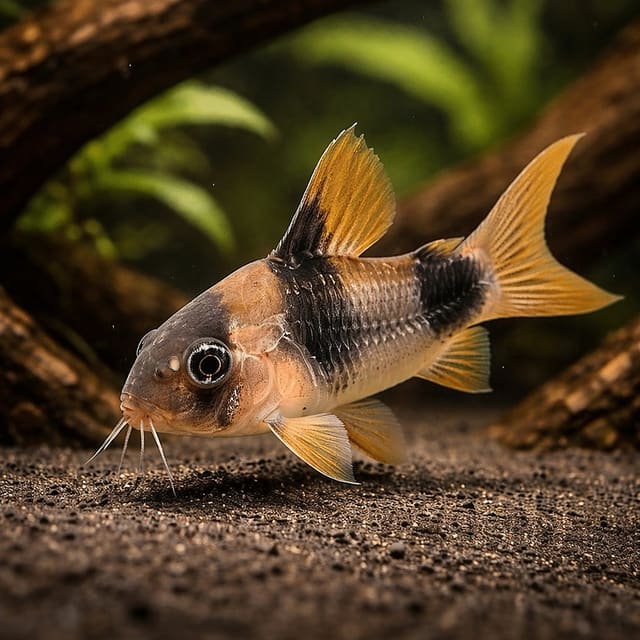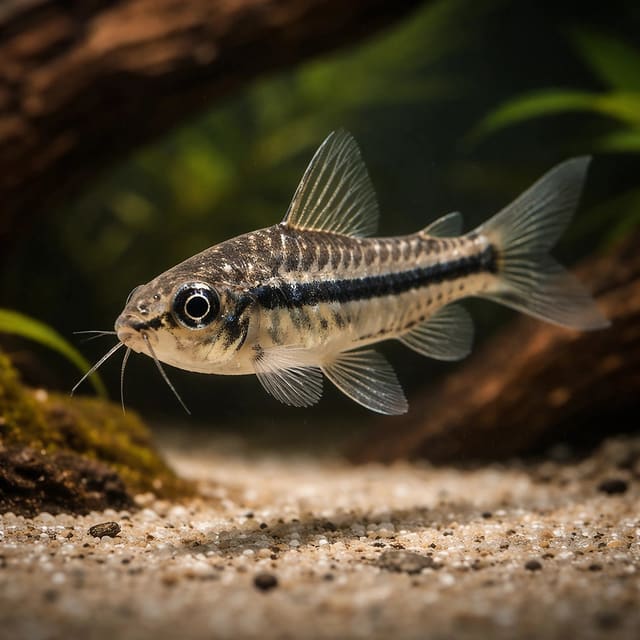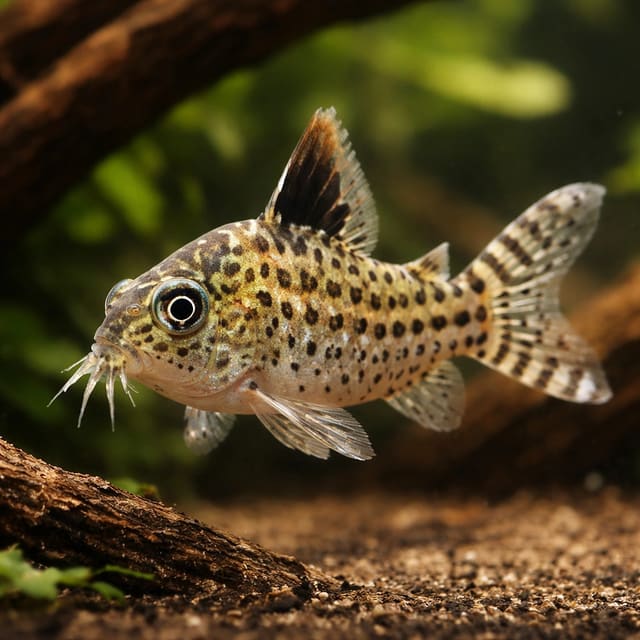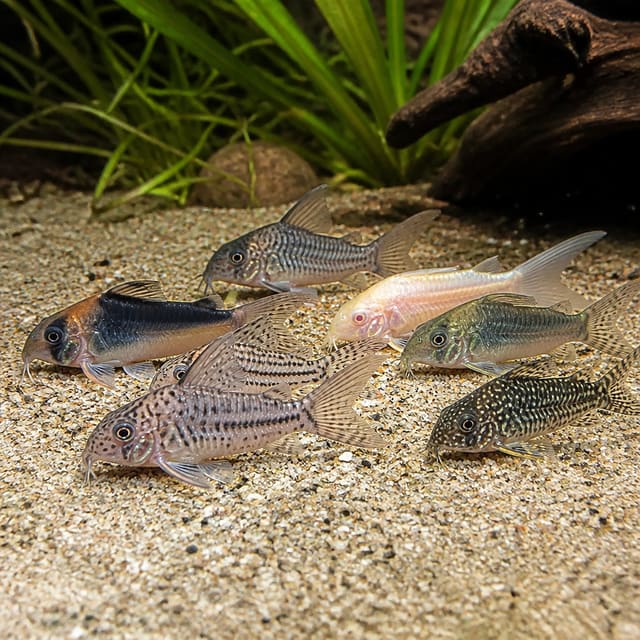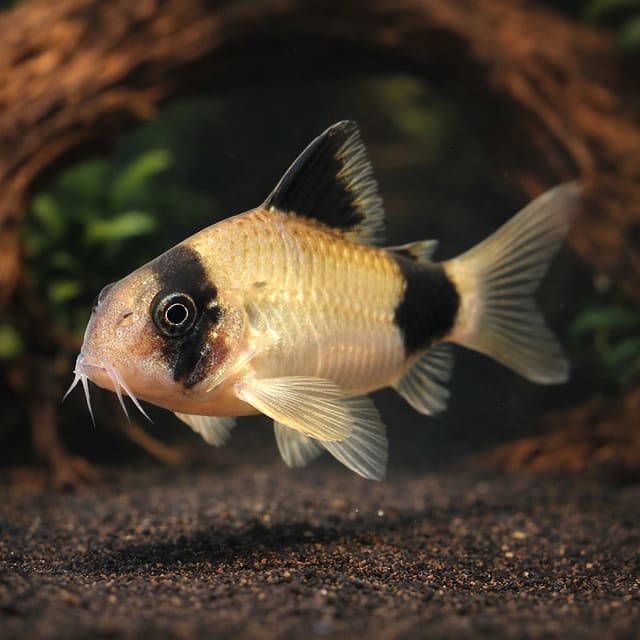
Panda Cory Catfish (Corydoras panda)
22–25°C · pH 6–7.4
£7.29

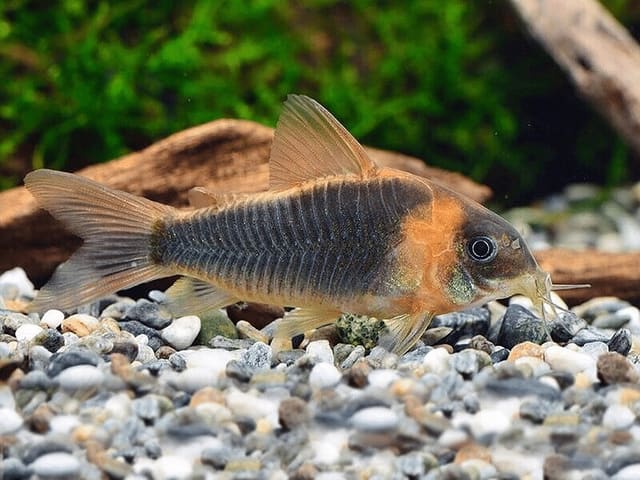
The Peppered Corydoras (Corydoras paleatus) is an armoured catfish from Argentina, Brazil and Uruguay that reaches 6.6 cm standard length. It suits measured freshwater communities planned for at least five fish; the FishBase and Seriously Fish overlap is 22–23°C, pH 6.0–7.0 and 5–12 dGH. Sold individually in 2 cm, 2–2.5 cm, 2.5–3 cm, 3–3.5 cm, over 3.5 cm and XL sizes.
Adult size is the maximum length this species reaches at full maturity (scientific sources). The livestock you receive will be younger and smaller — pick a size above for the actual shipping size. Product-photo provenance and any image-specific limitations are stated on the listing.
Shoaling fish: kept in a group they feel safer, stay calmer and show their best colour.
Minimum of 2 per order.
The Peppered Corydoras (Corydoras paleatus) is an armoured catfish from Argentina, Brazil and Uruguay that reaches 6.6 cm standard length. It suits measured freshwater communities planned for at least five fish; the FishBase and Seriously Fish overlap is 22–23°C, pH 6.0–7.0 and 5–12 dGH. Sold individually in 2 cm, 2–2.5 cm, 2.5–3 cm, 3–3.5 cm, over 3.5 cm and XL sizes.
Adult size is the maximum length this species reaches at full maturity (scientific sources). The livestock you receive will be younger and smaller — pick a size above for the actual shipping size. Product-photo provenance and any image-specific limitations are stated on the listing.
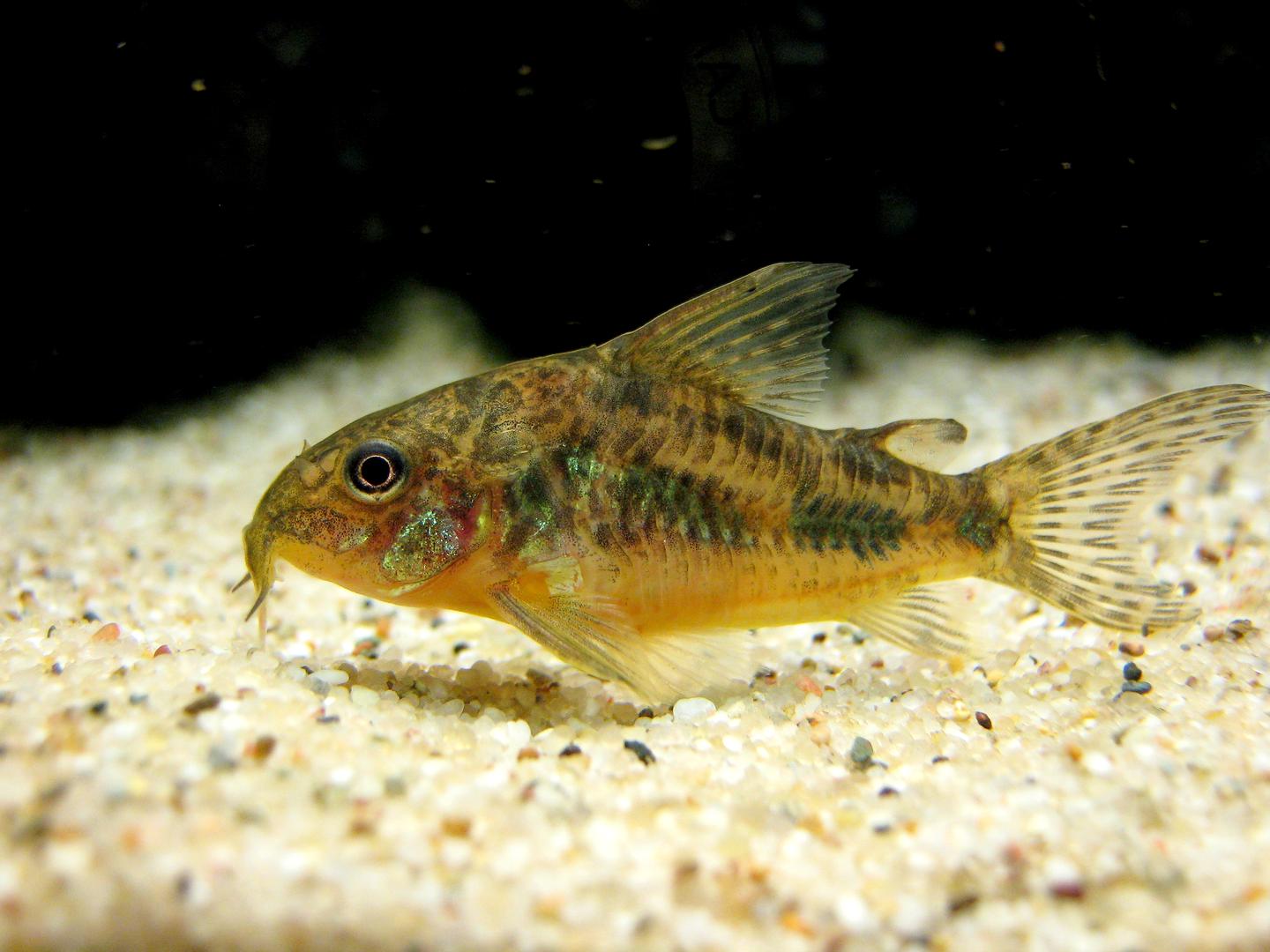
Identify the exact cory catfish before choosing care. Our starting policy for many common medium species is six compatible conspecifics, a mature 60 x 30 cm aquarium of about 60 litres, smooth fine sand and measured species-appropriate water.
Maintain these water conditions for optimal health and vibrant colors
Peppered Corydoras (Corydoras paleatus) is a social freshwater armoured catfish from Argentina, Brazil and Uruguay that reaches 6.6 cm standard length. It suits a keeper who can provide a group of at least five, a mature filtered aquarium with a base of at least 61 × 38 cm, measured water and deliberate sinking food. FishBase now lists it as Hoplisoma paleatum, with Corydoras paleatus treated as a synonym.
This peaceful bottom-dwelling fish can form part of a carefully planned freshwater community. Potential companions must fit the same temperature and chemistry while leaving sufficient floor area and feeding access for the complete cory group. Small tetras and dwarf cichlids are named as possible companions, but each exact species still needs checking.
Do not treat this fish as aquarium-cleaning equipment. Its recorded diet includes worms, crustaceans, insects and plant matter, while aquarium guidance recommends complete sinking food with small live or frozen foods for variety. Uneaten food, fish waste and ammonia must still be managed through mature filtration, testing, substrate cleaning and water changes.
We classify its care as intermediate. The routine is manageable, but success depends on coordinating social housing, floor space, measured water, clean substrate and fair food distribution.
One purchase supplies one fish. The live size selector uses the labels 2 cm, 2–2.5 cm, 2.5–3 cm, 3–3.5 cm, over 3.5 cm and XL; use it to choose the required dispatch size.
The size you select is the size supplied, not the adult size. A centimetre label describes the fish at dispatch. XL is a non-numeric trade label, so do not convert it into a precise length or use it to infer age, maturity or sex. Plan every size around the same adult aquarium, group and water requirements.
Sex is guaranteed only when the selected option explicitly states male or female. This Peppered Corydoras listing has no sex-guaranteed option.
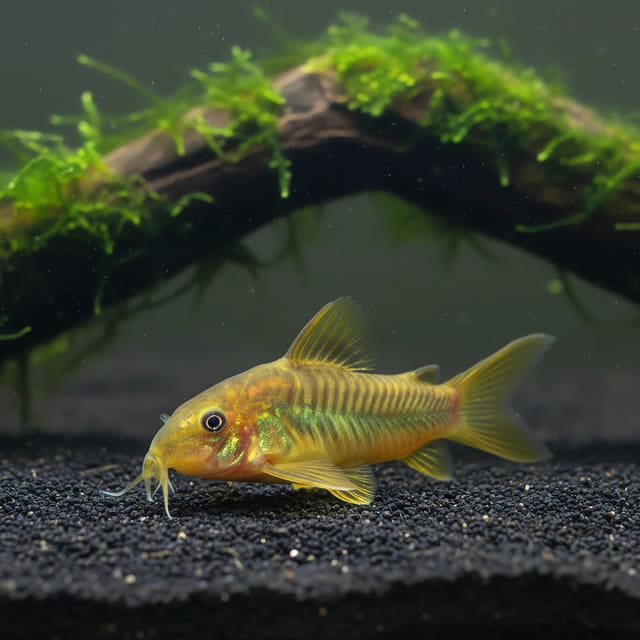
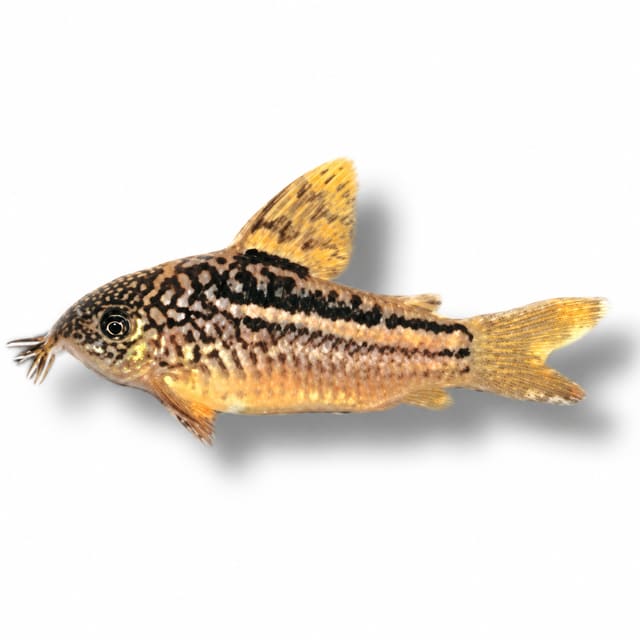
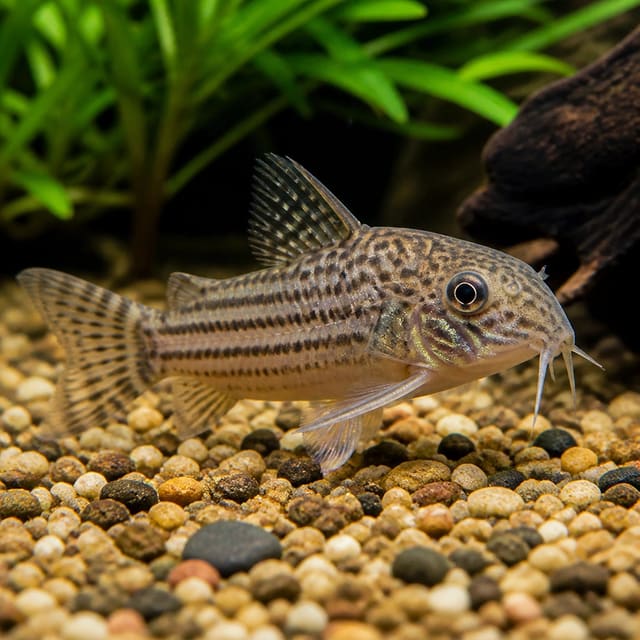
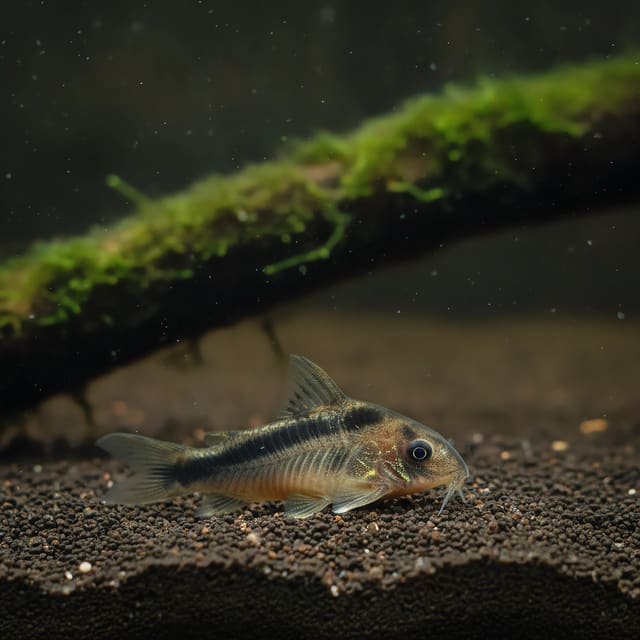
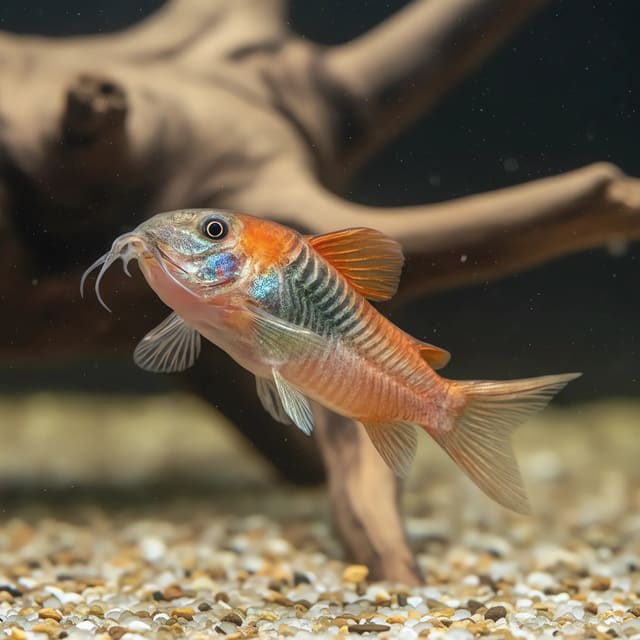
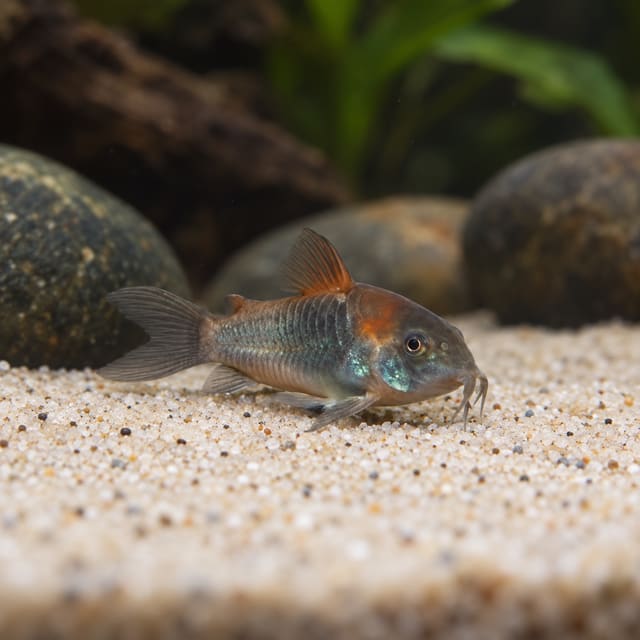
The gallery images are representative, based on reference photographs of this species, so colours can look slightly different from the live animal.
If you are comparing cory identities before choosing, browse the current Corydoras collection. Compare scientific identity, adult length, water range and social needs rather than using colour or dispatch size as a care guide.
Plan around a recorded maximum of 6.6 cm standard length, measured from the snout to the base of the tail. Seriously Fish uses 70 mm standard length as its aquarium planning figure and recommends a base of 61 × 38 cm with a volume of about 70 litres. The dispatch size does not reduce these adult housing requirements.
Keep at least five Peppered Corydoras together. FishBase gives five or more for this species, while OATA’s freshwater-catfish guidance also says Corydoras should be kept in groups of at least five and will often become stressed when kept singly or in groups that are too small.
Keep the aquarium at 22–23°C, pH 6.0–7.0 and 5–12 dGH. These values are the overlap of FishBase’s recorded range and the aquarium range from Seriously Fish.
| Suits | Not suited to |
|---|---|
| A group of at least five | Single-fish or undersized-group plans |
| About 70 litres with a 61 × 38 cm base | Aquariums without the required footprint |
| 22–23°C, pH 6.0–7.0 and 5–12 dGH | Water outside the shared range |
| Sand with cover and open foraging space | Poorly maintained gravel |
| Screened small community fish | Unscreened community combinations |
Treat volume and footprint as one decision. A tall aquarium holding about 70 litres may still provide too little useful floor area, while the stated footprint does not create unlimited capacity for companions. Reserve space and filtration for at least five corys before assessing other fish.
Peppered Corydoras should be kept in a group of at least five. Members of the same species provide the clearest social plan; one specimen from several different cory species is not a substitute for five Peppered Corydoras because each species has its own housing and group needs.
Reserve capacity for the complete group before introducing the first fish. Start with about 70 litres and a base of at least 61 × 38 cm, then assess whether decor, filtration and companions leave sufficient open floor area. Do not begin with one or two in a smaller aquarium on the assumption that housing can be changed later.
Consider a larger group only when usable floor area, filtration and feeding access remain suitable. Adding more fish is not helpful if the aquarium becomes crowded or water quality deteriorates.
Use feeding time as a practical head count. Confirm that all five or more fish emerge, reach the open substrate and swallow food. Repeat the check from several positions because one shelter or piece of wood can conceal a fish from a single viewpoint. If the same individual repeatedly remains apart, compare its breathing, body condition and feeding response with the rest of the group, then test the water and inspect how companions use the floor.
Watch how the group uses the aquarium. Each fish should forage, rest and approach food. Persistent isolation, hiding or missed meals calls for checks of water quality, group composition, floor layout, feeding distribution and companion behaviour.
Use smooth fine sand as the conservative substrate choice. Peppered Corydoras roots through the substrate while searching for food, and sand supports this normal foraging action. Seriously Fish warns that Corydoras can be prone to barbel infections when kept over poorly maintained gravel.
Leave a meaningful area of open substrate rather than covering the entire base with rocks, wood or dense planting. An open feeding zone allows the group to spread out and gives you a clear view of body condition, barbels, fins and feeding response. Arrange cover around that working area.
| Provide | Reason |
|---|---|
| Smooth fine sand | Supports substrate foraging |
| Open floor area | Allows the group to feed and move |
| Rocks or bogwood | Provides cover and resting choices |
| Clear cleaning access | Makes waste removal practical |
| Visible feeding areas | Lets you confirm that every fish eats |
Choose smooth shelters and position them so trapped food and solid waste can be removed. Reduce or rearrange decor if the fish are confined to a narrow strip or cleaning underneath becomes impractical.
Run a siphon around the finished arrangement and check that it reaches the feeding zone, the edges of shelters and the spaces around wood. Drop a small amount of sinking food into several planned feeding points and watch where it settles. Move decor if food disappears into inaccessible gaps or collects where it cannot be removed. This dry run turns floor design into a maintenance decision rather than relying on appearance alone.
Plants may provide cover, but they do not replace open floor or maintenance access. Select the final layout by what the fish can use: a feeding area large enough for the group, several resting choices and clear routes between cover and food.
Keep Peppered Corydoras at 22–23°C, pH 6.0–7.0 and 5–12 dGH. This routine range is the overlap of FishBase and Seriously Fish. Measure the aquarium rather than relying on a heater dial, a postcode estimate or a general description such as soft or hard.
Temperature, pH and general hardness are separate measurements. A suitable result for one does not compensate for another value outside the range. Check the source water before planning the aquarium, then confirm the established aquarium remains suitable before introducing fish.
Our water chemistry guide explains what temperature, pH, GH, KH, ammonia, nitrite and nitrate measurements mean. Once you have readings, the water matcher can help compare them with the stated range.
An aquarium at 23°C and pH 6.8 still needs a GH result before it can be compared with the full range. Likewise, a GH of 8 dGH does not make ammonia acceptable: ammonia and nitrite must each remain at zero mg per litre. Record the measurements together so a later change can be traced to replacement water, heating, maintenance or increasing livestock rather than judged from memory.
If a reading moves, check the aquarium, replacement water, heating and recent maintenance before altering several variables together. Make measured adjustments and retest so the effect of each change remains clear.
The RSPCA explains that a working biological filter supports bacteria that convert toxic ammonia first to toxic nitrite and then to safer nitrate. A filter is essential, but running one does not by itself show that the aquarium can process fish waste.
Prepare and mature the aquarium before livestock arrives. Use repeated test results showing zero mg per litre ammonia and zero mg per litre nitrite rather than relying only on elapsed time. The first tropical aquarium guide covers the preparation and maturation decisions to complete before fish are introduced.
Seriously Fish suggests four to five aquarium volumes of turnover per hour. Its example for about 70 litres is a filter rated at 280–350 litres per hour. Use this as a sizing reference alongside the aquarium’s stocking and layout, while arranging the outlet so fish are not forced to brace constantly against the flow.
When filter media needs cleaning, rinse it lightly in aquarium water removed during the partial water change. Do not run it under the tap because chlorine or chloramine may kill beneficial bacteria established in the media.
Keep the weekly readings beside notes on feeding, water changes and filter cleaning. A rising nitrate trend can show that waste removal or stocking needs attention even when ammonia and nitrite remain at zero. A reduction in visible flow calls for a blockage check; it does not justify washing all filter media aggressively. Change one part of the routine at a time and test again.
Increase livestock slowly. Each additional fish and increase in feeding adds waste that the bacterial population must process. If ammonia or nitrite appears, pause further additions, review feeding and filter function, and restore zero readings.
Peppered Corydoras is an opportunistic omnivore. FishBase records worms, crustaceans, insects and plant matter in its wild diet, while Seriously Fish records worms, crustaceans, plant matter and other bottom-living foods and recommends good-quality dried sinking food supplemented with small live and frozen foods.
Use a suitably sized complete sinking food as the staple. Place it where every group member can reach it, rather than depending on food left after faster fish have eaten. Food missed by other fish is unpredictable in amount and nutrition, while debris on the substrate is not a complete diet.
OATA’s freshwater-catfish guidance recommends feeding once daily and offering only what the fish can eat within a few minutes. Remove recurring leftovers before they break down. If food repeatedly remains after the group stops feeding, reduce the next portion and check whether the food size or placement is suitable.
If four fish reach food immediately and one remains behind wood, split the same daily amount between two or more open points. Watch whether the missed fish then feeds. Increase neither the frequency nor the total merely because one position failed. When residue remains after a few minutes, remove it and reduce the next portion; when all food disappears before every cory reaches it, spread the portion more widely.
If one fish misses a meal, check whether it was displaced, failed to find the food or showed reduced interest. Change the distribution before adding a larger total amount. Excess food increases the waste load without guaranteeing that the missed fish eats.
Small live or frozen foods add variety but supplement rather than replace the complete sinking staple. The feeding plan is working when every fish eats and ammonia, nitrite and nitrate remain controlled.
Prepare and test the receiving aquarium before dispatch. Confirm 22–23°C, pH 6.0–7.0, 5–12 dGH, zero mg per litre ammonia and zero mg per litre nitrite. Check filter operation and ensure the aquarium has room for the complete group.
The current delivery and Live Arrival Guarantee policy sets out the arrival procedure and claim requirements. Someone must be present to receive live fish, and the parcel must be opened and inspected on the day it arrives.
Keep the continuous unboxing video with the order number. If a Live Arrival Guarantee claim is required, send that footage; it must begin with the sealed parcel and show it being opened with the fish still inside the sealed bag before anything is disturbed.
Increase the established aquarium population slowly after introduction so the biological filter can respond to the additional waste and feeding. Recheck ammonia and nitrite rather than assuming earlier results will remain unchanged.
During the first week, confirm that each fish feeds, maintains balance and joins normal group activity. Test the water promptly if feeding, breathing or swimming changes.
Peppered Corydoras can take atmospheric air at the surface and absorb oxygen through the intestine. An occasional surface trip can therefore be normal. A clear change in frequency still calls for checks of temperature, water quality, filter flow, surface movement, breathing and stress.
Learn each fish’s usual swimming, resting, colour, breathing and feeding pattern. Warning signs listed by OATA include hanging at the surface, erratic swimming, unusual bottom sitting, darker or paler colour, altered aggression or hiding, changed gill movement, white spots, fluffy growths, lost fins or scales, weight change and reduced feeding.
Do not respond to reduced feeding by automatically adding more food. If competition is the cause, distribute food more widely. When appetite itself has changed, excess food can decay and make water quality harder to control.
Test the water first when health changes appear, inspect the aquarium and contact us for further guidance. Treatment should follow identification of the problem rather than guesswork; no disease treatment is part of the routine care plan.
Keep handling to what is necessary and take care around the leading pectoral-fin spines. Maintain clean, filtered water while the cause of any change is assessed.
Peppered Corydoras is described by Seriously Fish as a peaceful catfish for a smaller community aquarium. This makes a community possible, but it does not approve every fish automatically. Check the proposed companion’s temperature, chemistry, adult housing, social needs, temperament, floor use and feeding method.
| Check | Decision |
|---|---|
| Temperature and chemistry | Require overlap with 22–23°C, pH 6.0–7.0 and 5–12 dGH |
| Social housing | Reserve room for at least five Peppered Corydoras first |
| Floor use | Keep sufficient open sand and cover for the cory group |
| Food access | Confirm every cory can reach sinking food |
| Temperament | Watch for chasing, hiding, damage or missed meals |
Seriously Fish names small tetras and dwarf cichlids as potential companions. Treat these as examples to assess rather than universal approvals. The exact species must fit the water range and aquarium capacity while meeting its own social and feeding needs.
For example, a proposed small tetra cannot be judged only by its adult length. Its group number, temperature and chemistry must fit, and the aquarium must still retain the 61 × 38 cm base plan, food access and biological capacity required by the cory group. Apply the same sequence to a dwarf cichlid, with particular attention to how the finished arrangement uses shelters and lower-level space.
Observe every new combination during feeding and rest. Repeated chasing, fin damage, persistent hiding or missed feeding means the arrangement needs changing. Compatibility remains conditional because individuals and complete stocking plans differ.
For a stocking assessment, ask us with the aquarium dimensions, volume, measured water, current livestock, group numbers and adult sizes. A species name by itself cannot show whether the complete aquarium has sufficient capacity.
Small tetras are named as possible companions. Check the exact tetra’s temperature, chemistry, group needs and adult housing, then confirm the aquarium still has capacity for at least five Peppered Corydoras.
Dwarf cichlids are also named as possible companions. Assess the exact species and watch how it uses lower-level space, shelter and feeding areas. A named example remains conditional on the complete aquarium plan.
Do not use a collection of single corys to create a nominal group of five. Plan at least five Peppered Corydoras first. Another cory species brings its own identity, group, water, footprint and feeding requirements.
Assess shared floor space, shelter and sinking-food access carefully. Add another bottom group only when the aquarium has sufficient footprint, filtration and feeding positions for both groups.
Compatibility with kinds not named here remains uncertain until the exact animal’s water, adult housing, social needs, temperament and feeding method have been compared. Do not use a broad label such as peaceful or community as the whole assessment.
Observe the finished community at feeding and during rest. Every cory should emerge, move normally and swallow food. Persistent displacement, hiding or missed meals means the combination or layout needs changing.
Peppered Corydoras reaches a recorded maximum of 6.6 cm standard length. Plan its aquarium around that adult length rather than the size supplied at dispatch.
Peppered Corydoras needs a base of at least 61 × 38 cm and about 70 litres for its group. Reserve this floor area before adding decor or community fish.
Keep at least five Peppered Corydoras together. FishBase gives five or more for this species, and OATA warns that Corydoras kept singly or in groups that are too small will often become stressed.
We classify Peppered Corydoras as intermediate because it needs a complete social group, measured water, a mature filter, clean substrate and feeding that reaches every fish.
Feed Peppered Corydoras a complete sinking food once daily in an amount eaten within a few minutes, with regular small live or frozen foods for variety. It must be deliberately fed rather than expected to live on leftovers.
Keep it at 22–23°C, pH 6.0–7.0 and 5–12 dGH. These routine values are the overlap of FishBase and Seriously Fish.
This fish is described as peaceful and suitable for a smaller community aquarium. Continue watching for chasing, hiding, damage or missed meals whenever the stocking plan changes.
Small tetras and dwarf cichlids are named as possible companions, but each exact species must overlap with 22–23°C, pH 6.0–7.0 and 5–12 dGH and leave enough space and food for at least five corys.
Start filming before opening the sealed parcel, then record continuously as it is opened with the fish still in the sealed bag. Someone must be present to receive it; float the bag for 20–30 minutes and never pour the bag water into the aquarium.
Independently collected by Judge.me from customers who bought this item. All reviews are shown.
Healthy and doing well
Reply from Tropical Fish Co
<p>Thanks Tracey. Peppered Corys are the toughest of the group and happy in cooler water than most Corydoras - the one thing worth getting right is sand or smooth rounded gravel, so they can sift with their barbels without wearing them down. Good to hear they're settled. - Tropical Fish Co</p>