Moderate
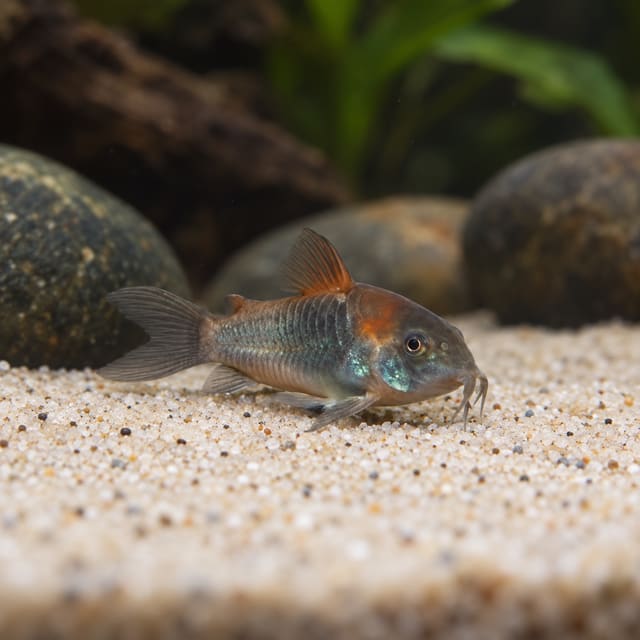
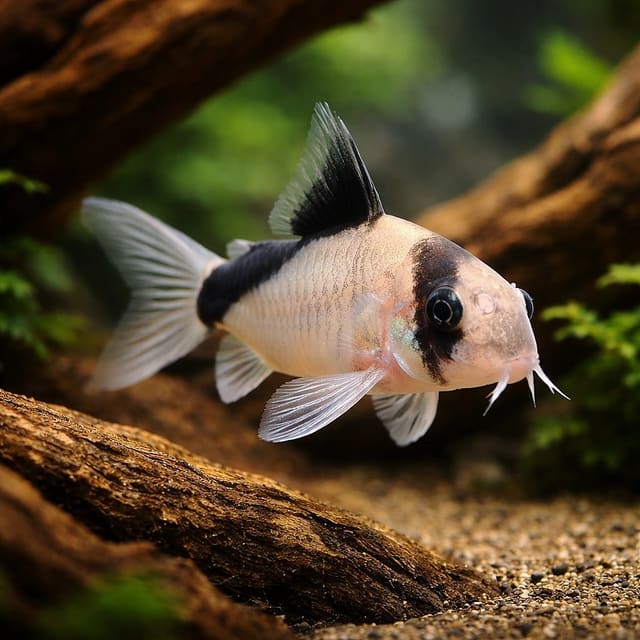
Masked Corydoras (Hoplisoma metae)
22–26°C · pH 6–8 · 75L
£15.99

One live, unsexed Peru Gold Stripe Cory in the selected approximate 3-4 cm or 4-5 cm grade. Also known as the Gold Laser Cory; current provisional identity Osteogaster sp. CW010.
Osteogaster sp. CW010
Each quantity is one pair containing 2 fish. Discounts count pairs.
One live, unsexed Peru Gold Stripe Cory in the selected approximate 3-4 cm or 4-5 cm grade. Also known as the Gold Laser Cory; current provisional identity Osteogaster sp. CW010.
Identify the exact cory catfish before choosing care. Our starting policy for many common medium species is six compatible conspecifics, a mature 60 x 30 cm aquarium of about 60 litres, smooth fine sand and measured species-appropriate water.
Maintain these water conditions for optimal health and vibrant colors
One live, unsexed Peru Gold Stripe Cory is supplied in the size selected on this page. This distinctive Peruvian aquarium fish is also widely sold as the Gold Laser Cory. Its most defensible current identity is Osteogaster sp. CW010: CW010 is a provisional aquarium code for an undescribed form, not a formal species epithet.
Choose an approximate 3-4 cm or 4-5 cm grade from the live selector. Each quantity is one fish, not a group or pair, and sex selection is not offered. Plan for a peaceful social group of at least six in a mature aquarium with fine sand, clean oxygen-rich water and food that reaches the bottom. Check the current price, availability and selected size in the buy box.
| Quick fact | Practical answer |
|---|---|
| Current identity | Osteogaster sp. CW010 |
| Trade names | Peru Gold Stripe Cory; Gold Laser Cory |
| Family | Callichthyidae |
| Sale unit | One live, unsexed fish in the selected size |
| Live size options | Approximately 3-4 cm or 4-5 cm |
| Adult planning size | About 5.5 cm for males and 6 cm for females |
| Care level | Moderate |
| Temperament | Peaceful, social bottom dweller |
| Group | At least six of the same trade form |
| Practical aquarium | About 80 litres and 75 cm long or larger |
| Temperature | 22-26°C |
| pH | 6.5-7.2 |
| Practical hardness | About 4-12 dGH, stable rather than chased |
| Diet | Benthic omnivore / micro-predator |
| Tank region | Bottom, with occasional rapid surface visits |
Quantity one means one live fish. Quantity six means six live fish. One selected quantity is not a complete social group. Build the group deliberately and confirm the basket total before checkout.
The live options are approximately 3-4 cm and 4-5 cm. A grade is a working size band for living animals, not a promise of an exact millimetre. A fish may sit near either edge of the selected band, and fins, barbels and tail position can affect a visual estimate.
No male, female or breeding pair can be selected from this listing. Mature females are usually fuller and can become slightly larger, while males are commonly slimmer, but size alone is not dependable for juveniles or newly transported fish. An order of several fish does not guarantee an even sex ratio.
A care page may remain visible when a size grade is unavailable. Check the selected size, quantity and basket before ordering; availability can differ between the two grades.
| Choice | What it means | What it does not guarantee |
|---|---|---|
| 3-4 cm | One fish within the approximate smaller grade | Exactly 3.0 or 4.0 cm |
| 4-5 cm | One fish within the approximate larger grade | A mature female or breeding adult |
| Quantity six | Six unsexed fish | A fixed male-to-female ratio |
| Visible care page | The information remains available | That every variant can currently be ordered |
CW numbers are aquarium-trade identifiers used for forms that need a stable label before or without a formal scientific description. The code helps aquarists discuss the same fish, but it is not a Latin species name. Writing the code after sp. makes the uncertainty visible instead of disguising it.
A major 2024 phylogenomic revision of Corydoradinae resurrected the genus Osteogaster for this lineage. A 2025 taxonomic paper then explicitly listed CW010 among putatively undescribed Osteogaster aquarium taxa. The familiar cory trade names remain useful alongside that provisional scientific identity.
For decades the aquarium trade used Corydoras broadly for many armoured catfish now placed in several genera. Shops, keepers and search engines still use "cory" and "Corydoras" as familiar umbrella terms. Those words remain useful common-language signposts, but they should not override a current scientific placement.
The inherited phrase "Corydoras aeneus peru gold strip" looked like a scientific trinomial, but no such formal subspecies name was established by the sources checked. Some older references have suggested an association with the Bronze Cory complex. That possibility is not the same as proof, so the listing does not present CW010 as Osteogaster aenea.
The care obligation does not disappear because the taxon awaits formal description. Use the documented CW010 appearance, adult size, social behaviour and water guidance. If future peer-reviewed work assigns a formal species name, the taxonomy can be updated without pretending that earlier uncertainty never existed.
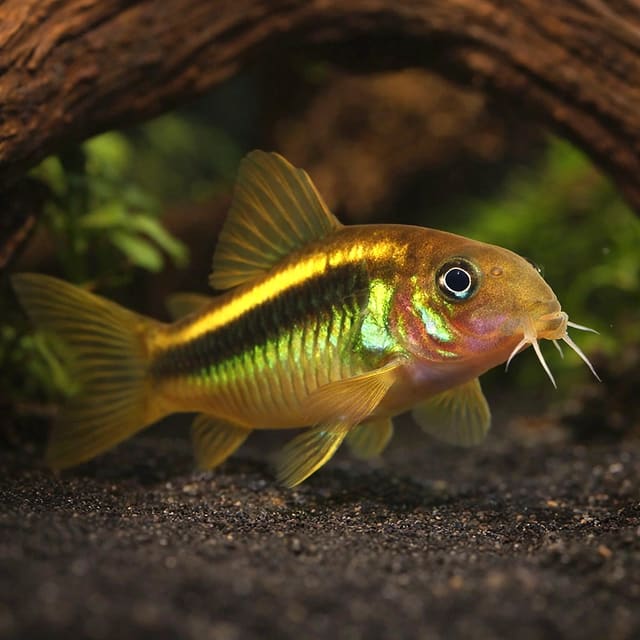
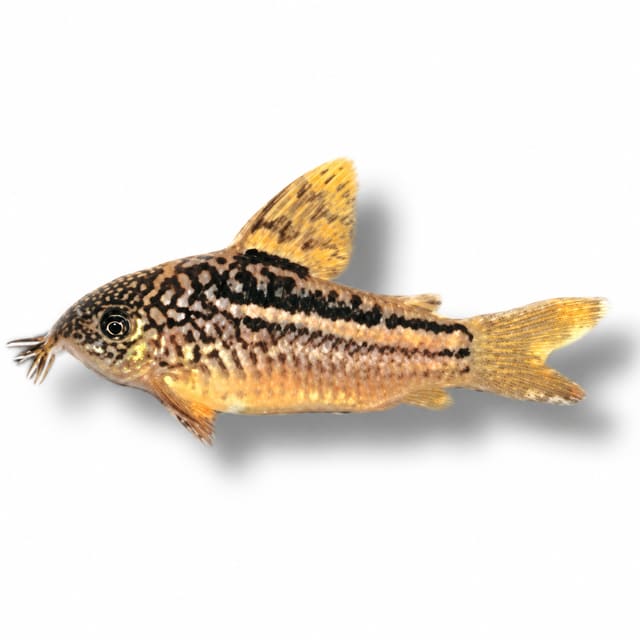
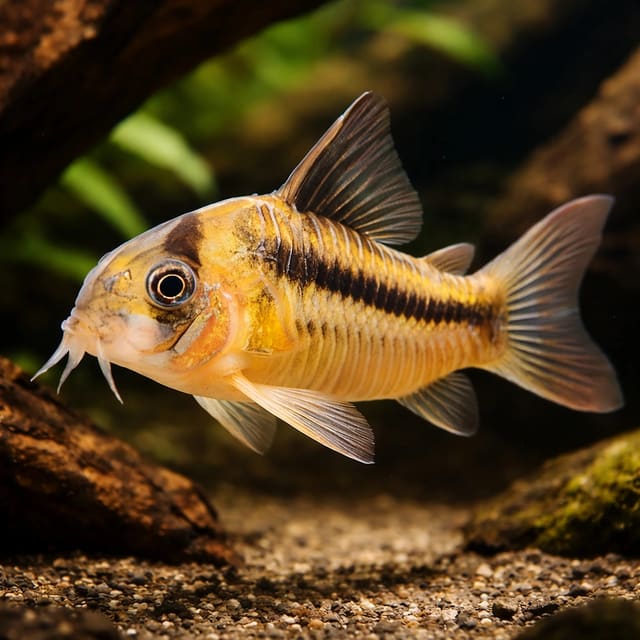
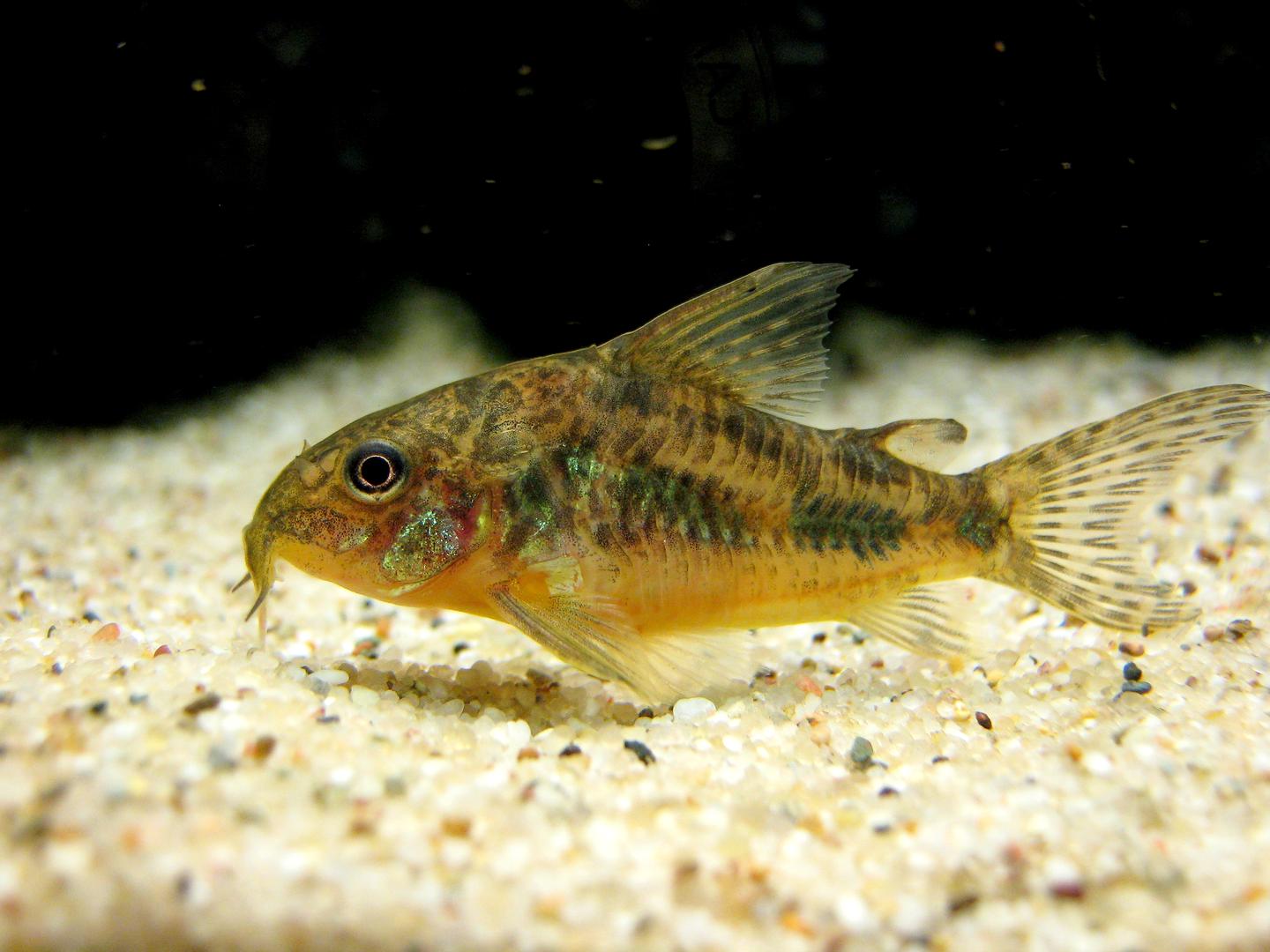
The defining visual feature is a bright gold to orange stripe running along the upper flank below the dorsal line. Its width, intensity and exact start point vary with individual genetics, age, condition, mood and lighting. A subdued newly arrived fish may not show the same contrast seen after settling.
The luminous stripe stands against a darker bronze, olive or charcoal flank. This contrast is why the name "laser" became popular: the bright line can appear almost illuminated under aquarium lighting. The effect should come from healthy colour and suitable light, not from editing expectations into an exact-fish promise.
Many CW010 show warm orange-gold colour around the pectoral region, belly and fins. Coverage varies and may be less obvious in juveniles. Colour is a trade-form characteristic rather than a guarantee that every fin will match one reference image.
Like other Corydoradinae, the body carries bony plates rather than ordinary overlapping scales. The head is short, the underside is adapted for benthic foraging and sensory barbels help investigate food around the substrate. Those structures are reasons to provide a clean, non-abrasive floor.
The current image is representative rather than proof of the fish selected for your order. It shows a dark flank and a bright gold upper stripe, but exact stripe brightness, body depth, fin colour, sex and size can vary naturally.
A standard Bronze Cory is the formally described Osteogaster aenea. It usually shows a broad metallic bronze or greenish sheen rather than CW010's strong gold upper stripe. The Long-fin Bronze Cory is therefore a separate biological and retail choice, not another spelling of this product.
The Masked Cory, Hoplisoma metae, has a dark eye mask and a dark line near the back rather than a glowing gold dorsolateral stripe. It shares social bottom-feeding habits but should be chosen as its own species group.
The Albino Golden Cory lacks normal dark pigment and has a pale body with red eyes. It should not be confused with a dark-bodied laser form merely because both names contain "gold". Appearance, identity and available size grades are different.
The Duplicareus Cory carries a dark eye band and dorsal saddle. It can suit a carefully planned soft-water community, but its markings and species identity are distinct. Similar adult length does not make two cory forms interchangeable for shoaling.
Tropical Fish Co also has a Gold Laser Cory listing with smaller approximate grades. It represents the same CW010 trade identity under the broader common name. Compare live sizes, price and availability; do not infer a biological difference that the supplier data does not establish.
| Listing | Main identification cue | Do groups mix? |
|---|---|---|
| Peru Gold Stripe / Gold Laser CW010 | Bright gold upper stripe over dark flank | Prefer a group of the same trade form |
| Bronze Cory | Bronze-green body sheen without the laser stripe | Do not count it as a CW010 companion |
| Masked Cory | Dark eye mask and rear marking | Keep its own social group |
| Albino Golden Cory | Pale body and red eyes | Keep enough of its own form |
| Duplicareus Cory | Eye band and dark dorsal saddle | Maintain its own species group |
CW010 is peaceful and usually accepts prepared food, but a rare undescribed form deserves more care than a generic "beginner cleaner fish" label suggests. It needs a proper same-form group, clean substrate, reliable bottom feeding and stable water. A mature aquarist who meets those basics should find it manageable.
Never add the fish to a newly filled, biologically unprepared aquarium. Ammonia and nitrite must stay at 0 mg/l. A test result, not elapsed calendar time or bottled-product advertising, should confirm that the filter can process the intended livestock load.
Watch group posture, breathing, barbel condition, belly profile and whether each individual reaches food. A healthy group may rest together, forage actively and make brief dashes. One fish repeatedly isolated, pinched, rapidly breathing or unable to feed needs investigation.
| Care area | Good sign | Concern |
|---|---|---|
| Group | Loose contact and shared foraging | One fish remains isolated or chased |
| Feeding | Food reaches the bottom and all fish eat | Surface fish consume every meal first |
| Barbels | Intact and used while searching | Rapid erosion, redness or swelling |
| Breathing | Steady gill movement with occasional surface dash | Repeated urgent surface visits by the whole group |
| Body condition | Gently rounded belly | Persistent hollow belly or sudden swelling |
Plan around at least 80 litres and roughly 75 cm of horizontal length for six adults. Volume provides dilution, while floor area creates foraging space and lets individuals move without constantly crossing each other. This is a practical starting point, not a licence to fill every remaining level with more fish.
A tall narrow aquarium may hold the same litres but offer less useful bottom area. Choose a rectangular footprint with a long open route, several shaded resting zones and enough clear substrate for the whole group to feed at once.
Use more space for a group above six, a busy community, large decor or tank mates that also feed on the bottom. Extra floor area reduces competition and gives shy individuals several routes to food. It does not replace filtration or water changes.
Specialist CW010 records place males around 5.5 cm and females around 6 cm. Use 6 cm for planning even when buying the 3-4 cm grade. The other residents must also be counted at adult size, including fish that currently occupy only the upper water.
Fine rounded aquarium sand lets the fish search naturally by moving its snout and barbels through the surface. Keep the bed shallow enough to maintain and avoid compacted dirty pockets. A suitable substrate should feel smooth, remain clean and not trap every sinking meal.
Very smooth, small rounded gravel can be workable when kept exceptionally clean, but sharp or rough material is a poor choice. Barbel problems are not caused by one factor in every case: abrasion, trapped organic waste, bacterial load and water quality can interact. Sand is the simpler conservative recommendation.
Use plants, wood and leaf litter suitable for aquarium use to create broken shade. Leave gaps beneath decor wide enough that an adult cannot wedge itself. Secure every rock and branch before fish are introduced; bottom dwellers will investigate spaces that look too small from above.
Keep at least one broad open patch where food can be seen and counted. Dense planting across the entire floor can hide waste and make it harder to verify that each fish eats. A mix of shelter and visible substrate supports both security and observation.
Corydoradinae can make rapid surface visits to take atmospheric air. Do not block the whole surface with floating plants, mesh or decor. Provide a lid to prevent escape but leave clear vertical routes and normal gas exchange.
Keep the aquarium within 22-26°C and avoid abrupt swings. A stable point near the middle of the range is often easier for a community than moving between extremes. Warmer water carries less dissolved oxygen, so circulation and surface movement deserve extra attention at the upper end.
Mildly acidic to near-neutral water matches the specialist guidance checked for CW010. Do not chase an exact decimal with repeated chemical additions. Test the source water, buffering and hardness, then make any necessary change gradually and consistently.
No precise controlled CW010 hardness study was found. A soft-to-moderate practical band of about 4-12 dGH is therefore used as conservative captive guidance. Stability and acclimation matter more than presenting one unverified number as a biological boundary.
Ammonia and nitrite should remain at 0 mg/l. Keep nitrate low and close to the normal level of the prepared source water through sensible stocking, restrained feeding and regular partial changes. A clear-looking aquarium can still carry harmful dissolved waste.
| Parameter | Working target | If the result is wrong |
|---|---|---|
| Temperature | 22-26°C | Correct gradually; check heater and oxygen |
| pH | 6.5-7.2 | Check buffering before adding adjusters |
| General hardness | About 4-12 dGH | Change through a measured water plan |
| Ammonia | 0 mg/l | Change water and investigate biological filtration |
| Nitrite | 0 mg/l | Act promptly and protect filter bacteria |
| Nitrate | Low and stable | Review feeding, stocking and maintenance |
Size the filter for the adult community and feed level. Preserve mature media during cleaning, rinse it in removed aquarium water where appropriate and avoid replacing every biological component together. A product cannot compensate for an undersized or repeatedly sterilised filter.
Use enough circulation to move waste towards the intake without forcing fish to brace constantly. A spray bar or broad return can spread current. Include calmer shaded margins where the group can rest while retaining movement across the main floor.
Visible surface ripple supports gas exchange. Sudden frequent air-gulping by most of the group can signal low oxygen, heat, gill irritation or poor water quality even though occasional individual surface visits are normal for the subfamily. Test first rather than assuming the behaviour is harmless.
Ensure intake slots cannot trap a weakened fish or draw long food fragments into the filter before they are eaten. A pre-filter sponge can help, but it must be cleaned often enough to preserve flow. Check behind equipment for individuals that have become confined.
Plan a same-form group of at least six. They may rest in contact, follow one another across the substrate and become more confident at feeding. Six is a care minimum for planning, not a compulsory pack size; each fish is still ordered individually.
Different cory species can occupy the same aquarium when water and temperament align, but a mixed collection of singletons is not equivalent to six CW010. Similar body shape does not guarantee identical social signals. Build the core group first, then consider other bottom dwellers only if space remains.
The fish may alternate between quiet rests and bursts of searching. Activity often increases around feeding and after a water change. Constant frantic glass surfing, gasping or inability to settle is different from normal exploratory movement and should trigger checks.
A quick rise, air intake and return to the bottom can be normal. The route should be unobstructed. When every fish repeats the trip frequently, inspect temperature, oxygenation, ammonia, nitrite and gill condition instead of treating the species label as an excuse.
Consider peaceful small tetras, rasboras, pencilfish and other calm community fish that accept the same water. Select upper- and mid-water residents that leave enough food for the bottom group. Compatibility depends on adult size, behaviour, group numbers and aquarium footprint.
Additional cory groups, loaches and small plecos increase competition for floor area, caves and sinking food. A tank can look empty in the upper half while the bottom is overcrowded. Count the usable substrate and feeding stations, not only total litres.
Do not combine this peaceful fish with large predators, territorial cichlids that control the floor or persistent fin and barbel nippers. An armoured body is not protection against swallowing, repeated attacks or chronic exclusion from food.
Adult shrimp may coexist in a well-structured aquarium, but tiny shrimplets, exposed eggs and minute fry can be eaten during normal foraging. This product is not guaranteed safe for a breeding project where every offspring must survive.
Use the water matcher as a planning aid, then confirm the real aquarium with reliable tests. A shared temperature value alone does not prove compatibility; pH, hardness, adult size, feeding behaviour and social space must also align.
| Companion type | Assessment | Main check |
|---|---|---|
| Peaceful small mid-water fish | Often suitable | Water overlap and enough group space |
| Another cory group | Possible in a larger aquarium | Floor area and separate same-species numbers |
| Small peaceful pleco | Use caution | Food, caves, adult waste and night activity |
| Adult shrimp | Use caution | Shrimplets are not guaranteed safe |
| Territorial bottom cichlid | Avoid in modest tanks | Spawning territory can exclude the group |
| Large predatory fish | Avoid | Swallowing and injury risk |
This fish cannot live on leftovers, faeces or algae. Calling cory catfish "cleaners" often results in underfeeding. Their foraging can move small particles, but the keeper remains responsible for substrate maintenance and a nutritionally complete diet.
Choose a quality sinking tablet, granule or soft food formulated for small omnivorous bottom feeders. The pieces should reach several points before upper-water fish take them. Break larger tablets when that spreads access more fairly.
Offer suitable frozen or live foods such as bloodworm, daphnia, brine shrimp or small insect larvae as controlled supplements. Rinse or prepare them according to the product directions. Variety supports feeding behaviour, but rich foods should not displace a complete staple or pollute the substrate.
Feed an amount the group can finish without leaving a mat of food to decay. Watch belly condition and access rather than relying on one universal minute rule. Remove persistent leftovers and reduce the next portion before water quality is affected.
If quick surface fish monopolise meals, add sinking food after the main lights dim or distribute it across several zones. Do not feed only at night without observing occasionally; hidden competition and poor appetite can otherwise go unnoticed.
| Food role | Examples | Use |
|---|---|---|
| Complete staple | Sinking omnivore tablet or granule | Regular nutritional foundation |
| Frozen variety | Bloodworm, daphnia, brine shrimp | Small measured rotations |
| Live variety | Appropriately sized clean cultures | Occasional enrichment |
| Plant-associated matter | Quality mixed formulation | Part of an omnivorous diet |
| Leftovers and waste | Uneaten food or faeces | Not food; remove during maintenance |
Use a repeatable schedule based on test results, stocking and feeding. Match replacement water for temperature and chemistry closely enough to avoid a sudden shock. Condition tap water correctly before it reaches fish or biological media.
Siphon visible waste from open areas and gently maintain the sand surface. Do not overturn the entire bed or dismantle every refuge at once. Rotate deeper tasks so the aquarium remains stable while dirty pockets are prevented.
Service mechanical material when flow declines, but retain established biological media. Never combine a major filter replacement, deep substrate clean and large stocking change without a reasoned transition plan. Stability is built from many small, predictable actions.
Write down temperature, pH, hardness, ammonia, nitrite and nitrate when setting up, after adding fish and whenever behaviour changes. A trend can reveal a developing problem before a single value crosses a dramatic threshold.
Confirm that the aquarium is mature, the intended parameters are stable and the group plan is ready before ordering. Make sure someone can receive the parcel under the current delivery conditions. Do not plan a large aquascape rebuild on arrival day.
Keep the transport bag away from bright light and follow the livestock instructions supplied with the order. The acclimation timer can help organise the steps. Do not prolong an opened-bag process without considering changing transport-water chemistry.
Move the fish with suitable equipment and minimise transport-water transfer where the instructions call for it. Avoid chasing an already stressed animal around a small container. Cover the aquarium after introduction and leave an unobstructed surface route.
Use subdued light and allow the fish to orient. Temporary pallor, stillness or hiding can occur after transport. Offer a small sinking meal once the group has settled, then confirm that each newcomer maintains balance and can reach the bottom safely.
Check breathing, appetite, stripe contrast, barbels, fins and social access each day. Re-test ammonia and nitrite because new livestock can reveal limited filter capacity. Make one corrective change at a time where possible so the response can be understood.
A separate mature quarantine aquarium can reveal problems before new fish enter the display. It still needs suitable heat, oxygen, filtration and cover; an unfiltered container is not a safe quarantine simply because it is separate.
Shortened, reddened or swollen barbels require attention to substrate texture, trapped waste, water quality and possible infection. Moving the fish to clean sand may help remove one risk, but it should accompany a full environmental review rather than a single-cause assumption.
Check temperature, oxygen, ammonia, nitrite, recent chemical use and gill appearance. An occasional surface dash differs from sustained fast gill movement or repeated urgent gulping. Act on the aquarium conditions before guessing at a medicine.
Confirm that food reaches the fish and that faster tank mates are not taking it. Persistent weight loss despite eating can have several causes and deserves experienced diagnosis. Do not repeatedly change treatments without evidence.
White marks are not one automatic diagnosis. Examine their shape, distribution, recent introductions and accompanying behaviour. Test water first and use only a current, suitable treatment after identifying the likely problem and checking every resident's tolerance.
| Observation | First checks | Boundary |
|---|---|---|
| Frequent surface visits | Oxygen, heat, ammonia, nitrite, gills | Do not assume every gulp is normal |
| Barbel erosion | Substrate, waste, water, infection | Do not blame one factor automatically |
| Hollow belly | Meal access, diet, faeces, duration | Seek diagnosis if it persists |
| White marks | Pattern, spread, behaviour, new stock | Do not medicate from one photograph |
| Isolation | Arrival stress, bullying, water, injury | Protect the fish if exclusion continues |
Selected size does not indicate sex, and two fish are not a guaranteed pair. A breeding project should begin with a healthy group, mature conditioned fish and spare rearing capacity rather than a speculative male-and-female purchase.
Breeders commonly use varied high-quality foods, excellent water and controlled water changes to condition Corydoradinae. This page does not prescribe a guaranteed trigger for CW010. Temperature and chemistry should remain within a safe, understood range.
Eggs may be placed on glass, plants or decor and can be eaten by adults or tank mates. A breeder who intends to raise young needs a planned method for protecting eggs, controlling fungus and providing stable water. Fertility and hatch rate cannot be promised.
Newly free-swimming fry require very small suitable foods, gentle mature filtration and frequent attention to waste. Growth can be uneven. Do not attempt breeding without enough space to separate larger juveniles and responsibly place surplus fish.
This page carries the established Peru Gold Stripe trade wording and live approximate 3-4 cm and 4-5 cm options. Compare the available size grades before ordering. Select only a grade that is available in the live control.
The separate Gold Laser page lists approximate 2-2.5 cm, 2.5-3 cm and 3-4 cm variants. It is not claimed to be a different species or locality. Compare the live stock and price rather than assuming the different historical product names describe different fish.
Similar-sized healthy CW010 can normally form one social group when acclimated carefully and given fair food access. Avoid a large size disparity that lets small fish miss every meal. Observe new additions because source history, health and confidence can differ even within one trade form.
The Corydoras range shows current stock, while the Corydoras retail hub supports broader species and buying comparisons. The Corydoras care guide covers shared husbandry themes, but this product's CW010-specific ranges take priority.
Live-fish stock moves with holding and supplier availability. A visible size label does not mean checkout is possible. Confirm the selected grade, quantity and basket immediately before ordering.
Read the delivery information and current live-arrival terms before ordering. Check postcode and dispatch restrictions, receipt arrangements and evidence requirements; eligibility is governed by the published terms.
Confirm the group plan, mature filtration, food supply and selected quantity before ordering. A discount or attractive colour does not make an unsuitable aquarium ready.
The single current image is representative, not proof of exact selected stock, measured size, sex or colour. Use the selected grade and written care details when planning the aquarium.
One live, unsexed CW010 is supplied per selected quantity in the chosen approximate grade. It is sold under the Peru Gold Stripe and Gold Laser trade names.
No. CW010 is a provisional aquarium identification code for this trade form, not a product SKU or a formal species epithet.
It should not be sold as a confirmed Bronze Cory subspecies. Some older trade sources associated it with the Bronze Cory complex, but current evidence treats CW010 as a putatively undescribed Osteogaster.
The visible title, body and metadata now carry the corrected identity. A legacy URL string is not presented as scientific evidence.
Choose the live approximate 3-4 cm or 4-5 cm option. Natural variation within a grade is normal, and neither band promises an exact measurement, sex or adult status.
Keep at least six of the same trade form in a suitable mature aquarium. Each fish is ordered individually, so select the required quantity only after checking adult stocking and live availability.
Use about 80 litres and 75 cm length or larger for six, with extra floor area for a bigger group or community. Footprint, filtration and bottom competition matter alongside litres.
Plan for roughly 5.5 cm in males and 6 cm in females. Individual size varies, and stock should be planned using the larger adult value rather than the dispatch grade.
Target stable water around 22-26°C, pH 6.5-7.2 and approximately 4-12 dGH. Keep ammonia and nitrite at 0 mg/l and nitrate low and stable.
No. They need complete sinking food and cannot live on algae, waste or leftovers. The keeper must still remove debris and maintain the substrate.
Permanent solitary care is not recommended. Plan a same-form group of at least six; temporary isolation may still be necessary for quarantine, treatment or protection.
No. Other cory species may coexist in a large compatible setup, but they do not automatically replace enough companions of the same form. Build each social group properly.
An occasional quick visit can be normal for Corydoradinae. Repeated urgent gulping by the group calls for immediate oxygen, temperature, ammonia, nitrite and gill checks.
No. Stock is unsexed, and selected size is not a sex guarantee. An order cannot promise a male, female, pair or breeding group.
No. The image is representative. Colour intensity, stripe width, body depth, fin tone and size vary naturally.
Check the selected size and quantity, mature aquarium, group plan and current delivery terms before ordering. Each fish needs suitable adult space, food and same-form companions.
Editorial evidence note: Identity and taxonomy were checked against the 2024 phylogenomic Corydoradinae revision and a 2025 Neotropical Ichthyology paper that lists the same code in CW10 format among putatively undescribed Osteogaster aquarium taxa. Species-specific size, temperature, pH and social guidance was cross-checked with the ScotCat CW010 profile, and general catfish welfare guidance with OATA. The practical 80-litre, 75 cm and 4-12 dGH recommendations are conservative Tropical Fish Co husbandry judgements. The supplier has not provided exact collection locality, breeding origin, sex, parentage or wild/captive provenance for this batch.
No reviews for this item yet. Bought one? Honest reviews only, good or bad.
What customers say about ordering from us
I have a small group of long finned mountain minnows. So was delighted to be able to order ten of this variety to increase the genetics in my tank . The ones I recieved are healthy but it’s to early to give a verdict on wether they are of a long finned type since they are small currently.
Gordon Walker · 23 Sept 2026
100% success travel and "installation". Pleased with quality of purchase. The Siamese fighter a bit "shy" so have not yet seen him at his best yet but looking good. Happy customer. GG
George E Garratt · 21 Sept 2026
Reviews of our shop, collected by Judge.me, an independent third-party review collector. Newest first.