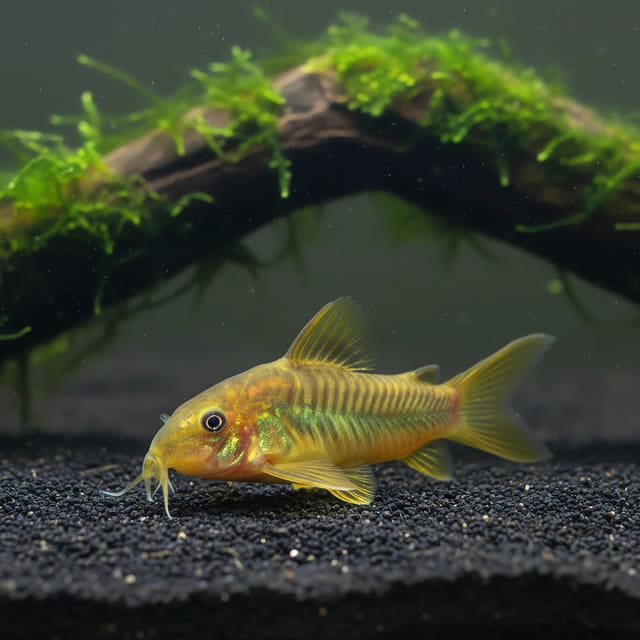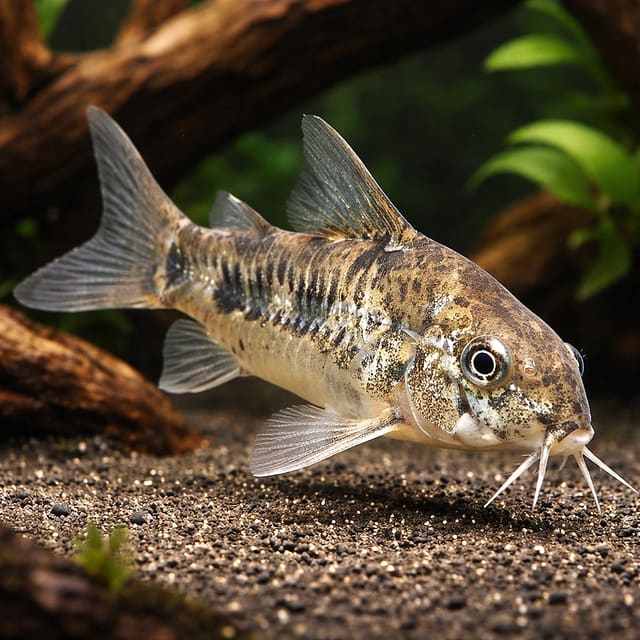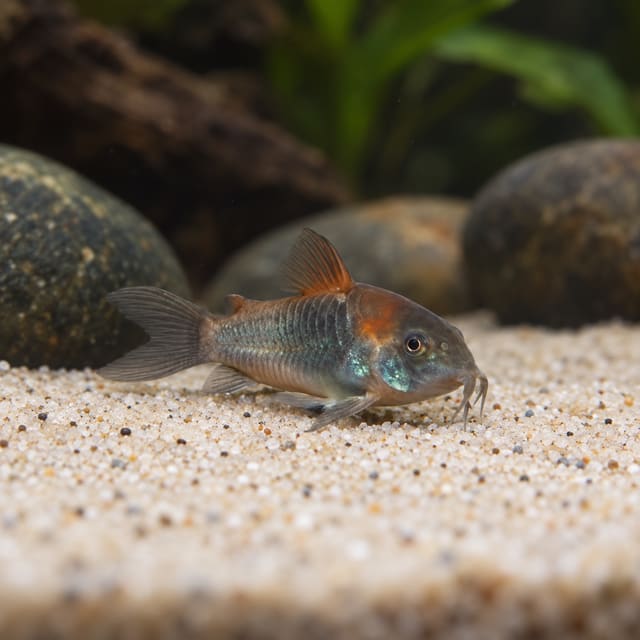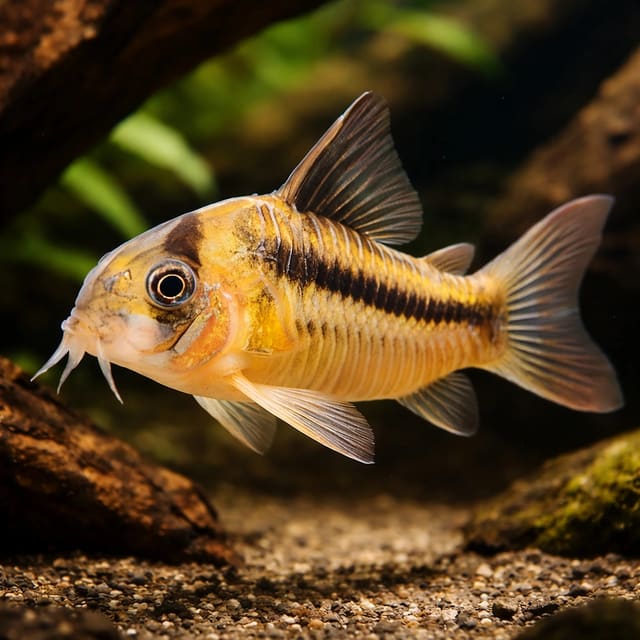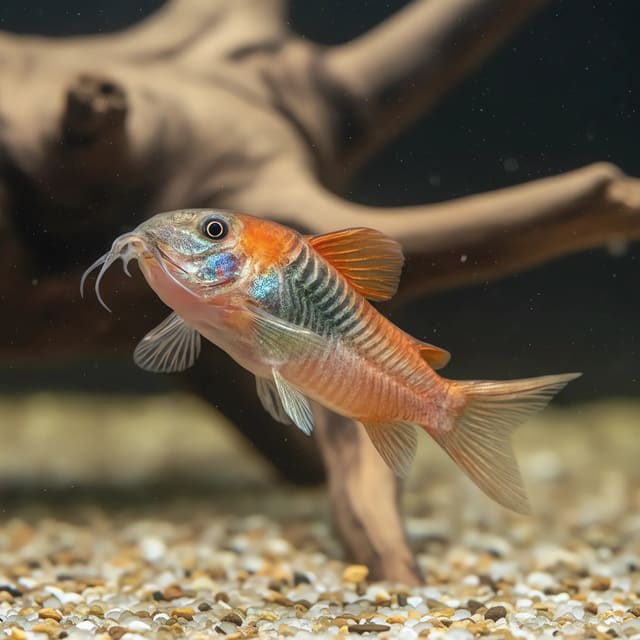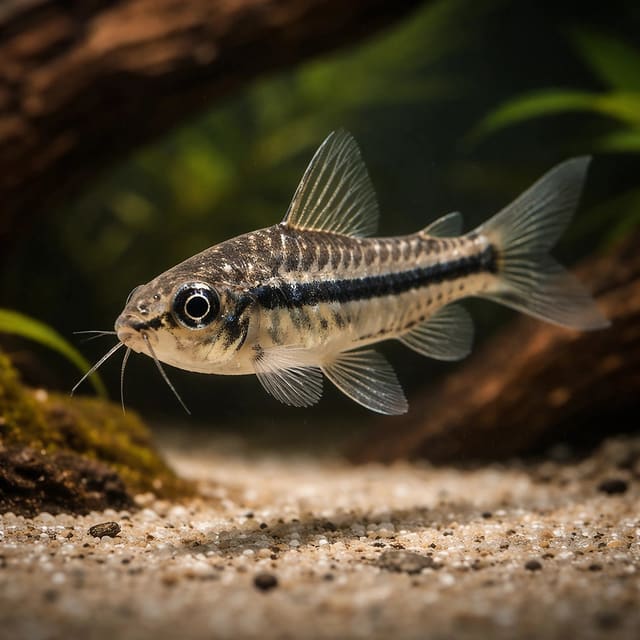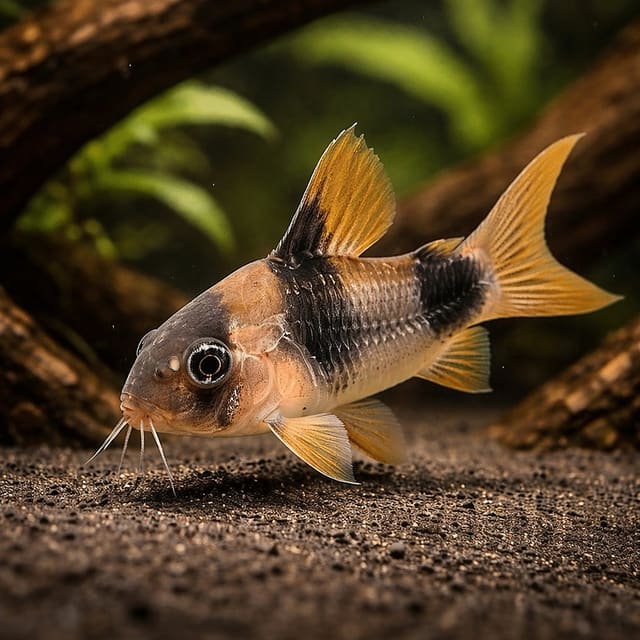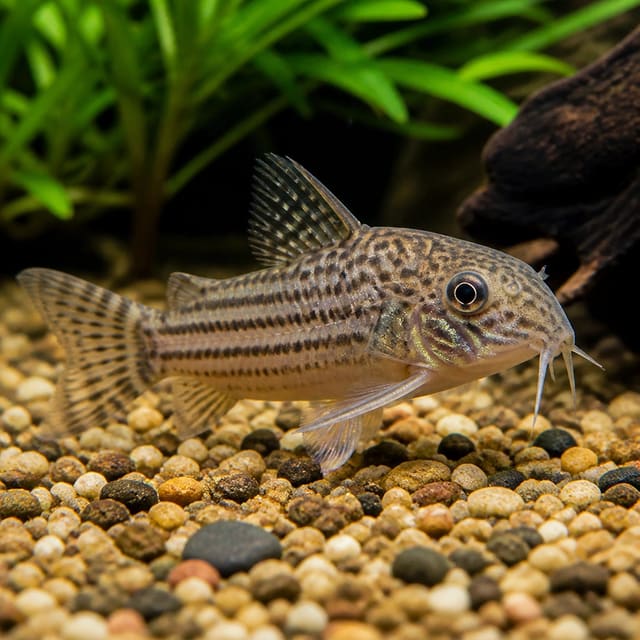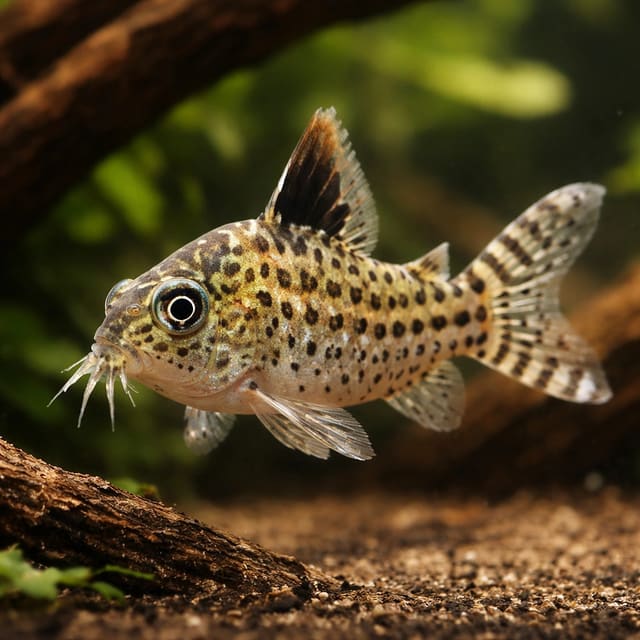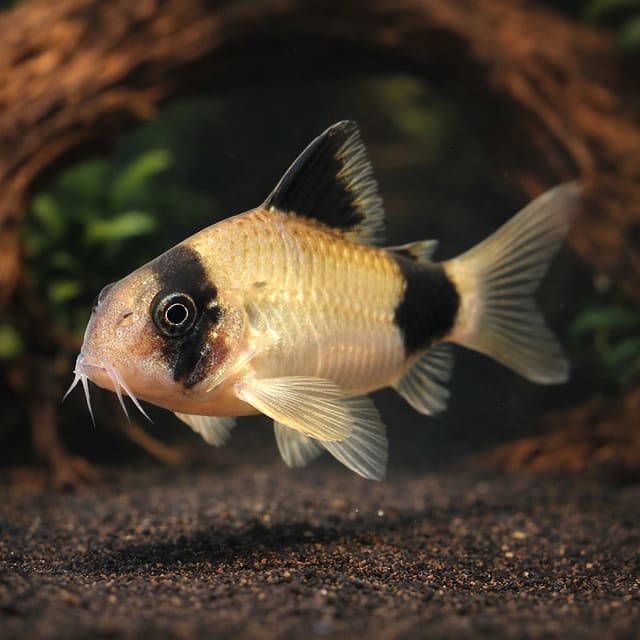
Panda Cory Catfish (Corydoras panda)
22–25°C · pH 6–7.4
From £8.69Some sizes on sale

The Duplicate Cory (Corydoras duplicareus) is a peaceful callichthyid catfish from the upper Negro River basin that reaches 5 cm standard length. It suits keepers able to maintain at least 4–6 together at the FishBase and Seriously Fish overlap of 22–26°C, pH 6.0–7.0 and 2–5 dGH. Sold individually in sizes from 2.5–3 cm to 3–3.5 cm.
Adult size is the maximum length this species reaches at full maturity (scientific sources). The livestock you receive will be younger and smaller — pick a size above for the actual shipping size. Product-photo provenance and any image-specific limitations are stated on the listing.
Corydoras duplicareus
Shoaling fish: kept in a group they feel safer, stay calmer and show their best colour.
The Duplicate Cory (Corydoras duplicareus) is a peaceful callichthyid catfish from the upper Negro River basin that reaches 5 cm standard length. It suits keepers able to maintain at least 4–6 together at the FishBase and Seriously Fish overlap of 22–26°C, pH 6.0–7.0 and 2–5 dGH. Sold individually in sizes from 2.5–3 cm to 3–3.5 cm.
Adult size is the maximum length this species reaches at full maturity (scientific sources). The livestock you receive will be younger and smaller — pick a size above for the actual shipping size. Product-photo provenance and any image-specific limitations are stated on the listing.
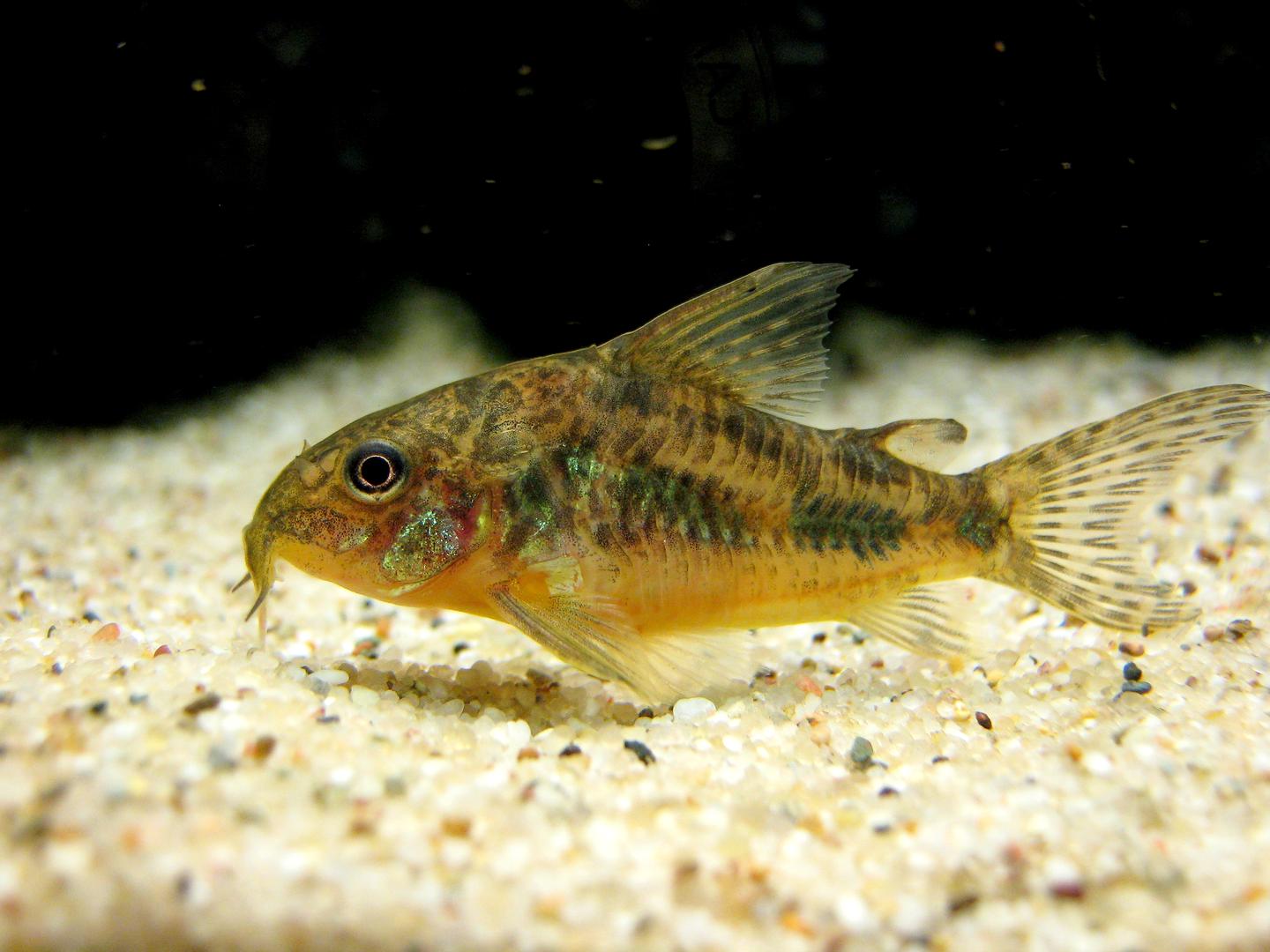
Identify the exact cory catfish before choosing care. Our starting policy for many common medium species is six compatible conspecifics, a mature 60 x 30 cm aquarium of about 60 litres, smooth fine sand and measured species-appropriate water.
Maintain these water conditions for optimal health and vibrant colors
The Duplicate Cory is a peaceful, gregarious freshwater catfish from the upper Negro River basin in South America. It belongs to Callichthyidae, the family of callichthyid armoured catfishes, and spends its aquarium life close to the bottom. It suits a keeper prepared to maintain a social group, provide deliberate sinking meals and keep a clean substrate in a mature filtered aquarium.
FishBase records a maximum of 4 cm standard length for this fish and now lists it as Hoplisoma duplicareum. The familiar aquarium name remains Corydoras duplicareus. Standard length runs from the snout to the base of the tail, so it excludes the tail fin.
A separate Seriously Fish species profile gives a planning length of 5 cm standard length. Use the 5 cm standard-length figure when planning aquarium space. Aquarium space, group planning and feeding access should accommodate this figure instead of being based on the dispatch size.
| Suits | Not suited to |
|---|---|
| A social group of at least 4–6 individuals | A solitary setup |
| Fine sand, open foraging room and secure cover | A layout without clean bottom space or cover |
| Stable water within 22–26°C, pH 6.0–7.0 and 2–5 dGH | Water outside the FishBase and Seriously Fish overlap |
| Deliberate sinking meals | Reliance on leftovers or aquarium cleaning |
| A mature filtered community assessed for water, feeding and space | An unfiltered or unsuitable aquarium |
This fish suits an aquarist prepared to maintain a social group, keep the substrate clean and place food where every individual can reach it. Its peaceful temperament does not remove the need to check the complete community: competition at the bottom can matter even when there is no aggression.
One purchase supplies one Duplicate Cory in the size selected. The dispatch sizes are 2.5–3 cm and 3–3.5 cm. Use the live size selector to choose between the sizes shown.
The size you select is the size supplied, not the adult size. A 2.5–3 cm fish therefore needs an aquarium planned around the 5 cm standard-length reference, its social group and the space occupied by every other fish. The larger dispatch band does not represent a different adult form or a different care category.
Quantity and size perform different jobs in the plan. The selected size determines the dispatch band; the purchase quantity determines how many individual fish are ordered. If the aquarium has no Duplicate Cory group, first decide whether it can support at least 4–6 individuals. If companions are already present, count their adult space and feeding demands before setting the quantity.
Sex is guaranteed only when the selected option explicitly states male or female. This Duplicate Cory listing has no sex-guaranteed option.
Some gallery images have been digitally enhanced to improve image quality. They show the listed type of animal rather than guaranteeing the exact markings of the individual supplied, so natural colour and pattern can vary.
Apparent sex, body size or colour in an image does not alter the offer. Use the live size selector, remember that each purchase supplies one fish, and confirm that the aquarium can support a complete social group.
Keep the Duplicate Cory in a group. The species profile says it should be maintained in a group of at least 4–6 individuals, while OATA recommends at least five for Corydoras generally. A plan for five meets OATA’s baseline and sits within the species profile’s stated group range; six provides another supported starting point when the aquarium has the extra floor space and filtration capacity.
OATA’s freshwater-catfish sheet gives broad group guidance of an aquarium of at least 80 litres for a shoal of smaller Corydoras or a smaller pleco. Use 80 litres as the starting volume for a small group, then increase space where the footprint, décor, established population or larger group reduces usable bottom area.
| Question | Action |
|---|---|
| Is the aquarium under 80 litres? | Choose a larger aquarium before planning the group. |
| Does décor occupy much of the floor? | Preserve open areas where the whole group can forage and feed. |
| Are other bottom fish present? | Count their shelter and feeding areas in the same space calculation. |
| Will the group exceed six? | Increase usable floor area and filtration capacity with the group. |
Volume helps water conditions remain stable, but litres alone do not describe the shape of the aquarium. A tall layout can contain the baseline volume while offering less bottom room than a longer design. Judge the clear floor after wood, plants, pots and other cover have been positioned.
Plan each fish at its adult reference length, even when all selected fish arrive at 2.5–3 cm. For example, five fish planned at 5 cm standard length represent a group whose eventual use of the bottom will be very different from five newly dispatched fish. Use this comparison alongside filtration, other inhabitants and the actual layout when deciding whether the aquarium has enough space.
Additions should not exceed the capacity of the mature biological filter. If the aquarium population must be increased gradually, test after each addition and preserve the supported social minimum rather than leaving one fish alone for an extended period.
Fine sand is the preferred substrate. Rounded gravel is an acceptable alternative when it is kept scrupulously clean, but sand provides the straightforward choice for a fish that forages along the bottom. Whatever material is chosen, remove trapped food and solid waste before it accumulates around resting and feeding places.
Arrange open foraging areas beside cover. Driftwood branches and dried leaf litter are useful additions, while plants and other secure décor can create shaded resting places. Cover helps the group feel secure without taking away every clear area where sinking food can be found.
Dried leaves decompose over time and can encourage colonies of microorganisms. The species profile describes those microorganisms as a valuable secondary food source for fry, while tannins and other chemicals released by the leaves are thought beneficial and can help imitate natural conditions. Leaves remain décor and habitat enrichment rather than a replacement for deliberate meals.
Keep every decoration stable. Bottom-foraging fish repeatedly move around the bases of wood and plants, so a layout should not depend on loose pieces balancing against one another. Avoid creating inaccessible pockets where sinking food can disappear and decay.
Check the substrate during each maintenance session. If food repeatedly gathers in one corner, alter the feeding position or circulation rather than allowing that point to become a permanent waste trap. When rounded gravel is used, inspect between the grains because debris can settle below the visible surface.
A useful finished layout lets you answer three questions clearly: can all group members reach food, can they move between cover and open floor, and can waste be removed without dismantling the aquarium? If any answer is no, adjust the décor before the fish are introduced.
Keep the aquarium at 22–26°C, pH 6.0–7.0 and 2–5 dGH. These values are the overlap between the Seriously Fish aquarium range of 20–26°C, pH 4.0–7.0 and 1–5 dGH and FishBase’s recorded environmental range of 22–26°C, pH 6.0–8.0 and 2–25 dH.
Measure the aquarium rather than choosing values by assumption. Our water chemistry guide explains the values to test, and the Water Parameter Matcher can compare measured aquarium conditions with the stated guidance.
The group-level OATA values are zero mg per litre ammonia, zero mg per litre nitrite and nitrate no more than 20 mg per litre above normal tap-water levels. These waste readings are operating limits for aquarium maintenance, not optional targets to approach.
| Reading | Decision |
|---|---|
| Ammonia above zero | Pause livestock additions and address biological filtration and waste. |
| Nitrite above zero | Pause additions and restore safe filtered conditions. |
| Temperature outside 22–26°C | Bring it into range gradually before introduction. |
| pH or hardness outside range | Choose a suitable water plan before moving the fish. |
Stability matters because every correction affects the whole group. Test replacement water as well as aquarium water when the two differ noticeably. Matching temperature and avoiding abrupt chemistry changes makes routine maintenance more predictable.
A working filter is essential. The RSPCA’s aquarium guidance explains that fish release toxic ammonia and that beneficial bacteria in a biological filter convert it first to nitrite, which is also toxic, and then to safer nitrate. The filter must therefore be established before the Duplicate Cory group is introduced.
The species profile says filtration can be gentle, with an air-powered sponge-style unit normally adequate, although some water movement is acceptable. Choose filtration that processes the aquarium’s total waste while leaving the bottom group able to forage and rest normally.
Do not rinse biological filter media under the tap. Chlorine or chloramine may kill the established bacteria. If cleaning is needed, rinse the media lightly in aquarium water removed during the partial water change. This protects more of the bacterial population while clearing debris.
A clogged filter may continue making noise while moving less water. Look at the return flow rather than relying on sound alone, and inspect the intake for trapped leaves or food. Clean only as much as needed to restore function; replacing all established media at once removes the bacteria that process waste.
Use the water change to inspect feeding areas. Siphon visible debris without turning every session into a complete rearrangement. If one zone remains dirty between changes, reduce the portion landing there, improve access for cleaning or adjust the layout.
Record unusual ammonia, nitrite or nitrate readings and note recent fish additions or feeding changes. A simple sequence of dated results makes it easier to see whether the filter has recovered before any further increase in stocking.
Duplicate Corys are foraging omnivores. Offer quality sinking dried food as the regular meal and rotate suitably small live or frozen foods such as chironomid larvae, commonly called bloodworm, or Tubifex. Freeze-dried bloodworm can also form part of the varied diet described for this group.
These catfish must not be expected to survive on leftovers from other aquarium inhabitants or be relied upon to clean the aquarium. Food reaching the bottom by accident does not show that every member of the group has eaten. Place a deliberate sinking portion where the fish can find it and remain present long enough to observe the whole group.
The once-daily schedule comes from OATA’s general catfish guidance. The species profile supplies the more precise food choices: sinking dried products plus small live and frozen varieties. Together they provide a workable routine without treating scavenging as nutrition.
| What you see | What to do |
|---|---|
| Food vanishes before the group reaches it | Place a separate sinking portion directly in the bottom feeding zone. |
| One fish repeatedly misses the meal | Add another feeding point and observe it closely. |
| Food remains after a few minutes | Remove it and make the next portion smaller. |
| Waste rises after feeding | Review portion size, trapped food and filter capacity. |
Variation means changing suitable foods over time, not giving a large mixed portion at every meal. Keep each feed modest and use observation to judge whether the whole group is maintaining interest in food.
Leaf-litter microorganisms may provide secondary food for fry, but adult aquarium care still requires deliberate sinking food. A clean-looking bottom is not evidence that the group has received a complete meal.
Complete the aquarium before the group arrives. The filter should be mature, the temperature should sit within 22–26°C, and tests should show zero mg per litre ammonia and zero mg per litre nitrite. Arrange the fine substrate, open feeding area and cover before fish are added so their first days are not interrupted by a major rebuild.
If this is your first setup, follow our first tropical aquarium guide to prepare and mature the system before livestock is introduced. Maturation allows the filter’s beneficial bacteria to establish before feeding and fish waste increase the biological load.
Increase aquarium stocking slowly because the beneficial bacterial population must grow as fish numbers and feeding rise. Adding too many fish too quickly can produce new tank syndrome, in which the filter bacteria cannot process the additional waste and ammonia or nitrite rises to harmful levels.
Social need and filter capacity must be considered together. Do not use slow stocking as a reason to keep one Duplicate Cory alone indefinitely. Instead, prepare enough mature capacity for the supported group, or delay the introduction until that capacity exists.
Keep the video and order number for any Live Arrival Guarantee claim. The full terms are on the delivery and Live Arrival Guarantee policy.
Check water after the addition and observe swimming, breathing, colour, feeding and group contact. Test promptly when behaviour changes or appetite falls. Keep the feeding portion modest while confirming that the filter continues to hold ammonia and nitrite at zero.
Learn the group’s ordinary pattern during feeding and quiet periods. OATA recommends watching swimming behaviour, colour, temperament, breathing, appearance, body condition and food intake. A change matters most when it persists or appears alongside another change.
| Change | First response |
|---|---|
| Hanging at the surface or erratic swimming | Test ammonia, nitrite and temperature immediately. |
| Faster or slower gill movement | Check water quality and filter operation without delay. |
| Darker or paler colour than normal | Compare behaviour, feeding and recent water readings. |
| More hiding or altered temperament | Review cover, group size, disturbances and companions. |
| White spots, fluffy growths or damaged fins | Test the water and obtain fish-health guidance before selecting a response. |
| Reduced food intake | Check competition, food access and water quality. |
Sitting on the bottom is included in OATA’s general warning list because it can represent a change in some fish. For a demersal catfish, location alone is less useful than a departure from its usual posture, movement and feeding. Compare the individual with its established pattern and the rest of the group.
Begin with measured conditions rather than guessing at a disease. Ammonia and nitrite should remain at zero mg per litre, and the filter should maintain normal flow. If a reading has changed, protect water quality and seek appropriate fish-health advice rather than choosing a treatment from appearance alone.
Inspect the whole group during the daily meal. One fish repeatedly failing to reach food may indicate competition even when the aquarium appears peaceful. Add a feeding point, watch again and check whether bottom space is being blocked by another inhabitant.
Continue the 25% partial water change at least once a week and maintain the testing routine when everything appears normal. Consistent records create the baseline that makes a genuine change easier to recognise.
The Duplicate Cory is described as peaceful and gregarious, and OATA places Corydoras among the catfish commonly kept in community aquariums. That describes the fish’s broad temperament, but each proposed pairing still needs a practical assessment.
Begin with water overlap. A companion should be maintainable within 22–26°C, pH 6.0–7.0 and 2–5 dGH without forcing either animal to live at an unsuitable value. Compare the planned stable setting rather than accepting a tiny overlap at the edge of two ranges.
| Result | Decision |
|---|---|
| All four checks pass | The combination may proceed with observation and suitable stocking. |
| Water ranges do not align | Choose a different companion. |
| Bottom food is monopolised | Change the feeding arrangement or the stocking plan. |
| Décor leaves too little floor | Reduce stocking or provide a larger suitable layout. |
The word “community” is not a complete compatibility decision. Two peaceful fish can still require different water, and two bottom-oriented species can compete for the same feeding places without obvious aggression.
Assess each proposed pairing by comparing adult size, water needs, feeding behaviour and aquarium dimensions before the animals are mixed. Base the stocking and compatibility assessment on the aquarium volume and footprint, measured water values, filter status, décor plan and exact species already present.
Browse the catfish and pleco collection to compare identity and care requirements, but assess each candidate separately rather than assuming all catfish share this fish’s size or temperament.
Compatibility continues after the fish are introduced. A combination that shares water values can still fail if one inhabitant controls the bottom, reaches every sinking meal first or leaves the Duplicate Cory group without usable cover.
Observe at feeding time because that is when hidden competition becomes visible. Every group member should have a route to food and enough time to eat. If one area is crowded, split the portion between separate open zones rather than simply adding more food to the same place.
Cover should create several usable resting choices without consuming the entire floor. When all shelter is concentrated beneath one piece of wood, another inhabitant can make that area difficult to use. Spread secure cover through the layout and retain clear routes between it and the feeding zones.
| Observation | Adjustment |
|---|---|
| One cory remains away from meals | Create another sinking-food point and watch the next feed. |
| The group hides more after a new addition | Review space, disturbances and access to cover. |
| Waste accumulates after split feeding | Reduce each portion and remove uneaten food. |
| Ammonia or nitrite appears | Stop further additions and restore zero readings. |
Reassess the community whenever fish are added or the décor is changed. A new ornament can remove feeding room just as effectively as another bottom-dweller, while a new fish increases both competition and filter load.
The most reliable community plan combines peaceful behaviour with measurable water overlap, deliberate feeding and sufficient space. Continue daily observation and weekly testing after the initial introduction rather than treating compatibility as a one-time decision.
The Duplicate Cory reaches 4 cm standard length according to FishBase; Seriously Fish gives a separate 5 cm standard-length planning reference.
Use an aquarium of at least 80 litres for a small group. This is OATA’s broad guidance for a shoal of smaller Corydoras, so also assess the footprint, décor, filtration and other inhabitants.
Keep at least 4–6 Duplicate Corys together, as directed by the Seriously Fish species profile; OATA recommends at least five for Corydoras generally.
Corydoras duplicareus suits a keeper prepared to maintain a mature filtered aquarium, a group of at least 4–6, stable water, clean substrate and deliberate feeding.
Feed the Duplicate Cory quality sinking dried food with suitably small live, frozen or freeze-dried foods. OATA’s catfish guidance says to feed once a day, offering only what can be eaten within a few minutes.
Keep it at 22–26°C, pH 6.0–7.0 and 2–5 dGH, the overlap between FishBase’s environmental values and the Seriously Fish aquarium range; ammonia and nitrite must remain at zero mg per litre.
This fish is described as peaceful and gregarious. Screen each community combination for adult size, shared water, feeding access and bottom space rather than relying on temperament alone.
It can be considered for a peaceful community aquarium when every companion shares its water range and allows the group enough bottom space, cover and access to sinking food.
Start filming before any floating, showing the sealed parcel and outer box, then continue in one take as it is opened with the fish still in the sealed bag. Someone must be present to receive it; float the bag for 20–30 minutes, then release the fish without pouring the bag water into the aquarium.
No reviews for this item yet. Bought one? Honest reviews only, good or bad.
What customers say about ordering from us
I have a small group of long finned mountain minnows. So was delighted to be able to order ten of this variety to increase the genetics in my tank . The ones I recieved are healthy but it’s to early to give a verdict on wether they are of a long finned type since they are small currently.
Gordon Walker · 23 Sept 2026
100% success travel and "installation". Pleased with quality of purchase. The Siamese fighter a bit "shy" so have not yet seen him at his best yet but looking good. Happy customer. GG
George E Garratt · 21 Sept 2026
Reviews of our shop, collected by Judge.me, an independent third-party review collector. Newest first.