Moderate
Mitu Cory CW106 (Brochis sp. CW106)
23–25°C · pH 6–7
£31.39
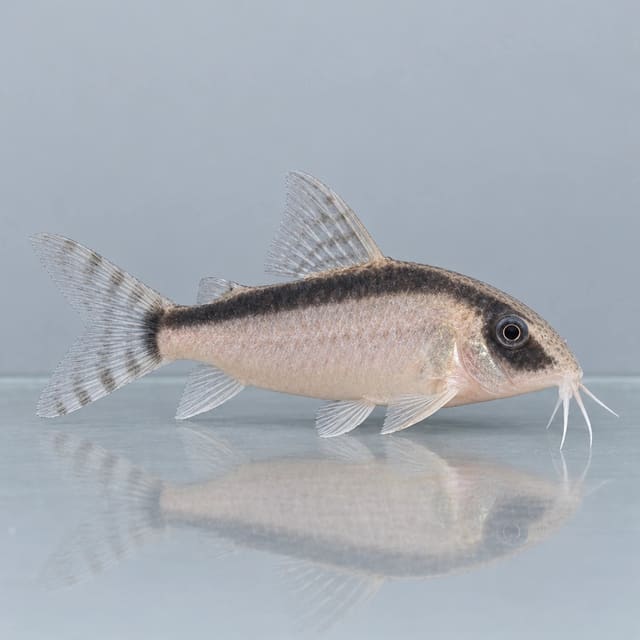
The Pantanal Cory (Brochis pantanalensis, formerly Corydoras pantanalensis, C005) is a peaceful armoured catfish from the Pantanal wetland, one of the larger corys at about 7–8 cm. Mature males develop a brown network pattern over an emerald-green body. Keep six or more on clean sand in a planted tank at 23–26°C and pH 6.5–7.2. One live fish per purchase.
Adult size is the maximum length this species reaches at full maturity (scientific sources). The livestock you receive will be younger and smaller. Product-photo provenance and any image-specific limitations are stated on the listing.
Brochis pantanalensis
Quantity discounts are pricing offers, not a group-size recommendation. Check the full care guidance and your existing animals before choosing a quantity.
The Pantanal Cory (Brochis pantanalensis, formerly Corydoras pantanalensis, C005) is a peaceful armoured catfish from the Pantanal wetland, one of the larger corys at about 7–8 cm. Mature males develop a brown network pattern over an emerald-green body. Keep six or more on clean sand in a planted tank at 23–26°C and pH 6.5–7.2. One live fish per purchase.
Adult size is the maximum length this species reaches at full maturity (scientific sources). The livestock you receive will be younger and smaller. Product-photo provenance and any image-specific limitations are stated on the listing.
Identify the exact cory catfish before choosing care. Our starting policy for many common medium species is six compatible conspecifics, a mature 60 x 30 cm aquarium of about 60 litres, smooth fine sand and measured species-appropriate water.
Read the full care guidance when planning conditions for your aquarium.
The Pantanal Cory is Brochis pantanalensis, an armoured catfish from the Pantanal, the vast tropical wetland on the borders of Bolivia and Brazil. For most of its history in the hobby it was called Corydoras pantanalensis, and before it was formally described it carried the C-number C005. Knaack described it in 2001 from the Cussis and Las Petas river basins in Bolivia, and the species name simply refers to the Pantanal. FishBase, Planet Catfish and Seriously Fish give its range as the Bolivian part of the wetland; Practical Fishkeeping, in a profile by Ian Fuller, also lists the northern Pantanal in Mato Grosso, Brazil.
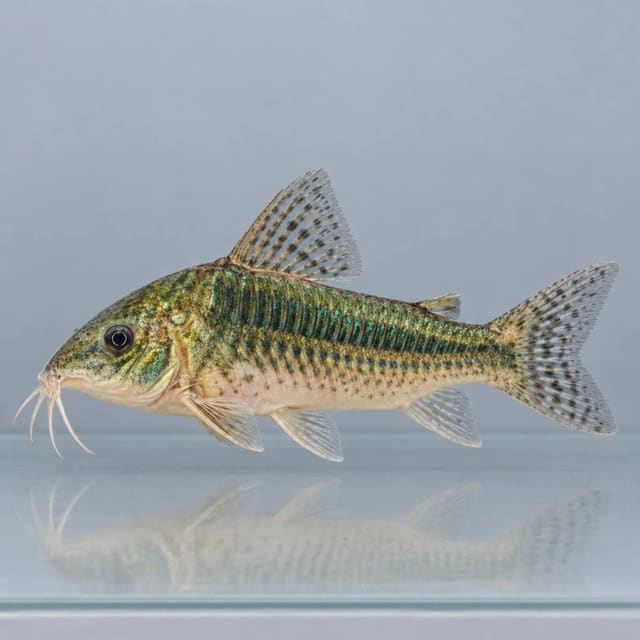
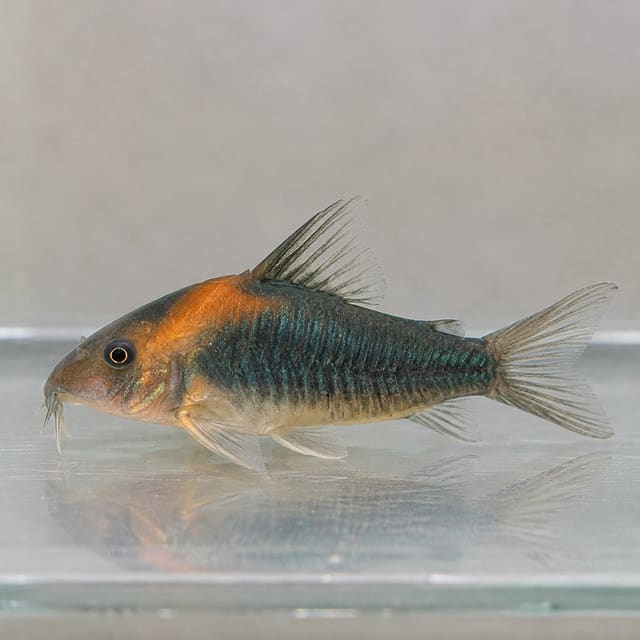
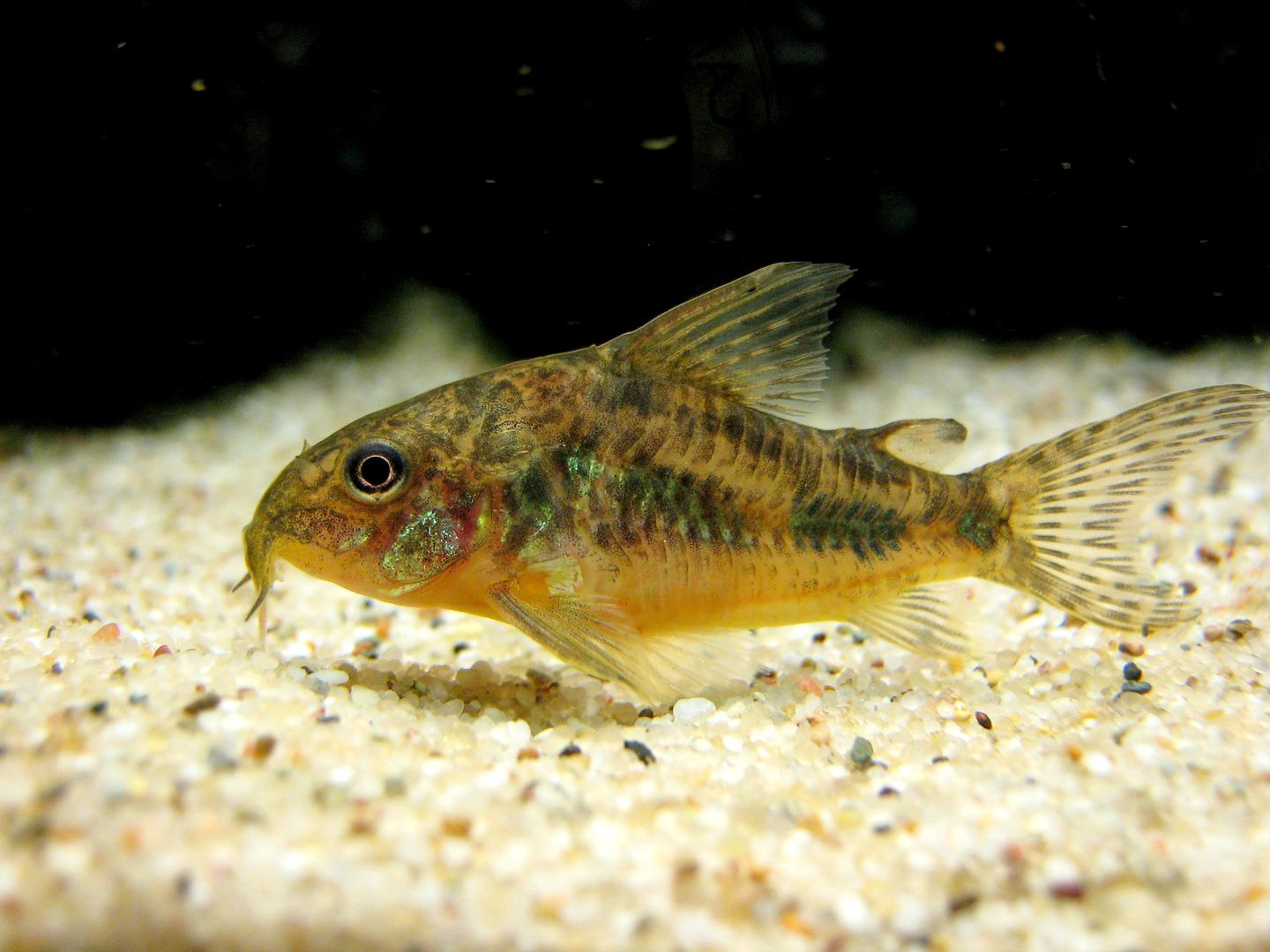
It is one of the larger corys, at around 7–8 cm as an adult, and one of the more striking ones when mature. Planet Catfish describes the basic colour as always emerald green, and mature males develop a brown network pattern over it, which Practical Fishkeeping calls a beautiful mosaic and which is strongest in the breeding season. Seriously Fish describes it as very peaceful and suitable for many community tanks. In the 2024 reclassification of the corydoradine catfishes by Dias and colleagues it moved, with the other deep-bodied "intermediate long-snouts" of ScotCat's lineage 8, into the genus Brochis.
| Name | Where you will see it | Notes |
|---|---|---|
| Pantanal Cory | Common name | Used by Planet Catfish and FishBase |
| C005 | Older import lists | Its C-number before it was described |
| Corydoras pantanalensis | Most shops and older books | The name used from 2001 to 2024 |
| Brochis pantanalensis | Seriously Fish, FishBase, Planet Catfish, ScotCat | The current name |
| "Corydoras latus" | Some export lists | A frequent misidentification, noted by ScotCat and Practical Fishkeeping |
Two fish are easily confused with the Pantanal Cory. Practical Fishkeeping and ScotCat both compare it with Brochis geryi, a slightly smaller relative from the same part of the Pantanal whose mature males show the same mosaic pattern; because the two live together, Practical Fishkeeping notes they may turn up together in imports. ScotCat also says it is reminiscent of the Emerald Catfish, Brochis splendens.
| Feature | Pantanal Cory | Brochis geryi | Emerald Catfish, B. splendens |
|---|---|---|---|
| Tail and dorsal fin | Tail fin clear | Prominent barring in the dorsal and tail fins | Compared by ScotCat on body shape rather than fin pattern |
| Body and snout | Higher body, longer snout and more dorsal-fin rays than B. splendens | Similar shape, slightly smaller overall | Lower body, shorter snout, fewer dorsal-fin rays |
| Male pattern | Brown network or mosaic on mature males | The same kind of mosaic on mature males | No such male pattern described by these sources |
Planet Catfish words the fin difference less clearly than the other two sources, but ScotCat and Practical Fishkeeping agree that the Pantanal Cory has a clear tail fin and B. geryi a patterned one.
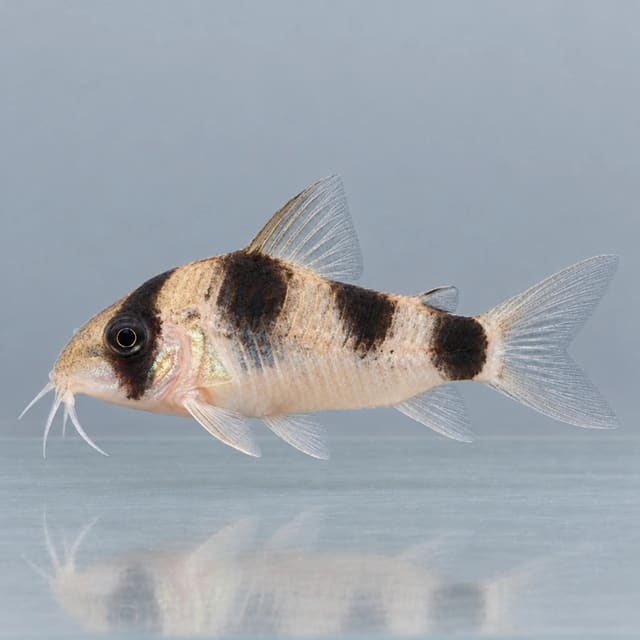
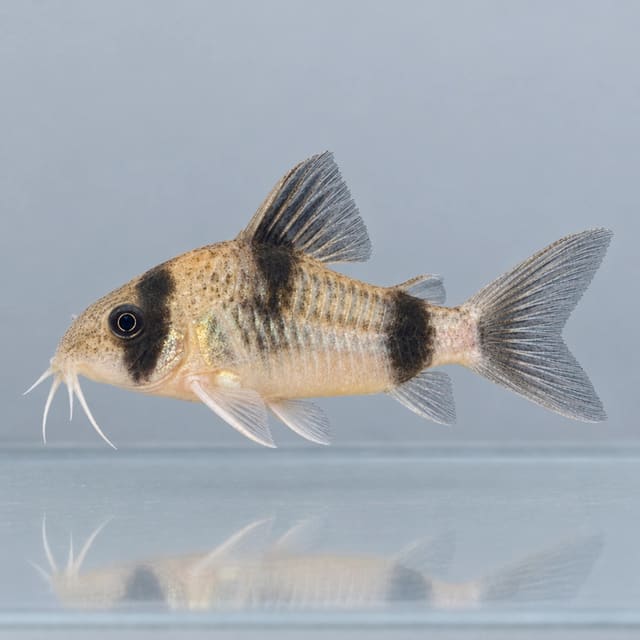
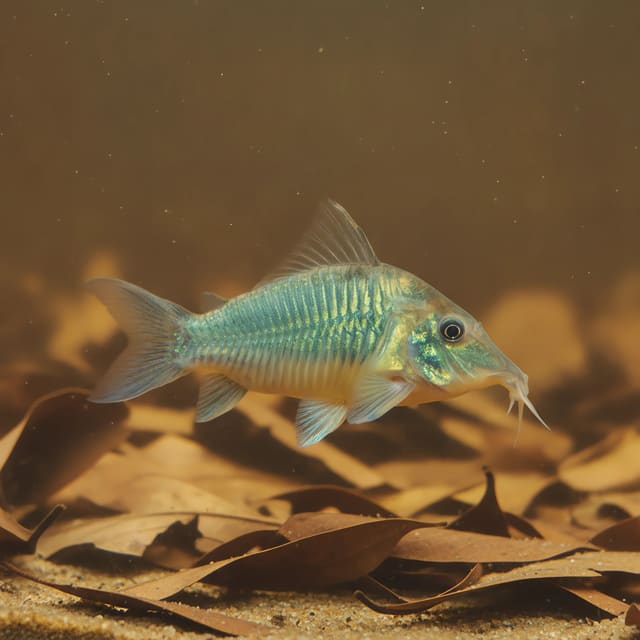
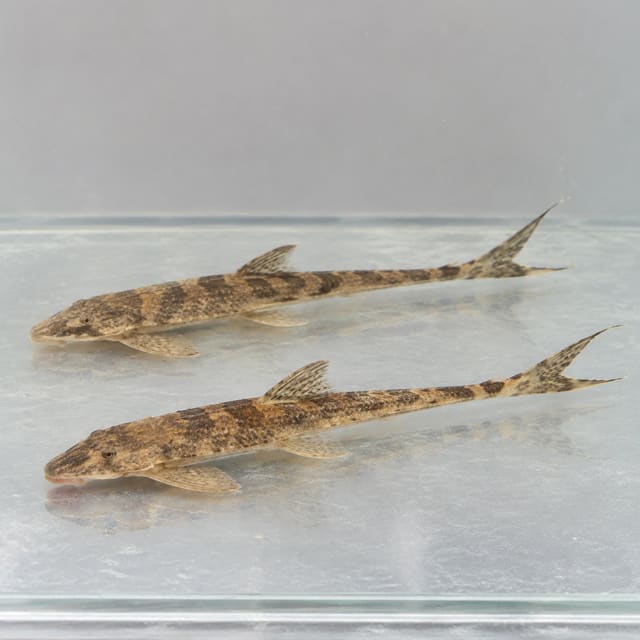
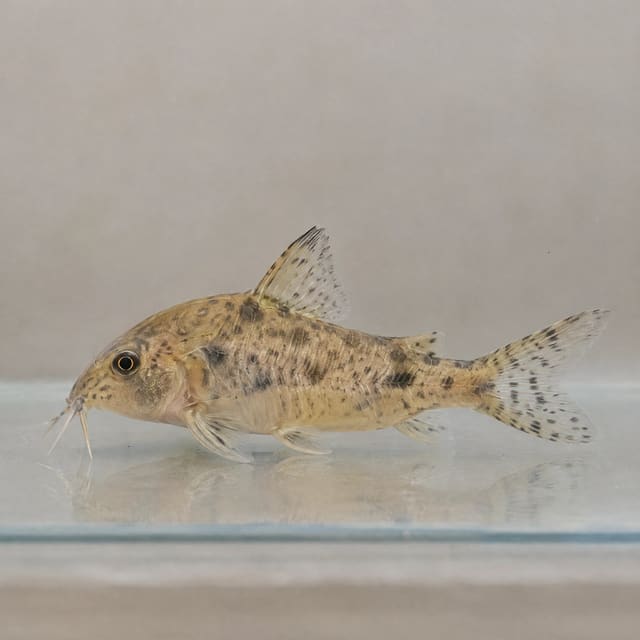
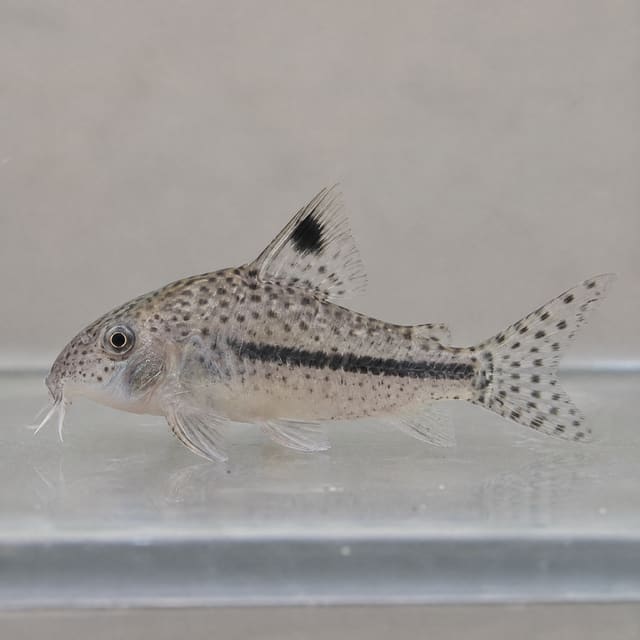
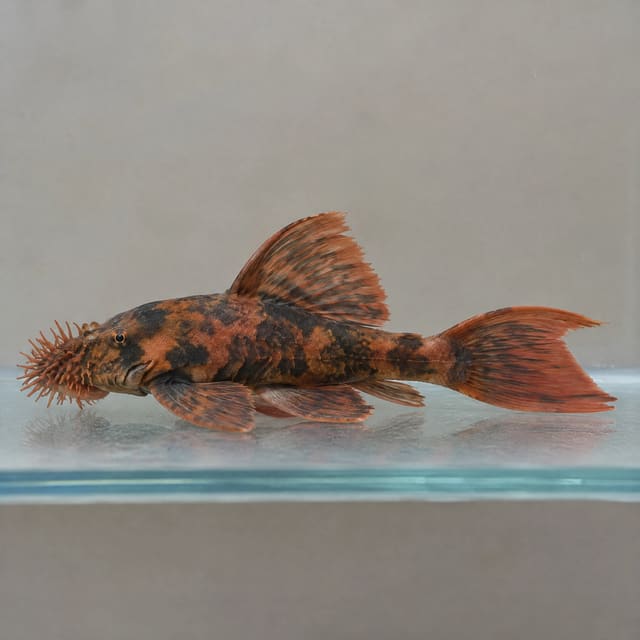
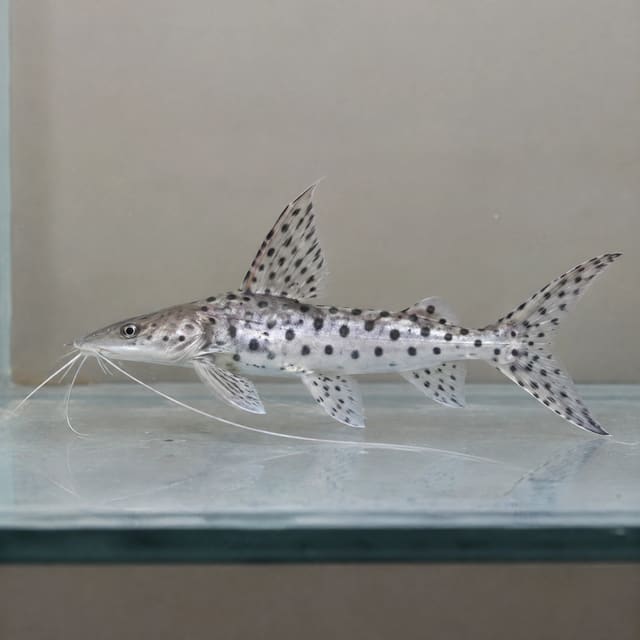
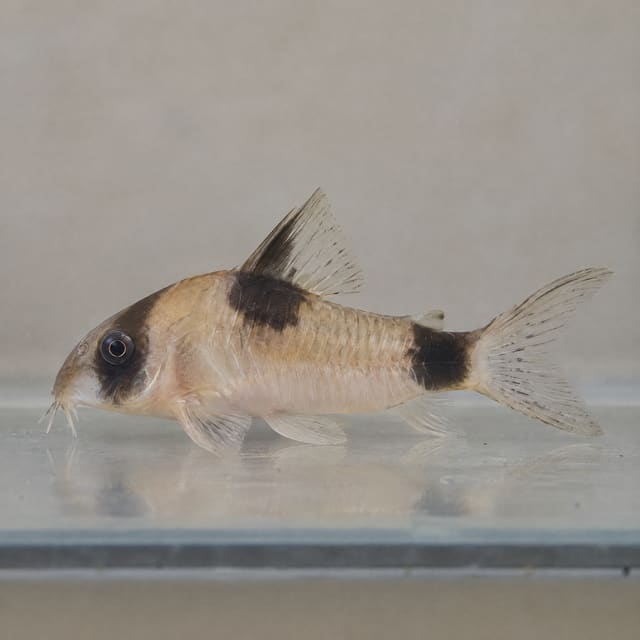
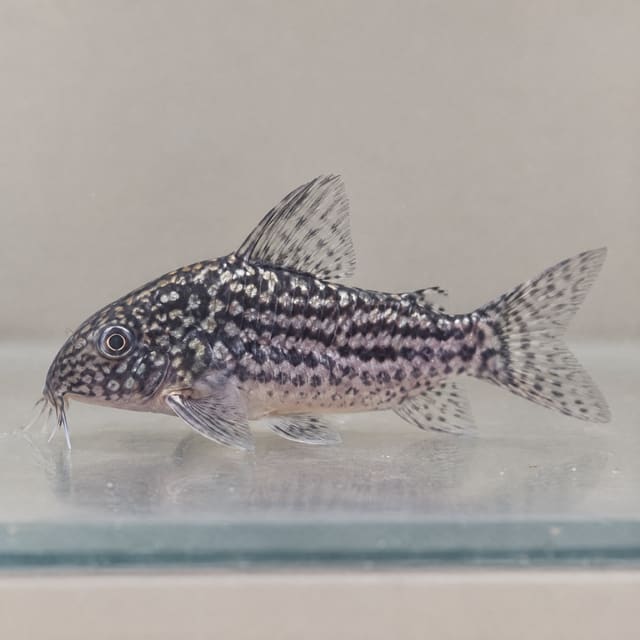
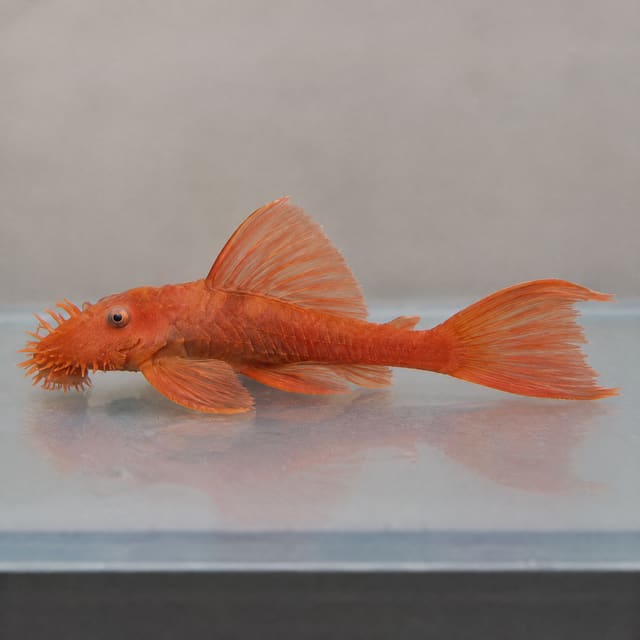
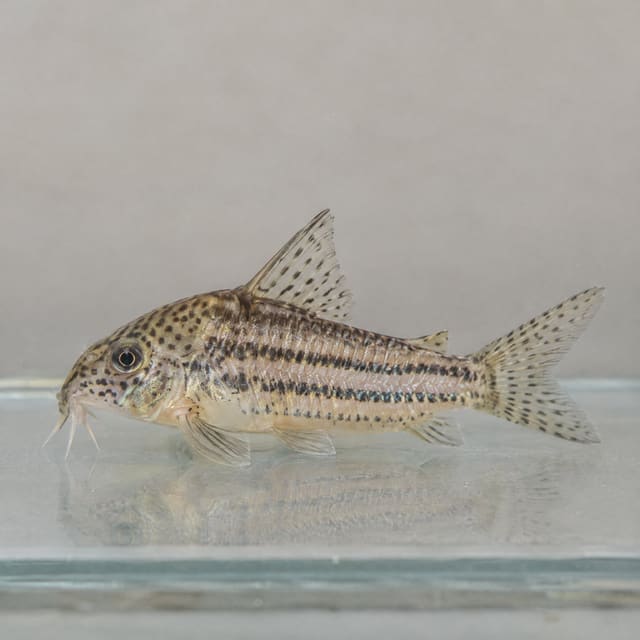
One purchase supplies one live Pantanal Cory in the standard size we receive, sex not chosen. Planet Catfish explains that males and females look the same until maturity, when only males develop the strong network pattern; plain fish are either females or males that are not yet mature or dominant. Seriously Fish adds that males are the smaller, slimmer sex, and Planet Catfish notes that mature females are larger and broader. The gallery images are representative, prepared from a reference photograph, and do not show the individual you will receive; young fish are much plainer than a fully coloured adult male.
| Source | Group advice |
|---|---|
| Seriously Fish | At least six; corys are far more confident and active with their own kind |
| Practical Fishkeeping | Six or more |
| OATA | At least five for any corydoras; smaller groups often become stressed |
A group of six or more is the plan to follow, and a larger group gives a better chance of seeing mature males in full pattern.
The published sizes differ, so plan for the largest. FishBase and Planet Catfish give 6.9 cm standard length, measured from the snout to the base of the tail. Seriously Fish gives 8 cm standard length, Practical Fishkeeping expects males to reach 7.5 cm and females a little more, up to 8 cm, and ScotCat gives 7.5 cm for males and 8 cm for females. A group of six fish of that size needs a real floor, not a nano tank.
| Source | Recommendation |
|---|---|
| Seriously Fish | Base of 75 × 30 cm, about 68 litres |
| Practical Fishkeeping | 36 × 15 × 12 inches (about 91 × 38 × 30 cm) is ideal for a group |
| OATA | At least 80 litres for a shoal of the smaller catfish such as corydoras |
For a group of six, the Practical Fishkeeping size is the comfortable choice; the Seriously Fish base is a minimum. Work out your tank's real volume with our tank volume calculator before you order.
Seriously Fish describes the Pantanal as the biggest wetland in the world, at around 150,000 square kilometres, and its waters as crystal clear with an abundance of aquatic plants, unlike much of the Amazon. It suggests a brightly lit aquarium with plenty of plants and some floating vegetation to imitate this. That makes the Pantanal Cory a natural choice for a planted community tank; browse our fish for planted tanks for companions.
The floor matters most. Seriously Fish warns that, like all corys, this species is sensitive to poorly maintained or dirty substrates and can lose its barbels in poor conditions, so the substrate must be kept scrupulously clean, and it advises against undergravel filters. Planet Catfish recommends sand, with rounded gravel as an imperfect alternative, and warns against rough, chipped gravel. Edge the sand with driftwood and plants, leave an open feeding area, and use floating plants or tall stems for shade.
| Area | What to use | Why |
|---|---|---|
| Front floor | Open fine sand | Foraging space that does not wear the barbels |
| Middle and back | Dense planting and driftwood | Mirrors the plant-rich Pantanal and gives resting cover |
| Surface | Some floating plants, with open gaps | Softens bright light; leaves room to gulp air |
| Feeding spot | A clear patch of sand at the front | Easy to see every fish eat and to siphon leftovers |
The Pantanal floods and drains through the year. Practical Fishkeeping points out an average rainfall of about 1.6 metres and concludes that water conditions must vary a lot during the year, so the Pantanal Cory tolerates change; even so, it recommends a neutral pH of 7.0 and a general hardness of 3–9°dH for the fish's long-term wellbeing. The three published sets of values differ slightly, so the table shows each and the range where they agree.
| Value | Seriously Fish | ScotCat | Practical Fishkeeping | Target where they overlap |
|---|---|---|---|---|
| Temperature | 22–26°C | 23–27°C | Not given | 23–26°C |
| pH | 6.5–7.5 | 6.0–7.2 | 7.0 ideal | 6.5–7.2, ideally near 7.0 |
| General hardness | 5–12°dH | Not given | 3–9°dH | 5–9°dH |
A neutral pH suits many UK tap supplies, but hardness varies widely between areas, and harder supplies can sit well above 9°dH. Test your tap water first, and if it is hard, plan to blend it with purified water and test every change. Keep the temperature steady with a correctly sized heater and thermometer; our tropical tank temperature guide explains how. The water matcher compares your tap water with the fish you plan to keep, and the water chemistry guide explains pH and hardness.
The values above describe the water the fish evolved in. Waste readings are a separate check: OATA advises zero ammonia, zero nitrite and nitrate no more than 20 mg per litre above your tap water, tested every week.
Use a good external, hang-on or internal filter rather than an undergravel plate, which Seriously Fish advises against for corys; an undergravel plate draws waste down into the sand they forage in. FishBase records the Pantanal Cory as a facultative air-breather: like other corys, it can dash to the surface to gulp air, which is normal behaviour and not on its own a sign of trouble. Keep part of the surface clear of floating plants so the fish can reach it easily. Our filtration guide explains how to choose a filter of the right size.
Practical Fishkeeping describes the natural diet as small crustaceans, insect larvae, worms and the microscopic life in the biofilm that coats submerged surfaces. In the aquarium, Seriously Fish says it accepts most sinking dried foods as well as small live and frozen foods such as bloodworm, brine shrimp and chopped earthworm, and that a varied diet keeps the fish in the best condition. Planet Catfish lists tablets, granules and larger flakes that reach the bottom, plus live or frozen bloodworm, white worm, grindal worm, Daphnia and Tubifex.
Add the fish only once the filter is fully matured and ammonia and nitrite read zero; OATA warns that adding fish too fast causes "new tank syndrome". Catfish travel double-bagged because their spines can puncture bags. Acclimatise with OATA's floating bag method: lights off, float the sealed bag for about 10 minutes, add small amounts of aquarium water to the bag over up to 20 minutes, then release the fish with as little bag water as possible. Avoid netting corys if you can, because their fin spines catch in the mesh.
| When | What to do |
|---|---|
| Before arrival | Confirm 23–26°C, pH 6.5–7.2, zero ammonia and nitrite |
| Day one | Low light, no disturbance, a very small sinking meal in the evening |
| Days two to four | Count the group at feeding time and check every fish eats |
| Mid-week | Retest ammonia and nitrite |
| End of week | Full water test and the first 25% partial change |
A settled group forages together over the sand, rests among the plants and makes quick trips to the surface for air. OATA lists the changes to watch for in any catfish: unusual swimming, colour turning darker or paler, more hiding, faster or slower breathing, white spots or fluffy growths, fin or scale loss and changes in weight or appetite. For corys, the barbels are an early warning, because Seriously Fish notes they can be lost in substandard conditions.
| If you see | Do this |
|---|---|
| Occasional dashes to the surface | Normal air-gulping; keep part of the surface open |
| Constant surface gulping by the whole group | Test ammonia, nitrite and temperature and increase aeration |
| Worn, short or red barbels | Siphon the sand thoroughly and check for sharp substrate |
| A thin fish among rounded ones | Feed at a fixed spot and check tank mates are not taking everything |
| White spots, fluffy growths or split fins | Test the water and seek fish-health advice before treating |
Seriously Fish recommends small characins, cyprinids, anabantoids, dwarf cichlids and other peaceful catfish, and warns against anything very large or aggressive. ScotCat suggests small to medium tank mates such as tetras, rasboras and danios. Choose fish that share 23–26°C and near-neutral water.
| Suits | Avoid |
|---|---|
| Small tetras and other characins | Very large fish |
| Rasboras and danios | Aggressive or territorial fish that harass bottom dwellers |
| Small, calm anabantoids | Fish that need hard, alkaline water |
| Dwarf cichlids and other peaceful catfish | Fish kept much warmer than 26°C |
From our range, the Lemon Tetra and Black Neon Tetra fill the middle water, and a pair of Agassiz's Dwarf Cichlid can share a large enough planted tank; check every species' water needs overlap. For related Brochis, compare the Emerald Catfish, the Reticulated Cory and the Delphax Cory, or browse all our Brochis corys, the South American catfish and the whole corydoras catfish range. Our corydoras care guide covers the group, the tank mates tool checks a mix before you buy, and our delivery details explain dispatch days.
The sources differ on how much is known. Planet Catfish records that Knaack, who collected and described the species, reports captive spawning and calls it easy to breed, comparing it with B. geryi, and notes that the fry are brownish and mottled at 15 mm. Practical Fishkeeping says it has been bred in aquariums but that a simulated dry season is believed to be needed before spawning. Seriously Fish's profile says no captive breeding information is available, but that it can probably be bred like many other corydoras, and sets out the usual method.
Seriously Fish also notes that many corys spawn in their wild wet season, which falls during the UK winter, so if summer attempts fail, try again in winter.
It is Brochis pantanalensis, long known as Corydoras pantanalensis and before its description as C005. It is an armoured catfish described by Knaack in 2001 from the Pantanal wetland, in the Cussis and Las Petas river basins of Bolivia. Practical Fishkeeping also lists the Brazilian part of the northern Pantanal in Mato Grosso.
Sources differ. FishBase and Planet Catfish give 6.9 cm standard length, while Seriously Fish gives 8 cm and Practical Fishkeeping gives 7.5 cm for males and up to 8 cm for females, measured without the tail. Plan for an adult of about 8 cm.
At least six. Seriously Fish and Practical Fishkeeping both recommend groups of six or more, and OATA advises at least five for any corydoras.
Seriously Fish suggests a 75 × 30 cm base, about 68 litres, and Practical Fishkeeping calls a 36 × 15 × 12 inch tank ideal. For a group of these larger corys, the bigger footprint is the better choice.
Aim for 23–26°C, pH 6.5–7.2 and 5–9°dH, where the Seriously Fish, ScotCat and Practical Fishkeeping figures overlap. Practical Fishkeeping calls a neutral pH of 7.0 ideal. Ammonia and nitrite must read zero.
Mature males develop a brown network or mosaic pattern over the emerald-green body, strongest in the breeding season, and stay slimmer. Females and young males are plainer, and mature females grow larger and broader.
No. Practical Fishkeeping and ScotCat note that the Pantanal Cory is often traded as Corydoras latus, a species whose true identity is uncertain. Brochis geryi lives in the same area and males look similar, but geryi has barred dorsal and tail fins, while the Pantanal Cory's tail fin is clear.
Yes. Planet Catfish records that Knaack, who described it, reports it as easy to breed. Practical Fishkeeping notes that a simulated dry season may be needed before spawning, and Seriously Fish describes the usual corydoras method of cool water changes.
Sinking tablets, granules and flake, plus live or frozen bloodworm, Daphnia, brine shrimp and chopped earthworm. In the wild it eats small crustaceans, insect larvae, worms and the tiny life in biofilm.
No reviews for this item yet. Bought one? Honest reviews only, good or bad.
What customers say about ordering from us
Easy website plenty of info on fish your buying great to pick a time slot
TRACEY DURRANT · 7 Oct 2026
Got some lovely fish thank you
Kevin Mackie · 7 Oct 2026
Reviews of our shop, collected by Judge.me, an independent third-party review collector. Newest first.
Moved by UK carriers licensed to handle live animals
Hand-packed with oxygen bags, poly box, heat pack
Email photos the same day; an optional unboxing video helps us review problems faster — claim terms apply
Klarna & PayPal Pay in 3 at checkout