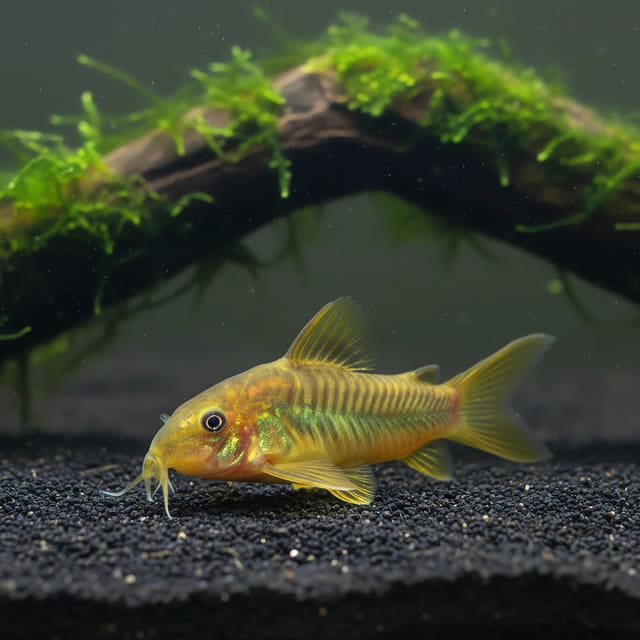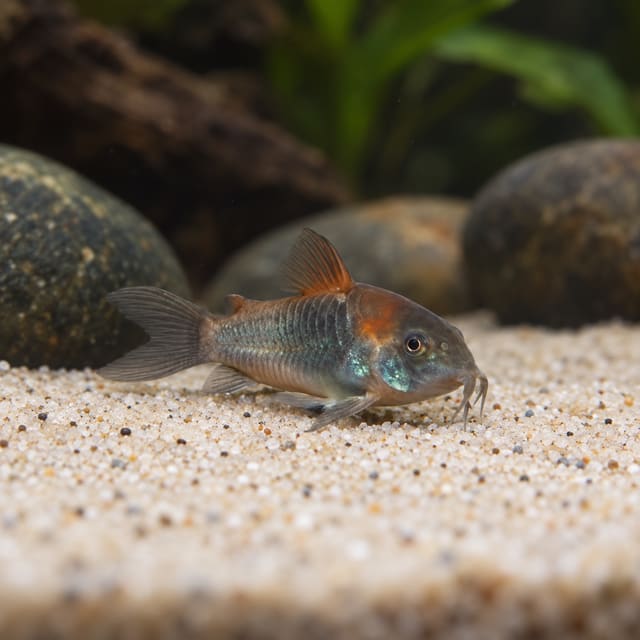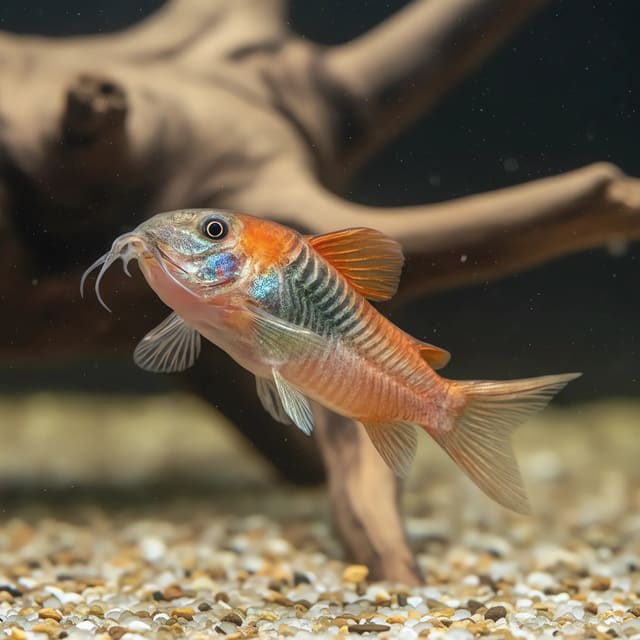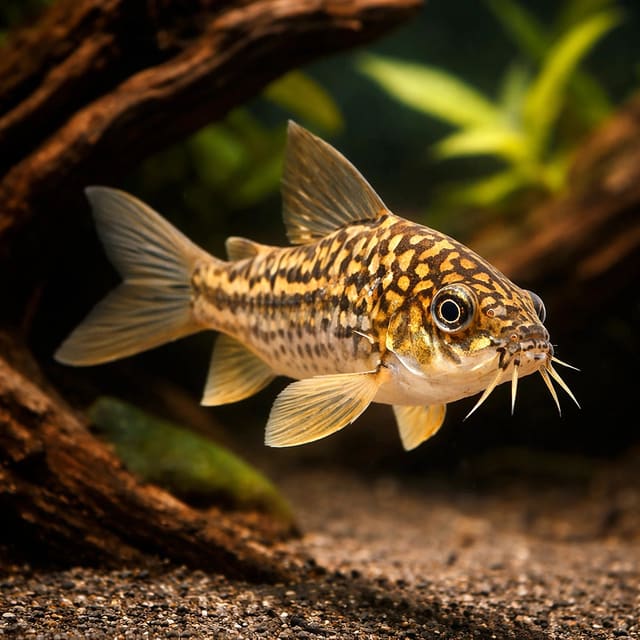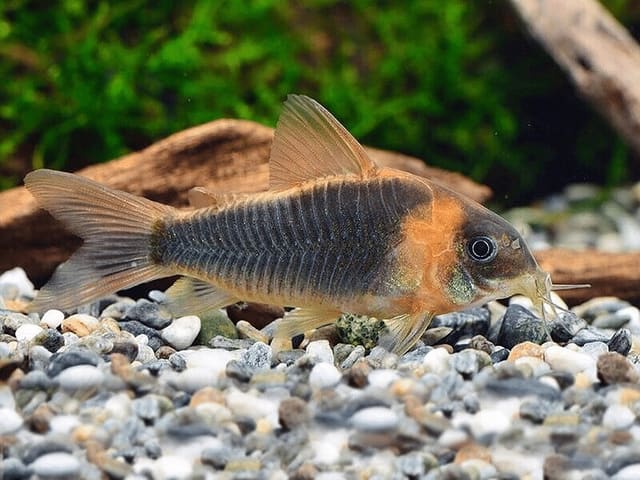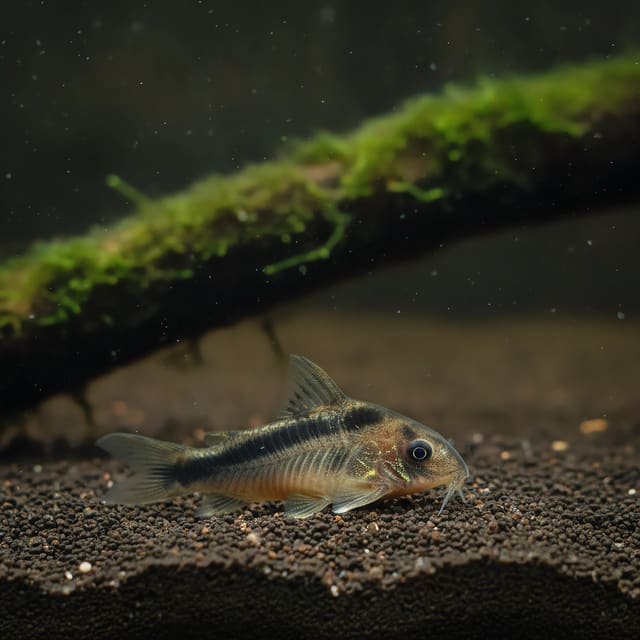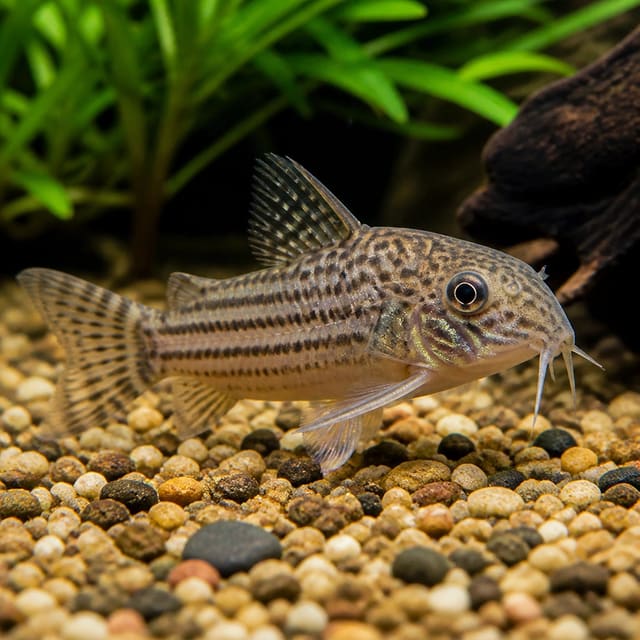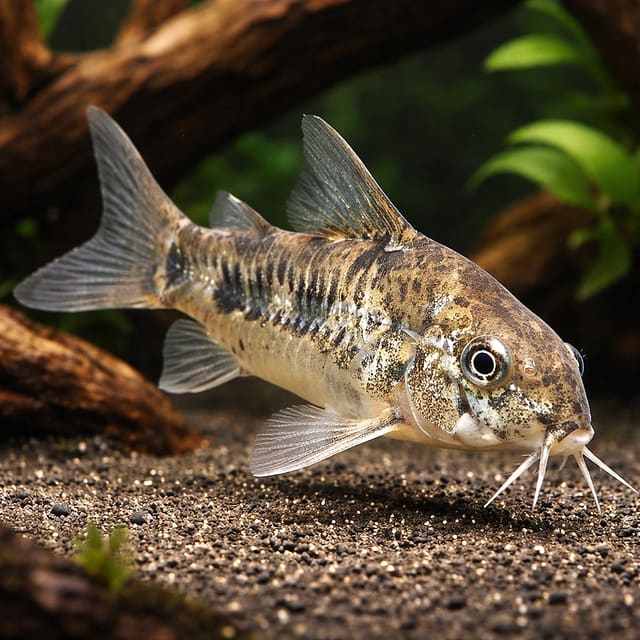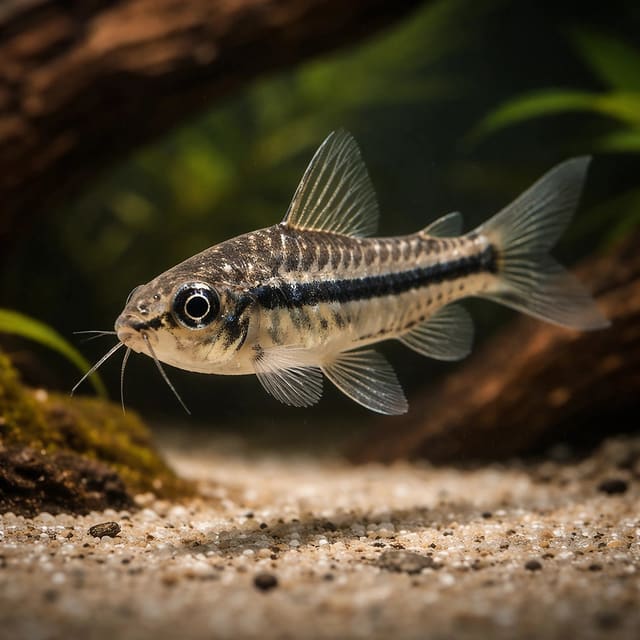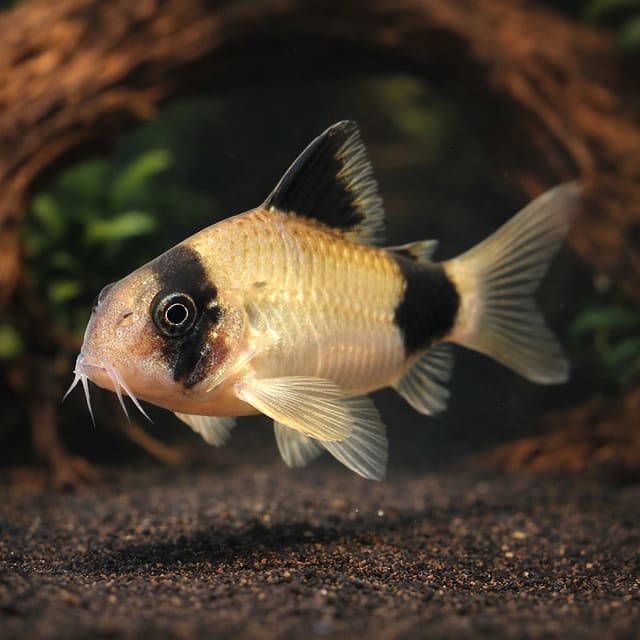
Panda Cory Catfish (Corydoras panda)
22–25°C · pH 6–7.4
From £8.69Some sizes on sale

Aspidoras spilotus is a small, peaceful Brazilian armoured catfish supplied as one unsexed fish per purchase at approximately 2–2.5 cm. Plan a mature aquarium with a 60 × 30 cm base, fine sand, cover and a group of at least 4–6; keep 20–25°C, pH 6.0–7.5 and 2–12 dGH, and feed varied sinking foods rather than relying on leftovers.
Adult size is the maximum length this species reaches at full maturity (scientific sources). The livestock you receive will be younger and smaller. Product-photo provenance and any image-specific limitations are stated on the listing.
Aspidoras spilotus
Shoaling fish: kept in a group they feel safer, stay calmer and show their best colour.
Aspidoras spilotus is a small, peaceful Brazilian armoured catfish supplied as one unsexed fish per purchase at approximately 2–2.5 cm. Plan a mature aquarium with a 60 × 30 cm base, fine sand, cover and a group of at least 4–6; keep 20–25°C, pH 6.0–7.5 and 2–12 dGH, and feed varied sinking foods rather than relying on leftovers.
Adult size is the maximum length this species reaches at full maturity (scientific sources). The livestock you receive will be younger and smaller. Product-photo provenance and any image-specific limitations are stated on the listing.
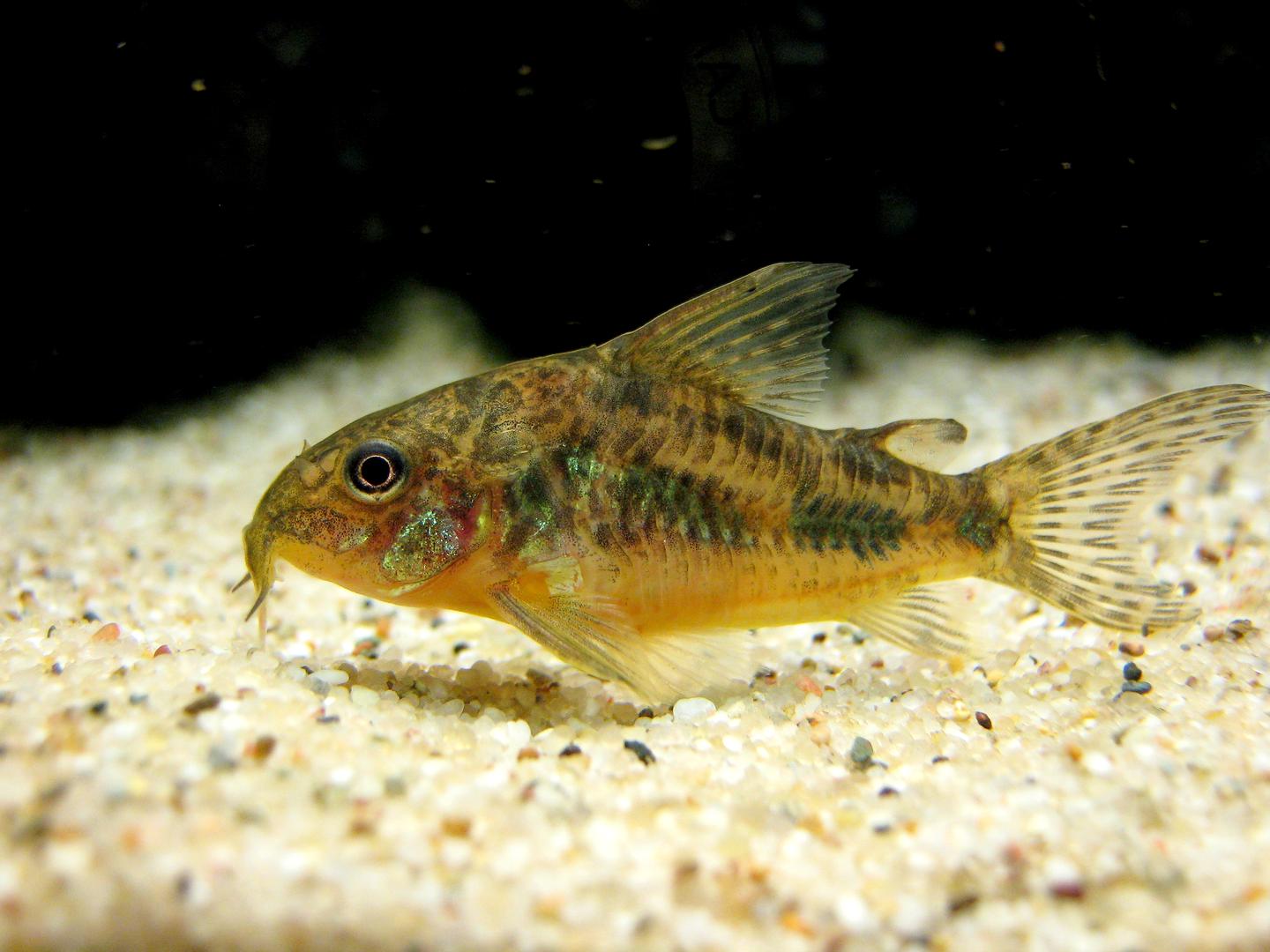
Identify the exact cory catfish before choosing care. Our starting policy for many common medium species is six compatible conspecifics, a mature 60 x 30 cm aquarium of about 60 litres, smooth fine sand and measured species-appropriate water.
Maintain these water conditions for optimal health and vibrant colors
Aspidoras spilotus is a compact, peaceful armoured catfish from coastal river systems in Ceará, Brazil. One purchase provides one live fish, supplied at approximately 2–2.5 cm. This is a dispatch size, not its finished adult length. Choose the fish for its species, social behaviour and care needs rather than for a presumed male or female appearance.
The adult is still small: the scientific record gives a maximum of 4.3 cm standard length, while a species aquarium profile gives 45 mm standard length. Standard length is measured to the base of the tail fin, rather than to the end of the fin. Those figures make the fish compact, but they do not make it suitable for a tiny container. A group needs usable floor space, stable water, a mature biological filter and enough feeding room for every member.
| Suits | Think again if |
|---|---|
| You can provide a mature aquarium with a base of at least 60 × 30 cm. | You are looking for a single fish to live alone on the bottom. |
| You want a peaceful, active group for the lower level of a calm community. | Your main goal is an animal that will remove aquarium algae or eat scraps. |
| You can use fine sand, provide cover and target food to the substrate. | The tank is newly set up, has rough dirty gravel or contains forceful bottom competitors. |
| Your established water can remain within 20–25°C, pH 6.0–7.5 and 2–12 dGH. | Your livestock plan needs a markedly different temperature or water chemistry. |
Its appeal is the behaviour of a small foraging group. Fish move over the substrate, investigate sinking food and use cover when they want security. They are peaceful and gregarious, so a purchase plan should build towards at least four to six of their own species rather than leaving one by itself. A keeper who can offer that group, clean substrate and stable conditions will see far more natural activity than someone treating it as an ornamental cleaner.
Sex is guaranteed only when the selected option explicitly states male or female. This Aspidoras spilotus listing has no sex-guaranteed option.
Browse the current corydoras collection if you are comparing small armoured catfish, but judge each species on its own adult size, group requirement and water range. Product alternatives are comparisons, not automatic tank mates. The accepted identity, distribution and maximum recorded length can be checked in the FishBase species account.
Gallery images have been digitally enhanced to improve image quality. Natural colour, pattern, size and maturity can vary between live animals.
The most useful question is not whether one fish will fit, but whether the whole social group will have an appropriate bottom area. The species profile recommends base dimensions of at least 60 × 30 cm, approximately 54 litres in a standard rectangular aquarium. Longer and wider is beneficial when the tank will also contain other animals, because extra floor space provides more foraging lanes, more places to rest and a better chance for sinking food to reach the group.
Prepare the aquarium before the fish arrives. The filter must already support the biological conversion of toxic ammonia and nitrite, and the system should be stable rather than newly filled. Fine sand is the preferred surface. Rounded gravel can be used only when it stays scrupulously clean; coarse, sharp or waste-filled substrate works against the fish's close-contact feeding style. Leave open areas for foraging, then add wood, plants or other cover so the group can retreat without vanishing into a completely cluttered floor.
This species is a foraging omnivore. It accepts sinking dried foods and small live or frozen foods, but it should receive a planned diet. It is not a substitute for gravel cleaning, water changes or balanced stocking, and it should not be expected to survive on food missed by fish above it. Choose it because you want its shape, subtle pattern and group behaviour; regard any incidental picking at edible particles as normal foraging rather than an algae-control service.
A good first decision is to compare your measured water, available floor area and existing livestock with the animal's needs. A calm community can work when every species overlaps in temperature, chemistry and temperament. A crowded bottom zone, large predators or highly boisterous feeders are poor foundations. If the aquarium itself is still being prepared, the first tropical tank guide explains maturation, filtration and the checks to complete before adding livestock.
We rate Aspidoras spilotus as intermediate. The fish is peaceful and its routine food is straightforward, but success depends on several connected choices: a proper group, a mature filtered aquarium, a gentle substrate, stable water and deliberate feeding at the bottom. None of those tasks is exotic; together, they ask for more planning than an easy impulse purchase. Keepers who already test water, maintain a stable tank and observe feeding access should find the routine manageable.
Plan around a minimum base of 60 × 30 cm, which the species profile equates to about 54 litres in a typical aquarium. The footprint matters because these fish spend much of their time near the substrate. A tall narrow aquarium can hold the same number of litres while offering less usable floor. For a simple species-focused group, the recommended base is the starting point; for a mixed community, use a larger footprint so that added animals do not compress every feeding and resting activity into the same strip.
The minimum is not a stocking formula. Filter capacity, décor, the adult size of every inhabitant and the keeper's maintenance routine all affect the sensible total. Begin with the Aspidoras group, reserve its floor area, then assess any additional livestock. A larger aquarium usually changes more slowly when a small error occurs, but volume cannot compensate for an immature filter, unsuitable companions or food that never reaches the bottom.
Fine aquarium sand is the clearest choice. It lets the fish search the surface without forcing its underside and mouthparts against angular material. The species profile also accepts rounded gravel, provided it is kept scrupulously clean. That condition is important: rounded grains are not helpful if waste settles deeply between them and remains there. Whichever surface you use, remove trapped debris during maintenance while preserving the stable biological system in the filter.
Create open feeding lanes rather than carpeting every centimetre with ornaments. A broad clear patch at the front or centre makes it easier to see whether each fish is eating. Around it, use wood, plants, smooth stones or other aquarium-safe cover. Cover allows a newly introduced or startled group to settle, while open ground gives them room to forage together. Décor should be stable and should not form tight traps around a small bottom fish.
A filter is essential. The RSPCA explains that fish release ammonia and that an established biological filter allows beneficial bacteria to convert ammonia to nitrite and then nitrate. For this species, the aquarium profile also stresses stable, clean conditions and rejects biologically immature set-ups. Select filtration that can process the tank's waste while leaving calm areas at the bottom. Point an outlet along the surface or diffuse it when a concentrated jet makes the fish fight the current.
The species profile illustrates a turnover of four to five times the aquarium volume per hour for a roughly 54-litre set-up. That works out at about 215–270 litres per hour as a starting filter rating, but quoted pump ratings are measured under test conditions. Media, lift height and maintenance affect actual output. Observe the aquarium: the surface should move, debris should reach the filter, and the fish should still be able to forage and rest without being pushed across the substrate.
Oxygen and cleanliness are connected. Surface movement supports gas exchange, while restrained feeding and routine debris removal reduce the oxygen demand created by decomposing waste. If fish breathe faster, stop feeding normally or behave differently, test the water promptly rather than assuming the group is simply shy.
Plants can provide useful visual cover, but they are not compulsory. Choose hardy rooted or attached plants that suit the same temperature and chemistry, and leave gaps between plant groups. Wood and smooth ornaments can give equivalent shelter. The goal is a layout in which the fish can move between cover and open sand, the keeper can inspect the whole group, and a siphon can reach the areas where debris gathers.
The species-specific layout and filtration figures are summarised by the Seriously Fish profile for Aspidoras spilotus.
For normal aquarium care, keep the water at 20–25°C, pH 6.0–7.5 and 2–12 dGH. These are species-level husbandry values. FishBase records 22–25°C, pH 6.0–7.2 and 8–12 dH for the fish's environment in nature; wild records describe where a species has been found, whereas the aquarium figures are the practical routine range used here. Aim for a stable point inside the husbandry range rather than steering the aquarium from one edge to the other.
| Measure | Working target |
|---|---|
| Temperature | 20–25°C |
| pH | 6.0–7.5 |
| General hardness | 2–12 dGH |
| Ammonia | 0 mg/l |
| Nitrite | 0 mg/l |
Test the source water before buying. Tap-water chemistry differs across the UK, and the aquarium can shift after substrate, wood or water treatments are added. The water chemistry guide explains what the common readings mean. Enter actual measurements into the water matcher to compare them with the stated range; use a reliable liquid or digital test rather than judging chemistry from how clear the water looks.
Temperature and pH should remain steady through the daily cycle. Position the heater where moving water distributes warmth, and confirm the reading with a separate thermometer. Make changes gradually when adjustment is necessary. A sudden correction can be more stressful than a stable value that is already safely inside the range.
Ammonia and nitrite belong at zero. Their absence is not inferred from an old tank or a clear appearance; it is checked. Test after adding fish, after an unexpectedly heavy feed, whenever filtration has been disrupted, or when behaviour changes. Nitrate management depends on source water and stocking, so compare the aquarium with the replacement water and follow the established maintenance schedule rather than chasing a universal number from an unrelated set-up.
OATA's broad freshwater-catfish sheet strongly recommends a partial water change of 25% at least once every week. Treat that as a sensible general starting routine, then use test results and the tank's waste load to judge whether the aquarium needs closer attention. Condition replacement tap water to remove chlorine or chloramine and bring it close to the aquarium's temperature before it enters the tank.
The order matters because observation before maintenance provides a clean reference. If a fish is already breathing rapidly or refusing food, that information should not be lost in the temporary disturbance caused by a water change.
When ammonia or nitrite is detected, protect the fish first: pause routine feeding, confirm the result, make an appropriate conditioned water change and check that the filter is running correctly. Look for the cause, such as excess food, an unnoticed dead organism, lost filter flow or a recent increase in livestock. Avoid washing established filter media under the tap, because chlorine or chloramine can harm the useful bacterial population.
For a pH or hardness result outside the plan, verify both aquarium and source water before choosing an adjustment. A repeatable value is more useful than a single surprising reading. If treatment is needed, use a method intended for aquariums and change it cautiously. This approach keeps the fish within a dependable routine instead of subjecting it to repeated swings.
The OATA freshwater catfish care sheet provides the broad maintenance framework, while the RSPCA filtration advice explains the biological role of an established filter.
Aspidoras species are foraging omnivores. The species profile recommends sinking dried foods together with small live and frozen foods such as bloodworm and Tubifex. Variety matters because one tablet or pellet does not necessarily provide the same texture, nutrient profile and feeding opportunity as a mixed routine. Choose foods small enough for the mouth and place them where the fish can reach them.
The group should never be expected to survive on leftovers from upper-water fish, and it should not be relied upon to clean the aquarium. A spotless-looking tank can still leave a bottom fish underfed, while an overfed tank can hold plenty of waste without providing a balanced diet. Feed the animal, then maintain the aquarium as separate jobs.
Start with a quality sinking food as the staple. Distribute several small pieces across the open foraging area so that one confident fish cannot occupy the only feeding point. Add suitably small frozen or live foods as part of the varied diet. Observe which items are eaten and how long they remain. The broad OATA catfish sheet advises feeding only what the fish can consume within a few minutes, once a day, while recognising that some grazing catfish take longer. For this species, direct observation is more useful than a rigid clock: offer a modest amount, confirm that all group members feed, and remove persistent excess.
| Food role | Examples and use |
|---|---|
| Staple | Small sinking dried food offered where the whole group can find it. |
| Variety | Small frozen or live foods, including bloodworm or Tubifex, used in suitable portions. |
| Observation | Check that shy fish receive food and that pieces are small enough to take. |
| Clean-up | Remove uneaten food and correct the next portion; the fish are not waste disposal. |
Feed over an open area where bellies and behaviour can be seen. In a community, try a placement that lets mid-water fish take their share without intercepting everything destined for the bottom. Sinking foods can be spread to two or three points. If faster animals still monopolise the meal, change the layout or stocking plan rather than continually adding extra food, which raises the waste load for the whole aquarium.
A healthy pattern is a group that notices food, forages and then returns to normal activity. Watch for an individual that hangs back, has a pinched belly, breathes differently or repeatedly loses access. Those signs call for water tests and a review of competition, food size and placement. A fish that misses one item may simply dislike it; a fish that stops feeding across several offerings deserves prompt attention.
Body shape can vary with recent feeding and maturity. Females tend to become larger and broader when mature, especially when gravid, but that biological tendency is not a retail sex guarantee. The fish supplied through this listing is unsexed, and neither colour nor a gallery image should be used to promise sex.
A settled group should show interest in the substrate, use both open areas and cover, and respond when sinking food arrives. The species is peaceful and gregarious. Individuals may rest at times, but the group plan should allow them to find one another and move without being chased away from the floor. Occasional trips towards the surface can occur in a facultative air-breathing catfish; judge that movement in context rather than in isolation.
Learn the group's ordinary pattern during the first days. Count the fish, look at body condition, watch the rhythm of the gill covers and confirm that each animal reaches food. Because small catfish can shelter behind décor, a consistent count is easier when the layout includes visible feeding lanes. Observing before the lights, maintenance or feeding routine changes gives a more useful comparison.
Begin a continuous unboxing video while the parcel is still sealed and continue through opening with the fish still inside the sealed bag; the policy requires this evidence for any Live Arrival Guarantee claim. Once the condition has been recorded, float the sealed bag for 20–30 minutes to equalise temperature. Transfer the fish without pouring transport water into the aquarium. The mature, filtered system, matched water and suitable group plan should already be ready before the parcel is opened.
OATA advises watching for changed swimming, unusual hiding, darker or paler colour, faster or slower breathing, damaged fins, spots, fluffy growths, altered body condition and reduced feeding. These signs are prompts to investigate, not diagnoses. Start with measured water quality and equipment checks. Temperature, ammonia, nitrite and filter flow can be assessed immediately, and the result helps distinguish an environmental problem from an issue that needs specialist advice.
Substrate condition deserves particular attention because the fish feeds in close contact with it. Remove trapped food, keep rounded gravel genuinely clean if it is used, and make sure sharp décor cannot damage a fish passing underneath. Clean water and suitable surfaces are preventative husbandry; medication should be chosen only for a correctly identified problem and used according to qualified advice and the product instructions.
A short weekly note can include temperature, ammonia, nitrite, pH, water-change volume, feeding response and any unusual observation. The purpose is to notice a trend, not create paperwork. A slowly changing pH, reduced filter output or one fish losing condition is easier to recognise when last week's normal reading is available.
Aspidoras spilotus is peaceful and gregarious. Maintain at least four to six together. A mixed collection of unrelated bottom fish does not replace that group, because social needs are met by companions of the same species. When space and filtration allow a larger group, the decision should still preserve open floor, feeding access and water quality rather than chasing a number for its own sake.
Buying one fish first and planning to complete the group much later leaves the animal without the arrangement the species profile recommends. Prepare the aquarium for the full group before the first purchase. If a staged introduction is unavoidable, keep the interval short, avoid repeated large stocking jumps and confirm that the filter can handle the final plan.
Compatibility is more than the absence of fighting. Two peaceful species can still be a poor pairing if both crowd the same feeding spots, one eats much faster, or their preferred temperatures barely overlap. For a small forager, persistent food competition is especially important. Spread sinking food, retain open routes and watch the least assertive fish rather than judging success by the boldest one.
Other bottom dwellers require extra floor area and their own social groups. Add their adult footprint to the plan instead of treating the aquarium's lower level as unused space. A 54-litre minimum set-up can be appropriate for the Aspidoras group, but it is not an invitation to stack several bottom-feeding groups into the same footprint.
Choose peaceful, similarly sized community animals whose temperature and chemistry overlap with 20–25°C, pH 6.0–7.5 and 2–12 dGH. Avoid predators capable of swallowing a small catfish, persistent chasers and boisterous fish that keep the group pinned under cover. Large or aggressive animals can cause harm even when the water values match.
Fin-nipping is not described as a normal behaviour for this peaceful species. Any repeated chasing, torn fins or exclusion from food should prompt a review of tank mates, group size, floor area and cover. Repeated stress is a compatibility failure, not something the smaller fish should be expected to tolerate.
| Compatibility check | What to confirm |
|---|---|
| Water | All animals thrive within the same stable temperature, pH and hardness. |
| Adult size | No companion is likely to swallow or physically intimidate a 4.3–4.5 cm SL catfish. |
| Temperament | The community is calm and does not chase the group away from open areas. |
| Feeding | Sinking food reaches every Aspidoras without chronic overfeeding. |
| Space | Each bottom-dwelling group has sufficient floor area, cover and feeding lanes. |
This peaceful species can take a community role, but a list of popular fish should never be treated as universal tank mates. Assess a proposed companion by its adult size, temperament, social requirement, temperature, pH, hardness and feeding zone. A species that passes five checks but fails one important check can still be unsuitable. For example, a calm fish needing much warmer water creates a long-term compromise, while a water-compatible animal that dominates every sinking meal creates a nutrition problem.
Start with the fixed needs of the Aspidoras group. Reserve at least a 60 × 30 cm base, keep the group at four to six or more, and protect the 20–25°C routine range. Then calculate the adult space and social numbers of the other animals. This order prevents the common mistake of filling the middle and upper water first and trying to fit bottom fish into whatever space remains.
Another peaceful catfish may still need its own shoal, caves, wood, a different diet or a larger adult footprint. Keepers often see two small juveniles and assume their needs will stay small. Compare adult dimensions and group totals before purchase. If the aquarium cannot support both complete groups, choose one well-supported group rather than two incomplete ones.
Feeding trials should be observed over several days. Confirm that food reaches different parts of the floor and that every Aspidoras maintains condition. If another animal consistently takes the food, separate feeding areas can help, but the tank should not require chronic overfeeding to keep the quieter fish alive.
A blanket shrimp or snail guarantee would be inappropriate. A small omnivore may investigate edible material it encounters, and very small young of another animal can present a different risk from healthy adults. Treat any invertebrate pairing as a considered community choice: provide adequate cover, accept that reproduction may be affected, and regard very small young as potentially vulnerable.
A suitable community lets the Aspidoras group remain visible, feed reliably and use the whole planned floor without being chased. A cautionary community creates heavy bottom competition, uncertain risk to very small animals or a narrow overlap in conditions. An unsuitable community contains predators, aggressive or highly boisterous fish, or animals whose water requirements conflict. Observe the real aquarium after introduction and be prepared to separate livestock if welfare is compromised.
FishBase records a maximum of 4.3 cm standard length, and the species aquarium profile gives 45 mm standard length. Standard length stops at the base of the tail fin. The fish supplied here is approximately 2–2.5 cm at dispatch, so that retail grade must not be mistaken for its adult measurement.
Use an aquarium with base dimensions of at least 60 × 30 cm, approximately 54 litres in a standard shape. Floor area is especially important for this bottom-foraging group. Choose a larger footprint when adding other livestock so feeding lanes, cover and water stability are not compromised.
Keep at least 4–6 together because the species is peaceful and gregarious. Prepare space and filtration for the complete group rather than keeping one alone. More can be considered when the aquarium has sufficient floor area, feeding access and biological capacity.
It can suit a prepared beginner, but Tropical Fish Co rates it intermediate. The fish needs a mature filtered aquarium, a group of at least 4–6, fine sand or scrupulously clean rounded gravel, stable water and food that deliberately reaches the bottom.
It is a foraging omnivore that accepts sinking dried foods and small live or frozen foods such as bloodworm and Tubifex. Offer a varied diet in portions the group can finish, spread food so shy fish can reach it, and remove persistent leftovers.
Keep the aquarium at 20–25°C, pH 6.0–7.5 and 2–12 dGH. These species-level aquarium values are working ranges, not targets to swing between. Test the source water and keep a stable point inside all three ranges.
This is a peaceful, gregarious catfish, and fin-nipping is not described as its normal behaviour. Maintain the proper group and enough floor space. Investigate repeated chasing, torn fins or exclusion from food because those signs point to a stocking or compatibility problem.
Choose peaceful, similarly sized community animals that share its water requirements and do not prevent food reaching the bottom. Avoid predators, persistent chasers and boisterous bottom competitors. Every proposed companion still needs its own adult-size, social and feeding assessment.
Tropical Fish Co hand-bags live fish in pure oxygen, uses an insulated poly box and adds a heat pack when the weather calls for it, then sends the parcel with a tracked licensed live-animal courier. Be present to receive it. For any Live Arrival Guarantee claim, make one continuous unboxing video from the sealed parcel through opening, with the fish still in the sealed bag, and contact the shop the same day with the order number and video. Read the delivery and Live Arrival Guarantee policy before the delivery date.
FishBase supports accepted identity, distribution and recorded maximum length, while the species aquarium profile covers footprint, water, diet, social behaviour and substrate. OATA contributes broad UK catfish maintenance advice, the RSPCA explains biological filtration, and the Tropical Fish Co delivery page governs packing, courier and claim steps.
Wild environmental records and broad group advice are kept distinct from the species-level aquarium routine. Dispatch size is also kept separate from adult standard length.
No reviews for this item yet. Bought one? Honest reviews only, good or bad.
What customers say about ordering from us
I have a small group of long finned mountain minnows. So was delighted to be able to order ten of this variety to increase the genetics in my tank . The ones I recieved are healthy but it’s to early to give a verdict on wether they are of a long finned type since they are small currently.
Gordon Walker · 23 Sept 2026
100% success travel and "installation". Pleased with quality of purchase. The Siamese fighter a bit "shy" so have not yet seen him at his best yet but looking good. Happy customer. GG
George E Garratt · 21 Sept 2026
Reviews of our shop, collected by Judge.me, an independent third-party review collector. Newest first.