
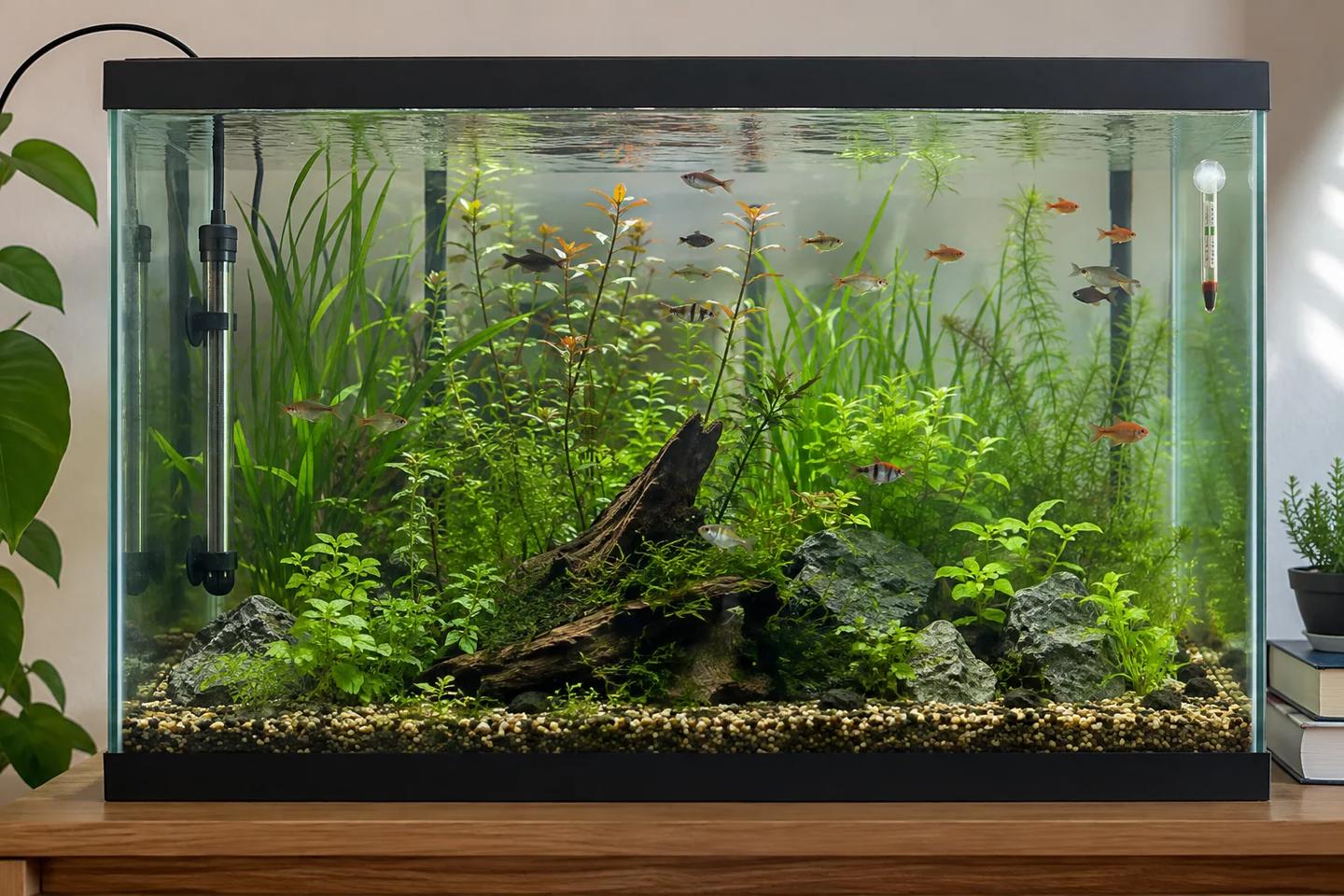
Tropical Fish Tank Temperature: A Species-First UK Guide

The familiar answer—“set a tropical tank to 25°C”—is memorable, but it hides the decision that matters. A tank may contain animals from different habitats, at different life stages, sourced from different holding conditions. The safe target is the supported overlap for the animals actually present.
For many compatible community fish, 24–27°C is a useful range to investigate, not a temperature to copy automatically. Before adjusting a heater:
- identify every fish and invertebrate to species or the narrowest reliable identity;
- compare current, trustworthy captive-care requirements;
- choose an overlap all inhabitants can share;
- check how the animals are currently held and plan any change gradually;
- verify the water with a separate thermometer rather than trusting the heater dial.
If several animals are breathing abnormally, gathering at the surface, losing balance or changing behaviour together, treat that as an environmental warning. Check temperature and water quality, strengthen safe aeration or surface movement, and seek qualified help; temperature alone does not identify the cause.
What temperature should a tropical fish tank be?
Current UK mobile results for “tropical fish tank temperature” place an AI Overview above the ordinary listings and repeatedly ask whether 24, 27, 28 or 30°C is safe. The common answer is a 24–27°C band, often with 25°C presented as a “sweet spot”. That shorthand can help someone begin their research, but it cannot prove compatibility.
RSPCA guidance says tropical fish need a heater set to the correct temperature for the species, giving guppies at 22–28°C and loaches at 18–26°C as examples.[1] The breadth of even those examples is the point: “tropical fish” is not one thermal requirement.
A sensible community target usually sits near the middle of a genuine overlap, rather than on one species' extreme. That leaves room for ordinary measurement uncertainty and minor variation. It still needs testing against:
- exact identity, not a broad shop label such as “tetra”, “loach” or “pleco”;
- juvenile, adult, breeding or recovery context where reliable guidance distinguishes them;
- captive-bred or wild-source conditions where provenance changes the plan;
- the temperature and water in which new stock is currently held;
- tank mates, oxygenation, water quality and the equipment's safe operating limits.
Build a species-first target range
Use a simple intersection method before buying fish or touching the thermostat.
| Step | Record | Decision |
|---|---|---|
| 1. Inventory | Exact species, number, life stage and source | Resolve vague common names before combining ranges |
| 2. Find sources | Current species care guide, scientific database and supplier conditions | Prefer ranges tied to the same identity and husbandry context |
| 3. Mark overlap | Temperatures supported for every inhabitant | No overlap means the stocking plan needs changing, not averaging |
| 4. Choose within it | A target with practical room on both sides | Avoid living permanently at an unsupported edge |
| 5. Measure the system | Actual water in representative locations | A dial setting is not a water reading |
| 6. Observe and record | Temperature, room conditions, water tests and behaviour | Investigate trends instead of reacting to one unexplained number |
For example, do not average a cool-water animal's upper limit with a warm-water animal's lower limit and call the result compatible. A mathematical midpoint cannot create suitable husbandry. The water-parameter guide and tank-mate checker can organise the wider comparison, but exact care evidence remains the decision source.
If two animals do not share a well-supported long-term range, do not “split the difference”. Choose a different combination or a separate system. Temperature compatibility also does not prove compatibility in water chemistry, adult size, behaviour, diet or group needs.
Tropical aquarium temperature examples
These source examples show why one number cannot represent the category. They are not a ready-made stocking list, and a reported habitat range is not automatically an ideal captive setpoint.
| Animal or group | Source-reported range | What the number does—and does not—mean |
|---|---|---|
| Guppy example | 22–28°C | RSPCA example for guppies; confirm the exact stock and all tank mates[1] |
| Captive-bred tetras and pencilfish, group guidance | 22–27°C | OATA group band; its page says species-specific needs still need checking[4] |
| Neon tetra (Paracheirodon innesi) | 20–26°C | FishBase environmental record; useful identity evidence, not a complete captive-care plan[12] |
| Discus (Symphysodon spp.) | 26–30°C | OATA captive-care band with a direction to ask about current holding conditions[5] |
| White cloud mountain minnow (Tanichthys albonubes) | 18–22°C | FishBase environmental band; evidence that a colourful aquarium fish need not belong at 25°C[13] |
Broad labels deserve extra caution. “Corydoras” covers many species and source regions. “Loach” covers animals with radically different adult size, flow, oxygen and thermal requirements. “Shrimp” can refer to different genera and lineages. Check the exact neon tetra, discus, betta or guppy guide when that is the animal you intend to keep.
Why stability, oxygen and measurement matter
Fish do not generate and regulate body heat in the same way mammals do. Temperature influences physiological and behavioural processes, while each species and life stage has limits. “Inside a range” therefore does not mean temperature has become irrelevant, and an unexplained swing deserves investigation.
Warm water also holds less dissolved oxygen at equilibrium than cold water.[9] That fact is important during hot weather, but it is not an aquarium oxygen reading. Dissolved oxygen also depends on surface exchange, circulation, animal and microbial respiration, plants, salinity and organic load. A keeper should not assume that a visible bubble, clear water or a thermometer proves oxygen is adequate.
MSD Veterinary Manual connects low oxygen with signs such as surface breathing and identifies temperature fluctuation as a hazard associated with thermostat or power failure.[8] Those signs are not exclusive diagnoses. Abnormal breathing can have several environmental or health causes, which is why temperature, ammonia, nitrite, circulation and recent changes should be assessed together.
Small water volumes often change faster when the room, light or equipment changes. Larger systems usually have more thermal inertia, but size does not make them immune to a stuck thermostat, direct sun, a failed pump or a prolonged outage.
Choose and install an aquarium heater safely
Most genuinely tropical aquariums in UK homes require a thermostatically controlled heater. Some temperate species can suit an unheated indoor aquarium; OATA lists examples and stresses the importance of location and species-specific requirements.[3] Decide from the animals and measured room conditions, not whether a fish looks “tropical”.
Avoid a universal watts-per-litre rule
Heater demand depends on both water volume and the temperature rise required above the coldest room conditions. Tank shape, surface area, lid, circulation, placement, insulation and the product's operating design affect performance. A fixed table such as “one watt per litre” or “100 W always covers 100 L” hides those variables.
- Estimate the actual operating water volume, allowing for substrate, decor and the normal waterline.
- Record the coldest realistic room temperature and the chosen water target.
- Use the current manufacturer's sizing chart for both volume and temperature difference.
- Check permitted orientation, minimum water level, flow requirements and controller location in the exact manual.
- Verify the installed result with an independent thermometer through normal day and night conditions.
One heater or two?
Two smaller heaters may improve distribution or leave some heat if one stops, but they are not automatically fail-safe. Both may share one socket, circuit, controller or power cut; both can be incorrectly sized; and a stuck-on fault still needs detection. If a system uses two, treat it as an engineered choice and verify how each is controlled.
Electrical and product safety
Use aquarium equipment that is suitable for the installation, carries the required information and is in good condition. Follow the manual for submersion, water level, orientation, cable routing, cooling time and disconnection. Keep plugs, sockets and controllers dry, and disconnect equipment before any approved user maintenance.
An RCD can reduce the risk from some electrical faults but cannot protect against every electric shock.[10] A 2024 UK product-safety report found a particular imported aquarium heater presented serious fire and electric-shock risks because of earthing, plug and documentation failures.[11] That is a reason to check the exact product and current recall information—not a claim that every heater is unsafe. If a cable, plug, socket, device or installation looks damaged or questionable, stop using it safely and consult the manufacturer or a competent electrician.
Check the actual water temperature
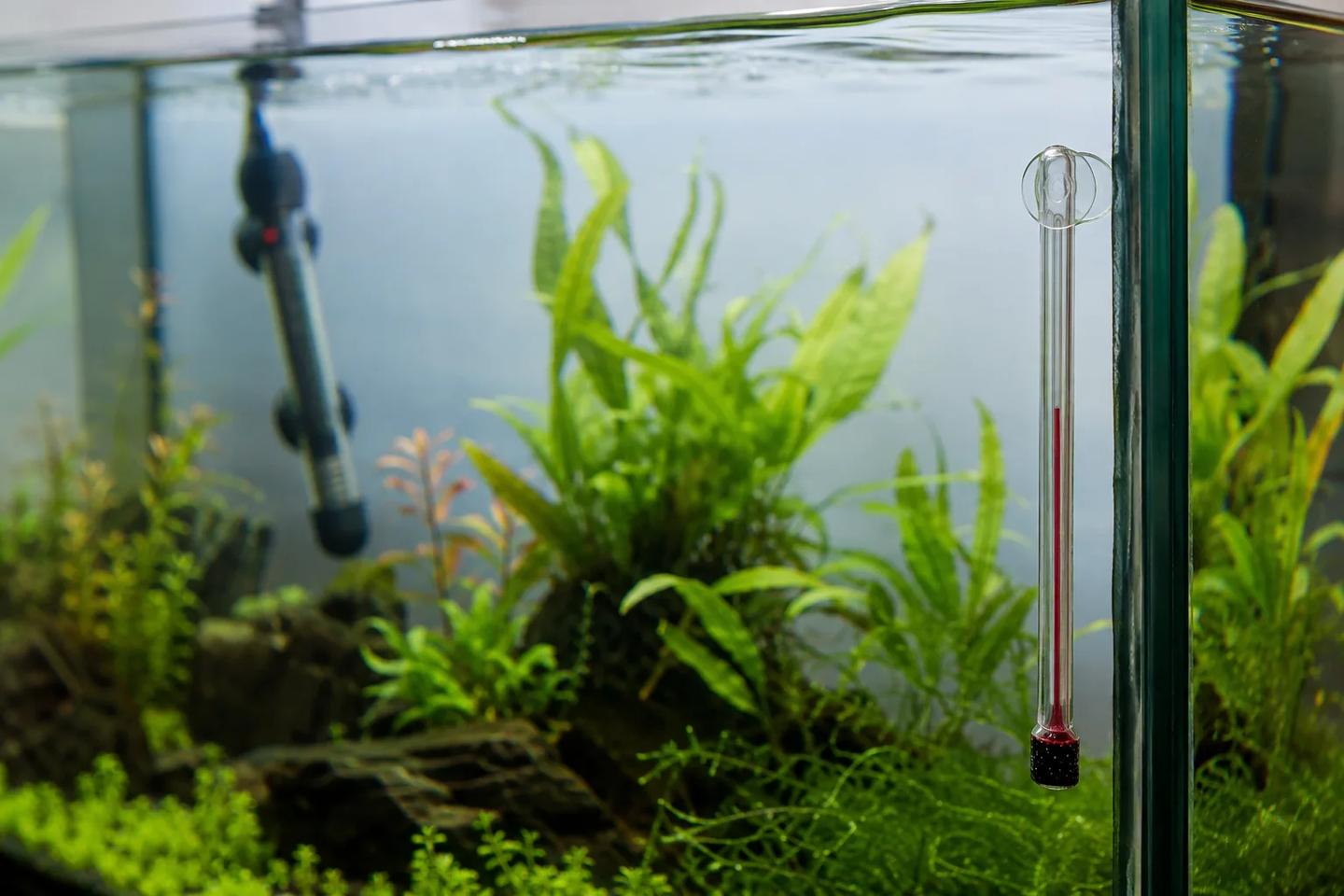
A thermostat decides when a heater should switch; a thermometer tells you what the water is doing. RSPCA and MSD guidance both recommend a separate thermometer rather than trusting the heater alone.[1][6]
Where to put the thermometer
Place it away from the heater in water the animals actually occupy. Avoid a position heated directly by the element, blasted by a return, exposed above a falling waterline or hidden where it cannot be read. Follow the thermometer's own placement instructions.
In a long, tall, compartmented or weakly circulated tank, compare a second location temporarily. A difference may point to circulation, placement or measurement problems; it does not justify moving equipment outside its approved installation.
Establish a baseline
For a new or changed system, record:
- water temperature at consistent times, including the coldest part of the day;
- room temperature and unusual sun, heating or draught conditions;
- heater indicator behaviour where the manual explains it;
- filter return and surface movement;
- ammonia and nitrite after any significant equipment interruption;
- normal feeding, breathing, swimming and resting behaviour.
A record turns “the tank feels warmer” into something testable. Daily visual and temperature checks are sensible because heaters and thermostats can fail.[1]
Is 24, 27, 28 or 30°C safe?
The number is safe only when the identified inhabitants and the complete system support it.
| Reading | Sensible interpretation | Immediate question |
|---|---|---|
| 24°C | Inside many published tropical bands, but not warm enough for every specialist plan and warmer than some temperate targets | Is 24°C inside the supported overlap for every inhabitant? |
| 27°C | Suitable for some species; at or beyond the upper part of other ranges | Was 27°C chosen deliberately, and are oxygenation and behaviour normal? |
| 28°C | A plausible warm-water target for compatible animals, not a default mixed-community setting | Does every animal share a supported range at 28°C? |
| 30°C | Within OATA's 26–30°C discus band but too warm for many ordinary community combinations | Is this a specialist plan or an unexpected heat event? |
If a reading is unexpected, confirm it with another reliable thermometer before making a large correction. Check whether the heater, room, sun, light, pump or lid changed. Then move toward the supported range gradually while watching behaviour and water conditions. The guide deliberately avoids a universal degrees-per-hour instruction because species, starting temperature and emergency severity differ.
Keep an aquarium cooler in a UK summer
Direct sunlight and room heat can raise an aquarium beyond its plan. Warmer water's lower oxygen-holding capacity makes surface movement and observation especially important.[6]
Use a measured sequence:
- Confirm the reading. Compare the independent thermometer and check another location if needed.
- Remove avoidable heat input. Shade the room, close blinds, and switch off non-essential aquarium lighting. Do not move a filled aquarium.
- Improve safe gas exchange. Check filter flow and increase appropriate surface movement or aeration without creating unsuitable current.
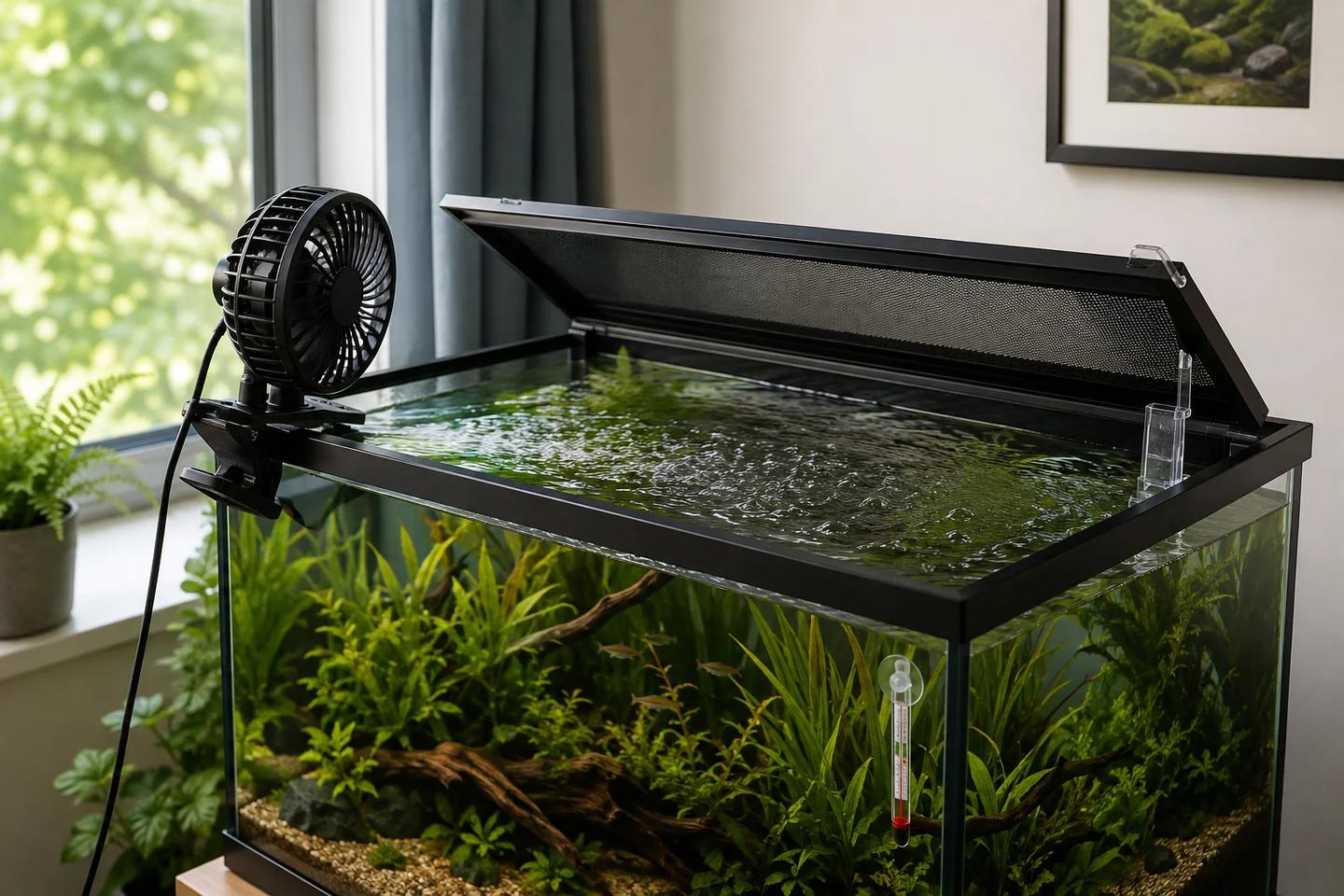
- Use evaporative cooling carefully. A secured fan can move room air across an open or ventilated surface. Protect jumping species, keep cables and electrics dry, and monitor the water continuously.
- Track evaporation. Evaporation removes water, not dissolved minerals. Replace loss with appropriate conditioned water for that system; do not confuse top-up with a water change.
- Escalate early. If temperature keeps rising or animals breathe or behave abnormally, use species-specific and fish-experienced veterinary help.
Avoid loose ice, frozen bottles, sudden large cold-water changes and unmonitored open lids. They can create sharp local cooling, contamination, unstable conditions or escape risks. A purpose-designed aquarium chiller may be appropriate for a consistently heat-sensitive system, but it must be selected and installed for that aquarium rather than treated as an emergency gadget.
UK winter, cold rooms and power cuts
RSPCA winter guidance recommends consistent temperature, a functioning heater, a reliable thermometer and an aquarium away from draughts, windows and radiators.[2] A radiator or portable heater can create another swing; it is not a substitute for controlled aquarium heating.
Before winter:
- verify the heater can hold the target through the coldest normal room period;
- keep the aquarium away from draughts and direct heat;
- use a suitable lid where the livestock and equipment plan permits it;
- keep a battery air pump and charged power source if the animals and local outage risk justify them;
- record emergency contacts and the safe operating instructions for all equipment;
- consider a monitored temperature alarm, but test it rather than assuming it works.
During a power cut
There is no honest universal statement such as “a 100 L tank loses 1°C per hour” or “all tropical fish are safe for 24 hours”. Cooling depends on water volume, exposed surface, room temperature, tank material, lid, insulation, circulation, stocking and outage length. Oxygen conditions may become urgent before temperature in a warm, heavily stocked system.
Record the water and room temperature, limit unnecessary lid opening and reduce safe heat loss around the back or sides without blocking ventilation or equipment. Preserve surface movement with appropriate battery equipment if available. Do not feed merely because the animals are gathered, and do not pour in hot water or place an uncontrolled hot-water bottle in the aquarium.
When power returns, inspect equipment before restarting it, follow each manual, restore circulation safely and check temperature, ammonia, nitrite and behaviour. MSD identifies many aquarium emergencies as environmental equipment failures where planning and monitoring matter.[7] Seek qualified help if equipment is damaged or animals show distress.
Troubleshoot a wrong or unstable reading
| Observation | Check safely | Do not assume |
|---|---|---|
| Heater setpoint and thermometer disagree | Confirm with another thermometer; check placement, water level, circulation and manual | The dial or the cheapest thermometer must be correct |
| One end is warmer | Compare locations; inspect circulation and obstructions | A stronger heater alone will fix distribution |
| Temperature keeps rising | Disconnect suspect heating safely, remove external heat and monitor | “Tropical” means 30°C is harmless |
| Temperature keeps falling | Check power, room conditions, heater rating and installation | A larger wattage is safe without the maker's chart |
| Heater cycles frequently | Check whether the manual describes normal cycling; review room-to-water difference and flow | Indicator behaviour proves a fault by itself |
| Condensation or water near electrics | Keep clear, disconnect only if safe and seek competent help | An RCD makes contact with water safe |
| Several animals change breathing or behaviour | Check temperature, ammonia, nitrite, circulation and recent changes; improve safe oxygenation and escalate | Temperature is the only cause |
Do not open a sealed heater, bypass a thermostat or improvise a mains repair. If a glass tube is cracked, a cable is damaged, water has entered a controller or a plug becomes hot, treat it as an electrical fault and obtain competent advice.
Before buying fish or heating equipment
Temperature planning belongs before checkout, not after animals arrive.
Ask about the animals
- What is the exact scientific identity?
- What temperature and water are they held in now?
- Are they captive-bred, a named domestic strain or wild-sourced?
- Do the intended tank mates share a supported range?
- What adult size, group, flow and oxygen needs change the system design?
Ask about the equipment
- Does the manufacturer size it for both actual litres and the required temperature rise?
- Is it suitable for the tank material, orientation, water level and flow?
- Are instructions, UK plug and safety markings complete?
- Can the thermostat be checked independently?
- Is the product or batch subject to a current safety notice?
- Can it be disconnected, inspected and replaced without unsafe access?
Browse the freshwater fish catalogue only after the aquarium plan is defined. Current availability, price, exact identity and sale unit belong on live product or category pages; this guide does not invent stock. The delivery page owns current dispatch and live-arrival terms.
Safe temperature checklist
- Exact identity resolved for every fish and invertebrate.
- Current, reliable captive-care evidence collected.
- Current supplier temperature recorded for new stock.
- A genuine shared range exists; no incompatible animals averaged together.
- Target chosen within the supported overlap, not at an arbitrary “tropical” number.
- Actual operating water volume estimated.
- Heater selected from its current volume-and-temperature-rise guidance.
- Manual checked for orientation, water level, flow, cable and disconnection rules.
- Separate thermometer placed away from the heater.
- More than one location compared when tank shape or circulation warrants it.
- Daily temperature and behaviour check established.
- Summer heat, winter cold and power-cut plan prepared without abrupt water changes.
- Temperature assessed alongside oxygenation, ammonia, nitrite and recent changes.
- Electrical damage, persistent instability or abnormal animal behaviour escalated to qualified help.
Related guides and tools
See independent temperature checking and careful summer cooling
Frequently asked questions
Browse our UK live-fish range
From this article straight into the catalogue.
Beginner Fish
The best tropical fish for beginners UK — hand-picked easy-care species that thrive with minimal fuss. Perfect starter community tank candidates.
Community Tank Fish
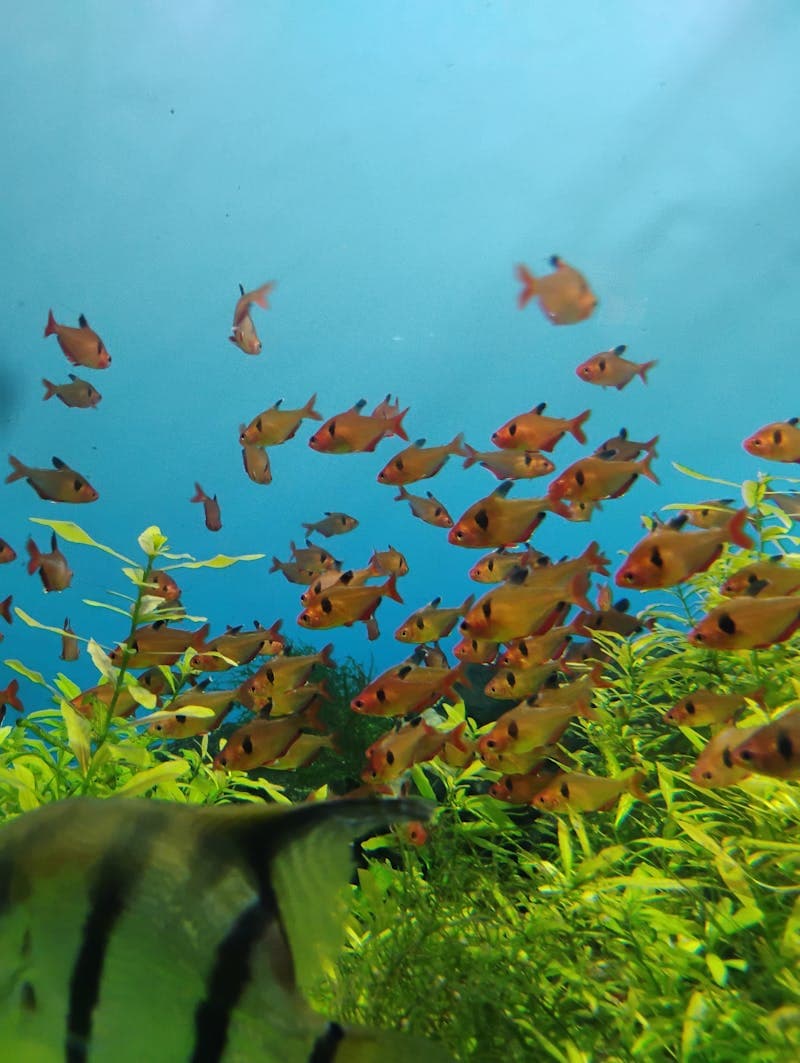
Peaceful tetras, rasboras, corydoras, platies and gouramis chosen to live together — temperament, adult size and water range per listing so the mix works.
Tetras
Premium Tetras for sale UK — Cardinal, Ember, Black Neon, Rummy Nose, Serpae, Diamond, Glowlight and more. Peaceful community schoolers.
Betta Fish
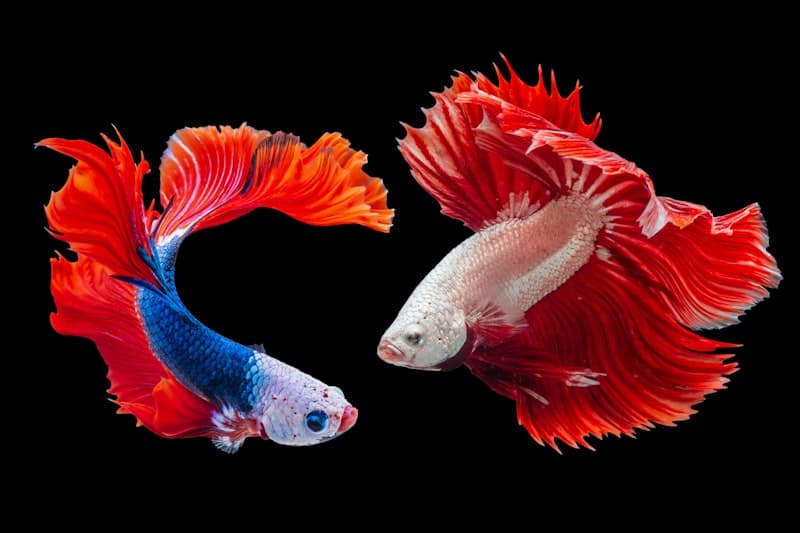
Halfmoon, plakat, koi, giant and wild-type Betta splendens, males and females, tail type and size stated per listing. Bagged singly, live arrival covered.
Guppy
Fancy guppies bred for colour — Moscow, Cobra, Dumbo ear and Endler lines as males, females or pairs. Hardy in UK tap water; arrive alive or replaced.
Cherry Shrimp
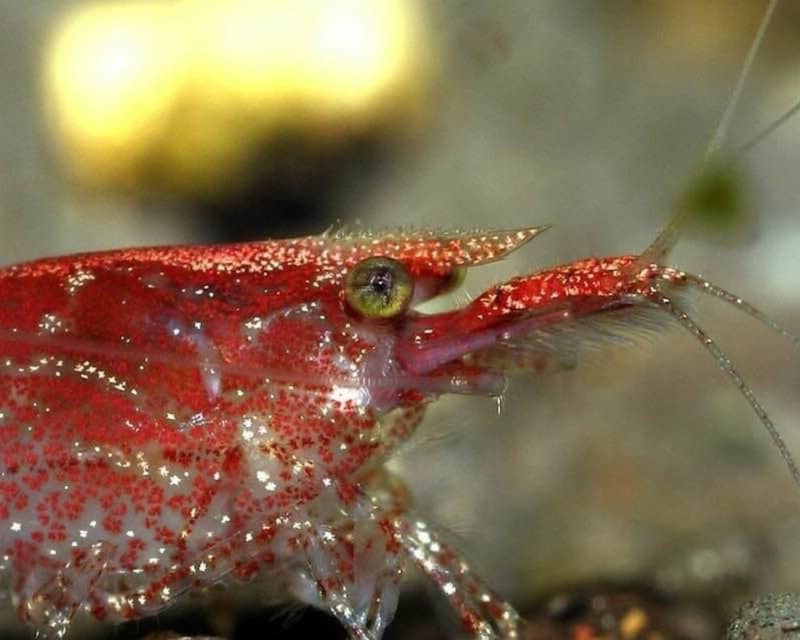
Red, blue, yellow, black and Rili cherry shrimp (Neocaridina) graded per listing, with mature-tank and water guidance so a new colony settles and breeds.
Corydoras
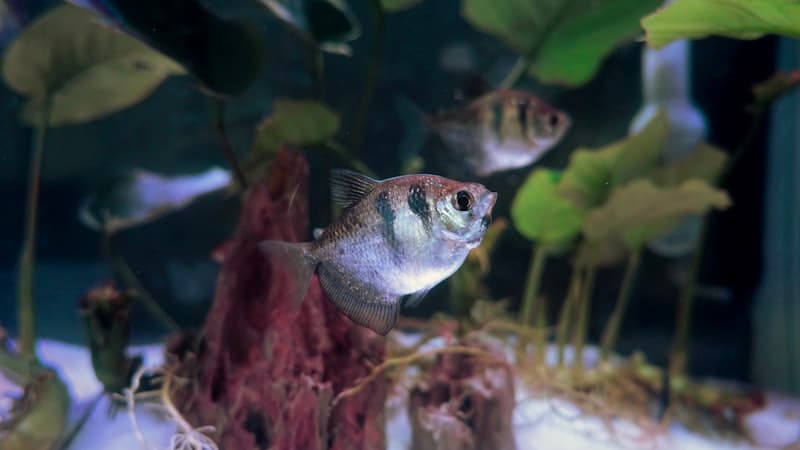
Shop current Corydoras catfish listings in the UK. Compare scientific identity, size and sale unit, with price and availability shown per product.
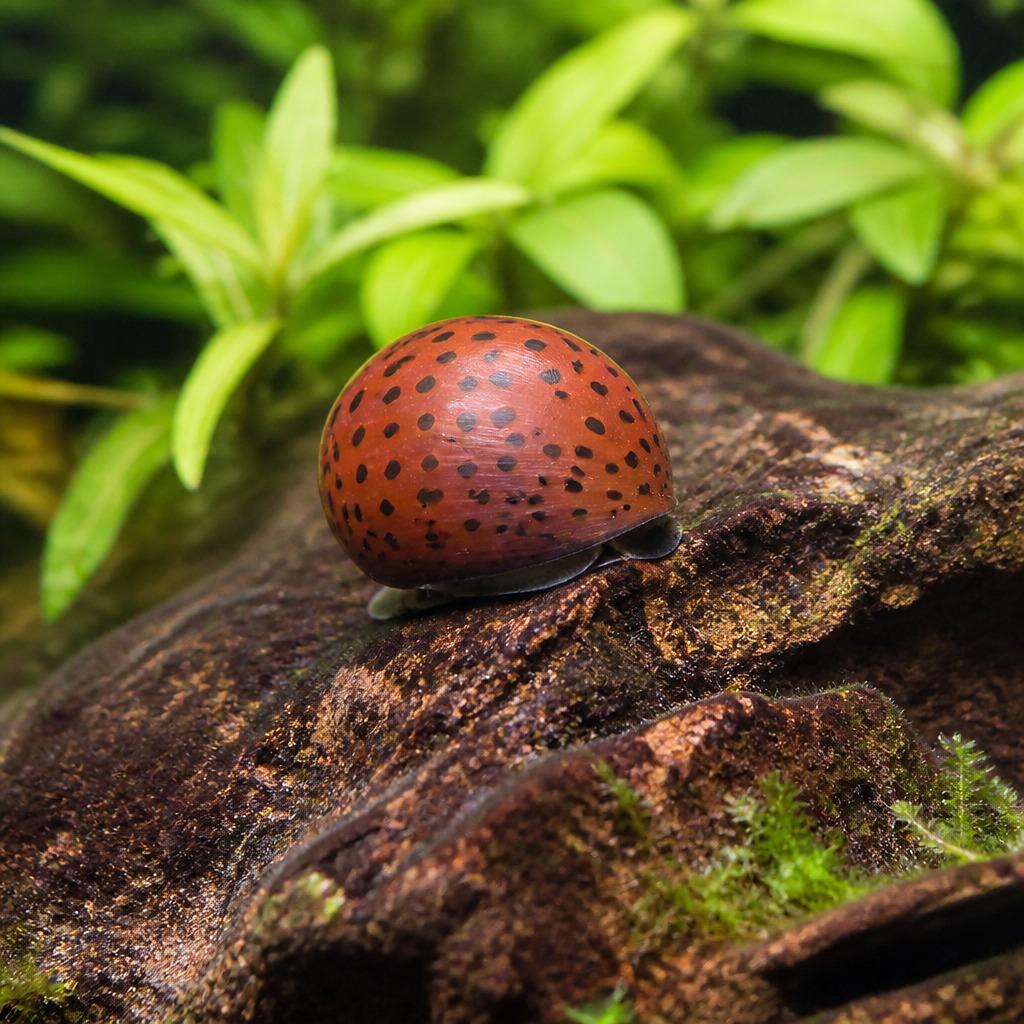
Freshwater Snails
Shop freshwater aquarium snails in the UK. Compare current species, adult size, water needs, diet, breeding risk, compatibility, prices and availability.
Sources & further reading
Material factual claims cite the sources below; store policy and cautious inference are labelled in the article. Sources are grouped by type so you can judge their weight at a glance.
Scientific database (2)
- [12]Froese, R. & Pauly, D. (eds.) (2026). Paracheirodon innesi — Neon Tetra. FishBase. View source
Species record reporting a 20–26°C environmental range for Paracheirodon innesi. A database habitat range is useful identity evidence, not by itself a captive target for every source population or life stage.
- [13]Froese, R. & Pauly, D. (eds.) (2026). Tanichthys albonubes — White Cloud Mountain Minnow. FishBase. View source
Species record reporting an 18–22°C environmental band for Tanichthys albonubes. It demonstrates why this species should not be swept into a generic 25°C community answer.
Veterinary reference (3)
- [6]Francis-Floyd, R. & Petty, B. D. (2026). Providing a Home for Fish. MSD Veterinary Manual. View source
Veterinary guidance for a separate thermometer, species-appropriate temperature, avoiding direct sun, warmer water holding less oxygen and not powering many submerged devices before the tank is filled. The exact device manual remains controlling.
- [7]Francis-Floyd, R. & Petty, B. D. (2024). Emergencies of Fish. MSD Veterinary Manual. View source
Veterinary overview identifying heater, pump, leak and electrical failures as environmental emergencies and recommending planning, monitoring and suitable circuit protection rather than improvised treatment.
- [8]MSD Veterinary Manual. Common Environmental Hazards for Fish. MSD Veterinary Manual. View source
Veterinary table connecting low dissolved oxygen with surface breathing and temperature fluctuation with thermostat or power failure. Signs and consequences vary, so the guide does not diagnose from temperature alone.
Animal-welfare charity (2)
- [1]Royal Society for the Prevention of Cruelty to Animals. Choosing an Aquarium for Pet Fish. RSPCA. View source
UK welfare guidance for species-specific temperature research, thermostatically controlled heaters, an independent digital thermometer, daily checking, avoiding direct sun and radiators, and matching replacement-water temperature. Its example group ranges are not universal setpoints.
- [2]Royal Society for the Prevention of Cruelty to Animals. Caring for Pet Fish in Winter. RSPCA. View source
UK seasonal guidance to maintain consistent temperature, verify the heater, use a reliable thermometer, avoid draughts and heat sources, and reduce heat loss. The broad tropical range given there does not replace species research.
Trade-body guidance (3)
- [3]Ornamental Aquatic Trade Association. How to Pick and Look After Fish in Unheated Aquariums. OATA. View source
UK trade-body guidance showing that some aquarium fish suit unheated systems and that species must be checked individually. It supports avoiding the false rule that every colourful freshwater fish belongs at one tropical temperature.
- [4]Ornamental Aquatic Trade Association. How to Look After Tetras and Pencilfish. OATA. View source
UK group-level care guidance for captive-bred tetras and pencilfish, including a 22–27°C suggested band, heater use and temperature records. It explicitly requires species-specific checking.
- [5]Ornamental Aquatic Trade Association. How to Look After Discus. OATA. View source
UK care guidance for captive discus, including a 26–30°C band, heater use, avoiding fluctuations and checking the conditions in which the fish are currently held.
Government / regulatory (2)
- [10]Health and Safety Executive (2026). Electrical Safety: Frequently Asked Questions. Health and Safety Executive. View source
General electrical-safety guidance that a 30 mA RCD can reduce risk but cannot protect from every shock. It is not aquarium-device installation advice and does not replace a competent electrician.
- [11]Office for Product Safety and Standards (2024). Product Safety Report: Aquarium Heater Y1-25W and Y1-50W. GOV.UK. View source
A specific UK safety report showing that an aquarium heater can present fire and electric-shock hazards when required safety standards are not met. It supports checking recalls, markings, instructions and condition—not condemning all heaters.
Reference source (1)
- [9]U.S. Environmental Protection Agency (2026). Dissolved Oxygen. U.S. Environmental Protection Agency. View source
Government science reference explaining that oxygen solubility decreases as water temperature increases and that circulation, respiration, plants and organic load also affect oxygen. Temperature is therefore not an oxygen measurement.
Spotted something that needs a fix?
Fishkeeping moves fast and we want every guide spot-on. If you think something here is wrong, out of date, or could be clearer, tell us — our team reads every message and updates the page.
Suggest an editRelated care guides
How to Set Up a Tropical Fish Tank: 10 Safe Steps
Choose the intended fish before the aquarium, place the tank on a suitable level support, install a filter and thermostatic heater, condition and test the water, then complete a fishless cycle. Add fish only after the chosen maturation process reaches its defined endpoint and repeated tests show zero ammonia and zero nitrite; elapsed days alone do not prove readiness.
Aquarium Water Parameters: What to Test and Why
There is no universal set of perfect freshwater aquarium parameters. Identify the animals, learn what the test and unit actually report, establish your local source-water baseline, and compare repeat measurements. In an established aquarium, a confirmed ammonia or nitrite detection needs investigation; pH, GH, KH, temperature and nitrate decisions depend on the species, life stage and whole system.
Live Aquarium Plants for Beginners: 7 Easy Picks
For a first low-tech planted aquarium, start with one or two correctly labelled lower-demand species, match their mature size to the tank, keep the rhizomes of Java fern and Anubias above the substrate, and change only one lighting or feeding variable at a time.