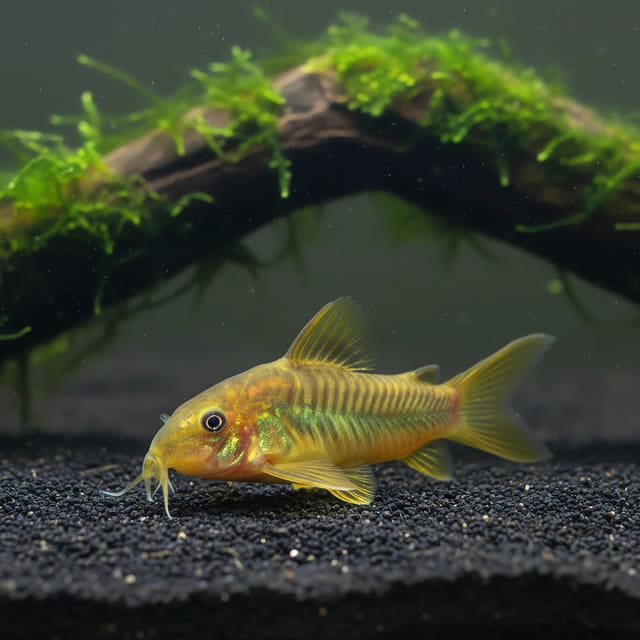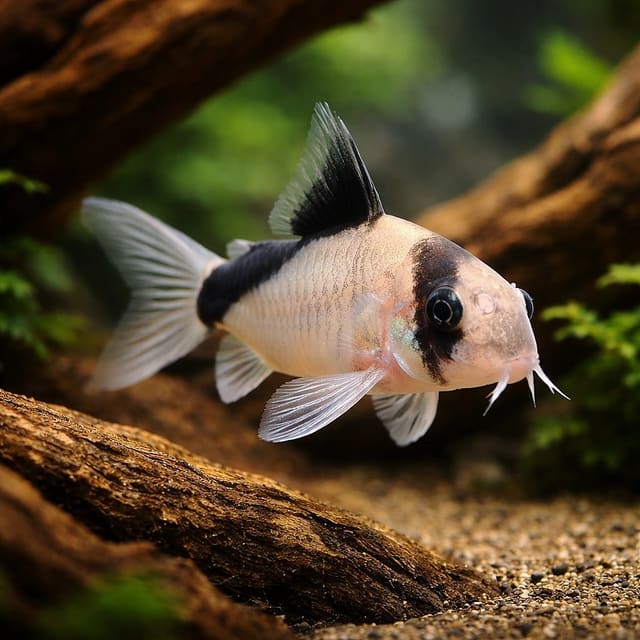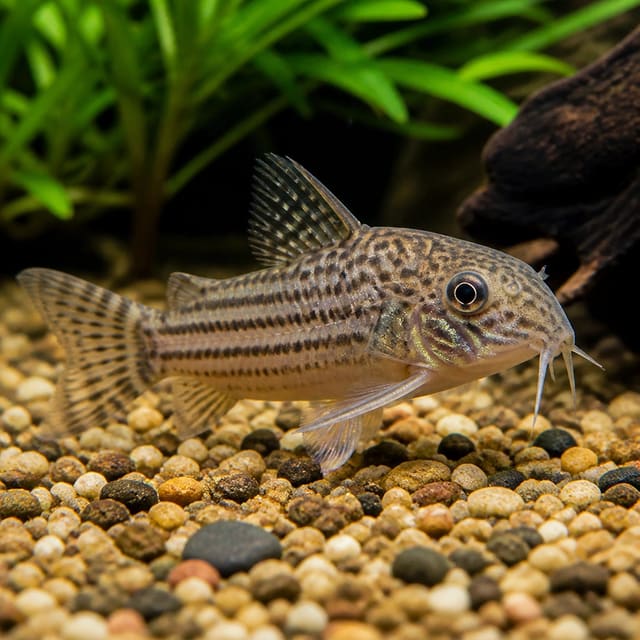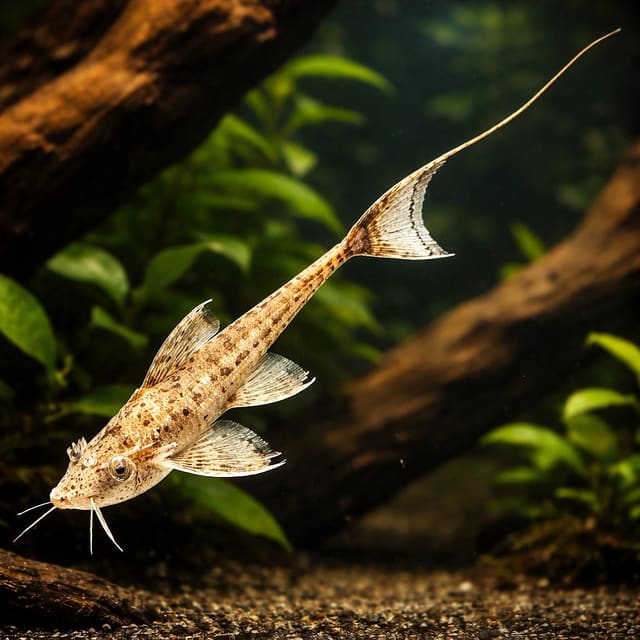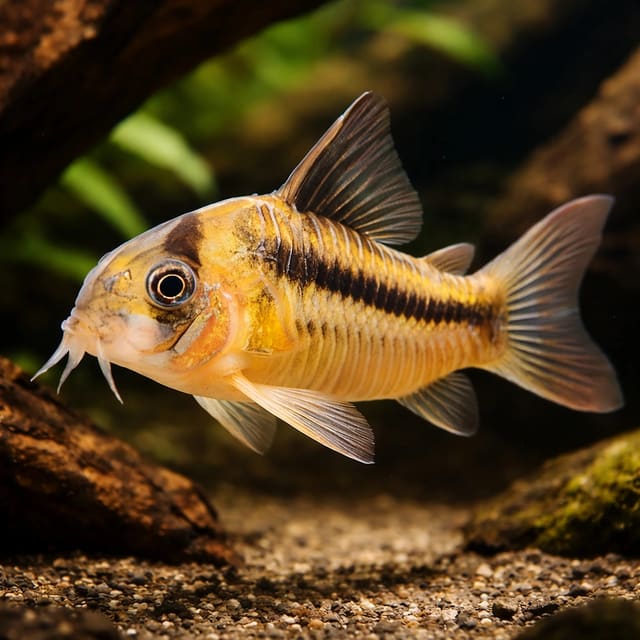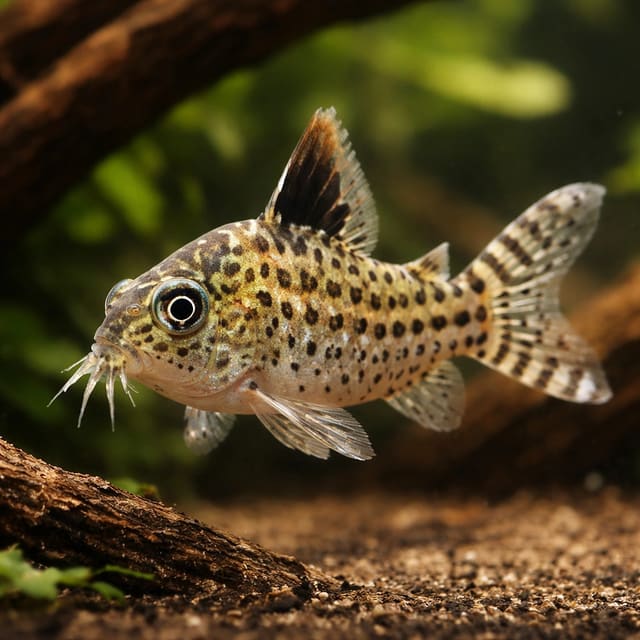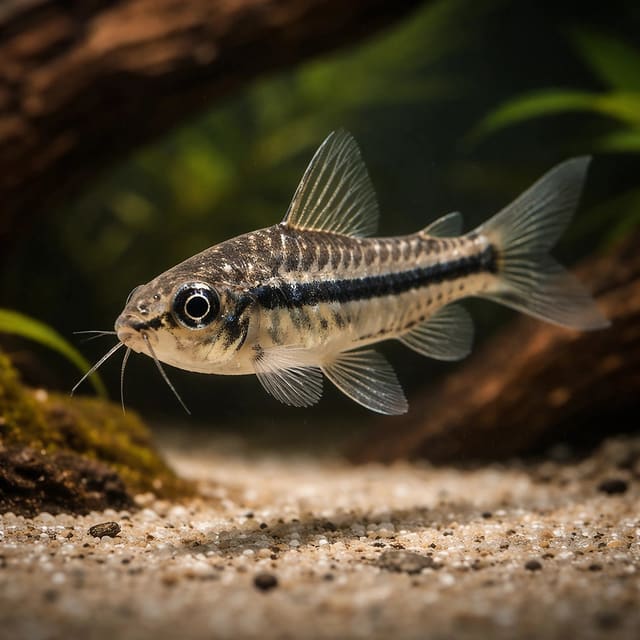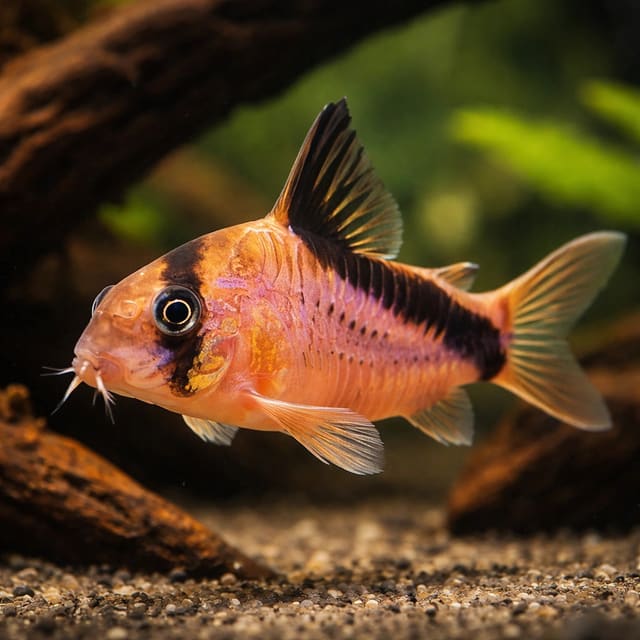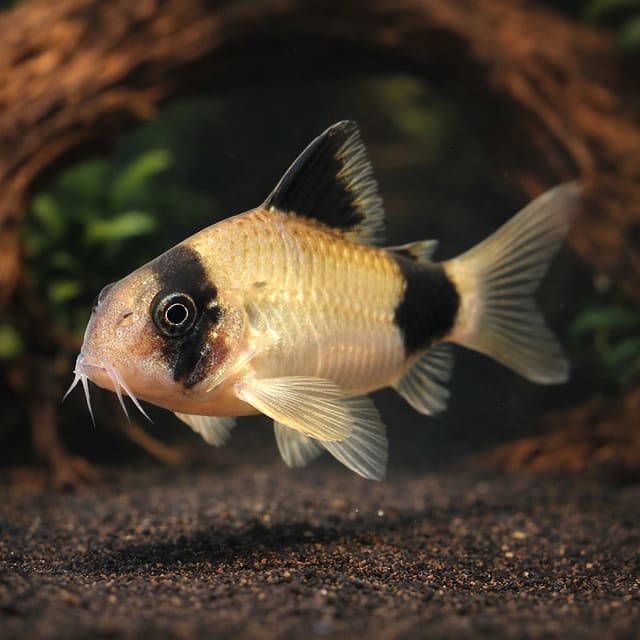
Panda Cory Catfish (Corydoras panda)
22–25°C · pH 6–7.4
£7.29

The Pictus Catfish (Pimelodus pictus) is an active catfish from the Amazon and Orinoco river basins of South America that reaches 11 cm. It suits a spacious aquarium of at least 120 × 45 × 45 cm, about 243 litres, with six or more showing the most outgoing behaviour in 22–25°C water at pH 5.8–6.8. Sold individually in 3–4 cm, 5–6 cm, 6–7 cm and 6.5–8 cm sizes.
Adult size is the maximum length this species reaches at full maturity (scientific sources). The livestock you receive will be younger and smaller — pick a size above for the actual shipping size. Product-photo provenance and any image-specific limitations are stated on the listing.
Pimelodus pictus
The Pictus Catfish (Pimelodus pictus) is an active catfish from the Amazon and Orinoco river basins of South America that reaches 11 cm. It suits a spacious aquarium of at least 120 × 45 × 45 cm, about 243 litres, with six or more showing the most outgoing behaviour in 22–25°C water at pH 5.8–6.8. Sold individually in 3–4 cm, 5–6 cm, 6–7 cm and 6.5–8 cm sizes.
Adult size is the maximum length this species reaches at full maturity (scientific sources). The livestock you receive will be younger and smaller — pick a size above for the actual shipping size. Product-photo provenance and any image-specific limitations are stated on the listing.
Maintain these water conditions for optimal health and vibrant colors
Pictus Catfish is an active freshwater catfish from the Amazon and Orinoco river basins of South America. FishBase identifies Pimelodus pictus as a member of the long-whiskered catfish family Pimelodidae and records a maximum length of 11 cm total length for male or unsexed fish. It suits a keeper who can provide a spacious aquarium, strong filtration and carefully screened companions. Its predatory feeding behaviour matters more to community planning than that relatively compact recorded measurement: any fish small enough to swallow may become prey.
This is a catfish for a spacious, carefully planned aquarium rather than a small community tank. It cruises actively when comfortable, responds vigorously to food and may disturb slower fish through its speed and long barbels. A layout that combines open swimming room, dimmer areas and secure retreats lets it move naturally without forcing it to remain hidden.
| Decision | Planning figure |
|---|---|
| Aquarium footprint | At least 120 × 45 cm |
| Approximate minimum volume | 243 litres |
| Aquarium temperature | 22–25°C |
| Aquarium pH | 5.8–6.8 |
| General hardness | 1–15 dGH |
| Social plan | Six or more for the most outgoing behaviour |
| Suits | Not suited to |
|---|---|
| Spacious aquariums with a base of at least 120 × 45 cm | Small community aquariums |
| Robust, active companions too large to swallow | Fish small enough to swallow |
| Layouts with open swimming room, subdued areas and retreats | Bright layouts without secure cover |
| Keepers prepared for vigorous feeding and strong filtration | Communities dominated by slower-moving fish |
The footprint is as important as the nominal volume because this fish needs room to travel along the lower levels. Do not treat 243 litres as an automatic stocking allowance for every group and community combination. The number, adult sizes and activity of all occupants still determine whether the aquarium has enough swimming room, filtration capacity and feeding access.
Choose this fish when you can provide strong, efficient filtration and screen every proposed companion by adult size and behaviour. Its confident feeding response and active movement can make it highly engaging, but those same qualities create risks for tiny or slow occupants. A successful plan therefore starts with adult dimensions, floor space and compatibility rather than the fish's dispatch size.
One purchase supplies one Pictus Catfish in the size selected. The live size selector lists 3–4 cm, 5–6 cm, 6–7 cm and 6.5–8 cm. The size you select is the size supplied, not the adult size. Plan the permanent aquarium before choosing a smaller size, using the 11 cm adult record and the full 120 × 45 cm base requirement rather than treating a young, compact fish as suitable for a small tank.
Sex is guaranteed only when the selected option explicitly states male or female. This Pictus Catfish listing has no sex-guaranteed option.
The gallery images are representative, based on reference photographs of this species, so colours can look slightly different from the live animal.
A smaller dispatch size does not reduce the need for a mature biological filter, suitable chemistry or protected swimming space. It only describes the measurement at dispatch. If a planned group would make the aquarium crowded once the fish have grown, select a larger aquarium rather than relying on the temporary size of the animals.
For the current dispatch schedule, packing terms and Live Arrival Guarantee process, read our delivery and live-arrival policy. Check the current terms before arranging to receive a live animal.
Seriously Fish recommends an aquarium measuring at least 120 × 45 × 45 cm, approximately 243 litres, because of this species' active nature. Its profile also states 120 mm standard length, while FishBase records the 11 cm total-length figure used throughout this listing. Use the 11 cm adult figure together with the stated footprint when planning space.
Long tanks are more useful than tall, narrow tanks of similar volume because they provide an extended route through the lower levels. Keep the centre and front portions open enough for uninterrupted movement, then place shelter around the margins. Check that wood, stones and plant growth do not gradually divide the aquarium into cramped channels.
The minimum footprint is a starting point, not permission to fill every part of the aquarium with other fish. A group of six plus robust community occupants creates more movement and waste than a single animal. Calculate the total adult stocking plan, then allow spare capacity for unobstructed swimming and effective filtration.
Review the plan whenever decor changes or plants spread. A layout that worked when the fish were small may become restrictive as bodies and barbels occupy more room. Move or thin decor rather than reducing the open lane, but retain shaded retreats because bright, exposed surroundings can keep this fish hidden except at feeding time.
When choosing between aquariums, favour the model that provides the larger base, easier filter access and clearer travel route. Extra height alone does not compensate for a short base. This approach gives the fish usable territory rather than volume that exists mainly above its normal swimming area.
Maintain 22–25°C, pH 5.8–6.8 and hardness of 1–15 dGH for routine aquarium care. These figures come from the species profile and are narrower than FishBase's environmental entries of 22–25°C, pH 6.0–8.0 and 5–19 dH. Use the aquarium range for day-to-day husbandry rather than selecting the broadest environmental extremes.
| Value | Action |
|---|---|
| Temperature | Keep it stable within 22–25°C |
| pH | Keep it within 5.8–6.8 |
| General hardness | Keep it within 1–15 dGH |
| Ammonia | Maintain at zero mg/l |
| Nitrite | Maintain at zero mg/l |
Test the aquarium and source water rather than estimating chemistry from appearance. Our aquarium water-chemistry guide explains what the principal measurements mean, while the water matcher helps compare measured values with the target range.
Stability matters because rapid adjustment can create a new problem even when the intended endpoint sits inside the range. If pH or hardness needs changing, first identify the measured difference, then choose a controlled method and monitor each adjustment. Do not combine several large changes at once, as that makes their effect difficult to track.
Temperature planning should account for aquarium volume and room conditions. For a tank around 243 litres in a room around 20°C, the species profile suggests roughly 150–200 W of heating to hold 22–25°C. This is a planning reference rather than a guarantee for every room, aquarium shape or heater design. Check the actual aquarium with a thermometer and size equipment for the installation.
Use the same measurement routine before introduction, after maintenance and whenever behaviour changes. A written log makes slow drift easier to notice. Record the value, date and any action taken; this separates a genuine trend from a single unusual test and helps avoid unnecessary adjustments.
Create a dimly lit environment with plenty of swimming room and a few hiding places. Under bright lighting, Pictus Catfish may remain less visible except at feeding time. Lower light helps a settled fish cruise more regularly, while retreats provide security whenever it chooses to withdraw.
Arrange roots and branches so long barbels and fast-moving bodies have broad approaches. A narrow decorative arch may look open from the front yet form a bottleneck from the side. Inspect every route at fish level and remove structures that create abrupt dead ends.
Plants are optional, but attached species can provide shade without consuming the entire substrate. Anubias and Java fern have modest lighting demands and can be grown on wood or stones. Place them around the edges and above retreats, leaving the main lane open. If leaves begin to obstruct circulation or feeding access, prune or reposition them.
Use lighting to support observation as well as security. The goal is not permanent darkness; it is a subdued arrangement where the fish can choose between open and sheltered zones. Watch where it spends time after settling. Persistent avoidance of a brightly exposed area is a reason to add shade or alter the light distribution rather than filling the area with more decor.
Keep the substrate and feeding zones accessible to a siphon. Elaborate structures that trap sinking food make maintenance harder and can undermine water quality. A simpler layout with removable wood or stones is often easier to clean while still supplying the cover this active catfish uses.
Use strong, efficient filtration with a good amount of flow. For an aquarium around 243 litres, a turnover of four to five times the volume each hour corresponds to approximately 970–1,215 litres per hour. Compare that requirement with the filter's realistic performance once media, pipework and normal maintenance are considered.
The RSPCA's general aquarium guidance explains why a working biological filter is essential: fish release toxic ammonia, beneficial bacteria convert it to toxic nitrite and then to the safer nitrate. Prepare and mature the aquarium before livestock arrives; our first tropical aquarium guide sets out that preparation in a practical sequence.
| Checkpoint | What to do |
|---|---|
| Filter capacity | Aim for 970–1,215 lph at about 243 litres |
| Intake area | Keep it clear of leaves and trapped debris |
| Return flow | Direct it through open water without creating blocked corners |
| Biological media | Preserve the established bacterial population |
| Backup observation | Check flow whenever feeding response or breathing changes |
Turnover is only one part of filter performance. The unit must also hold suitable biological media, remain accessible for maintenance and move water through the aquarium rather than short-circuiting between intake and return. Inspect behind wood and stones for settled debris that indicates a poorly circulated area.
Do not solve every dead spot by adding unrestricted current. This species benefits from flow, but the aquarium still needs sheltered positions. Adjust the return, decor or plant placement so water travels across waste-prone zones while leaving calmer retreats.
Prepare filtration for the complete adult stocking plan. Six active catfish and community companions place a greater demand on the system than one small dispatch-size animal. Add livestock slowly so bacterial capacity can respond to increased waste and feeding. Equipment sized only for the first fish may leave too little margin as the group and other occupants are introduced.
OATA's freshwater-catfish sheet gives 22–27°C and pH 6.0–8.0 for the broad group; the narrower Pictus aquarium range above should guide routine care. Its group guidance also calls for zero mg/l ammonia, zero mg/l nitrite and nitrate no more than 20 mg/l above the normal tap-water level.
At least once every week, carry out a partial water change of 25% and test the water. Treat replacement tap water with a conditioner that removes chlorine or chloramine before it enters the aquarium. Match replacement water sensibly to the aquarium to avoid an abrupt temperature or chemistry change.
If filter media needs cleaning, rinse it lightly in the aquarium water removed during the partial change rather than under the tap. Chlorine or chloramine can damage the beneficial bacteria established in the media. Clean only as much as needed to restore flow and avoid treating every maintenance session as a complete filter reset.
Use nitrate as a trend as well as a single figure. Compare the aquarium measurement with the normal tap-water level because OATA's limit is expressed as no more than 20 mg/l above that baseline. A rising trend can indicate excessive feeding, trapped debris, crowded stocking or insufficient water changes.
Ammonia or nitrite above zero requires immediate attention. Check the test, pause further livestock additions, remove uneaten food and carry out an appropriate conditioned water change. Continue testing until both return to zero, while preserving biological media and investigating the cause.
Maintenance should make the aquarium more stable, not simply look cleaner. Clear water can still contain harmful nitrogen compounds, so visual inspection never replaces testing. Consistent records reveal whether the present feeding, stocking and water-change routine is keeping up with the fish.
Pictus Catfish mainly preys on aquatic invertebrates in nature and accepts a wide range of aquarium foods. Use a quality dried sinking food as the dependable base, supplemented with meaty items such as live or frozen bloodworm, Tubifex or small earthworms. Deliver food where the catfish can find it rather than relying on scraps left by surface-feeding fish.
This species can gorge until its stomach becomes heavily distended, so restraint is central to feeding. Adults only really need feeding every few days. Judge portions by body condition, feeding response and the amount left behind rather than adding more simply because the fish reacts vigorously to the smell of food.
| Observation | Response |
|---|---|
| Food remains on the bottom | Remove it and reduce the next portion |
| One area becomes frantic | Distribute sinking food across several accessible points |
| A new fish stays hidden | Offer food after the lights dim |
| The stomach becomes very distended | Stop feeding and reassess portion size |
| Another fish misses food | Change distribution before increasing the total amount |
Newly introduced fish may feed more readily at night while they become accustomed to the aquarium. Place a measured amount near a sheltered route, then check whether it has been taken. Do not leave repeated portions overnight, as uneaten meaty food adds waste and increases demand on the filter.
A varied menu does not require an uncontrolled mixture at every feeding. Rotate an appropriate sinking dried product with the named meaty foods, keeping the total portion modest. Watch the whole group because a vigorous feeding response can allow the fastest animals to take most of the food.
Separate feeding points can improve access, but they must remain visible enough to inspect and siphon. Avoid dropping food behind fixed wood or stones where it can decay unnoticed. If the filter carries food away too quickly, briefly adjust the delivery location rather than disabling essential circulation for a long period.
Do not keep Pictus Catfish as an algae-control animal or general scavenger. Its diet and predatory behaviour require deliberate feeding. Supplying a proper sinking diet also reduces the temptation to assume that leftovers from other fish will meet its needs.
Move Pictus Catfish only into an established, filtered aquarium that already meets its temperature and chemistry ranges. Test ammonia and nitrite and confirm both are zero before introduction. Increase the fish population slowly because the beneficial bacteria in the filter must respond whenever stocking and feeding increase.
Avoid adding the entire planned community in one step. A rapid increase in waste can exceed the biological filter's capacity and lead to new tank syndrome, with harmful ammonia or nitrite. Stage additions, test after each change and wait for stable zero readings before increasing the load again.
Healthy fish should show clear, bright eyes, undamaged fins, intact scales and appropriate swimming behaviour. Changes worth investigating include hanging at the surface, unusual bottom sitting, erratic swimming, darker or paler colour, increased hiding, altered breathing, white spots, fluffy growths, loss of fins or scales, changes in body condition and reduced interest in food.
Respond to a change by testing water quality first. Check temperature, ammonia, nitrite and recent maintenance or feeding changes, then correct any measured husbandry problem. If you remain concerned about the animal's health, contact us for further guidance rather than selecting a treatment without a diagnosis.
Observation is most useful when it is consistent. View the aquarium during normal lighting, dimmer periods and feeding so you learn the fish's routine. A settled individual may be more active under lower light, while a fish kept alone may hide during the day. Compare changes with its own established pattern rather than expecting constant activity.
Catfish may carry spines, so avoid unnecessary handling and plan transfers carefully. Keep routes clear, prepare the destination in advance and minimise the time the fish spends being moved.
Pictus Catfish is peaceful enough toward suitable companions but remains a predator. Avoid fish small enough to swallow, including neon- and guppy-sized fish. A companion that looks safe at purchase may become vulnerable if its adult size remains small, so compare the mature dimensions of both animals rather than their dispatch sizes.
Use caution with slower-moving fish. The catfish's activity and long barbels may bother them, particularly during feeding or after the lights dim. Many cichlids fall into this behavioural caution, but the decision depends on the exact fish, aquarium dimensions and feeding arrangement rather than the group name alone.
| Question | Decision |
|---|---|
| Could the companion fit into its mouth? | Exclude it |
| Can it cope with rapid movement and vigorous feeding? | Proceed only if robust and active |
| Will both animals reach food? | Create separate feeding points |
| Do their water ranges overlap? | Use only a stable shared range |
Robust, active fish too large to swallow are the strongest candidates. The species profile names rainbowfish, medium to large characins, cyprinids and tough catfish such as loricariids or doradids as suitable examples. Treat those names as a starting screen rather than a universal promise: adult size, temperament, swimming demand and individual behaviour still matter.
Do not use labels such as “community fish” or “bottom dweller” as the final decision. Different bottom-dwelling species may compete for the same floor space, shelters and sinking food, while fish from another level may still be small enough to become prey. Assess the complete aquarium rather than matching labels.
Watch the proposed community most closely at feeding time and in dimmer conditions. Repeated displacement from food, persistent hiding, damaged fins or a companion being chased from shelter means the arrangement needs changing. Rework feeding points, decor or stocking before the pattern becomes established.
A single Pictus Catfish can survive by itself, but it tends to remain hidden during daylight. The species is naturally shoaling and becomes more outgoing and active when maintained in a group of six or more. Make that social decision before stocking because a complete group needs more swimming room, feeding access and filtration capacity than one animal.
The 243-litre, 120 × 45 × 45 cm recommendation is the species' minimum aquarium plan, not a guaranteed community formula. A group of six plus other active fish may justify a larger footprint and greater filtration margin. Ask us for a stocking and compatibility assessment using your aquarium dimensions, measured water values and the adult sizes of every proposed occupant.
| Plan | Likely consequence |
|---|---|
| One animal in suitable space | It may remain more hidden during daylight |
| Six or more with sufficient room | The group is likely to be more outgoing and active |
| Group added to a crowded floor | Swimming, shelter and feeding access become restricted |
| Group with robust active companions | Still requires individual compatibility screening |
Calculate the community from adult needs backwards. First reserve the full swimming lane and multiple retreats for the catfish group. Next place feeding stations where all animals can reach them. Finally assess the remaining capacity for robust companions whose mature size keeps them outside the prey screen.
Avoid solving social confidence by simply adding more fish to an aquarium that is already at its practical limit. More Pictus Catfish may increase visible group behaviour, but they also increase movement and waste. Upgrade space and filtration before increasing group size where the existing setup lacks margin.
Monitor each new combination rather than relying only on a compatibility label. Individual behaviour and aquarium layout can change the result. If slower fish repeatedly retreat during Pictus feeding, or if one catfish cannot reach food, revise the arrangement promptly.
To compare different lower-level aquarium animals without treating them as automatic companions, browse the catfish and plecos collection. Each candidate needs its own adult-size, water and behaviour assessment before it is combined with this active predator.
FishBase records it at a maximum of 11 cm total length for male or unsexed fish. Plan its permanent aquarium around that adult figure rather than the fish's dispatch size.
Plan at least 120 × 45 × 45 cm, approximately 243 litres, for this fish. Seriously Fish bases this minimum on the species' active nature, so prioritise a long base, open swimming space and strong filtration.
One can survive alone but may remain hidden during daylight. Six or more are more likely to show outgoing, active shoaling behaviour when the aquarium provides sufficient space, filtration and feeding access.
It suits a keeper prepared to provide at least 243 litres, maintain 22–25°C water, control feeding and screen every companion by adult size and activity. It is not a suitable choice for a small community aquarium.
Feed it a quality dried sinking food supplemented with live or frozen bloodworm, Tubifex or small earthworms. Adults only really need feeding every few days, and portions should prevent gorging or uneaten food accumulating.
Keep it at 22–25°C, pH 5.8–6.8 and 1–15 dGH for routine aquarium care. Maintain ammonia and nitrite at zero mg/l and test the water at least weekly.
It is peaceful enough toward suitable companions but is predatory and may swallow small fish. Its activity and long barbels may also bother slower-moving tank mates, especially during feeding or after the lights dim.
Choose robust, active fish too large to swallow; Seriously Fish names rainbowfish, medium to large characins, cyprinids, loricariids and doradids as candidates. Avoid neon- and guppy-sized fish, and screen slower companions carefully.
Start filming the sealed parcel before opening it, continue in one take as it is opened and show the fish still inside the sealed bag; someone must be present to receive the parcel. Float the bag for 20–30 minutes before releasing the fish, and never pour the bag water into the aquarium.
No reviews for this item yet. Bought one? Honest reviews only, good or bad.
What customers say about ordering from us
I have a small group of long finned mountain minnows. So was delighted to be able to order ten of this variety to increase the genetics in my tank . The ones I recieved are healthy but it’s to early to give a verdict on wether they are of a long finned type since they are small currently.
Gordon Walker · 23 Sept 2026
100% success travel and "installation". Pleased with quality of purchase. The Siamese fighter a bit "shy" so have not yet seen him at his best yet but looking good. Happy customer. GG
George E Garratt · 21 Sept 2026
Reviews of our shop, collected by Judge.me, an independent third-party review collector. Newest first.