Moderate
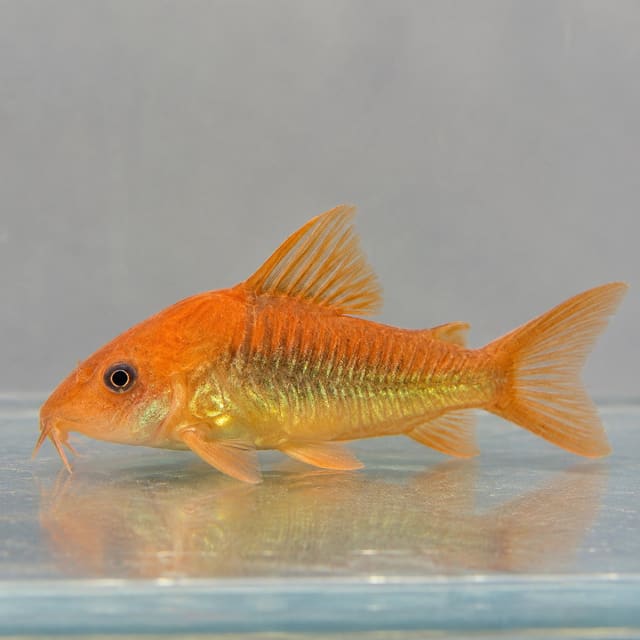
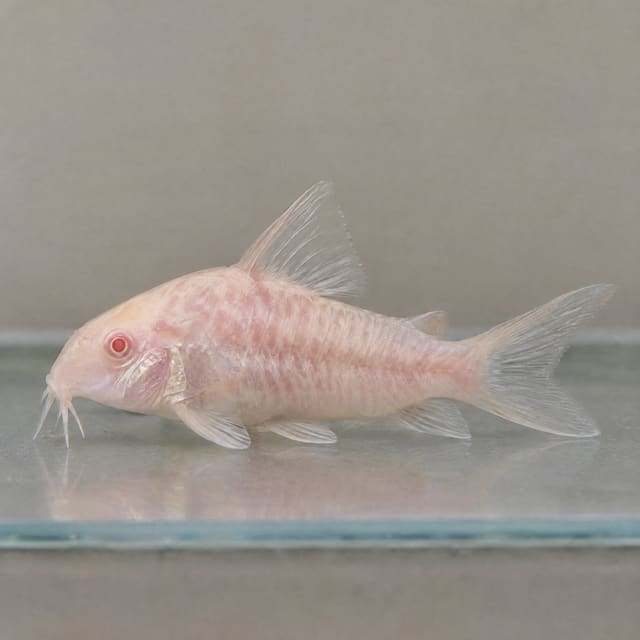
Pantanal Cory C005 (Brochis pantanalensis)
23–26°C · pH 6.5–7.2
£28.29
Corydoras CW106, the Mitu Cory (Brochis sp. CW106), is a long-snouted cory from the Río Vaupés system in Colombia with a black eye mask and a dark band along the back. It grows to about 6–6.5 cm and is peaceful and shoaling, best kept in a group of six or more over soft sand at 22–26°C. One live fish per purchase.
Adult size is the maximum length this species reaches at full maturity (scientific sources). The livestock you receive will be younger and smaller. Product-photo provenance and any image-specific limitations are stated on the listing.
Brochis sp. CW106
Quantity discounts are pricing offers, not a group-size recommendation. Check the full care guidance and your existing animals before choosing a quantity.
Corydoras CW106, the Mitu Cory (Brochis sp. CW106), is a long-snouted cory from the Río Vaupés system in Colombia with a black eye mask and a dark band along the back. It grows to about 6–6.5 cm and is peaceful and shoaling, best kept in a group of six or more over soft sand at 22–26°C. One live fish per purchase.
Adult size is the maximum length this species reaches at full maturity (scientific sources). The livestock you receive will be younger and smaller. Product-photo provenance and any image-specific limitations are stated on the listing.
Read the full care guidance when planning conditions for your aquarium.
Corydoras CW106 is a long-snouted cory catfish from the Río Vaupés system in eastern Colombia, catalogued by Corydoras World and listed by Planet Catfish as the Mitu Cory. The trade name most likely refers to Mitú, the main town on the Vaupés. Its current label is Brochis sp. CW106, after the 2024 reclassification of the corydoras group, though it is still widely sold as Corydoras sp. CW106.
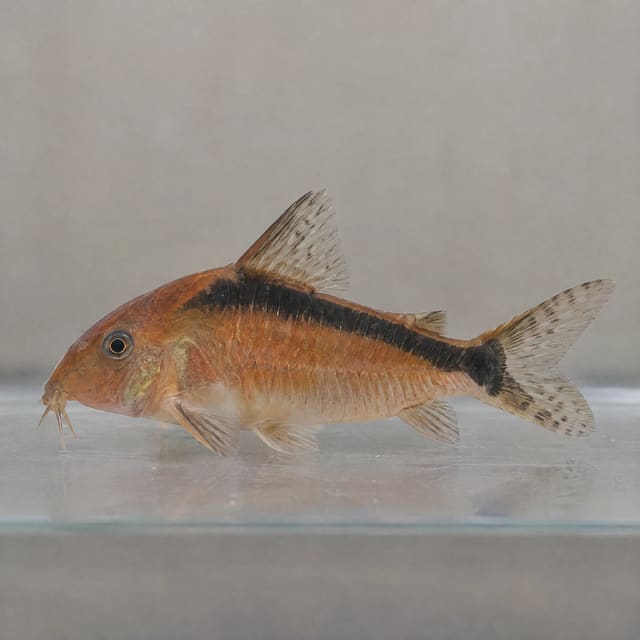
It is a peaceful, shoaling bottom-dweller of about 6 cm with a long, pointed snout, a black mask through the eye and a broad dark band along the back. It suits a soft-water community or a species tank with a group of six or more over soft sand.
A CW number is a placeholder code for a cory without a scientific name. ScotCat's article by Rob McLure explains that Ian Fuller and Hans-Georg Evers began the CW series through Corydoras World after the older C-number series ended in 2009, and that the number stays with the fish whether or not it is later described.
| Item | Detail |
|---|---|
| Current label | Brochis sp. CW106 |
| Older label | Corydoras sp. CW106 |
| Trade name | Mitu Cory |
| Group | Brochis sub-clade 4, long straight-snouted species |
| Origin | Cuduyarí river, Río Vaupés system, Colombia |
| Adult size | Males about 6.0 cm, females about 6.5 cm (ScotCat) |
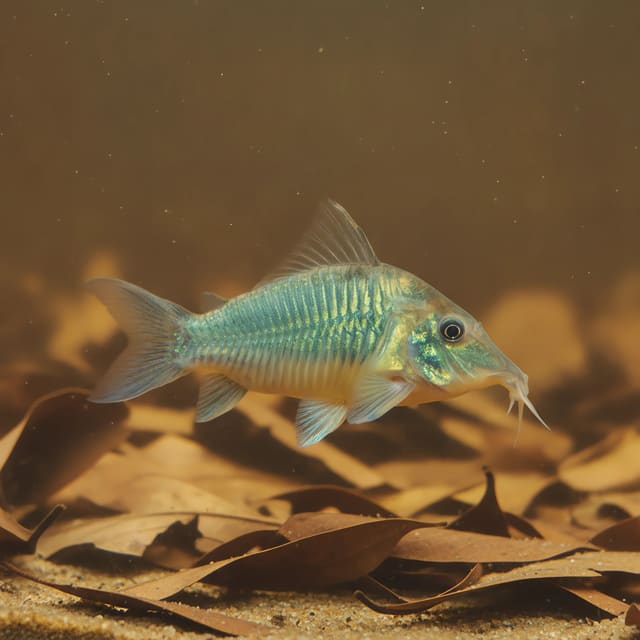
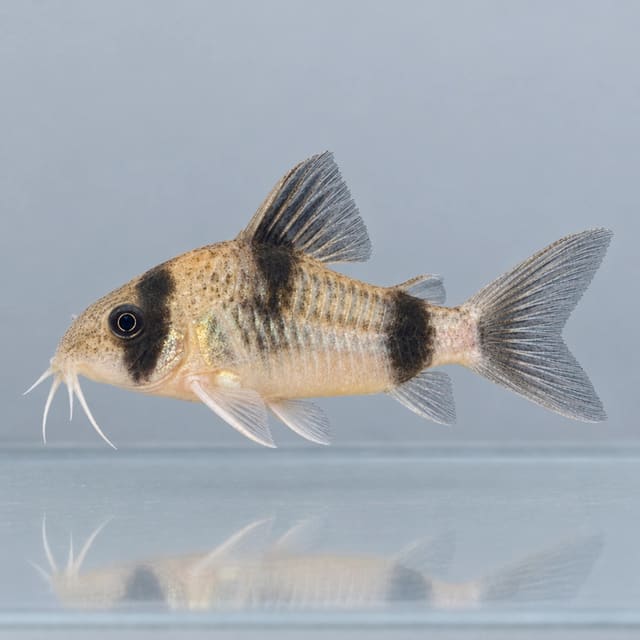
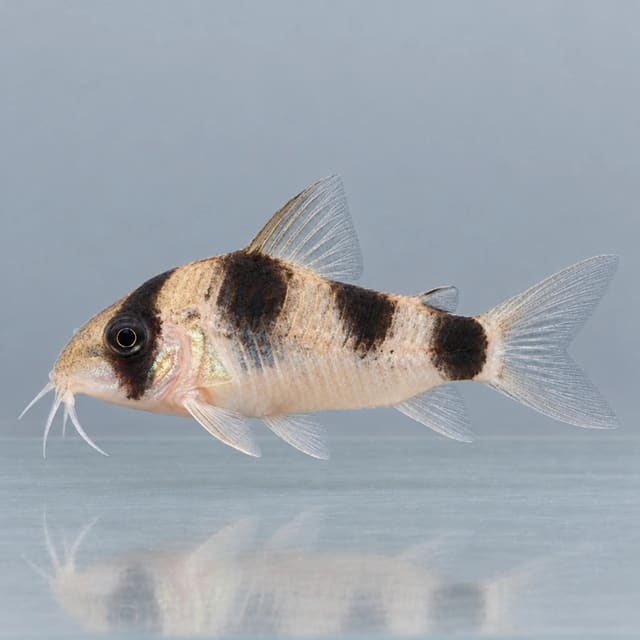
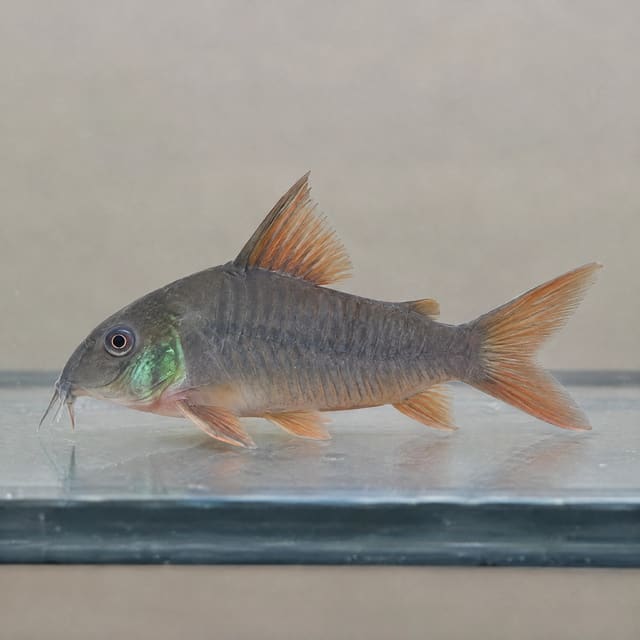
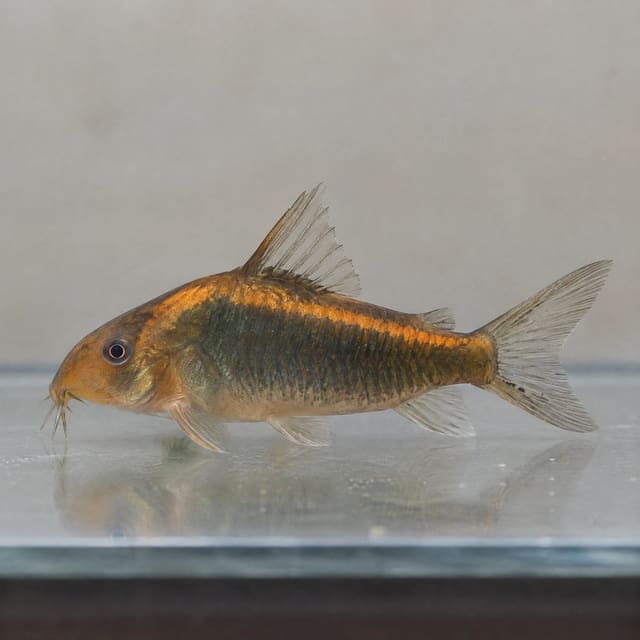
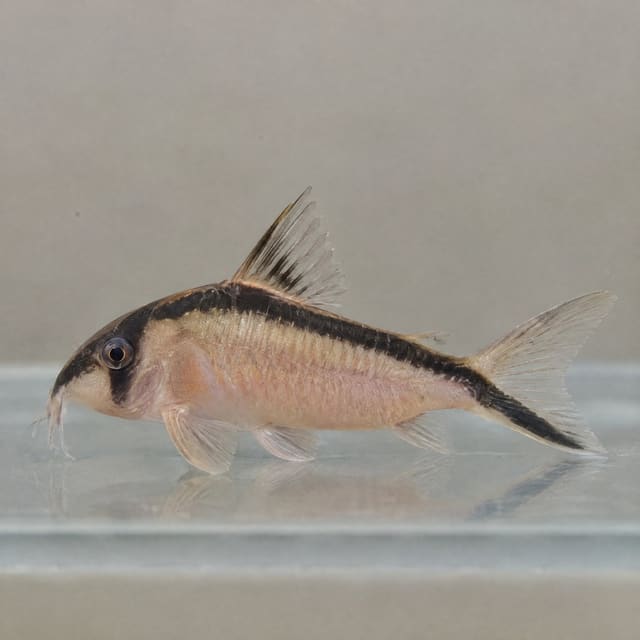
Photographs of CW106 on Corydoras World and ScotCat show a slim-headed cory with a long, pointed snout and a pale, silvery-pink to beige body. A black mask runs down through the eye, and a broad black band runs along the upper flank from below the dorsal fin back to the base of the tail. The fins are mostly clear. Planet Catfish notes that females grow larger and fuller in the body, best seen from above, and that mature males have more pointed fin tips.
ScotCat records that CW106 lives alongside a shorter-nosed fish with almost the same pattern, coded CW107, which has since been shown to be a colour form of Hoplisoma melini. Seriously Fish describes H. melini, the false bandit cory, as having an oblique dark bar along the back that splits in two above the tail base.
| Feature | CW106 (Mitu Cory) | CW107 / H. melini |
|---|---|---|
| Snout | Long and pointed | Short and rounded |
| Genus today | Brochis | Hoplisoma |
| Pattern | Eye mask and dark band along the back | Eye mask and oblique dark back bar |
| Adult size | 6.0–6.5 cm (ScotCat) | CW107 5.0–5.5 cm (ScotCat) |
| Locality | Cuduyarí river, Vaupés system | Same river for CW107; H. melini more widely in the Negro, Caquetá and Orinoco |
We sell the short-snouted Bandit Cory, so you can keep the two forms side by side as they live in the wild.
For most of the hobby's history, nearly all these catfish were called Corydoras. In 2024 Dias and colleagues published a classification based on DNA and anatomy that divided them into several genera. ScotCat explains that Brochis, first named by Cope in 1871 and merged into Corydoras by Britto in 2003, was brought back for the long-snouted lineage. Corydoras World describes Brochis sub-clade 4 as the largest group, with 32 described species and twice as many coded ones, the straight-snouted species, including some of the largest in the subfamily. ScotCat and Corydoras World both place CW106 in sub-clade 4; one Planet Catfish heading lists sub-clade 3, so the sources differ on that detail. Care is unchanged by the new name.
Our Brochis and long-nosed cory catfish page gathers this genus, including the Delphax Cory and Reticulated Cory. The C53 Longnose Cory is another long-snouted cory with similar care.
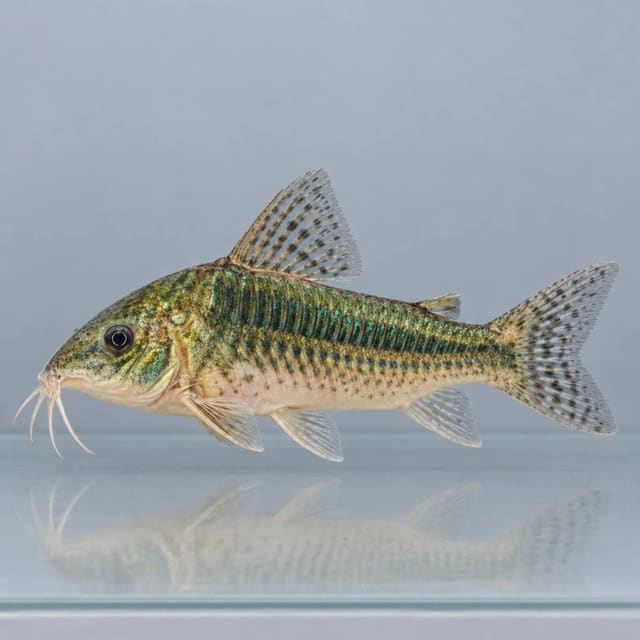
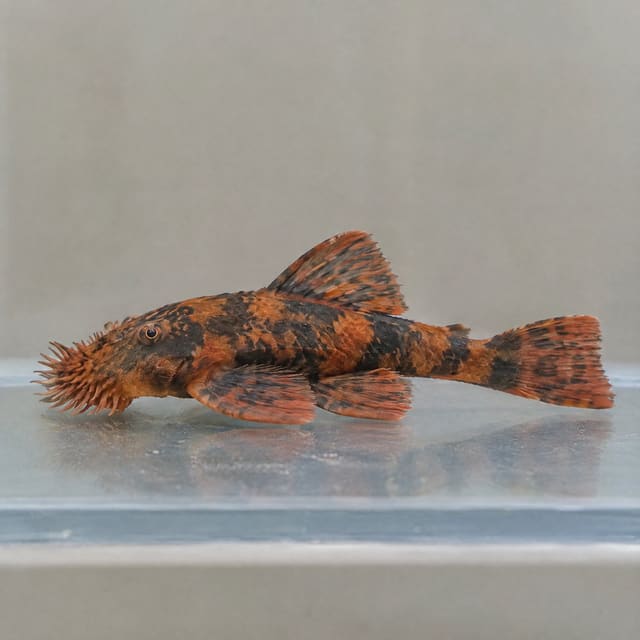
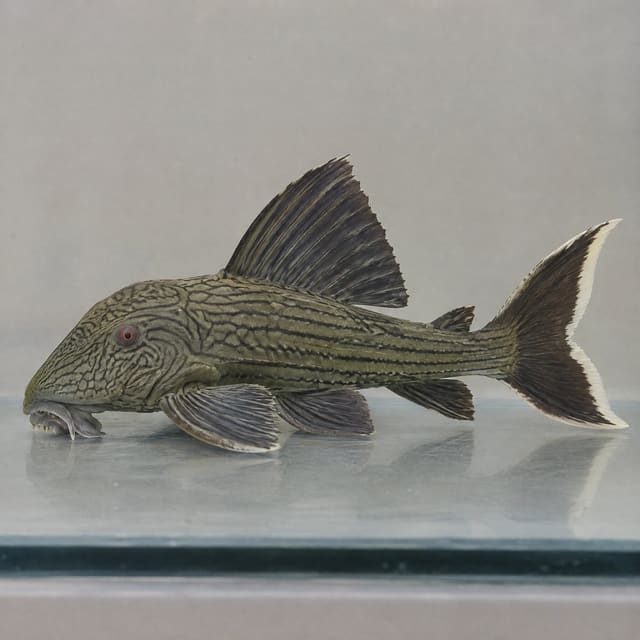
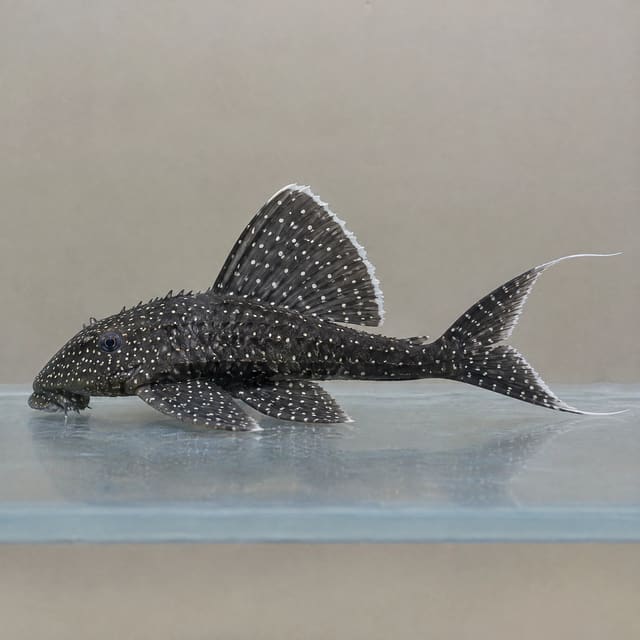
One purchase supplies one live Corydoras CW106 in the standard size we receive. Sex is not specified, and the price is for one fish. Planet Catfish describes it as a peaceful, shoaling community fish, and OATA advises groups of at least five for corydoras, noting that fish kept singly or in small groups often become stressed. Please order six or more. The gallery images are representative of the species; the width of the back band and the strength of the mask vary between fish.
Our delivery and arrival guarantee page explains dispatch days and how we pack fish. See our full corydoras range for other species.
OATA recommends at least 80 litres for a shoal of corydoras, and Seriously Fish gives an 80 × 30 cm base for the bandit cory, H. melini, which is a little smaller. Corys live on the floor, so the base area is what limits the group. Our stocking calculator helps you fit a group of six or more alongside the rest of your fish.
Planet Catfish advises sand as the ideal substrate, with rounded gravel as an imperfect alternative, and warns that rough-edged gravel damages the barbels as the fish dig. It suggests bordering the sand with driftwood and plants and giving shade with overhanging wood or tall and floating plants. A long-snouted cory spends its day probing the substrate, so keep the sand soft, clean and deep enough to dig in.
| Area | Purpose |
|---|---|
| Open, soft sand | Foraging with the long snout; feeding area |
| Smooth rounded stones | Shelter and resting places along a stream-like bed |
| Driftwood at the back | Shade and a natural Rio Negro-type look |
| Plants and floating cover | Softer light and security |
ScotCat gives the water values for CW106. Planet Catfish gives none. Seriously Fish gives values for H. melini, which shares its rivers, and OATA gives broad values for catfish. The target sits inside the ranges for CW106 and its neighbour.
| Value | ScotCat (CW106) | Seriously Fish (H. melini) | OATA (catfish) | Our target |
|---|---|---|---|---|
| Temperature | 22–26°C | 20–26°C | 22–27°C | 23–25°C |
| pH | 6.0–7.2 | 4.0–7.0 | Not given | 6.0–7.0 |
| General hardness | Not given | Not given | 4–18 dGH | Softer end of 4–18 dGH |
The Vaupés flows to the Rio Negro, a region of soft, acidic water, while a lot of UK tap water is hard and above pH 7. Test yours, and if needed blend in reverse osmosis water to bring the values down gradually. Our water matcher and pH guide for tropical fish explain how.
Habitat values set the background; waste readings decide day-to-day health. OATA's targets are zero ammonia, zero nitrite and nitrate no more than 20 mg per litre above your tap water. Test weekly, and always after adding fish.
Choose a filter rated for the whole tank, with the outlet set to move the surface without blasting the floor. Waste settles where corys feed, so clean sand matters as much as clear water. Rinse filter media only in water removed from the tank, as OATA advises.
Planet Catfish says CW106 readily takes prepared foods that reach the bottom, such as tablets, granules and larger flakes, and that live or frozen bloodworm, white worm, grindal worm, Daphnia and tubifex are taken readily and help condition a group. ScotCat recommends good flake and tablets for adults with occasional frozen or live food. OATA advises feeding once a day, only what is eaten within a few minutes.
| Food | Role | How often |
|---|---|---|
| Small sinking tablets or granules | Staple that reaches the floor | Most days |
| Frozen bloodworm or Daphnia | Variety and condition | Two or three times a week |
| Live white worm or grindal worm | Conditioning; worked out of the sand | Once a week |
| Good flake | Variety | Occasionally |
Spread the food over the open sand so every fish can probe for a share, and feed after lights-out if faster fish take everything first.
OATA's floating-bag method is to turn the aquarium lights off, float the sealed bag for about 10 minutes, then add small amounts of tank water over about 20 minutes before moving the fish across with as little bag water as possible. It recommends double-bagging catfish because their fin spines can pierce a bag. Our step-by-step acclimatisation guide covers the method.
| When | Check | Action |
|---|---|---|
| Day 1 | Group resting together near cover | Lights low; no food |
| Days 2–3 | Fish probing the sand | Small meal of sinking tablets after lights-out |
| Days 4–5 | Ammonia and nitrite still zero | Test daily; change water if either rises |
| Days 6–7 | Group active and feeding in daylight | Normal meals; add frozen foods |
Planet Catfish describes CW106 as a peaceful, shoaling community fish, and ScotCat suggests small to medium tank mates such as tetras, rasboras and danios, or a species tank for breeding. Rio Negro-type fish that like the same soft, slightly acidic water make the most natural company. Our tank mates tool checks a combination before you buy.
| Suits | Avoid |
|---|---|
| A Cardinal Tetra shoal | Any fish large enough to swallow a 6 cm cory |
| Surface fish such as the Blackwing Hatchetfish | Territorial cichlids that guard the sand |
| A group of short-snouted Bandit Corys | Boisterous, greedy bottom feeders |
| Otocinclus and other small, peaceful grazers | Fin-nippers and fish that need hard water |
Our corydoras care guide covers group size and community planning. More floor-dwellers are in our bottom-dwelling fish range and the South American catfish category.
OATA describes a healthy fish as having clear eyes, undamaged fins, no ulcers or bumps, normal swimming and steady breathing. In a long-snouted cory, the snout and barbels are the first places to show trouble from a poor substrate. Corys have sharp spines in the dorsal and pectoral fins that tangle in net mesh, so move them in a fine soft net or a small container.
| You see | Likely cause | Action |
|---|---|---|
| Worn barbels or a sore snout | Sharp or dirty substrate | Use soft sand; siphon more often |
| Rapid breathing or surface dashes | Low oxygen or rising waste | Test, change water, increase surface movement |
| Fish hiding all day after the first week | Bright light, too few corys, harassment | Add shade, enlarge the group, review tank mates |
| Thin bellies | Food not reaching the floor | Feed sinking foods after lights-out |
Planet Catfish has no breeding report for CW106, and the full Corydoras World record is for members only. ScotCat suggests a species tank for breeding, as with other corys. If your group does spawn, OATA notes that cory eggs left in the main tank seldom survive unless they are moved and raised separately, so have a small container ready.
It is an undescribed, long-snouted cory catfish from the Río Vaupés system in Colombia, coded CW106 by Corydoras World. Since the 2024 reclassification it is labelled Brochis sp. CW106. Planet Catfish lists the common name Mitu Cory.
In 2024 Dias and colleagues split the old genus Corydoras by DNA and anatomy. CW106 belongs to the long-snouted group that now takes the name Brochis, a genus first named in 1871 and merged into Corydoras in 2003.
No. It lives alongside a short-snouted look-alike, coded CW107, which ScotCat says has been shown to be a colour form of Hoplisoma melini, the bandit or false bandit cory. CW106 is the long-nosed partner and belongs to a different genus.
ScotCat gives about 6.0 cm for males and 6.5 cm for females.
At least six. Corys are shoaling fish; OATA advises groups of at least five, and Planet Catfish describes CW106 as a peaceful, shoaling community fish.
ScotCat gives 22–26°C and pH 6.0–7.2. Soft, clean water at about 23–25°C and pH 6.0–7.0 suits it and most Rio Negro-type tank mates.
Sinking foods: tablets, granules and good flake, with frozen or live bloodworm, Daphnia, white worm or grindal worm several times a week.
Yes. Keep each species as its own group so every fish has companions of its kind; the short-snouted Bandit Cory makes a natural pairing.
No reviews for this item yet. Bought one? Honest reviews only, good or bad.
What customers say about ordering from us
Easy website plenty of info on fish your buying great to pick a time slot
TRACEY DURRANT · 7 Oct 2026
Got some lovely fish thank you
Kevin Mackie · 7 Oct 2026
Reviews of our shop, collected by Judge.me, an independent third-party review collector. Newest first.
Moved by UK carriers licensed to handle live animals
Hand-packed with oxygen bags, poly box, heat pack
Email photos the same day; an optional unboxing video helps us review problems faster — claim terms apply
Klarna & PayPal Pay in 3 at checkout