Moderate
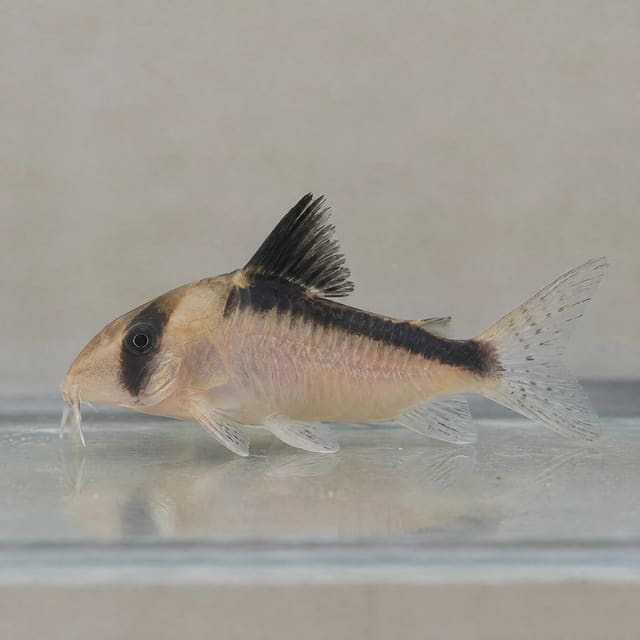
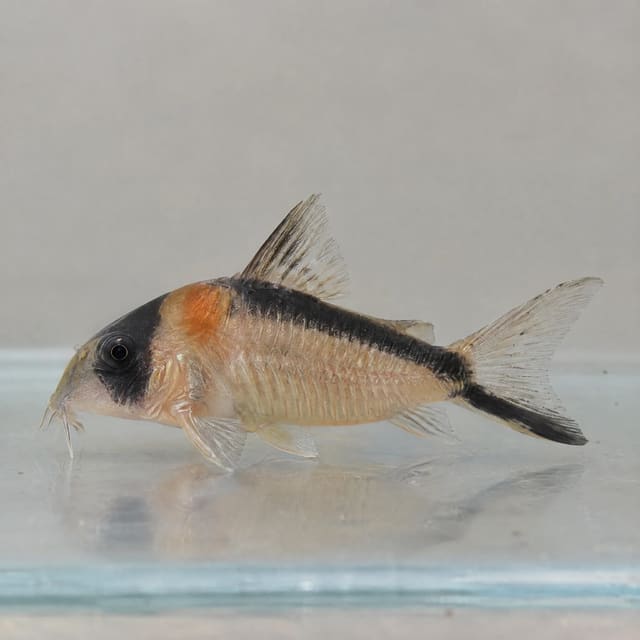
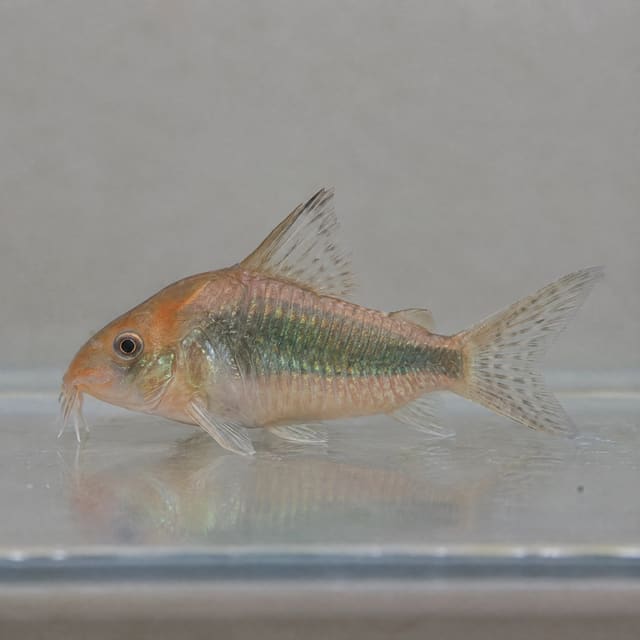
The albino form of the peppered cory, Hoplisoma paleatum: a peaceful armoured catfish with a peach-pink body, golden sheen and red eyes, growing to 7.1 cm standard length. Keep five or more on fine sand at 22–23°C, pH 6.0–7.0. One unsexed fish per quantity, in five size grades: 2–2.5 cm, 2.5–3 cm, 3–3.5 cm, over 3.5 cm and XL. XL has no stated centimetre range.
Adult size is the maximum length this species reaches at full maturity (scientific sources). The livestock you receive will be younger and smaller — pick a size above for the actual shipping size. Product-photo provenance and any image-specific limitations are stated on the listing.
Hoplisoma paleatum
Quantity discounts are pricing offers, not a group-size recommendation. Check the full care guidance and your existing animals before choosing a quantity.
Minimum of 2 per order.
The albino form of the peppered cory, Hoplisoma paleatum: a peaceful armoured catfish with a peach-pink body, golden sheen and red eyes, growing to 7.1 cm standard length. Keep five or more on fine sand at 22–23°C, pH 6.0–7.0. One unsexed fish per quantity, in five size grades: 2–2.5 cm, 2.5–3 cm, 3–3.5 cm, over 3.5 cm and XL. XL has no stated centimetre range.
Adult size is the maximum length this species reaches at full maturity (scientific sources). The livestock you receive will be younger and smaller — pick a size above for the actual shipping size. Product-photo provenance and any image-specific limitations are stated on the listing.
Identify the exact cory catfish before choosing care. Our starting policy for many common medium species is six compatible conspecifics, a mature 60 x 30 cm aquarium of about 60 litres, smooth fine sand and measured species-appropriate water.
Read the full care guidance when planning conditions for your aquarium.
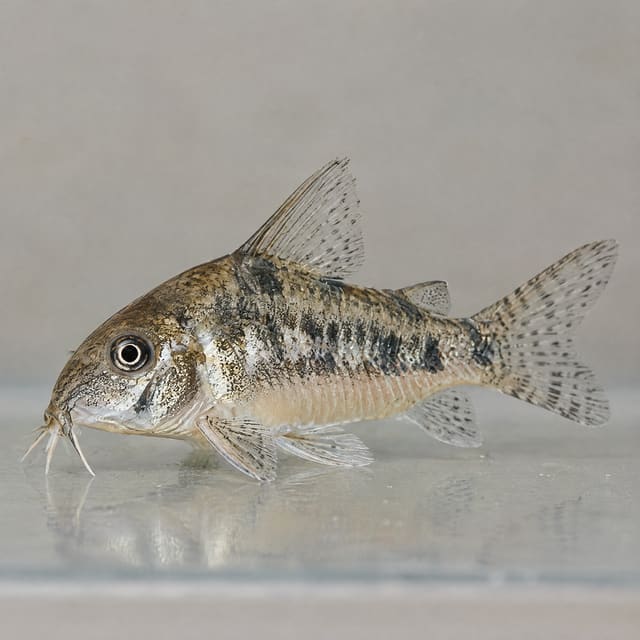
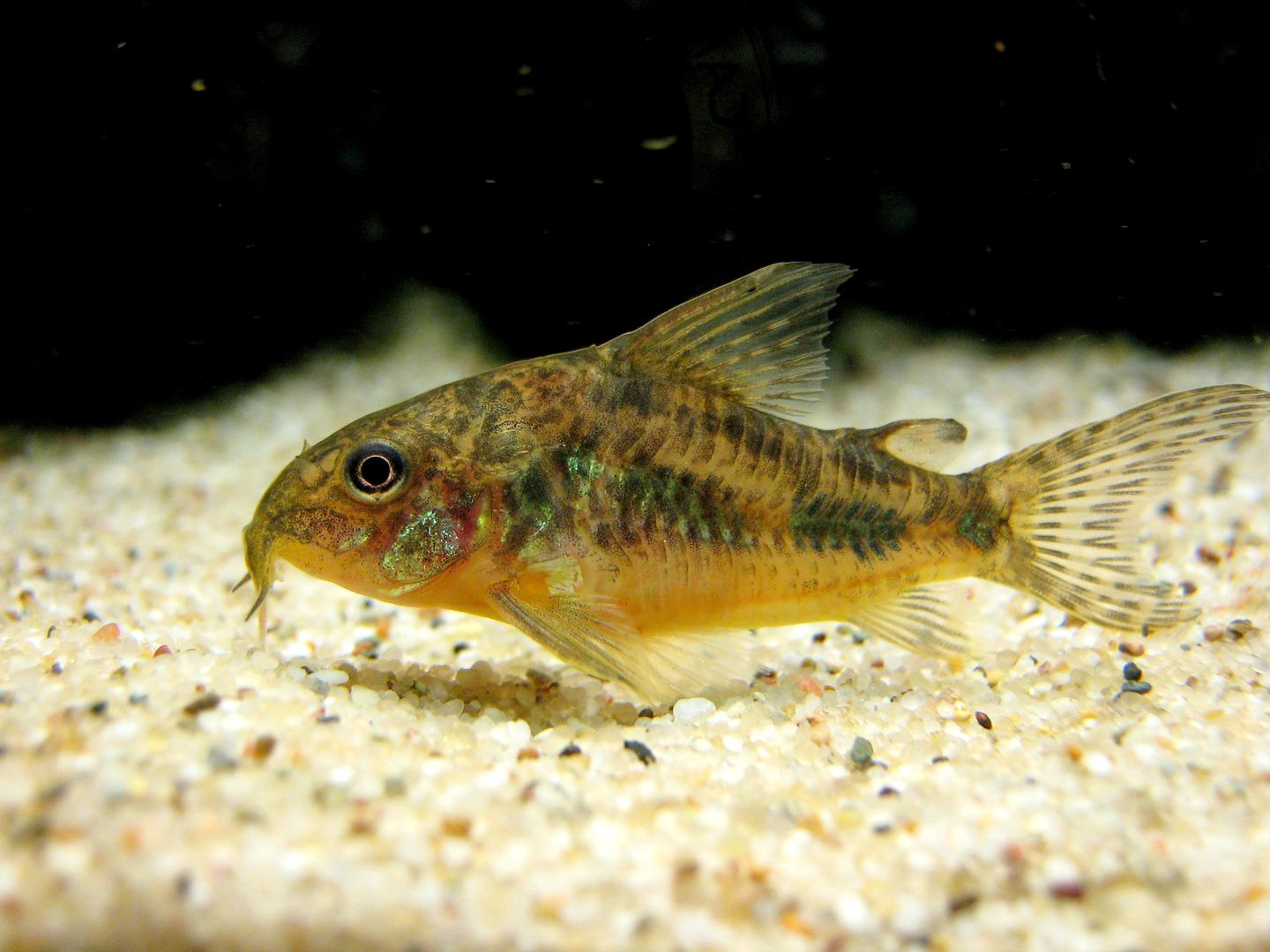
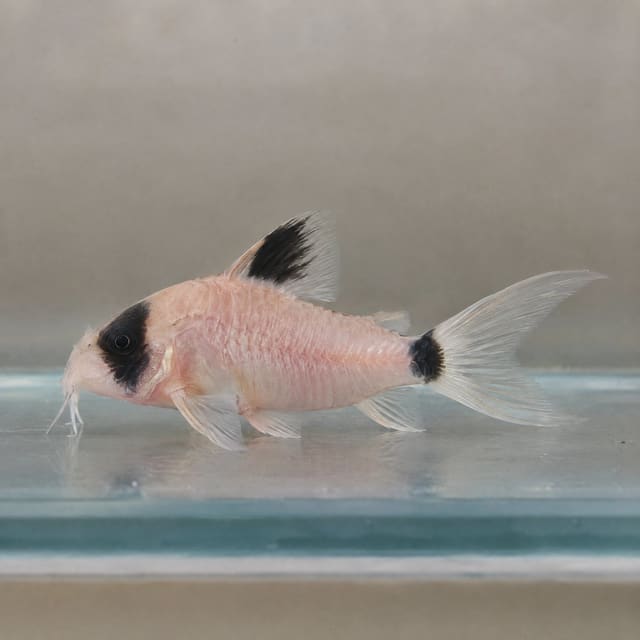
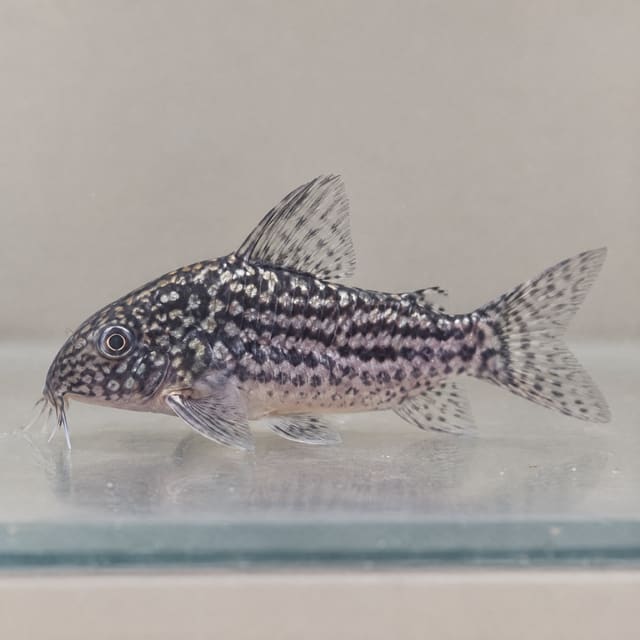
This little catfish is the albino form of the peppered cory, a species first described as long ago as 1842. It has the compact body, the short barbels around the mouth and the steady, nose-down foraging of the normally coloured fish. What it lacks is dark pigment. Albinism, as Wikipedia's article on the subject puts it, is the congenital absence of pigmentation; the albino zebrafish strains it describes, for example, lack their dark pigment cells altogether. The photographs on this page show the result in this cory: no dark markings at all, just a soft peach to pinkish-white body with a warm golden-orange sheen along the flanks and a pink-red eye.
That eye colour has a simple explanation. With no pigment in the iris, the red of the blood vessels in the retina shows through, which is why albino animals so often have pink or red eyes.
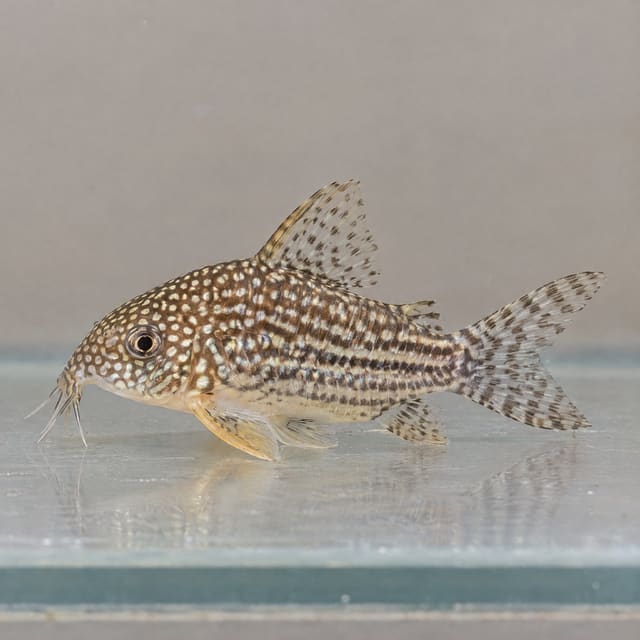
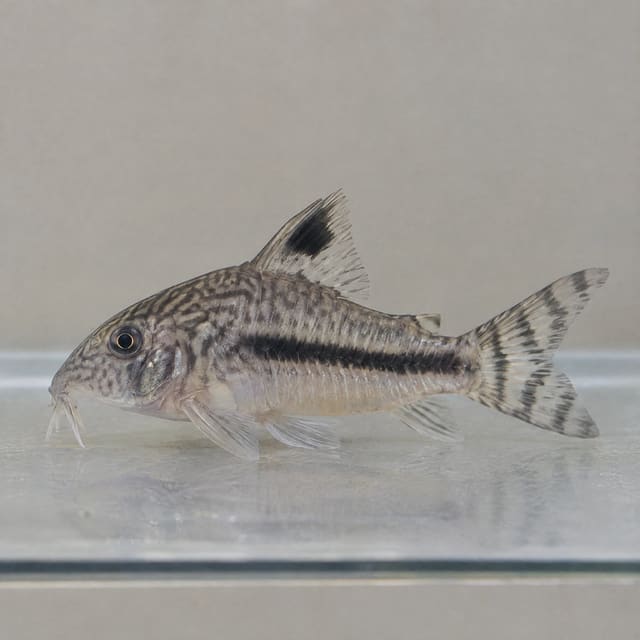
Albino corys are an aquarium creation rather than a wild population. Wikipedia lists albino catfish and corydoras among the artificially selected strains kept by fishkeepers, and Seriously Fish notes that most peppered corys on the market are captive bred specifically for the aquarium trade. Underneath the colour, though, this is exactly the same species as the normal Peppered Corydoras, with the same size, needs and behaviour.
The species was described in 1842 by Jenyns as Callichthys paleatus, from fish Charles Darwin found at Buenos Aires during the voyage of HMS Beagle in the 1830s. Most keepers know it as Corydoras paleatus, the name it carried for many years. In 2024, after phylogenomic studies of the group, it was moved to the genus Hoplisoma, and FishBase now gives the accepted name as Hoplisoma paleatum (Jenyns, 1842). The ending of the species name changes to agree with the new genus, which is why "paleatus" becomes "paleatum". Seriously Fish has adopted the new name too. It is in the same family as before, Callichthyidae, the armoured catfishes, in the subfamily Corydoradinae.
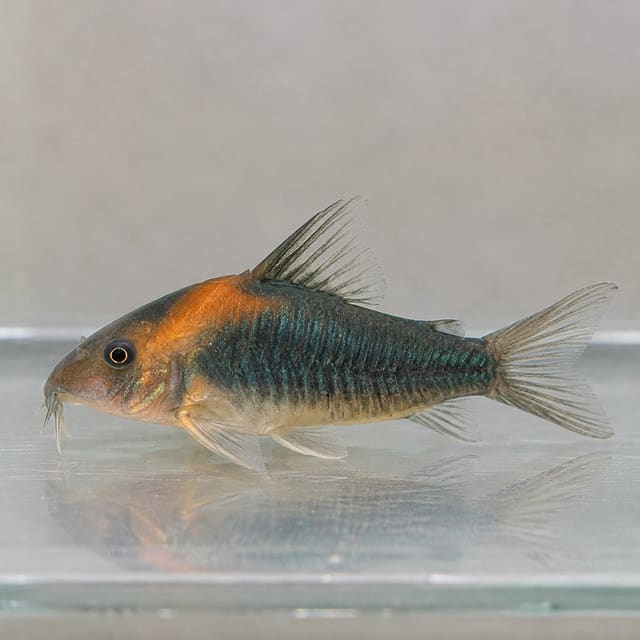
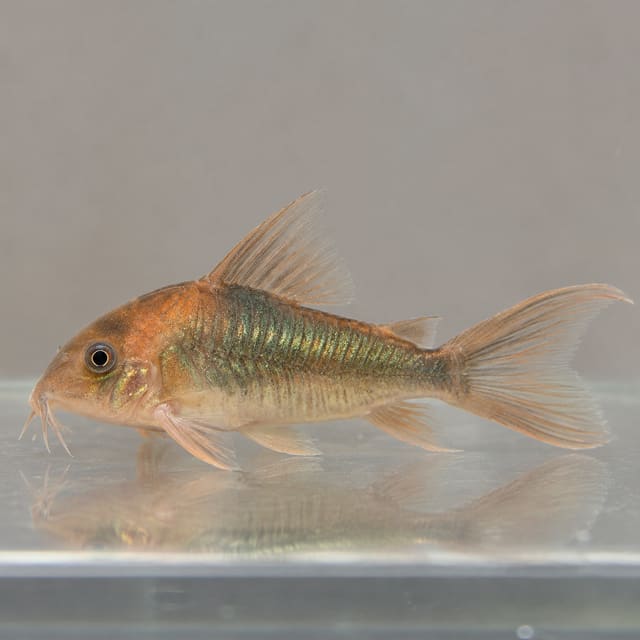
If you were looking for the Albino Bronze Cory (Osteogaster aenea), note that it is a separate species with its own care page. If you want the albino peppered cory specifically, check the scientific name, Hoplisoma paleatum, before you order.
| Quick facts | |
|---|---|
| Accepted name | Hoplisoma paleatum (Jenyns, 1842), albino form |
| Family | Callichthyidae (subfamily Corydoradinae) |
| Wild range of the species | Argentina, Brazil, Paraguay and Uruguay |
| Adult size | Up to 7.1 cm standard length (females); 6.6 cm in males |
| Temperature | 22–23°C (where FishBase and Seriously Fish overlap) |
| pH and hardness | pH 6.0–7.0, 5–12 dGH |
| Aquarium | About 70 litres, base around 61 × 38 cm |
| Group | Five or more |
| Sold as | One fish per quantity, in five size grades, unsexed |
This listing offers five size grades: 2–2.5 cm, 2.5–3 cm, 3–3.5 cm, over 3.5 cm, and XL. XL is a supplier grade, not a stated measurement in centimetres. Choose the size, then set the quantity to the number of fish you want; one quantity is one live albino peppered cory. Each size is its own option, so you can add more than one size to the same order if you like. The fish are not sexed, and the mix of males and females in any order is down to chance.
Those are the sizes the fish are when they leave us, not how big they will get. For adult size, FishBase records a maximum of 7.1 cm standard length for females and 6.6 cm for males. Seriously Fish gives 70 mm, and Wikipedia gives a typical adult range of about 5.9–7 cm. Standard length is measured from the snout to the base of the tail and leaves out the tail fin, so a fully grown female looks a little longer than that figure in the tank.
The sexes are easy enough to separate once the fish mature. Seriously Fish describes females as growing considerably bigger and much more rounded, especially in breeding condition, and Wikipedia adds that males are smaller with proportionally longer dorsal and pectoral fins.
The centimetre ranges and XL label describe the supply grades, rather than guaranteeing age or how much growing each fish has left to do. Young corys grow on what they can find on the floor, which means the feeding advice below matters even more for the smaller sizes. Offer foods small enough for them to manage, such as crushed sinking pellets and baby brine shrimp, and make sure the bigger fish in the tank are not taking it all.
Whichever size you choose, plan for at least five. FishBase recommends groups of five or more, and Seriously Fish says the species does best kept in groups. A bigger group is better still if the tank allows.
The albino form is bred in captivity, but its needs come from where the species lives in the wild. FishBase places the peppered cory in subtropical South America, in Argentina, Brazil and Uruguay. Wikipedia narrows that to the lower Paraná River basin in Paraguay, Argentina and Brazil and the coastal rivers of Brazil and Uruguay, and Seriously Fish describes the range as parts of southern Brazil, Uruguay, Paraguay and Argentina.
"Subtropical" is the key word. It explains why FishBase's temperature range for this species runs as low as 18°C, cooler than many tropical aquarium fish are kept. Darwin's specimens came from Buenos Aires, at the southern end of the range, in the 1830s.
Seriously Fish lists rivers, tributaries and standing waters, including pools and small lakes, among its habitats, and FishBase also records it in ponds. FishBase classes it as demersal, a fish that lives on or close to the bottom, and describes it as a facultative air-breather: it can take oxygen from gulped air when it needs to, as well as through its gills. Seriously Fish explains the mechanism. Peppered corys can absorb oxygen through the gut, which is why you will occasionally see one dart to the surface for a gulp of air and then drop straight back down.
In the wild it is an opportunistic omnivore. FishBase lists worms, crustaceans, insects and plant matter in its diet, and Seriously Fish describes worms, crustaceans, plant matter and other zoobenthos, the small animals living in and on the bottom. The IUCN Red List assessed the species as Least Concern on 15 October 2020, according to FishBase.
Seriously Fish adds that wild-caught peppered corys are occasionally available and are much more vividly coloured than captive-bred fish. That point concerns the normal form. The albino is an artificially selected aquarium strain, so the albinos you find in the hobby come from aquarium breeding.
The two main references give different ranges, and the gap between them is the most useful thing to understand about keeping this fish.
| Parameter | FishBase | Seriously Fish | Where they overlap |
|---|---|---|---|
| Temperature | 18–23°C | 22–26°C | 22–23°C |
| pH | 6.0–8.0 | 6.0–7.0 | 6.0–7.0 |
| Hardness | 5–19 dH | 0–12 dGH | 5–12 dGH |
Our care figures use that overlap: 22–23°C, pH 6.0–7.0 and 5–12 dGH. FishBase's temperature range runs as low as 18°C, which reflects the subtropical origin, while Seriously Fish allows up to 26°C. A heater set to the low 20s keeps the fish inside both. Treat the 26°C top of the Seriously Fish range as a ceiling for hot spells rather than a setting to aim for.
The cooler preference matters most when you plan the rest of the tank. Many popular tropical fish are kept warmer than 23°C, so check the temperature needs of every companion before you mix them. An aquarium for albino peppered corys suits fish that are happy in the low 20s.
FishBase's range reaches down to 18°C, so a short-lived drop below the low 20s during a power cut is a little less worrying for this species than for fish that need 26°C or more. It is still a stress best kept short. If the power goes off, wrap the tank in blankets or polystyrene sheets to hold the heat in, keep the lid closed and do not feed until the heater is running again. When the temperature recovers, check it has settled back at 22–23°C rather than overshooting.
FishBase gives hardness in dH and Seriously Fish in dGH; both are degrees of German hardness, so the numbers line up directly. Either way, know your own tap water figures before the fish arrive.
Seriously Fish suggests an aquarium with a base of at least 61 × 38 cm, about 70 litres, and FishBase's aquarium note gives a minimum length of 60 cm. For a bottom-dwelling fish, the floor is what counts. A tank with a broad base gives a group of corys room to forage across the sand; extra height adds little for them.
Seriously Fish recommends a sandy substrate, because these fish enjoy rooting about in it in search of food. Watching a group push their snouts into the sand, sift and move on is half the pleasure of keeping them, and fine, soft sand lets them do it freely. Choose a smooth sand and keep it clean.
Seriously Fish advises some cover in the form of rocks or bogwood, and plants add more. For an albino fish, shaded resting places make particular sense. Research on albinism in mammals records light sensitivity linked to the missing pigment. That work was not done on fish, so we would not claim it applies directly, but giving albino corys shaded spots under wood, broad leaves or floating plants costs nothing and lets each fish choose its own light level.
Because peppered corys gulp air from time to time, they need clear access to the surface. Do not let floating plants cover it completely, and leave a little air space between the water and the lid.
A sand floor only works if it stays fresh. Run a gravel siphon just over the surface at each water change, hovering rather than digging, to lift waste without pulling up the sand. Stir any compacted patches gently with your fingers now and then, and do not overfeed: uneaten food working its way into the sand soon fouls it. Fine sand also shows debris clearly, so you can see when it needs attention.
| Element | Suggestion |
|---|---|
| Base | 61 × 38 cm or larger (Seriously Fish); 60 cm minimum length (FishBase) |
| Volume | About 70 litres or more |
| Substrate | Fine, smooth sand |
| Décor | Rocks, bogwood and plants for cover and shade |
| Surface | Partly open for air gulps, with a small gap under the lid |
| Temperature | 22–23°C |
Peppered corys are easy to feed in one sense: Seriously Fish says they will eat virtually anything offered. The challenge is making sure enough of it reaches them. In a community tank the mid-water fish get first pick, and a cory left to live on what drifts down after everyone else has eaten will slowly lose condition.
FishBase gives this species a trophic level of 2.9, which fits an omnivore that takes both small animals and plant matter. Seriously Fish recommends regular meals of small live and frozen foods alongside the dry staple, so a good routine combines the two:
Practical tips:
| Day | Suggested meal |
|---|---|
| Most days | Sinking pellets or tablets |
| Two or three times a week | Frozen or live bloodworm, Daphnia or brine shrimp |
| Once or twice a week | A wafer with vegetable content |
Watching them feed is also your best daily health check. A group that gathers quickly when food lands, barbels working through the sand, is a group that is doing well.
Seriously Fish describes the peppered cory as a peaceful catfish for the smaller community aquarium that does best in groups, and Wikipedia calls it a common choice for community tanks because it is relatively hardy and peaceful. The albino behaves in exactly the same way. Expect a loose group working its way across the sand, rooting for food in the way Seriously Fish describes.
Even the males are easy-going. Wikipedia notes that during breeding they do not behave aggressively towards each other, nor try to monopolise females or spawning sites, which makes a mixed group straightforward to keep.
Two habits surprise new keepers. The first is the dash to the surface for a gulp of air, described above; occasional trips are normal. If the whole group is constantly heading up, though, check the temperature and the water quality, and make sure the surface is moving enough to keep the water well oxygenated.
The second is sound. Wikipedia reports that the peppered cory makes sounds by moving its pectoral fins. Males use them during courtship and to communicate, and both sexes, and juveniles, make them when distressed. So do not be surprised if a netted fish makes a faint sound.
Seriously Fish suggests tetras and dwarf cichlids as tank mates. The important filter is temperature: any companion has to be comfortable at 22–23°C, so check each species' own range before you buy. Beyond that, choose peaceful, small to medium fish that will not harass a slow bottom-dweller.
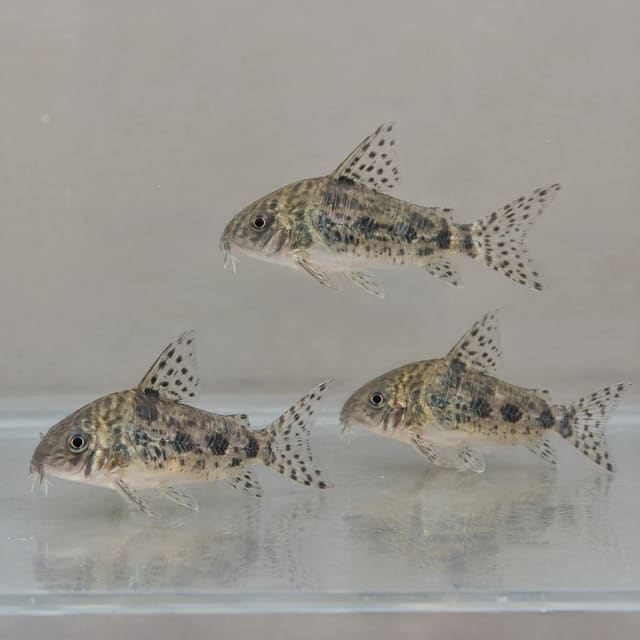
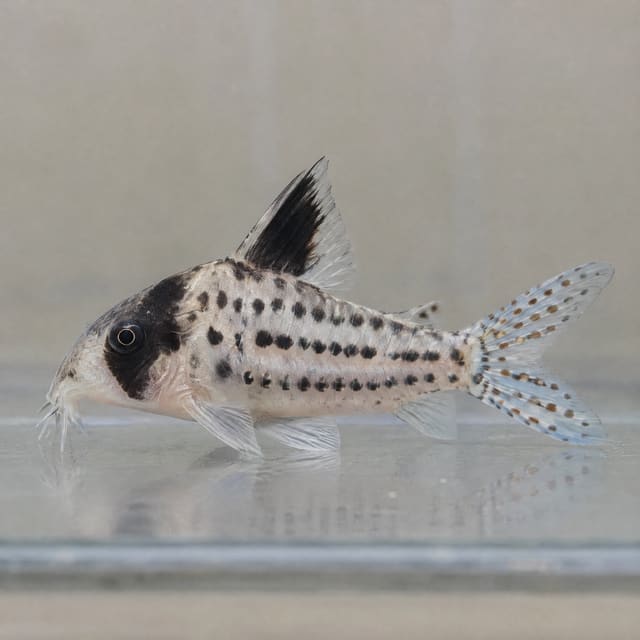
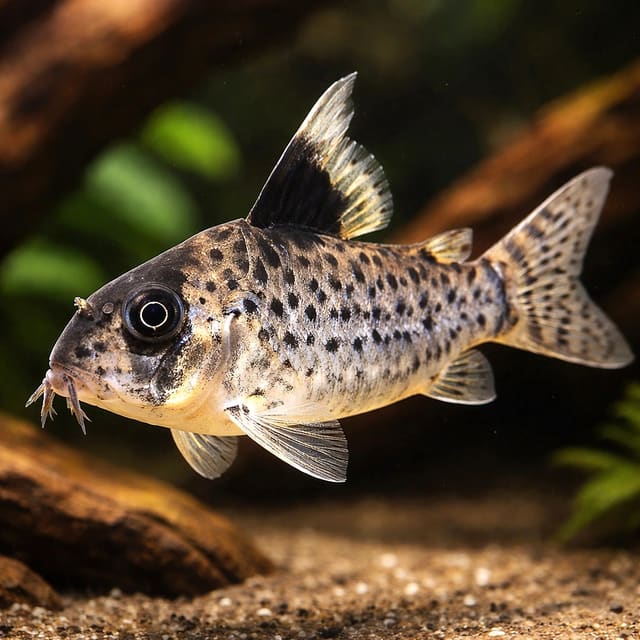
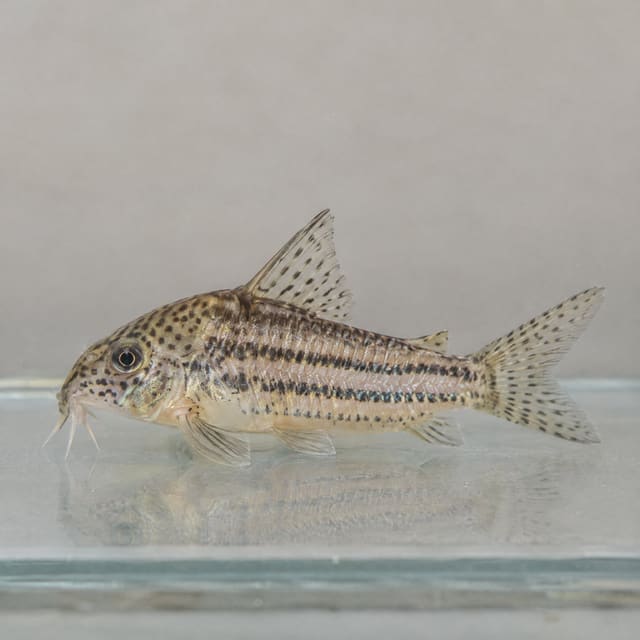
The most natural companions of all are more of the same species. The normally coloured peppered cory is the same fish, so albino and normal corys can be kept together as one mixed group; we also list a three-pack of normal Peppered Corydoras if you want to add colour to the shoal.
For a tank of about 70 litres with a 61 × 38 cm base, a sensible starting point is six albino peppered corys on the floor and a modest group of small, peaceful tetras that like the same 22–23°C water in the open water above. Add the fish in stages rather than all at once, so the filter bacteria can keep pace, and test ammonia and nitrite after each addition. Larger tanks give room for more corys or for a pair of dwarf cichlids, as Seriously Fish suggests.
Wikipedia describes the peppered cory as relatively hardy, and captive-bred fish are generally well used to aquarium life. That does not make them indestructible. Most problems come back to water quality, temperature or a substrate that is hard to keep clean.
None of the references we use describes albino peppered corys as blind. What the albinism literature does record, in mammals, is that the missing pigment changes how the eye develops, with light sensitivity and an under-developed centre of the retina among the effects. Those findings come from mammals, not catfish, so we would not assume the same for this fish. The sensible response is practical: give albino corys shade, avoid very bright lighting, and make sure food lands where they forage, as they spend their lives finding food in the sand.
On a pale albino body, colour changes such as redness show up clearly, which helps you spot trouble early.
Seriously Fish notes that corys carry spines in the leading rays of the pectoral fins. Use a soft, fine net and lift fish gently; where you can, guide them into a container instead of netting them out of the water.
If you already keep fish, a small quarantine tank for new arrivals is good practice. Give it a sand floor and some cover, run it at the same 22–23°C as the main tank, and watch the newcomers there for a few weeks before they join the established group.
| How often | What to check |
|---|---|
| Daily | Count the corys at feeding time and check the thermometer reads 22–23°C |
| Weekly | Partial water change, light siphon over the sand, test ammonia, nitrite and nitrate |
| Monthly | Check pH and GH against your target, rinse filter media in old tank water |
FishBase, Seriously Fish and Wikipedia do not give a recorded lifespan for this species, so we would rather not put a number on it. Stable, cool, clean water and good food give any fish its best chance of a long life.
Seriously Fish sets out a detailed breeding method for the peppered cory, and as the same species the albino form breeds the same way.
Wikipedia notes that the T-position courtship is shared with the other corydorine catfishes, and that males do not fight over females or spawning places.
Wikipedia's article on albinism notes that most forms of albinism follow a recessive pattern of inheritance. On that basis, two albino parents would normally be expected to produce albino young, while albino crossed with the normal form usually gives normally coloured offspring that carry the albino gene. If you want to keep the strain pure, breed albino to albino.
Many breeders either move the adults out after spawning or gently roll the eggs off the glass with a finger and move them to a separate container filled with water from the breeding tank, where they are easier to watch and keep clean. Keep that water clean and gently aerated, and remove any egg that turns white and fluffy so the fungus does not spread to the rest. Once the fry are free-swimming and looking for food, start with microworm, as Seriously Fish recommends, and move on to powdered foods and brine shrimp nauplii as they grow. Little and often is the rule, with small water changes to keep the rearing tank clean.
Before trying, plan where the young will go. A single spawn can produce many fry, and you will need space to grow them on until they reach a size you can rehome.
Have the aquarium ready before the parcel arrives: filter running, water tested and temperature matched to the low 20s. Please read our delivery and live-arrival information before ordering. Someone must be at the delivery address to receive live animals, and we email the confirmed delivery date and tracking.
The fish travel in oxygen-filled bags in insulated packaging, with heat packs when conditions call for them, and are carried by a tracked live-animal courier service.
If a fish arrives dead, dying or clearly compromised, email hello@tropicalfishco.co.uk on the day of delivery with your order number, the affected animals and quantities, and clear photos of the problem and packaging. A short unboxing video can help show the arrival condition, but it is optional and clear photos are accepted. Do not delay necessary animal care to film or while waiting for our reply. An approved claim offers a replacement with your next order or a refund for the affected fish, subject to the guarantee terms; a refund does not require another purchase.
Keep the lights low for the first week and watch breathing, appetite and behaviour. Once the new fish are moving about and foraging, offer a small meal of sinking food where they can find it.
No reviews for this item yet. Bought one? Honest reviews only, good or bad.
What customers say about ordering from us
Easy website plenty of info on fish your buying great to pick a time slot
TRACEY DURRANT · 7 Oct 2026
Got some lovely fish thank you
Kevin Mackie · 7 Oct 2026
Reviews of our shop, collected by Judge.me, an independent third-party review collector. Newest first.
Moved by UK carriers licensed to handle live animals
Hand-packed with oxygen bags, poly box, heat pack
Email photos the same day; an optional unboxing video helps us review problems faster — claim terms apply
Klarna & PayPal Pay in 3 at checkout




22–26°C · pH 6–7.8 · 75L