Easy
Bandit Cory (Hoplisoma melini)
22–26°C · pH 5.5–7
£20.99

Sands' Cory (Hoplisoma davidsandsi, formerly Corydoras davidsandsi) is a peaceful armoured catfish from the Rio Unini in Brazil's Rio Negro basin. Each fish is sent at about 3-4 cm. Keep six or more on fine sand in soft, acidic water at 20-28 °C and feed them their own sinking food.
Hoplisoma davidsandsi
Shoaling fish: kept in a group they feel safer, stay calmer and show their best colour.
Sands' Cory (Hoplisoma davidsandsi, formerly Corydoras davidsandsi) is a peaceful armoured catfish from the Rio Unini in Brazil's Rio Negro basin. Each fish is sent at about 3-4 cm. Keep six or more on fine sand in soft, acidic water at 20-28 °C and feed them their own sinking food.
Maintain these water conditions for optimal health and vibrant colors
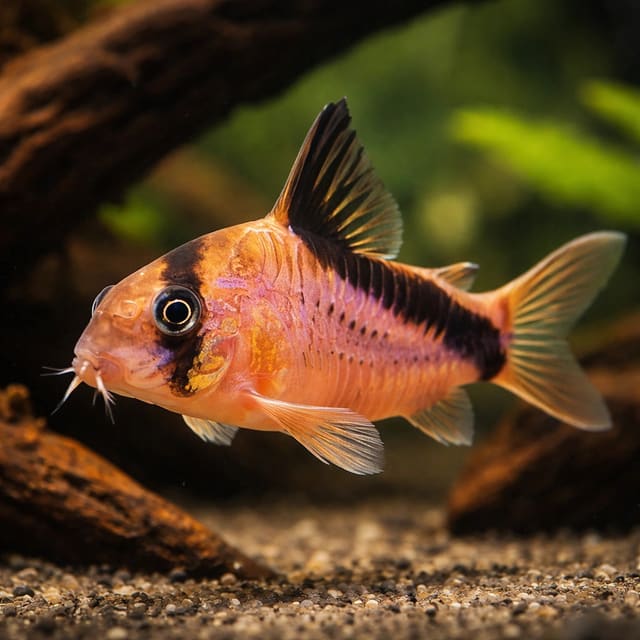
Sands' Cory is a small armoured catfish from a single tributary system of Brazil's Rio Negro. It is peaceful and sociable, and a settled group working its way across a patch of open sand is one of the most watchable sights a soft-water aquarium can give you. The fish has a gold-washed head and shoulders, a black mask through the eye and a dark band that runs from the dorsal fin back along the top of the body towards the tail. Its current scientific name is Hoplisoma davidsandsi. For most of its time in the hobby it was sold as Corydoras davidsandsi, and that is still the name you will find in older books, forum threads and shop tanks.
Every unit you add to the basket is one fish, sent at a dispatch size of roughly 3 to 4 cm. At that size it is a young fish with some growing still to do, not a finished adult. This is a shoaling catfish, so you decide how many to buy, and our honest advice is to buy a group rather than a pair. Six is a good starting number. More is better if the tank has the floor space to carry them.
It suits a keeper with a mature soft-water aquarium who enjoys watching natural behaviour rather than ticking a box marked "bottom cleaner". It is a poor fit for a hard-water tank set up for livebearers or African cichlids, and it is wasted in a tank of large, fast fish that clear every pellet before it reaches the sand. If you are building a Rio Negro-style tank around wood, leaves and soft acidic water, this is exactly the sort of fish that belongs on the floor of it.
| Quick fact | Sands' Cory |
|---|---|
| Scientific name | Hoplisoma davidsandsi (Black, 1987) |
| Family | Callichthyidae, the armoured catfishes |
| Wild range | Rio Unini tributary system, lower Rio Negro basin, Brazil |
| Maximum size | 4.4 cm standard length (FishBase); up to 6 cm standard length (Seriously Fish) |
| Size when sent | About 3 to 4 cm |
| Temperature | 20 to 28 °C |
| pH | 5.0 to 7.0 |
| Hardness | 1 to 5 dGH |
| Tank | Base of at least 90 x 30 cm, around 81 litres |
| Group | Six or more |
| Diet | Omnivorous bottom forager that needs its own sinking food |
| Conservation | Least Concern on the IUCN Red List (assessed 2018) |
The species was described by B. Black in 1987 and named in honour of David Sands, the English aquarist and author. For decades it sat in Corydoras, the old catch-all genus for cory catfish. A phylogenomic study published in 2025 resurrected Hoplisoma as a valid genus, and this fish moved across with many other familiar corys. Hoplisoma combines Greek words for armour and body, a reference to the bony plates along the flanks. Nothing about the animal changed when the label did, so sensible care advice written under the old name still applies.
Start with the outline. Sands' Cory has the compact, high-backed cory shape, a body that sits low over the substrate and a fairly short, rounded snout with small barbels around the mouth. The flanks are armoured with bony plates, or scutes, which is where the family gets its armoured-catfish name. Each pectoral fin is led by a stiff spine, and that matters later when you come to net the fish.
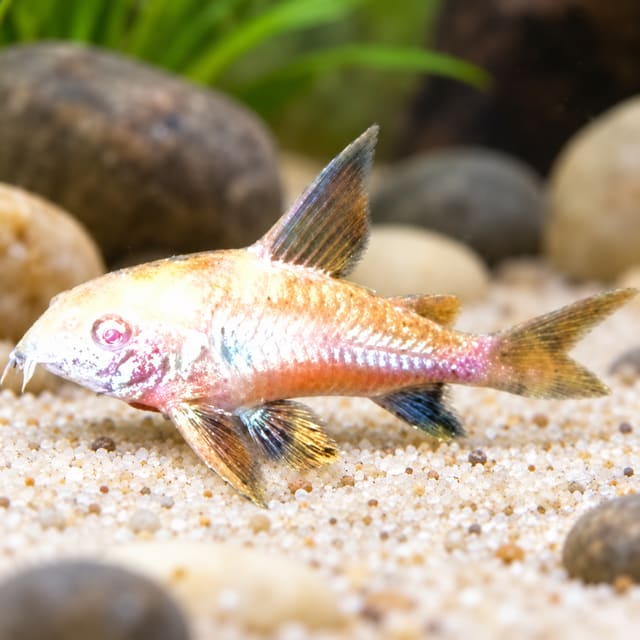
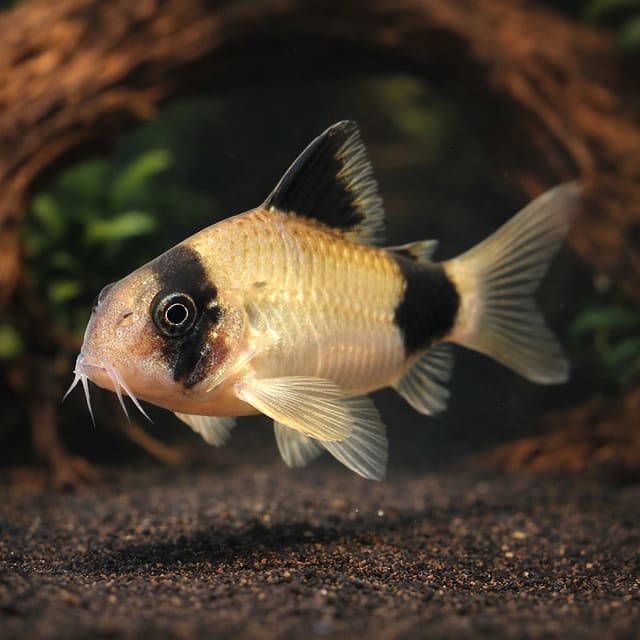
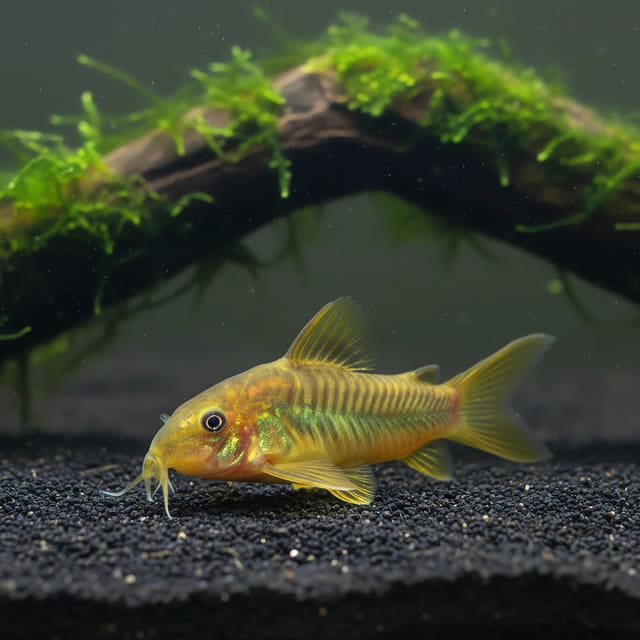
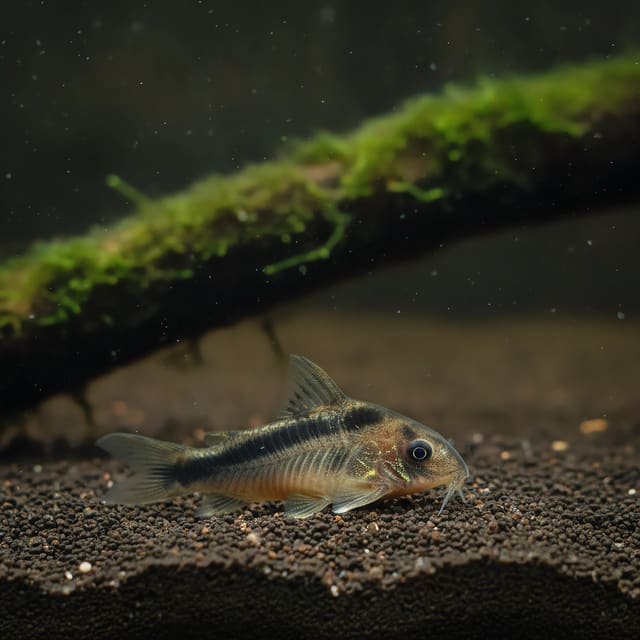
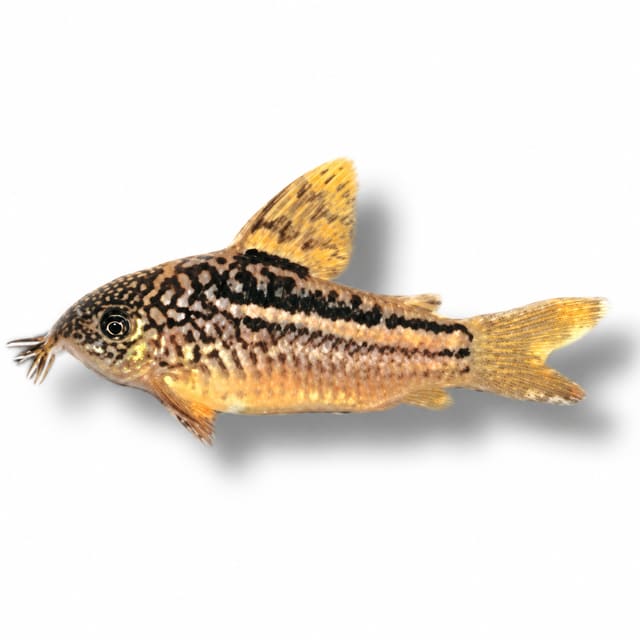
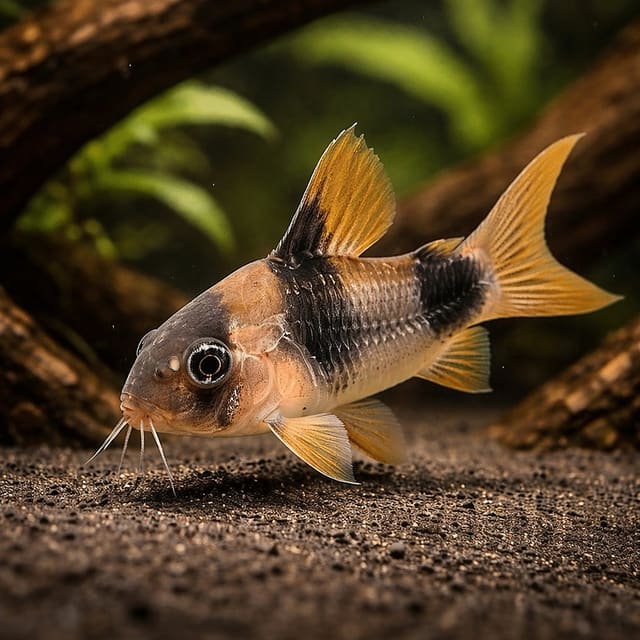
In the photographs on this page the pattern reads clearly. A black stripe runs down through the eye like a mask. Behind it the head and shoulders carry a warm orange-gold wash. Seriously Fish describes this as a pale orange area between the dark facial stripe and the dorsal bar, and it is one of the main features that separates this species from its closest look-alike. From the base of the dorsal fin a dark band runs back along the upper body, high on the back rather than through the middle of the side, and finishes on the caudal peduncle, the narrow stem just in front of the tail. Above the peduncle that bar splits in two. The lower flanks are a pale silvery cream with a soft gold sheen, and the fins are clear to faintly yellow, with the black of the bar running up into the front of the dorsal fin.
Give new fish a little time before you judge them on colour. A cory that has just travelled and is settling into strange water rarely looks its best, so judge the orange on the head once the fish has settled and is feeding well.
Several catfishes from the Rio Negro region wear a similar oblique dark bar under the dorsal fin. Seriously Fish lists Hoplisoma adolfoi, H. duplicareum, H. melini, Corydoras serratus and Brochis imitator. Wikipedia notes that these patterned Rio Negro catfishes, together with H. burgessi, often form large mixed schools in the wild and may even interbreed. Brochis imitator takes its name from that likeness: imitator means mimic, a nod to its resemblance to H. adolfoi.
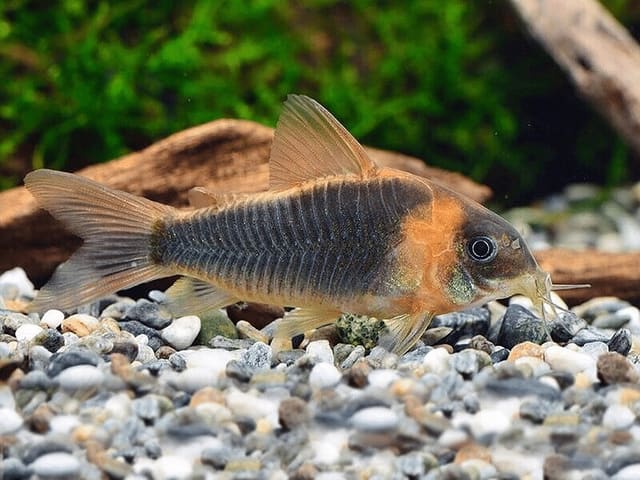
The look-alike Seriously Fish singles out is the Bandit Cory, Hoplisoma melini. The two share the split in the dark bar above the caudal peduncle, which Seriously Fish says no other species in the group has. The difference to look for is on the head and flanks. Sands' Cory shows that pale orange patch between the facial stripe and the dorsal bar and has no extra dark markings on the sides. If you want to compare the two properly, our Bandit Cory (Hoplisoma melini) listing sits alongside this one. For the wider group, you can also look at Adolfo's Cory and the Duplicate Cory, both of which carry a dark dorsal bar of their own. These links are there for identification. They are not a recommendation to mix species.
FishBase gives a maximum of 4.4 cm standard length for males and unsexed fish. Seriously Fish gives a larger figure of 60 mm standard length. Standard length is measured from the tip of the snout to the end of the body and leaves out the tail fin, so a fish on either figure looks a little longer in the tank than the number suggests. Plan for a small catfish that finishes somewhere in that bracket, with the tail on top.
Females grow larger than males. Once mature, Seriously Fish describes them as noticeably rounder and higher-bodied, which is the easiest way to tell the sexes apart when you look down on a group feeding. Fish sent at 3 to 4 cm are still growing, so those differences may not be obvious for a while. This listing does not sell sexed fish.
Sands' Cory comes from a small part of South America. Its type locality is the Rio Unini in Brazil, and Seriously Fish describes it as endemic to the Rio Unini tributary system in the lower Rio Negro basin. FishBase records its distribution more broadly as the Negro River basin. Either way it is a Rio Negro fish, and that one fact tells you a great deal about the water it expects.
Seriously Fish describes the habitat as blackwater tributaries and areas of flooded forest. Water of that kind is stained dark with organic chemicals, holds very little detectable hardness, has low conductivity and runs acidic. In plain terms it is soft, tea-coloured and nearly free of dissolved minerals. That is the opposite of what comes out of the tap in much of the UK, and it is the main reason this fish deserves a little more planning than the hardiest corys.
FishBase lists the species as freshwater, demersal and tropical. Demersal simply means it lives on or near the bottom, which matches what you will see in a tank: the fish spend their time on and around the substrate. FishBase also records it as a facultative air-breather. It breathes through its gills as normal, but it can take a gulp of air at the surface when it chooses. In an aquarium you will see the odd fish shoot up, take a breath and drop back down. That is normal behaviour, not a sign of trouble, as long as it is occasional rather than constant.
The note on mixed schools matters too. Wikipedia describes the similarly patterned Rio Negro catfishes as often forming large mixed schools in the wild. It is a reminder that this is a group-living animal through and through. A single Sands' Cory in a tank of strangers is not living the life it is built for.
On conservation, FishBase shows the species as Least Concern on the IUCN Red List, assessed in November 2018. That assessment is a snapshot of the wild population and nothing more. It does not make the fish any less deserving of a properly set-up tank.
You do not need to recreate a river to keep this species well. What you are aiming for is the spirit of it: soft, slightly acidic water, a sandy floor, some wood and leaf litter, shaded corners and steady, clean conditions. Get those right and the fish will show you the behaviour that makes people fall for corys in the first place.
Seriously Fish recommends an aquarium with a base of at least 90 x 30 cm, which works out at around 81 litres. That is the starting point for a group, not a target to squeeze a shoal into. With a bottom-dwelling catfish, floor area is what counts. A long, shallow tank gives a group far more usable space than a tall one of the same volume, because the fish live in the bottom few centimetres and rarely use the upper half except for the occasional trip to the surface.
Seriously Fish says fine sand is preferred, and that rounded gravel is acceptable if it is kept scrupulously clean. Sand is the better choice for two reasons. The fish forage by pushing their snouts and barbels into the substrate and sifting it, and soft sand lets them do that naturally. Sand also keeps waste on the surface where you can see it and siphon it off, instead of letting it sink into gaps between stones. Avoid sharp or angular gravel completely. A thin, even layer of sand is easier to keep clean than a deep bed, and it gives you a tidy feeding area you can actually watch.
Seriously Fish recommends some cover for security, and a group that feels safe will spend more time out in the open. A good layout puts the cover at the back and sides and leaves open ground at the front:
Seriously Fish suggests filter turnover of four to five times the tank volume per hour, which is 325 to 405 litres per hour for an 81-litre tank. Aim for clean, well-oxygenated water with gentle to moderate movement rather than a powerful current. A sponge filter, an internal filter or a small external all work if they are maintained. Make sure there is some surface movement for gas exchange, because good oxygen levels are part of keeping corys comfortable.
Because the fish gulp air from time to time, keep a small gap between the water and the lid and do not let floating plants carpet the whole surface. A partial cover of floaters is useful for softening the light. A solid mat that leaves no clear water at the top is not.
Seriously Fish suggests a 50 to 75 W heater for a tank of the recommended size. A thermostatic heater with a separate thermometer is the simplest way to keep temperature steady. Lighting can be moderate. In a planted tank, shade from wood and floating plants gives the corys darker areas to rest in while still letting you enjoy them at the front.
This is where Sands' Cory differs most from the hardy corys many people start with. It comes from soft, acidic blackwater, and the ranges quoted by Seriously Fish reflect that.
| Parameter | Range | Notes |
|---|---|---|
| Temperature | 20 to 28 °C | Set the heater in the middle of the range so there is room either side |
| pH | 5.0 to 7.0 | Slightly acidic to neutral; avoid alkaline water |
| General hardness | 1 to 5 dGH | Soft water; very hard tap water needs blending |
UK tap water varies a great deal from one area to the next. Some regions have naturally soft water that suits this fish with little or no adjustment. Many others have hard, alkaline water well outside the range above. Test your general hardness (GH), carbonate hardness (KH) and pH before you buy, not after the fish arrive. A simple liquid test kit is enough.
If your tap water is hard, the usual approach is to blend it with reverse osmosis water until the GH sits in the right range. Make up water change water the same way every time so the fish see the same conditions week after week. Wood and leaf litter will soften the look of the water and can nudge the pH down a little, but they will not turn hard water soft on their own.
Fish cope far better with steady conditions inside a sensible range than with water that swings between a perfect reading and a poor one. Make changes gradually, over days rather than hours, and never try to correct pH with a large dose of chemicals in a tank that already holds fish. If your water sits comfortably within the ranges above and stays there, leave it alone.
A fully cycled filter is essential before any fish go in. After that, regular partial water changes keep nitrate down and the water fresh. Use a dechlorinator, match the new water's temperature to the tank, and siphon the sand surface as you go, because waste lying on the bottom is waste your corys are sifting through all day.
One thing worth knowing: Seriously Fish notes that a large water change with cooler water, together with more oxygen and flow, is a common trigger for spawning. If you do a big change and a day later find small eggs stuck to the glass, that is why. It is a good sign, not a problem.
The quoted range of 20 to 28 °C is wide, which gives you some margin in a warm British summer or a cold spell. There is no benefit in pushing either end. Warm water holds less oxygen, so if the room heats up in summer, increase surface movement and keep an eye on the group's breathing.
Seriously Fish describes Sands' Cory as a foraging omnivore. In practice that means a fish that spends much of the day picking through the substrate for small edible items, and which will take a wide range of foods in the aquarium. It also means a fish that needs to be fed on purpose.
The oldest myth about corys is that they live on what other fish drop. They do not. Seriously Fish is clear that they should not be expected to survive on leftovers, and a group left to scavenge in a busy community tank will slowly go thin. Plan their food as carefully as you plan anyone else's in the tank.
Seriously Fish lists sinking dried foods, bloodworm and Tubifex among the foods taken, and recommends a varied diet to keep the fish in good condition. A sensible week looks like this:
Drop food over the open sand at the front of the tank, where the group can find it and you can see who is eating. If the midwater fish are fast and greedy, feed them at the surface first and add the corys' food once the rush has passed, or feed the corys a little after the main lights go down. Give enough for the group to clear in a reasonable time and lift out anything still lying on the sand an hour or so later, so it never starts to rot.
Watch the bellies. A well-fed Sands' Cory looks gently rounded underneath when you see it from the side. A pinched or hollow belly means a fish is not getting its share, often because faster tank mates are taking the food first. Mature females will look fuller than males anyway, so compare like with like and look for change over time rather than one thin day.
New arrivals can be shy about feeding for the first day or two. Offer a small amount of sinking food once the lights are low on the first evening, and do not worry if not much goes on the first night.
Seriously Fish describes Sands' Cory as peaceful and gregarious, and recommends a minimum group of four to six. We suggest six or more as the place to start. A proper group can forage across the sand together, the way this gregarious species is built to live. A single fish or a pair misses that company of its own kind.
Expect the group to spend most of its time on or near the bottom, working through the sand for food. Each fish will make the occasional dash to the surface for a breath of air and drop straight back down. That is normal for a facultative air-breather.
In the wild, Sands' Cory is one of several similarly patterned Rio Negro catfishes that often form mixed schools. That does not mean a few of each makes a group in the aquarium. Buy a proper group of Sands' Cory. If you want other corys too, give each species its own group and make sure all of them are suited to the same soft, acidic conditions.
Seriously Fish rates the species as suitable for community tanks. The best companions are fish that share its taste for soft, slightly acidic water and that live in the middle and upper levels without bothering the bottom:
A busy shoal of small fish above the substrate also helps the corys feel secure, so the two parts of the tank support each other.
A healthy Sands' Cory is easy to read once you know what normal looks like. It forages with its barbels down on the sand, swims with its fins open, has a gently rounded belly and breathes at a steady, unhurried rate. Checking the group at feeding time each day is the simplest health routine you can have.
When you see any of these, test the water first. Ammonia, nitrite, a sudden change in temperature and low oxygen are quick to check and quick to put right, so rule them out before anything else. With barbel damage in particular, look at the substrate: is it clean, is it smooth, and is waste lying on it between water changes?
Seriously Fish warns that the pectoral-fin spines of these catfishes can pierce skin painfully, and that secretions from glands at the base of each spine may be mildly toxic or venomous. Do not hold a cory in your bare hand. When you need to move one, guide it into a fine net or, better, into a small container underwater, so you never need to touch it. If you are pricked, clean the wound and treat it as you would any other puncture.
A separate quarantine tank for new fish is good practice for any established aquarium. It gives the new arrivals a calm place to settle and feed, and it gives you time to watch for problems before they reach your other fish. If you add Sands' Cory straight into a display tank, do it into a mature system with clean sand and steady water, and keep a close eye on the group for the first couple of weeks.
Most long-term problems come back to the same three things: water quality, substrate hygiene and food. Keep the water soft, clean and stable, keep the sand clean, and make sure every fish gets fed. A group kept that way should be a fixture in the tank, not a worry.
Sands' Cory is not sold as a breeding project, but a settled group in good condition may spawn on its own, and Seriously Fish gives a clear outline of what to expect.
Seriously Fish recommends a ratio of two males to each female. This listing does not sell sexed fish, so the practical route is to buy a group and let the fish mature. As they grow, the females become larger, rounder and higher-bodied than the males, and once you can see that you can judge the balance of your group.
The trigger described by Seriously Fish is a large water change of 50 to 70 percent with cooler water, combined with increased oxygen and flow.
Eggs are placed on the aquarium glass or on vegetation, and Seriously Fish notes that spawning mops can be offered for the same purpose. The eggs take three to four days to hatch. If you want to raise as many young as possible, lift the eggs or the mop into a separate container with water from the main tank, so they are not lost in a busy community setting.
Seriously Fish suggests microworm and Artemia nauplii, newly hatched brine shrimp, as first foods. It also recommends rearing the fry over a thin layer of sand rather than in a bare-bottomed tank. Keep the rearing water clean with small, frequent water changes, and feed little and often.
If your group spawns without any help, take it as a sign that the conditions you have built are right.
Have the aquarium ready before you order. That means a filter already running and cycled, water tested and inside the ranges above, and the temperature set and steady. Someone needs to be at the delivery address to receive the parcel, because it contains live animals. Please read our delivery and live-arrival information before ordering. Your confirmed delivery date and tracking details are sent by email.
Your fish travel in oxygen-filled bags inside insulated packaging, with heat packs when the weather calls for them, carried by a tracked courier licensed to carry live animals.
Start a continuous video before you open the parcel, while it is still sealed. Keep filming in the same take as you open it and show the fish in the still-sealed bag. If a fish arrives dead, dying or clearly compromised, email hello@tropicalfishco.co.uk on the day of delivery with your order number and that video. Photos alone do not meet the policy. The resolution is a replacement with your next order or a refund for the affected fish, subject to the guarantee terms.
Keep the lights low for the rest of the first day. New Sands' Corys may hide among wood and plants at first. Offer a small amount of sinking food that evening and remove what is not eaten. Over the first week, watch breathing, appetite and behaviour: steady breathing, interest in food and the group starting to forage together across the sand are the signs you want. Hold off on major changes to the tank during this time, and keep water quality steady.
The facts on this page come from the sources below. They are worth reading if you want to go further.
No reviews for this item yet. Bought one? Honest reviews only, good or bad.
What customers say about ordering from us
I have a small group of long finned mountain minnows. So was delighted to be able to order ten of this variety to increase the genetics in my tank . The ones I recieved are healthy but it’s to early to give a verdict on wether they are of a long finned type since they are small currently.
Gordon Walker · 23 Sept 2026
100% success travel and "installation". Pleased with quality of purchase. The Siamese fighter a bit "shy" so have not yet seen him at his best yet but looking good. Happy customer. GG
George E Garratt · 21 Sept 2026
Reviews of our shop, collected by Judge.me, an independent third-party review collector. Newest first.