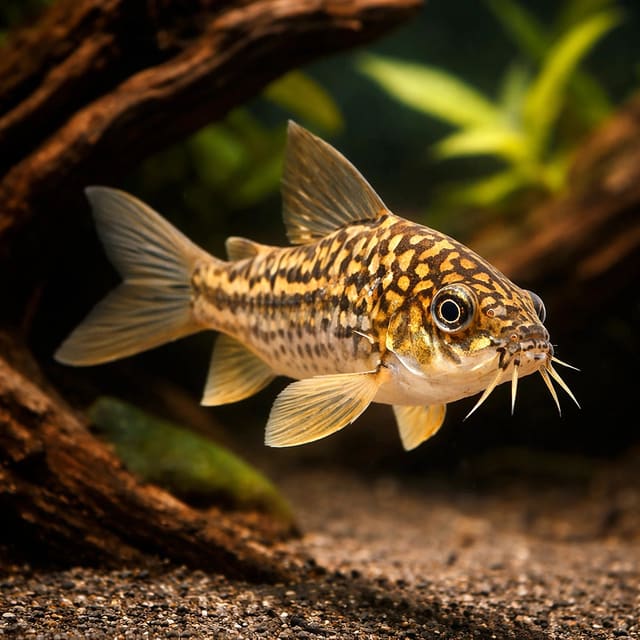
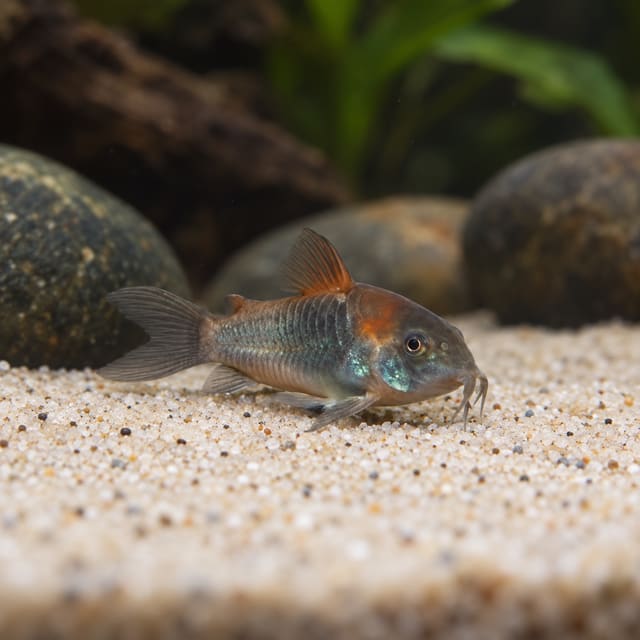
Albino Bronze Cory (Osteogaster aenea)
22–27°C · pH 6–8 · 72L
£2.99

A peaceful Black Band Cory for mature community aquariums, best kept in groups over soft sand with calm tank mates and stable, clean water.
Adult size is the maximum length this species reaches at full maturity (scientific sources). The livestock you receive will be younger and smaller — pick a size above for the actual shipping size. Product-photo provenance and any image-specific limitations are stated on the listing.
Corydoras zygatus
Shoaling fish: kept in a group they feel safer, stay calmer and show their best colour.
Confirm your email, then we’ll send an availability message for this exact item if it returns within 180 days.
This request is only for this product—no newsletter or other promotions. A mail-provider retry may very rarely duplicate the same availability message. Unconfirmed addresses are removed after 48 hours. See our privacy policy.
A peaceful Black Band Cory for mature community aquariums, best kept in groups over soft sand with calm tank mates and stable, clean water.
Adult size is the maximum length this species reaches at full maturity (scientific sources). The livestock you receive will be younger and smaller — pick a size above for the actual shipping size. Product-photo provenance and any image-specific limitations are stated on the listing.
Identify the exact cory catfish before choosing care. Our starting policy for many common medium species is six compatible conspecifics, a mature 60 x 30 cm aquarium of about 60 litres, smooth fine sand and measured species-appropriate water.
Maintain these water conditions for optimal health and vibrant colors
The Black Band Cory is a peaceful, social armoured catfish for planted community aquariums with a soft sand base. Customers and suppliers usually know this fish as Corydoras zygatus, while newer reference sources may place it in Osteogaster.
The useful information from the existing page has been preserved and expanded: black band patterning, western Amazon origin, easy community temperament, group care, soft substrate, sinking foods, breeding notes, acclimation and delivery support. The page now reads as a practical care guide first, with search terms appearing only where they help customers identify the fish.
| Common names | Black Band Cory, Black Band Corydoras, Black Band Catfish |
|---|---|
| Trade scientific name | Corydoras zygatus |
| Current reference name | Osteogaster zygata or Osteogaster zygatus in recent trade references |
| Adult size | Usually around 5-6 cm; some aquarium references list mature fish up to about 7 cm |
| Temperament | Peaceful, social and suitable for calm community aquariums |
| Best kept | In a group of at least 5, ideally 6 or more where space allows |
| Tank level | Bottom level, with occasional surface air gulps |
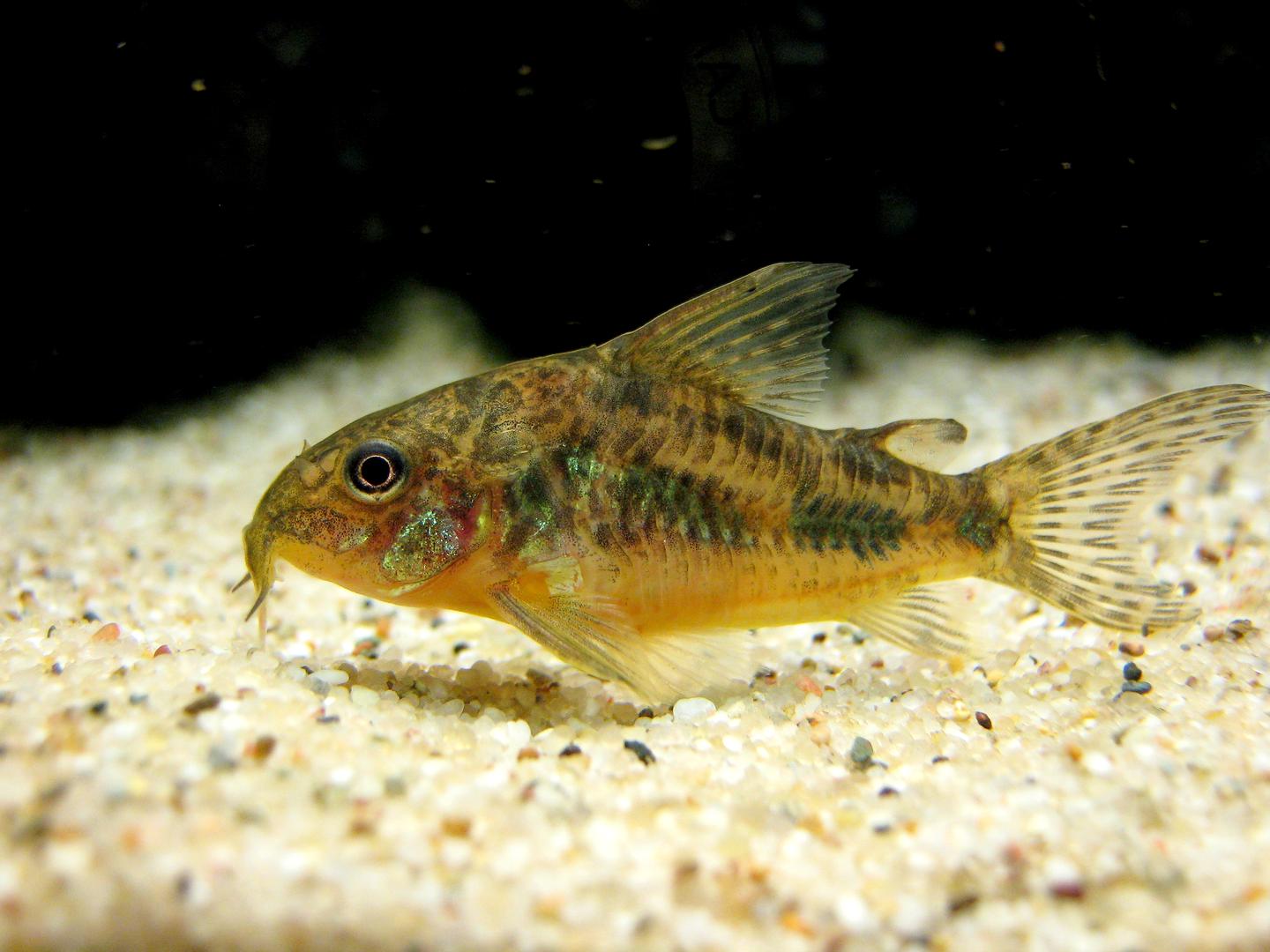
Black Band Cory has the compact, armoured body shape that makes Corydoras-type catfish so popular. The base colour is pale silver, cream or light beige, crossed by a darker band through the body and dorsal area. Healthy fish should show clear eyes, smooth barbels, clean fin edges and a rounded body profile without swelling.
The pattern is elegant rather than loud. It shows best over pale sand, dark wood, leaf litter and green planting, where the group can be seen foraging in the open. Because the species can be confused with similar Corydoras and Osteogaster forms, especially O. rabauti, this page uses careful identification language instead of repeating one sales phrase.
The aquarium trade still commonly uses Corydoras zygatus. FishBase currently lists the fish as Osteogaster zygata, and some UK care references use Osteogaster zygatus while noting the older Corydoras name as a synonym. That naming difference is why the product title keeps the familiar Corydoras wording but the care text also mentions Osteogaster.
This matters for search and for accuracy. A customer may search for Black Band Cory, Black Banded Catfish, Corydoras zygatus or Osteogaster zygata and still mean the same fish. The content now includes those names naturally, once they are useful, rather than pushing them into every paragraph.
Reference sources place Black Band Cory in the western Amazon basin, with trade care notes pointing to Ecuador and Peru. In nature, related Corydoras-type catfish use the bottom layer of tributaries, margins and slower areas where fine sand, leaf litter, roots and submerged branches create shelter and feeding surfaces.
FishBase gives a broad freshwater range of pH 6.0-8.0, hardness 2-25 dH and 22-25C. Captive-raised stock can adapt to a range of UK tap-water conditions when water quality is stable, but that should not be read as permission for sudden swings. Mature filtration, regular maintenance and clean substrate are more important than chasing a perfect number.
| Minimum aquarium | 60 litres for a modest group; 80 litres or more gives better floor space |
|---|---|
| Substrate | Soft sand is strongly recommended to protect barbels and support natural sifting |
| Temperature | 22-25C for a stable tropical community layout |
| pH | 6.0-8.0, with stable mature water preferred |
| Hardness | 2-25 dH; soft to moderate water is ideal for most planted community tanks |
| Decor | Open sand, driftwood, smooth stones, live plants, leaf litter and shaded resting areas |
| Flow | Gentle to moderate flow with good oxygenation and no dirty dead spots |
Avoid sharp gravel and rough decor. Corydoras-type catfish feed by searching the surface of the substrate with their barbels, and coarse gravel can trap waste around the mouth. A clean sand foreground gives the group room to sift, while planting and wood help shy fish settle after arrival.
Black Band Cory is not a loner. A single fish may survive, but it rarely shows the confident behaviour customers expect. Keep a group so the fish can rest together, search the sand together and move around the aquarium without constantly hiding. Groups also spread attention from tank mates and reduce stress after transport.
Occasional dashes to the surface are normal. Corydoras-type catfish can take atmospheric air, so leave a small clear gap between the water surface and any cover glass. If the whole group is repeatedly gasping or hanging near the top, check oxygen, temperature, ammonia, nitrite and flow immediately.
Offer a varied sinking diet. Good staples include quality catfish pellets, soft sinking granules and small wafers. Rotate in frozen foods such as bloodworm, brine shrimp, daphnia and mosquito larvae, especially when conditioning the group. These fish are not aquarium cleaners; they need their own food after mid-water fish have been accounted for.
Feed small portions that reach the sand, then remove obvious leftovers. In a mixed community, target feeding with a turkey baster or feeding tube can help make sure the Cory group receives enough food without overfeeding the whole tank.
| Good choices | Small tetras, rasboras, pencilfish, hatchetfish, peaceful livebearers, small gourami and calm dwarf cichlids |
|---|---|
| Other bottom fish | Other peaceful Corydoras-type catfish can work if there is enough floor space and food |
| Use caution | Dwarf shrimp may be safe with adults, but tiny shrimplets can be eaten opportunistically |
| Avoid | Large predators, aggressive cichlids, fin nippers, very boisterous loaches and territorial bottom dwellers |
The best companions are calm fish that enjoy similar water and do not compete aggressively for sinking food. Avoid keeping Black Band Cory with species that guard caves, chase bottom dwellers or make feeding at the substrate stressful.
Breeding follows the general Corydoras pattern. Condition adults with excellent water quality and protein-rich frozen or live foods, then use cool, clean water changes to mimic seasonal triggers. Pairs may adopt the classic T-position, with eggs placed on glass, plants, decor or other smooth surfaces.
Adults may eat eggs, so breeders often move eggs or adults after spawning. Eggs usually need clean, well-oxygenated water, and newly hatched fry start on very fine first foods before moving to microworms, newly hatched brine shrimp and powdered foods. This is not the reason most customers choose the fish, but the behaviour is rewarding in a mature species aquarium.
On arrival, keep the lights low and float the sealed bag for temperature matching before gradually mixing small amounts of aquarium water. Net the fish into the aquarium rather than pouring bag water into the tank. Give the group a quiet first day and offer food only once they are settled.
We ship live fish with insulated packing and weather-aware courier planning. Your order is covered by our Live Arrival Guarantee when the delivery instructions are followed, and first-time customers can use the 10% welcome discount shown on site. Keep the page bookmarked for care details after your fish arrive.
Black Band Cory is best for aquarists who want a peaceful bottom-level group for a mature, sand-bottomed aquarium. It is a strong choice for planted community tanks, Amazon-inspired layouts and mixed Corydoras displays where the keeper can provide clean substrate, steady water and proper sinking foods.
No reviews for this item yet. Bought one? Honest reviews only, good or bad.
What customers say about ordering from us
I have a small group of long finned mountain minnows. So was delighted to be able to order ten of this variety to increase the genetics in my tank . The ones I recieved are healthy but it’s to early to give a verdict on wether they are of a long finned type since they are small currently.
Gordon Walker · 23 Sept 2026
100% success travel and "installation". Pleased with quality of purchase. The Siamese fighter a bit "shy" so have not yet seen him at his best yet but looking good. Happy customer. GG
George E Garratt · 21 Sept 2026
Reviews of our shop, collected by Judge.me, an independent third-party review collector. Newest first.