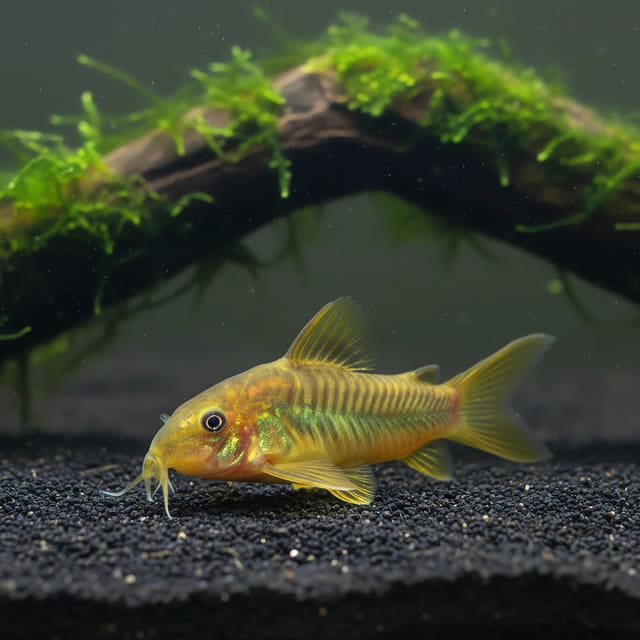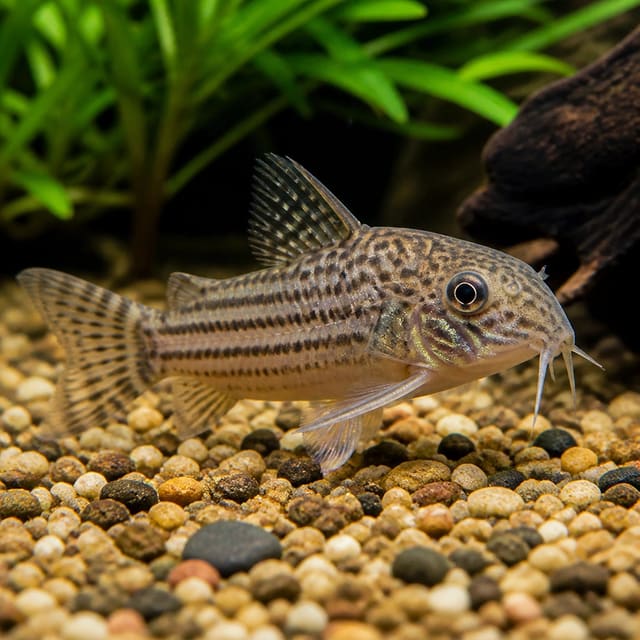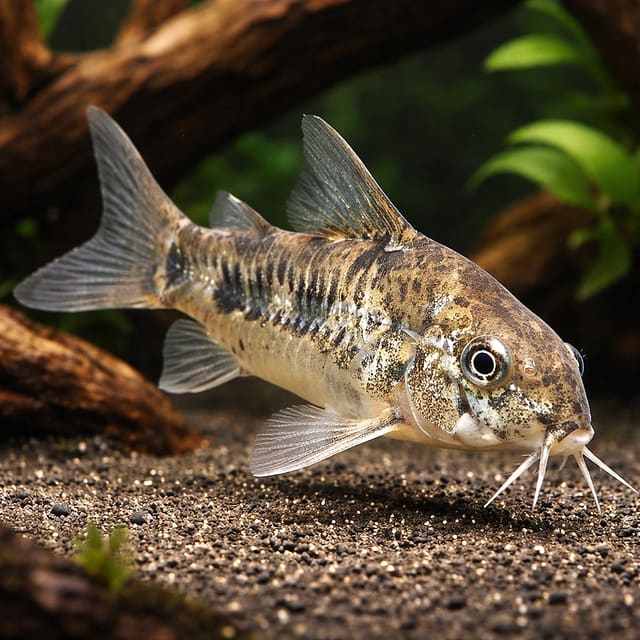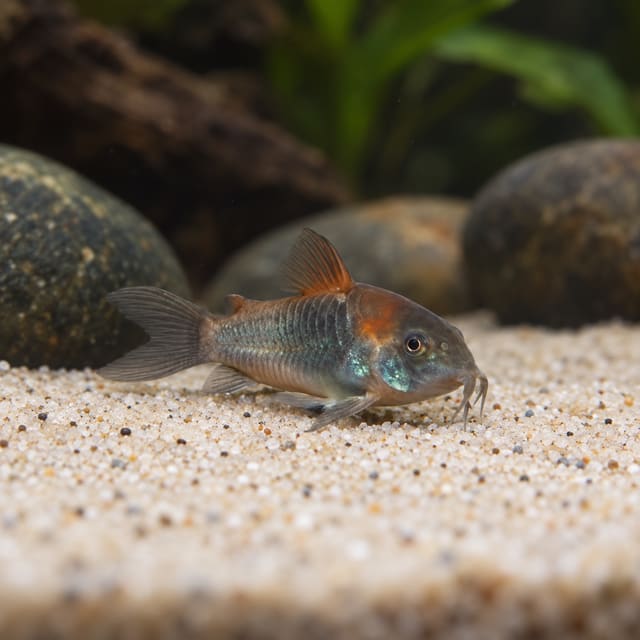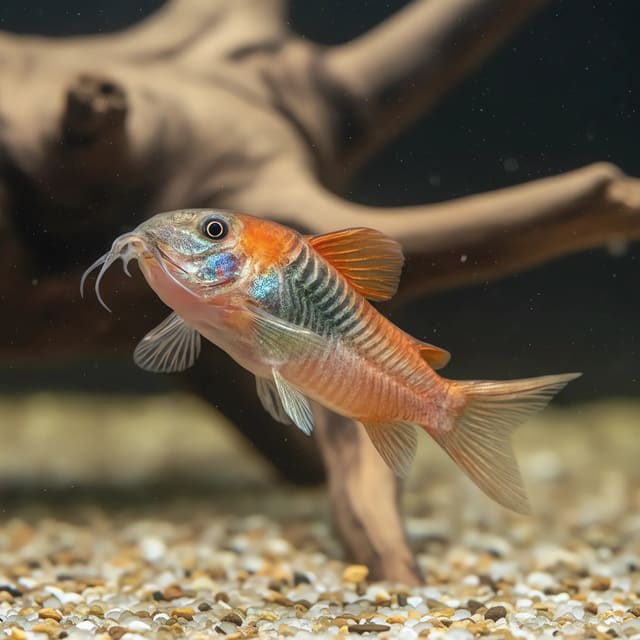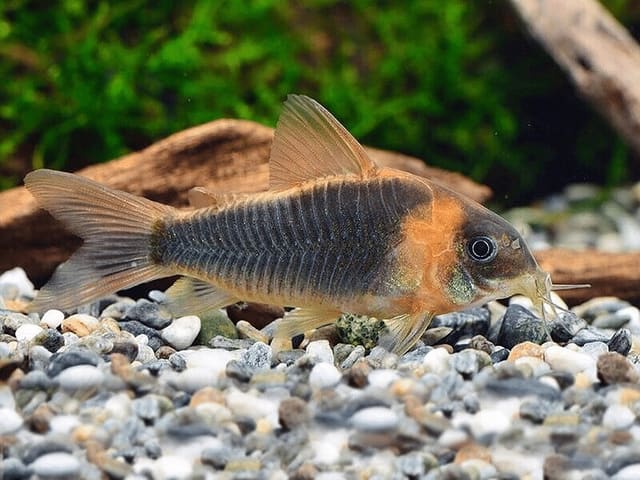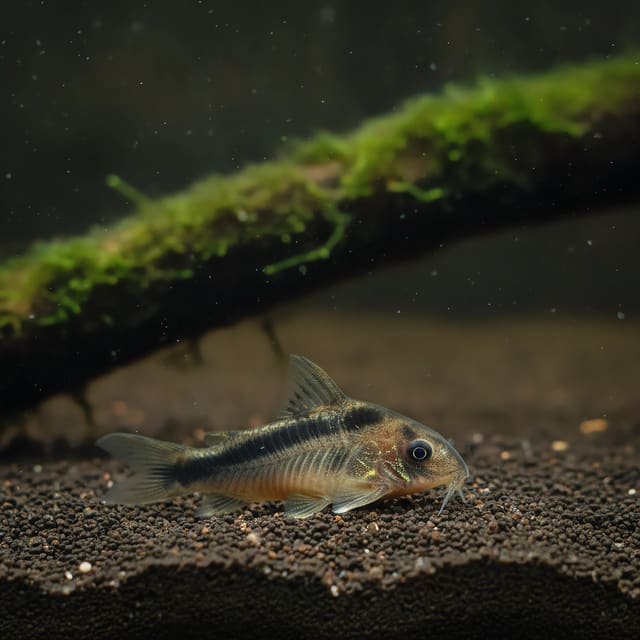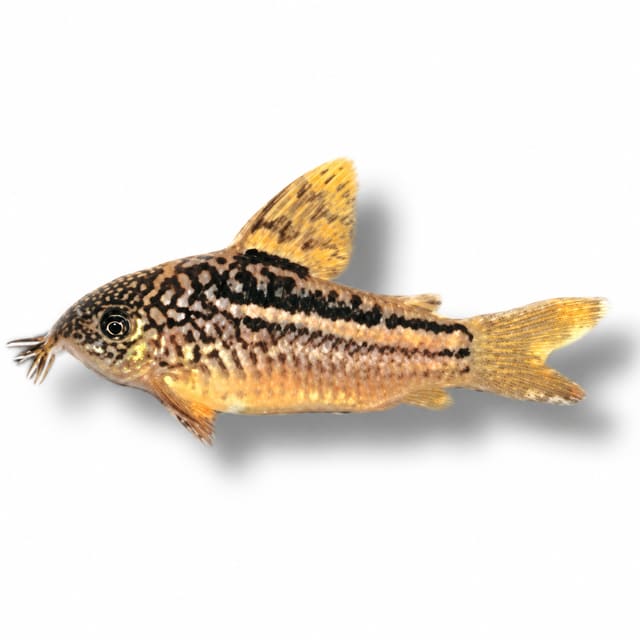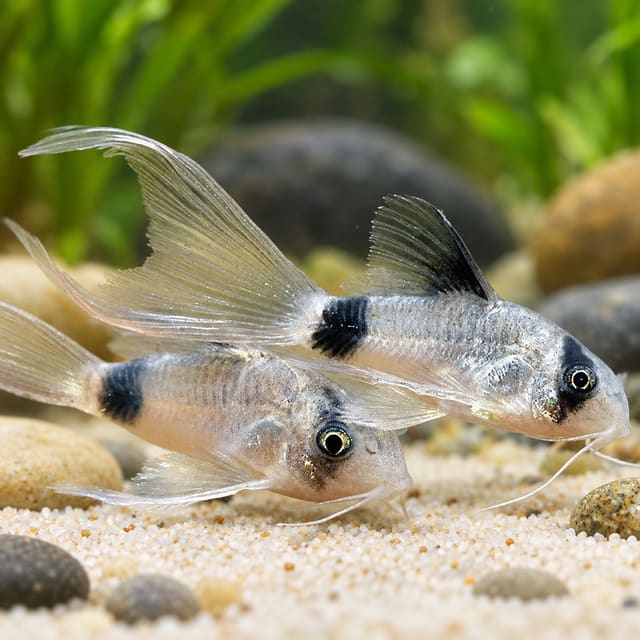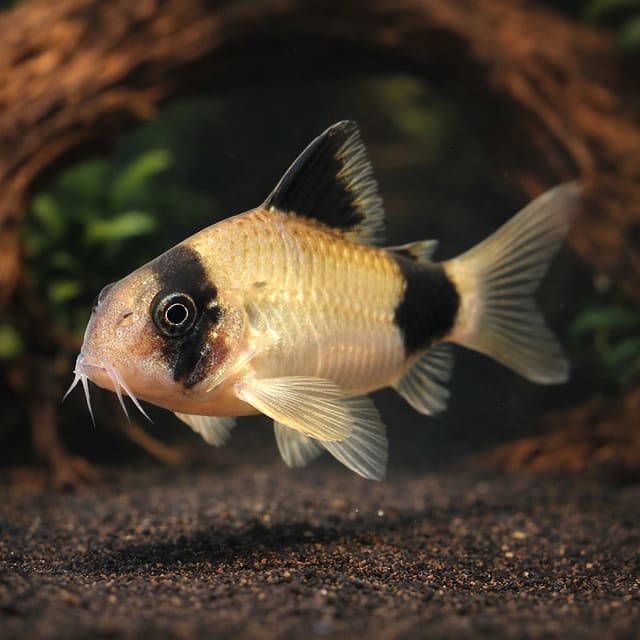
Panda Cory Catfish (Corydoras panda)
22–25°C · pH 6–7.4
From £8.69Some sizes on sale

The Napo Cory (Gastrodermus napoensis) is a peaceful South American catfish from the western Amazon basin that reaches 5 cm standard length. It suits community keepers who can maintain at least six fish in 41 litres or more at 22–26°C and pH 6.0–7.4. Sold individually in 2.5–3 cm and 3–4 cm sizes.
Adult size is the maximum length this species reaches at full maturity (scientific sources). The livestock you receive will be younger and smaller. Product-photo provenance and any image-specific limitations are stated on the listing.
Gastrodermus napoensis
Shoaling fish: kept in a group they feel safer, stay calmer and show their best colour.
The Napo Cory (Gastrodermus napoensis) is a peaceful South American catfish from the western Amazon basin that reaches 5 cm standard length. It suits community keepers who can maintain at least six fish in 41 litres or more at 22–26°C and pH 6.0–7.4. Sold individually in 2.5–3 cm and 3–4 cm sizes.
Adult size is the maximum length this species reaches at full maturity (scientific sources). The livestock you receive will be younger and smaller. Product-photo provenance and any image-specific limitations are stated on the listing.
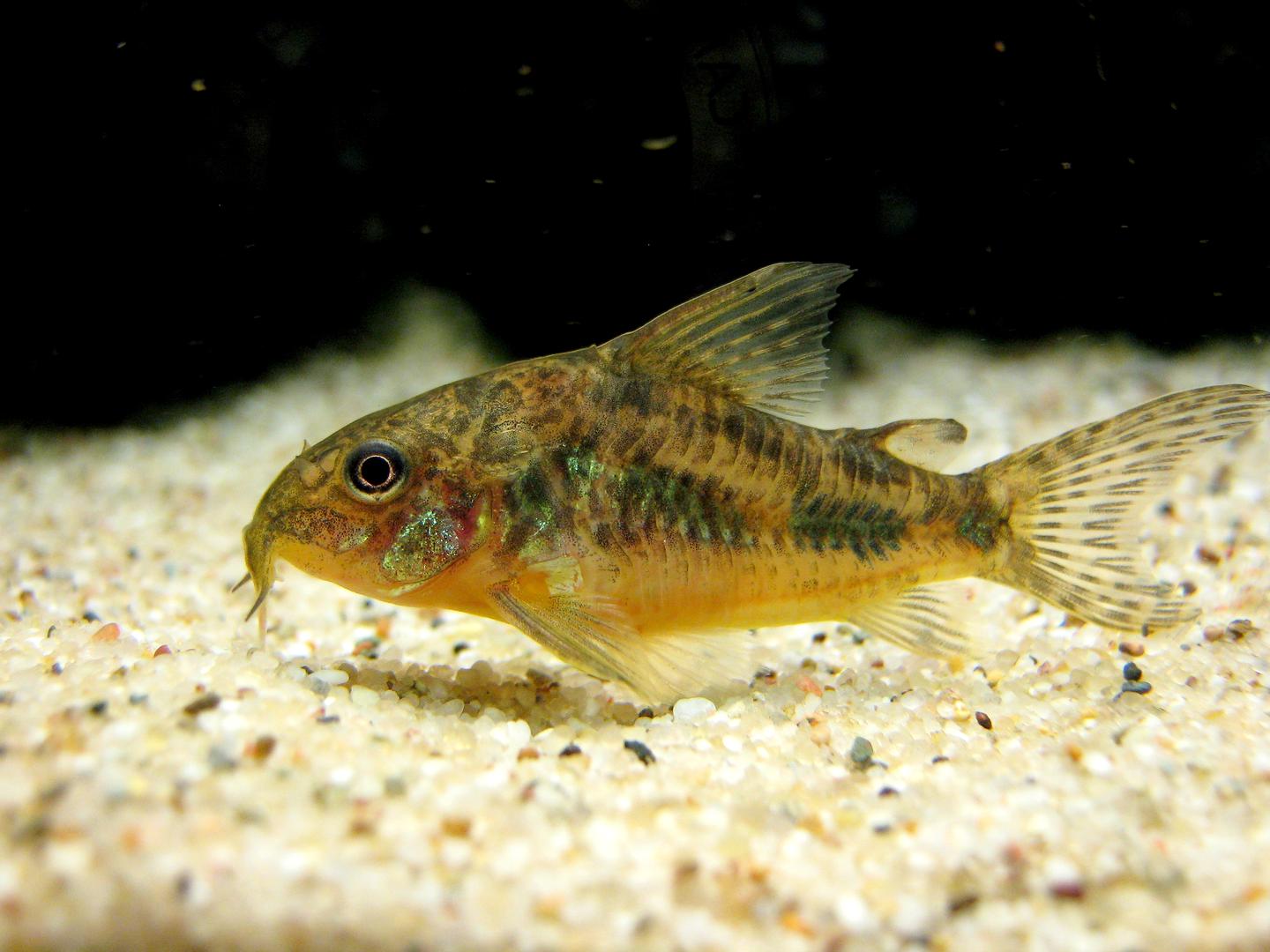
Identify the exact cory catfish before choosing care. Our starting policy for many common medium species is six compatible conspecifics, a mature 60 x 30 cm aquarium of about 60 litres, smooth fine sand and measured species-appropriate water.
Maintain these water conditions for optimal health and vibrant colors
Napo Cory (Gastrodermus napoensis), also called the Rio Napo cory, is a peaceful armoured catfish from the western Amazon basin in eastern Ecuador and Loreto, Peru. FishBase places it in the family Callichthyidae, records it as a demersal freshwater fish and notes that it forms schools. It reaches a conservative planning maximum of 5 cm standard length, making it small in body but not a fish to keep alone or squeeze into leftover floor space.
The everyday attraction is its group behaviour. Six or more fish moving over smooth sand, pausing around wood and feeding together create a lively lower level without the territorial pressure associated with many bottom-dwellers. The species is very peaceful and fits many carefully chosen community aquaria, provided its companions are not very large or aggressive and do not prevent the corys from reaching food.
This is an easy fish for a keeper who understands that easy does not mean self-cleaning. Napo Corys need a mature biological filter, stable water, a deliberate sinking diet and regular maintenance. They are omnivorous foragers, not algae-control equipment. A clean aquarium comes from the keeper's routine; the fish should be chosen for its behaviour and suitability.
The strongest display comes from giving the group enough room to act together while keeping food and shelter easy to reach. That makes this fish a thoughtful community choice: small enough for a modest aquarium, yet social enough that the complete group and its floor space must be planned before purchase.
Plan at least a 45 × 30 cm base, about 41 litres, for a small group. Keep the water at 22–26°C, pH 6.0–7.4 and 1–12 dGH. The Seriously Fish species profile supplies those aquarium values and the group recommendation. Give the group more room when other bottom-dwellers share the tank, because water volume alone does not create feeding space.
One purchase supplies one live fish. The size selector offers 2.5–3 cm and 3–4 cm fish. The size you select is the size supplied, not the adult size. Whichever size is chosen, plan for at least six fish and a 5 cm standard-length adult from the beginning.
Sex is guaranteed only when the selected option explicitly states male or female. This Napo Cory listing has no sex-guaranteed option. Mature females can be broader and rounder when viewed from above, but that biological difference does not create a sex promise for an unsexed purchase.
Gallery images have been digitally enhanced to improve image quality. Natural colour, pattern, size and maturity can vary between live animals.
| Suits | Not suited to |
|---|---|
| Peaceful community aquaria | Homes with very large or aggressive fish |
| Groups of at least six | Single-fish or very small-group plans |
| Smooth sand and deliberate sinking feeds | Sharp dirty substrate or reliance on leftovers |
| Stable 22–26°C water at pH 6.0–7.4 | Aquaria outside the shared water range |
Use the Corydoras collection to compare adult size, group needs and water values. Alternative corys are useful comparisons, not proof that different species should be mixed into one shoal.
A 45 × 30 cm base and about 41 litres is adequate for a small group of Napo Corys in the species profile. Treat that as the minimum complete setup, not as a promise that every community fits into the same volume. Six corys plus active mid-water fish use more oxygen, filtration and feeding capacity than six corys alone, while another bottom-dwelling species competes for the same floor.
Use river sand or another smooth fine substrate that lets the fish forage without repeatedly meeting sharp edges. Add driftwood branches and twisted roots to create shaded routes and resting points. A few dried leaves can provide a natural blackwater character when they are managed carefully and replaced before they rot and foul the water. The profile also says the species does well in a more standard, preferably well-planted aquarium, so a planted community is a valid alternative to a strict biotope.
If this is a new aquarium, complete the first tropical tank setup and mature the biological filter before the fish arrives. Napo Corys breathe atmospheric air facultatively and may visit the surface, but that behaviour does not replace oxygenated, filtered water. A secure lid and an unobstructed route to the surface make the aquarium easier for the fish to use.
Dimmer lighting suits a leaf-and-wood layout, while plants can soften a brighter community tank. In either style, the useful test is whether all six fish can forage, rest and reach the surface without being blocked by decor or dominant residents.
Keep Napo Corys at 22–26°C, pH 6.0–7.4 and 1–12 dGH. These are the species-level aquarium values in Seriously Fish. FishBase records a broader environmental pH and hardness range, while OATA's freshwater-catfish sheet gives broad group guidance of 22–27°C, pH 6.0–8.0 and 4–18 dGH. The narrower species aquarium range is the practical routine target.
Choose one stable point inside the shared needs of every resident. For example, 24°C, pH 6.8 and moderate softness sit inside the Napo Cory range; a candidate tank mate must also be comfortable there. Avoid choosing one value for the corys and a different value for another fish, then allowing the aquarium to swing between them.
The water chemistry guide explains the role of each test, and the water matcher helps compare measured water with the plan. Test the tap and aquarium rather than assuming a local-water label tells the full story.
Match conditioned replacement water closely to the aquarium. A reading can fall within the permitted range and still represent a stressful sudden change when it differs sharply from the tank. Repeatable preparation is more valuable than repeatedly correcting the aquarium with several products at once.
If the group becomes less active, breathes unusually or loses interest in food, test first. Water-quality changes can affect the whole group before a single dramatic symptom appears.
At about 41 litres, the species profile illustrates four to five turnovers per hour with a filter rated around 165–205 litres per hour. Use that as a starting check, then consider the real resistance of media and pipework. Create gentle circulation across the floor and visible surface movement without turning the open sand into a constant current the fish must fight.
The RSPCA's fish environment guidance explains why every aquarium needs a well-set-up biological filter: toxic ammonia is converted to nitrite and then to safer nitrate by beneficial bacteria. Surface visits by corys are natural air-breathing behaviour, but frequent or changed surfacing should still prompt checks of temperature, oxygenation and water quality.
Check the intake and media when flow falls. Rinse dirty media lightly in water removed from the aquarium; do not run it under the tap. Replace only worn media that truly needs replacement, and avoid replacing all biological material together. The objective is to restore flow while protecting the bacteria that carry the nitrogen cycle.
Keep the route to the surface open. Floating plants or hardscape should not form a complete barrier, and the lid should remain secure around cables and pipe openings. Observe how easily the fish rise and return to the group. A clean direct route supports normal behaviour and makes unusual effort easier to notice.
Filter capacity must reflect the whole community. Adding another shoal or a bottom-dwelling fish increases waste and feeding demand even if the aquarium still looks spacious. Confirm that ammonia and nitrite remain at zero after additions and that the filter continues to move water around wood and plants rather than leaving permanent debris pockets.
Napo Corys are omnivorous and easy to feed when food reaches them. Use a quality sinking pellet or tablet as the staple, then supplement it with live or frozen Daphnia, Artemia, bloodworm and similar foods. The species profile supports that combination. Algae growing in the aquarium and scraps left by mid-water fish do not form a complete feeding plan.
OATA's freshwater-catfish guidance recommends one daily feed that the fish consume within a few minutes. Place the food in more than one part of the open sand so all six fish can feed without crowding one tablet. When active mid-water fish are present, watch the food reach the substrate rather than assuming some will be left over.
Vary the animal foods rather than serving one rich item continuously. Daphnia, Artemia and bloodworm provide useful rotation, while a balanced sinking staple supplies consistency. Feed particle sizes the fish can take without repeatedly spitting them out or leaving fragments to decay in the substrate.
The popular description of corys as scavengers can lead to underfeeding. They do forage along the bottom, but the keeper remains responsible for supplying an appropriate ration. Likewise, no fish cleans its own waste. Siphoning accessible debris, controlling portions and maintaining the filter are still required in an aquarium full of active foragers.
When another bottom-dweller shares the tank, separate feeding points can reduce competition. Compatibility is not complete until every species receives the food its biology requires.
Keep at least six Napo Corys. Seriously Fish says corys are more confident and active in the presence of their own species and gives six as the best minimum group. FishBase also records that the species forms schools. OATA's broader catfish guidance says corys kept singly or in groups that are too small will often become stressed.
A group is not just six fish counted at purchase. It needs enough usable base area, shared water conditions and feeding capacity throughout adult life. If the aquarium already holds several bottom dwellers, calculate whether the Napo Cory group will have open sand and food access rather than fitting the number into the remaining litres.
Do not split six fish between two aquaria merely to add activity to both. Each aquarium would then hold an undersized group. If quarantine or treatment requires temporary separation, keep the long-term plan focused on restoring an adequate social group once it is safe.
Sex differences are not needed for ordinary group care. Females can appear broader and rounder, especially when carrying eggs, and may be slightly larger. Those observations do not guarantee the sex of a purchased fish, and a mixed-sex ratio is not part of this offer.
When adding fish to an established group, increase stocking slowly so the biological filter can adapt to additional waste. Test ammonia and nitrite after the change, observe feeding and avoid adding several unrelated species at the same time. One measured change makes the group's response easier to understand.
Sand, wood, roots and managed leaf litter create a useful lower-level environment. The species profile describes an Amazonian-style layout with river sand, driftwood branches, roots and dried leaves, and also accepts a standard planted tank. Choose the style you can maintain consistently.
Replace old leaves every few weeks before they rot and foul the water. Remove accessible debris from open areas during water changes, but avoid stripping every leaf and refuge at once. Clean enough to protect water quality while keeping the layout predictable for the group.
OATA recommends at least once every week, a partial water change of 25%. Treat replacement water with conditioner before adding it and match it closely to the aquarium temperature. If filter media needs cleaning, rinse it in the removed aquarium water rather than under the tap.
Use the weekly routine to assess the fish as well as the decor. Check clear eyes, intact fins, body condition, breathing and appetite. A group that abruptly hides more, breathes differently or ignores food deserves immediate water testing. Contact the shop for guidance when a health change persists after the environmental checks.
Keep changes proportionate. One decaying leaf should be removed; it does not require dismantling every piece of wood. A recurring debris pocket may need a small flow adjustment; it does not automatically require a larger filter. Controlled changes preserve both the biological filter and the group's sense of cover.
Confirm the aquarium is mature, the filter is running, ammonia and nitrite are zero and the planned group space is ready before the parcel arrives. The delivery and Live Arrival Guarantee policy explains receipt, evidence and acclimatisation. Follow the order exactly so the fish is handled calmly and any problem can be assessed.
Before release, check that the aquarium sits inside 22–26°C and pH 6.0–7.4 and that the intended feeding and cover zones remain open. Those aquarium checks belong to the care routine, while the numbered parcel steps stay exactly focused on the policy.
Observe whether every new fish can join the group, reach the surface and take sinking food. Test ammonia and nitrite more often after the additional bioload. Offer modest food portions in more than one location and remove leftovers before they disappear beneath wood or leaves.
One fish spending a little time under cover can be normal; continuous isolation, rapid breathing, loss of balance or inability to feed requires attention. Test water, check equipment and watch interactions before adding any more animals. Avoid changing the entire layout while the group is settling unless a safety or aggression problem makes that necessary.
Napo Corys are very peaceful and suitable for many community aquaria. Seriously Fish names small characins, cyprinids, anabantoids, dwarf cichlids and other peaceful catfish as suitable kinds. Avoid anything very large or aggressive. Those boundaries are more useful than a long list of individual species because the aquarium still has to match adult size, water values and feeding behaviour.
| Candidate | Decision check |
|---|---|
| Small peaceful mid-water fish | Consider when its water range overlaps 22–26°C and pH 6.0–7.4 |
| Another peaceful catfish | Check floor space, shelter and food access |
| Dwarf cichlid | Check adult behaviour and protect the cory feeding area |
| Very large or aggressive fish | Avoid |
A peaceful species can still be a poor match if it eats all sinking food or occupies every low-level shelter. Feed the community and observe which fish actually receives the ration. If the corys wait until nothing remains, change feeding placement or the stocking plan.
Water overlap must be real. A candidate that merely tolerates the edge of the Napo Cory range while preferring different conditions creates a compromise for both. Choose a stable shared target and use measured aquarium water, not a generic community label, to judge the match.
Keep the cory group intact. Mixing one or two individuals of several Corydoras species does not replace six Napo Corys together. Product alternatives can help compare care plans, but each species needs its own appropriate social group.
The aquarium floor is the Napo Cory group's main living and feeding area. Another bottom-dweller changes that space more than a similar-sized mid-water fish does. Before adding one, map where each species will rest, feed and retreat. If every answer points to the same small patch of sand, increase the aquarium or choose a different combination.
Start with the simplest effective change: spread sinking food, add a separate feeding location or adjust cover while preserving open sand. If a very large or aggressive fish is responsible, separation follows the species guidance more honestly than repeated layout changes.
Do not rely on the corys to absorb a maintenance problem. Extra leftovers intended to ensure they eat can increase ammonia and nitrate, while a dirty substrate can harm the whole group. A compatible community is one in which the normal portion reaches every fish and the weekly routine keeps the floor clean.
Plan for 5 cm standard length. Seriously Fish records that conservative maximum, while FishBase records 4.2 cm standard length; the 2.5–4 cm dispatch sizes are not the adult size.
Use at least 45 × 30 cm of base space, about 41 litres, for a small group of six. A larger aquarium gives the group more feeding room and makes water conditions easier to keep stable.
Keep at least six together. The species is peaceful and social, and a proper group is more confident and active than a single fish or an undersized group.
Yes, it is an easy community fish when the aquarium is mature, filtered and planned for a group of at least six. The keeper must still provide smooth sand, sinking food and stable water.
Use a quality sinking pellet or tablet as the staple, then add live or frozen Daphnia, Artemia, bloodworm and similar foods. It is an omnivore that needs deliberate feeding, not a substitute for aquarium cleaning.
Keep this fish at 22–26°C, pH 6.0–7.4 and 1–12 dGH. These are the species aquarium values in the Seriously Fish profile; choose a steady point that also suits every tank mate.
It is very peaceful and suited to many community aquaria. Keep it away from very large or aggressive fish, and make sure every bottom-dweller can reach food without being displaced.
Suitable kinds include small characins, cyprinids, anabantoids, dwarf cichlids and other peaceful catfish. Match water needs, provide enough floor space and avoid very large or aggressive residents.
Start filming every parcel while it is still sealed, then open it in one continuous take with the fish still in the sealed bag. Be present to receive it, inspect it the same day, float the bag for 20–30 minutes before releasing the fish, and contact Tropical Fish Co the same day with your order number and video if anything is wrong.
No reviews for this item yet. Bought one? Honest reviews only, good or bad.
What customers say about ordering from us
I have a small group of long finned mountain minnows. So was delighted to be able to order ten of this variety to increase the genetics in my tank . The ones I recieved are healthy but it’s to early to give a verdict on wether they are of a long finned type since they are small currently.
Gordon Walker · 23 Sept 2026
100% success travel and "installation". Pleased with quality of purchase. The Siamese fighter a bit "shy" so have not yet seen him at his best yet but looking good. Happy customer. GG
George E Garratt · 21 Sept 2026
Reviews of our shop, collected by Judge.me, an independent third-party review collector. Newest first.