Easy
Napo Cory (Gastrodermus napoensis)
22–26°C · pH 6–7.4 · 41L
£15.99
False-Spotted Cory (Corydoras leucomelas) is a peaceful Upper Amazon armoured catfish for mature aquariums with fine substrate. Keep at least six, provide complete sinking food, stable 22-26 C water and about 60 litres or more with useful floor space.
Corydoras leucomelas
Shoaling fish: kept in a group they feel safer, stay calmer and show their best colour.
Confirm your email, then we’ll send an availability message for this exact item if it returns within 180 days.
This request is only for this product—no newsletter or other promotions. A mail-provider retry may very rarely duplicate the same availability message. Unconfirmed addresses are removed after 48 hours. See our privacy policy.
False-Spotted Cory (Corydoras leucomelas) is a peaceful Upper Amazon armoured catfish for mature aquariums with fine substrate. Keep at least six, provide complete sinking food, stable 22-26 C water and about 60 litres or more with useful floor space.
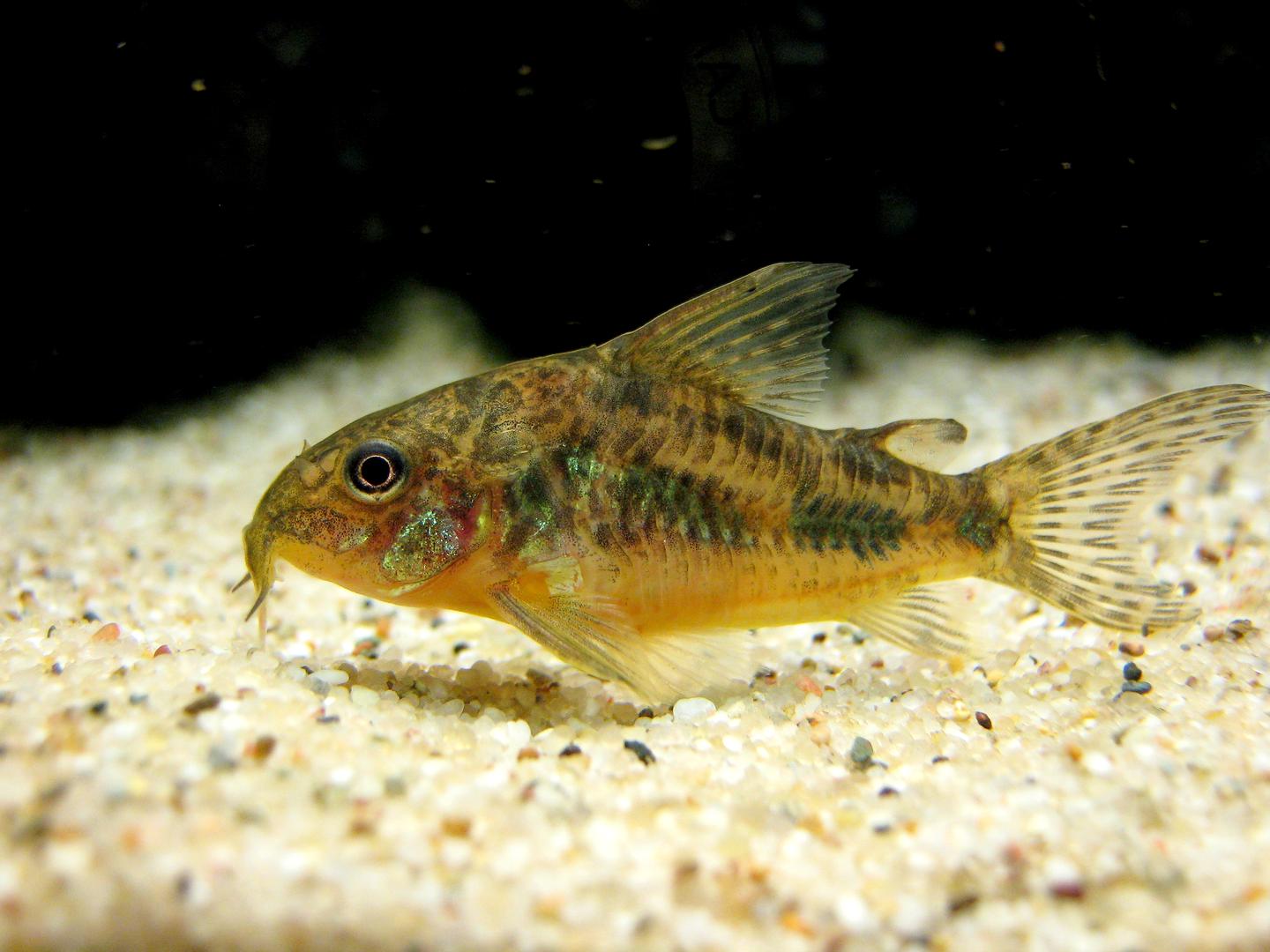
Identify the exact cory catfish before choosing care. Our starting policy for many common medium species is six compatible conspecifics, a mature 60 x 30 cm aquarium of about 60 litres, smooth fine sand and measured species-appropriate water.
Maintain these water conditions for optimal health and vibrant colors
False-Spotted Cory (Corydoras leucomelas), also called the Blackfin Cory, is a small social armoured catfish from the Upper Amazon basin. It spends much of the day searching the aquarium floor with its barbels, but it is not an algae-eating substitute for an Otocinclus, bristlenose pleco or Siamese algae eater. Give it a complete sinking diet, fine substrate, clean oxygenated water and a group of its own kind.
The species reaches 4.5 cm standard length in the FishBase record; allowing for the tail, an aquarium fish may be described at roughly 5-5.5 cm total length. Plan around an adult group rather than the juvenile dispatch size. A mature aquarium of about 60 litres can be a lower plan for six in a carefully stocked layout, but floor dimensions, filtration and the number of other bottom fish matter more than a litre number alone.
| Accepted scientific name | Corydoras leucomelas Eigenmann & Allen, 1942 |
|---|---|
| Common names | False-Spotted Cory, False Spotted Catfish, Blackfin Cory |
| Family | Callichthyidae |
| Natural range | Upper Amazon River basin in South America |
| Adult size | 4.5 cm standard length; approximately 5-5.5 cm including the tail |
| Social group | At least six of the same species; a larger group where floor space permits |
| Lower aquarium plan | About 60 L for six, with a useful footprint and restrained total stocking |
| Temperature | 22-26 C |
| Practical pH | 6.0-7.5; published species range extends to pH 8.0 |
| Practical hardness | 2-15 dGH; stability is more important than chasing an extreme |
| Temperament | Peaceful and social |
| Diet | Varied omnivorous sinking foods; not leftovers or algae alone |
FishBase publishes a wider hardness range of 2-25 dH. The narrower practical target above is intended to simplify stable community care, not to redefine the species. Test the aquarium and source water, keep ammonia and nitrite at zero, and make changes gradually.
Corydoras leucomelas is the accepted name used here. “False-Spotted” refers to the spotted pattern and its resemblance to other small Corydoras; “Blackfin” refers to the strong dark marking around the dorsal area. Common names vary between exporters and shops, so the scientific name is the safest identity anchor.
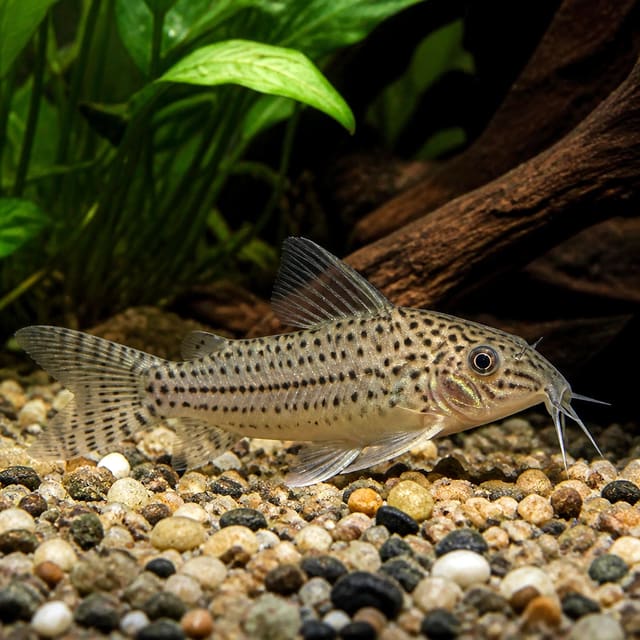
A typical fish has a pale silver, cream or light brown ground colour, dark spotting over the head and front of the body, a darker dorsal-fin area and armoured bony plates along the flanks. Pattern density, contrast and body shade can vary with age, condition, background and lighting. The listing does not guarantee identical spots, sex, a future breeding pair or an exact match to one photograph.
When choosing an individual, look for an even body profile, intact barbels, open fins, regular breathing and active group response. A newly transported Cory may rest or look paler while settling, but persistent gasping, clamped fins, a hollow belly, reddened skin or isolation requires investigation.
The accepted distribution is the Upper Amazon basin. That broad range includes seasonal freshwater habitats rather than one fixed chemistry value. In the aquarium, the useful lesson is to provide clean warm water, a soft bottom, shaded structure, oxygen and open foraging space rather than trying to recreate a single photographic biotope.
Use fine aquarium sand or a very smooth rounded substrate. Corydoras repeatedly push their snouts into the surface and pass grains through the mouth while locating food. Sharp gravel is not the only cause of damaged barbels, but abrasive substrate combined with trapped organic waste and poor water quality creates an avoidable risk. Keep the surface clean without making it sterile.
Wood, leaf litter suitable for aquarium use and robust plants can create shade and visual shelter. Leave clear lanes across the front and between structures so the group can forage together. Broad obstacles should not divide a small footprint into isolated pockets where one fish cannot reach food.
Corydoras are social fish, so the minimum plan must accommodate a group rather than one specimen. Keep at least six C. leucomelas. Eight or more can produce more confident, natural movement where the aquarium footprint, filtration and stocking allow it. Mixed Corydoras may associate, but a collection of single fish from different species is not equivalent to a proper same-species group.
| Plan | Assessment | What to check |
|---|---|---|
| One or two fish | Not recommended | Increase to a proper same-species group rather than treating hiding as a personality trait |
| Six in about 60 L | Lower practical plan | Useful floor area, mature filtration, modest mid-water stocking and no bottom-zone crowding |
| Eight to twelve | Excellent where space permits | Longer footprint, multiple feeding points and enough open substrate for the whole group |
| Several bottom species | Needs careful calculation | Count territories, feeding competition and adult bioload, not only total litres |
Use the tank-volume tool to estimate actual filled volume after substrate and decor. The longest and widest internal dimensions are especially important for bottom dwellers. A tall narrow aquarium may hold the same litres as a longer tank while offering much less usable Corydoras floor space.
The size selector describes the fish at dispatch, not the adult size. A smaller juvenile needs finer food and closer observation, but it does not justify a smaller permanent aquarium or a reduced group. Larger juveniles may settle more visibly and take a wider range of prepared foods, yet they still need gentle handling, quarantine and gradual acclimation.
Do not judge growth from length alone. View each fish from the side and above at regular intervals. The abdomen should look filled after feeding without remaining swollen, and the line behind the head should not become pinched. Compare photographs taken from a similar angle each month; slow weight loss can be difficult to notice when a group is always moving.
| Observation | Likely meaning | Next check |
|---|---|---|
| All fish forage and rest together | Group is confident | Confirm every individual maintains body condition |
| One juvenile stays thin | Food competition, illness or both | Watch it eat, test water and assess quarantine needs |
| Short or worn barbels | Substrate, hygiene or previous damage may be involved | Inspect the floor, trapped waste and water quality |
| Rapid growth with heavy feeding | Waste production is also increasing | Recheck nitrate, filter capacity and portion size |
Retail measurements are approximate because a live fish rarely holds still against a ruler. Natural individual variation is expected. The listing does not promise that every fish within one dispatch band has exactly the same length.
The cycle tracker can organise test evidence before livestock is added. A product that claims to make an aquarium instantly ready does not replace proof that the biological filter can process waste.
Maintain 22-26 C with a practical pH target of 6.0-7.5 and hardness around 2-15 dGH. These values sit within the broader published species range. Stable, clean conditions are safer than repeatedly altering water to reach a precise midpoint.
| Ammonia | 0 mg/L |
|---|---|
| Nitrite | 0 mg/L |
| Nitrate | Keep controlled through measured stocking, feeding and water changes |
| Temperature | 22-26 C without abrupt swings |
| pH | 6.0-7.5 practical target |
| Hardness | 2-15 dGH practical target |
| Flow | Enough circulation for oxygen and waste pickup without pinning fish to the substrate |
Start with weekly partial water changes, then adjust the amount and frequency from test results, stocking and feeding. Match replacement water closely for temperature and chemistry. Siphon exposed waste from the substrate surface, especially around wood and plants, while avoiding deep disruption that releases trapped debris around the fish.
Use the water matcher to compare source water with this care range. Do not make sudden pH adjustments merely because a test is away from an imagined perfect number.
A mature sponge, internal or external filter can all work when correctly sized and maintained. The biological stage must process the aquarium's total waste, while mechanical media should capture debris before it accumulates across the sand. Position the outlet to circulate water through the lower aquarium without creating one high-speed jet that the fish must fight continuously.
Warm water carries less dissolved oxygen than cooler water. Surface movement, sensible stocking and clean filter flow are therefore important even though this species can gulp air. Air breathing is an adaptation, not permission to run an oxygen-poor aquarium. An air stone can add resilience during warm weather or treatment, but it cannot compensate for ammonia or a failed biological filter.
After a prolonged outage, stagnant filter water can be depleted of oxygen. Do not simply pour foul water from an external filter back into the aquarium. Assess and clean the mechanical waste carefully while preserving viable media, then monitor the tank as if filter capacity may have been reduced.
The published temperature range tops out at 26 C, so a summer heatwave deserves planning. Measure the aquarium rather than relying on room temperature. Reduce unnecessary heat from lighting, improve safe surface movement and increase aeration before fish show distress. Keep the lid secure while allowing the equipment's intended ventilation.
Do not add ice directly or create rapid temperature swings. A fan directed across the water surface can cool by evaporation, but it also increases water loss; top up appropriately and remember that evaporation leaves dissolved minerals behind. Partial water changes should remain closely temperature matched rather than being used as a sudden cold shock.
Higher temperature raises fish metabolism while reducing the oxygen water can hold. Feed conservatively, keep filters clear and watch the whole group for increased breathing or repeated surfacing. During cold weather, use a reliable guarded heater and verify it with an independent thermometer. Place equipment so a resting Cory cannot become trapped against it.
Corydoras are facultative air breathers. A healthy fish may make a rapid trip to the surface, take a gulp and return to the bottom. Occasional surface visits can therefore be normal. The aquarium must have unobstructed surface access and a secure lid that does not seal away gas exchange.
Repeated frantic surfacing by the whole group is different. Check temperature, oxygenation, ammonia, nitrite, filter operation and any recent chemical exposure immediately. Do not dismiss a sudden change as normal Cory behaviour simply because the species can breathe air.
Corydoras leucomelas is a bottom-feeding omnivore that searches for small animal and plant material. It may pick around biofilm or investigate surfaces, but it will not control algae like a specialist grazer. It also cannot live on scraps missed by other fish. Every member of the group needs a deliberate complete diet.
| Food | Role | How to offer it |
|---|---|---|
| Complete sinking micro pellet or Cory tablet | Regular nutritional base | Use a size the fish can rasp or swallow and spread portions across the floor |
| Frozen daphnia, cyclops, brine shrimp or suitable bloodworm | Variety and conditioning | Rotate small portions rather than making one rich food the entire diet |
| Soft gel or wafer formulated for omnivorous bottom fish | Alternative texture and feeding opportunity | Remove uneaten material before it fouls the substrate |
| Algae wafer alone | Incomplete as a sole diet | Choose an omnivore formula and include protein-rich variety |
| Community leftovers | Unreliable and inadequate | Feed the Cory group intentionally, even when mid-water fish are present |
Feed adults once or twice daily in amounts the group clears without leaving waste. Juveniles may benefit from smaller portions more often. Feeding after lights dim can help in a busy community, but first confirm visually that each fish eats. A sinking tablet is not automatically shared fairly; dominant or faster tank mates may monopolise it.
Frozen bloodworm is a useful occasional food, not a complete staple. Live food should come from a trusted source to reduce contamination and parasite risk. Avoid mammalian meat and oversized hard pieces. Persistent refusal to feed should trigger water testing and health investigation rather than repeated overfeeding.
There is no universal tablet count because foods differ in size and density. Begin with a modest measured portion, watch how long it remains and adjust at the next feed. The target is for all fish to eat while leaving no food to decay in hidden corners. Breaking tablets into several pieces often distributes food more fairly than dropping one large wafer.
In a community, mid-water fish may intercept slow-sinking food and plecos or loaches may defend larger wafers. Use several feeding points and vary particle size so the Corydoras can feed without crowding. A dim evening feed may help, but darkness should not be used to avoid checking whether the smallest fish actually eats.
| Body condition | Interpretation | Response |
|---|---|---|
| Gently rounded after a meal | Normal fed profile | Continue measured varied feeding |
| Persistently hollow underside | Insufficient access or possible health problem | Observe separately, review competition and investigate |
| Sudden marked swelling | Not normal growth | Stop guessing, test water and seek diagnosis |
| Uneaten food remains after the group leaves | Portion too large or food not accepted | Remove it and reduce or change the next portion |
This is a peaceful species that suits calm South American and general tropical communities sharing the same temperature and water range. Suitable companions can include small to medium tetras, peaceful rasboras, pencilfish, hatchetfish and other non-aggressive fish that do not consume all sinking food. Compatibility depends on the actual species, adult size and aquarium, not a generic community label.
| Companion type | Assessment | Main condition |
|---|---|---|
| Peaceful tetras and rasboras | Often suitable | Match temperature and leave enough food for bottom fish |
| Other small Corydoras | Possible in a larger aquarium | Keep a proper group of each species and avoid floor-space crowding |
| Otocinclus | Possible in a mature planted aquarium | Provide its specialist feeding needs and monitor bottom-zone competition |
| Dwarf cichlids | Conditional | Breeding cichlids may defend the same lower area and harass Corydoras |
| Large or aggressive cichlids | Avoid | Predation, stress and injury risk |
| Very boisterous bottom feeders | Avoid or use a much larger setup | Competition can leave Corydoras underfed |
Use the tank-mates tool as an initial screen, then check the adult needs of every species. Never assume that another catfish is automatically compatible. Plecos can become territorial around caves and food, while some “algae eaters” grow far larger and behave very differently.
Adult ornamental shrimp and snails are usually ignored, but newly hatched shrimplets may be eaten opportunistically. Dense moss and fine cover improve survival where shrimp breeding matters. Corydoras will not eradicate pest snails and should not be purchased for that purpose.
Plants are useful for shade and water quality, but arrange roots and hardscape so the group cannot be trapped. Attach plants to wood or use protected planting areas if constant foraging dislodges delicate stems. Keep an open sandy section where bellies and barbels can be inspected.
A settled group alternates between resting, short bursts of foraging and coordinated movement. Individuals may perch under leaves or wood, then join the group when food appears. More visible activity at dawn, dusk or after a water change can be normal.
Constant hiding is not automatically normal shyness. Check group size, lighting, cover, tank mates, water quality and feeding access. A fish repeatedly separated from the group, breathing faster, losing weight or remaining clamped needs closer assessment.
A stocking example is a thought process, not a universal recipe. Water chemistry, aquarium dimensions, filter maturity and the adult size of each fish can change the answer. Add species gradually and quarantine them rather than filling a new aquarium all at once.
In a mature long aquarium around the lower 60-litre plan, a group of six False-Spotted Corys may share with one restrained shoal of small peaceful mid-water fish. Keep the lower zone for the Cory group, avoid an additional bottom species and leave spare biological capacity. This plan fails if “60 litres” describes a tall tank with little floor area or if many extra fish are added later.
A longer 100-litre-plus planted aquarium can support eight to twelve Corys and a larger mid-water shoal where water parameters match. Multiple feeding points and broad open sand make the group easier to observe. Extra volume does not remove the need to control nitrate and trapped waste beneath wood.
This is conditional. A dwarf cichlid pair may defend a cave, leaf or floor territory, especially when breeding. Corydoras do not understand territorial boundaries and may repeatedly enter the area. Use a larger footprint with visual separation and be ready to move one species if harassment persists.
Several catfish species can crowd the same feeding and shelter zone even when the litre calculation appears acceptable. Check adult pleco size, cave ownership, nocturnal feeding and waste production. Do not add a bristlenose merely as an “algae cleaner” to a floor already occupied by a full Cory group.
Condition a mature group with varied foods and excellent water quality. Females are often broader through the abdomen when viewed from above, while mature males tend to be slimmer. Sex cannot be guaranteed at juvenile sale size.
Corydoras commonly use a “T-position” during spawning. A female carries adhesive eggs between her pelvic fins and places them on glass, plants or other surfaces. Adults may eat eggs, so breeders often move the eggs or remove the adults after spawning. Use a mature separate setup if raising fry is the objective.
Hatch time and fry growth depend on temperature, fertility and water conditions, so fixed guarantees are misleading. Remove failed eggs carefully and keep equipment fry-safe. Breeding is an optional advanced project, not a test of whether the display aquarium is healthy.
Healthy Corydoras have intact barbels, a filled but not swollen abdomen, open fins and steady breathing. Warning signs include barbel erosion, red patches, white spots, rapid breathing, clamped fins, persistent surface distress, hollow body shape, swelling or loss of group response.
Test water before reaching for medication. Many apparent disease signs begin with ammonia, nitrite, low oxygen, unstable temperature, accumulated waste or aggression. Correct an environmental cause safely, then seek a diagnosis for persistent symptoms. Follow product instructions and confirm that any treatment is appropriate for scaleless or armoured catfish; do not mix medicines without evidence that the combination is safe.
Quarantine new fish in a heated, filtered, fully cycled aquarium with smooth substrate or an easy-to-clean floor, cover and surface access. Use separate nets and siphons where possible. Observe feeding, faeces, breathing, skin and fins before mixing groups.
Corydoras possess stiff fin spines that can catch in coarse netting. Guide them calmly into a smooth container or suitable fine net rather than chasing them around decor. Handle as little as possible and never grasp the body.
| Claim | Better guidance |
|---|---|
| “Corys clean the aquarium” | They add bioload and require their own food; maintenance remains the keeper's job |
| “One Cory will join any other catfish” | Keep at least six of the same Corydoras species |
| “They only eat at night” | They can feed by day or in dim conditions; choose a schedule that allows observation |
| “Surface gulping always means low oxygen” | Occasional gulps can be normal, but a sudden repeated group-wide change needs urgent checks |
| “Any gravel damages barbels” | Abrasive substrate and dirty conditions are avoidable risks; fine clean sand is the preferred practical choice |
| “A hardy fish does not need quarantine” | Every new arrival can carry stress or disease and benefits from observation before mixing |
Act promptly when several fish show rapid breathing, repeated frantic surfacing, loss of balance or sudden collapse. Check ammonia, nitrite, temperature, oxygenation, filter operation and recent additions such as tap water, medication, aerosols or cleaning products. Increase safe aeration and prepare matched dechlorinated water while identifying the cause.
When only one fish is affected, compare its body condition, skin, fins, barbels and feeding with the rest of the group. Isolation can reduce competition and improve observation, but moving a weak fish into an uncycled container may make matters worse. A hospital aquarium needs mature filtration and matched conditions.
Record test values and the sequence of events. “Water is fine” is not enough for diagnosis; actual temperature, ammonia, nitrite, nitrate and pH values are far more useful. Avoid combining medicines in panic or repeatedly moving fish between different water conditions.
Prepare the mature aquarium before delivery. Dim the lights, check temperature and water chemistry, and make sure the filter is running normally. Follow the supplied acclimation instructions and do not pour transport water into the aquarium.
Release the group near calm cover with a clear route to the surface. Avoid a heavy first feed; offer a small sinking meal after the fish have settled and remove leftovers. Check every individual over the following days for feeding, breathing and group contact.
The acclimation timer helps organise the process. Review packing, eligible routes and claim requirements on the live-fish delivery page.
Choose this species when you want a small active social Corydoras, not an algae-control animal. An Otocinclus is a small specialist grazer with different feeding and maturity requirements. A bristlenose pleco grows larger, produces more waste and may defend a cave. A Siamese algae eater is a much larger, faster cyprinid that needs more swimming room. These fish are not interchangeable merely because shops place them near the aquarium floor.
| Fish | Primary appeal | Key difference |
|---|---|---|
| False-Spotted Cory | Social bottom-foraging group | Needs complete sinking food and six or more of its own kind |
| Otocinclus | Small biofilm and soft-algae grazer | Best in a mature aquarium with reliable specialist nutrition |
| Bristlenose pleco | Larger rasping catfish | Greater waste output, cave use and adult space requirement |
| Siamese algae eater | Active algae-grazing cyprinid | Far larger and more active; not a Corydoras substitute |
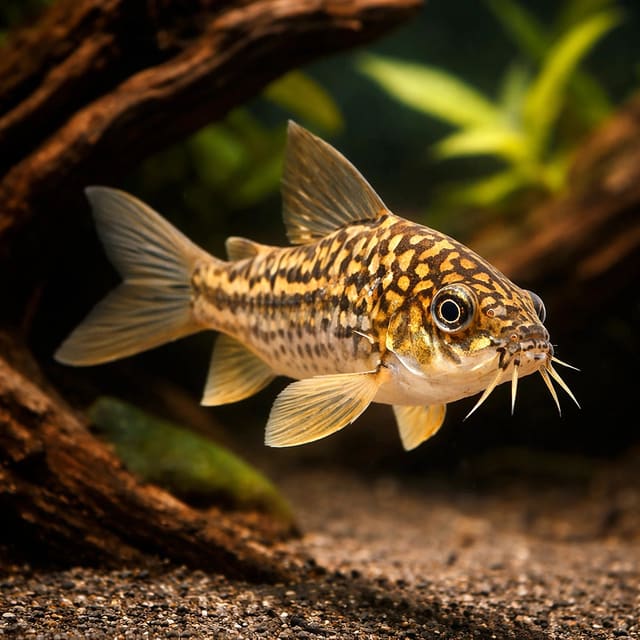
For another compact South American Cory, compare Rio Napo Cory (Corydoras napoensis). The Leopard Cory listing and Ceara Bulldog Cory listing provide other body-pattern and group-planning comparisons. Each species still needs its own same-species group and verified care range.
This species is a good choice when you can provide at least six, a mature tropical aquarium, fine substrate, stable 22-26 C water and intentional sinking meals. It is not a good choice for an uncycled tank, a coarse dirty floor, a community dominated by aggressive fish, or a keeper seeking one animal to clean algae and leftovers.
Before ordering, confirm actual filled volume, floor dimensions, water chemistry, existing bottom stock and a quarantine plan. Use the stocking calculator as a planning aid, then apply judgement for floor-space competition and adult behaviour.
No. It may investigate biofilm and pick through the substrate, but it needs complete omnivorous sinking food and should not be bought as an algae-control fish.
Keep at least six of the same species. A larger group is even better where floor area, filtration and total stocking permit.
FishBase reports 4.5 cm standard length. Including the tail, plan for approximately 5-5.5 cm total length.
About 60 litres is a lower practical plan for six in a carefully stocked aquarium, but footprint and bottom-zone competition matter more than litres alone.
Fine sand is the preferred practical choice for natural foraging. Very smooth rounded substrate can work, but avoid abrasive material and trapped organic waste.
Occasional rapid surface visits can be normal because Corydoras can breathe atmospheric air. Repeated frantic surfacing by the group requires immediate water-quality, temperature and oxygen checks.
Adult shrimp are usually ignored, although tiny shrimplets may be eaten opportunistically. Dense fine cover improves shrimplet survival.
Different species may associate, but mixed singles do not replace a proper group. Keep at least six C. leucomelas and provide additional space for every other bottom group.
Use a complete sinking micro pellet or Cory tablet as a base, varied with suitable frozen or trusted live foods. Do not rely on algae wafers or community leftovers alone.
It can suit a prepared beginner who understands cycling, water testing, group size and deliberate bottom feeding. It is not suitable for a new uncycled aquarium.
No reviews for this item yet. Bought one? Honest reviews only, good or bad.
What customers say about ordering from us
Easy website plenty of info on fish your buying great to pick a time slot
TRACEY DURRANT · 7 Oct 2026
Got some lovely fish thank you
Kevin Mackie · 7 Oct 2026
Reviews of our shop, collected by Judge.me, an independent third-party review collector. Newest first.