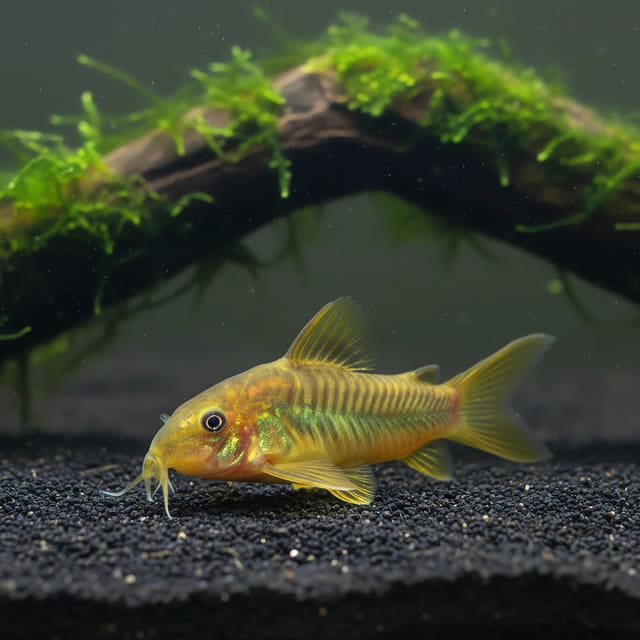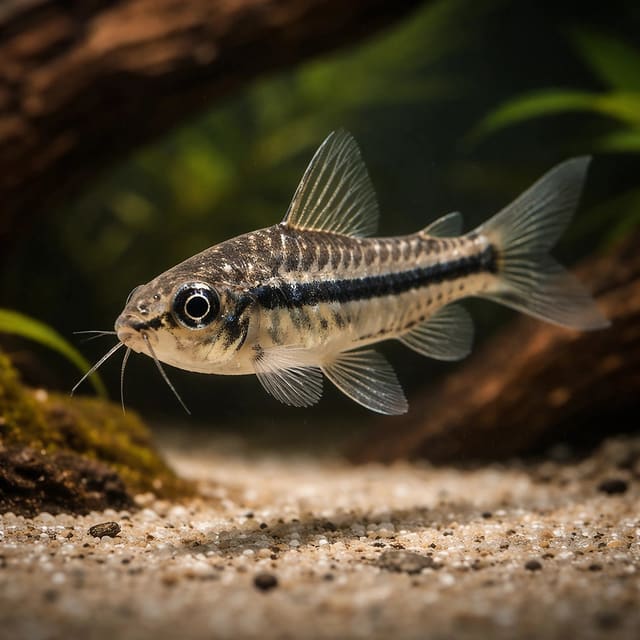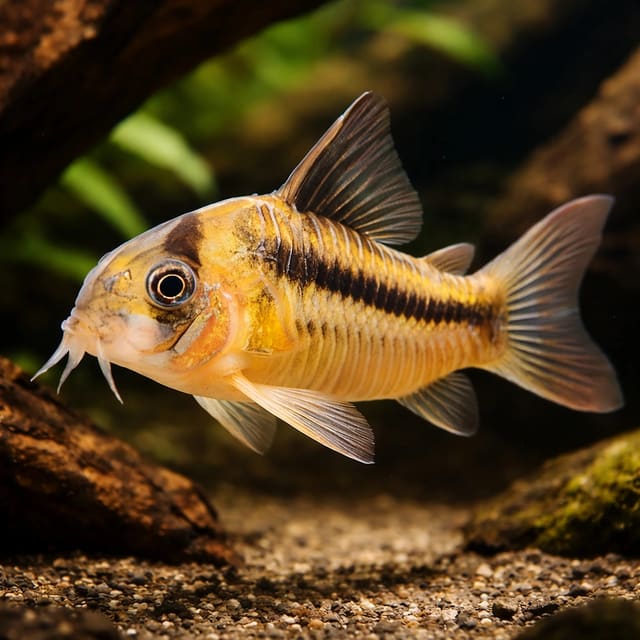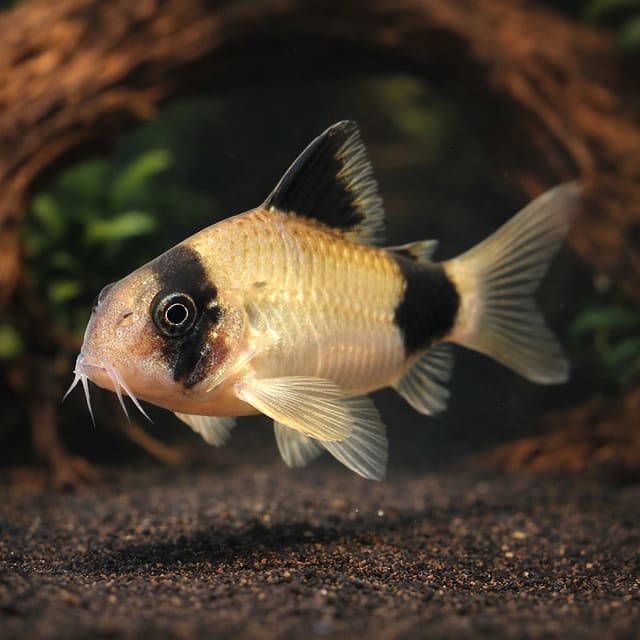
Panda Cory Catfish (Corydoras panda)
22–25°C · pH 6–7.4
From £8.69Some sizes on sale

The Leopard Cory (Corydoras leopardus) is a bottom-living armoured catfish from the western Amazon River basin that reaches 6.1 cm standard length. It suits a mature, filtered community aquarium: OATA advises at least five Corydoras in at least 80 litres, while the FishBase and OATA overlap is 22–25°C, pH 6.0–8.0 and 4–18°dH. Sold individually in 3–3.5 cm and 4–5 cm dispatch sizes.
Adult size is the maximum length this species reaches at full maturity (scientific sources). The livestock you receive will be younger and smaller — pick a size above for the actual shipping size. Product-photo provenance and any image-specific limitations are stated on the listing.
Corydoras leopardus
Shoaling fish: kept in a group they feel safer, stay calmer and show their best colour.
Confirm your email, then we’ll send an availability message for this exact item if it returns within 180 days.
This request is only for this product—no newsletter or other promotions. A mail-provider retry may very rarely duplicate the same availability message. Unconfirmed addresses are removed after 48 hours. See our privacy policy.
The Leopard Cory (Corydoras leopardus) is a bottom-living armoured catfish from the western Amazon River basin that reaches 6.1 cm standard length. It suits a mature, filtered community aquarium: OATA advises at least five Corydoras in at least 80 litres, while the FishBase and OATA overlap is 22–25°C, pH 6.0–8.0 and 4–18°dH. Sold individually in 3–3.5 cm and 4–5 cm dispatch sizes.
Adult size is the maximum length this species reaches at full maturity (scientific sources). The livestock you receive will be younger and smaller — pick a size above for the actual shipping size. Product-photo provenance and any image-specific limitations are stated on the listing.
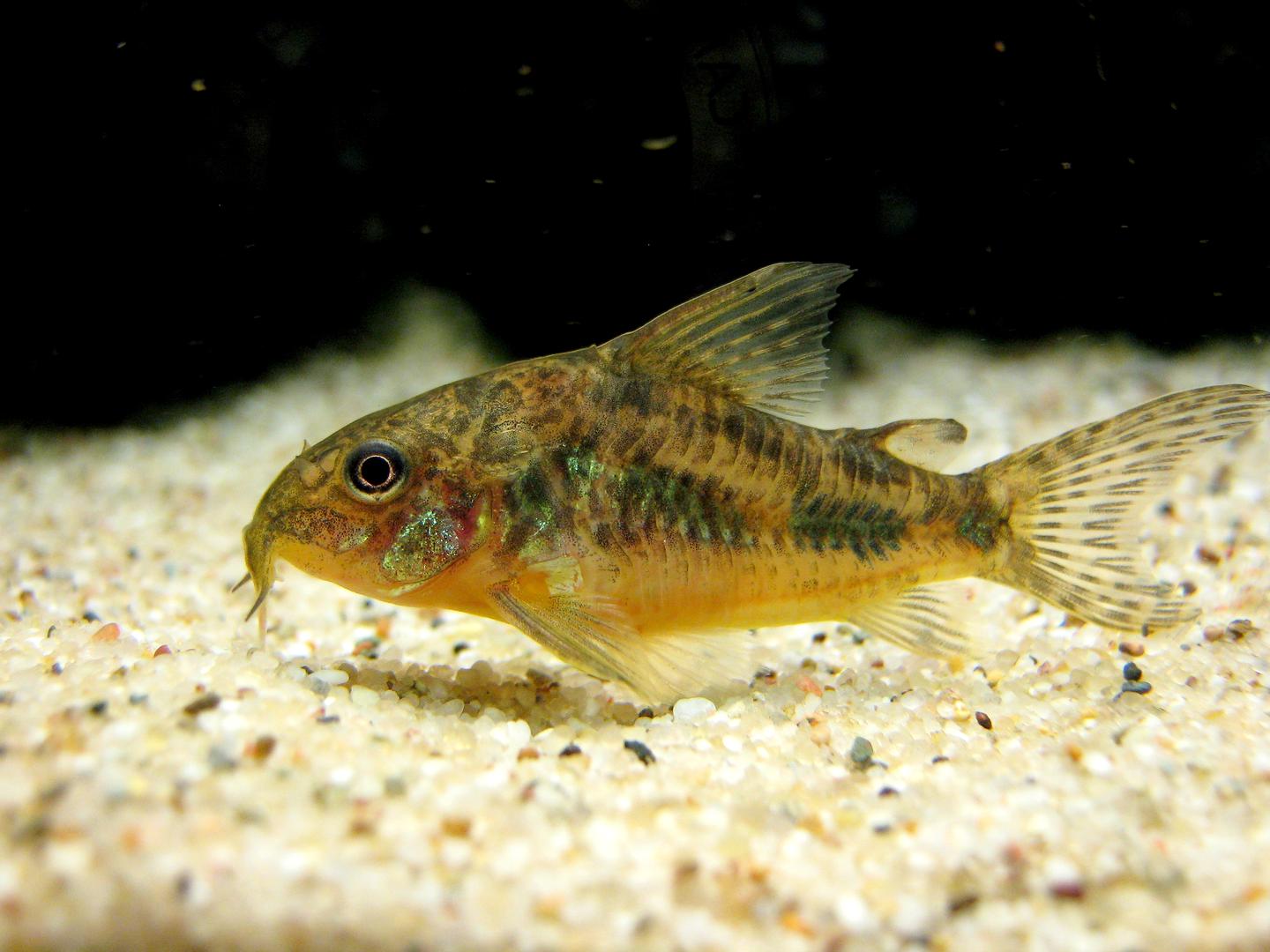
Identify the exact cory catfish before choosing care. Our starting policy for many common medium species is six compatible conspecifics, a mature 60 x 30 cm aquarium of about 60 litres, smooth fine sand and measured species-appropriate water.
Maintain these water conditions for optimal health and vibrant colors
The Leopard Cory is a freshwater, bottom-living member of the armoured-catfish family Callichthyidae. FishBase records this fish from the western Amazon River basin and gives a maximum of 6.1 cm standard length for male or unsexed specimens. It is also a facultative air-breather, so access to the water surface must remain unobstructed. It suits keepers who can provide a mature, filtered community aquarium, maintain stable water and plan for a social Corydoras group.
FishBase now lists it as Brochis leopardus.
The Wikipedia summary of the Leopard Cory explains that it is often confused with the three line cory, Hoplisoma trilineatum. The clearest stated differences are the Leopard Cory’s longer, more pointed snout and its larger eventual size. Treat those as identification clues rather than promises about the precise pattern or proportions of an individual fish.
This is therefore not a combined identity covering several spotted cory species. Use the Leopard Cory name for this animal, allow for natural visual variation, and plan the aquarium around the 6.1 cm maximum recorded standard length. If you are assembling a tightly identified breeding project, compare the fish’s structure carefully rather than relying on a shared Julii-style trade label.
One purchase supplies one animal of the selected option. The live selector uses the labels “3 - 3,5 cm” and “4 - 5 cm”; choose there when ordering rather than relying on a static statement elsewhere on the page. The size you select is the size supplied, not the adult size.
Dispatch length helps you plan the immediate introduction, but all choices require space for the same adult fish. A smaller selection does not describe a different species, a guaranteed age or a guaranteed life stage.
Because each purchase unit is one animal, a planned group of five requires a quantity of five animals. Keep the selected size clear while changing quantity, and check the resulting order before completing it. This avoids mistaking one size choice for a multi-fish pack.
Sex is guaranteed only when the selected option explicitly states male or female. This Leopard Cory listing has no sex-guaranteed option.
Some gallery images are representative, based on reference photographs of this species, and none shows the exact animal supplied, so colours can look slightly different from the live animal.
Keepers comparing this fish with other members of the group can browse the current Corydoras collection. Make the final choice from adult size, social needs, water requirements and compatibility rather than pattern alone.
Three numbers shape the plan: a maximum recorded standard length of 6.1 cm, a group of at least five and an aquarium of at least 80 litres for a shoal of smaller Corydoras. The length comes from FishBase. OATA’s freshwater-catfish guidance supplies the group and aquarium figures. Those OATA figures are group guidance rather than a species-specific optimum.
| Decision | Working figure |
|---|---|
| Adult planning length | Up to 6.1 cm standard length |
| Corydoras group | At least five |
| Aquarium volume | At least 80 litres for the shoal |
| Routine temperature | 22–25°C |
| Routine pH | 6.0–8.0 |
| Routine general hardness | 4–18°dH |
For water, FishBase records 22–25°C, pH 6.0–8.0 and 2–25°dH for the species. OATA gives 22–27°C, pH 6.0–8.0 and 4–18°dH for freshwater catfish. Keep the aquarium at 22–25°C and pH 6.0–8.0, while using the narrower 4–18°dH hardness range. This stays inside the species figures and gives a practical routine range.
| Suits | Not suited to |
|---|---|
| A mature, filtered community aquarium | An aquarium without an established biological filter |
| A Corydoras group of at least five | Keeping one fish or too small a group |
| At least 80 litres for the shoal | A setup below OATA’s group-planning volume |
| 22–25°C and pH 6.0–8.0 | Water outside the stated routine range |
| Community fish screened for water, behaviour and feeding | A mix that creates predation, harassment or feeding exclusion |
Do not treat 80 litres as permission to add five fish to any aquarium of that nominal volume. Check that the established community leaves enough biological capacity for the extra waste and enough usable lower-level space for the group to feed. A larger aquarium offers more stable environmental conditions, but it still requires filtration, testing and maintenance.
Start with a mature, filtered aquarium rather than adding Leopard Corys while a new biological filter is still developing. The filter’s beneficial bacteria process toxic ammonia into toxic nitrite and then into safer nitrate. Both ammonia and nitrite must read zero before the fish enter, and those readings must remain zero after the group is added.
If this is your first setup, follow our guide to preparing and maturing a tropical aquarium before choosing livestock. Maturation is a biological process inside the filter; leaving an aquarium standing with water in it is not the same decision as establishing bacteria able to process fish waste.
OATA recommends live plants as cover for smaller or shy catfish and notes that many catfish appreciate shelter such as wood, pots or caves. Arrange cover without filling every part of the lower level. The group still needs accessible places where sinking food can be placed and where you can check that each fish is feeding.
Choose an aquarium of at least 80 litres for the Corydoras shoal, then assess the existing inhabitants and filter capacity before adding the group. The larger environmental plan matters more than the height of the water alone: every inhabitant contributes waste, uses oxygen and competes for feeding opportunities.
Keep the temperature between 22 and 25°C, pH between 6.0 and 8.0, and general hardness between 4 and 18°dH. Measure the aquarium rather than estimating from regional tap-water descriptions. The relevant values are those in the aquarium after conditioning, heating, décor and routine maintenance have influenced the water.
Our water chemistry guide explains what the common measurements mean, while the water matcher helps compare measured values with this working range. Test before purchase so that any adjustment happens gradually without a fish waiting to be introduced.
| Reading | Action |
|---|---|
| Below 22°C | Stabilise the aquarium within 22–25°C before introduction. |
| Above 25°C | Bring the routine temperature back inside the range gradually. |
| pH outside 6.0–8.0 | Resolve the cause before adding the fish. |
| Hardness outside 4–18°dH | Plan a stable, repeatable water routine before purchase. |
| Ammonia or nitrite detected | Pause livestock additions and restore both to zero. |
Stability does not mean ignoring a poor result. It means correcting the underlying cause through measured, controlled changes instead of repeatedly pushing the value up and down. Test source water as well as aquarium water when a reading shifts unexpectedly; the comparison can show whether the change begins at the tap or inside the tank.
Record the result and date each week. A short sequence of readings reveals movement that a single test can miss, especially after a group is introduced and feeding increases. Temperature, pH and hardness determine whether the setup fits this fish, while ammonia, nitrite and nitrate show whether filtration and maintenance are keeping pace.
The RSPCA explains why aquarium filtration is vital: fish release toxic ammonia, and a working biological filter houses bacteria that convert it first to toxic nitrite and then to safer nitrate. Clear-looking water can still contain harmful dissolved waste, so appearance never replaces testing.
Check the filter for blockages during routine maintenance. If the media needs cleaning, rinse it lightly in aquarium water removed during the partial water change. Do not rinse established biological media under the tap, because chlorine or chloramine may kill part of the beneficial bacterial population.
Add livestock slowly because every extra fish and every increase in feeding asks the bacterial colony to process more waste. Adding a complete new population too quickly can create new tank syndrome, in which the filter cannot yet process the increased ammonia and nitrite. A mature filter is therefore not a permanently fixed capacity; it responds to the biological load placed on it.
Do not replace all established media simply because it looks stained. The useful bacteria live on the media, and preserving that colony is part of preserving water quality. Mechanical debris can be removed gently while leaving the biological system intact. Keep the filter running continuously, inspect it when flow changes, and use test results to judge performance.
OATA describes Corydoras as omnivorous and recommends appropriate sinking foods for catfish. Their reputation as scavengers must not become a feeding plan. Food eaten by midwater fish or left to decay elsewhere in the aquarium does not ensure that the bottom-living group receives a complete meal.
Offer an appropriate sinking food once a day and give only what the fish can eat within a few minutes. Place it where the group can reach it and remain present long enough to see that more than the boldest fish are feeding. The food should be labelled for the needs of omnivorous aquarium catfish and sized so the selected fish can handle it.
| What happens | What to change next time |
|---|---|
| Food remains after a few minutes | Remove the excess and reduce the next portion. |
| Other fish take everything first | Use more than one feeding point and watch the bottom group. |
| Only one or two corys feed | Check access, group behaviour and water quality before adding more food. |
| All food is eaten promptly | Keep the measured portion and continue observing body condition. |
Overfeeding does not compensate for competition. Uneaten food breaks down and releases waste, placing extra pressure on the biological filter. Solve competition by changing placement and checking the proposed community, not by scattering a large surplus through the aquarium.
Feed at a time when you can observe the full group. If a fish shows a reduced intake or loses interest in food, test the water and compare its behaviour with its normal pattern. A change in feeding response is useful early information, particularly when it appears alongside altered breathing, colour or swimming.
Carry out a partial water change of 25% at least once every week. Treat replacement tap water with a conditioner that removes chlorine or chloramine before it enters the aquarium. Match the new water sensibly to the aquarium conditions so routine maintenance does not create an abrupt temperature or chemistry change.
Use a siphon to remove solid waste from accessible areas of the substrate. The aim is to remove settled debris and uneaten food without dismantling the aquarium or destroying the biological filter. Check beneath feeding points and around shelters, where waste may collect out of immediate view.
The nitrate limit is relative to the source water. For example, if conditioned tap water measures 10 mg per litre nitrate, the stated ceiling is 30 mg per litre in the aquarium. If tap water measures 20 mg per litre, the corresponding ceiling is 40 mg per litre. Use the measured baseline rather than assuming every household starts from zero.
Test at least weekly and add extra checks after a livestock addition, a filter interruption or an unexpected behaviour change. Write down the results. A log showing ammonia at zero, nitrite at zero and a stable nitrate pattern is more useful than trying to remember whether a colour looked slightly different the week before.
Finish by confirming that the filter is flowing, the surface remains accessible and no decaying food is trapped around the feeding area. This short sequence joins water changing, waste removal, testing and equipment inspection into one repeatable routine.
Arrange the aquarium and complete the water tests before the delivery day. Someone must be present to receive live fish, so use the confirmed delivery information for the order when planning. Keep the aquarium stable and avoid making an unrelated large change to décor, filtration or water chemistry immediately before introduction.
Read our delivery and Live Arrival Guarantee policy before the parcel arrives. Keep the continuous unboxing video and order number if you need to report a problem on the day of arrival.
A group adds several fish and increases the food entering the aquarium. OATA advises raising the aquarium population slowly because filter bacteria need to respond whenever fish numbers and feeding increase. If other livestock has just been added, wait for stable zero-ammonia and zero-nitrite readings rather than stacking another biological increase onto the same period.
Normal settling can include reduced activity or sheltering, but observation should remain active rather than intrusive. Check whether the group maintains appropriate swimming behaviour, whether breathing is steady and whether any fish shows damage. Offer only a controlled amount of sinking food once feeding begins, then remove excess instead of trying to draw a shy fish out with repeated portions.
During the first week, test ammonia and nitrite more often than the minimum weekly routine if anything changes. The correct response to a detectable reading is to protect water quality and filter function, not to add another fish to make the group look more confident.
Learn the normal behaviour and appearance of the group so a change is easy to recognise. Healthy fish should have clear, bright eyes, undamaged fins, intact external surfaces and swimming behaviour appropriate to the species. Appetite and body condition should remain consistent with the feeding routine.
| Change noticed | First response |
|---|---|
| Hanging at the surface, unusual bottom sitting or erratic swimming | Test water quality and inspect filter operation. |
| Faster or slower gill movement | Check temperature, ammonia, nitrite and recent changes. |
| Darker or paler colour than normal | Compare behaviour, feeding and water readings. |
| More hiding or altered temperament | Review the community and recent disturbance. |
| White spots, fluffy growths, ulcers or fin loss | Record the signs and seek prompt guidance. |
| Reduced food intake or body-condition change | Confirm that food reaches the fish and test the water. |
An occasional trip to the surface can fit the species’ facultative air-breathing biology. A persistent change in surface use, breathing rate or swimming pattern still requires a water-quality check. Judge the change against the fish’s established pattern and the behaviour of the rest of the group.
Start with measured facts: temperature, pH, ammonia, nitrite, nitrate, recent maintenance and the timing of the last livestock addition. Do not apply a disease treatment merely because one sign resembles a condition seen elsewhere. Different water-quality and health problems can produce similar behaviour, while an unnecessary treatment may add another variable.
If you are concerned about a health change, test the water and contact us with the readings, timeline and visible signs. Photographs or a short video can help describe movement and appearance, but continue protecting water quality while guidance is sought.
OATA describes Corydoras as suitable additions to community aquariums, while also warning that catfish compatibility varies. That supports a conditional community placement rather than a universal tank-mate list. Exact outcomes depend on the other animal’s adult size, behaviour, feeding method and water requirements, so assess the complete combination before purchase.
A shared “community fish” description does not answer all six checks. Two animals may fit the same water range but compete strongly at feeding time, or they may feed differently while needing incompatible temperatures. The aquarium must satisfy the combination, not merely each animal viewed separately.
When assessing an existing aquarium, include every resident and its adult size. Also account for recent livestock additions because the filter bacteria may still be responding to the previous increase. If the intended mix cannot be assessed clearly from these factors, contact us with the aquarium volume, measured water values, full livestock list and intended group quantity.
Do not use resemblance as a compatibility test. Another spotted catfish may have different social behaviour or adult size. Likewise, a fish occupying the middle of the aquarium can still affect the cory group if it consumes all sinking food before the bottom fish reach it.
The social requirement and compatibility plan must work together. OATA advises at least five Corydoras because individuals kept alone or in groups that are too small often become stressed. Adding five fish solves only the group-number decision; the aquarium must still accommodate the added biological load and allow all five to reach food.
Watch the first controlled feeding after introduction. If midwater residents intercept the food, place suitable sinking food at more than one accessible point. If a lower-level resident blocks a feeding area, reassess the mix rather than increasing the portion. A larger surplus raises the amount of waste without guaranteeing fair access.
| Observation | Decision |
|---|---|
| Food is taken before it sinks | Change placement and assess competition. |
| Food reaches the bottom but remains uneaten | Remove it and check appetite, stress and water quality. |
| One fish repeatedly prevents access | Reassess the community arrangement. |
| Every cory feeds within a few minutes | Keep the measured portion and observation routine. |
Use shelter to give shy fish cover, but do not hide every feeding point behind décor. You need a clear view of the group during meals and enough access to siphon away uneaten food. This balance lets shelter support confidence without making condition and appetite difficult to assess.
Review compatibility again as fish grow. Dispatch sizes are immediate measurements, while adult planning must use eventual size. A mix that appears spacious around small fish may place a different demand on filtration and feeding access later. Plan for the group at up to 6.1 cm standard length rather than treating the selected dispatch size as permanent.
FishBase records the Leopard Cory at a maximum of 6.1 cm standard length. Plan the aquarium around that adult figure rather than the selected dispatch size.
Use a mature, filtered aquarium of at least 80 litres for the shoal. OATA gives this as group guidance for smaller Corydoras, not a species-specific optimum.
OATA advises keeping Leopard Corys as part of a Corydoras group of at least five because fish kept alone or in groups that are too small often become stressed.
A beginner needs to provide a mature biological filter, zero ammonia and nitrite, stable water, a group of at least five and direct daily feeding with suitable sinking food.
OATA describes Corydoras as omnivorous. Give the Leopard Cory an appropriate sinking catfish food once daily, offering only what the group can eat within a few minutes.
Keep it at 22–25°C and pH 6.0–8.0; this is the overlap of FishBase’s species range and OATA’s freshwater-catfish guidance. Use 4–18°dH general hardness.
OATA places Corydoras in community aquariums, but compatibility still varies. Screen every mix for predation, harassment, lower-level conflict and whether the group can reach its food.
Consider community fish that share 22–25°C, pH 6.0–8.0 and 4–18°dH, cannot prey on or harass it, and allow the Corydoras group to reach sinking food.
Start filming the sealed parcel before opening it, then continue in one take until the Leopard Cory is visible inside the sealed bag. Someone must be present to receive the parcel. Float the bag for 20–30 minutes, then release the fish without pouring bag water into the aquarium.
No reviews for this item yet. Bought one? Honest reviews only, good or bad.
What customers say about ordering from us
I have a small group of long finned mountain minnows. So was delighted to be able to order ten of this variety to increase the genetics in my tank . The ones I recieved are healthy but it’s to early to give a verdict on wether they are of a long finned type since they are small currently.
Gordon Walker · 23 Sept 2026
100% success travel and "installation". Pleased with quality of purchase. The Siamese fighter a bit "shy" so have not yet seen him at his best yet but looking good. Happy customer. GG
George E Garratt · 21 Sept 2026
Reviews of our shop, collected by Judge.me, an independent third-party review collector. Newest first.