By Tropical Fish Co Editorial Team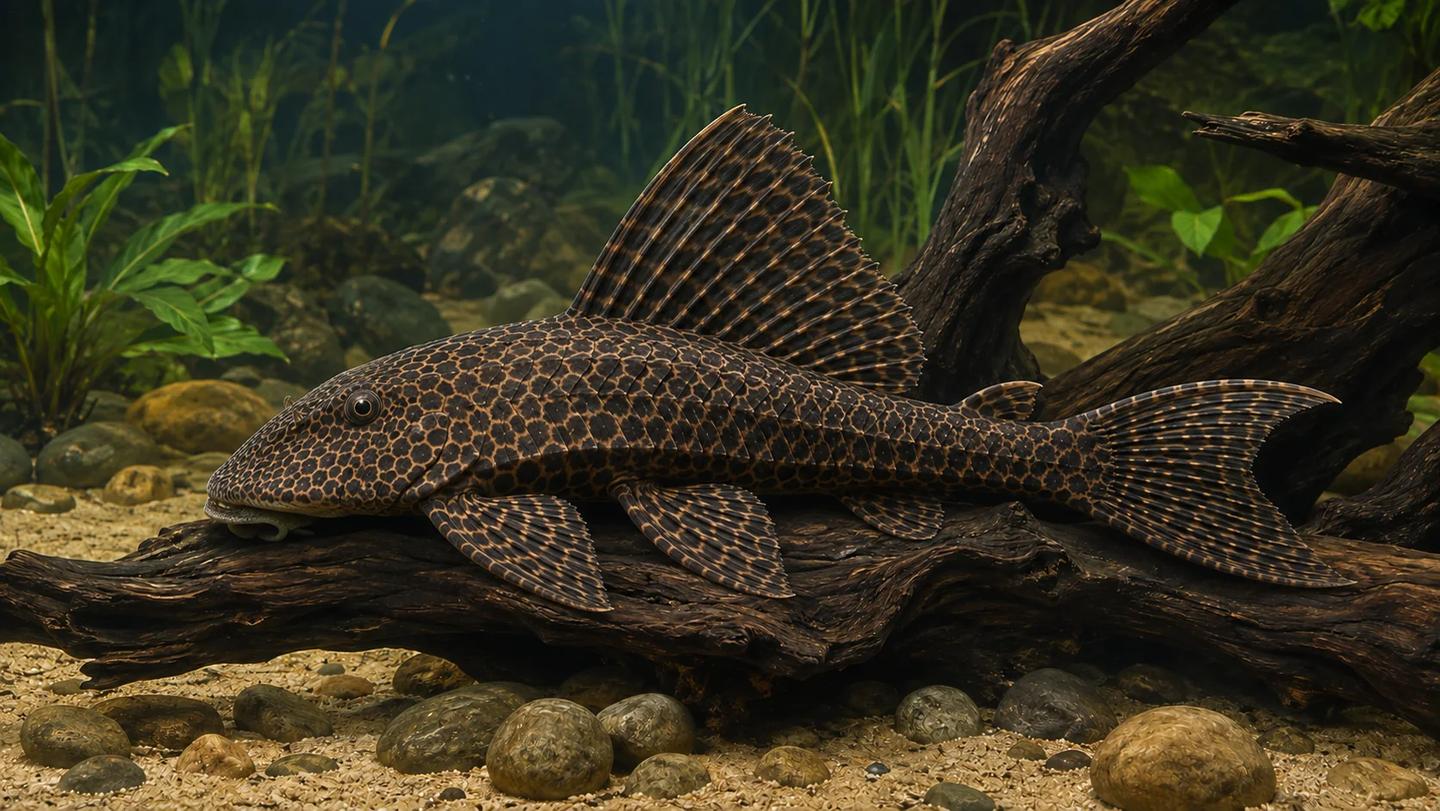
The direct answer
The most important fact about a common pleco is not a tank number. It is that the name may not identify the fish. Hypostomus plecostomus is a valid species, but the 2012 identity revision reports that its name had often been applied erroneously to numerous other fishes. Large Pterygoplichthys sailfin-type plecos are also relevant to the aquarium trade [1] [8].
That uncertainty materially changes adult planning. FishBase records 25 cm maximum standard length for H. plecostomus, while its record for Pterygoplichthys pardalis reaches 57.8 cm maximum total length [2] [4]. Standard length excludes the tail; total length includes it [3]. The two numbers must not be merged into a confident “30–45 cm common pleco” promise.
Ask the seller for the scientific name or defensible L-number, current measured size, likely adult record, source water and feeding history. If identity remains “probably common,” plan for the larger plausible adult or pause the purchase. A cheap juvenile and an algae claim are not evidence that the final fish fits your aquarium.
Common pleco identity: what the name can and cannot prove
Hypostomus plecostomus belongs to Loricariidae, the armoured suckermouth catfishes. FishBase restricts its native range to the Guianas' coastal river systems and notes that reports of introduced fish used in the Asian aquarium trade need further confirmation [2]. That is very different from saying every brown spotted pleco in a UK shop is this species.
Use an evidence ladder:
| Evidence | What it helps establish | What it still cannot guarantee |
|---|---|---|
| Scientific name on the supplier record | A specific claim to verify | That the shipment was identified correctly |
| Defensible L-number and collection or breeding source | A narrower trade identity | Adult outcome without checking the named taxon |
| Several clear full-body and dorsal-fin views | Features that may support or contradict the label | A formal species identification by appearance alone |
| Measured current length | Housing pressure today | Adult size or age |
| Source water and feeding history | A safer transition plan | Universal long-term parameters |
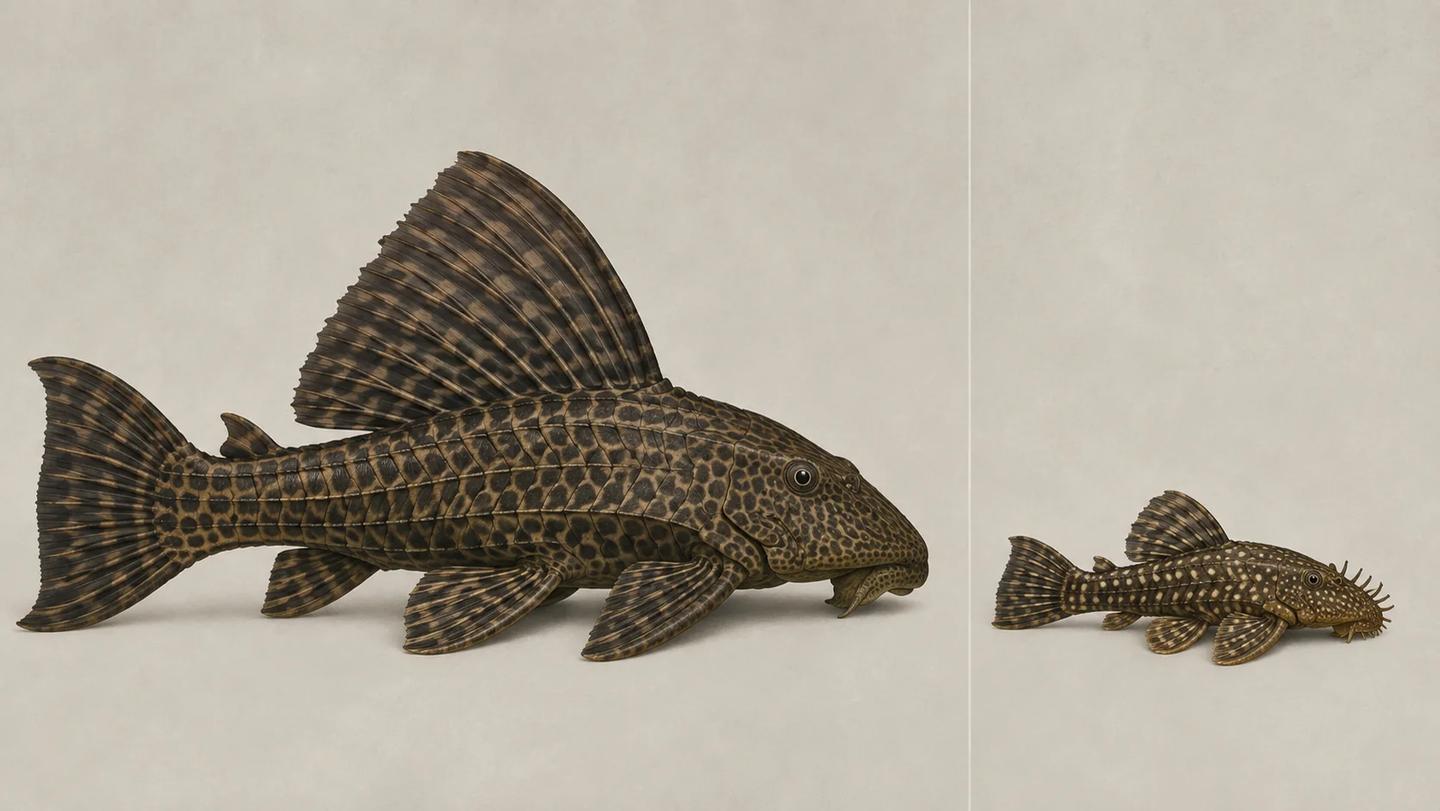
A tall multi-rayed sail can be a reason to investigate Pterygoplichthys, but this page is not a visual key. The hero and gallery are planning illustrations, not vouchers for a retail animal. Exact identity should come from traceable source information plus competent examination, not from matching one search image.
Common pleco size: keep the measurement attached
Search Console shows that “common pleco size,” “common pleco size by age” and “common pleco tank size” are the strongest questions already finding this page. The accurate answer begins with measurement convention:
| Named record | FishBase figure | Measurement | Responsible interpretation |
|---|---|---|---|
| Hypostomus plecostomus | 25 cm maximum | Standard length | Tail fin excluded; a named-species record, not every trade fish |
| H. plecostomus | 28 cm common length | Total length | Tail included; “common length” is not a guaranteed adult size |
| Pterygoplichthys pardalis | 57.8 cm maximum | Total length | A large sailfin example relevant to identity risk, not every specimen's outcome |
The former page said the true H. plecostomus reaches 30–40 cm and combined it with sailfin values. That did not match the current FishBase record. The repair keeps every number beside its taxon and measurement method.
Why the old size-by-age chart was removed
The previous chart promised 12–20 cm at 6–12 months, 20–30 cm at 1–2 years and 30–45 cm after three years. None of the cited sources established that schedule. Growth varies with species, starting age, temperature, nutrition, health and conditions; a trade fish may also arrive with no dependable birth date.
Measure the fish from consistent photographs or a safe viewing position, record the date and compare the current setup with the verified adult plan. Do not delay suitable housing because an unsupported chart says the upgrade can wait.
Tank size: answer the litres question without false precision
The reviewed scientific records describe fishes; they do not prescribe one aquarium minimum. The UK welfare and trade sources emphasise adult size, tank dimensions, mature filtration, stable water and species-specific advice [9] [6]. Therefore this guide does not repeat the old unsupported “300 L minimum, 400 L recommended” rule.
Litres alone can hide the features a large bottom fish actually uses. Before purchase, write down:
- the exact or largest plausible adult dimensions, including the measurement method;
- internal tank length and width after substrate, wood and rocks displace space;
- whether the fish can turn, rest fully supported and move between shelters without abrasion;
- the final adult stock, not just today's juveniles;
- filtration and oxygen capacity for the real feeding and waste load;
- accessible feeding places and a secure, cycled separation option;
- a realistic home for the adult if your own final system cannot accommodate it.
Tank Volume Calculator
Enter length, width, and height to get your real water volume in litres.
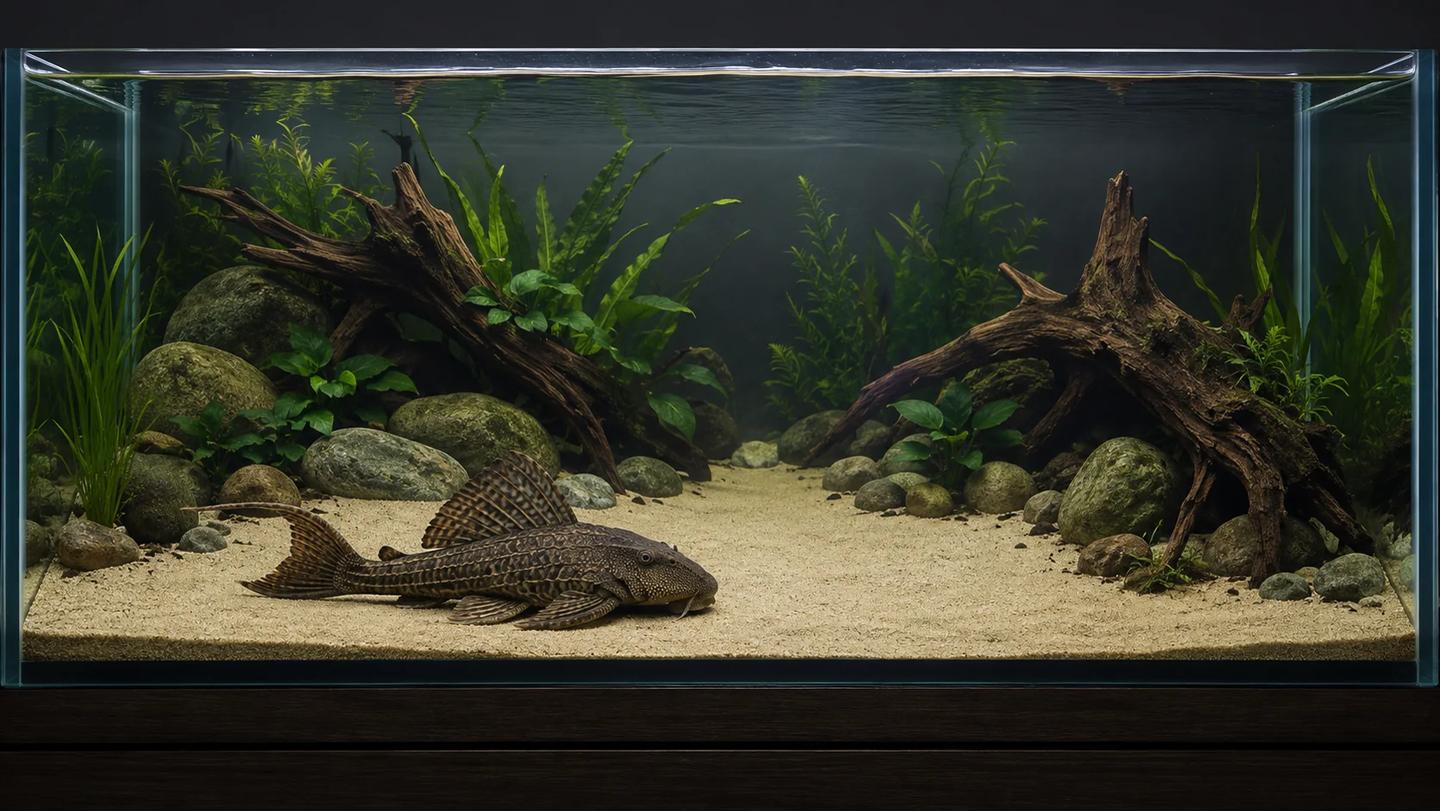
Open tool →The tank-footprint gallery visual intentionally shows the whole aquarium. It is not a minimum-size template or a promise that one attractive aquascape can house every fish sold under the common label.
Common pleco, sailfin or bristlenose?
These names are not interchangeable:
| Label | Identity checkpoint | Adult-planning consequence |
|---|---|---|
| Common pleco / common plec | Do not assume H. plecostomus; demand source evidence | Use the largest plausible verified adult record until identity is resolved |
| Sailfin pleco | Confirm the Pterygoplichthys species rather than the fin alone | Some named records are very large; ordinary community-tank assumptions may fail |
| Bristlenose pleco | Confirm Ancistrus and any known lineage | A different, generally smaller-bodied group with its own food, space and social decisions |
| Clown pleco | Confirm the exact Panaqolus or L-number | Do not borrow size or feeding claims from a generic “clown” label |
Our Pleco Fish Guide owns broad family and type comparison. The Bristlenose Pleco Guide, Bristlenose Size Guide, Ancistrus Guide and Clown Pleco Guide own their narrower decisions. This page remains the owner of common/sailfin identity risk, adult size and final-space planning.
Water parameters in a UK aquarium
FishBase's named records differ:
| Named record | Temperature | pH | Hardness |
|---|---|---|---|
| H. plecostomus | 20–28°C | 6.2–8.2 | Upper compiled value 28 dH; lower value not supplied |
| P. pardalis | 23–28°C | 7.0–7.5 | 10–20 dH |
These are compiled evidence ranges, not instructions to move a fish between limits. If the retail identity is uncertain, they cannot safely be averaged into one “common pleco” care card. Ask for the seller's holding water, test the aquarium, and choose a stable point supported by the actual identity and all tank mates.
UK tap water is not one chemistry. The Drinking Water Inspectorate says hardness varies with local geology and directs consumers to their supplying water company for local information [11]. Use that as context, then measure the aquarium. OATA's broad catfish guidance also requires mature filtration with ammonia and nitrite at zero [6].
Water Parameter Matcher
Enter your tap water readings to see if this species will thrive.
Open tool →Food, algae and wood: three claims to separate
Algae grazing is not tank maintenance
FishBase records algae and small crustaceans in the natural diet of H. plecostomus [2]. That does not prove that an unidentified trade fish will clean a particular algae, keep cleaning as it grows or live on whatever appears on the glass. OATA explicitly says algae-eating fish do not replace maintenance and require supplementary food [5].
Choose the fish because its complete adult care fits. Treat any algae grazing as behaviour, not a guaranteed service.
Supplementary food must follow identity
Use a suitable complete sinking food as the dependable base, then add identity-appropriate plant, animal or detrital items according to trustworthy source guidance. Observe after lights change so you know the fish actually eats, and prevent faster tank mates from taking every sinking item. Adjust amount and placement from body condition and measured water quality rather than a universal wafer count.
Wood is structure, not a universal complete meal
Wood can provide cover, rasping surfaces and environmental complexity. It should not be described as something every pleco must digest. A primary digestive study of selected Panaque, Hypostomus and Pterygoplichthys relatives found that the tested fishes did not efficiently digest fibrous wood like true wood-digesting animals [7]. That study did not test every common-pleco trade fish, so the correct conclusion is modest: verify species-specific habitat and diet, and never use wood as a substitute for complete nutrition.
How many common plecos, and which tank mates?
The live mobile SERP asks how many plecos should be kept together and whether they eat other fish. No responsible answer comes from the common name alone. Adult territory, identity, sex, shelter, feeding access, water and usable floor area all matter.
Use this screen before adding another pleco or community fish:
| Check | Better sign | Stop or separate when |
|---|---|---|
| Adult space | Each fish can rest, turn and reach distinct shelter | One fish controls all usable bottom space |
| Water overlap | One stable setting suits every verified species | A fish sits at the edge of its evidence range |
| Feeding | Each fish reaches its own suitable food | Blocking, weight loss or repeated displacement occurs |
| Contact | Fish disengage and use the aquarium normally | Rasping, wounds, trapped fish or persistent pursuit appears |
| Waste and oxygen | Tests stay stable under the real feeding load | Ammonia/nitrite appear or oxygen stress develops |
| Contingency | Suitable cycled separation is ready | There is nowhere safe for a targeted or injured fish |
Do not call a common pleco an active fish predator from its label, but do not promise that every pairing is harmless. The named H. plecostomus record includes small crustaceans in its natural diet, and an unidentified trade fish may be another species [2]. Therefore ornamental shrimp, shrimplets and fry are not guaranteed safe; use a fish-free nursery or species-only invertebrate setup when maximum survival matters. Investigate missing fish, injuries and abnormal contact using actual observations. Use the tank-mates tool as a starting screen, then verify each named species and the complete adult system.
Arrival and health without a fixed drip recipe
The old page called the fish a hardy shipper and prescribed 30 minutes floating, a 45–60-minute drip, no food for 24 hours and fixed lighting times. Those rules were not supported by the cited source and could conflict with the seller's packing method, bag-water chemistry or current fish condition.
Before arrival, prepare a mature heated system or suitable quarantine space, calibrated tests, a secure shelter and the exact food plan. On arrival:
- inspect the bag and fish before opening;
- follow the current seller's shipment-specific instructions;
- avoid mixing incompatible acclimation routines;
- transfer with equipment that cannot snag or crush the fish's spines and plates;
- observe breathing, posture, skin, fins, attachment, movement and feeding access;
- record water results and escalate severe or persistent signs rather than guessing a treatment.
The MSD Veterinary Manual supports a complete history, water-quality assessment, quarantine and diagnosis before targeted treatment [12]. This page therefore does not prescribe salt, heat, medication or a symptom-based dose. Use our new-fish acclimation guide and seek a fish-experienced veterinary professional when appropriate.
Buying in the UK: verify before checkout
Search results mix informational guides, category pages and individual fish listings. This page owns the pre-purchase decision, not today's stock, price or sale size. Before checkout, confirm:
- the exact scientific name or defensible L-number on the current listing and invoice;
- current measured sale size and how it was measured;
- the source or breeding information the retailer can actually support;
- likely adult record and whether the final tank is ready now;
- seller water, feeding history and shipment-specific arrival instructions;
- the sale unit and quantity—never infer one fish, a pair or a group from a photograph;
- a workable rehoming route before an emergency develops.
Browse the current catfish and pleco range only after completing those checks. The live shop owns current availability, price, size and checkout; this guide intentionally does not freeze those facts or promote an uncertain SKU as H. plecostomus.
Pause the purchase or plan against the largest credible adult candidate. Do not choose the most convenient scientific name, shrink the expected adult size or rely on a generated or stock image. A smaller verified bristlenose-type option may be worth investigating, but it also needs its own identity check.
Rehoming and the UK release rule
Start rehoming before water quality, movement or body condition deteriorates. Give potential keepers an honest measured length, clear recent full-body images, every identity record, the actual water and feeding history, health concerns and the final-space requirement. Contact the original retailer, reputable specialist aquatic shops, established clubs, rescue contacts or public aquariums; availability and acceptance are never guaranteed.
Never release the fish or aquarium water into the wild. GOV.UK explains that the Wildlife and Countryside Act 1981 bans release of animals that are neither resident nor regular wild visitors in Great Britain [10]. The rule is enough: do not rely on the mistaken argument that a tropical fish will simply die in winter.
Pterygoplichthys also deserves global context. The reviewed synthesis describes aquarium-traded members of the genus as exceptionally successful invaders in suitable climates [8]. That does not identify every common pleco or claim a British population; it explains why containment and responsible rehoming matter.
How this guide was checked
The identity boundary comes from the peer-reviewed 2012 H. plecostomus revision. FishBase supplies named-species size, measurement, distribution, diet and environmental records. OATA and the RSPCA provide UK husbandry and welfare context; the Drinking Water Inspectorate provides local-water context; primary digestive research bounds the wood claim; GOV.UK and the Pterygoplichthys invasion synthesis support containment and release guidance.
Search Console shows that this exact URL is submitted, indexed, fetched successfully as mobile and selected as its own canonical. In the latest 28-day UK-mobile window it recorded 184 Web impressions and zero clicks at average position 5.62, including 33 impressions for “common pleco” at position 4.03 and 32 for “common pleco size” at position 6.28. Google Images recorded 619 impressions and zero clicks, dominated by the broader “pleco” and “pleco fish” terms. The page therefore has a snippet, identity and image-usefulness problem—not an indexing failure.
The broader Pleco Fish Guide remains the family/type owner. A 90-day query-and-page check found the common-pleco and size intent overwhelmingly assigned here, so this page remains separate instead of being consolidated. It now focuses on exact identity risk and adult planning rather than competing for every “pleco” query.
Three distinct, rights-complete visuals replace the undocumented single hero and the mismatched image that had been called a warehouse photograph of H. plecostomus. Their captions state what they illustrate and what they cannot prove. No ranking, click, image-search, engagement or revenue improvement is claimed until the exact release is deployed, recrawled and compared over an equal window.
Forms, email, corrections, feedback and newsletters are never counted as leads or ecommerce conversions. Add-to-cart and checkout are diagnostic commerce steps; purchase and revenue are the final commercial outcomes.
Continue with the right owner
- Use the Pleco Fish Guide to compare pleco identities and evidence across the trade group.
- Use the Bristlenose Pleco Guide and Bristlenose Size Guide before assuming a smaller spotted fish is Ancistrus.
- Check the Ancistrus Guide or Clown Pleco Guide only when the relevant identity is supported.
- Browse the live catfish and pleco range for current commercial facts after the adult plan is complete.