By Tropical Fish Co Editorial Team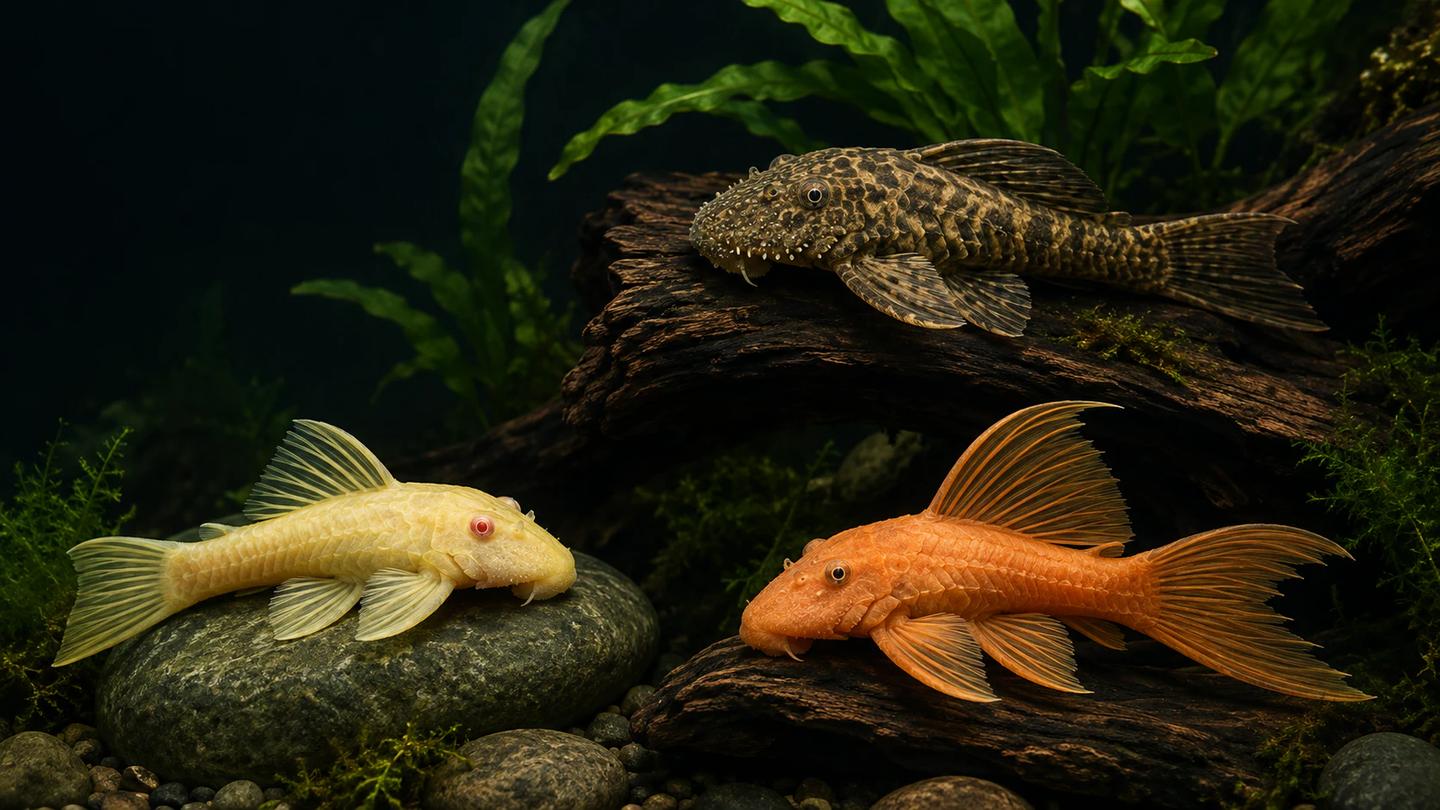
The useful answer is short: Ancistrus is a genus; bristlenose pleco is a common trade name. They overlap, but they are not interchangeable proof of one exact species. If a listing says only Ancistrus sp., it is making a genus-level identification. If it adds an L-number, colour or fin label, read that as another field—not as an automatic scientific name.
- Is the name a full scientific binomial, Ancistrus sp., an L-number or only a common name?
- Does the seller separate species or provisional identity from colour and fin form?
- Is sale size clearly different from expected adult size, with the length method stated where it matters?
- Is the picture described as the exact fish, the offered line, a representative stock image or an illustration?
- Are source, sex and age stated only when known rather than inferred from colour?
- Do the live product option, unit, price and availability still match at checkout?
Ancistrus, bristlenose and pleco are different kinds of label
Ancistrus Kner, 1854 is a genus within the armoured suckermouth catfish family Loricariidae. “Bristlenose pleco” and “bristlenose catfish” are practical aquarium common names. “Pleco” is broader again: it is used across many loricariid catfish and therefore cannot establish Ancistrus on its own[1].
That distinction matters because a small juvenile sold as “a pleco” may not share the adult dimensions or needs of commonly traded bristlenose forms. It also matters in the other direction: adding “bristlenose” does not turn an undocumented trade fish into confirmed Ancistrus cirrhosus.
Research on sampled Ancistrus populations has found distinct evolutionary lineages where morphology and colour alone left the taxonomic picture unclear[2]. FishBase likewise warns that references attached to A. cirrhosus require care pending taxonomic revision[4]. Neither source identifies an aquarium-shop fish. Together they explain why a cautious genus-level label can be more truthful than a confident but unsupported species name.
| Label on a listing | What it can tell you | What it cannot prove |
|---|---|---|
| Ancistrus | Proposed genus | Exact species, source or captive line |
| Bristlenose pleco | Familiar trade group | A formal taxon |
| Pleco | Broad aquarium common name | That the fish is Ancistrus |
| Ancistrus sp. | Genus stated, species unstated | Which species is supplied |
| Colour or longfin name | Visible or selective trade trait | Species, ancestry or identical care |
| L-number | A loricariid trade identifier | A permanently valid scientific name |
How to read sp., spp. and cf.
Open nomenclature makes uncertainty visible instead of hiding it. Sigovini and colleagues explain that qualifiers are used when an identification cannot responsibly be presented as settled, while also warning that usage varies across data and authors[3].
Ancistrus sp.
“Sp.” is singular: the genus is given, the species is not. On a retail record, ask whether that reflects a genuinely unresolved identity, a supplier shorthand or missing catalogue work. Do not silently expand it to A. cirrhosus.
Ancistrus spp.
“Spp.” is plural: more than one species within the genus. It is suitable for a genus-wide statement, not the identity field for one individual fish.
Ancistrus cf. name
“Cf.” means “compare with”. It expresses resemblance plus uncertainty. A useful record should say what supports the comparison and what remains unresolved. It is not a decorative way to make a listing sound more scientific.
Accuracy comes from traceable evidence. A careful Ancistrus sp. can be more reliable than a full binomial copied through supplier lists without diagnostic or provenance support.
What an L-number adds—and what it does not
The L-number convention was developed in the aquarium community to distinguish loricariid forms before or alongside formal taxonomic work. A recent Loricariidae review describes this aquarium-origin system and notes that many numbered forms have since been assigned valid species names[5].
That history creates three practical rules:
- Keep the number and the scientific name as separate fields. Check whether current taxonomic work links them.
- Keep locality or exporter information separate again. A repeated number does not prove two fish share a documented origin.
- Do not infer adult size or care from the letter L. It covers diverse loricariids, not one husbandry profile.
When a number is important to the buying decision, retain the supplier wording and ask what record supports it. Do not “upgrade” an uncertain fish by guessing the most commercially attractive number.
Colour, eye and fin names describe traits—not taxonomy
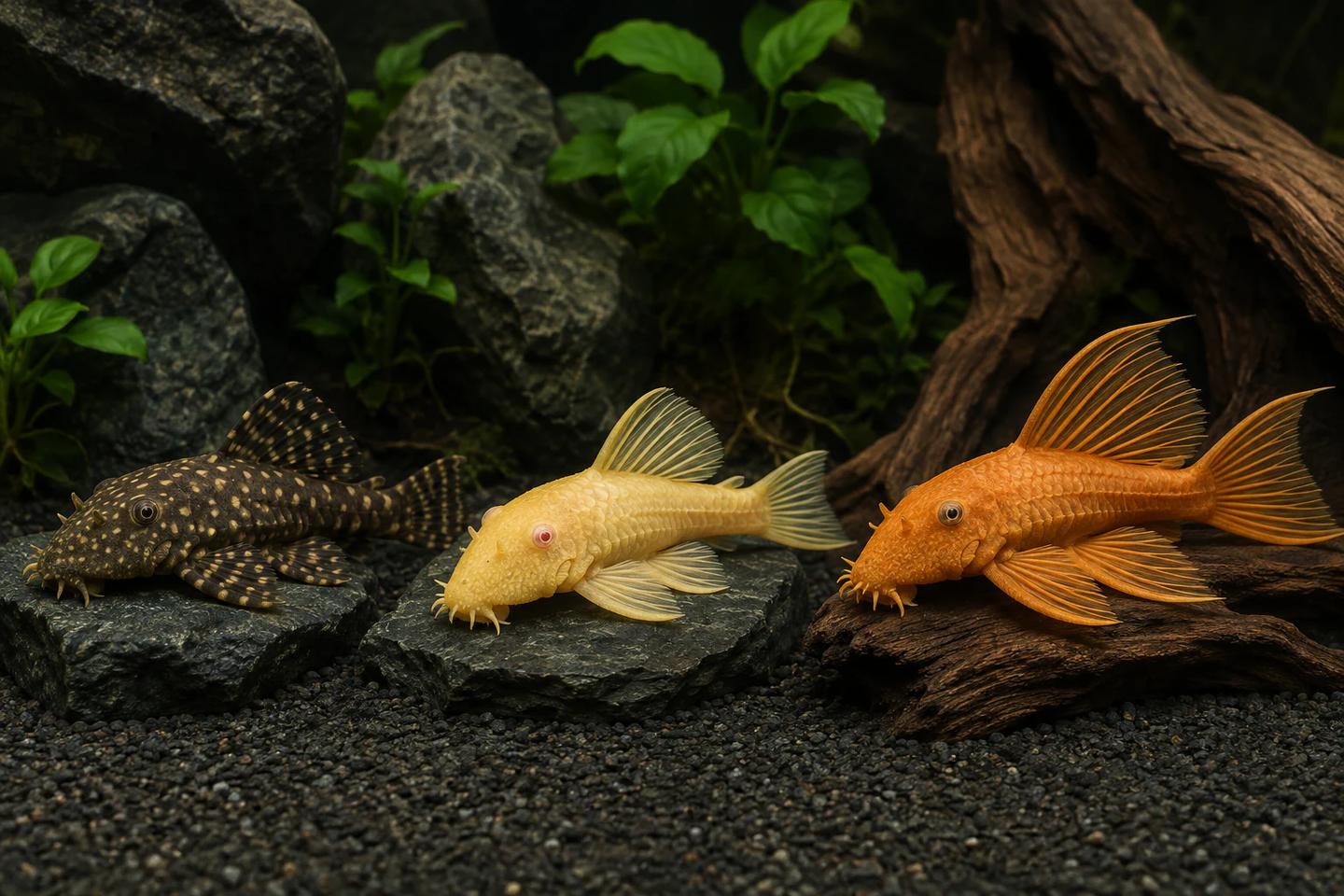
Standard, albino, lemon, golden, super red, snow white and longfin are common kinds of aquarium-trade wording. They can help a customer select an appearance, but they should not be allowed to replace the identity field.
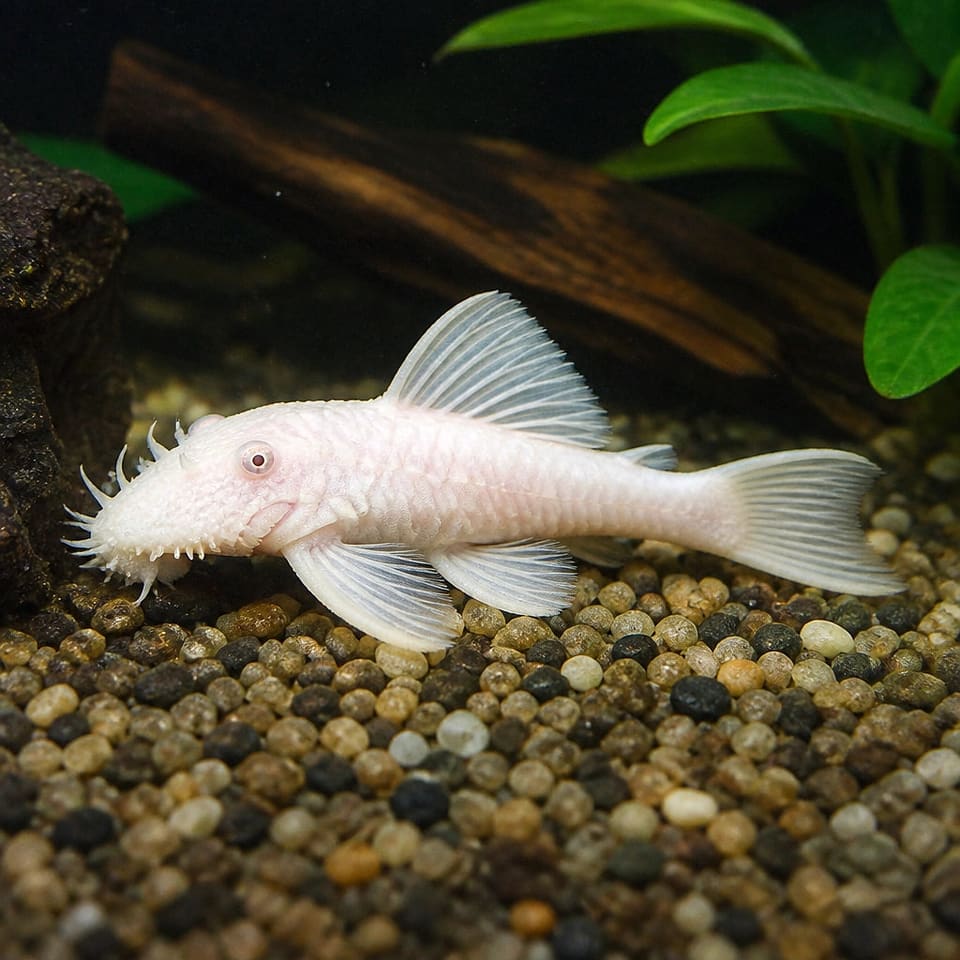
Colour is especially weak evidence by itself. Lighting, stress, age, substrate, editing and selective breeding can all change what a customer thinks they see. “Longfin” describes extended fins; it does not demonstrate a new species. A pale fish with red-looking eyes can support an albinism description, but it does not establish its complete lineage.
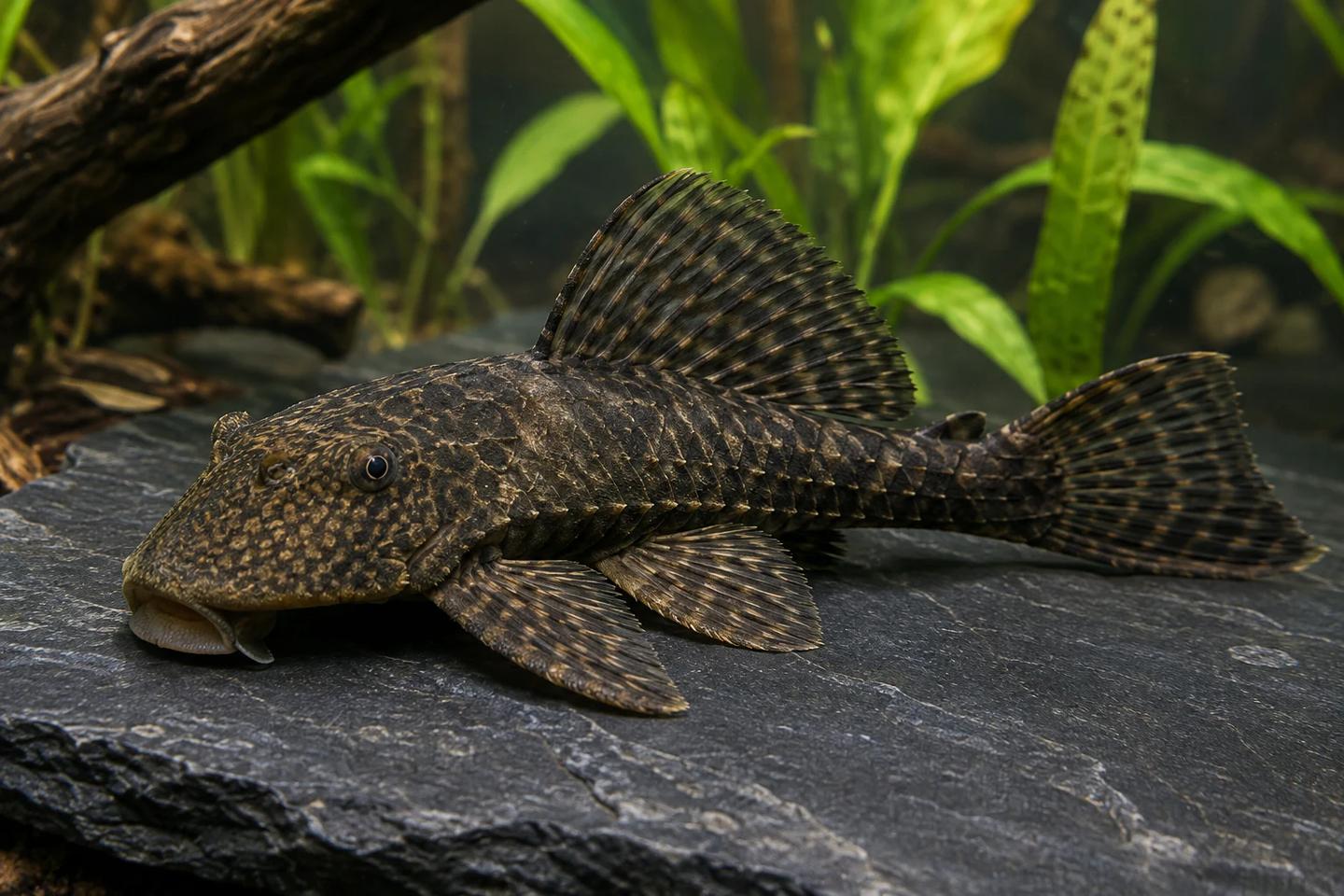
The three original illustrations on this page intentionally show different trade appearances. They are educational references, not current-stock photographs. Their captions state the limit because image search should help a reader understand the page—not turn a plausible visual into false specimen evidence.
What can you learn from the head and body?
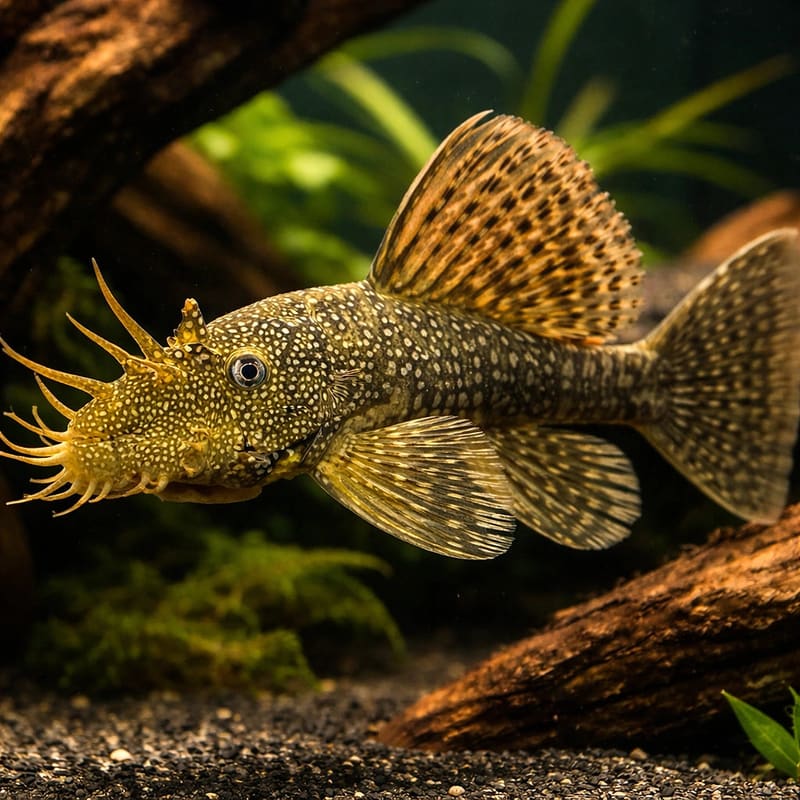
Commonly traded bristlenose forms have a flattened armoured body, a ventral sucker mouth and, in mature males, conspicuous soft fleshy structures on the snout. Those are useful observation clues. They are not a complete identification key.
Avoid three shortcuts:
- “It has bristles, so it is definitely this species.” A genus-level clue is not species proof.
- “It has no bristles, so it is female.” Juveniles and species variation make that conclusion unsafe from one photograph.
- “It is brown with spots, so it is wild type.” Appearance does not establish ancestry or collection origin.
If exact identity matters, ask for clear side, dorsal and head photographs, the supplier name, any locality or lineage record, how the fish was labelled before arrival and whether the seller is expressing uncertainty. Defra's current English seller guidance expects prospective owners to receive care information and to be told the country of origin, species, age and sex where known[7]. “Where known” is important: unknown should remain unknown.
Choose the right page for the question you actually have
This guide deliberately stops before repeating every Bristlenose answer. Clear ownership helps readers and search engines:
- For adult length, sale size, measurement method, sex and type comparison, use the Bristlenose Pleco size and types guide[8].
- For water, diet, habitat, territory, compatibility and health planning, use the Bristlenose Pleco care guide.
- For a broader comparison with large loricariids, read the Common Pleco guide and the general Pleco care guide.
- For current products, selectable sizes, prices and availability, use the live Bristlenose Pleco shop[9].
OATA's broad UK algae-eater guidance is useful for welfare screening, but it is not a species-level identification key and it does not make any fish an automatic aquarium cleaner[6]. Identity comes first; then use the correct care record for the fish actually offered.
Check the live listing without freezing volatile claims
The product shown below is a live candidate from the site's current Bristlenose catalogue. Its name, variants, sizes, price, availability and image can change. Open the individual product and perform the identity check above; this article does not certify every live card as the same exact species or line.
Check the current common Bristlenose record
Open the live product for today's exact displayed name, selectable size, sale unit, price, availability and image. A product card is commercial evidence, not a taxonomic voucher.
If the record uses only Ancistrus sp., keep that uncertainty. If it gives a binomial or L-number, look for the evidence behind it. If the exact option is unavailable, do not substitute a different pleco merely because the juvenile silhouette looks similar.
A durable six-field record for an Ancistrus listing
For future catalogue work, store these facts separately:
| Field | Example format | Quality rule |
|---|---|---|
| Accepted or proposed taxon | Ancistrus sp. | Never invent the species epithet |
| Common trade name | Common Bristlenose Pleco | Useful wording, clearly non-formal |
| Provisional identifier | L-number or cf. label | Preserve its source and uncertainty |
| Appearance | Brown spotted, pale, orange, longfin | Do not convert trait to taxon |
| Size | 4–5 cm TL or SL | Separate sale size from adult evidence |
| Provenance | Captive line, supplier or locality if documented | Unknown is better than a guess |
This structure also improves future corrections. A taxonomic update can change the first or third field without erasing the retail name customers recognise, and a colour variant can change without rewriting the species.
Editorial method and corrections
The Tropical Fish Co Editorial Team rebuilt this page from current taxonomy, genetics, open-nomenclature, UK trade guidance, owned Search Console and GA4 evidence, and a narrow UK-mobile SERP check. Scientific sources establish what the labels can support; they do not authenticate one live retail fish. The page contains no claimed staff observation, no guaranteed sexing, algae, breeding, survival, delivery or lifespan result, and no static price or stock promise.
The illustrations were produced for this guide after comparing multiple independent Ancistrus visual references. They are labelled internally as synthetic editorial assets and publicly described as illustrations. They must not be used as proof of a product's identity or current appearance.
If you can document an identification or wording error, use the contact and correction page and include the page URL plus the source you think resolves it. That message supports editorial correction; it is not counted as an ecommerce lead, add-to-cart, checkout or purchase. Only genuine commerce events and revenue are evaluated as ecommerce outcomes.
References
The source list below is intentionally mixed by role: peer-reviewed taxonomy and genetics for scientific boundaries, current databases for name checking, UK guidance for buyer information, and live site records for volatile commerce. Each citation states what it does not prove so a source cannot be stretched beyond its evidence.