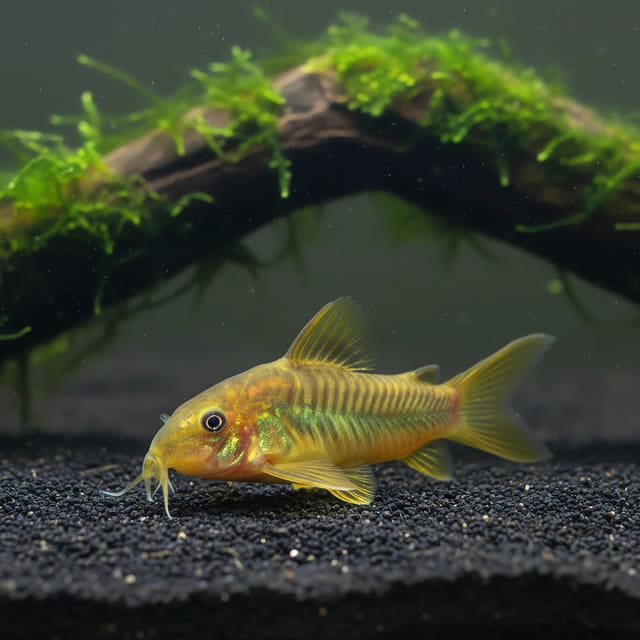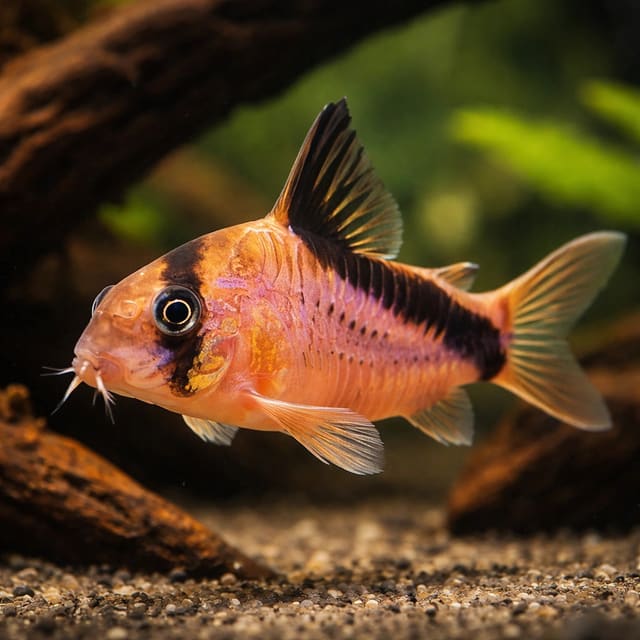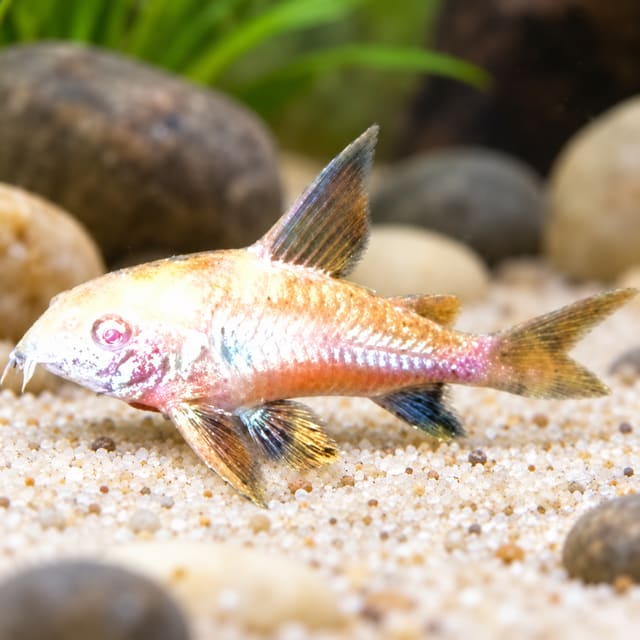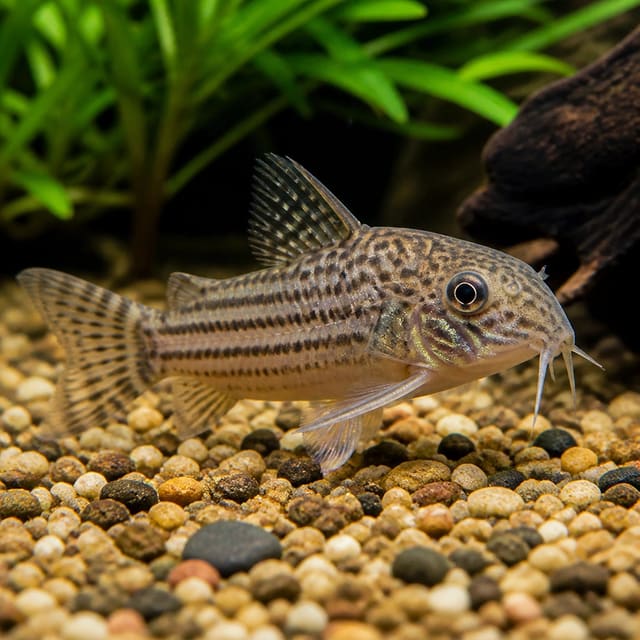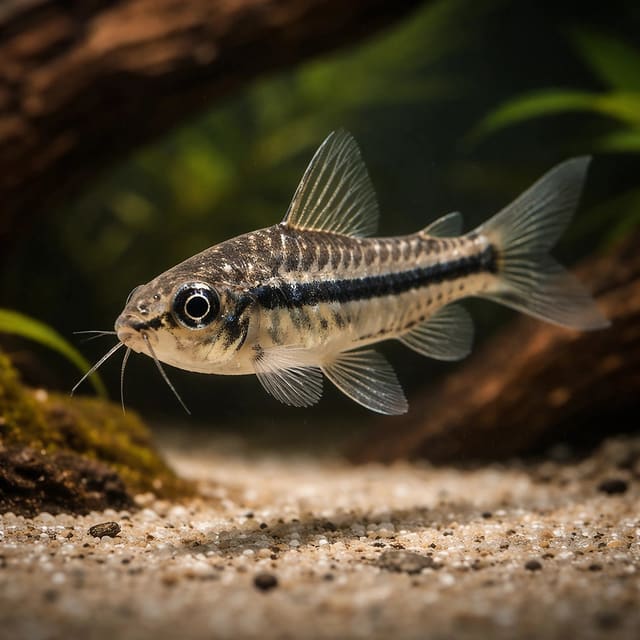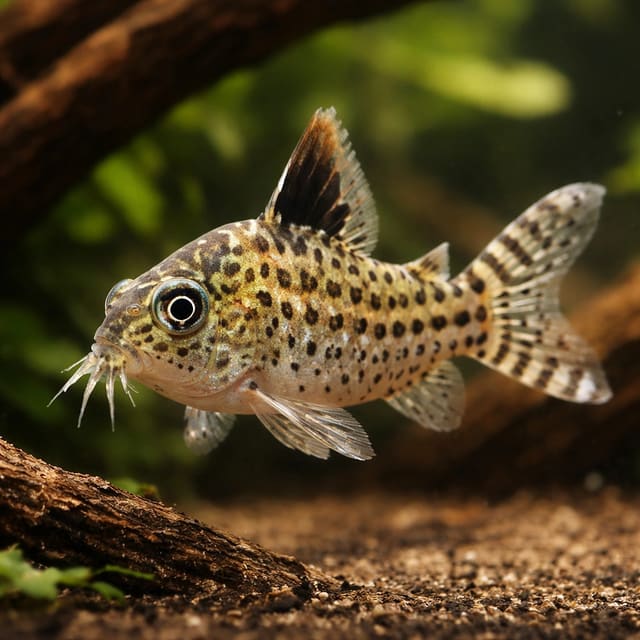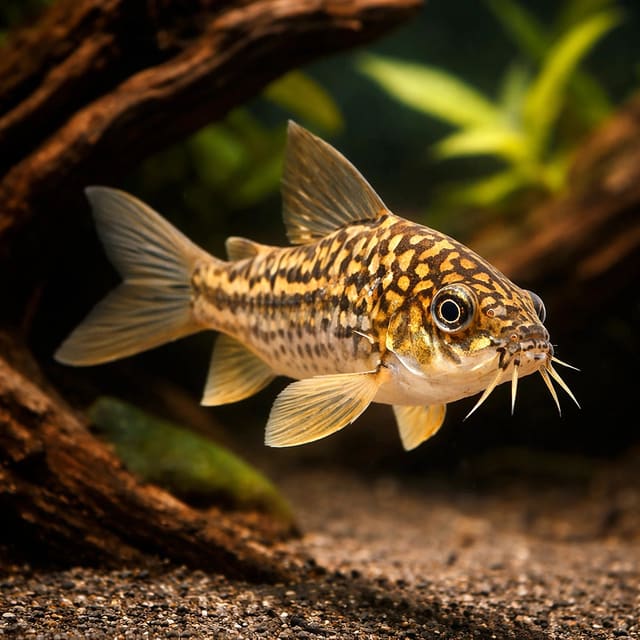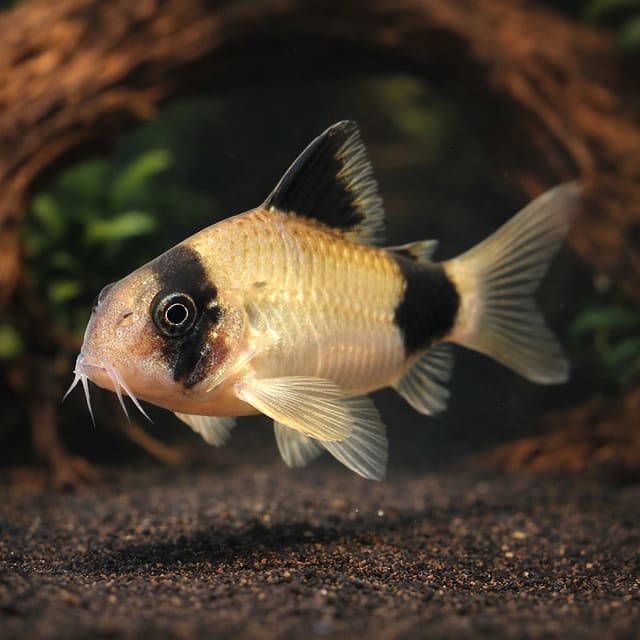
Panda Cory Catfish (Corydoras panda)
22–25°C · pH 6–7.4
£7.29
The Longfin Panda Cory (Hoplisoma panda) is a peaceful callichthyid catfish from the upper Amazon River basin in South America that reaches 5 cm standard length. It suits mature community aquariums with at least six fish, 22–25°C water and pH 6.0–7.4. Sold individually in sizes from 2.5 cm to 4–5 cm.
Adult size is the maximum length this species reaches at full maturity (scientific sources). The livestock you receive will be younger and smaller — pick a size above for the actual shipping size. Product-photo provenance and any image-specific limitations are stated on the listing.
Hoplisoma panda
Shoaling fish: kept in a group they feel safer, stay calmer and show their best colour.
The Longfin Panda Cory (Hoplisoma panda) is a peaceful callichthyid catfish from the upper Amazon River basin in South America that reaches 5 cm standard length. It suits mature community aquariums with at least six fish, 22–25°C water and pH 6.0–7.4. Sold individually in sizes from 2.5 cm to 4–5 cm.
Adult size is the maximum length this species reaches at full maturity (scientific sources). The livestock you receive will be younger and smaller — pick a size above for the actual shipping size. Product-photo provenance and any image-specific limitations are stated on the listing.
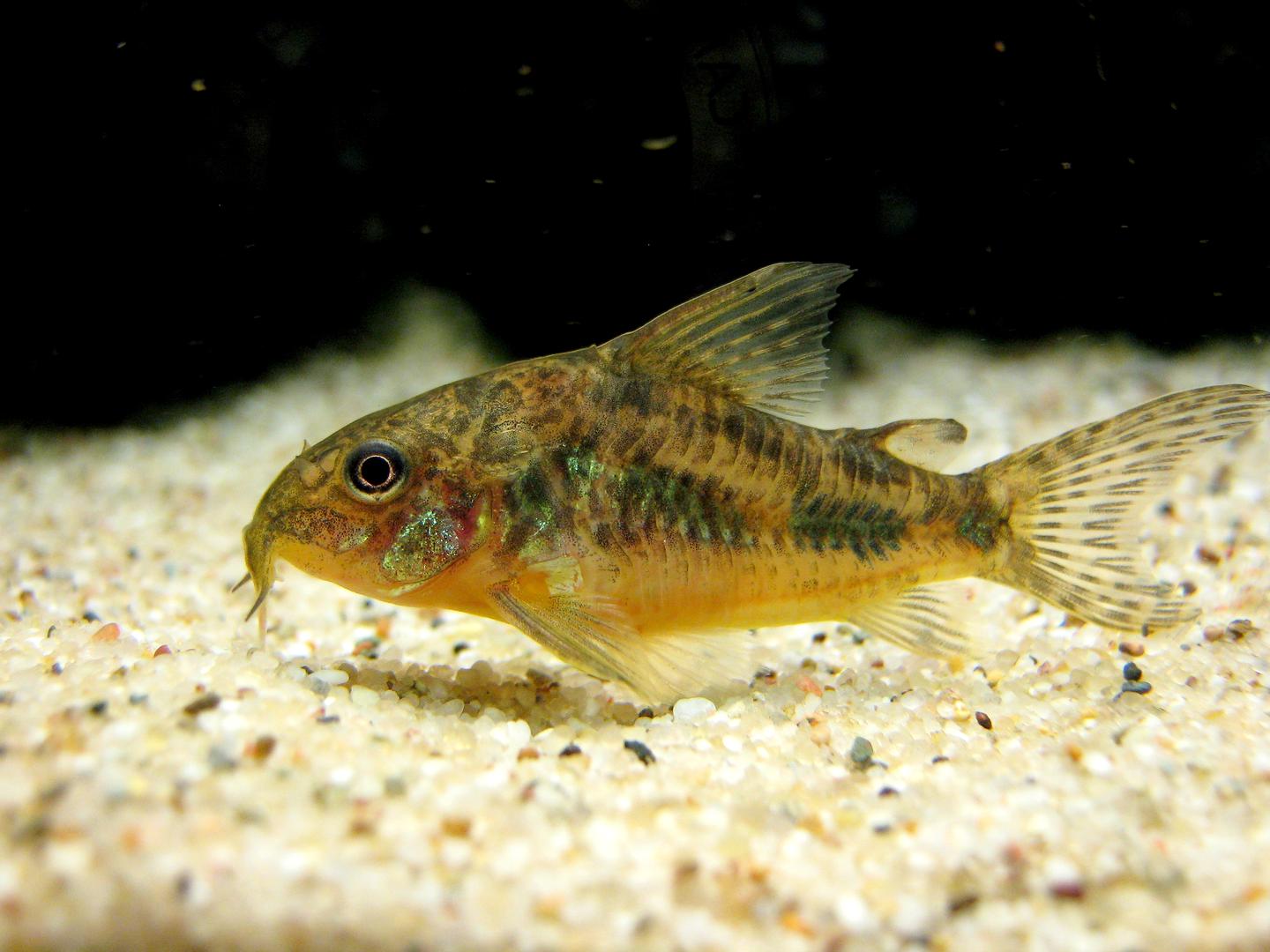
Identify the exact cory catfish before choosing care. Our starting policy for many common medium species is six compatible conspecifics, a mature 60 x 30 cm aquarium of about 60 litres, smooth fine sand and measured species-appropriate water.
Maintain these water conditions for optimal health and vibrant colors
The Longfin Panda Cory (Hoplisoma panda) is a peaceful, bottom-dwelling callichthyid catfish from the upper Amazon River basin in South America. Plan for an adult standard length of 5 cm and keep it with at least five companions of the same species. It suits a mature freshwater community aquarium whose keeper can maintain stable water, feed the bottom-dwelling group deliberately and prevent larger or aggressive fish from disturbing it.
FishBase lists Hoplisoma panda in the family Callichthyidae and records freshwater, demersal habits, facultative air-breathing and a maximum of 3.8 cm standard length. Seriously Fish gives 5 cm standard length for aquarium planning, so 5 cm is the adult figure used throughout this guide. Keep the routine aquarium at 22–25°C, pH 6.0–7.4 and 1–12 dGH.
| Suits | Not suited to |
|---|---|
| A group of at least six | Solitary or token-group keeping |
| A mature, filtered freshwater aquarium | An unfiltered or newly established aquarium |
| Peaceful community fish with matching needs | Very large or aggressive fish |
| Routine temperatures of 22–25°C | Long-term temperatures above 25°C |
| Dedicated sinking food | Reliance on scraps left by other fish |
One purchase supplies one Longfin Panda Cory. Use the live size selector to choose 2.5 cm, 3–4 cm or 4–5 cm, then choose the purchase quantity needed for the group you are building. The size you select is the size supplied, not the adult size. Use the 5 cm standard-length figure when planning permanent space, water quality and compatible companions.
Sex is guaranteed only when the selected option explicitly states male or female. This Longfin Panda Cory listing has no sex-guaranteed option. Plan a social group rather than buying fish in the hope of receiving a particular sex, and do not use dispatch size or a photograph to infer whether an individual will be male or female.
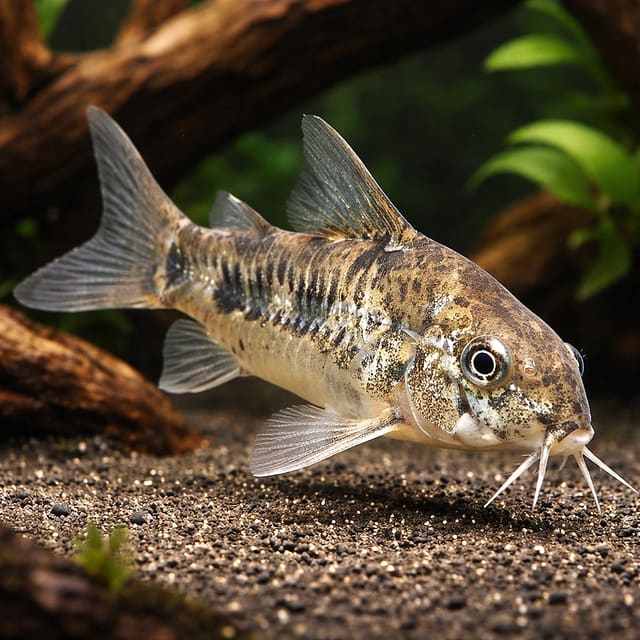
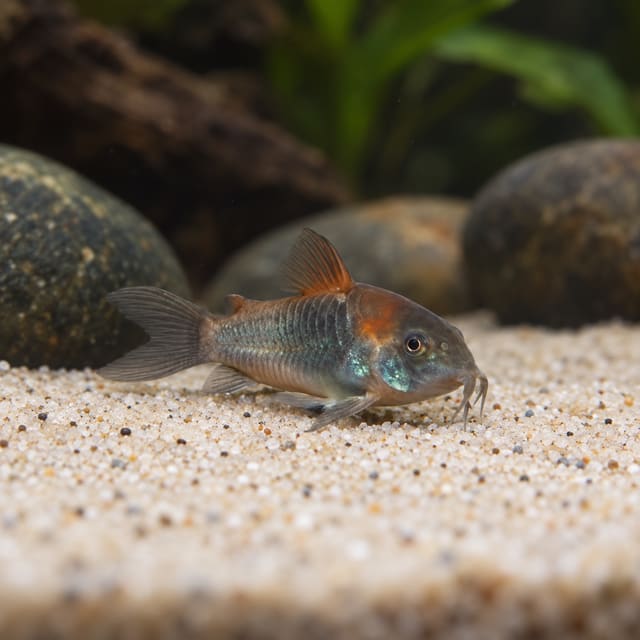
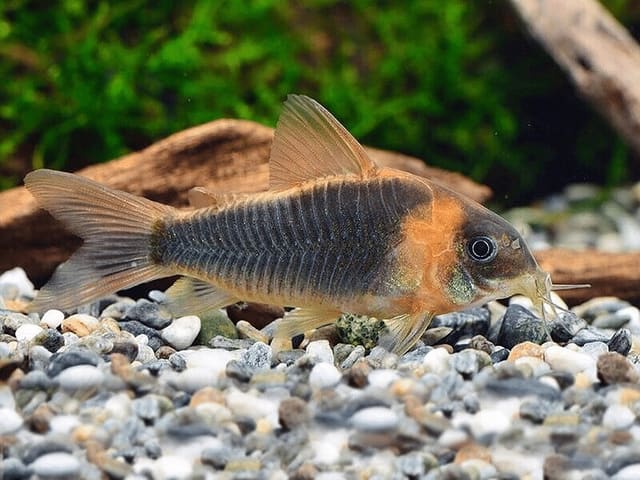
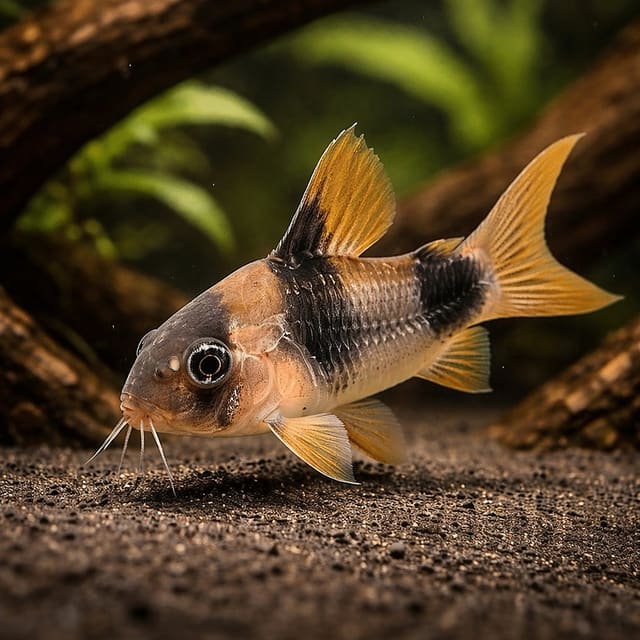
The gallery images are representative of this type of animal rather than photographs of the exact animal supplied, so colours can look slightly different from the live animal. Two fish may be visible in an image, but the purchase unit remains one animal. Use the written identity and care requirements when deciding whether this long-finned trade form fits your aquarium.
Keep at least six Longfin Panda Corys together. The Seriously Fish Panda Cory profile describes the species as far more confident and active with its own kind and gives six as the best minimum group. Because each purchase supplies one fish, count the Panda Corys already in the aquarium and choose enough individuals to reach or maintain that group.
Use an aquarium measuring at least 45 × 30 cm across the base for a small group. A 45 × 30 × 30 cm aquarium is about 41 litres, but footprint remains the decisive measurement because these catfish live and feed near the bottom. A taller aquarium with fewer litres spread across the base does not create the same foraging room. Choose more floor area when adding other bottom-dwelling fish or when several species must feed in the same zone.
A larger aquarium normally gives more room for retreats, feeding stations and gradual stocking. If you are comparing other social bottom dwellers, browse our corydoras collection and assess each species on its own adult needs.
Keep the aquarium at 22–25°C, pH 6.0–7.4 and 1–12 dGH. Seriously Fish gives these routine aquarium values for Panda Corys. FishBase records a wider natural environmental range of 20–25°C, pH 6.0–8.0 and 2–25 dH, but the narrower aquarium values are the practical targets for ongoing care.
OATA’s freshwater-catfish sheet gives 22–27°C, pH 6.0–8.0 and 4–18 dGH for the group. Those group-level figures help explain the wider range seen among catfish, while the Panda Cory values set the limits here. In particular, do not use the OATA maximum of 27°C to extend this fish’s routine range: Seriously Fish warns against keeping Panda Corys above 25°C over the long term.
Our water chemistry guide explains what each test measures. Enter your readings in the water matcher to compare them with the 22–25°C, pH 6.0–7.4 and 1–12 dGH targets.
Do not chase one exact pH within the range. A stable aquarium at pH 6.8 does not need to be moved towards 7.0, and a stable aquarium at pH 7.2 does not need to be moved down. The decision is whether the measured water remains inside the full care range and whether every planned resident shares it.
Use a fully established biological filter and keep ammonia and nitrite at zero mg/l. The RSPCA explains biological filtration as the process in which beneficial bacteria convert toxic ammonia into nitrite and then into the safer nitrate. A filter must be running, established and maintained before it can manage the waste produced by a new group of fish.
If this is your first aquarium, follow our first tropical tank guide to prepare and mature it before livestock arrives. Adding six fish to an immature filter does not create an instant social aquarium; it creates a sudden waste load before the bacterial population is ready. Plan the group and the filter together.
Seriously Fish suggests four to five times the aquarium volume per hour. For the 41-litre reference aquarium, that is about 165–205 litres per hour. Treat the manufacturer’s flow figure as a starting point, because filter media, pipework and accumulated debris can reduce actual movement. Arrange the outlet so water circulates without forcing the fish to remain in a strong jet.
Increase stocking gradually even when test results are good. OATA explains that additional fish and food require the filter’s bacterial population to increase. Testing after each addition shows whether ammonia and nitrite remain at zero rather than leaving the filter’s response to chance.
Cover the bottom with aquarium sand and leave generous open areas for foraging. Seriously Fish describes river sand, driftwood branches, twisted roots and dried leaves as a suitable Amazon-style arrangement for Panda Corys. The same profile also says they do well in a more standard aquarium, preferably with plants, so a planted community layout is a sound alternative.
| Zone | Purpose |
|---|---|
| Open sand | Gives the group clear feeding and foraging space |
| Wood and roots | Breaks sight lines and creates sheltered edges |
| Planted cover | Offers cover in a standard community layout |
| Clear surface route | Allows access for a facultative air-breathing fish |
Keep decorations stable and preserve enough open bottom for all six fish to feed at once. An attractive layout can still fail functionally if wood, pots and dense planting occupy almost the whole footprint. Look down through the water and identify at least two clear feeding areas before introducing the group.
For a blackwater-style display, dried beech or oak leaves can be used with wood and roots. Replace old leaves every few weeks before they rot and foul the water. Wood and leaves may tint the water like weak tea, which is part of that layout rather than a substitute for filtration or water changes. Fairly dim lighting suits this arrangement.
Plants are optional for an Amazon-style interpretation but useful as cover in a conventional community aquarium. Choose the layout that you can clean consistently. During each water change, move the siphon across exposed feeding areas and check for food trapped beside wood, stones or plant bases.
Watch where the group rests and where every fish finds food. If one feeding point creates crowding, open a second patch rather than increasing the ration. If waste repeatedly collects behind one object, adjust the layout or circulation so maintenance can reach that area. These small changes preserve the floor space that the 45 × 30 cm minimum footprint is intended to provide.
Use a good-quality sinking pellet or tablet as the staple food. Seriously Fish describes Panda Corys as omnivorous and recommends supplementing the staple with live or frozen foods such as Daphnia, Artemia and bloodworm. Choose pieces the fish can take comfortably and vary the supplementary food rather than relying on one item every day.
Feed once a day and offer only what the fish can consume within a few minutes. This schedule comes from OATA’s freshwater-catfish guidance and controls the amount rather than changing the species-appropriate menu. Remove food that remains after the group has had a fair chance to eat, because decaying leftovers add waste that the filter must process.
These catfish need their own ration even when other fish drop fragments onto the bottom. Uneaten scraps are unpredictable in quantity and nutritional balance. Dedicated pellets or tablets make it possible to judge whether the group has eaten and to remove a persistent excess.
If fast fish consume the ration before it sinks, change where you place the food or divide it between feeding points. If one Cory repeatedly misses out, confirm that it can move normally, that companions are not excluding it and that the food is small enough to take. Do not automatically add a large extra portion, because the excess can remain hidden around wood or plants.
Live and frozen Daphnia, Artemia or bloodworm add variety but do not replace the dependable staple. Keep the same once-daily portion rule and include every food offered when judging what the group can finish within a few minutes.
Complete the aquarium plan before the fish travels. Confirm a group of at least six, a base of at least 45 × 30 cm, water at 22–25°C and pH 6.0–7.4, and ammonia and nitrite at zero mg/l. Make sure someone can receive the parcel because live fish must not be left unattended.
Our delivery and Live Arrival Guarantee policy explains the packing, arrival and claim conditions. Fish are hand-bagged in pure oxygen, protected by an insulated poly box and given a heat pack when the weather calls for one. A licensed live-animal courier carries the parcel, with tracking and the confirmed delivery date sent by email.
Float the sealed bag for 20–30 minutes before release. The aquarium should already be ready, tested and correctly heated so the fish can move into suitable water after the bag has floated.
OATA’s general introduction advice is to increase the aquarium population slowly because additional fish and feeding increase the load on the biological filter. Test ammonia and nitrite after adding the group and keep both at zero. Continue the established feeding plan rather than adding large portions to encourage shy fish.
Count the group during feeding and check that every fish maintains normal posture, moves with the others and reaches sinking food. A fish that rests briefly on the bottom is not assessed in isolation; compare it with its usual swimming, breathing, colour and feeding behaviour. The aim is to notice a change early enough to test the water and protect the whole aquarium.
During the first water change, confirm that waste is not collecting around feeding points and that the filter flow remains steady. Keep the routine predictable: stable water, deliberate feeding and weekly maintenance are more useful than repeated changes made simply because the fish are new.
Know the group’s normal behaviour so a change is easy to recognise. OATA advises watching swimming, colour, temperament, breathing, body condition, external appearance and interest in food. Compare each fish with its own usual pattern and with the rest of the group rather than treating one brief movement as a diagnosis.
| If you notice | Check first |
|---|---|
| Faster or slower gill movement | Temperature, ammonia, nitrite and filter flow |
| Erratic swimming or loss of balance | Water tests and whether other fish show the same change |
| More hiding or isolation | Group size, chasing, feeding access and recent changes |
| Darker or paler colour | Water quality and interactions with companions |
| White spots, fluffy growths or damaged fins | The affected fish, water tests and progression of the change |
| Reduced feeding response | Food access, breathing, body condition and water values |
FishBase identifies Hoplisoma panda as a facultative air-breather. Interpret a trip to the surface alongside the fish’s breathing rate, posture, frequency of surfacing and the aquarium’s test results. Repeated unusual surfacing combined with rapid breathing or loss of balance calls for an immediate check of temperature, ammonia, nitrite and filtration.
If a change persists, test the water first and write down the readings. Correct measurable husbandry problems without making several uncontrolled changes at once. Contact us about health changes with the temperature, pH, ammonia, nitrite and nitrate results, a description of the behaviour and when it began.
Do not choose a treatment from one symptom alone. White marks, fin damage, hiding and poor appetite can have different causes, while medication can add another variable to an aquarium whose water quality has not been checked. Keep observation factual, protect stable filtration and isolate only when a suitable separate setup and a clear reason make that the safer course.
Longfin Panda Corys are very peaceful community fish. Seriously Fish names small characins, cyprinids, anabantoids, dwarf cichlids and other peaceful catfish as suitable kinds of companion. Each choice remains conditional on adult size, temperament, water requirements, feeding access and the floor space left for the Cory group.
Avoid anything very large or aggressive. This is the direct exclusion in the Panda Cory profile and is more dependable than assuming that every fish carrying a broad community label will behave appropriately. A companion that repeatedly drives Corys away from food, confines them to one corner or damages fins fails the compatibility test even if the species is often described as peaceful.
Dwarf cichlids need particular planning because their use of the lower aquarium can overlap with Cory feeding and shelter. Provide adequate floor area and watch behaviour rather than relying on the category name alone. Other peaceful catfish also add demand to the bottom zone, so enlarge the footprint and separate feeding points when combining groups.
No fixed list predicts every individual interaction. Monitor the actual aquarium and keep a separation plan for repeated chasing, exclusion from food or fin damage. For a stocking assessment, contact us with the aquarium dimensions, measured water values, established fish and the proposed adult group sizes.
Start the stocking plan with six Longfin Panda Corys, then account for every other fish at its adult size. Do not count a different catfish species as a substitute for the Panda Cory group. The social requirement is for its own kind, while other bottom dwellers create additional demand for space, shelter and food.
| Proposed situation | Decision |
|---|---|
| Six Corys with small peaceful characins | Proceed if water matches and sinking food reaches the bottom |
| Six Corys with peaceful cyprinids | Check temperature, adult size and feeding competition |
| Six Corys with an anabantoid | Check individual temperament and shared water needs |
| Six Corys with dwarf cichlids | Provide extra floor space and watch lower-level territorial behaviour |
| Several peaceful catfish groups | Increase base area and create separate feeding places |
| A very large or aggressive fish | Avoid this combination |
Use observed feeding as a compatibility measure. If all the food is intercepted above the bottom, place the Cory ration in more than one clear area. If another fish repeatedly guards those areas, the issue is not solved by adding more food; change the stocking or layout so the Corys can eat without harassment.
Seriously Fish notes that Panda Corys may consume bite-sized items such as eggs or fry even though aggression towards other species is virtually unheard of. Do not place them in a breeding setup where every egg or fry must remain untouched. This feeding response is separate from aggression towards adult companions.
Compatibility with invertebrates depends on the chosen animal’s size, behaviour, water needs and vulnerability during moulting. Screen that proposed combination individually rather than treating shrimp, snails or other invertebrates as one interchangeable category.
Reassess after growth or a layout change. A community that works while all fish are small can become crowded when adult bodies occupy more of the same space. The permanent plan must still preserve a group of at least six Corys, the 22–25°C range and open access to sinking food.
A Longfin Panda Cory reaches 5 cm standard length. Use that adult figure for aquarium planning rather than the dispatch size selected at purchase.
Use an aquarium measuring at least 45 × 30 cm across the base; a 45 × 30 × 30 cm aquarium is about 41 litres and is adequate for a small group.
Keep at least six together. They are more confident and active with their own kind, so do not plan to keep one or two as a token bottom-dwelling addition.
It suits a keeper who can mature the filter first, maintain ammonia and nitrite at zero, keep a group of at least six and make sure sinking food reaches every fish.
Use a good-quality sinking pellet or tablet as the staple, with live or frozen Daphnia, Artemia or bloodworm for variety. Feed once daily and limit the portion to what is eaten within a few minutes.
Keep it at 22–25°C, pH 6.0–7.4 and 1–12 dGH. Avoid keeping it above 25°C over the long term.
It is very peaceful, and aggression towards other species is virtually unheard of. Avoid very large or aggressive companions and separate any fish if repeated chasing or fin damage occurs.
Suitable kinds can include small characins, cyprinids, anabantoids, dwarf cichlids and other peaceful catfish when adult size, water, floor space and feeding access all match.
Before opening the parcel, film every delivery continuously from the sealed parcel onward. It is hand-bagged in pure oxygen, protected in an insulated poly box with a heat pack when weather calls for one, and carried by a licensed live-animal courier. Be home to receive it, float the sealed bag for 20–30 minutes and release the fish without pouring bag water into the aquarium.
No reviews for this item yet. Bought one? Honest reviews only, good or bad.
What customers say about ordering from us
Easy website plenty of info on fish your buying great to pick a time slot
TRACEY DURRANT · 7 Oct 2026
Got some lovely fish thank you
Kevin Mackie · 7 Oct 2026
Reviews of our shop, collected by Judge.me, an independent third-party review collector. Newest first.