By Tropical Fish Co Editorial Team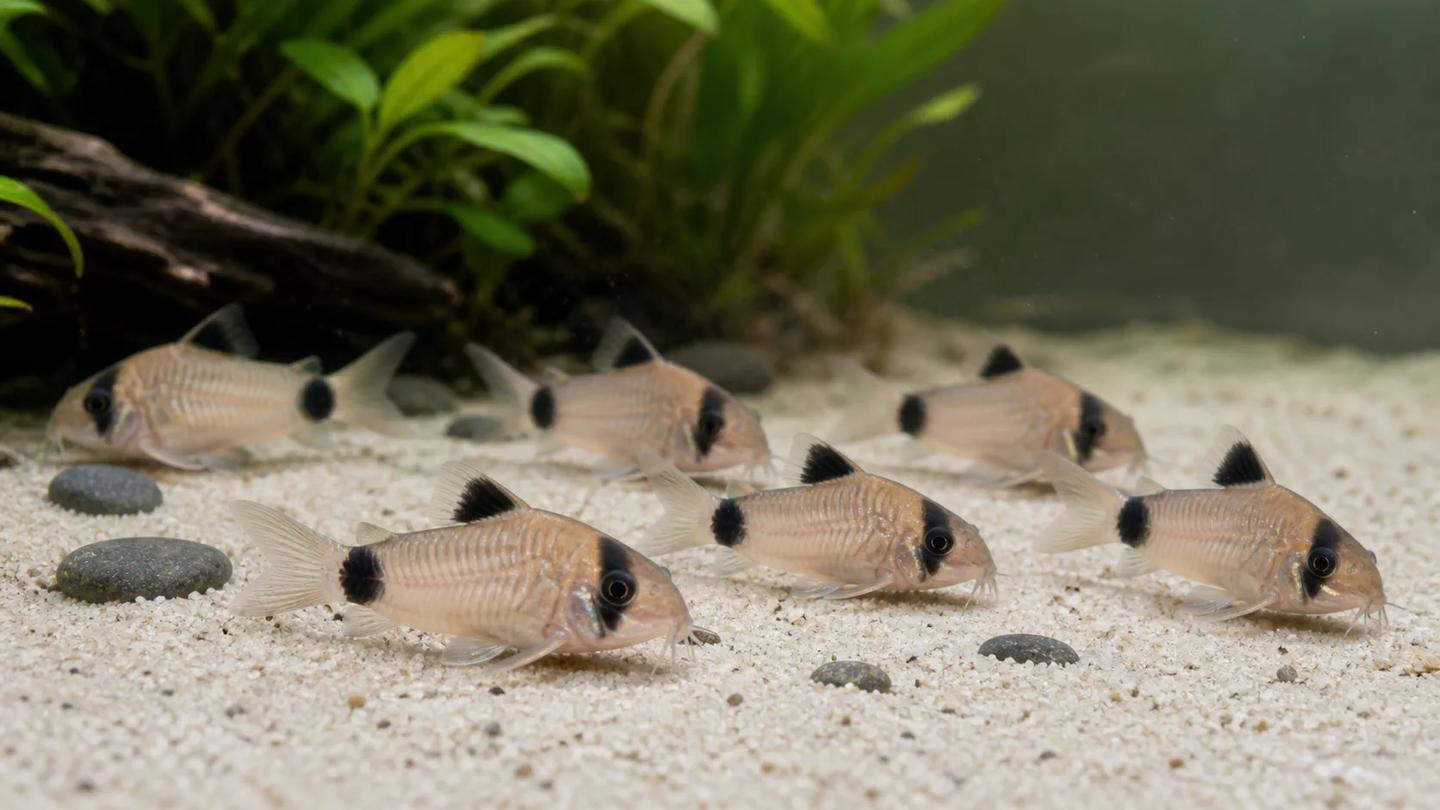
The direct answer
Panda Corys are small, social armoured catfish that need a real same-species group, mature water and deliberate feeding—not a job as the aquarium cleaner. Their accepted name is Hoplisoma panda. Corydoras panda is the original name and remains the wording most UK shops and searchers recognise [1].
The current FishBase record gives 3.8 cm maximum standard length, 20–25°C, pH 6.0–8.0 and 2–25 dH [3]. Standard length ends at the base of the tail fin, so do not silently turn it into an unqualified “5 cm” total-length promise.
For a responsible UK aquarium plan:
- keep at least five Panda Corys of the same species, following OATA's Corydoras baseline;
- use OATA's 80-litre starting point for a shoal of smaller catfish, then check usable floor area and the complete adult community;
- establish and test the biological filter before purchase;
- provide fine sand or smooth fine gravel, cover and open foraging room;
- use deliberately supplied sinking food and confirm every fish gets access;
- match companions to the measured water instead of relying on a generic “community safe” label.
The live Corydoras category owns current availability. Open the exact product page before buying because the photograph, name, form, sale unit, source water, price and stock can change; this evergreen guide does not freeze any of those facts.
Why the scientific name changed
Nijssen and Isbrücker described the fish as Corydoras panda in 1971. Their paper says the name refers to the giant panda because of the black-and-white pattern [4].
A 2024 phylogenomic study combined ultraconserved-element data with morphology and recognised seven genera in Corydoradinae, including the resurrected Hoplisoma [1]. The current Catalog of Fishes therefore lists Hoplisoma panda as valid while preserving Corydoras panda as the original combination [2].
That is a naming update, not a different fish. Keep both names visible for clarity:
| Where you see the name | How to interpret it |
|---|---|
| Hoplisoma panda | Current accepted scientific combination |
| Corydoras panda | Original combination and familiar trade/search synonym |
| Panda Cory / Panda Corydoras | Common UK names; useful, but not a complete identity check |
How to identify a Panda Cory
The original description is unusually useful for visible identification. It records a pale-tan body with a black mask across the eyes, a dorsal fin that is almost entirely black and a large black blotch on the caudal peduncle—the narrow section immediately before the tail fin [4].
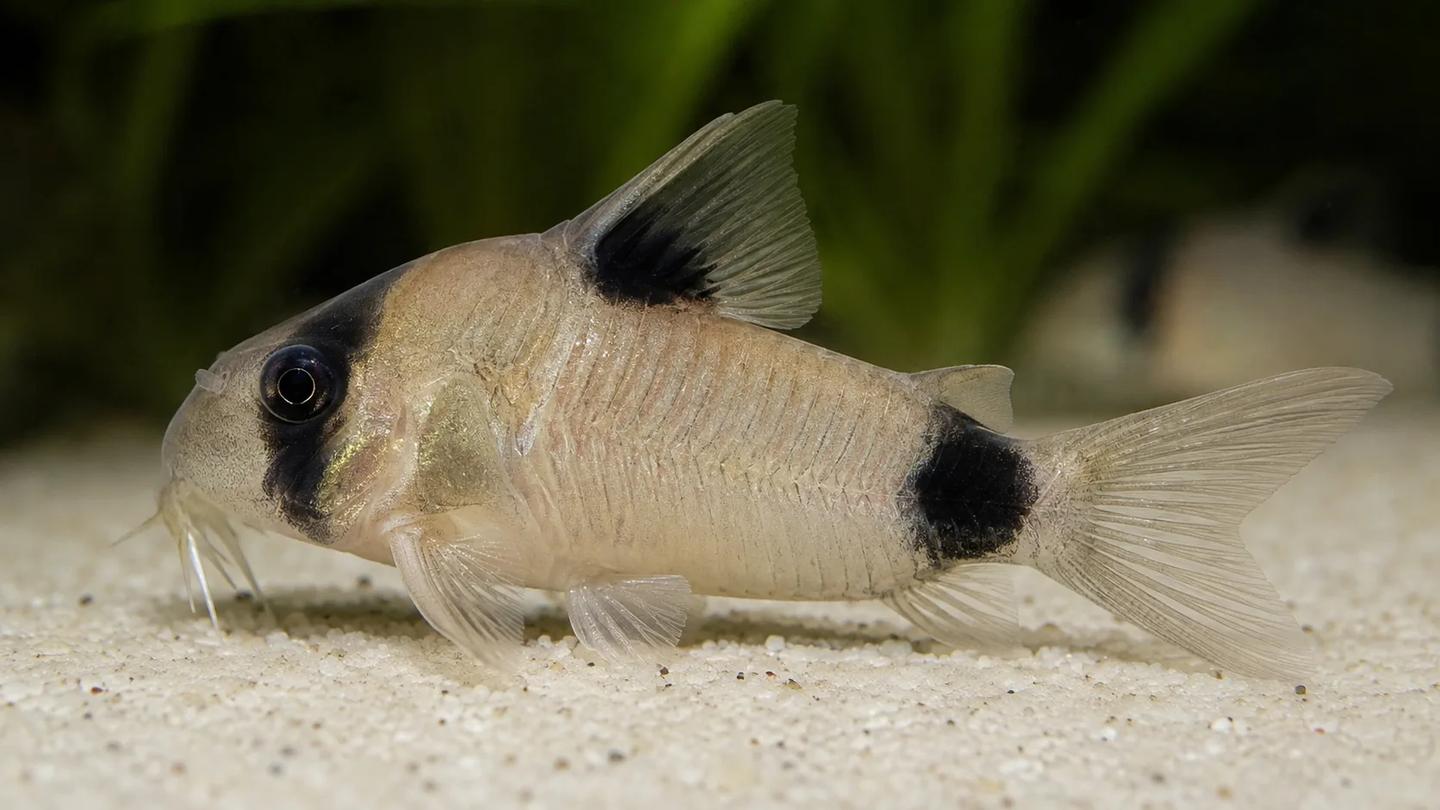
Use all three main dark areas together: eye mask, dorsal patch and tail-base patch. This reference-informed visual is not a photograph of current stock.
Pattern alone is still not enough to identify every shop fish. The original paper compared H. panda with other dark-tail-patch species, and long-fin or selectively bred forms can alter the silhouette. Before purchase, compare the current fish photograph with the seller's scientific name; do not infer sex, adult size, health, ancestry or form from “panda” in a title.
The type locality is Aquas Amarillas, a tributary of the Río Pachitea in Peru's Ucayali system. The current Catalog of Fishes gives the broader recorded distribution as the upper Amazon basin in Peru and Ecuador [2]. That is evidence about the species—not proof that a particular UK shop fish was wild collected.
Panda Cory size: keep the measurement label
FishBase records a maximum 3.8 cm standard length for male or unsexed fish [3]. The 1971 description measured its holotype at 41.9 mm standard length and two paratypes at 32.3 and 37.0 mm [4].
Those figures do not conflict as much as an unlabelled summary suggests: they come from different records, and both use standard length rather than total tip-to-tip length. For tank planning, use the adult fish and group—not the juvenile sale size—and preserve the measurement convention whenever quoting a number.
Group size and tank space
How many Panda Corys should you keep?
OATA says Corydoras are shoaling fish and should be kept in groups of at least five, with smaller groups or single fish at risk of stress [7]. Plan five or more of the same species. Do not combine two or three different cory species and assume the total automatically creates one equivalent social group.
The peer-reviewed Corydoras husbandry protocol describes sociality, group coordination and natural barbel-led foraging, while making clear that knowledge across this diverse group is still incomplete [5]. That supports social housing; it does not create a universal “eight ideal” or “ten best” number for every home.
What tank size is responsible?
OATA recommends at least 80 litres for a shoal of smaller catfish such as Corydoras and notes that larger aquariums provide more stable conditions [7]. Treat 80 litres as a conservative group-level starting point, not a stocking formula or permission to ignore tank shape.
Prioritise:
- useful horizontal floor area for the whole group;
- a mature biological filter sized for the complete adult waste load;
- open foraging space plus sheltered areas;
- enough feeding stations that slower bottom fish are not excluded;
- capacity for all companions, not only the Panda Corys.
The laboratory protocol similarly stresses horizontal space and dilution capacity rather than litres per individual [5]. A tall tank with a small base can therefore be less useful than a wider aquarium of similar volume.
Temperature and UK tap water
FishBase records 20–25°C, pH 6.0–8.0 and 2–25 dH for H. panda [3]. These are broad compiled screening bounds. They are not one captive optimum, a target at every edge or permission for a rapid change.
Use this sequence instead:
- obtain the current seller's temperature, pH and hardness information;
- test the mature destination aquarium rather than relying on its postcode;
- choose a stable overlap suitable for every resident;
- use a thermostatic heater and independent thermometer to prevent room-driven swings;
- decide the acclimation method from the actual temperature and chemistry difference.
UK supply water is not uniform. The Drinking Water Inspectorate explains that hardness depends on geology and can vary locally, so ask the water company for the local value [10]. That report is still source-water context, not the GH, KH or pH currently inside an aquarium.
OATA's water-testing guidance supports recurring ammonia, nitrite, nitrate, pH and hardness checks; ammonia and nitrite should be zero [9]. The RSPCA also recommends fishless cycling and warns that clear water is not proof of healthy water [11]. Use the water-chemistry guide and nitrogen-cycle guide before trying to alter water.
A domestic softener, bottled water or a fixed tap-to-RO ratio does not automatically produce suitable aquarium water. Starting GH, KH, pH, sodium and treatment differ. Measure source and destination water, understand how replacement water is prepared and keep changes controlled.
Sand, barbels and aquarium layout
Fine sand is the clearest choice for Panda Cory foraging. The peer-reviewed husbandry protocol uses fine-grained sand so Corydoras can engage in natural foraging and describes it as purportedly gentler on barbels [5]. OATA allows aquarium sand or fine gravel chosen to prevent barbel injury [7].
That evidence supports a more accurate rule than “sand or the fish will starve”:
- choose fine, smooth material without sharp edges;
- leave accessible open patches where the group can search for food;
- keep the substrate clean enough that waste does not accumulate;
- avoid deep neglected pockets and trapped uneaten food;
- provide cover without filling the entire floor with hardscape.
Sand enables the clearest natural behaviour, but dirty sand is not automatically safer than well-kept smooth fine gravel. Barbel change, redness, reduced feeding or weight loss should trigger water, substrate and health checks—not an instant single-cause diagnosis.
Feeding: Panda Corys are not cleaners
Corydoras are social bottom-feeders that need food which actually sinks. The peer-reviewed protocol reports using small sinking granules or pellets, appropriate variety and enough distribution for every fish to feed without leaving food to foul the water [5]. OATA likewise warns that the “scavenger” reputation does not remove the need for appropriate sinking foods [7].
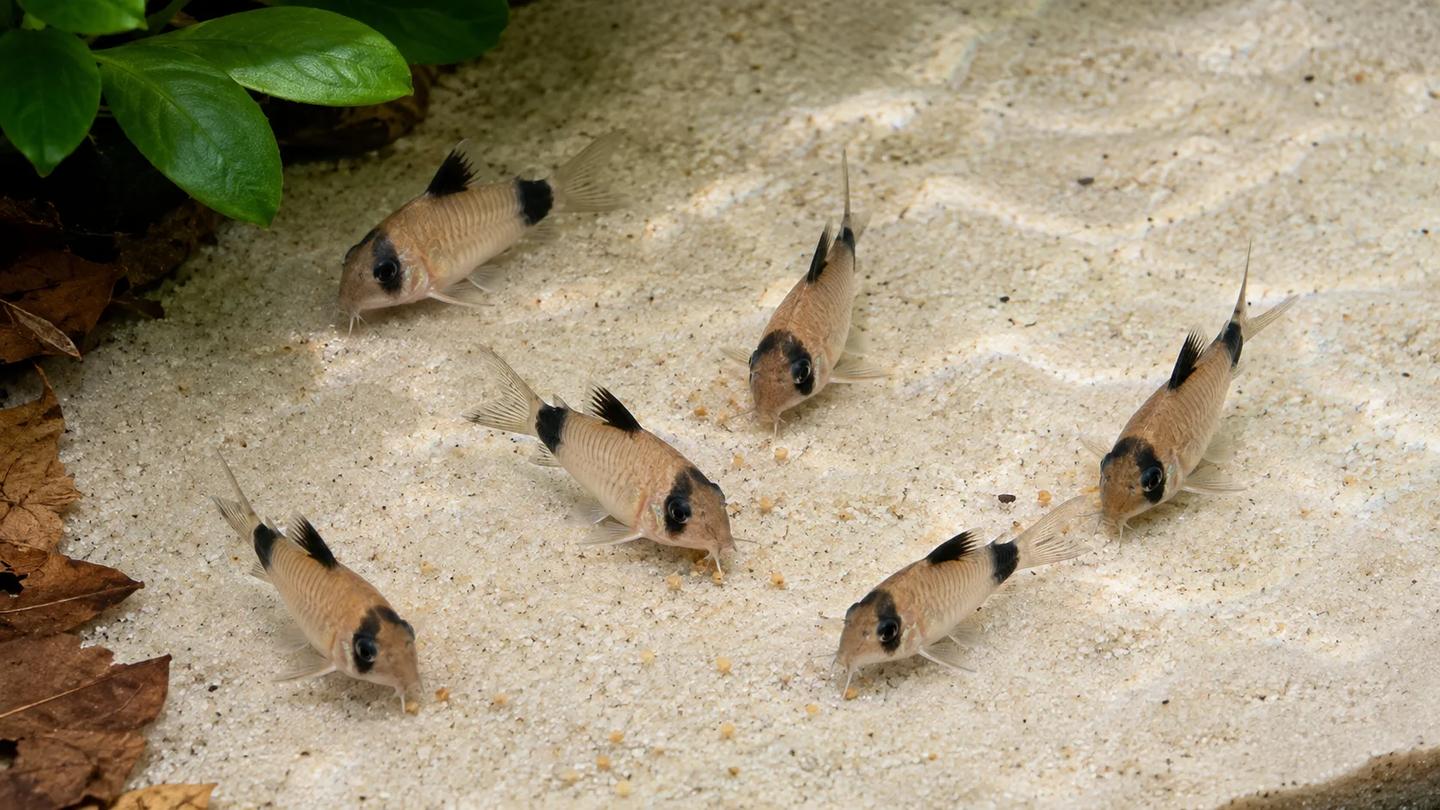
Sinking food should reach the entire group. Searching the floor is normal feeding behaviour, not evidence that the fish can live on waste or control algae.
A useful routine is observational rather than clockwork:
- choose a complete sinking staple appropriate to the fishes' mouth size;
- add suitable variety while keeping total nutrition and water quality in view;
- distribute food so dominant or faster residents cannot monopolise it;
- watch each Panda Cory feed and retain its normal body condition;
- remove persistent excess before it breaks down.
If a belly becomes sunken, appetite falls or one fish stops joining normal group activity, test the water and assess access to food. Do not diagnose a parasite or select medication from one visible sign.
Tank mates, shrimp and snails
“Peaceful community fish” is a starting description, not a compatibility guarantee. Screen every proposed companion for:
- an overlapping stable temperature, pH and hardness range;
- adult size and predation risk;
- activity and fin-nipping behaviour;
- competition at the substrate;
- total adult capacity and oxygen demand;
- disease and quarantine history.
Small, non-predatory mid-water fish may be candidates when their measured requirements overlap, but species names alone cannot prove a match. Other Corydoradinae may coexist yet still need their own appropriate social group and space. Read the broader Corydoradinae care guide to compare group-level needs, and use the Pygmy Cory guide when a genuinely smaller species is under consideration.
Shrimp and snails are not guaranteed safe. This evidence set does not quantify risk to adult shrimp, moulting animals, eggs, shrimplets or small snails, so opportunistic ingestion remains possible. Use a fish-free aquarium when maximum shrimp breeding survival is the objective.
Arrival, surface visits and health
FishBase records H. panda as a facultative air-breather [3]. An occasional rapid visit to the surface can therefore be normal. A new or repeated change in surfacing can also accompany heat, low oxygen, poor water quality, stress or illness, so assess the aquarium rather than dismissing the behaviour.
Before buying, verify a mature filter and zero ammonia/nitrite. OATA describes a low-light floating-bag acclimation method and close monitoring during the first week, while also telling buyers to check that their water is suitable [8]. Do not replace that comparison with a fixed 20- or 45-minute recipe. Transport time, bag condition, temperature and chemistry can differ.
If behaviour, breathing, appetite, balance, colour, eyes, barbels or fins change:
- test temperature, ammonia, nitrite and other established parameters;
- review recent additions, maintenance, feeding and equipment changes;
- isolate a sick fish when appropriate, using separate equipment;
- seek a knowledgeable aquatic retailer or aquatic veterinarian;
- use only a correctly identified, label-compliant treatment when evidence supports it.
The MSD Veterinary Manual prioritises water quality, history, quarantine, diagnostics and targeted treatment [12]. This guide deliberately gives no heat, salt, half-dose, antibiotic or symptom-to-drug recipe.
Breeding without a guaranteed recipe
Panda Corys can lay eggs and produce larvae in captivity. An exact-species study documented egg and larval development under its reported research conditions [6]. That is valuable biological evidence, but one study's approximate hatch time is not a promise for every aquarium.
Breeding advice online often compresses a complex process into “make a cool water change.” Do not alter temperature or chemistry abruptly to chase a spawn. A responsible project must separately plan adult condition, sex ratio uncertainty, egg protection, fungus control, fry feeding, biofiltration, water stability and long-term capacity for the young. The broader laboratory protocol reports spontaneous spawning under established husbandry rather than requiring a single universal trigger [5].
How to buy Panda Corys without relying on stale claims
Use the live Corydoras category, then inspect the exact product page. Check:
- current image and diagnostic pattern;
- scientific name and whether the form is standard or long-fin;
- sale unit and the number needed to reach a responsible same-species group;
- stated size and whether it is sale size or adult size;
- current holding temperature and water information;
- availability, price and checkout status;
- current delivery and livestock-support terms.
This article intentionally contains no fixed SKU, price, stock, “UK-bred,” delivery or live-arrival claim. Those facts belong to current commerce, not an evergreen care page. Purchase and revenue are final ecommerce outcomes; add-to-cart and checkout are diagnostic steps. Feedback, contact, email and newsletter actions are not leads or ecommerce conversions.
How this guide was checked
The Tropical Fish Co Editorial Team compared the current Catalog of Fishes, the 2024 Corydoradinae revision, FishBase, the original 1971 description, exact-species developmental research, a peer-reviewed Corydoras husbandry protocol, OATA's current UK guidance, DWI water information, RSPCA welfare guidance and the MSD Veterinary Manual. Each source is used only for the claim it can support.
The three page visuals are original reference-informed editorial assets checked against more than seven independent real exact-subject image references. They are not photographs of current stock. If a claim appears wrong or a source has changed, use contact and identify the exact sentence plus a supporting source. Feedback is a correction route, not a lead or ecommerce conversion.
Continue planning
- Read the Corydoradinae care guide for the group-level taxonomy, social, substrate and health framework.
- Use the water-chemistry guide to interpret GH, KH, pH, ammonia, nitrite and nitrate.
- Follow the fish-tank nitrogen-cycle guide before adding livestock to a new aquarium.
- Compare the Pygmy Cory guide rather than assuming every small cory uses space in the same way.
- Compare the Kuhli Loach guide when considering another social bottom-dweller with different behaviour.