By Tropical Fish Co Editorial Team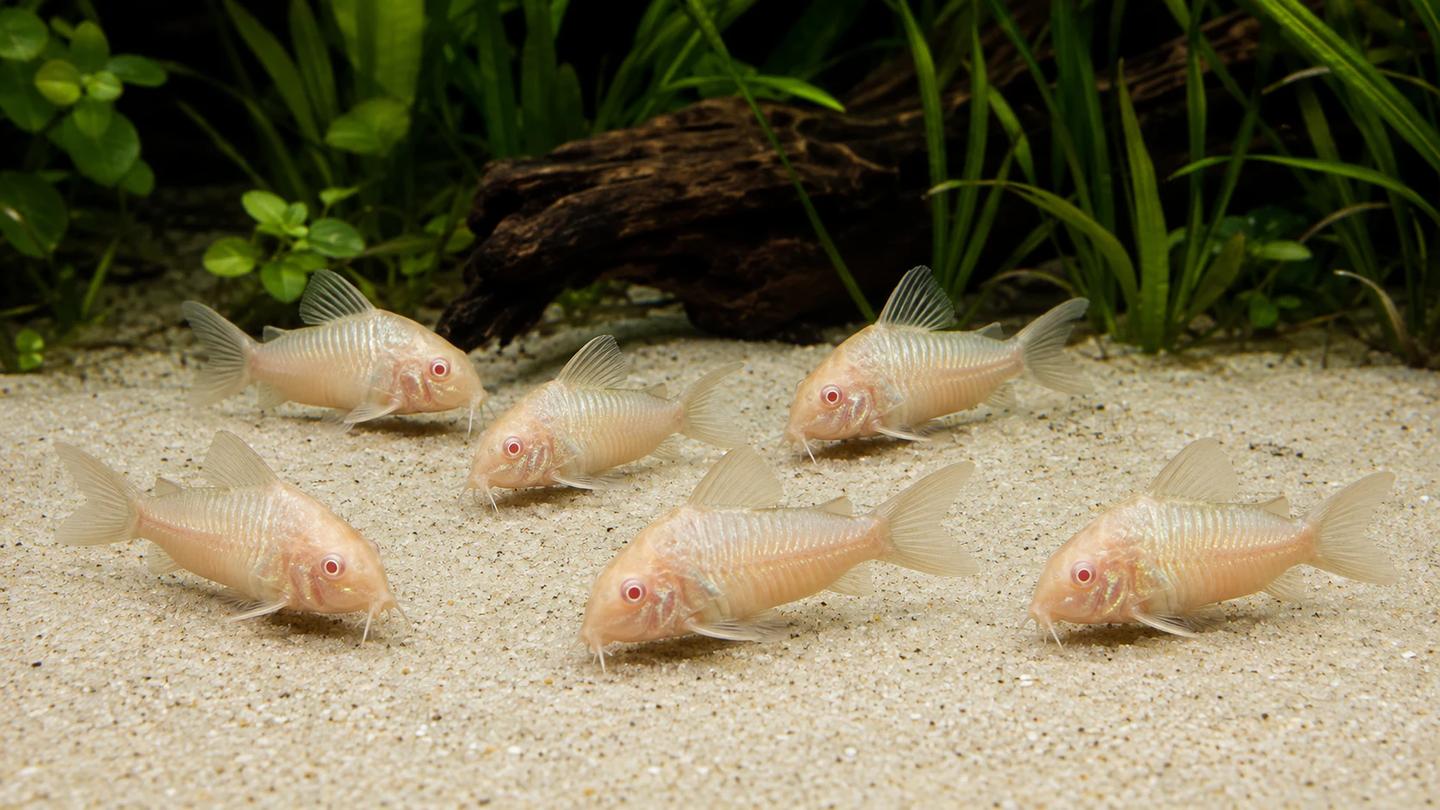
The direct answer
Albino Corydoras is a useful search and trade phrase, but it is not a complete scientific identity. Many shops use it for the albino form of the bronze cory, whose accepted name is now Osteogaster aenea and whose familiar trade synonym is Corydoras aeneus [1]. Do not assume that every pale cory offered under a generic title is automatically that species.
For a fish confirmed as O. aenea, FishBase records 7.5 cm maximum standard length, 25–28°C, pH 6.0–8.0 and 5–19 dH [3]. Standard length stops before the tail fin, and a database range is a compatibility screen—not a promise of adult total length or one perfect captive setting.
For a responsible UK aquarium plan:
- verify the current seller's scientific name and photograph before applying species-level advice;
- keep at least five of the same identified species, following OATA's Corydoras baseline;
- use OATA's 80-litre starting point for a shoal of smaller catfish, then judge floor area and the entire adult community;
- establish and test biological filtration before purchase;
- provide fine sand or smooth fine gravel, shelter and open foraging room;
- feed suitable complete sinking food and watch every fish gain access;
- compare the actual aquarium, source and seller water instead of assuming all UK tap water is suitable.
The live Corydoras category owns current availability. The exact product page must confirm which albino form is being sold, plus its image, sale unit, size, source water, price and stock.
What does “albino Corydoras” actually mean?
“Corydoras” remains the familiar trade umbrella for these armoured catfish, while modern taxonomy divides the subfamily Corydoradinae among seven recognised genera [1]. “Albino” describes a pigmentation form. Put together, the words still do not supply an accepted species name.
The common aquarium form is usually labelled Corydoras aeneus albino or albino bronze cory. The current Catalog of Fishes lists the species as Osteogaster aenea [2]:
| Wording | What it can tell you | What it cannot prove |
|---|---|---|
| Albino Corydoras / albino cory | A pale, pink-eyed trade form is intended | Exact species, adult size, water or group identity |
| Osteogaster aenea albino | Current name for the common albino bronze-cory form | That an unverified photograph or shipment matches the name |
| Corydoras aeneus albino | Familiar older combination for the same confirmed species | Current stock, source, sex, health or sale size |
This distinction matters. A colour label cannot safely decide water, adult size or whether another cory counts towards the same-species social group. When a listing omits the scientific name or uses an image that does not clearly match it, ask before buying.
How to identify the common albino bronze cory form
The common O. aenea albino form is pale cream to soft pink, with pink-red eyes, a short rounded cory head, downturned mouth barbels, an arched back and two rows of bony plates along each side. The fins are usually translucent in the normal short-fin form.
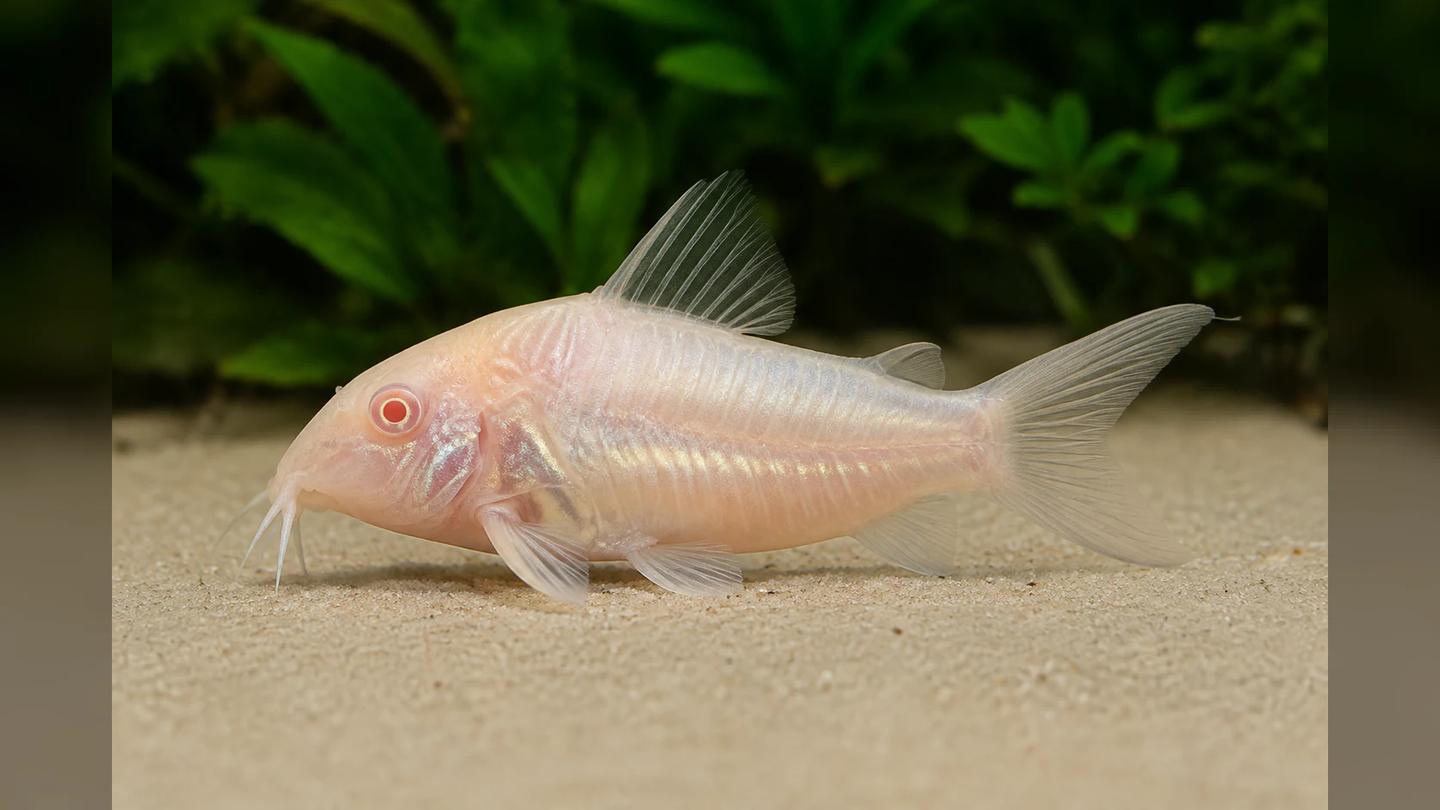
This reference-informed visual shows the common albino bronze cory form; it is not a photograph of current stock and has no scale for age, sex or sale size.
Use the image as an anatomy guide, not as remote identification. Long-fin forms can change the silhouette, lighting changes body colour, and a pale fish photographed badly may hide useful detail. Before purchase, match the current scientific name, a current photograph, normal Corydoradinae anatomy, the seller's sale-size convention, and the current holding water.
Are albino Corydoras blind?
Pink eyes do not diagnose blindness, and the reviewed evidence does not justify “slightly weaker eyesight” as a universal fact. The most direct sensory comparison located for albinotic and normally pigmented Corydoras aeneus tested hearing and found no difference [6]. That shows why pigmentation should not be turned into an assumption about every sensory system—but hearing is not vision.
Two 2024 studies add nuance. One reports behavioural and lateralisation differences between albino and pigmented bronze corys [7]. Another examines light/dark choice and how social context affects that response [8]. Neither paper is a clinical eye examination, and neither establishes that every albino cory is blind or has a fixed visual deficit.
Use function, not myth, as the practical check:
- distribute sinking food so every fish has a fair opportunity to find it;
- watch each individual feed and retain normal body condition;
- provide cover and avoid abrupt, intense lighting changes;
- investigate new collisions, failure to reach food, cloudy eyes, injury or abnormal behaviour;
- do not explain a health or husbandry problem away as “just the albino eyesight.”
Adult size and lifespan
For confirmed O. aenea, FishBase records 7.5 cm maximum standard length for male or unsexed fish [3]. Standard length measures from the snout to the base of the tail fin, so it is not the same as total length and should not be compared silently with a shop's juvenile sale size.
Use the adult species record to plan space, but do not promise that every individual will reach exactly 7.5 cm. More importantly, one unidentified “albino cory” cannot inherit the O. aenea figure until its species is confirmed.
The old page advertised five to ten years. The reviewed UK source is more cautious: OATA says smaller catfish can live for several years in a mature, well-maintained aquarium [10]. Species identity, source condition, water stability, nutrition and health all affect the individual outcome.
Group size and tank space
How many should be kept together?
OATA says Corydoras are shoaling fish and should be kept in groups of at least five of the same species [10]. That makes identification part of the social plan. Five fish carrying a generic albino label are not automatically one same-species group if their identities differ.
Riley and colleagues showed that C. aeneus actively coordinates with familiar and unfamiliar partners in pairs and triplets [5]. This supports genuine social behaviour, but the study did not test a home-aquarium minimum. OATA supplies the practical UK baseline; the study should not be stretched into “six minimum” or “ten ideal.”
A confirmed albino O. aenea and a normally pigmented bronze O. aenea are forms of the same species. They may contribute to a same-species plan when their identities really are confirmed. Do not use colour resemblance alone.
What tank size is responsible?
OATA recommends at least 80 litres for a shoal of smaller catfish such as Corydoras and notes that larger aquariums are generally more stable [10]. Treat 80 litres as a conservative group-level starting point, not a litres-per-fish formula.
Prioritise:
- useful horizontal floor area, not only total litres;
- a mature biological filter sized for the complete adult waste load;
- open foraging patches plus shelter;
- enough feeding positions for every bottom fish;
- adult space, oxygen and behaviour for all tank mates.
The peer-reviewed husbandry protocol likewise emphasises horizontal space, mature filtration, water monitoring and social housing [4]. A narrow tall tank can therefore be less useful than a wider aquarium of similar volume.
Temperature and UK water
FishBase compiles 25–28°C, pH 6.0–8.0 and 5–19 dH for O. aenea [3]. OATA's broader freshwater-catfish guide gives 22–27°C, pH 6.0–8.0 and 4–18 dH [10]. These sources have different scopes. Their ranges should not be averaged or presented as one experimentally proven optimum.
Use this safer sequence:
- confirm the fish's species and seller's current holding water;
- test temperature, pH, GH, KH, ammonia, nitrite and nitrate in the mature destination;
- choose a stable overlap suitable for every resident;
- use a thermostatic heater and independent thermometer;
- base acclimation on the real source-to-destination difference, not a fixed timer.
UK tap water is not uniform. The Drinking Water Inspectorate explains that hardness varies with geology and local supply, so obtain the water-company value and still test the aquarium [13]. Ion-exchange softeners replace calcium and magnesium with sodium; softened household water is not automatically suitable.
OATA advises testing ammonia, nitrite, nitrate, pH and hardness, with ammonia and nitrite at zero [12]. The RSPCA recommends fishless cycling and warns that clear water is not proof of healthy water [14]. Use the water-chemistry guide and nitrogen-cycle guide before altering chemistry.
“Hard UK tap water is fine” is too broad. Identify the fish, measure the aquarium, compare it with the seller's source and species evidence, and keep any change controlled. Do not improvise a tap-to-RO ratio or use softened water without knowing the resulting chemistry.
Sand, barbels and aquarium layout
The peer-reviewed Corydoras husbandry protocol uses fine sand to support natural barbel-led foraging [4]. OATA permits aquarium sand or fine gravel chosen to prevent barbel injury [10]. That supports a preference for fine sand without the false claim that every gravel aquarium will injure or starve the fish.
Choose material that is fine and smooth, kept free of decomposing food, open enough for group foraging and paired with shaded cover. Monitor the substrate alongside barbel, mouth, belly and skin condition. Dirty sand is not automatically safer than clean smooth fine gravel; if barbels shorten or redden, check water, hygiene, sharp surfaces, feeding and health rather than assigning one cause remotely.
Feeding: not a clean-up crew
Corydoras searching the floor are feeding, not cleaning the aquarium. The husbandry protocol reports appropriately sized sinking granules or pellets, dietary variety, distribution that lets every fish feed and avoidance of excess that degrades water [4]. OATA likewise says so-called scavengers need suitable sinking foods [10].
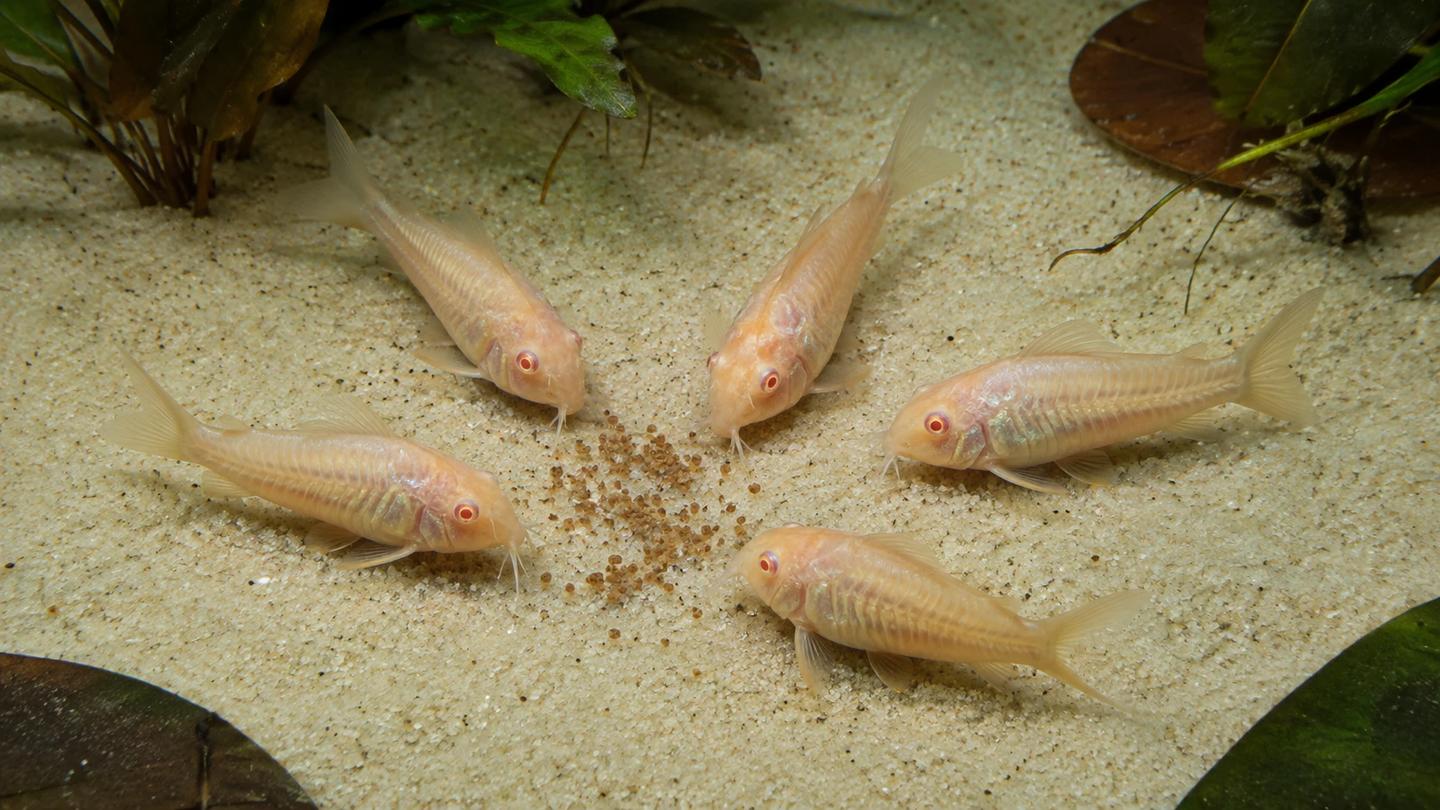
The food reaches several separate positions on fine sand. Foraging behaviour does not prove that leftovers or algae provide a complete diet.
Choose a suitable complete sinking staple, add appropriate variety, distribute food so faster fish cannot monopolise it, watch each cory eat and remove persistent excess. Never treat wafers, missed flakes or waste as proof that the group has eaten enough. If one fish becomes thin or stops joining feeding, test water and assess access before guessing at a diagnosis.
Surface dashes and health changes
Kramer and McClure documented facultative aerial respiration in C. aeneus [9]. A quick surface visit can therefore be part of normal physiology. The study does not supply a harmless “times per hour” rule.
A new, repeated or frantic pattern can also appear alongside high temperature, low oxygen, poor water quality, stress or illness. Test the aquarium, check circulation and aeration, and compare behaviour with the individual's normal pattern. Do not dismiss a whole group gasping near the surface as routine air breathing.
For arrival, OATA advises suitable mature water, low-stress transport, a context-dependent transfer and close first-week observation [11]. Do not apply one 20- or 45-minute acclimation recipe to every journey, bag and water difference.
If appetite, balance, breathing, eyes, barbels, fins or behaviour changes, test the established parameters; review recent livestock, feeding, maintenance and equipment changes; quarantine when appropriate; and obtain knowledgeable aquatic-retailer or aquatic-veterinary help. The MSD Veterinary Manual prioritises environment, history, diagnostics and targeted treatment [15]. This guide gives no salt, heat, antibiotic, half-dose or symptom-to-drug recipe.
Tank mates and compatibility
“Peaceful” is not a guarantee. Screen every companion for overlapping measured water, adult size, predation, fin-nipping, activity, feeding speed, oxygen demand and total space. Slow bottom fish can be excluded even when no obvious aggression occurs.
Other cory species may coexist, but each still needs an appropriate same-species group. Shrimp, eggs, shrimplets, moulting animals and very small snails are not proven risk-free by this evidence set. Use a fish-free aquarium if maximum shrimp breeding survival is the objective.
Read the broader Corydoradinae care guide for shared needs. Compare the Bronze Cory guide only after confirming that the fish is O. aenea, and use the Panda Cory guide to see why a visually different cory needs its own evidence.
How to buy without relying on stale claims
Use the live Corydoras category, then inspect the exact product page. Check:
- current photograph and normal visible anatomy;
- accepted scientific name plus familiar trade synonym;
- whether the offered form is standard-fin or another selected form;
- sale unit and the number needed for a responsible same-species group;
- sale size versus documented adult standard length;
- current holding temperature, pH and hardness where available;
- current price, availability, delivery and livestock-support terms.
This article contains no fixed SKU, price, “UK-bred,” stock, delivery or live-arrival promise. Those facts belong to current commerce. Purchase and revenue are final ecommerce outcomes; add-to-cart and checkout are diagnostic steps. Contact, correction feedback, email and newsletters are not leads or ecommerce conversions.
How this guide was checked
The Tropical Fish Co Editorial Team compared the 2024 Corydoradinae revision, current Catalog of Fishes, FishBase, peer-reviewed albino/bronze-cory sensory, behaviour and respiration studies, a peer-reviewed husbandry protocol, OATA's current UK guidance, Drinking Water Inspectorate information, RSPCA welfare guidance and the MSD Veterinary Manual. Each source is used only within its scope.
The three active visuals are distinct original reference-informed editorial assets checked against more than seven independent real exact-subject image references. They are not photographs of current stock. If a claim appears wrong or a source changes, use contact with the exact sentence and supporting evidence. Feedback is a correction route, not a lead or ecommerce conversion.
Continue planning
- Read the Corydoradinae care guide for the group-level taxonomy, social, substrate and health framework.
- Use the water-chemistry guide to interpret GH, KH, pH, ammonia, nitrite and nitrate.
- Follow the fish-tank nitrogen-cycle guide before adding livestock to a new aquarium.
- Compare the Bronze Cory guide after confirming O. aenea identity.
- Compare the Panda Cory guide rather than assuming every cory uses identical size and temperature evidence.