
 By Sophie Harding
Easy
Three-Stripe Cory (Hoplisoma trilineatum)
22–26°C · pH 6–7.2 · 41L
£14.99
Corydoras · Buying Guide
UK julii corydoras guide — the honest truth that nearly all 'julii' sold here are false julii (C. trilineatus). How to tell them apart. Read or listen.
11 products in stock today
Live prices and stock. Every fish covered by our Live Arrival Guarantee.
22–26°C · pH 6–7.2 · 41L

22–26°C · pH 6–7.5 · 60L
22–27°C · pH 6–8

21–25°C · pH 5–7
22–25°C · pH 5–7 · 60L
22–26°C · pH 6–8 · 75L

22–26°C · pH 6–7.8 · 75L
22–25°C · pH 6–7.4
22–26°C · pH 6.4–7.4 · 41L
The shaded band shows the range julii corydoras is comfortable in. Match it to your tap water before you buy.
Our trained assistant knows this julii corydoras page inside out. Ask it anything — water parameters, tank mates, how many to buy — or have it read the guide aloud while you set up your tank.
You searched "julii corydoras", and I'm going to tell you something most listings won't: the fish you're almost certainly looking at isn't a julii at all. It's a closely related species sold under the same name. That's not a reason to walk away — it's a reason to buy with your eyes open.
I'm Sophie Harding — I breed shrimp and run nano tanks from my spare room in Bristol, and I keep a shoal of spotted cories on the bottom of one of my community setups. The julii is the cory I'm asked about most, and the question is nearly always the same once people learn the truth: "so is mine real?" This guide answers that honestly — how to tell a true julii from the false one, why it doesn't matter for care, and how to keep a group of these lovely spotted catfish thriving for years.
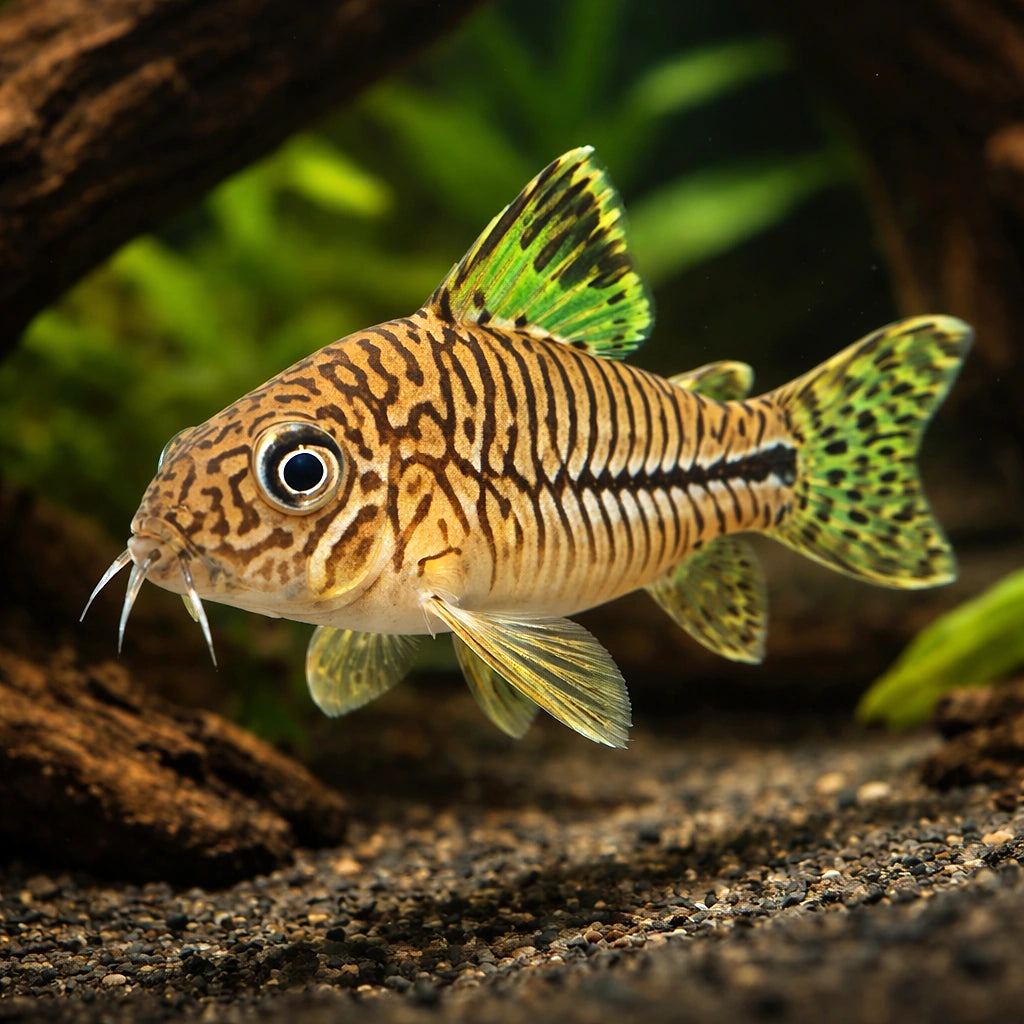
A Corydoras trilineatus — the "false julii". Look at the head: that connected, net-like maze pattern (rather than small separate spots) and the bold, solid dark stripe down the mid-body are the tell-tale signs you're looking at trilineatus, not true C. julii [5]. Product photo · our warehouse.
Let's get the big one out of the way. The overwhelming majority of fish sold as "julii corydoras" across the UK trade are actually Corydoras trilineatus — the threestripe or false julii — not the genuine Corydoras julii, which is rare in the hobby [5]. The two look superficially alike, they've been muddled in the trade for decades, and honestly most shops don't realise (or don't mention) the distinction.
I'm not telling you this to put you off — quite the opposite. C. trilineatus is a brilliant aquarium fish: hardy, peaceful, beautifully patterned and dead easy to keep. The point is simply that you should know what you're buying, and you shouldn't pay a "rare true julii" premium for a fish that's actually the common trilineatus unless you've verified it yourself.
Here's the identification you can do at the tank glass, and it's genuinely simple once you know where to look — at the head and the mid-body stripe:
| Feature | True julii (C. julii) | False julii (C. trilineatus) |
|---|---|---|
| Head pattern | Small, separate, distinct spots | Connected, net-like / reticulated maze |
| Mid-body line | Finer, often broken into spots | Bolder, more solid dark stripe |
| Trade availability | Genuinely rare | Very common (this is what you'll see) |
| Care | Identical | Identical |
The quickest tell is the head: separate spots = julii, joined-up maze = trilineatus [5]. If you're staring at a tank full of "julii" with that net-pattern head and a bold body stripe — which you almost always will be — you're looking at trilineatus, and that's a fish well worth buying.
This isn't usually dishonesty — it's a labelling habit older than most of us in the hobby. Corydoras julii and C. trilineatus were confused in the trade for decades, and the "julii" name stuck to the far more commonly imported trilineatus [5]. The genus is also taxonomically messy and constantly being revised, which doesn't help. The upshot for you: judge the fish by its head pattern, not its label.
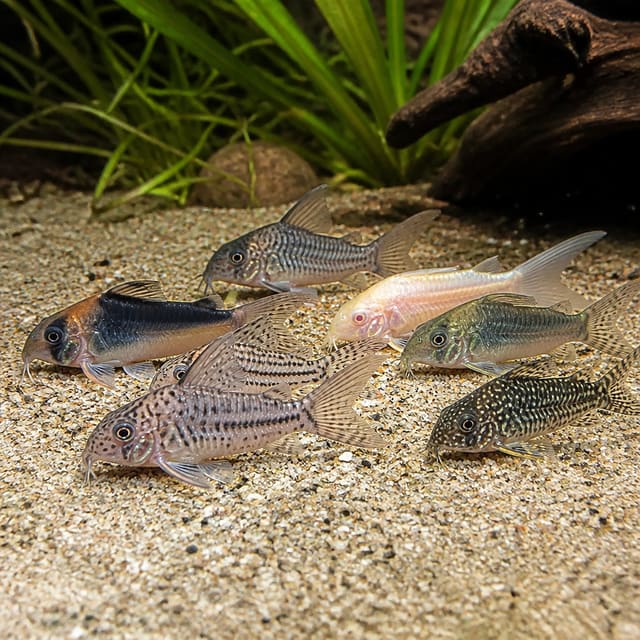
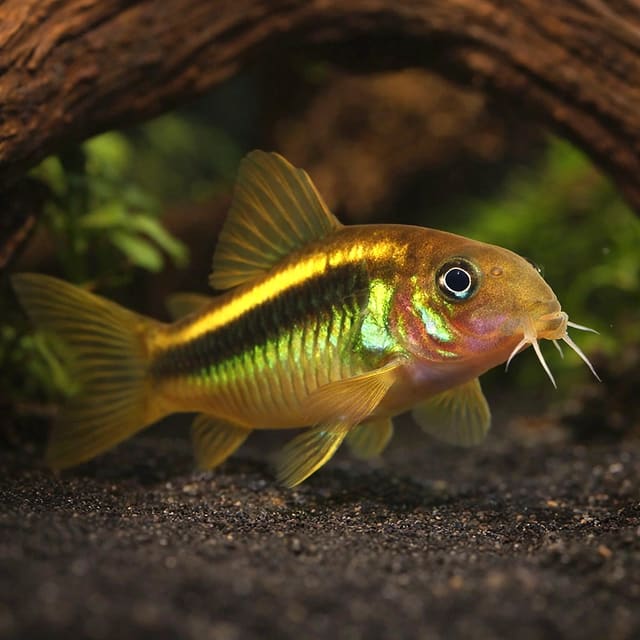
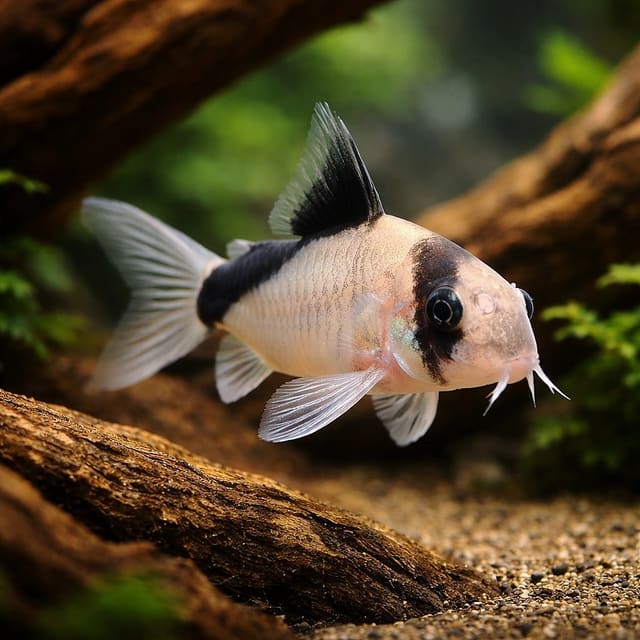
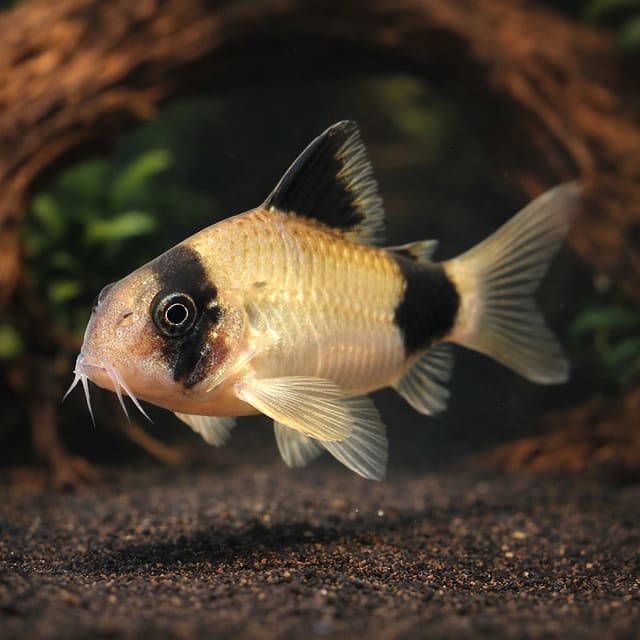
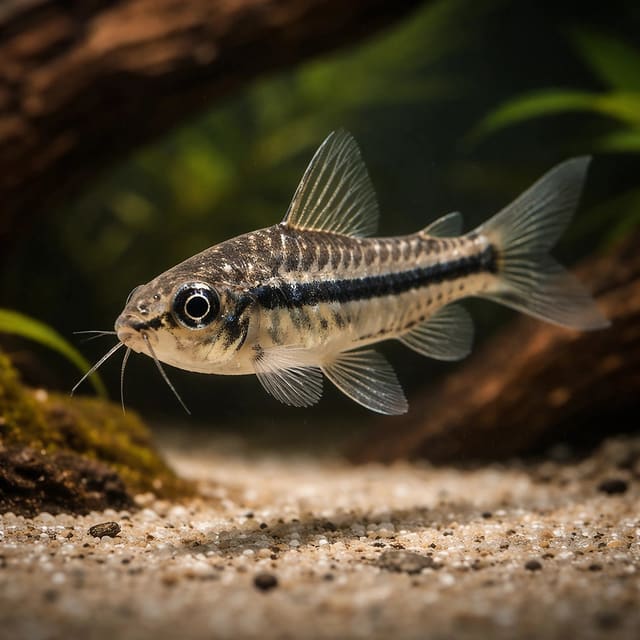
Both the true-trilineatus "false julii" and the leopard-patterned spotted cories are superb, hardy community fish. These are our current in-stock spotted cories:
Whatever the label, these are all the same easy fish to keep underneath — you're choosing a pattern, not a harder animal. If this is your first bottom-dweller, any of them will do beautifully.
Julii and trilineatus cories are not a clean-up crew and they do not live on the food other fish miss. They are omnivores that need their own sinking food on the bottom every day [4]. Treating them as a self-feeding tank gadget is the number-one welfare mistake — you'll see hollow, sunken bellies and short lives. Feed them properly and they thrive for years.
Whether you end up with true julii or (far more likely) trilineatus, these are shoaling fish — peer-reviewed work on Corydoras shows familiar individuals coordinate how the group moves and feeds [3]. So keep six or more of the same species, and ideally more. A pair or trio spends its life hiding; a proper group is out in the open, patrolling the sand together.
A six-fish starter shoal in a 60-litre tank is a balanced, beginner-friendly setup. Floor space matters far more than height for a bottom-dweller, so go long and shallow rather than tall and narrow [4].
For a spotted-cory shoal I run a 60-litre over a smooth sand bed (the same fine sand my shrimp tanks use), with a tangle of spiderwood, some Java fern and a few smooth pebbles for cover. Dechlorinated hard Bristol tap water, heater at 23–24 °C, gentle sponge filter. Six trilineatus, fed a sinking wafer or frozen bloodworm to the bottom each evening. They potter about in a tight little group all day — it's one of my favourite tanks to watch.
This is the bit most beginner setups get wrong. Cories feed by taking mouthfuls of substrate, sifting out the food and rooting with the delicate sensory barbels at the corners of the mouth. On smooth sand this works perfectly. On sharp, coarse gravel — especially in a tank where detritus builds up — those barbels abrade and wear down over time [4], and a cory that can't feel its food can't feed efficiently.
Setting up fresh? Choose smooth sand. Already running rounded gravel? Keep it scrupulously clean and watch the barbels — but for a new tank, sand is the clear winner.
A spotted cory occupies the bottom zone most community fish ignore, which makes it one of the most compatible fish you can buy. Companions I keep with cories and trust:
Avoid: large or aggressive cichlids and fin-nippers that could harass a slow, peaceful, bottom-bound catfish [4].
Transcript / what you're seeing (0:00–0:20): corydoras methodically sift the substrate and graze across leaves and wood, occasionally darting up to the surface. That surface dash is air-breathing [2] — normal, not distress. Watch how they work the bottom as a loose group rather than scattering: that out-in-the-open, coordinated pottering is the tell-tale of a settled, properly sized shoal of six or more.
Sexing is straightforward in mature fish: females are larger, rounder and broader across the body — obvious from above — while males stay slimmer. Trilineatus and true julii both breed in the classic Corydoras way: a well-fed group often spawns after a cool water change, females carrying eggs in a pelvic-fin "pouch" and pressing them onto glass, plants and wood [7]. If you're keeping a genuine C. julii for a species project, accurate ID before breeding is essential — otherwise you risk quietly perpetuating the julii/trilineatus muddle [5].
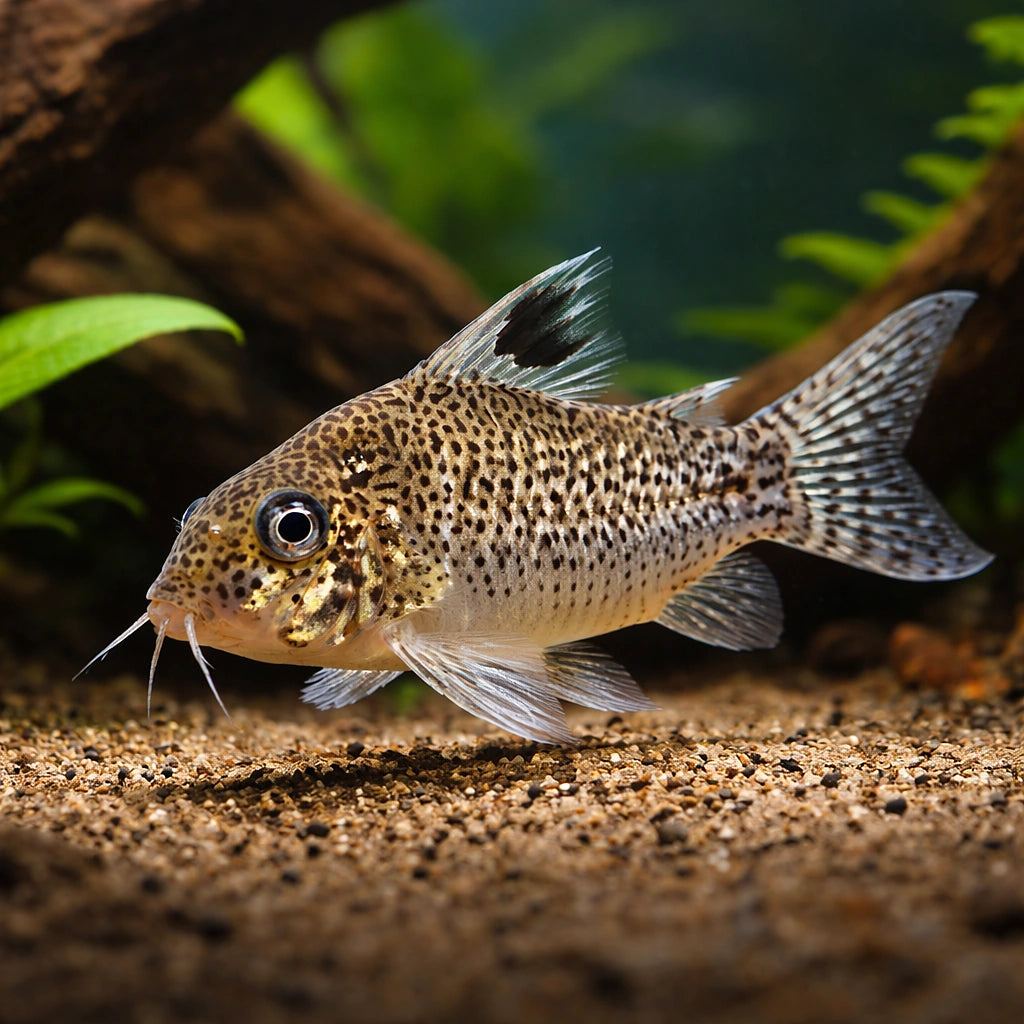
A leopard-patterned spotted cory feeding with its barbels down against the substrate — exactly the rooting behaviour smooth sand protects. Product photo · our warehouse.
Whether you buy from us or anyone else, these welfare markers separate a healthy spotted cory from a problem one:
Corydoras have a passionate, knowledgeable UK following — and given the julii/trilineatus muddle, the hobby itself is genuinely the best place to learn accurate species ID and source verified lines:
Spotted cories are hardy and forgiving, but as a bottom-dweller they can't escape to a different water layer when conditions change — so take the drip gently, especially moving into hard UK tap water [6]:
Visual route into the rest of our UK live-fish range.
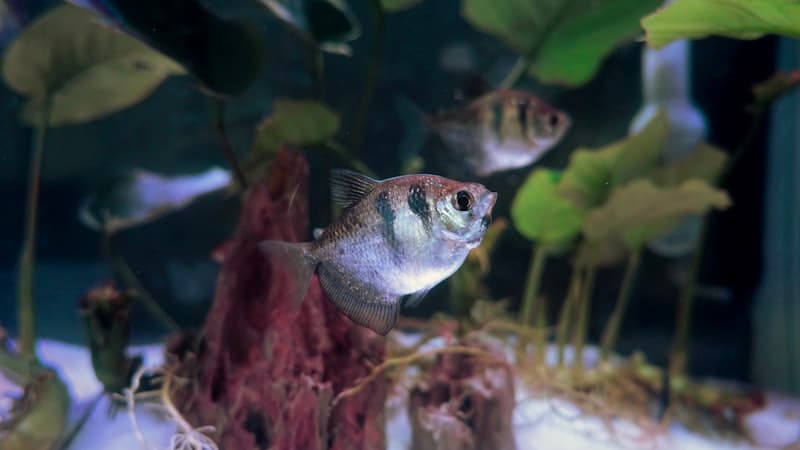
Shop current Corydoras catfish listings in the UK. Compare scientific identity, size and sale unit, with price and availability shown per product.
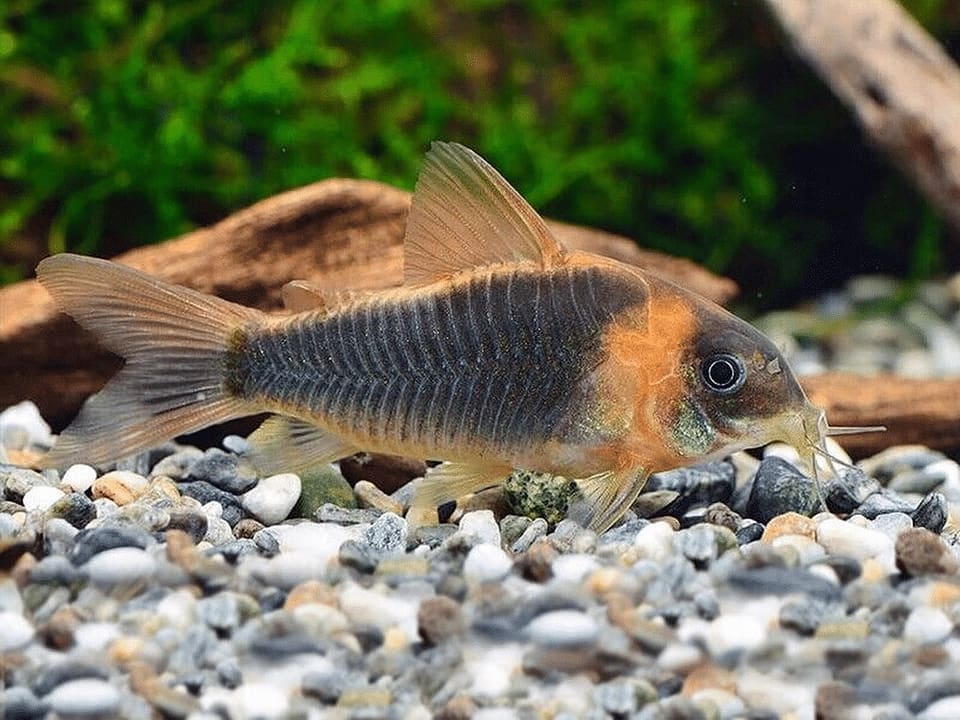
Corydoras, Bristlenose, L-number plecos, Synodontis and Otocinclus for clean-up and character — supplied and adult size on each listing so the tank fits.
Material factual claims cite the sources below; store policy and cautious inference are labelled in the article. Sources are grouped by type so you can judge their weight at a glance.
Peer-reviewed evidence that Corydoras are facultative air-breathers, gulping surface air and absorbing oxygen through a modified intestine.
Peer-reviewed study of shoaling and group coordination in Corydoras — the basis for the keep-6+ rule that applies across the genus.
Used for genus-level Corydoras husbandry, the Callichthyidae classification and water-parameter ranges shared across the genus.
Independent cross-check of size, water parameters, substrate, diet and group size for the genus.
Used for the julii-vs-trilineatus identification point — the reticulated head pattern, the bolder mid-body stripe, and the fact that most aquarium 'julii' are trilineatus.
Practical video walk-through of corydoras care — group size, substrate, diet and behaviour.
UK authority confirming much of southern England is hard to very hard water.
Fishkeeping moves fast and we want every guide spot-on. If you think something here is wrong, out of date, or could be clearer, tell us — our team reads every message and updates the page.
Suggest an editShop current Corydoras catfish listings in the UK. Compare scientific identity, size and sale unit, with price and availability shown per product.
Corydoras, Bristlenose, L-number plecos, Synodontis and Otocinclus for clean-up and character — supplied and adult size on each listing so the tank fits.
Corydoras care for UK aquariums: compare popular cory catfish by adult size and temperature, then check tank, group, substrate, food and tank mates.
Pleco fish guide for UK keepers: compare types, adult sizes, diets, tank planning, water and buying checks before choosing a suckermouth catfish.
Shrimp & Invertebrate Specialist · 12+ years in the hobby
Sophie has been breeding freshwater shrimp in her Bristol spare room since 2014, starting with a single colony of neocaridina and now running twelve species-specific tanks. Her shrimp guides on Tropical Fish Co lean heavily on first-hand breeding data — moults logged, water parameters tested with Salifert kits, and cull-rate stats that no YouTube video will give you.