By Tropical Fish Co Editorial Team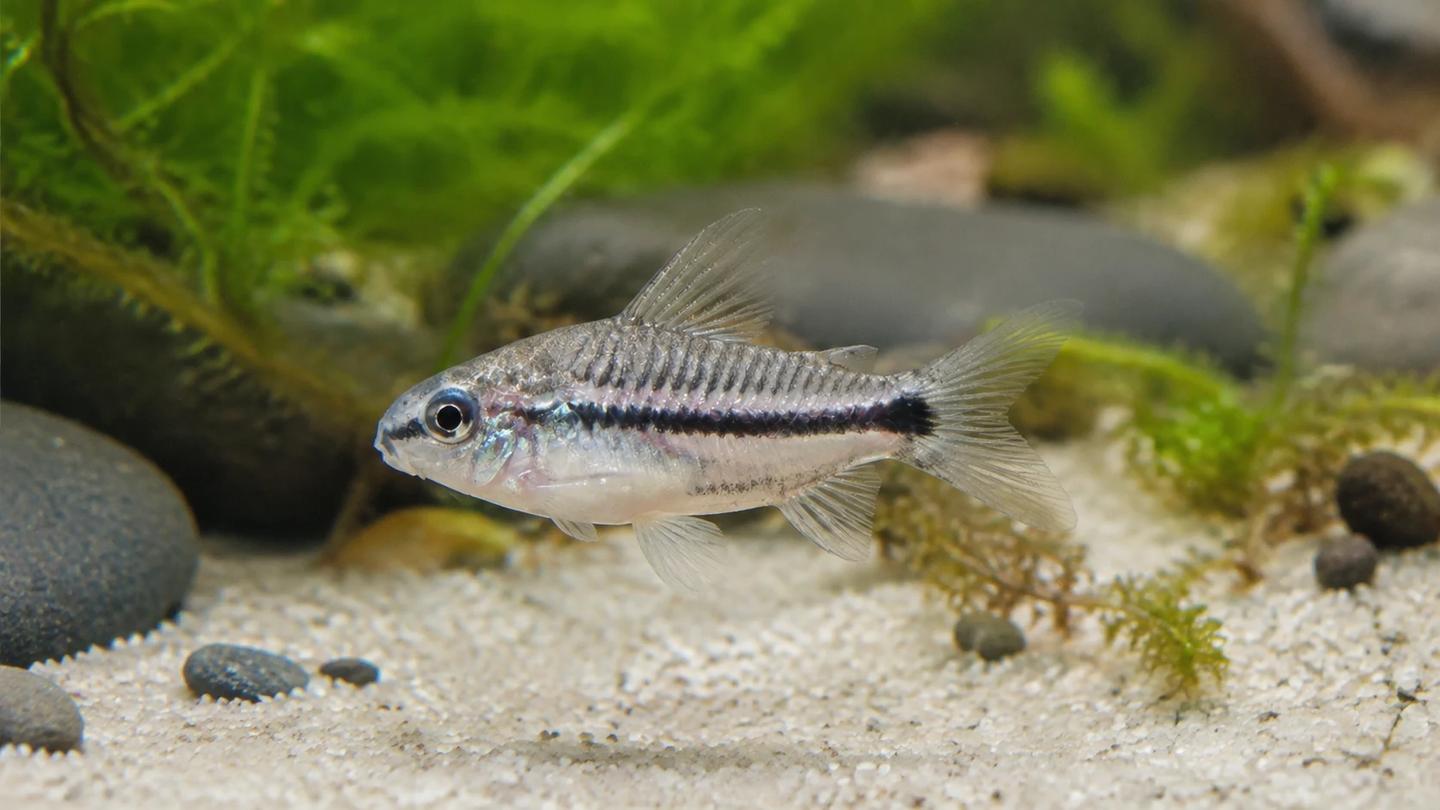
The direct answer
Pygmy corydoras are tiny, social armoured catfish—not cleaners and not an automatic fit for a tiny aquarium. The currently accepted name is Gastrodermus pygmaeus; the older Corydoras pygmaeus remains useful because shops and UK searchers still use it [1].
FishBase records a maximum 2.1 cm standard length, 22–26°C, pH 6.0–8.0 and 2–25 dH, with the Madeira River basin as the recorded distribution [3]. Standard length stops before the tail fin, and the water figures are broad screening bounds—not one captive optimum.
For a responsible plan:
- keep at least five of the same species, following current OATA Corydoras guidance;
- treat OATA's 80-litre minimum for a shoal of smaller catfish as a conservative UK starting point, then check the tank's horizontal dimensions and total adult stock;
- use mature filtration and test ammonia, nitrite, nitrate, pH, hardness and temperature;
- provide fine sand, planting or other cover, open lower-water space and deliberate feeding access;
- verify current fish, sale unit, holding water and availability through the live Corydoras category and exact product page rather than trusting evergreen prose.
This species can use the substrate and lower-to-middle water, but visible open-water behaviour varies. A specialist exact-species profile describes middle-water use, while a laboratory comparison found no strong open-water preference in C. pygmaeus and recorded time-of-day effects [7] [6]. Plan both horizontal open space and sheltered resting and foraging areas; do not buy it as a guaranteed mid-water display fish.
Which fish is a pygmy cory?
The familiar trade name “pygmy corydoras” now maps to Gastrodermus pygmaeus. A 2024 phylogenomic and morphological revision recognised seven Corydoradinae genera and resurrected Gastrodermus; a 2025 correction did not change this classification [1] [2].
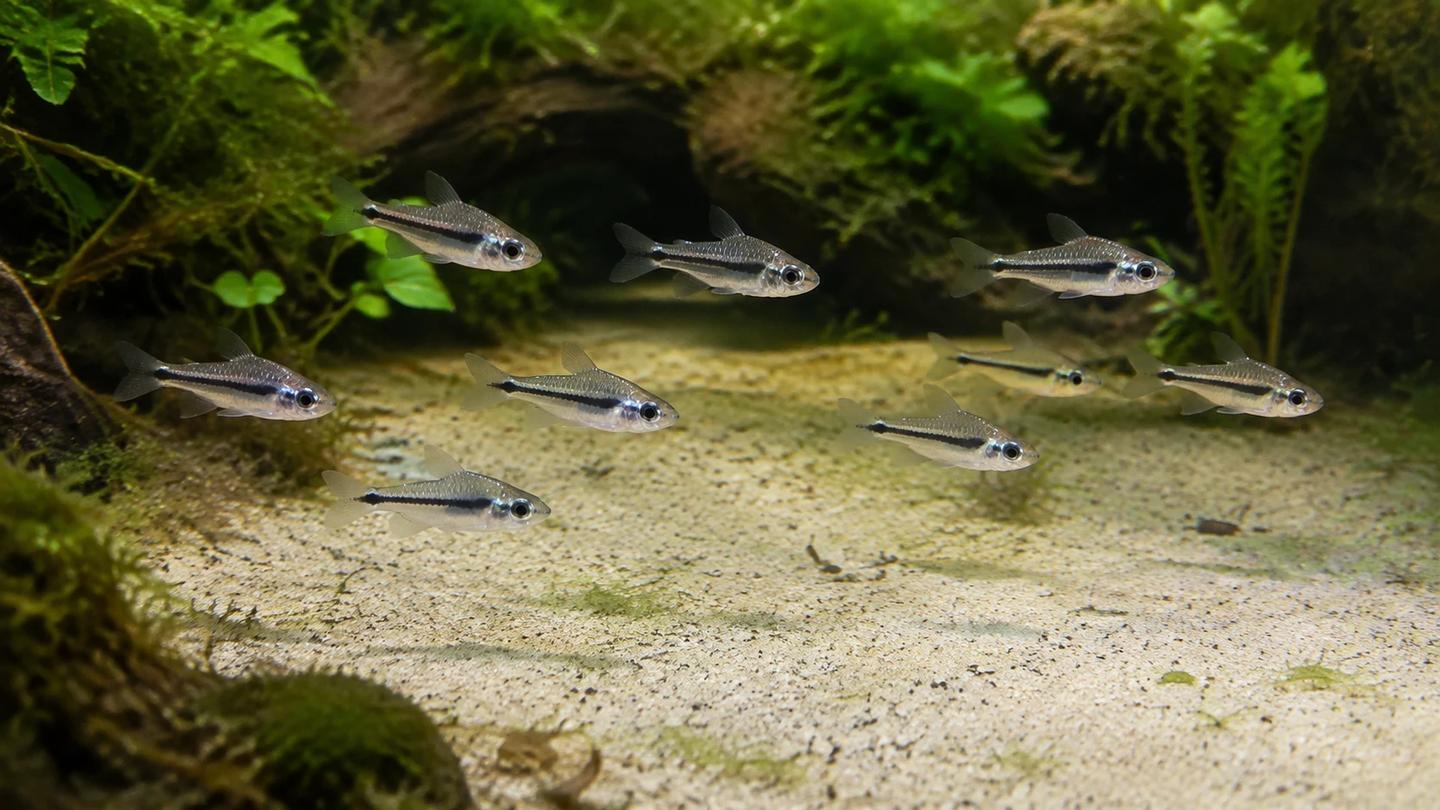
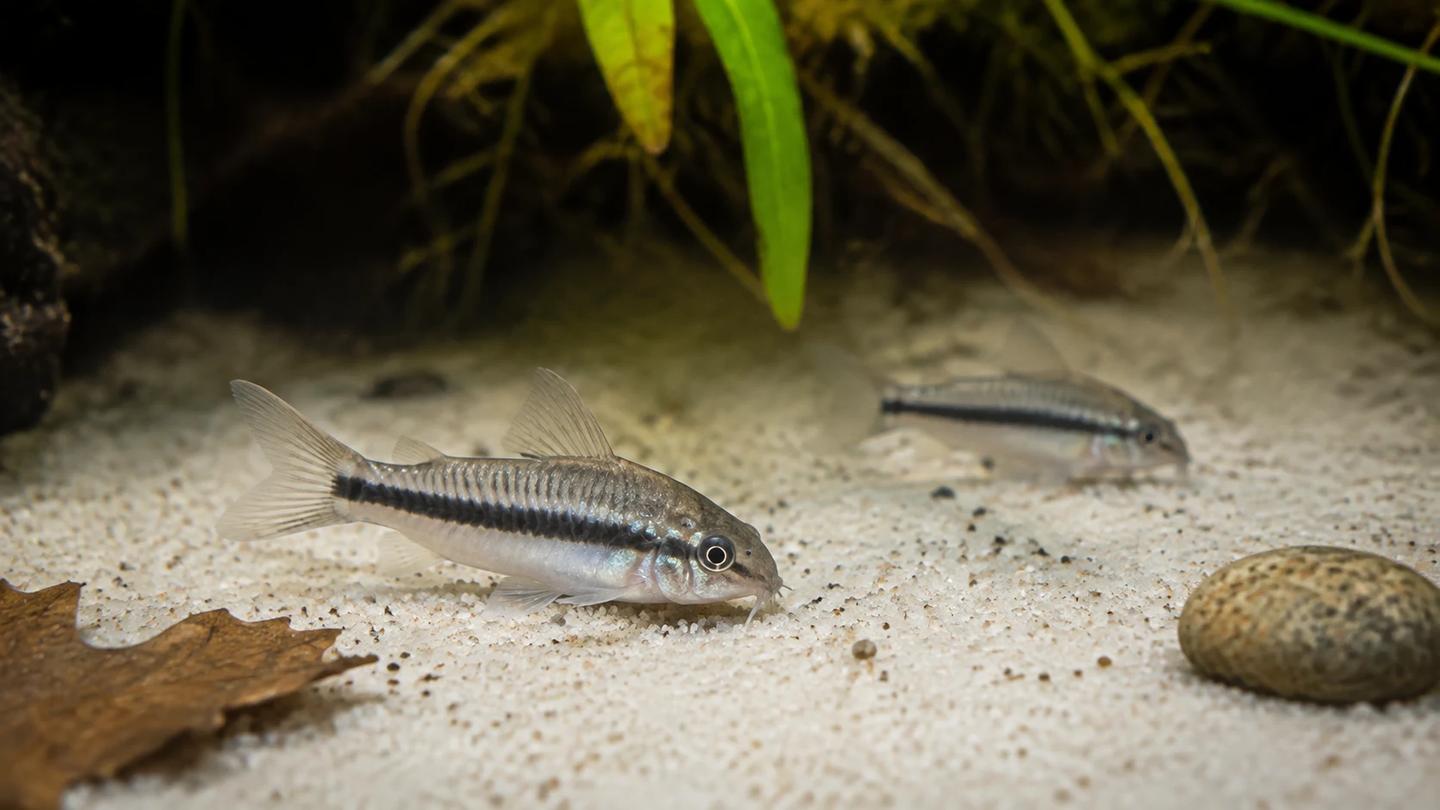
Look for a small, slender armoured catfish with a short snout and a narrow dark line running along the side towards a darker mark at the tail base. Do not identify it from “dwarf cory” alone. G. habrosus has a more broken, spotted flank pattern, while G. hastatus is associated with a stronger isolated tail-base mark. A listing photograph, scientific name and seller confirmation should agree.
FishBase's 2.1 cm figure is standard length, measured without the tail fin. Do not silently compare it with another seller's total-length figure or advertise every shop fish as exactly 2.1 cm.
Group size: five is the starting line
OATA says Corydoras are shoaling fish and should be kept in groups of at least five; individuals or undersized groups may become stressed [8]. That gives a clear answer to a common search question: do not plan a group of four.
Five is a welfare baseline, not a magic optimum. A larger group can provide more same-species social opportunity, but only if the aquarium supports the combined adult group with horizontal room, mature biological capacity and food access. “Ten to fifteen is always ideal” ignores tank shape, other residents and the keeper's ability to observe every fish.
When a group has fallen below five, pause before replacing it. Test the water, review recent deaths or symptoms, and confirm that the remaining fish and aquarium are stable. Adding new animals to an unexplained problem can amplify it.
Tank size: why this is not a 30-litre promise
Small adult length does not scale every other welfare requirement down to a nano cube. OATA recommends at least 80 litres for a shoal of smaller catfish such as Corydoras [8]. It is group-level guidance rather than a pygmaeus-specific experiment, so use it as a conservative UK planning point—not a claim that every 80-litre tank works.
Assess the actual aquarium in this order:
- Horizontal footprint: can the full group move, forage and rest without a narrow bottleneck?
- Maturity: is biological filtration established, with ammonia and nitrite testing at zero?
- Total adult community: do all fish still fit after growth, not only on purchase day?
- Feeding access: can these small, slower foragers reach food before faster fish take it?
- Cover and observation: are there sheltered areas without making the fish impossible to monitor?
A tall narrow aquarium may hold litres without providing useful floor length. Conversely, a long tank still fails if it is immature or overloaded. The fish tank nitrogen-cycle guide explains why clear-looking water is not proof that a new aquarium is ready.
The RSPCA likewise places adequate dimensions, fishless cycling, filtration, thermostatic heating, testing and stability together in its aquarium-environment guidance [12]. No single litre figure cancels those linked responsibilities.
Water parameters for UK homes
FishBase compiles 22–26°C, pH 6.0–8.0 and 2–25 dH for G. pygmaeus [3]. These ranges are useful for rejecting an obvious mismatch; they do not prove that a fish can be moved quickly from one end to the other.
Before buying, record:
- aquarium temperature, pH, GH and KH;
- ammonia and nitrite, which OATA says should be zero;
- the seller's current temperature, pH and hardness;
- whether the supply has passed through a domestic ion-exchange softener.
UK tap water is not one chemistry. The Drinking Water Inspectorate explains that hardness varies with geology and that your water company can provide a local value [11]. It also notes that ion-exchange softeners replace calcium and magnesium with sodium, so softened household water is not an automatic aquarium solution.
Choose a stable overlap supported by the seller, species record and existing community. Do not chase pH with abrupt chemical corrections. The water-chemistry guide explains GH, KH and pH as separate measurements.
Sand, planting and filtration
A peer-reviewed Corydoras husbandry protocol uses fine sand so fish can perform natural foraging behaviour [4]. That is the strongest reason to choose it. The same paper calls the idea that fine sand is gentler on barbels “purported”, so an honest guide should not turn that into “all gravel destroys barbels”.
Use a manageable layer of fine sand and maintain it so food and waste do not accumulate. Avoid sharp material. Provide plant cover, wood or other safe enrichment while keeping open places to feed and observe the group. Protect fish from filter intakes and maintain oxygenation without forcing them to fight an unsuitable current.
The aquarium should be biologically mature. The laboratory protocol and OATA guidance both emphasise filtration and regular water testing [4] [10]. “Established for several weeks” is not enough evidence by itself; test results and stable husbandry history matter.
Feeding: a cory is not a cleaning tool
Pygmy corydoras may forage on the substrate and in the lower water, but they do not live on leftovers and they do not clean an aquarium. Give suitably sized complete sinking food and appropriate variety. The peer-reviewed protocol specifically notes smaller G. pygmaeus among species receiving very small foods, and stresses that all fish must be able to access food [4].
Watch the group eat. A rounded healthy profile, intact fins and barbels, alert eyes and ordinary social movement matter more than whether food disappeared. Fast upper-water fish can consume a ration before it reaches the corys. Uneaten food is not insurance; remove excess before it degrades water.
Count pygmy corydoras in the aquarium's adult stocking and waste load. Keep the substrate, filter and water yourself; the fish's welfare must not depend on scavenging whatever other residents leave behind.
Tank mates and shrimp: use a screen, not a list
No named “community fish” is automatically compatible. For every proposed companion, compare:
| Check | Suitable direction | Warning sign |
|---|---|---|
| Water | Stable overlap in measured temperature, pH and hardness | One species sits near an outer database limit |
| Adult size | Cannot swallow or physically dominate a pygmy cory | Predator-sized mouth or large territorial body |
| Feeding | Food reaches every cory | Fast fish clear the ration first |
| Behaviour | Calm, with different space use and escape routes | Chasing, fin nipping or persistent exclusion |
| Capacity | Full adult community fits filtration and footprint | “Small today” is used as the calculation |
Shrimp compatibility is unknown and not guaranteed safe. The available sources do not establish that adult shrimp, eggs, shrimplets or moulting animals are safe with pygmy corydoras, and food competition remains possible. A specialist profile only suggests some small shrimp as possible companions; that is not evidence of survival or breeding success [7]. If maximum shrimp survival or breeding is the objective, use a fish-free shrimp aquarium.
The Cherry shrimp and Amano shrimp guides explain each shrimp's own care evidence. They do not turn either animal into a guaranteed pygmy-cory tank mate.
For broader comparisons, use the Corydoras care guide. It owns family-level decisions; this page owns the exact pygmy species.
Surface dashes: normal ability, useful warning
FishBase records G. pygmaeus as a facultative air-breather [3]. Research on another corydoradine, Corydoras aeneus, describes the posterior intestine's accessory respiratory role [5]. That makes an occasional rapid trip to the surface plausible normal behaviour.
Do not use that fact to dismiss a change. Repeated surfacing, rapid gill movement, loss of balance, hiding, appetite loss, damaged barbels or a fish separating from the group requires a water and environment check. Temperature, oxygen, ammonia, nitrite, recent additions and equipment performance all belong in the first assessment.
Buying and acclimation without stale promises
This guide is intentionally evergreen. For current pygmy corydoras availability, use the live Corydoras category, then open the exact product page. Confirm:
- accepted and trade scientific names;
- a current photograph that matches the continuous-stripe identity;
- sale unit and whether the number meets your social plan;
- stated size and whether it is standard or total length;
- source and holding-water measurements;
- current price, stock and checkout status.
Do not copy one fixed acclimation timer from a guide. OATA describes floating and drip methods and says the choice and duration depend on the fish and the difference between source and destination water [9]. Follow the current seller instructions, keep transport time and light stress low, and monitor the group and water closely after arrival.
Health, diagnosis and escalation
If something looks wrong, start with observations rather than a medicine guess:
- test temperature, ammonia, nitrite, nitrate, pH and hardness;
- inspect every fish for respiration, appetite, body profile, eyes, barbels, skin and fins;
- record recent fish, plants, foods, maintenance and equipment changes;
- separate only when a suitable cycled space and the welfare reason are clear;
- contact the retailer promptly and seek an aquatic-experienced veterinary professional when signs persist, spread or are severe.
The MSD Veterinary Manual emphasises water quality, environment and stocking history as part of diagnosis and supports targeted treatment [13]. This page therefore does not map one visible symptom to a drug or dose.
Breeding evidence, without a home recipe
FishBase records the female holding a small number of eggs between the pelvic fins before attaching adhesive eggs to a surface [3]. That is useful biological context, but it does not justify a universal “cool water change by a few degrees” instruction. Breeding attempts require stable adult condition, exact water evidence, appropriate food, egg/fry planning and capacity for the resulting animals.
A six-step decision before checkout
Use this short sequence before treating availability as a reason to buy:
- Identity: the current image, common name and scientific name should all point to G. pygmaeus. Ask when the flank pattern or name does not agree.
- Social capacity: the purchase and fish already owned must produce at least five healthy same-species animals without exceeding the aquarium's adult capacity.
- Water match: compare measured source and destination temperature, pH and hardness. A value inside FishBase's broad range does not erase a large transfer difference.
- Mature space: confirm zero ammonia and nitrite, stable history, horizontal room, protected filter intakes and a quiet feeding area.
- Community screen: assess every adult companion for predation, harassment, feeding speed and water overlap. Do not approve the combination only because both pages say “peaceful”.
- Contingency: know what you will do if new fish arrive weak, the group is excluded from food, water deteriorates or an existing resident becomes aggressive.
If any answer is unknown, delay checkout and ask the retailer for the missing fact. That is especially important when a listing uses the older scientific name, a generic “dwarf cory” image or a quantity selector that makes an undersized group easy to order. The goal is not to find a slogan that makes the purchase fit; it is to decide whether this exact group can be housed well.
Evidence and correction policy
Scientific names follow the current Corydoradinae revision and FishBase record. Water figures are labelled as compiled screening ranges; OATA supplies the conservative UK social and tank starting points; the husbandry paper supplies group-level filtration, substrate, feeding and health context. None of these sources proves the identity, water history or availability of a particular shop fish.
The three page visuals are original reference-informed editorial scenes. They illustrate identity, group footprint and foraging; they are not photographs of current inventory. If you spot a factual or identification problem, send the exact claim and supporting source through contact. Feedback is a correction route, not a lead or ecommerce conversion.