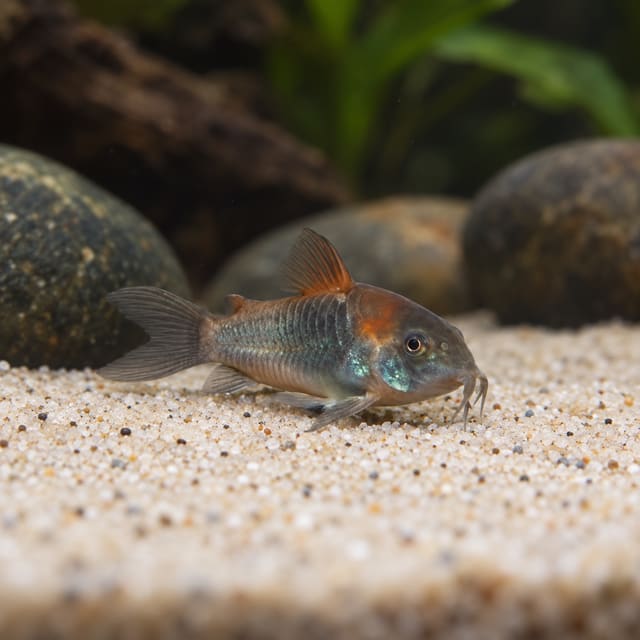
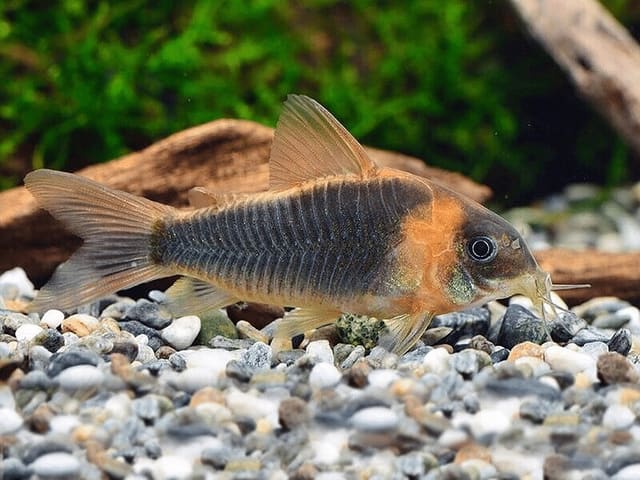
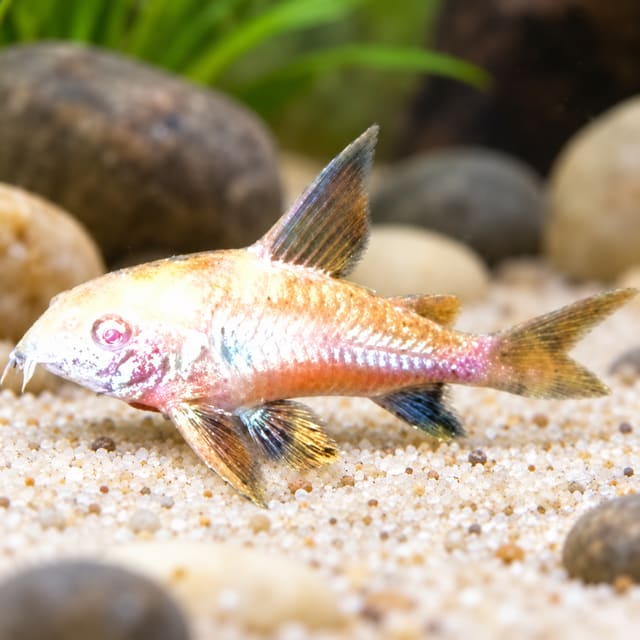
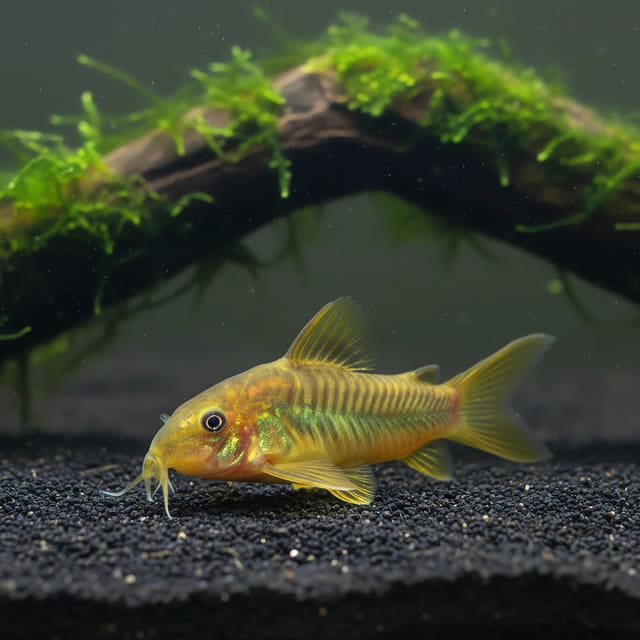
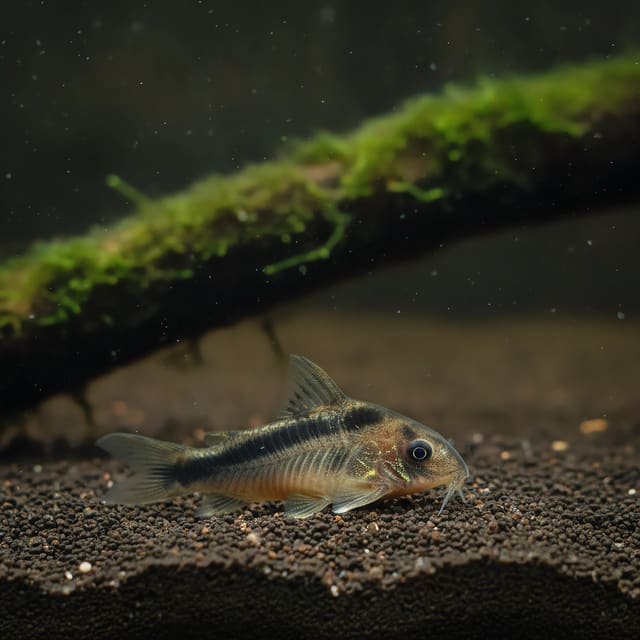
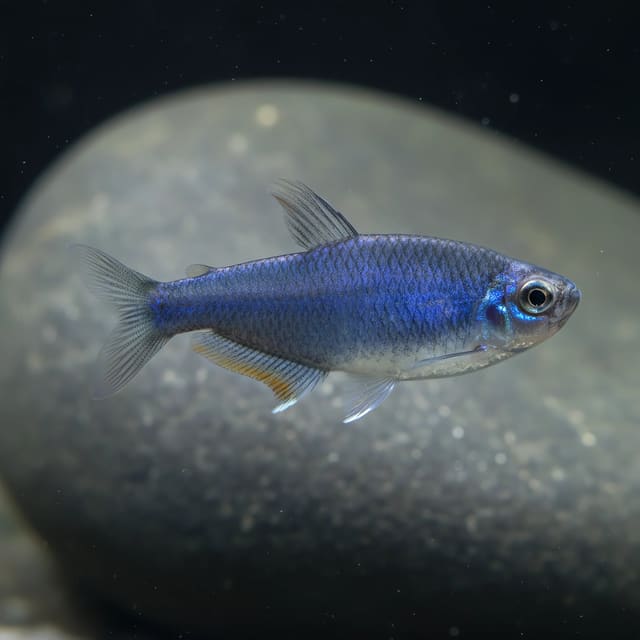
Albino Bronze Cory (Osteogaster aenea)
22–27°C · pH 6–8 · 72L
£2.99

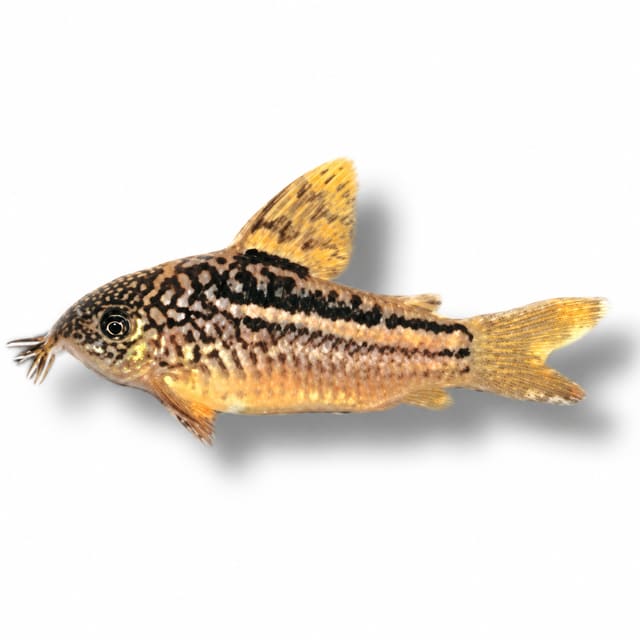
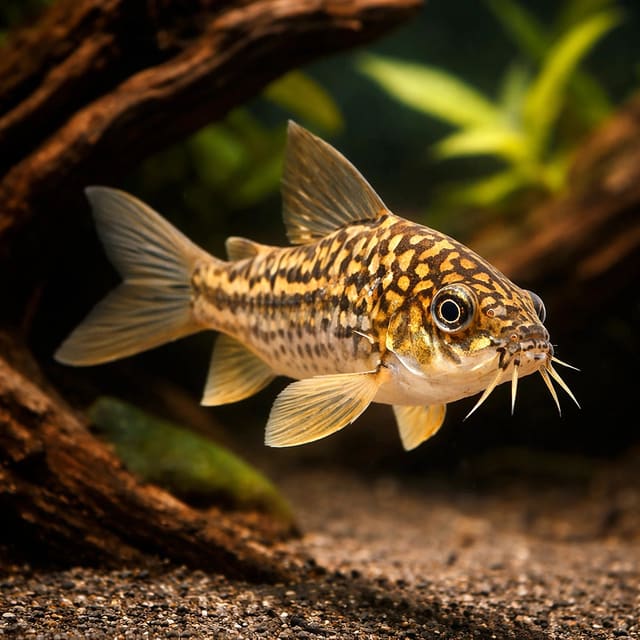
Mini Cory / Light-Spot Catfish (Gastrodermus nanus) is a small South American armoured catfish for an established community aquarium. Sold as one unsexed live fish of the selected size; plan a group, accessible sinking food and a clean, sheltered bottom.
Adult size is the maximum length this species reaches at full maturity (scientific sources). The livestock you receive will be younger and smaller — pick a size above for the actual shipping size. Product-photo provenance and any image-specific limitations are stated on the listing.
Gastrodermus nanus
Save when buying multiple fish. Each quantity is one fish; sex and pair formation are not guaranteed unless the selected variant explicitly states them.
Mini Cory / Light-Spot Catfish (Gastrodermus nanus) is a small South American armoured catfish for an established community aquarium. Sold as one unsexed live fish of the selected size; plan a group, accessible sinking food and a clean, sheltered bottom.
Adult size is the maximum length this species reaches at full maturity (scientific sources). The livestock you receive will be younger and smaller — pick a size above for the actual shipping size. Product-photo provenance and any image-specific limitations are stated on the listing.
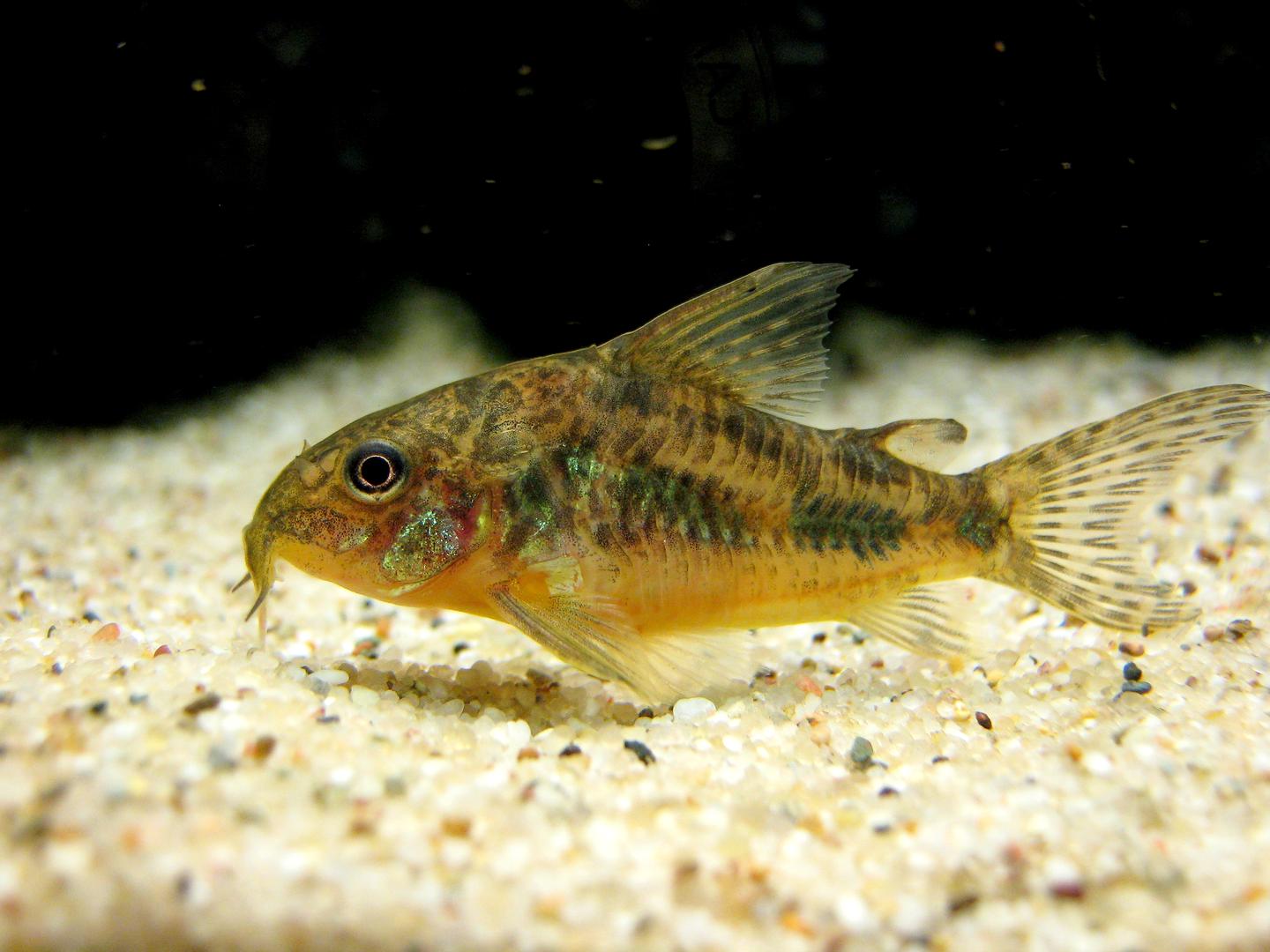
Identify the exact cory catfish before choosing care. Our starting policy for many common medium species is six compatible conspecifics, a mature 60 x 30 cm aquarium of about 60 litres, smooth fine sand and measured species-appropriate water.
Maintain these water conditions for optimal health and vibrant colors
The Mini Cory / Light-Spot Catfish is Gastrodermus nanus, a small South American armoured catfish also known by the older scientific name Corydoras nanus. It is a bottom-dwelling freshwater fish for an established aquarium where a group can feed, rest and move around without competing with large or forceful companions. Its small size makes the aquarium floor especially important: open feeding space, sheltered areas and a maintained biological filter matter more than fitting one small fish into a spare corner.
One purchase supplies one live fish of the selected size. The size you select is the size supplied, not the adult size. The size choices are 2 - 2,5 cm, 2,5 - 3 cm, 3 - 3,5 cm, plus the > 3,5 cm grade. Use the live size selector when ordering. Those grades describe the size of the animal supplied; its identity and care remain the same. Sex is guaranteed only when the selected option explicitly states male or female. This Mini Cory / Light-Spot Catfish listing has no sex-guaranteed option.
FishBase records a maximum length of 4.5 cm SL. SL means standard length, measured without the tail fin, so this figure should not be treated as a directly interchangeable total-length measurement. Individual growth varies; use the recorded species maximum when planning space. A young fish remains a growing animal, and selecting a smaller dispatch grade does not reduce its eventual need for companions, food or aquarium space.
The accepted name Gastrodermus nanus and the historical Corydoras nanus name refer to the same species. Mini Cory and Light-Spot Catfish are the familiar trade names used here. The scientific name is particularly useful when comparing older books and newer species records: a change of genus can make the same animal appear under two headings. Keep the species name alongside the common name when researching, rather than assuming that every fish called a mini cory has identical requirements.
A peaceful planted aquarium with a soft, clean bottom is the useful starting point retained from the traditional cory-style setup. Provide shaded cover as well as open areas, and make feeding the group an intentional part of the daily routine. These fish should receive appropriate sinking food rather than being expected to clean up whatever other fish leave behind. Their place near the bottom does not make them a substitute for substrate cleaning or water changes.
For group and aquarium planning, OATA recommends at least five for shoaling corys and an aquarium of at least 80 litres for a shoal of smaller catfish such as Corydoras. These are broad group recommendations, a starting point requiring assessment for this fish. They offer a practical starting point when assessing your tank. Existing livestock, the aquarium's footprint, cover, feeding access and filter capacity may all make a larger aquarium the better choice.
OATA's general freshwater catfish guidance gives 22–27°C, pH 6.0–8.0 and general hardness 4–18°dH. Treat those values as broad group guidance to discuss against your actual aquarium, rather than a species-specific optimum or an invitation to move repeatedly between extremes. FishBase's environmental records describe the species in nature and serve a different purpose. An established tank with suitable, stable conditions is preferable to continual adjustment aimed at a single unexplained number.
Gastrodermus nanus is recorded from the Suriname and Maroni river basins in Suriname and the Iracoubo basin in French Guiana. FishBase describes freshwater bottom-dwelling habits and reports specimens from a shallow creek with moderate current, sandy to sandy-muddy substrate and subdued light. That observation gives a useful reason to include shelter and a comfortable bottom, but it is not a complete aquarium recipe. Adapt the layout to the aquarium's usable floor, cover and circulation.
The small catfish is best considered as an animal to watch and care for, rather than a decorative accessory. When assessing whether it suits you, picture the whole group feeding at the bottom while the other inhabitants eat, and imagine how you will clean around its shelters. If those everyday tasks are straightforward in your aquarium, the setup is more promising than one chosen simply because the fish is small. Browse the corydoras collection when comparing different offers, and assess each species separately before deciding.
A mature biological filter is the foundation of this aquarium. The RSPCA explains that fish release toxic ammonia, which a working biological filter processes first into nitrite and then into nitrate. Both ammonia and nitrite are harmful, so a tank that looks clear can still be unsuitable. OATA advises checking that ammonia and nitrite are zero before introducing catfish. Do that with water tests, rather than relying on the age of the aquarium, clear water or the presence of live plants.
Setting up the glass tank, filling it and switching on a filter does not immediately make it ready for livestock. Allow the biological filter to establish and check the results before making an order. If this will be your first aquarium, the first tropical tank guide helps organise the preparation. The useful goal is a tank that can process the waste from its inhabitants, with an owner who can test the water and maintain that capacity.
Adding a group increases the waste entering the filter. OATA warns that stocking too quickly can exceed the bacteria's capacity and lead to new tank syndrome. Plan the social group and the filter together: do not resolve a crowded tank by keeping one isolated cory, and do not add a large number of animals without considering the existing load. Ask for advice on a sensible introduction plan if your aquarium is newly matured or already well stocked.
OATA's broad starting point is an aquarium of at least 80 litres for a shoal of smaller cory-type catfish. Volume alone does not describe the usable home, however. A tall aquarium with much of its base covered by solid ornaments can offer less practical bottom space than its capacity suggests. Look at the floor as the fish will use it: there should be room to approach food, move between sheltered areas and rest without every route passing another territorial animal.
Retain a mixture of open bottom and cover. Plants and suitable wood can create quieter areas while leaving accessible places for feeding and cleaning. OATA recommends plants for smaller or shy catfish and notes that many catfish appreciate shelter. A heavily furnished aquarium is useful only if you can maintain it: avoid making a dense, inaccessible corner where every feeding leaves waste that you cannot remove. Arrange the layout so it supports both the fish and routine husbandry.
A soft sand bottom is a practical choice for this style of aquarium, consistent with the sandy habitat observation in FishBase and the useful layout advice in the existing guide. Check all substrate and decorations for rough or sharp surfaces before use. Do not assume that sand makes a tank hygienic by itself. Uneaten food and other waste still need to be removed, especially around resting places. The surface should allow comfortable bottom access without becoming a store of decaying food.
Shade does not require shutting out all light. You can leave an open foreground visible while providing quieter areas beneath plants or suitable shelter. Avoid making the only feeding spot an exposed area that a shy fish will not readily enter. Equally, do not put all food into a deep hiding place where you cannot see whether it is eaten. A helpful layout lets you observe feeding without needing to move decorations every day.
For general freshwater catfish care, OATA gives a temperature range of 22–27°C, pH 6.0–8.0 and general hardness of 4–18°dH. Those are group-level figures and are presented here with that scope. Discuss the conditions for this species before purchase. If your aquarium already operates at an unusual end of a range, compare the needs of every inhabitant and discuss the setup before buying. Assess behaviour, feeding and space alongside temperature.
FishBase also lists environmental ranges of 22–26°C, pH 6.0–8.0 and hardness 2–25°dH for this species. These are wild environmental records, wild observations to interpret alongside aquarium husbandry. In particular, the wider hardness range does not justify deliberately pushing an aquarium towards an extreme. Keep the distinction clear when reading care cards: a species record describes where the animal has been reported, while aquarium guidance must also account for feeding, stocking, filtration and stable daily care.
Start with measurements of your water supply and the established aquarium. The water chemistry guide explains which values to test and why. General hardness and pH describe different aspects of water and should not be treated as interchangeable numbers. Keep a short record of results so that you can recognise a change. This is more useful than making frequent adjustments based on how the fish looks under one lighting condition.
Use the water matcher to organise a comparison of measured water and stated guidance. A comparison tool is a starting point for planning; also assess filter maturity, feeding access and the behaviour of companions. If the water appears compatible but the daily conditions are poor, improve those conditions before adding livestock. Make changes deliberately and verify their effect rather than stacking several changes together.
Maintain filtration and circulation without making the entire bottom difficult to use. FishBase reports moderate current in the observed creek habitat; that is a description rather than a pump specification. Check where the aquarium's flow goes after it meets plants and wood. Food should reach a usable feeding area, and there should be places where the group can rest. Adjust the layout or outlet if every sinking food particle is swept into an inaccessible corner.
FishBase describes Gastrodermus nanus as a facultative air-breather. Preserve access to the water surface and do not use this fact as a reason to neglect water quality. OATA lists changes in swimming and breathing among signs to watch. A brief surface movement should be considered in the context of the fish's normal behaviour, but persistent distress, unusual breathing or a change affecting several fish calls for prompt water testing and advice.
Check the filter for blockages during regular maintenance. A filter that still makes noise may not be moving water as intended. Look at the outlet, intake and the areas behind cover rather than judging performance from sound alone. If plant growth alters circulation, trim or rearrange it as part of maintenance. Avoid leaving a previously usable feeding area cut off by dense growth or an accumulated mass of debris.
OATA identifies corys as omnivorous catfish and recommends appropriate sinking foods even for catfish with a reputation as scavengers. Choose food that the fish can reach and eat. A small dispatch grade needs accessible particles, but that does not mean sprinkling extra food over the whole aquarium. Deliver an appropriate portion to the bottom and watch what happens. The feeding plan succeeds when the fish eat, not simply when pellets disappear from the surface.
Observe the group as well as the other inhabitants. A midwater fish may intercept food before it sinks, or a dominant bottom feeder may take over the feeding area. If that happens, spreading an appropriate ration between accessible spots may be more useful than adding ever larger amounts. The total amount still needs to suit the aquarium. More food can increase waste without solving the original competition, especially when the smallest fish never reaches it.
OATA's broad guidance is to feed what the fish can eat within a few minutes, generally once daily, with allowances for slower grazing species where applicable. Use observation to assess the portion and remove uneaten food. Adapt that group-level advice to feeding observations in your aquarium. The appropriate amount changes with the number and size of fish, the food and the aquarium's other inhabitants. Follow the food's instructions and seek advice if feeding remains uncertain.
Keep an eye on body condition over time. OATA advises watching changes in weight, condition and appetite. Looking at each fish during feeding helps reveal a quieter individual that otherwise stays behind cover. If one stops eating, do not assume that the whole group needs more food. Check water results, look at feeding access and note any other changes. A loss of appetite accompanied by abnormal appearance or breathing needs further advice.
OATA strongly recommends a weekly partial water change of 25% as general catfish husbandry guidance, together with regular testing at least weekly. Use that as a starting routine and adjust with informed advice to the aquarium's measured needs. Treat replacement tap water to remove chlorine or chloramine and prepare it appropriately before use. A water change should support stability, rather than subject the fish to a sudden avoidable difference in the water entering the tank.
Remove visible solid waste with a siphon while protecting the layout's useful shelter. You do not need to strip the entire aquarium on each occasion. Work around plants and decorations, paying attention to feeding areas and places where flow deposits debris. If maintaining a particular ornament repeatedly requires disrupting the whole group, reconsider its position. A practical aquarium remains comfortable for the fish while allowing you to reach the places that need cleaning.
When filter media needs cleaning, OATA advises rinsing it lightly in aquarium water removed during a water change and keeping it away from tap water. Chlorine or chloramine can damage the beneficial bacteria. Preserve the filter's biological function while clearing blockages, and follow the equipment manufacturer's instructions.
OATA's general catfish guidance calls for ammonia and nitrite at zero and nitrate no more than 20 mg per litre above normal tap-water levels. The nitrate advice is a comparison with your water supply, which accounts for the water supply's starting point. Record results and respond to a developing problem before adding more fish. If ammonia or nitrite is detected, take advice promptly and reassess feeding, filter performance and stocking.
Prepare the aquarium before dispatch and make sure someone can receive the parcel. Tropical Fish Co's delivery policy describes hand packing in oxygen-filled bags, an insulated box and a heat pack when weather requires it, with transport by a licensed live-animal courier. Read the delivery and Live Arrival Guarantee policy for the current arrangements and terms. Follow the confirmed information sent for your own order rather than relying on a general description as a promised date.
Open and inspect the parcel on the day it arrives. For a Live Arrival Guarantee claim, the policy asks for a continuous unboxing video beginning with the still-sealed parcel, showing it being opened and the fish still in their sealed bags. Record that before disturbing the contents if you may need claim evidence. Having your camera ready is an administrative preparation; it should not become a reason to postpone attending to the animals after inspection.
The store advises slow acclimatisation and floating the bag for 20–30 minutes before release. Read the current store arrival guidance and keep transport water out of the aquarium. Prepare your equipment and route to the tank in advance so that you do not improvise while holding an open bag. Handle catfish carefully: OATA notes that many have spines, so avoid rough handling or unnecessary transfers.
Keep the introduction calm and observe the fish after release. Give them access to their prepared cover and do not repeatedly chase them into view. Check that the other inhabitants allow them to settle and that food can reach their level. If anything appears wrong with an arrival, contact the store the same day with your order number and the requested evidence. For later health concerns, test the water and seek advice rather than choosing a treatment solely from a photograph.
OATA describes corys as suitable additions to community aquariums, while warning that the wider catfish group also contains predatory species. For this listing, the useful compatibility rule is to choose calm, non-predatory companions with suitable water requirements and adequate room for every inhabitant. Individual behaviour and aquarium conditions also matter. Look at the aquarium's daily feeding and resting arrangements before making a decision.
Choose a calm community and assess compatibility for the actual fish and aquarium. A small catfish needs to reach the bottom without being chased, rest without having its cover occupied by a territorial fish and eat without all food being taken first. If your present fish already contest the bottom fiercely, adding another group may worsen that pressure. Extra shelter can help a layout, but it does not turn a predator into a safe companion.
Size differences matter as well as temperament. Avoid animals capable of treating a small catfish as prey, and assess the adult sizes of the animals already present. A companion purchased young can outgrow a relationship that initially seems peaceful. The smallest dispatch grade should not be chosen simply because it fits beside a much larger fish today. Compare the eventual community and its feeding requirements, rather than treating the current shop sizes as permanent.
Use OATA's recommendation of at least five for shoaling corys as broad group planning guidance. Buying one fish does not mean solitary keeping is the intended arrangement. Assess how many of the same kind your aquarium can support, then plan the purchase quantity around that social need and the existing filter capacity. If you already have a group, additions still change the biological load and need a considered introduction.
A collection of different catfish should not automatically be counted as one adequate social group. They may share part of the aquarium while having different feeding habits, adult sizes or behaviour. Plan the Mini Cory group on its own merits. When comparing another cory-style fish, check its identity and care requirements rather than assuming that a similar shape means interchangeable companionship. Related products are alternatives to research, not a prescription to combine them all.
More bottom fish also means more demand on the same floor area. Consider where each animal rests and eats. Several shelters in one corner may still leave only one useful feeding route, which a larger animal can monopolise. Aim for access that lets you observe the group and distribute its food sensibly. If the aquarium has no spare usable bottom space, a larger tank or a different stocking choice may be preferable to further decoration.
Watch a normal feeding in your existing aquarium. Does appropriate food arrive on the substrate, or is everything intercepted above it? Does one animal push the others out of the feeding area? These observations are more revealing than a list of supposedly universal tank mates. The Mini Cory's care depends on receiving suitable sinking food, and no compatibility label removes the need to feed it directly.
If you are considering companions from OATA's named community catfish groups, such as Otocinclus or smaller plecos, investigate their separate needs first. The broad statement that these groups can be community additions does not establish that every member suits the same tank or diet. A pleco's adult size and feeding needs, for example, must be assessed for its exact species. Do not use a common name alone to decide the final stocking.
Use caution with an aquarium containing forceful feeders or animals that disturb all bottom cover. Even without obvious injury, repeated displacement can make the group hard to observe and feed. Look for changes after introduction as the animals settle into the aquarium. If the fish cannot use their prepared areas, reassess the community and seek advice. Adding more food without solving the competition may create a water-quality problem.
There is no universal shrimp-safe or breeding-safe guarantee attached to this offer. Small invertebrates, eggs and very young animals present different questions from adult fish compatibility. If that is your purpose, discuss the particular aquarium and livestock before buying, and retain a separate plan for animals that need protection.
For a beginner, the practical question is whether the aquarium and routine are ready. A keeper who can maintain the filter, test water, manage a group and observe bottom feeding has a useful foundation. A new, untested tank with unclear stocking is a poor place to start, regardless of how small the catfish is. Choose the fish after the setup is ready, and ask for help with any uncertain community arrangement before adding it.
FishBase records Gastrodermus nanus at up to 4.5 cm standard length, measured without the tail fin. This recorded maximum helps with planning; the dispatch sizes describe smaller supplied animals. Allow room for growth when planning its group.
OATA recommends at least 80 litres for a shoal of smaller cory-type catfish as broad group guidance. Floor area, cover, existing livestock and filter capacity also matter. Use that starting point to assess the whole aquarium alongside the needs of the existing community.
OATA recommends groups of at least five for shoaling corys. This is general group advice, rather than a species-specific experiment. Plan a group of its own kind with enough usable bottom space and feeding access, and consider the increased waste load before adding the fish.
It can be considered by a beginner with a mature filtered aquarium, suitable community and a reliable testing and feeding routine. Prepare the tank first, confirm zero ammonia and nitrite, and learn how to deliver sinking food to the group. Small size does not remove these responsibilities.
OATA identifies corys as omnivorous and recommends appropriate sinking foods for catfish. Choose food the fish can reach and eat, watch the group feed and remove leftovers. Do not rely on food missed by other fish or buy a bottom catfish as a replacement for aquarium cleaning.
OATA's broad freshwater catfish guidance is 22–27°C, pH 6.0–8.0 and general hardness 4–18°dH. These are group values, broad group values requiring species-specific consideration. Keep suitable conditions stable and discuss your measured aquarium water before purchasing if you are uncertain about the match.
OATA describes corys as community aquarium fish, with individual behaviour and arrangements still needing assessment. Choose calm companions and monitor the group. Repeated chasing, blocked feeding access or new damage calls for reassessment of the aquarium rather than relying on a peaceful label.
Other catfish need individual assessment. OATA names corys, Otocinclus and smaller plecos as community groups, but their exact species, adult sizes and diets still matter. Avoid predatory animals and bottom feeders that prevent the group reaching food or shelter. Similar appearance alone does not establish compatibility.
Tropical Fish Co hand packs fish in oxygen-filled bags and insulated boxes, with a heat pack when weather requires it, for a licensed live-animal courier. Be present to receive and inspect the parcel that day. For a Live Arrival Guarantee claim, keep a continuous video from the sealed parcel through opening to fish in sealed bags, and contact the store the same day with your order number.
FishBase: Gastrodermus nanus supplies the accepted identity, distribution, maximum recorded standard length and wild habitat observations. Environmental records describe nature and should not be read as aquarium targets.
Gastrodermus nanus species summary provides additional reading on the family and native range.
OATA freshwater catfish care provides the broad group guidance used for water, group and tank planning, feeding, maintenance and compatibility.
RSPCA aquarium environment guidance explains the role of filtration and waste processing in a maintained aquarium.
No reviews for this item yet. Bought one? Honest reviews only, good or bad.
What customers say about ordering from us
I have a small group of long finned mountain minnows. So was delighted to be able to order ten of this variety to increase the genetics in my tank . The ones I recieved are healthy but it’s to early to give a verdict on wether they are of a long finned type since they are small currently.
Gordon Walker · 23 Sept 2026
100% success travel and "installation". Pleased with quality of purchase. The Siamese fighter a bit "shy" so have not yet seen him at his best yet but looking good. Happy customer. GG
George E Garratt · 21 Sept 2026
Reviews of our shop, collected by Judge.me, an independent third-party review collector. Newest first.