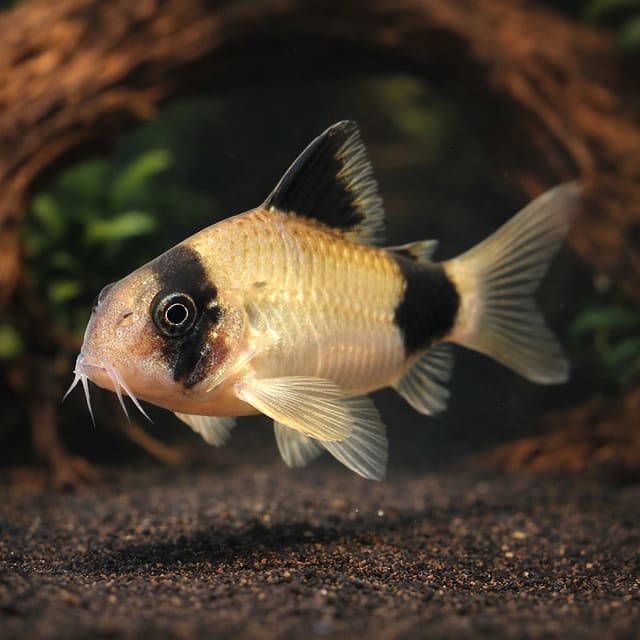
Panda Cory Catfish (Corydoras panda)
22–25°C · pH 6–7.4
From £8.69Some sizes on sale

The Skunk Cory (Corydoras arcuatus) is a peaceful armoured catfish from South America's upper Amazon basin that reaches 4.8 cm standard length. It suits a mature, filtered aquarium planned for at least six fish, with the FishBase–Seriously Fish overlap of 22–26°C and pH 6.0–7.5. Sold individually in sizes from 2.5–3 cm to 4–5 cm.
Adult size is the maximum length this species reaches at full maturity (scientific sources). The livestock you receive will be younger and smaller — pick a size above for the actual shipping size. Product-photo provenance and any image-specific limitations are stated on the listing.
Corydoras arcuatus
Shoaling fish: kept in a group they feel safer, stay calmer and show their best colour.
The Skunk Cory (Corydoras arcuatus) is a peaceful armoured catfish from South America's upper Amazon basin that reaches 4.8 cm standard length. It suits a mature, filtered aquarium planned for at least six fish, with the FishBase–Seriously Fish overlap of 22–26°C and pH 6.0–7.5. Sold individually in sizes from 2.5–3 cm to 4–5 cm.
Adult size is the maximum length this species reaches at full maturity (scientific sources). The livestock you receive will be younger and smaller — pick a size above for the actual shipping size. Product-photo provenance and any image-specific limitations are stated on the listing.
Identify the exact cory catfish before choosing care. Our starting policy for many common medium species is six compatible conspecifics, a mature 60 x 30 cm aquarium of about 60 litres, smooth fine sand and measured species-appropriate water.
Maintain these water conditions for optimal health and vibrant colors
The Skunk Cory (Corydoras arcuatus) is a peaceful, gregarious armoured catfish from South America’s upper Amazon basin. It belongs to the Callichthyidae family and reaches a recorded 4.8 cm standard length. This compact bottom-dweller suits a keeper prepared to maintain at least six together in a mature, filtered aquarium with clean substrate, dedicated food and compatible community fish.
FishBase lists this freshwater species as demersal, meaning that its activity is associated with the lower part of the water column. FishBase now lists it as Brochis arcuatus. It is also facultatively air-breathing, so its behaviour includes more than movement along the aquarium floor.
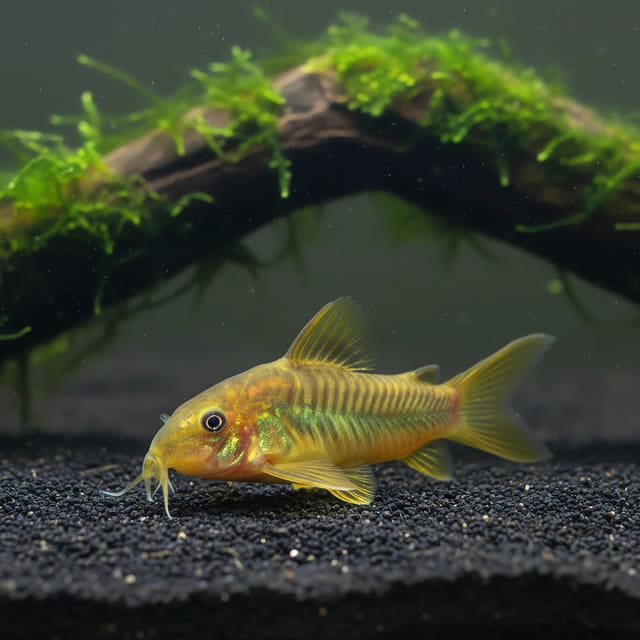
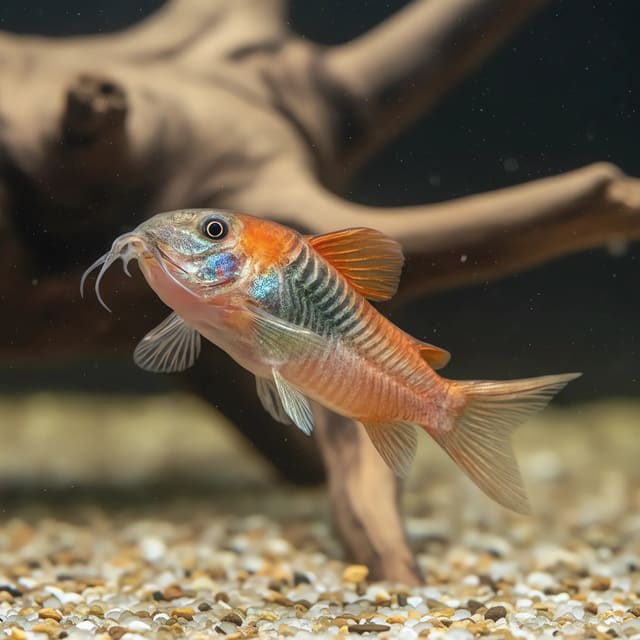
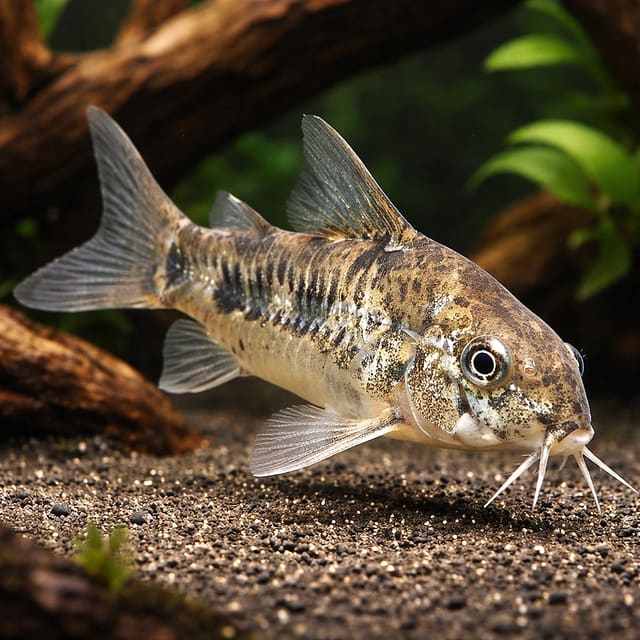
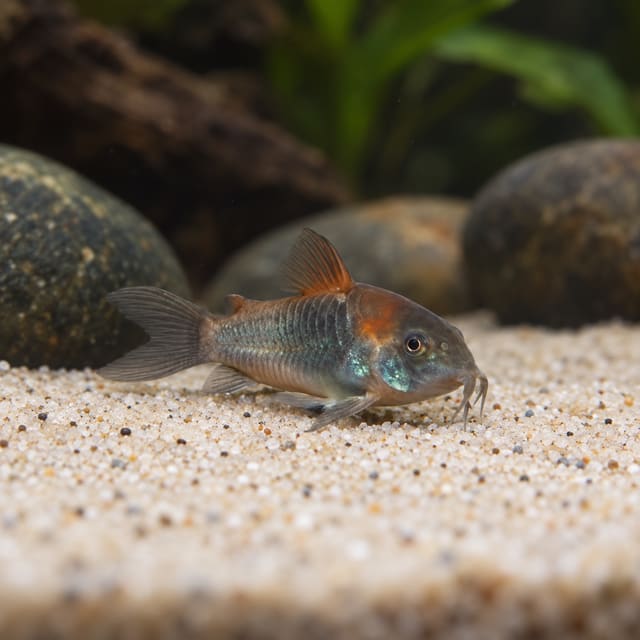
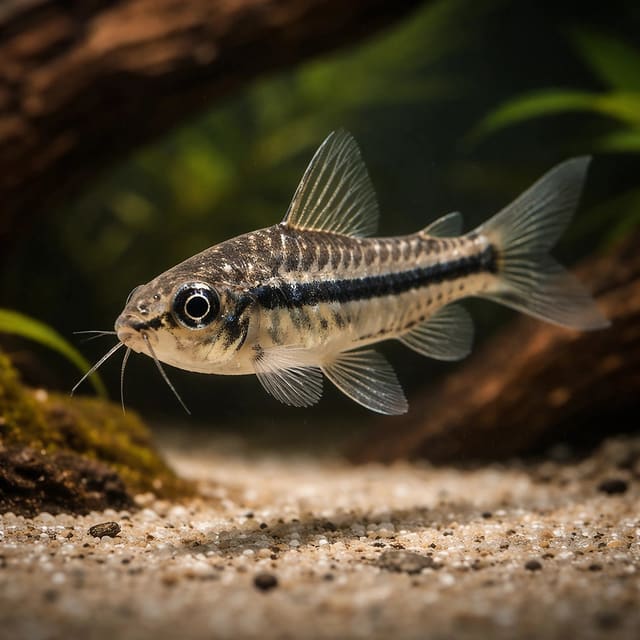
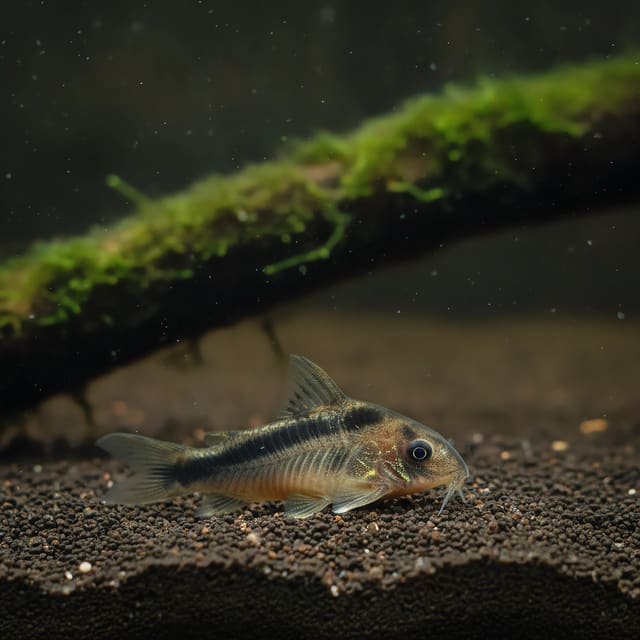
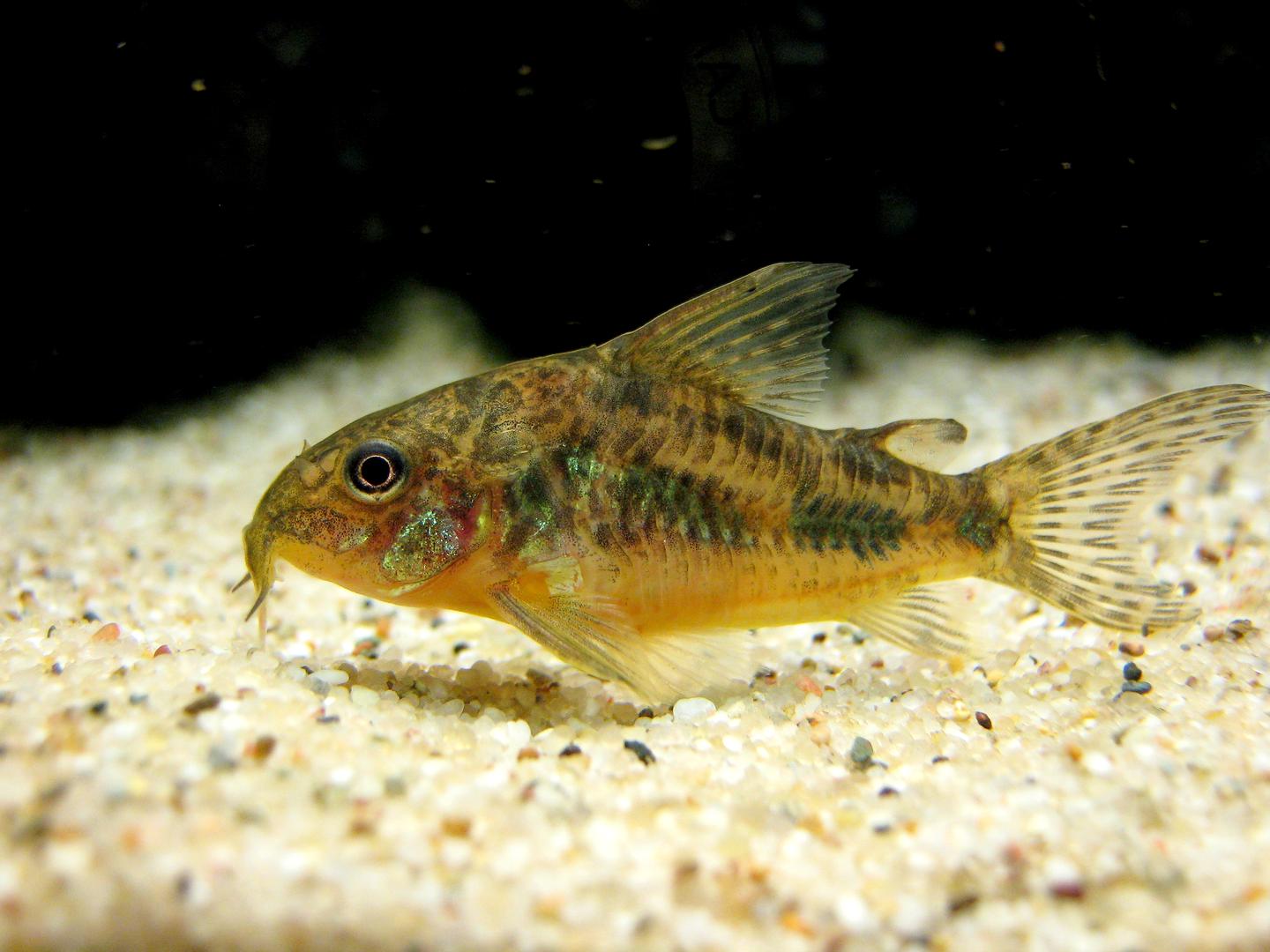
Look for the black body stripe that runs through the eye, which helps separate it from the similar-looking Corydoras urucu. Seriously Fish also gives Arched Cory as a trade name and describes the species as peaceful and gregarious. Similar-looking Corydoras exist, so the combination of identity, adult planning size and characteristic upper stripe matters more than a trade name alone.
Its social requirement is decisive. Plan for at least six of the same species rather than treating it as a solitary bottom fish. The aquarium also has to feed the whole group deliberately; Corydoras must not be expected to live on scraps left by fish feeding higher in the water.
One purchase supplies one Corydoras arcuatus from the size selected on the live size selector. The labels are 2.5–3 cm, 3–3.5 cm and 4–5 cm. Use the label to plan the fish you will receive and the adult figure to plan its permanent aquarium. The size you select is the size supplied, not the adult size.
Buying one fish does not change the social requirement. Count the Skunk Corys already living in the aquarium and plan towards a group of at least six. If this is the first one for a new group, make sure the aquarium can support the intended group rather than judging space and filtration around a single dispatch-sized fish.
Sex is guaranteed only when the selected option explicitly states male or female. This Corydoras arcuatus listing has no sex-guaranteed option. Seriously Fish notes that females tend to grow larger and that sexually mature females are noticeably rounder and broader-bodied than males, especially when gravid, but this does not assign a sex to an individual fish offered here.
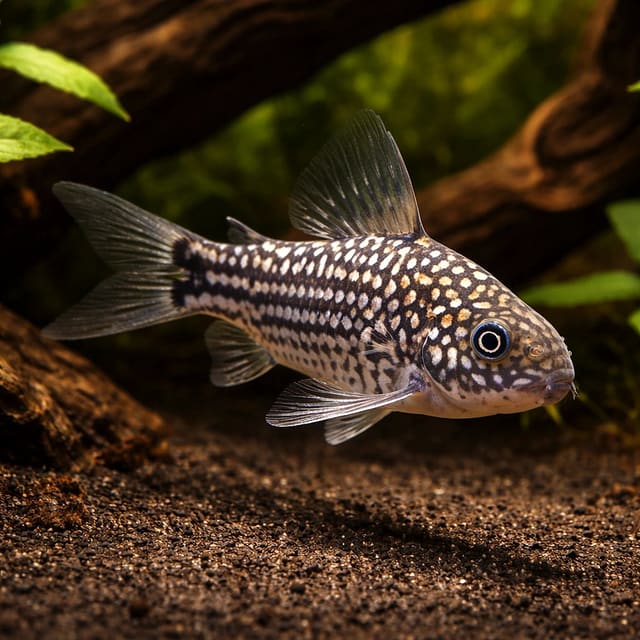
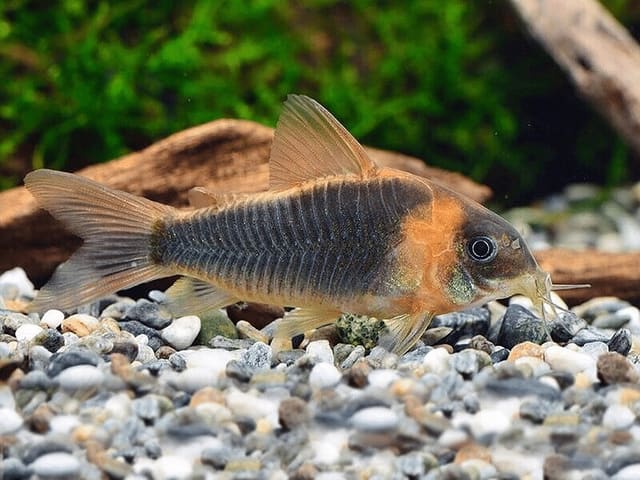
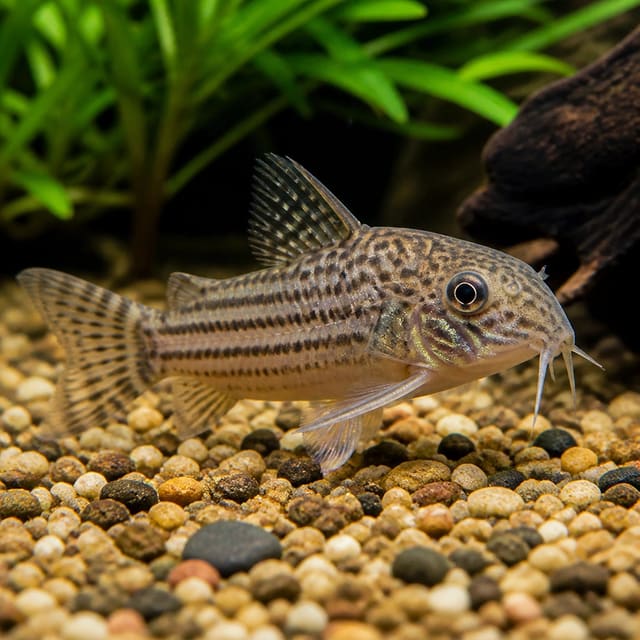
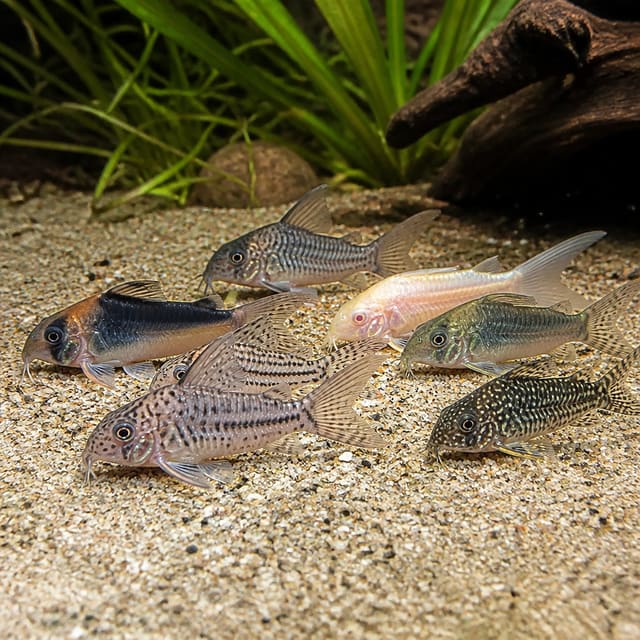
The gallery images are representative, based on reference photographs of this species, so colours can look slightly different from the live animal. Use the gallery to understand the broad dark upper stripe, Corydoras body shape and mouth barbels while allowing for natural differences between individual animals.
If you are comparing this fish with other members of the group, browse the current Corydoras collection. Compare adult size, water range, social needs and aquarium footprint before deciding which group fits your setup.
Keep at least six Skunk Corys in an aquarium of at least 80 litres, with a mature filter, suitable bottom area and cover. Seriously Fish gives a group of at least 4–6 for this species, so planning around at least six provides a clear social minimum. OATA’s freshwater-catfish sheet gives at least 80 litres for a shoal of smaller species such as Corydoras as group guidance.
Keep the aquarium at 22–26°C, pH 6.0–7.5 and 2–12 dGH. These routine values fall within both FishBase’s recorded species environment and the aquarium range given by Seriously Fish. Keep ammonia and nitrite at zero, and follow OATA’s catfish guidance that nitrate should not exceed 20 mg per litre above the normal tap-water level.
| Suits | Not suited to |
|---|---|
| A mature, filtered freshwater aquarium | An unfiltered or biologically immature setup |
| A planned group of at least six | Solitary or pair-only keeping |
| Fine sand or scrupulously clean rounded gravel | A bottom that cannot be kept clean |
| A peaceful community sharing its water range | A mix chosen without checking water, space and feeding access |
| Dedicated sinking food once daily | Reliance on other fishes’ leftovers |
This fish suits a keeper who will test water, maintain the filter and watch every group member eat. Its compact body does not reduce the need for group space or stable water quality.
Use 4.8 cm standard length as the adult planning figure. FishBase gives this as the maximum recorded length for male or unsexed fish. Plan bottom area, décor spacing and the number of animals the aquarium can support around a complete group at that adult size.
Standard length is an anatomical measurement, while the size labels on this offer are dispatch grades. Do not turn a dispatch label into a growth prediction. Instead, plan the permanent setup for a complete adult group and treat the selected size as the fish’s size when sent.
Start with at least 80 litres for the shoal and favour a useful horizontal footprint. OATA explains that the larger the aquarium, the more stable temperature and water quality will be, so extra capacity is worthwhile when other fish share the setup. An 80-litre aquarium crowded with décor across the entire floor may offer less practical foraging room than a thoughtfully arranged aquarium of the same volume.
Divide the lower area into open feeding lanes and covered resting places. Fine substrate should remain accessible for the group, while plants, wood, pots or caves can create security. Keep routes to the surface open because FishBase identifies this species as facultatively air-breathing.
The practical question is not whether one compact fish fits. It is whether the mature aquarium can support the complete social group without compromising water quality, feeding access or usable bottom space.
Keep Corydoras arcuatus at 22–26°C, pH 6.0–7.5 and 2–12 dGH. This is the overlap between FishBase’s recorded range of 22–26°C, pH 6.0–8.0 and 2–25 dGH and Seriously Fish’s aquarium range of 20–28°C, pH 5.0–7.5 and 2–12 dGH. Staying inside the overlap keeps every routine value within both references.
Measure the aquarium rather than assuming that its water matches the tap or heater setting. Our aquarium water-chemistry guide explains the values to test, and the water matcher helps compare measured results with the target range.
If a reading is outside the routine range, identify the cause before adding livestock. Check source water, temperature control, biological filtration, recent feeding and stocking changes. Make adjustments deliberately and re-test rather than making several changes without measuring their effect.
A suitable pH does not compensate for detectable ammonia, and the correct temperature does not make an immature filter safe. Water chemistry, waste processing and stability work together. Record results in a consistent format so gradual nitrate growth, a pH shift or a change after maintenance remains visible.
When choosing community fish, compare their full ranges with these values. A shared temperature alone is not enough if hardness or pH falls outside the needs of one group.
Use fine sand where possible. Seriously Fish recommends fine sand as the ideal substrate and accepts rounded gravel when it is kept scrupulously clean. This gives the group a suitable lower area for its normal foraging while making settled waste easier to see and remove.
Rounded gravel is a conditional choice, not permission to let debris collect between the grains. Inspect it during each maintenance session and use a siphon to remove solid waste. With sand, move the siphon over the surface so food and waste are taken out without unnecessarily disturbing the whole floor.
Provide cover to give the fish security. Plants, wood, suitable ornaments, pots or caves can all contribute, while the exact visual arrangement can follow your preference. Keep some open substrate in front of or between covered areas so all six or more fish can forage and reach sinking food.
| Setup choice | Practical check |
|---|---|
| Fine sand | Keep the surface free from trapped food and solid waste |
| Rounded gravel | Use only when it can be kept scrupulously clean |
| Plants and wood | Create cover without closing every feeding lane |
| Pots or caves | Position them securely and retain access around them |
| Open foreground | Make sure the whole group can feed without crowding |
Watch how the fish use the layout. A secure group should have both sheltered places and clear routes across the bottom. If food repeatedly disappears into inaccessible gaps, adjust the feeding point or décor so the Corydoras can reach it and uneaten food can be removed.
Cleanliness matters more than creating a decorative imitation of a river. A manageable arrangement that supports weekly siphoning, visual checks and reliable feeding is preferable to a densely packed floor that cannot be maintained properly.
Use a well-established biological filter before adding the group. The RSPCA explains that filtration supports beneficial bacteria which convert toxic ammonia to nitrite and then to the safer nitrate. The filter therefore has to be mature, correctly sized for the aquarium and kept running effectively.
If this is your first setup, follow our guide to preparing and maturing a tropical aquarium before livestock arrives. Confirm zero ammonia and zero nitrite with tests; elapsed time on its own is not a substitute for measured water quality.
Chlorine or chloramine may kill the beneficial bacteria established in filter media. Cleaning every component aggressively at once can also remove too much biological capacity. The aim is to restore flow while retaining the bacteria that process fish waste.
If ammonia or nitrite is detectable, pause further stocking and test again after corrective maintenance. Check for excess food, increased livestock load, a blocked filter or disrupted media. Continue measuring until both values return to zero and remain there.
Increase livestock numbers slowly. Every added fish and every increase in feeding raises the waste load, and the bacterial population must adjust. This is why an established aquarium can still develop new-tank syndrome when too many animals are added in a short period.
Feed a varied omnivorous diet that reaches the bottom. Seriously Fish describes Corydoras as foraging omnivores that accept most sinking dried foods together with small live or frozen foods such as bloodworm and Tubifex. A quality dried product and freeze-dried bloodworm are also suitable parts of the rotation.
Offer food once a day and give only what the fish can eat within a few minutes. This timing follows OATA’s freshwater-catfish guidance. The portion has to reflect the number and size of Corydoras as well as competition from other inhabitants, so watch the group instead of relying only on a fixed number of pieces.
Do not employ this fish as an aquarium cleaner. It may encounter food that reaches the floor, but it must never be expected to survive on scraps from other inhabitants. Dedicated feeding lets you judge appetite, body condition and whether faster tank mates are taking too much.
A reduction in feeding response can be an early sign that something has changed. If one fish hangs back, check water quality, breathing, appearance and interactions before simply adding more food. Increasing the portion without finding the cause can leave waste on the substrate and raise the load on the filter.
After adding more fish to the community, reassess the portion while continuing to apply the few-minutes rule. More animals increase both food demand and waste production, so feeding and filtration should be evaluated together.
Arrange for someone to receive the parcel because live fish must not be left unattended. The fish is hand-bagged in pure oxygen and placed in an insulated poly box, with a heat pack when the weather calls for it. A licensed live-animal courier carries the parcel.
Read the current delivery and Live Arrival Guarantee policy before arrival so the receiving and claim requirements are clear.
OATA advises checking that ammonia and nitrite are zero before adding fish. Have the mature aquarium ready at the FishBase–Seriously Fish overlap of 22–26°C, with the filter operating normally and the intended group space prepared.
Add fish only as quickly as the biological filter can support the increased waste and feeding. OATA warns that stocking too quickly can produce new-tank syndrome because the nitrifying bacteria have not expanded enough to process the added load.
During the first week, keep the normal weekly testing schedule and add extra checks if behaviour or feeding changes. Confirm that every Skunk Cory reaches sinking food, that the filter flow remains normal and that no food is accumulating around décor. Maintain the established 25% weekly water change rather than replacing observation with unnecessary alterations.
Judge settling by the fish’s own consistent pattern. Appetite, swimming, breathing, colour and use of cover should become familiar, giving you a baseline against which later changes can be recognised.
Observe the group every day and compare each fish with its normal appearance and behaviour. Healthy signs include clear, bright eyes, undamaged fins, intact scales, an appropriate swimming pattern and a reliable feeding response. Body condition should remain steady rather than rising or falling unexpectedly.
FishBase describes this species as facultatively air-breathing. Use its normal pattern as the baseline, while treating a change such as persistent surface-hanging as a reason to check the whole aquarium. OATA also highlights changes in bottom-sitting, erratic swimming, hiding, aggression, breathing rate, colour and appetite.
| If you see | Do this first |
|---|---|
| Reduced feeding response | Test water and check whether every fish can reach food |
| Faster or slower gill movement | Check ammonia, nitrite, temperature and filter operation |
| More hiding or altered swimming | Review water, cover, group behaviour and recent changes |
| White spots, fluffy growths or damaged tissue | Test ammonia, nitrite and temperature promptly and correct any fault found |
| Weight or condition change | Observe feeding access and compare all group members |
Start with measured water quality because ammonia and nitrite are toxic and must remain at zero. Also check temperature, recent maintenance, filter flow, food left on the bottom and whether livestock was added recently.
Do not select a treatment from appearance alone. Similar outward signs can follow different problems, and the correct response depends on the cause and the other animals in the aquarium. When a health change persists or the fish develops visible lesions, growths, damaged tissue or abnormal breathing, retest ammonia, nitrite and temperature, correct any fault found and keep checking every fish daily.
Maintain at least six Skunk Corys together. Seriously Fish describes the species as peaceful and gregarious and states that it should be maintained in a group of at least 4–6 individuals. Using six as the planning minimum gives the social fish a clear group structure while remaining within that species guidance.
OATA likewise identifies Corydoras as shoaling fish and explains that fish kept singly or in groups that are too small will often become stressed. A pair should therefore be treated as an incomplete group, not as the finished social arrangement.
Watch the fish as individuals as well as a group. One animal repeatedly missing food, hiding more than its companions or changing body condition needs attention even when the rest of the shoal appears settled. Begin with water testing and feeding access, then review the layout and community interactions.
Adding more Corydoras changes the biological load. Increase numbers at a pace the mature filter can support, and test ammonia and nitrite after a stocking change. Both readings must remain at zero.
A mixed collection of differently named Corydoras should not be used to sidestep the same-species group plan. Build the core group of Corydoras arcuatus first, then assess any broader community against space, water and filtration capacity.
Use this species in a peaceful freshwater community only after checking the proposed inhabitants against its needs. OATA describes Corydoras as excellent additions to community aquariums, while Seriously Fish characterises Corydoras arcuatus as peaceful. Neither description removes the need to assess the particular aquarium.
Treat every pairing as conditional. Match 22–26°C, pH 6.0–7.5 and 2–12 dGH, then check adult space, temperament, bottom access and feeding competition. The aquarium must still hold at least six Skunk Corys and give them dedicated sinking food.
| Check | Decision rule |
|---|---|
| Water | All animals must share the full routine range |
| Space | The mature community must fit without losing usable bottom area |
| Temperament | Choose a peaceful community and monitor actual interactions |
| Feeding | Sinking food must reach every Corydoras |
| Filtration | Ammonia and nitrite must remain at zero after stocking changes |
Apply the same screen to fish and invertebrates. Do not assume that occupying a different water level creates compatibility, or that a peaceful label guarantees equal access to food. Observe what happens at feeding time and around covered bottom areas.
Reconsider a match if the Corydoras are repeatedly displaced from food, hide more than their established pattern, show altered breathing or lose condition. Test water first, then separate the animals if an interaction is causing continuing harm.
Before adding any animal, check it against the aquarium dimensions, measured water values, existing livestock and the planned group of at least six. Decide each match for your own aquarium from those details.
It reaches a recorded 4.8 cm standard length according to FishBase. Plan its permanent aquarium around that adult figure, not the selected dispatch size.
Plan at least 80 litres for the group. OATA gives this minimum for a shoal of smaller species such as Corydoras as group guidance, and a useful horizontal footprint should include open substrate and cover.
Keep at least six together. Seriously Fish describes the species as peaceful and gregarious and states that it should be maintained in a group of at least 4–6 individuals, so six is the clear planning minimum.
It suits a keeper who can provide a mature filtered aquarium, at least six fish, suitable substrate, dedicated daily feeding and weekly water testing and maintenance. Do not add it to an immature or unfiltered setup.
Feed varied sinking dried foods with small live, frozen or freeze-dried foods such as bloodworm or Tubifex. Feed once daily, offering only what the fish can eat within a few minutes.
Keep Corydoras arcuatus at the FishBase–Seriously Fish overlap of 22–26°C and pH 6.0–7.5, with hardness of 2–12 dGH.
Seriously Fish describes it as peaceful and gregarious. Monitor real interactions, feeding access and changes in hiding or condition, because every mixed aquarium depends on its particular inhabitants and space.
OATA places Corydoras in community aquariums, and this species is described as peaceful. Choose peaceful animals sharing 22–26°C, pH 6.0–7.5 and 2–12 dGH, then check space, feeding access and actual interactions.
It is hand-bagged in pure oxygen, packed in an insulated poly box with a heat pack when weather calls for it, and carried by a licensed live-animal courier. Be present to receive it and start a short continuous unboxing video before opening, showing the sealed parcel, the opening and the fish still inside the bag. Float the bag for 20–30 minutes, then release the fish without pouring bag water into the aquarium.
No reviews for this item yet. Bought one? Honest reviews only, good or bad.
What customers say about ordering from us
I have a small group of long finned mountain minnows. So was delighted to be able to order ten of this variety to increase the genetics in my tank . The ones I recieved are healthy but it’s to early to give a verdict on wether they are of a long finned type since they are small currently.
Gordon Walker · 23 Sept 2026
100% success travel and "installation". Pleased with quality of purchase. The Siamese fighter a bit "shy" so have not yet seen him at his best yet but looking good. Happy customer. GG
George E Garratt · 21 Sept 2026
Reviews of our shop, collected by Judge.me, an independent third-party review collector. Newest first.