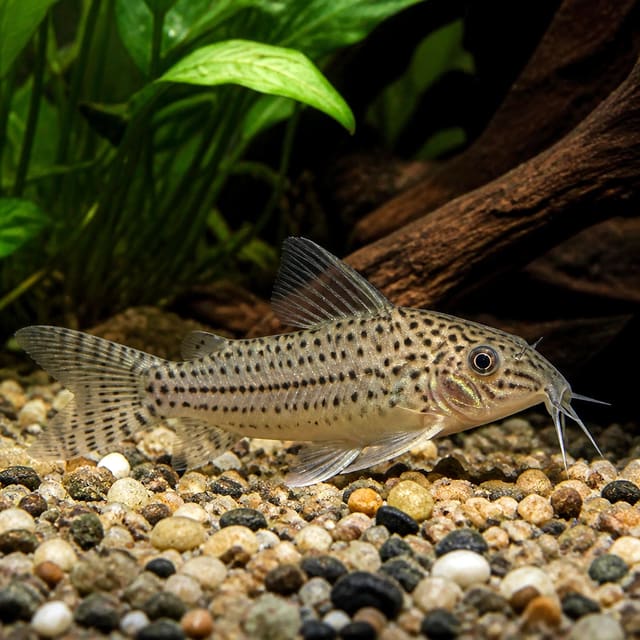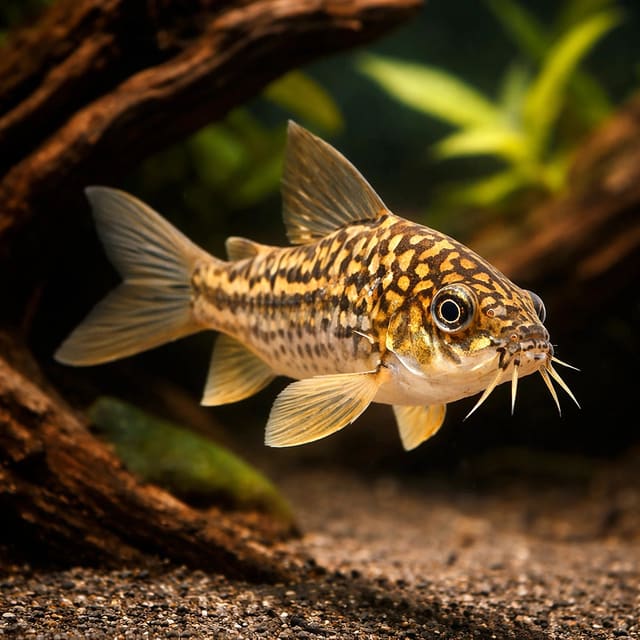
Easy
Napo Cory (Gastrodermus napoensis)
22–26°C · pH 6–7.4 · 41L
£15.99

Add Corydoras simulatus, a peaceful moderate-care catfish that helps keep tanks tidy. Great for community aquariums. Buy online with UK delivery.
Adult size is the maximum length this species reaches at full maturity (scientific sources). The livestock you receive will be younger and smaller. Product-photo provenance and any image-specific limitations are stated on the listing.
Corydoras simulatus
Shoaling fish: kept in a group they feel safer, stay calmer and show their best colour.
Confirm your email, then we’ll send an availability message for this exact item if it returns within 180 days.
This request is only for this product—no newsletter or other promotions. A mail-provider retry may very rarely duplicate the same availability message. Unconfirmed addresses are removed after 48 hours. See our privacy policy.
Add Corydoras simulatus, a peaceful moderate-care catfish that helps keep tanks tidy. Great for community aquariums. Buy online with UK delivery.
Adult size is the maximum length this species reaches at full maturity (scientific sources). The livestock you receive will be younger and smaller. Product-photo provenance and any image-specific limitations are stated on the listing.
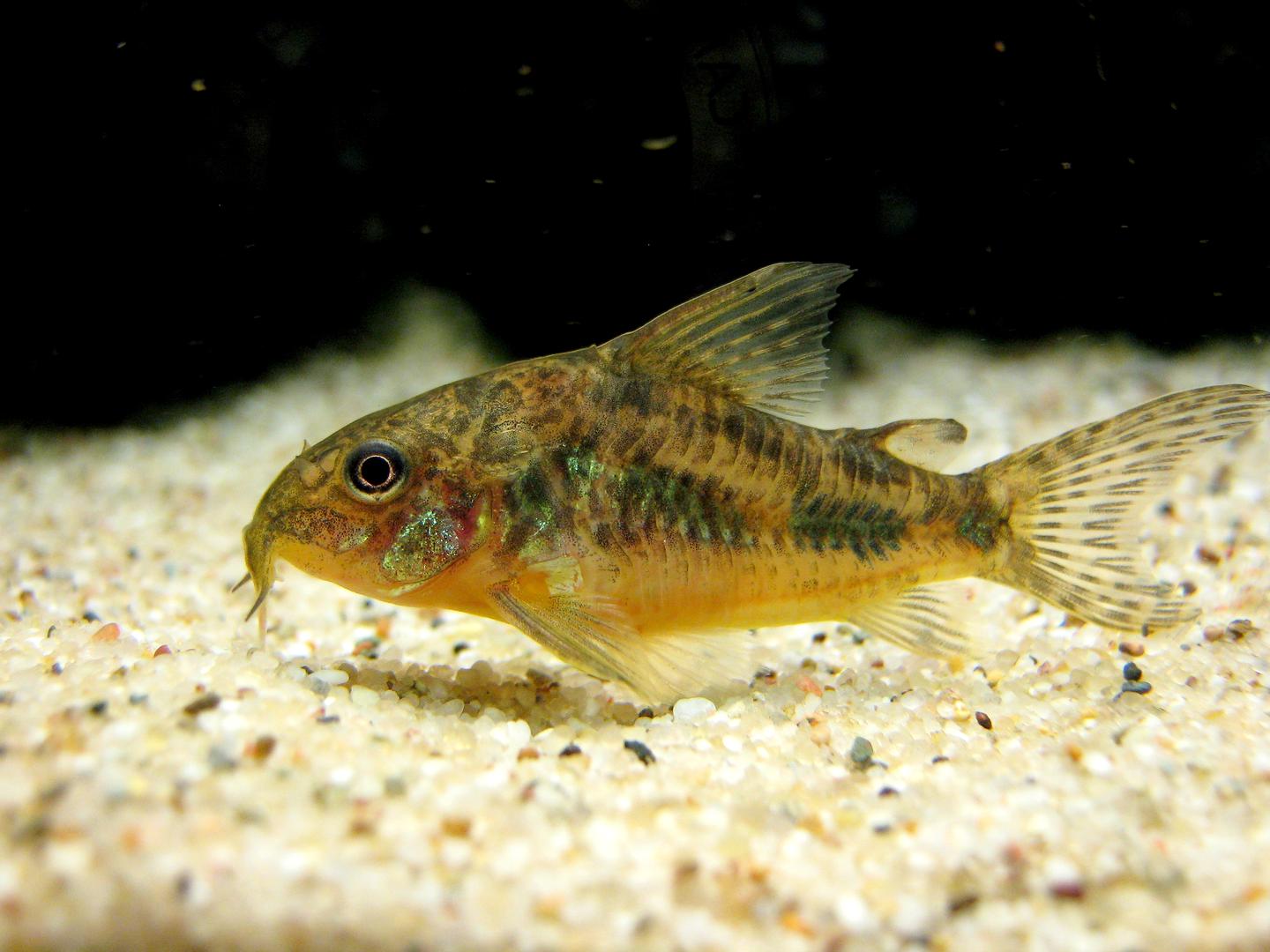
Identify the exact cory catfish before choosing care. Our starting policy for many common medium species is six compatible conspecifics, a mature 60 x 30 cm aquarium of about 60 litres, smooth fine sand and measured species-appropriate water.
Maintain these water conditions for optimal health and vibrant colors
Olga Cory (Corydoras simulatus) is a small, elegant South American catfish that brings movement, character, and reliable bottom-level activity to a planted aquarium. Often searched by aquarists looking for the best algae eating fish, this species is actually more accurately described as a peaceful omnivorous scavenger than a true algae specialist—but that is exactly why it is so useful in a balanced community tank. At just 5.5 cm adult size, with a gentle temperament, a 5-year lifespan, and an easy care level, it is a superb choice for hobbyists who want one of the most dependable peaceful bottom dwellers for aquarium setups. Native to Colombia, the Olga Cory is a shoaling fish that thrives in groups, sandy substrates, and stable water conditions, making it a strong fit for corydoras for planted tank layouts, corydoras for small aquarium builds, and calm community aquariums. If you are comparing best corydoras for beginners, best catfish for freshwater aquarium options, or even researching algae eater fish care, this species deserves a close look. See our detailed photos showing the masked face pattern, compact body shape, and subtle colour contrast that make Corydoras simulatus stand out in the hobby. Used correctly, it adds both visual interest and practical clean-up support to your tank.
Corydoras simulatus sits within the classic armored catfish group that has made Corydoras one of the most popular names in freshwater fishkeeping. In the hobby, it is valued for being hardy, social, and adaptable, with the added appeal of a distinctive masked pattern. It is closely related in care style to species such as the Peppered Cory - Corydoras Paleatus, Sterba'S Cory - Corydoras Sterbai, and Neon Albino Cory - Corydoras Aeneus, all of which share the same love of soft substrate and group living. For aquarists comparing Olga Cory tank mates, Olga Cory minimum tank size, or Olga Cory lifespan, this species offers a very manageable entry into the world of Corydoras keeping.
Corydoras simulatus originates from Colombia, where it lives in slow-moving freshwater systems with soft sediment, leaf litter, and plenty of cover. In the wild, these fish spend much of their time close to the riverbed, sifting through sand and detritus for tiny invertebrates, biofilm, and organic matter. That natural lifestyle explains why corydoras aquarium requirements are so specific: they need gentle water movement, fine substrate, and a calm environment rather than a bare-bottom or high-flow setup. Hobbyists often search for bristlenose catfish habitat, bristlenose catfish natural habitat, or where bristlenose catfishes are native to, but the Olga Cory comes from a very different South American ecosystem and should be kept according to Corydoras needs, not pleco assumptions.
In terms of habitat, think shaded tributaries, flooded margins, and quiet stretches where the fish can school and forage safely. This is why corydoras tank setup should include sand, leaf litter, and driftwood, plus stable filtration and low stress tank mates. The species is not known as an algae specialist in the same way as a siamese algae eater or chinese algae eater, yet it still contributes to general tank cleanliness by consuming leftover food and grazing on surfaces. Many aquarists looking for algae eating fish for ponds or best algae eating fish for ponds are actually better served by pond species, but for indoor freshwater aquariums the Olga Cory is a far better match. It is also a strong option for those asking about best algae eaters freshwater or best algae eating fish for tropical tank, because it suits peaceful tropical communities and planted aquascapes.
Conservation status is not widely cited in the hobby, but responsible sourcing matters for all Corydoras. Choosing captive-bred stock where possible supports healthy fish and reduces pressure on wild populations. If you are comparing this species with algae eating fish for ponds uk or best pond fish for eating algae, remember that the Olga Cory is an aquarium fish, not a coldwater pond fish, and should be kept indoors in stable tropical conditions.
Mimicking the natural habitat of Corydoras simulatus improves feeding response, reduces stress, and encourages the active shoaling behaviour that makes this species so rewarding to watch. Use soft sand, scattered leaves, and dimmer areas under floating plants to recreate a more natural river-edge environment.
The minimum tank size for a small group is 60 litres, but a 90-litre aquarium is much better for a proper shoal. This matters because Corydoras are social fish, and corydoras temperature requirements are only one part of the picture; space, floor area, and substrate quality are equally important. When hobbyists search for bristlenose catfish tank size, bristlenose catfish minimum tank size, or bristlenose catfish tank requirements, they are often looking for a similar bottom-dweller benchmark. For Olga Cory, the key is footprint rather than height. A long tank gives the group room to forage side by side, which is much better than a tall, narrow aquarium.
Because this is a shoaling species, keep at least 6 individuals. Smaller groups often become shy, less active, and more prone to hiding. That is especially relevant in mixed communities where larger fish may dominate the lower levels. If you are planning a tank around siamese algae eater minimum tank size or siamese algae eater tank requirements, remember those fish are more active and need different space planning than a Cory shoal.
Stable water quality is more important than chasing exact numbers. Keep ammonia and nitrite at zero, and aim for moderate nitrate levels through regular maintenance. For aquarists researching bristlenose catfish ideal temperature, bristlenose catfish temperature range, bristlenose catfish water temperature, or bristlenose catfish requirements, the Olga Cory sits in a similar tropical band, but it prefers a slightly more delicate, soft-bottom setup. The species does best in clean, oxygen-rich water with gentle flow. Avoid sudden temperature swings, because Corydoras can become stressed if the tank is overheated or under-filtered.
A good external filter or oversized internal filter with a gentle outlet is ideal. You want biological filtration and steady circulation, but not a blasting current that pushes the fish around. This is where many aquarists make mistakes by copying chinese algae eater tank size or chinese algae eater requirements assumptions, because those fish are often kept in more robust flow than Corydoras. For Olga Cory, use smooth aquarium sand substrate, ideally 2-4 cm deep, so the barbels are not damaged while foraging. Sharp gravel can cause injury and long-term feeding problems.
Planting should favour rooted species and soft cover: Amazon swords, Cryptocoryne, Java fern, Anubias, and floating plants all work well. A planted tank with driftwood, leaf litter, and shaded zones makes the fish feel secure. If you are building a broader Cory setup, species such as False Spotted Catfish - Corydoras Leucomelas, False Horseman'S Cory - Corydoras Sp., and Rio Napo Cory - Corydoras Napoensis are also strong choices for similar aquascapes. Lighting should be moderate and run for 7-9 hours daily; too much brightness can make the fish retreat, while soft lighting encourages natural grazing.
Always cycle the tank for 4-6 weeks before adding Olga Cory. A mature filter and stable bacterial colony are essential for bottom-dwelling catfish, especially in planted aquariums where organic waste can build up in the substrate.
For equipment, pair this species with a reliable tropical aquarium heater, a quiet external canister filter, and a soft sand substrate for Corydoras. If you want to build a naturalistic aquascape, add live aquarium plants that provide cover without blocking the whole bottom area.
Corydoras simulatus is an omnivore, not a strict algae eater. That means it benefits from a varied diet with sinking foods, frozen foods, and occasional plant-based items. Many customers searching for bristlenose catfish diet, bristlenose catfish what do they eat, what bristlenose catfishes eat, or why bristlenose catfishes algae eaters are really looking for bottom-feeding fish that help tidy the tank. Olga Cory does that job well, but it should be fed as a proper catfish, not as a fish that survives on algae alone. That is also why algae eater fish care matters: the best results come from combining algae wafers with protein-rich foods and clean water.
Staple foods should include high-quality sinking pellets, catfish wafers, and micro-granules that reach the bottom quickly. Supplemental foods include frozen bloodworms, brine shrimp, daphnia, and chopped blackworm alternatives. For conditioning or breeding, use richer foods several times per week. Although people often ask what day bristlenose catfishes eat, what time bristlenose catfishes eat, or when bristlenose catfishes eat, the key is consistency: feed once or twice daily, ideally after lights dim slightly, when bottom dwellers become more active. If you are comparing with Olga Cory diet or Olga Cory feeding guide searches, this species responds best to small, regular portions rather than one large meal.
| Time | Food | Amount |
|---|---|---|
| Morning | Sinking pellets or catfish wafers | Small pinch for the group |
| Evening | Frozen bloodworms or brine shrimp | Enough to finish in 2-3 minutes |
For variety, rotate foods so the fish receive a balanced mix of protein and fibre. This also helps support colour, growth, and breeding readiness. If you keep shrimp too, remember that cherry shrimp algae grazing and Cory feeding can coexist well because these species occupy different niches. For food products, consider sinking catfish pellets and frozen bloodworm cubes as reliable staples.
Overfeeding causes ammonia spikes, dirty substrate, and reduced barbels health. Remove uneaten food after a few hours, especially in smaller tanks, and never rely on algae alone as the primary diet for this species.
Foods to avoid include oversized pellets, heavily copper-treated foods, and anything that sinks too slowly for a bottom feeder to access. If you are trying to decide between what bristlenose catfishes algae eaters, what bristlenose catfishes can you eat, or similar search terms, remember that Corydoras are not herbivorous plecos. They need protein and variety, not just vegetable matter.
The Olga Cory reaches around 5.5 cm in length and has the classic Corydoras body plan: a short, armored body, downward-facing mouth, and delicate barbels used for sensing food in the substrate. Its most attractive feature is the masked facial pattern that gives the species its “Masquerade Corydoras” nickname. The body is usually a muted brown to grey-brown tone, with darker markings around the eyes and dorsal area. In some lighting it can appear as a bristlenose catfish black-style dark shade, although that comparison is only visual and not taxonomic. Aquarists sometimes describe a young fish at bristlenose catfish 3cm size when they first arrive, but they quickly develop a fuller body shape as they mature.
Sexual dimorphism is subtle. Females are usually broader and rounder, especially when viewed from above, while males tend to be slimmer and slightly smaller. This is useful if you are researching how to tell if a siamese algae eater is male or female or similar gender-identification searches, because Corydoras sexing is generally easier than with many algae eaters. The colour pattern may deepen under dark substrate and subdued lighting, which is why aquascape contrast matters. Our photos show the intense chocolate-brown tones achieved through darker sand, driftwood, and floating plant shade.
There are no major colour morphs like some other Corydoras species, but the natural patterning can vary slightly by individual. Hobbyists comparing what day chinese algae eater size, what time chinese algae eater size, or when chinese algae eater size are often looking for growth cues; with Olga Cory, growth is steady and modest, and the fish remains compact and elegant throughout life. Good diet, stable water, and low stress help the markings stay crisp and the body condition full.
Corydoras simulatus is one of the easiest catfish to place in a community aquarium because it is peaceful, non-territorial, and happiest in a shoal. If you are asking what fish can live with bristlenose catfish or whether are bristlenose catfish aggressive, the same general bottom-dweller logic applies here: choose calm tank mates that will not compete for the same space. Olga Cory is not aggressive, but it can become withdrawn if kept with boisterous fish or large predators. It is a great fit for aquarists wanting Olga Cory with other fish in a planted tank, and it is especially good in setups with small characins, rasboras, and dwarf cichlids.
Ideal tank mates include tetras, rasboras, guppies, dwarf cichlids, and peaceful shrimp. Many keepers also ask are siamese algae eaters community fish, are siamese algae eaters safe with shrimp, or are siamese algae eaters aggressive to other fish. Those questions matter if you are mixing bottom and midwater species, but Olga Cory is generally much easier than an active algae eater. It is also safer with shrimp than many larger catfish, although very tiny shrimp fry may still be eaten opportunistically. For those wondering can bristlenose catfish live with shrimp, the answer is often yes in a well-fed community tank, and the same is usually true for Olga Cory.
| Species | Compatible? | Notes |
|---|---|---|
| Neon Albino Cory - Corydoras Aeneus | ✅ Yes | Similar size, peaceful, and happy in the same water range. |
| Ceara Bulldog Cory - Aspidoras Spilotus | ✅ Yes | Good bottom-dweller companion in a soft-sand community tank. |
| Large aggressive cichlids | ❌ Avoid | Stress, fin damage, and food competition are likely. |
Other excellent companions include Albino Peppered Cory - Corydoras Paleatus, Sterba'S Cory - Corydoras Sterbai, and False Horseman'S Cory - Corydoras Sp.. These species share similar water preferences and social behaviour. If you are comparing with bristlenose catfish compatibility, bristlenose catfish tank mates, or even can bristlenose catfish live with guppies, the same rule applies: choose peaceful fish that will not outcompete the Cory at feeding time.
Species to avoid include large predatory fish, highly territorial bottom dwellers, and anything that will nip barbels or bully the shoal. A single Olga Cory is usually shy, so always think in groups. For community stocking, a 90-litre tank can comfortably house 6 Olga Cory, a school of small tetras, and a few shrimp colonies if the tank is mature and heavily planted.
Always quarantine new arrivals for 2-4 weeks. This is especially important if you are mixing Corydoras with other catfish, shrimp, or delicate schooling fish, because parasites and bacterial issues spread quickly in community tanks.
For PAA-style questions: best algae eaters for small tank often points hobbyists toward compact species like Corydoras rather than larger plecos. algae eating fish for small tank searches should focus on fish that stay small, remain peaceful, and do not need huge bioload capacity. Olga Cory fits that role well, even though it is not a pure algae specialist.
Breeding Corydoras simulatus is considered moderate difficulty. Like many Corydoras, it can be bred in a dedicated tank with clean water, good conditioning, and a slight temperature or water-change trigger. If you are researching breeding bristlenose catfish in a tank, bristlenose catfish breeding, or bristlenose catfish how to breed, the general principle of providing clean water and breeding caves is familiar, but Corydoras usually spawn on flat surfaces rather than inside caves. For Olga Cory, use a 40-60 litre breeding setup with fine sand or a bare-bottom base, a sponge filter, and spawning mops or broad leaves.
Condition the group with rich foods for 1-2 weeks. Females become fuller-bodied, while males stay slimmer. Spawning often follows a cooler water change that mimics seasonal rainfall. If you are searching bristlenose catfish breeding age, bristlenose catfish breeding behaviour, or bristlenose catfish breeding time, the Corydoras equivalent is similar: mature fish, stable conditions, and strong conditioning usually produce the best results. Eggs are typically laid on glass, plants, or decor, and should be removed if you want to protect them from adults.
Eggs usually hatch in about 3-5 days depending on temperature. Fry begin on infusoria or liquid fry food, then move to microworms and crushed sinking food as they grow. Keep the water very clean, because fry are sensitive to waste. Common challenges include fungus on eggs, poor fertility, and weak fry if the parents were underfed. These issues are usually solved by better conditioning, cleaner water, and more stable temperatures.
For better spawning success, simulate a rainy-season trigger by performing a slightly cooler 30-40% water change after heavy feeding. Pair this with soft water, subdued lighting, and a mature sponge filter to encourage natural breeding behaviour.
Additional breeding-related searches such as breeding bristlenose catfish in a tank, bristlenose catfish breeding caves, bristlenose catfish how to tell male and female, and what day bristlenose catfishes spawn show how often aquarists want species-specific reproductive guidance. For Olga Cory, the same careful observation applies: healthy fish, proper conditioning, and calm surroundings are the foundation of success.
Comparing Corydoras species helps you choose the best fish for your tank size, aquascape, and water conditions. Olga Cory is a compact, peaceful option with a distinctive mask-like pattern, but other Corys may be better if you want a different colour, size, or temperature preference. This is especially useful if you are browsing corydoras for sale UK, comparing corydoras temperature requirements, or deciding whether to buy a more common species instead.
| Feature | Olga Cory | Peppered Cory |
|---|---|---|
| Max Size | 5.5 cm | 6.5 cm |
| Care Level | Easy | Easy |
| Temperature | 22-26°C | 18-24°C |
| Price | £16.45 | £[price] |
| Best For | Planted tropical community tanks | Cooler, flexible community tanks |
| Feature | Olga Cory | Sterbai Cory |
|---|---|---|
| Max Size | 5.5 cm | 6.5-7 cm |
| Care Level | Easy | Moderate |
| Temperature | 22-26°C | 24-28°C |
| Price | £16.45 | £[price] |
| Best For | Smaller peaceful communities | Warmer planted aquariums |
Choose Olga Cory if you want a smaller shoaling catfish that is easy to care for, attractive, and well suited to planted freshwater systems. Choose Peppered Cory if you want a slightly hardier cool-water edge, or Sterbai if you keep a warmer tank with more active midwater fish. For those asking about are bristlenose catfish territorial, are chinese algae eaters schooling fish, or when do chinese algae eaters become aggressive, the Olga Cory is the calmer, lower-risk choice for community aquariums.
Related Corydoras worth comparing include False Spotted Catfish - Corydoras Leucomelas and Rio Napo Cory - Corydoras Napoensis. Both are excellent if you want similar behaviour with a slightly different look.
Healthy Olga Cory are active, curious, and spend much of the day sifting the substrate. Their barbels should be intact, their belly should look rounded but not bloated, and their fins should be held normally. If fish become pale, hide constantly, or refuse food, check water quality first. Common issues include stress from poor substrate, bacterial infections, and parasite problems introduced by new fish. Searches like bristlenose catfish diseases, bristlenose catfish ich, bristlenose catfish sick, and bristlenose catfish skin disease all point to the same key lesson: prevention is easier than treatment.
Because Corydoras live on the bottom, they are especially vulnerable to dirty substrate and low oxygen. Keep the tank clean, vacuum gently, and avoid sharp gravel. If you keep shrimp or snails, remember the warning about medication. Copper-based treatments can be lethal to invertebrates and should be avoided unless you can move them to a separate system. When aquarists ask which bristlenose catfishes or which bristlenose catfishes algae eaters, they are often trying to identify hardy stock; for Olga Cory, the best defence is stable husbandry and quarantine.
NEVER use copper-based medications with invertebrates - lethal to shrimp! If treatment is needed, remove sensitive tank mates and use a separate hospital tank whenever possible.
For prevention, keep water changes regular, avoid overcrowding, and feed a varied diet. Healthy fish are less likely to develop bristlenose catfish ich or other stress-related illnesses. If you notice one fish isolating itself, losing weight, or flashing against decor, inspect water quality and consider quarantine immediately. Aquarists who keep Olga Cory health as a priority usually enjoy a longer-lived, more active shoal.
Olga Cory are active during the day and especially lively when the lights dim. They are shoaling fish, not true solitary catfish, and they become more confident in groups of six or more. You will often see them moving in loose formation across the tank floor, pausing to sift sand with their barbels, then darting to the surface for a quick gulp of air. That air-breathing behaviour is normal for Corydoras and is one reason they need a well-oxygenated aquarium.
They are peaceful, non-territorial, and generally easy to read once settled. If the group is too small or the tank too bright, they may hide more than expected. This is why aquarists asking are siamese algae eaters schooling fish, are bristlenose catfish aggressive, or are siamese algae eaters community fish often end up choosing Corydoras instead: the behaviour is more predictable and community-friendly. To encourage natural behaviour, keep a proper group, use soft substrate, and provide shaded resting places under plants and wood.
Our Olga Cory are selected for strong body condition, clear patterning, and good acclimation to UK aquarium conditions. Each fish is held under observation before sale, helping reduce the risk of shipping stress and giving you a healthier start. We focus on fish that settle quickly, feed well, and show the calm shoaling behaviour that makes Corydoras simulatus such a rewarding community species. If you are searching for catfish for sale UK, bristlenose catfish buy, bristlenose catfish for sale, bristlenose catfish online, or corydoras for sale UK, this is the kind of carefully prepared livestock that makes a real difference.
Orders are packed in insulated bags with oxygen where appropriate, and heat packs are used in colder months to protect tropical fish in transit. We also provide clear care guidance so your new Cory can settle into the tank smoothly. If you are comparing bristlenose catfish price, bristlenose catfish sale, bristlenose catfishes for sale, or even bristlenose catfish for sale near me, remember that preparation, quarantine, and safe packing matter as much as the fish itself. We aim to deliver fish that arrive ready to thrive, not just survive.
Order your Olga Cory today with confidence and build a calm, natural-looking bottom layer in your aquarium.
Complete your setup with more peaceful bottom dwellers and practical aquarium essentials. Good companions include Albino Peppered Cory - Corydoras Paleatus for a cooler-water option, Sterba'S Cory - Corydoras Sterbai for a warmer planted tank, and Neon Albino Cory - Corydoras Aeneus for a classic community choice. For tank support, add a gentle aquarium heater, a quiet canister filter, and sinking catfish food to keep your shoal healthy and active. If you want a broader Cory collection, the Catfish cory pleco collection is a great place to compare species.
No reviews for this item yet. Bought one? Honest reviews only, good or bad.
What customers say about ordering from us
I have a small group of long finned mountain minnows. So was delighted to be able to order ten of this variety to increase the genetics in my tank . The ones I recieved are healthy but it’s to early to give a verdict on wether they are of a long finned type since they are small currently.
Gordon Walker · 23 Sept 2026
100% success travel and "installation". Pleased with quality of purchase. The Siamese fighter a bit "shy" so have not yet seen him at his best yet but looking good. Happy customer. GG
George E Garratt · 21 Sept 2026
Reviews of our shop, collected by Judge.me, an independent third-party review collector. Newest first.